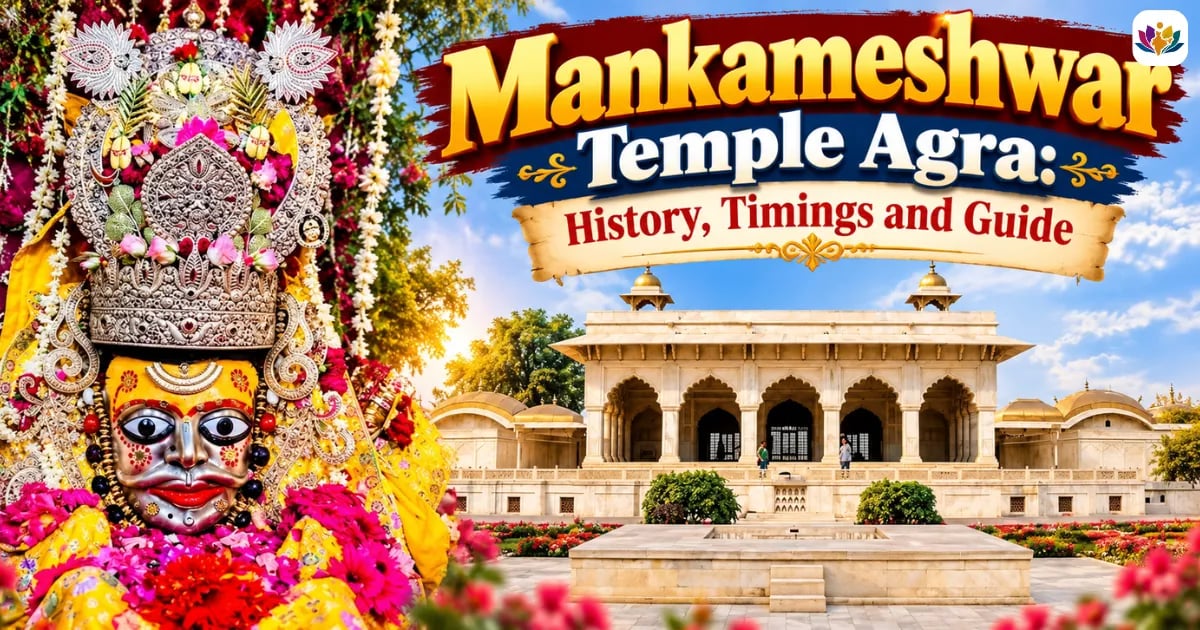
Quick Answer
Shri Mankameshwar Temple is one of Agra's oldest and most revered Shiva temples, near Agra Fort railway station in the old city, with a silver-clad Swayambhu lingam in an underground sanctum. Its name means the Lord who fulfils heartfelt wishes. Entry is free; it is open daily, mornings and evenings. Delhi Agra Tour Packages, a unit of Experience My India, plans Agra trips.
Shri Mankameshwar Temple is one of the oldest and most revered Hindu shrines in Agra, a deeply atmospheric Shiva temple hidden in the bustling lanes of the old city near Agra Fort, where a silver-clad lingam sits in an underground sanctum and devotees come to have their heartfelt wishes fulfilled. Far from the tourist trail of the great Mughal monuments, it offers a glimpse of the living, devotional heart of Agra. This guide from Delhi Agra Tour Packages covers Mankameshwar Temple in full, its history and legend, the timings, the free entry, the darshan guidelines and how to reach it, a meaningful addition for anyone wanting to see the spiritual side of the city on a Golden Triangle tour.
I was born in Delhi and in more than 11 years planning trips across the region for Experience My India I have taken travellers into the old city to this much-loved temple, a world away from the marble monuments. Here is the clear, practical guide to visiting.
Mankameshwar Temple at a glance
Detail | Information |
What it is | One of Agra's oldest and most revered Shiva temples |
Presiding deity | Lord Shiva, as a silver-clad Swayambhu lingam |
Meaning of the name | The "Lord who fulfils heartfelt wishes" |
Where | Rawatpara, old city, near Agra Fort railway station |
Timings | Daily, 5:00 AM to 12:00 PM and 4:00 PM to 10:00 PM |
Entry | Free admission |
Known for | An underground sanctum and deep local devotion |
About Shri Mankameshwar Temple
Shri Mankameshwar Temple is one of the city's oldest and most sacred Hindu shrines, dedicated to Lord Shiva and it holds a cherished place in the devotional life of Agra. While visitors flock to the Taj Mahal and the Agra Fort, this ancient temple, tucked into the dense old-city market area of Rawatpara, is where the people of Agra themselves come to worship, which gives it a wonderfully authentic and living atmosphere.
The temple's presiding deity is Lord Shiva, worshipped here in the form of a Swayambhu lingam, a self-manifested lingam, which is clad in silver. Its very name carries its promise: Mankameshwar is derived from "Man", meaning the heart or mind and "Kameshwar", the Lord of desires, so the name means the Lord who fulfils heartfelt wishes and it is this belief that draws so many devotees. For the traveller willing to step away from the monuments and into the bustle of the old city, the temple offers a moving encounter with the living faith of Agra, a fine complement to the city's other sights, as our things to do in Agra guide covers the full range of the city's attractions.
The history and legend of Mankameshwar Temple
The temple is wrapped in deep antiquity and legend, which is a large part of its sacred aura. By tradition, its origins are believed to trace back over 5,000 years, to the age known as the Dwapara Yuga, placing it among the most ancient sacred sites of the region. These origins belong to faith and tradition rather than documented history, but they are central to the temple's meaning for its devotees.
The most beautiful legend attached to the temple connects it to the birth of Lord Krishna in nearby Mathura. According to tradition and local folklore, Lord Shiva established or rested at this very site at the time of Krishna's birth, wishing to witness and behold the divine child's childhood form. This tender story, linking Shiva to the Krishna legends of the Braj region all around Agra, gives the temple a special resonance. The temple is also traditionally regarded as one of four ancient Shiva temples standing at the four corners of Agra, guarding the city, together with the Rajeshwar, Balkeshwar and Kailash temples, a tradition that marks its importance in the sacred geography of Agra.
The temple layout and deities
Part of what makes a visit to Mankameshwar Temple so atmospheric is its layout and in particular its sanctum. The sanctum sanctorum or garbhagriha, where the sacred lingam resides, is not at ground level: to reach the silver-plated Shiva lingam, worshippers must descend a flight of underground stairs, which lends the darshan a deep, cave-like intimacy and a powerful sense of the sacred.
Around this central shrine, the temple complex houses a number of smaller shrines dedicated to other Hindu deities, making it a rich place of worship. These include shrines to the goddesses Ganga, Yamuna, Saraswati and Gayatri, as well as to Lord Hanuman, Lord Rama and Lord Krishna, so that a visit takes in a whole array of the Hindu pantheon around the central presence of Shiva. Taking a little time to visit these surrounding shrines, as devotees do, adds greatly to the experience of the temple.
Within the temple | Detail |
Main sanctum (garbhagriha) | A silver-plated Swayambhu Shiva lingam, reached by descending underground stairs |
Goddess shrines | Ganga, Yamuna, Saraswati and Gayatri |
Other shrines | Lord Hanuman, Lord Rama and Lord Krishna |
Mankameshwar Temple timings
Mankameshwar Temple is open daily, in two sessions, as is traditional for many Hindu temples, closing in the middle of the day. The usual hours are from 5:00 AM to 12:00 PM in the morning and again from 4:00 PM to 10:00 PM in the afternoon and evening. On Mondays, the day especially sacred to Lord Shiva, the temple keeps extended hours, remaining open until around 11:00 PM.
The early morning and the evening are the most atmospheric and auspicious times to visit, when the aartis and rituals take place and the temple is most alive with devotion. Do bear in mind that the temple closes in the middle of the day, so plan your visit for the morning or the evening session accordingly.
Timings and entry | Detail |
Morning | 5:00 AM to 12:00 PM |
Afternoon and evening | 4:00 PM to 10:00 PM |
Mondays | Extended hours, until around 11:00 PM |
Entry fee | Free admission |
Festivals and the busiest days
As one of Agra's most revered Shiva temples, Mankameshwar is the focus of great devotion on the special days of the Shaivite calendar and knowing these helps you plan whether to join the fervour or to visit in quiet. Mondays, as the day of Shiva, always draw larger crowds and the temple's extended Monday hours reflect this.
The temple sees truly massive footfall during the holy month of Sawan (Shravan), the monsoon month most sacred to Shiva and above all on Maha Shivratri, the great night of Shiva, when enormous crowds of devotees throng the temple. Visiting on these days is an unforgettable experience of mass devotion, but it means long queues and dense crowds in the narrow lanes; visiting on an ordinary weekday morning, by contrast, offers a calmer, more peaceful darshan. As the dates of Sawan and Maha Shivratri follow the traditional Hindu calendar and shift each year, check them for your year of travel when planning.
Busy day or festival | When (dates shift each year) | What to expect |
Mondays | Weekly, the day of Shiva | Larger crowds; extended hours to around 11:00 PM |
Sawan (Shravan) | The monsoon month sacred to Shiva | Massive footfall through the month |
Maha Shivratri | The great night of Shiva | The biggest crowds of the year |
Visitor guidelines and the inner sanctum
As a sacred and active Hindu temple, Mankameshwar has some clear guidelines that visitors should know and respect. A modest, conservative dress code is required: your attire should cover the shoulders and legs. Importantly, if you wish to enter the inner sanctum for direct Abhishek rituals, strict traditional Indian attire is mandatory, meaning a dhoti for men and a saree for women. Leather items are prohibited inside the temple.
Please also note that non-Hindu visitors are typically restricted from entering the inner sanctum directly, though they are welcome to observe the rituals from the designated exterior areas and to visit the wider complex. As at any place of worship, visitors of all backgrounds should behave respectfully and quietly. Observing these guidelines ensures a smooth and welcome visit to this living temple.
Visitor guidelines | Detail |
Dress code | Modest, conservative attire covering shoulders and legs |
Inner-sanctum Abhishek | Traditional attire mandatory: dhoti for men, saree for women |
Leather | Leather items prohibited inside |
Non-Hindu visitors | Typically not permitted in the inner sanctum; may observe from exterior areas |
Location and how to reach Mankameshwar Temple
Mankameshwar Temple stands in the heart of the old city, on Daresi Road in the Rawatpara and Mantola area, near the Sheb Bazar, close to the Agra Fort Railway Station and the lively Rawatpara wholesale market. Its location deep in the old city is part of its authentic character.
A practical note on access: the temple sits within a dense, narrow wholesale market area, where car parking is nearly impossible. It is therefore best reached on foot or by auto-rickshaw from nearby landmarks such as the Agra Fort, rather than by car. Because it lies right by the Agra Fort and the old city, it is easy to combine with those sights, as our Agra Fort ticket and timings guide covers that mighty fort nearby.
Location and how to reach | Detail |
Address | Daresi Road, Rawatpara, Sheb Bazar, Mantola, Agra 282003 |
Nearby | Agra Fort Railway Station and the Rawatpara market |
Best reached | On foot or by auto-rickshaw from nearby landmarks such as Agra Fort |
Parking | Nearly impossible in the dense market lanes; avoid coming by car |
Combine the temple with Agra's old city
Mankameshwar Temple's location in the heart of the old city, right by the Agra Fort, makes it easy to combine with the sights and bustle of old Agra into a rich day of sightseeing that takes in both the grand monuments and the living city.
The mighty Agra Fort is close by and the great Shahi Jama Masjid stands nearby in the old city too, as our Jama Masjid Agra guide covers that grand mosque. All around the temple lie the colourful, chaotic lanes of the Rawatpara and Kinari Bazaar markets, a sensory delight to explore. Combining the temple with the fort, the mosque and the old-city bazaars makes for a wonderful half-day that shows a very different and very real, side of Agra beyond the Taj.
The best time to visit Mankameshwar Temple
The temple can be visited year round, but the most comfortable season to explore Agra and its old city is the cooler period from about October to March, when the weather is pleasant for walking the crowded lanes, as our best time to visit Agra guide covers the seasons in the city.
Within the day, the early morning and the evening are both the most atmospheric times, when the aartis take place and the temple is alive with devotion and they also avoid the midday closure. For a calmer, more peaceful darshan, visit on an ordinary weekday rather than on a Monday or during Sawan or Maha Shivratri, when the crowds are at their greatest. For the full fervour of mass devotion, those very days are the most powerful, if the most crowded, time to come.
How to plan your visit
A visit to Mankameshwar Temple takes only a short while for darshan, so it is best combined with the nearby Agra Fort, the Jama Masjid and the old-city bazaars into a rewarding half-day of sightseeing beyond the Taj. Because the temple lies deep in the narrow market lanes where parking is impossible, it is best reached on foot or by auto-rickshaw and a local guide or driver who knows the old city makes the visit easy.
Agra sits at the heart of the Golden Triangle and fits beautifully into a wider trip, as our one week North India itinerary guide maps out a route taking in Agra and more.
Want your Agra trip planned, with the temple, the great sights and the old city all sorted around you? Message us on WhatsApp and Experience My India will build it for you.
Tips for visiting Mankameshwar Temple
Visit in the early morning or evening for the aartis and the most devotional atmosphere and to avoid the midday closure.
Dress modestly, covering shoulders and legs; for the inner sanctum and Abhishek, traditional attire (dhoti or saree) is required.
Leave leather items behind, as they are prohibited inside the temple.
For a calm darshan, choose an ordinary weekday; for mass devotion, come on a Monday, in Sawan or at Maha Shivratri.
Reach the temple on foot or by auto-rickshaw, as the dense market lanes make car parking nearly impossible.
Combine the visit with the nearby Agra Fort, Jama Masjid and the old-city bazaars for a rewarding half-day.
Visit respectfully and quietly, remembering this is a deeply revered living place of worship.
What to expect
A visit to Mankameshwar Temple is an encounter with the living, devotional soul of Agra, quite different from the city's marble monuments. You can expect an ancient, atmospheric Shiva temple deep in the bustling old-city market, where you descend underground stairs to the silver-clad lingam in a cave-like sanctum, surrounded by shrines to many gods and goddesses and thronged with the genuine devotion of the people of Agra, believed to fulfil the heartfelt wishes of those who pray here.
As one of Agra's oldest and most revered temples, wrapped in legend and alive with faith, yet almost unknown to ordinary tourists, Mankameshwar is a meaningful and memorable addition for any traveller who wishes to see beyond the monuments to the real, spiritual heart of the city. With modest dress, a respectful manner and a visit timed for morning or evening, it rewards richly.
Plan your trip with us
A visit to Mankameshwar Temple, as part of a wider Agra and Golden Triangle trip, is easiest and most enjoyable when the travel, the stays, the guide and the sightseeing are all arranged for you. That is what we do, a comfortable private car and an experienced driver, a knowledgeable guide to bring the temple and the old city to life, well-chosen stays and the whole trip planned around you.
Tell us your dates and group size and we will price it honestly around your standard rather than a fixed figure. You can combine Agra with the classic circuit on our Golden Triangle tours and we can build it all within our wider Delhi Agra Tour Packages.
Related guides
New Delhi tour: the capital's imperial landmarks.
Old Delhi tour: the Red Fort, Jama Masjid and Chandni Chowk.
Delhi day tour: the best of the capital in a day.
Experience My India has personally hosted 50,000+ travelers and the service he leads is rated 4.9 from 2,600+ reviews, operating since 2015. Delhi Agra Tour Packages is a unit of Experience My India.
Book Your Delhi - Agra Trip Today 📞 +91-7302265809 💬 WhatsApp: +91-7302265809 Rated 4.9★ / 2600+ Reviews Explore all: Delhi Agra Tour Packages |
What a Experiance My India
Complete Delhi-Agra services
Private AC Cabs
Comfortable AC cars with experienced local drivers for Delhi, Agra and Jaipur tours.
Local Expert Guides
Explore the Taj Mahal and historic monuments with knowledgeable local guides.
Handpicked Hotels
Comfortable stays near the Taj Mahal and prime locations across Delhi and Agra.
Delhi–Agra Tours
Well-planned same-day and multi-day tours covering the best attractions.
Golden Triangle
Experience Delhi, Agra and Jaipur together with carefully planned itineraries.
24/7 Travel Support
Get assistance throughout your journey from booking to your return.
Plan Your Trip
Get a free quote in 30 mins
100% Trusted & Verified
by 50,000+ Travellers since 2018
Why travellers choose Experience My India
What makes us different from other agencies
We plan and run every trip ourselves, so you get a private AC car, a local expert guide, an honest fixed price, and no reseller or touts in between. We have guided travelers and families since 2018 and hold a 5.0 star rating across 3 verified reviews.
What Our Travellers Say
Real reviews from real Travellers
“We booked our Agra tour package with Experience My India, and the overall experience was excellent. Abhay ji guided us during our visit to Mankameshwar Temple and explained its history, religious importance, and connection with Lord Shiva beautifully. The cab was clean and comfortable, our hotel was good, and the sightseeing arrangements were well managed. We enjoyed a peaceful temple visit and a smooth trip overall. Highly recommended for anyone planning an Agra holiday.”
Rohit Bhatia
Lucknow· 2026-09-28
“Our family had a wonderful Agra trip with Experience My India. Abhay ji was a knowledgeable and friendly guide who helped us understand the spiritual importance of Mankameshwar Temple. He also made sure our sightseeing plan was comfortable and properly organised. The hotel arrangements were satisfying, the cab service was reliable, and the team provided helpful support throughout the trip. We returned with lovely memories and would happily recommend their services.”
Snehal Deshmukh
Nashik· 2026-10-01
“Our Agra tour with Experience My India was a great experience. Abhay ji was an excellent guide who helped us appreciate the spiritual side of Agra beyond its famous monuments. His explanation of Mankameshwar Temple and its connection with local traditions made the visit more meaningful. We were also pleased with the cab, hotel, and overall travel arrangements. The service was professional, and we felt well supported throughout our trip.”
Arvind Krishnamurthy
Mysuru· 2026-10-15
We booked our Agra tour package with Experience My India, and the overall experience was excellent. Abhay ji guided us during our visit to Mankameshwar Temple and explained its history, religious importance, and connection with Lord Shiva beautifully. The cab was clean and comfortable, our hotel was good, and the sightseeing arrangements were well managed. We enjoyed a peaceful temple visit and a smooth trip overall. Highly recommended for anyone planning an Agra holiday.
Rohit Bhatia
Lucknow
Our family had a wonderful Agra trip with Experience My India. Abhay ji was a knowledgeable and friendly guide who helped us understand the spiritual importance of Mankameshwar Temple. He also made sure our sightseeing plan was comfortable and properly organised. The hotel arrangements were satisfying, the cab service was reliable, and the team provided helpful support throughout the trip. We returned with lovely memories and would happily recommend their services.
Snehal Deshmukh
Nashik
Our Agra tour with Experience My India was a great experience. Abhay ji was an excellent guide who helped us appreciate the spiritual side of Agra beyond its famous monuments. His explanation of Mankameshwar Temple and its connection with local traditions made the visit more meaningful. We were also pleased with the cab, hotel, and overall travel arrangements. The service was professional, and we felt well supported throughout our trip.
Arvind Krishnamurthy
Mysuru
We booked our Agra tour package with Experience My India, and the overall experience was excellent. Abhay ji guided us during our visit to Mankameshwar Temple and explained its history, religious importance, and connection with Lord Shiva beautifully. The cab was clean and comfortable, our hotel was good, and the sightseeing arrangements were well managed. We enjoyed a peaceful temple visit and a smooth trip overall. Highly recommended for anyone planning an Agra holiday.
Rohit Bhatia
Lucknow
Our family had a wonderful Agra trip with Experience My India. Abhay ji was a knowledgeable and friendly guide who helped us understand the spiritual importance of Mankameshwar Temple. He also made sure our sightseeing plan was comfortable and properly organised. The hotel arrangements were satisfying, the cab service was reliable, and the team provided helpful support throughout the trip. We returned with lovely memories and would happily recommend their services.
Snehal Deshmukh
Nashik
Frequently Asked Questions
Quick answers to common questions
Shri Mankameshwar Temple is one of Agra's oldest and most revered Hindu temples, dedicated to Lord Shiva, in the old-city market area of Rawatpara near Agra Fort. Its deity is a silver-clad Swayambhu (self-manifested) Shiva lingam, housed in an underground sanctum reached by descending stairs. Its name means the Lord who fulfils heartfelt wishes and it is a deeply devotional, living temple at the spiritual heart of the city.
The name Mankameshwar is derived from "Man", meaning the heart or mind and "Kameshwar", the Lord of desires. Together, the name means the "Lord who fulfils heartfelt wishes". It is this belief, that Lord Shiva here grants the sincere wishes of his devotees, that draws so many worshippers to the temple and that gives it its special place in the devotional life of Agra.
The temple is open daily in two sessions, closing in the middle of the day. The usual hours are 5:00 AM to 12:00 PM in the morning and 4:00 PM to 10:00 PM in the afternoon and evening. On Mondays, the day sacred to Shiva, it keeps extended hours until around 11:00 PM. The early morning and evening, when the aartis take place, are the most atmospheric and auspicious times to visit.
No. Entry to Mankameshwar Temple is free, as at most Hindu temples. It is a living place of worship open to devotees and respectful visitors. Do note, however, the dress code and the guidelines for the inner sanctum: modest attire covering shoulders and legs is required, traditional dress is mandatory for inner-sanctum rituals, leather items are prohibited and non-Hindu visitors are typically restricted to the exterior areas.