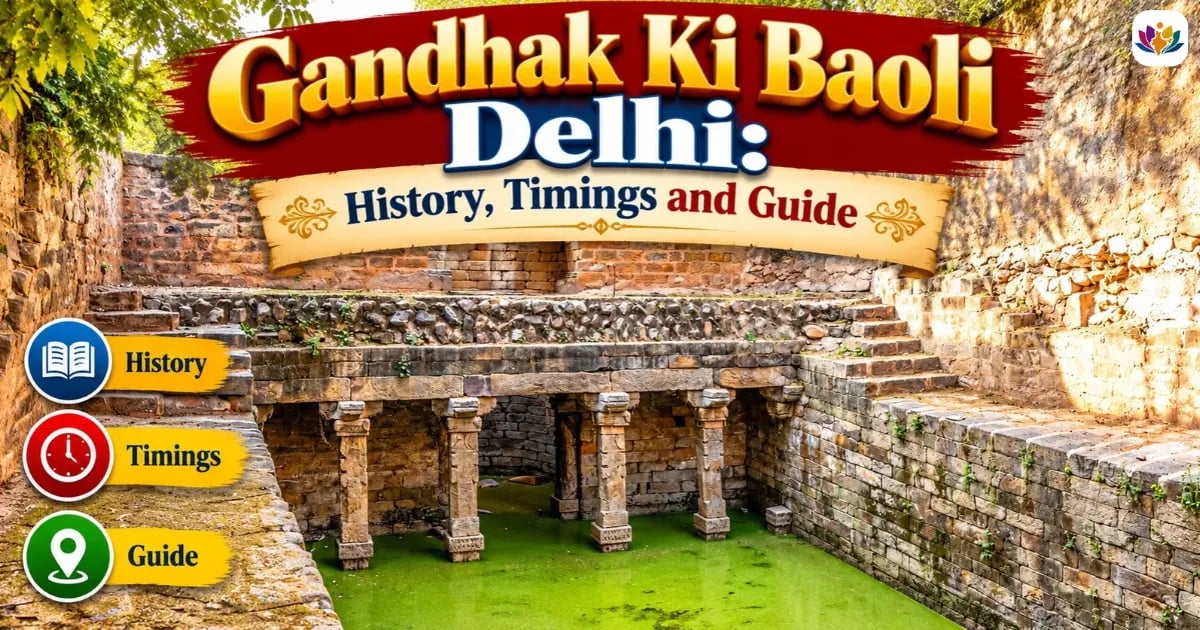
Quick Answer
Gandhak Ki Baoli is the oldest surviving stepwell in Delhi, in Mehrauli Archaeological Park near the Qutub Minar, built in the early 13th century under Sultan Iltutmish. A deep, five-tier sandstone baoli named for its sulfur-rich water, it has free entry and is open daily through daylight hours. Delhi Agra Tour Packages, a unit of Experience My India, plans Delhi trips.
Gandhak Ki Baoli is one of the most historic and atmospheric hidden gems of Delhi, understood to be the oldest surviving stepwell in the city, tucked into the lanes of Mehrauli near the Qutub Minar and named for the distinctive sulfur-rich water that once drew people to its depths. Deep, austere and steeped in a lovely legend of a Sufi saint, it is a rewarding find for anyone who loves history and the remarkable stepwell architecture of old India. This guide from Delhi Agra Tour Packages covers Gandhak Ki Baoli in full, its history and legend, its architecture, the timings, the free entry and how to reach it, a fascinating offbeat stop for anyone exploring the capital's medieval heritage on a Golden Triangle tour.
I was born in Delhi and in more than 11 years planning trips across the region for Experience My India I have taken curious travellers into the Mehrauli lanes to find this ancient stepwell, which few visitors ever reach. Here is the clear, practical guide to visiting.
Gandhak Ki Baoli at a glance
Detail | Information |
What it is | The oldest surviving stepwell (baoli) in Delhi |
Built under | Sultan Shams-ud-din Iltutmish, in the early 13th century |
Name origin | "Gandhak" means sulfur, for its sulfur-rich water |
Design | A deep, five-tier sandstone stepwell, simple and unadorned |
Where | Mehrauli, near the Qutub Minar and Adam Khan's Tomb, South Delhi |
Timings | Open daily, during daylight hours |
Entry | Free |
About Gandhak Ki Baoli
Gandhak Ki Baoli is a historic stepwell or baoli, in the Mehrauli area of South Delhi and it holds the distinction of being understood to be the oldest surviving stepwell in the city. It lies within the historic landscape of Mehrauli, near the famous Qutub Minar complex and close to Adam Khan's Tomb and the dargah of the Sufi saint Qutbuddin Bakhtiyar Kaki, so it sits amid some of the most ancient and sacred sites of Delhi.
A baoli or stepwell, is a form of water architecture once common across India, in which long flights of steps descend to the water, allowing people to reach it however high or low the water level and serving as a cool gathering place as well as a water source. Gandhak Ki Baoli is a fine and very early example, deep and austere and its great age, its unusual sulfur water and its connection to a revered saint make it a wonderfully atmospheric and historic place to visit, well off the usual tourist trail. It belongs to the same remarkable spread of monuments as the great park around it, as our Mehrauli Archaeological Park guide covers that vast open-air site.
The history and legend of Gandhak Ki Baoli
The history of Gandhak Ki Baoli takes us back to the very early years of the Delhi Sultanate. It was built in the early 13th century, during the reign of Sultan Shams-ud-din Iltutmish, one of the greatest of the early Delhi sultans, which makes it among the oldest surviving structures of its kind in the city, the work of the same ruler who raised other great early monuments of Delhi.
A beautiful legend explains why the Sultan built it. According to tradition, Iltutmish noticed that the revered Sufi saint Hazrat Qutbuddin Bakhtiyar Kaki, who lived in Mehrauli, did not have enough water for his regular ablutions and baths, because of the severe water scarcity in the area. Moved to help the saint, the Sultan had this great stepwell built to provide a reliable supply of water. This tender story, linking the powerful Sultan and the holy man in an act of devotion and care, gives the baoli a special resonance and it connects the monument to the deep spiritual heritage of Mehrauli, long a centre of Sufi devotion. Built to serve a saint, it went on to serve the whole community for centuries.
Why it is called Gandhak Ki Baoli
The stepwell owes its name to a distinctive natural feature of its water. "Gandhak" is the word for sulfur and the baoli is named Gandhak Ki Baoli, the sulfur stepwell, because its water has a distinct sulfur-rich odour originating from a natural sulfur spring that feeds it.
This sulfurous water was more than a curiosity. Over the centuries, it was historically believed to possess healing properties, particularly for curing various skin diseases, so that people came to the baoli not only for water but in hope of its medicinal benefits. This belief in the healing power of its sulfur water adds another layer to the baoli's long history as a place of gathering and resort and it explains the name by which this ancient stepwell has been known for so many centuries.
The architecture of Gandhak Ki Baoli
The architecture of Gandhak Ki Baoli is notable for its simplicity and its depth, in keeping with its great age and its practical purpose. Unlike some of the more ornate stepwells of later centuries, it is simple and unadorned in structure, featuring slender pillars and narrow walkways rather than elaborate carving and decoration, which gives it an austere, ancient dignity.
The baoli is a deep, five-storey or five-tier stepwell, descending in levels towards the water and it is constructed primarily of red and yellow sandstone. Its depth and its plain, strong design make it an impressive sight and a striking contrast to the more elaborate and decorated Rajon Ki Baoli, another fine stepwell nearby in the Mehrauli area. One notable quality is that Gandhak Ki Baoli retains water longer than many of the other, now-dry baolis in the area and it often fills up notably during the monsoon season, when it is at its most impressive. Descending its tiers and looking down into its depths is a memorable experience of early Indian water architecture.
Architectural feature | Detail |
Type | A deep stepwell (baoli), the oldest surviving in Delhi |
Tiers | Five storeys or tiers deep |
Material | Primarily red and yellow sandstone |
Style | Simple and unadorned, with slender pillars and narrow walkways |
Water | Fed by a natural sulfur spring; fills notably in the monsoon |
Cultural and historical significance
Beyond its great age and unusual water, Gandhak Ki Baoli has long held a rich place in the life of Mehrauli. Its sulfur-rich water, believed to heal skin ailments, drew people in search of its medicinal benefits, giving it a reputation as a place of healing as well as of water.
Over the centuries, the baoli also functioned as an important social hub. It served as a resting place for travellers passing through Mehrauli and, in later times, became a popular local spot for diving and swimming, with young people leaping from its tiers into the water below, a lively tradition that many older residents of the area still remember. Today, as a protected historical monument, it is a place to admire and explore rather than to swim in, but this long history of gathering, healing and recreation gives the ancient stepwell a warm, human story alongside its architectural and historical importance.
Gandhak Ki Baoli timings and entry
Gandhak Ki Baoli is open to visitors on all days of the week, during daylight hours. As a quiet, less-managed monument tucked into the Mehrauli lanes, its hours are informal, so it is best visited during the daytime, when you can see and appreciate it safely and in good light.
Entry to the baoli is completely free, which makes it an easy and rewarding stop for anyone exploring the heritage of Mehrauli. The morning and the late afternoon are especially pleasant times to visit, with softer light on the sandstone tiers. Because the stepwell is deep and its edges and steps can be uneven, do take care while exploring, especially near the water and watch children closely.
Timings and entry | Detail |
Opening days | All days of the week |
Hours | Daytime hours (informal; visit in daylight) |
Entry fee | Free |
Best time of day | Morning or late afternoon, for soft light and safety |
Location and how to reach Gandhak Ki Baoli
Gandhak Ki Baoli stands in the historic Mehrauli area of South Delhi, within the wider Mehrauli Archaeological Park, near Adam Khan's Tomb and the dargah of Qutbuddin Bakhtiyar Kaki and close to the famous Qutub Minar complex. Its setting deep in the Mehrauli lanes is part of its character and it places the baoli amid a wealth of other great monuments.
By the Delhi Metro, the nearest station is Qutab Minar on the Yellow Line, from where the baoli is a short auto-rickshaw ride or walk into the Mehrauli village lanes, as our Delhi metro guide for tourists covers using the metro to reach the city's sights. You can also reach it easily by taxi or auto-rickshaw. Because the entrance is tucked into the old village lanes, it can be a little tricky to find the first time, so it helps to have a guide or driver who knows the area or to allow a little extra time to locate it.
Location and how to reach | Detail |
Area | Mehrauli, within the Mehrauli Archaeological Park, South Delhi |
Near | Adam Khan's Tomb, the dargah of Qutbuddin Bakhtiyar Kaki and the Qutub Minar |
Nearest metro | Qutab Minar (Yellow Line), then a short auto or walk |
Note | Tucked in the village lanes; a guide or driver who knows the area helps |
Combine Gandhak Ki Baoli with Mehrauli's heritage
Gandhak Ki Baoli lies in one of the most history-rich quarters of all Delhi, which makes it wonderful to combine with the area's other great monuments into a rewarding day of heritage exploring, well off the usual tourist trail.
Close by is the world-famous Qutub Minar, built by the very dynasty of Iltutmish who created this baoli, as our Qutub Minar ticket and timings guide covers that soaring tower. All around lie the monuments of the Mehrauli Archaeological Park and a little further off, another of Iltutmish's great works, the tomb he built for his son at Sultan Ghari, as our Sultan Ghari Tomb Delhi guide covers that remarkable early mausoleum. Together, these sites tell the story of the earliest centuries of the Delhi Sultanate and a day spent among them is one of the most rewarding ways to experience the deep history of the capital, as our things to do in Delhi guide covers the full range of the city's attractions.
The best time to visit Gandhak Ki Baoli
Gandhak Ki Baoli can be visited year round, but the most comfortable season to explore Delhi and the Mehrauli monuments is the cooler period from about October to March, when the weather is pleasant for walking around the site and the lanes, as our best time to visit Delhi guide covers the seasons in the capital.
Within the day, the morning and the late afternoon are the loveliest times, with soft light on the sandstone tiers and a safer, more pleasant visit than in the harsh midday sun. The baoli is also at its most impressive after the monsoon, when it fills notably with water, so a visit in the post-monsoon months of October and November can be especially rewarding, with the deep well brimming and the weather turning pleasant.
How to plan your visit
A visit to Gandhak Ki Baoli takes only about half an hour to admire the deep sandstone tiers and take in its history, so it is best combined with the other monuments of Mehrauli, such as the Qutub Minar, the archaeological park and Sultan Ghari, into a rewarding half-day of heritage exploring. Because the baoli is tucked into the old village lanes, a private car with a driver who knows the area makes finding it and moving between the sites simple and stress-free.
Delhi is the gateway to the Golden Triangle and fits beautifully into a wider trip, as our one week North India itinerary guide maps out a route taking in Delhi, Agra, Jaipur and more.
Want your Delhi days planned, with Gandhak Ki Baoli, the monuments of Mehrauli and the great sights all sorted around you? Message us on WhatsApp and Experience My India will build it for you.
Tips for visiting Gandhak Ki Baoli
Visit in the morning or late afternoon for soft light on the sandstone and a safer, more pleasant experience than midday.
Entry is free and there is no ticket counter, making this an easy, budget-friendly stop.
The entrance is tucked into the Mehrauli village lanes, so allow extra time to find it or go with a guide or driver who knows the way.
Take care near the deep well and on the uneven steps and watch children closely; the baoli is for admiring, not swimming.
Visit after the monsoon, in October or November, to see the deep stepwell notably full of water.
Combine the visit with the nearby Qutub Minar, the Mehrauli Archaeological Park and Sultan Ghari for a full half-day of heritage.
Visit respectfully, mindful of the baoli's connection to the nearby dargah of Qutbuddin Bakhtiyar Kaki.
What to expect
A visit to Gandhak Ki Baoli is a step back to the very dawn of the Delhi Sultanate. You can expect a deep, austere five-tier stepwell of red and yellow sandstone, the oldest surviving baoli in Delhi, descending in long flights of steps towards its sulfur-scented water, tucked into the historic lanes of Mehrauli near the Qutub Minar and wrapped in a lovely legend of a Sultan providing water for a beloved Sufi saint. It is quiet, atmospheric and genuinely ancient.
As a free, offbeat and deeply historic monument, the oldest of Delhi's stepwells, set amid the great heritage of Mehrauli, Gandhak Ki Baoli is a wonderful find for any traveller who loves history and water architecture and seeks out the hidden depths of the city. With a little effort to find it, a morning visit and a respectful, careful manner, it rewards richly.
Plan your trip with us
A visit to Gandhak Ki Baoli, as part of a wider Delhi and Golden Triangle trip, is easiest and most enjoyable when the travel, the stays, the guide and the sightseeing are all arranged for you. That is what we do, a comfortable private car and an experienced driver who knows the lanes, a knowledgeable guide to bring the monument and its legend to life, well-chosen stays and the whole trip planned around you.
Tell us your dates and group size and we will price it honestly around your standard rather than a fixed figure. You can combine Delhi with the classic circuit on our Golden Triangle tours and we can build it all within our wider Delhi Agra Tour Packages.
Related guides
New Delhi tour: the capital's imperial landmarks.
Old Delhi tour: the Red Fort, Jama Masjid and Chandni Chowk.
Delhi day tour: the best of the capital in a day.
Experience My India has personally hosted 50,000+ travelers and the service he leads is rated 4.9 from 2,600+ reviews, operating since 2015. Delhi Agra Tour Packages is a unit of Experience My India.
Book Your Delhi - Agra Trip Today 📞 +91-7302265809 💬 WhatsApp: +91-7302265809 Rated 4.9★ / 2600+ Reviews Explore all: Delhi Agra Tour Packages |
What a Experiance My India
Complete Delhi-Agra services
Private AC Cabs
Comfortable AC cars with experienced local drivers for Delhi, Agra and Jaipur tours.
Local Expert Guides
Explore the Taj Mahal and historic monuments with knowledgeable local guides.
Handpicked Hotels
Comfortable stays near the Taj Mahal and prime locations across Delhi and Agra.
Delhi–Agra Tours
Well-planned same-day and multi-day tours covering the best attractions.
Golden Triangle
Experience Delhi, Agra and Jaipur together with carefully planned itineraries.
24/7 Travel Support
Get assistance throughout your journey from booking to your return.
Plan Your Trip
Get a free quote in 30 mins
100% Trusted & Verified
by 50,000+ Travellers since 2018
Why travellers choose Experience My India
What makes us different from other agencies
We plan and run every trip ourselves, so you get a private AC car, a local expert guide, an honest fixed price, and no reseller or touts in between. We have guided travelers and families since 2018 and hold a 5.0 star rating across 3 verified reviews.
What Our Travellers Say
Real reviews from real Travellers
“We booked our Delhi tour package with Experience My India, and the overall experience was excellent. Abhay ji was a wonderful guide who explained the history of Gandhak Ki Baoli and its connection with Sultan Iltutmish and the Sufi saint Qutbuddin Bakhtiyar Kaki in a very interesting way. The cab was clean and comfortable, the hotel was well maintained, and the sightseeing arrangements were smooth. We were very happy with the service and would recommend Experience My India to anyone planning a Delhi heritage trip.”
Rohan Deshmukh
Nagpur· 2026-10-15
“Experience My India organised a lovely Delhi tour for us. We especially enjoyed visiting Gandhak Ki Baoli in Mehrauli because Abhay ji shared fascinating stories about its history, sulfur-rich water, and connection with the Delhi Sultanate. His knowledge made the monument much more interesting than simply exploring it on our own. The cab service was reliable, the hotel was comfortable, and the itinerary was well planned. We truly appreciated the team's hospitality.”
Kunal Chatterjee
Bhubaneswar· 2026-09-15
“Our trip to Delhi was well organised by Experience My India. Abhay ji was an excellent guide who explained the story behind Gandhak Ki Baoli, including its traditional connection with Sultan Iltutmish and the revered Sufi saint. We enjoyed learning about this lesser-known historical place. The cab, hotel, and sightseeing arrangements were all very good, and the team was helpful throughout the trip. We would happily consider Experience My India for another family holiday.”
Vivek Mishra
Ranchi· 2026-10-07
We booked our Delhi tour package with Experience My India, and the overall experience was excellent. Abhay ji was a wonderful guide who explained the history of Gandhak Ki Baoli and its connection with Sultan Iltutmish and the Sufi saint Qutbuddin Bakhtiyar Kaki in a very interesting way. The cab was clean and comfortable, the hotel was well maintained, and the sightseeing arrangements were smooth. We were very happy with the service and would recommend Experience My India to anyone planning a Delhi heritage trip.
Rohan Deshmukh
Nagpur
Experience My India organised a lovely Delhi tour for us. We especially enjoyed visiting Gandhak Ki Baoli in Mehrauli because Abhay ji shared fascinating stories about its history, sulfur-rich water, and connection with the Delhi Sultanate. His knowledge made the monument much more interesting than simply exploring it on our own. The cab service was reliable, the hotel was comfortable, and the itinerary was well planned. We truly appreciated the team's hospitality.
Kunal Chatterjee
Bhubaneswar
Our trip to Delhi was well organised by Experience My India. Abhay ji was an excellent guide who explained the story behind Gandhak Ki Baoli, including its traditional connection with Sultan Iltutmish and the revered Sufi saint. We enjoyed learning about this lesser-known historical place. The cab, hotel, and sightseeing arrangements were all very good, and the team was helpful throughout the trip. We would happily consider Experience My India for another family holiday.
Vivek Mishra
Ranchi
We booked our Delhi tour package with Experience My India, and the overall experience was excellent. Abhay ji was a wonderful guide who explained the history of Gandhak Ki Baoli and its connection with Sultan Iltutmish and the Sufi saint Qutbuddin Bakhtiyar Kaki in a very interesting way. The cab was clean and comfortable, the hotel was well maintained, and the sightseeing arrangements were smooth. We were very happy with the service and would recommend Experience My India to anyone planning a Delhi heritage trip.
Rohan Deshmukh
Nagpur
Experience My India organised a lovely Delhi tour for us. We especially enjoyed visiting Gandhak Ki Baoli in Mehrauli because Abhay ji shared fascinating stories about its history, sulfur-rich water, and connection with the Delhi Sultanate. His knowledge made the monument much more interesting than simply exploring it on our own. The cab service was reliable, the hotel was comfortable, and the itinerary was well planned. We truly appreciated the team's hospitality.
Kunal Chatterjee
Bhubaneswar
Frequently Asked Questions
Quick answers to common questions
Gandhak Ki Baoli is understood to be the oldest surviving stepwell or baoli, in Delhi, located in the historic Mehrauli area near the Qutub Minar and Adam Khan's Tomb. Built in the early 13th century under Sultan Iltutmish, it is a deep, five-tier sandstone stepwell named for its sulfur-rich water. A baoli is a traditional Indian stepwell in which flights of steps descend to the water, serving as both a water source and a cool gathering place.
Gandhak Ki Baoli was built in the early 13th century, during the reign of Sultan Shams-ud-din Iltutmish, one of the greatest early rulers of the Delhi Sultanate. By legend, the Sultan had it built after noticing that the revered Sufi saint Qutbuddin Bakhtiyar Kaki, who lived in Mehrauli, lacked enough water for his ablutions amid the area's severe water scarcity, so the stepwell was created to provide a reliable supply.
It is called Gandhak Ki Baoli, meaning the sulfur stepwell, because its water has a distinct sulfur-rich odour originating from a natural sulfur spring that feeds it. This sulfurous water was historically believed to have healing properties, particularly for curing skin diseases, so people came to the baoli in hope of its medicinal benefits as well as for water. The name has stayed with the stepwell for many centuries.
Gandhak Ki Baoli is open to visitors on all days of the week, during daylight hours. As a quiet, less-managed monument tucked into the Mehrauli lanes, its hours are informal, so it is best visited in the daytime, when you can see and explore it safely and in good light. The morning and late afternoon are the most pleasant times, with softer light on the sandstone tiers of the deep stepwell.