Quick Answer
Gyarah Sidi, meaning eleven steps, is the ruined remnant of an astronomical observatory built by the Mughal emperor Humayun in the 16th century, in Kachhpura village on the north bank of the Yamuna near Mehtab Bagh and across from the Taj Mahal. Entry is free, open sunrise to sunset. Delhi Agra Tour Packages, a unit of Experience My India, arranges Agra tours.
Hidden away in a quiet village on the far bank of the Yamuna, almost directly opposite the Taj Mahal, lies one of Agra's most intriguing and least-visited relics: Gyarah Sidi, the ruined observatory of the emperor Humayun. This guide from Delhi Agra Tour Packages covers what Gyarah Sidi is, the fascinating story of Humayun and the stars, its location near Mehtab Bagh and how to visit, so you can add this unusual piece of Mughal history to your trip, whether on its own or as part of a Golden Triangle tour.
I was born in Delhi and in more than 11 years guiding travellers across the region for Experience My India. I have always loved sharing Agra's lesser-known corners and Gyarah Sidi, with its eleven carved steps and its tale of an emperor who ruled by the planets, is one of the most memorable. Here is what to know.
Gyarah Sidi at a glance
Detail | Information |
What it is | The ruined remnant of Humayun's 16th-century observatory |
Meaning | Gyarah Sidi means eleven steps |
Location | Kachhpura village, north bank of the Yamuna, Agra |
Near | Mehtab Bagh, across the river from the Taj Mahal |
Timings | Daily, sunrise to sunset |
Entry fee | Free |
Time to allow | 20 to 30 minutes |
What is Gyarah Sidi?
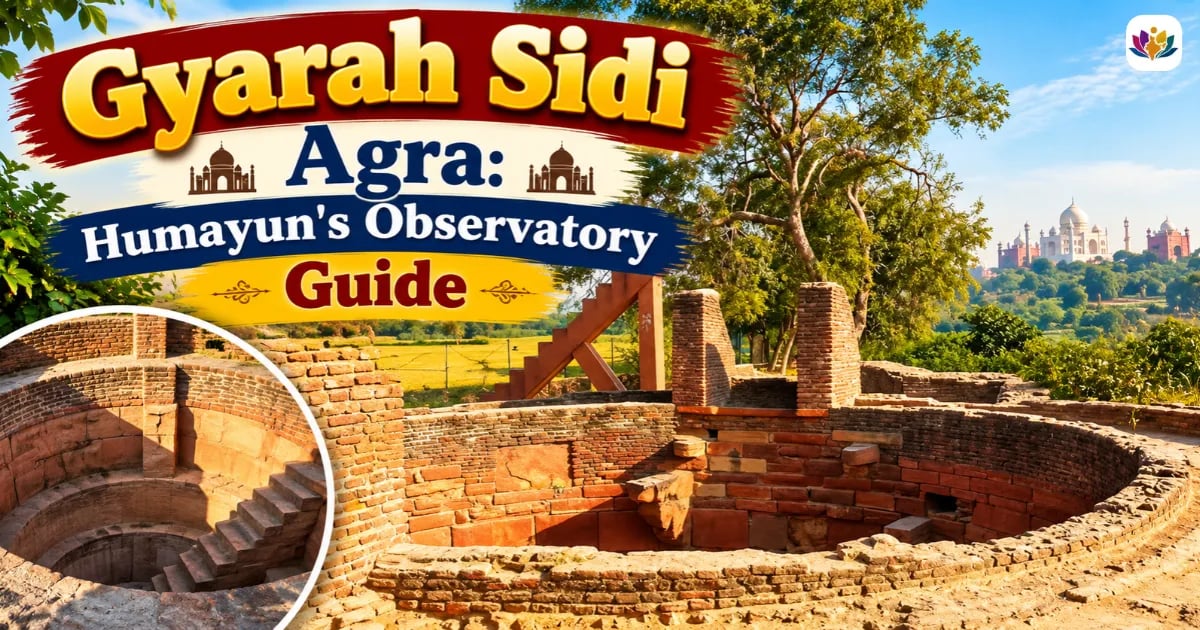
Gyarah Sidi, whose name translates as eleven steps, is the ruined remnant of an astronomical observatory built by the Mughal emperor Humayun in the 16th century. What survives today is a freestanding flight of eleven carved red sandstone steps, standing quietly amid the fields and lanes of Kachhpura village on the north bank of the Yamuna, a modest but historically fascinating structure that most visitors to Agra never see.
The steps overlook a set of hemispherical cavities and calculation holes set into the ground, which were used to measure the lengths of shadows and to track the positions of celestial bodies and a circular brick-and-sandstone stepwell or baoli, lies nearby. It is a simple, ruined site rather than a grand monument, but for anyone interested in Mughal history and the story of astronomy in India, it is a genuinely special place, made all the more atmospheric by its quiet rural setting so close to the great Taj Mahal.
The story of Humayun's observatory
The real fascination of Gyarah Sidi lies in its story. The emperor Humayun was deeply absorbed by astronomy and astrology and he used this site to observe the movements of the planets and to schedule major court and military decisions according to what he read in the heavens. For Humayun, the positions of the celestial bodies were not idle curiosity but a guide to the timing of the most important affairs of state.
Historical accounts record just how far this went. Humayun and his ministers are said to have coordinated even their daily attire to match the colours associated with the ruling planet of each day of the week, dressing in particular colours on particular days and assigning different kinds of business, such as government matters or military affairs, to the days governed by the appropriate planet. It is a vivid glimpse into the mind of a Mughal ruler for whom the cosmos and the court were intimately connected and it is this human story, as much as the stones themselves, that makes Gyarah Sidi worth seeking out.
The eleven steps and the design
The structure that gives Gyarah Sidi its name is a freestanding flight of eleven steps, carved from the warm red sandstone so characteristic of Mughal Agra, the same material you see across the river at the Agra Fort and in so many of the city's monuments. The steps would have allowed the observer to climb and sight along fixed lines towards the sky.
Feature | Detail |
The steps | A freestanding flight of eleven carved red sandstone steps |
The ground features | Hemispherical cavities and calculation holes to measure shadows |
Purpose | Tracking shadow lengths and the positions of celestial bodies |
Nearby | A circular brick-and-sandstone stepwell (baoli) |
The hemispherical cavities and holes set into the ground below the steps were the working part of the observatory, used to measure the shifting shadows cast by the sun and to help track the heavens through the year. Though modest and now ruined, the design marks Gyarah Sidi as an early and diminutive predecessor of the far more monumental observatories that would come later, the great Jantar Mantars built in Jaipur and Delhi, which share the same essential idea of using built structures to read the sky.
Where is Gyarah Sidi and what is nearby?
Gyarah Sidi sits in Kachhpura village on the north or far, bank of the Yamuna in Agra and its location is a large part of its appeal. It lies very close to the beautiful riverside garden of Mehtab Bagh, famous for its sunset view of the Taj Mahal and almost directly across the river from the Taj Mahal itself, so a visit naturally combines with these better-known sights on the same bank.
Also on this side of the river, a little way off, stands the exquisite Itmad-ud-Daulah, the jewel-like tomb often called the Baby Taj, making the north bank a rewarding area to explore beyond the usual trail. Kachhpura itself is a traditional village and the walk through its lanes to reach Gyarah Sidi, sometimes as part of a local heritage walk, is an experience in itself, offering a glimpse of everyday rural life a stone's throw from one of the wonders of the world. You can see the full range of the city's sights in our Agra attractions guide.
How to reach Gyarah Sidi
Gyarah Sidi is reached via Kachhpura village on the north bank of the Yamuna, the same side as Mehtab Bagh, so most visitors come by road, crossing the river from the main city and then walk the short distance through the village lanes to the site.
Detail | Information |
Area | Kachhpura village, north bank of the Yamuna, Agra |
By road | Cross the river to the Mehtab Bagh side, then a short local approach |
Combine with | Mehtab Bagh and the north-bank Taj view |
Getting to Agra | By road or train from Delhi or the Agra Metro within the city |
Because it is off the main tourist trail and set within a village, a little local guidance helps in finding it and it is easiest to visit together with Mehtab Bagh. For getting around the city generally, our Agra Metro guide covers the city's growing network and for reaching Agra from the capital region our Noida to Agra distance guide sets out the route and if you are extending the trip into the Braj region our Agra to Vrindavan distance guide covers that popular onward journey. A private car with a driver is by far the most convenient way to reach an off-the-beaten-path site like this.
Timings and entry fee
Gyarah Sidi is an open, free site, with no ticket required and it is accessible during daylight hours. There are no formal facilities, as it is a simple ruined monument in a village setting rather than a managed attraction.
Detail | Information |
Timings | Daily, sunrise to sunset |
Entry fee | Free |
Facilities | None; an open, ruined site in a village |
Time to allow | 20 to 30 minutes |
Since there is no entry fee and the site is small, a visit takes only twenty to thirty minutes and it is best combined with the nearby Mehtab Bagh and the north-bank sights to make the trip across the river worthwhile. Daylight hours are the only time to visit and the softer light of the morning or late afternoon is the most pleasant.
Best time to visit Gyarah Sidi
The best time to visit Gyarah Sidi, as with all of Agra's outdoor sights, is the cool season from about October to March, when the weather is pleasant and comfortable for wandering the village lanes and the open riverside. This is also the ideal season for the Taj Mahal and the rest of the city, so it fits naturally into a wider Agra trip.
The summer, from April to June, is very hot in Agra and makes an open, shadeless site like this uncomfortable, so a visit then is best confined to the early morning. The monsoon, from July to September, brings some relief and a little green to the riverside. Pairing the site with the city's great sights, such as the red-sandstone Mughal city of Fatehpur Sikri a little outside Agra, makes a full and varied day. Within the day, the gentle light around sunrise or late afternoon suits both the ruins and the nearby Taj view across the water and our wider travel guides cover more on planning the season.
Tips for visiting Gyarah Sidi
Combine your visit with the neighbouring Mehtab Bagh and its Taj sunset view to make the river crossing worthwhile.
Allow only twenty to thirty minutes for the site itself, as it is small and ruined.
Visit in the cool season, October to March and in the softer morning or late-afternoon light.
A little local guidance helps, as the site is off the main trail within Kachhpura village.
Wear comfortable shoes for the village lanes and the uneven ground around the ruins.
Take the chance to see the north-bank sights together, including the Baby Taj a little further along.
Bring water and sun protection, as the open riverside site offers little shade.
What to expect
A visit to Gyarah Sidi is a quiet, offbeat encounter with Mughal history, a world away from the crowds at the Taj yet right across the water from it. You can expect a modest, ruined structure of eleven carved red sandstone steps set among village fields, with the old shadow-measuring cavities in the ground below and a stepwell nearby and above all the remarkable story of an emperor who read the planets and timed his empire by the stars.
As an attraction it is small and unmanaged rather than grand and its reward is atmosphere and history rather than spectacle. For travellers who enjoy going beyond the obvious, it pairs perfectly with Mehtab Bagh and the north-bank Taj view for a memorable half-day that shows a side of Agra most visitors never discover.
Plan your trip with us
Offbeat sights like Gyarah Sidi are far easier and more rewarding to visit with the travel and guiding arranged for you, especially somewhere tucked into a village off the main trail. We handle it all, a comfortable private car and an experienced driver, a knowledgeable guide to lead you to the site and bring Humayun's story to life and a day planned around the north-bank sights and the great monuments across the river.
Tell us your dates and group size and we will price it honestly around your standard rather than a fixed figure. Agra is the heart of our Golden Triangle tours and this offbeat corner pairs beautifully with a dawn visit to the Taj on our Sunrise Taj Mahal tour. You can see our full range of Delhi Agra Tour Packages to build the right trip.
Want your Agra day planned around you? Message us on WhatsApp and Experience My India will build it for you.
Related guides
Same-day Agra tour from Delhi: the Taj and Agra Fort in a single day.
Agra overnight tour from Delhi: a relaxed two-day visit with time to spare.
Agra Fort tickets and timings: plan the great fort across the river.
Experience My India has personally hosted 50,000+ travelers and the service he leads is rated 4.9 from 2,600+ reviews, operating since 2015. Delhi Agra Tour Packages is a unit of Experience My India.
Book Your Delhi - Agra Trip Today 📞 +91-7302265809 💬 WhatsApp: +91-7302265809 Rated 4.9★ / 2600+ Reviews Explore all: Delhi Agra Tour Packages |
What a Experiance My India
Complete Delhi-Agra services
Private AC Cabs
Comfortable AC cars with experienced local drivers for Delhi, Agra and Jaipur tours.
Local Expert Guides
Explore the Taj Mahal and historic monuments with knowledgeable local guides.
Handpicked Hotels
Comfortable stays near the Taj Mahal and prime locations across Delhi and Agra.
Delhi–Agra Tours
Well-planned same-day and multi-day tours covering the best attractions.
Golden Triangle
Experience Delhi, Agra and Jaipur together with carefully planned itineraries.
24/7 Travel Support
Get assistance throughout your journey from booking to your return.
Plan Your Trip
Get a free quote in 30 mins
100% Trusted & Verified
by 50,000+ Travellers since 2018
Why travellers choose Experience My India
What makes us different from other agencies
We plan and run every trip ourselves, so you get a private AC car, a local expert guide, an honest fixed price, and no reseller or touts in between. We have guided travelers and families since 2018 and hold a 5.0 star rating across 3 verified reviews.
What Our Travellers Say
Real reviews from real Travellers
“We booked our Agra tour package through Experience My India, and the experience was wonderful. Abhay ji guided us through Gyarah Sidi and explained the interesting history of Humayun's observatory in a very simple and engaging way. The cab was clean and comfortable, our driver was polite, and the overall arrangements were excellent. We also enjoyed visiting Mehtab Bagh and seeing the Taj Mahal from across the Yamuna. Highly recommended for a well-organised Agra trip!”
Rohit Khanna
Chandigarh· 2026-10-15
“Our Agra trip with Experience My India was a lovely experience. We wanted to visit some lesser-known historical places, and Gyarah Sidi was a great addition to our itinerary. Abhay ji was an excellent guide who explained the connection between Humayun and astronomy with great patience. The hotel arrangements were comfortable, the cab service was punctual, and everything went smoothly. We were very happy with the service.”
Ananya Mukherjee
Kolkata· 2026-10-02
“We had a fantastic time exploring Agra with Experience My India. Gyarah Sidi was something different from the usual tourist attractions, and Abhay ji made the visit interesting by sharing its history and architectural details. The driver was friendly, the vehicle was neat, and our hotel stay was comfortable. The team managed the entire tour professionally. Thank you for making our Agra holiday so enjoyable!”
Kunal Deshmukh
Nagpur· 2026-09-18
We booked our Agra tour package through Experience My India, and the experience was wonderful. Abhay ji guided us through Gyarah Sidi and explained the interesting history of Humayun's observatory in a very simple and engaging way. The cab was clean and comfortable, our driver was polite, and the overall arrangements were excellent. We also enjoyed visiting Mehtab Bagh and seeing the Taj Mahal from across the Yamuna. Highly recommended for a well-organised Agra trip!
Rohit Khanna
Chandigarh
Our Agra trip with Experience My India was a lovely experience. We wanted to visit some lesser-known historical places, and Gyarah Sidi was a great addition to our itinerary. Abhay ji was an excellent guide who explained the connection between Humayun and astronomy with great patience. The hotel arrangements were comfortable, the cab service was punctual, and everything went smoothly. We were very happy with the service.
Ananya Mukherjee
Kolkata
We had a fantastic time exploring Agra with Experience My India. Gyarah Sidi was something different from the usual tourist attractions, and Abhay ji made the visit interesting by sharing its history and architectural details. The driver was friendly, the vehicle was neat, and our hotel stay was comfortable. The team managed the entire tour professionally. Thank you for making our Agra holiday so enjoyable!
Kunal Deshmukh
Nagpur
We booked our Agra tour package through Experience My India, and the experience was wonderful. Abhay ji guided us through Gyarah Sidi and explained the interesting history of Humayun's observatory in a very simple and engaging way. The cab was clean and comfortable, our driver was polite, and the overall arrangements were excellent. We also enjoyed visiting Mehtab Bagh and seeing the Taj Mahal from across the Yamuna. Highly recommended for a well-organised Agra trip!
Rohit Khanna
Chandigarh
Our Agra trip with Experience My India was a lovely experience. We wanted to visit some lesser-known historical places, and Gyarah Sidi was a great addition to our itinerary. Abhay ji was an excellent guide who explained the connection between Humayun and astronomy with great patience. The hotel arrangements were comfortable, the cab service was punctual, and everything went smoothly. We were very happy with the service.
Ananya Mukherjee
Kolkata
Frequently Asked Questions
Quick answers to common questions
Gyarah Sidi, meaning eleven steps, is the ruined remnant of an astronomical observatory built by the Mughal emperor Humayun in the 16th century. It consists of a freestanding flight of eleven carved red sandstone steps, with hemispherical cavities and calculation holes in the ground below that were used to measure shadows and track celestial bodies and a stepwell nearby. It stands in Kachhpura village on the north bank of the Yamuna in Agra, almost directly across the river from the Taj Mahal and is an offbeat but fascinating piece of Mughal history.
Gyarah Sidi was built by the Mughal emperor Humayun in the 16th century as an astronomical observatory. Humayun was deeply fascinated by astronomy and astrology and he used the site to observe the movements of the planets and to schedule major court and military decisions according to the heavens. For him, reading the positions of the celestial bodies was a guide to the timing of important affairs of state, making this modest structure a window into the beliefs and routines of a Mughal ruler.
Gyarah Sidi means eleven steps, a direct description of the structure, which is a freestanding flight of eleven carved red sandstone steps. The name captures exactly what survives of Humayun's observatory today. The steps, together with the hemispherical cavities and calculation holes set into the ground below them, formed a simple instrument for measuring shadows and tracking the sky and the site is considered an early, diminutive predecessor of the later monumental observatories, the Jantar Mantars of Jaipur and Delhi.
Gyarah Sidi is located in Kachhpura village on the north or far, bank of the Yamuna River in Agra, very close to the Mehtab Bagh garden and almost directly across the river from the Taj Mahal. This places it on the same side as several north-bank sights, including the Baby Taj, Itmad-ud-Daulah, a little further along. Its position opposite the Taj and beside Mehtab Bagh makes it easy and natural to combine with those better-known attractions on a visit to that side of the river.