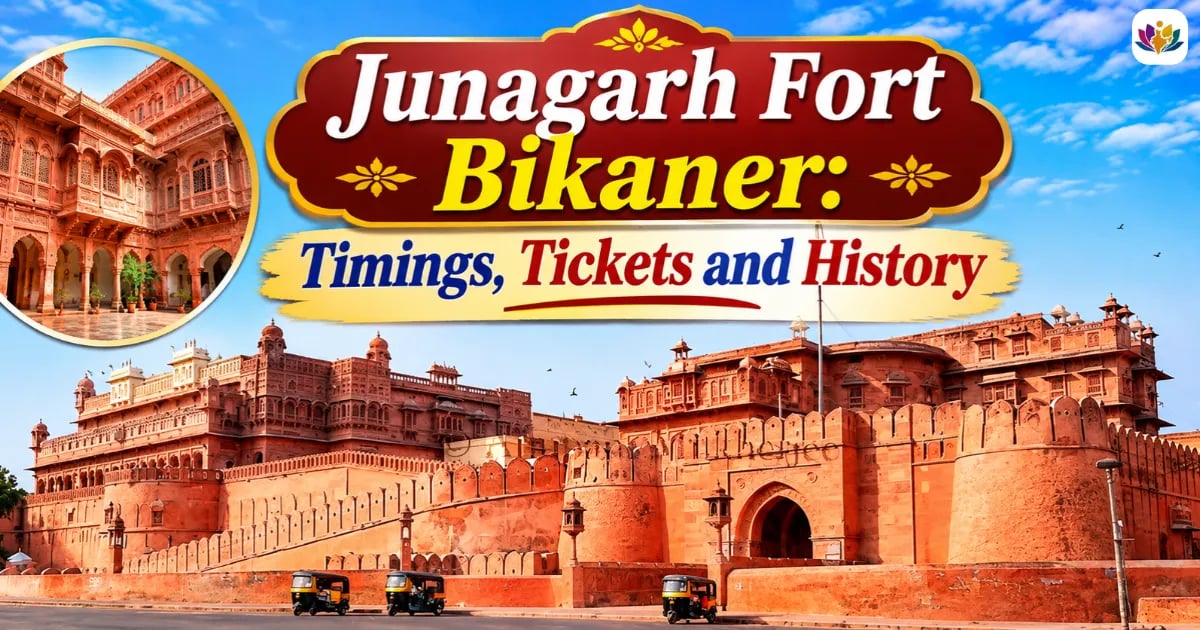
Quick Answer
Junagarh Fort is a magnificent 16th-century fort in the heart of Bikaner, built between 1589 and 1594 and famous as one of the few major Rajasthan forts not set on a hilltop and for never being conquered. It is open 10 AM to 4:30 PM daily. Delhi Agra Tour Packages, a unit of Experience My India, builds Bikaner trips.
Junagarh Fort is the crown jewel of Bikaner, a magnificent fort that breaks the Rajasthan mould by standing not on a hill but proudly on the flat desert plains, ringed by walls and a moat that no attacker ever breached. Inside is a treasury of painted palaces, mirrored halls and museums gathered over three centuries, making it one of the best-preserved and most rewarding forts in the state. This guide from Delhi Agra Tour Packages covers its history, architecture, gates, palaces, timings, entry fees and how to reach it, so you can plan your visit, whether on its own or as part of a wider Rajasthan journey extended from a Golden Triangle tour.
I was born in Delhi and in more than 11 years planning trips across the region for Experience My India I have found Junagarh to be the fort that most surprises first-time visitors, as uncrowded as it is grand and far richer inside than its plain outer walls suggest. Here is how to visit it well.
Junagarh Fort at a glance
Detail | Information |
Location | Heart of Bikaner city, Rajasthan |
Built by | Raja Rai Singh, supervised by his prime minister Karan Chand |
Built between | 1589 and 1594 |
Architectural style | Rajput, Mughal and Gujarati, in red Dulmera sandstone and white marble |
Timings | 10 AM to 4:30 PM, daily |
Visit duration | 1.5 to 3 hours |
Best season | October to March |
Junagarh Fort key information
The essential visitor details in one place: timings, fees and how to reach the fort. Figures are correct at the time of writing, so reconfirm locally.
Timings
Detail | Information |
Opening hours | 10 AM to 4:30 PM |
Days | Open daily |
Visit duration | 1.5 to 3 hours |
Entry fee and camera charges
Ticket | Price (at the time of writing) |
Indian adult | ₹50 (students ₹30) |
Foreign visitor | ₹300 (foreign students ₹150) |
Museum fee | ₹50 (bundled or separate, by counter) |
Still camera | ₹30 |
Video camera | ₹100 |
How to reach
Route | Distance or detail |
Nal Airport to fort | 16 km |
Bikaner Railway Station to fort | 2.5 km |
Within the city | Auto-rickshaw or taxi; Kote Gate is a nearby landmark |
What is Junagarh Fort?
Junagarh Fort is a 16th-century fort in the heart of Bikaner and one of the very few major forts in Rajasthan not built on a hilltop. Originally called Chintamani Durg, it was renamed Junagarh, meaning "Old Fort", in the early 20th century when the royal family moved to the nearby Lalgarh Palace. Famous for never having been conquered, it is celebrated for its formidable walls and moat and, above all, for the opulent palaces and museums preserved within.
It is the centrepiece of any visit to Bikaner and the natural starting point for exploring the city's forts, palaces and havelis. Bikaner itself pairs beautifully with the other desert cities and you can plan the wider circuit using our guides to things to do in Jodhpur and things to do in Jaisalmer.
History of Junagarh Fort
Junagarh Fort was built between 1589 and 1594 by Raja Rai Singh, the sixth ruler of Bikaner and a distinguished general in the army of the Mughal emperor Akbar, with construction supervised by his prime minister, Karan Chand. Its original name, Chintamani Durg, gave way to Junagarh, the "Old Fort", only in the early 20th century, after the royal family shifted their residence to the newer Lalgarh Palace outside the walls.
The fort's great distinction is that it was built on the plains rather than a defensible hilltop, yet was never conquered, its wide walls, bastions and moat proving impregnable through the centuries. Successive rulers added palaces and halls within, so that the fort grew into the layered complex you see today, a record in stone of Bikaner's royal history. For the mightier hill-fort experience of neighbouring Jodhpur, the Mehrangarh Fort makes a fascinating contrast on a desert trip.
Junagarh Fort architecture and design
The architecture of Junagarh Fort is a rich blend of Rajput, Mughal and Gujarati styles, worked in red Dulmera sandstone and white marble. The relatively austere outer walls give little hint of the lavishly decorated courtyards, balconies and palaces within, a deliberate contrast that makes the interior all the more striking.
Dulmera sandstone: The warm red local stone that gives the fort and the city their characteristic colour.
Blended styles: Rajput robustness, Mughal refinement and Gujarati detailing combined across the complex.
Fine craftsmanship: Intricate carving, stone screens and inlay throughout, among the best preserved in Rajasthan.
The carving and the preservation are what set Junagarh apart and it is often rated among the finest forts in the state precisely because so much of its decoration survives intact. The same red sandstone and the same carving tradition define Bikaner's famous Rampuria havelis, which pair well with a fort visit.
Gates of Junagarh Fort
The fort is entered through a series of grand gates, each with its own history and a sober reminder of the past near the entrance.
Karan Pol: The historic and grand main entry gate to the fort complex.
Suraj Pol (Sun Gate): The principal modern entry and exit, facing east to catch the first rays of the morning sun and flanked by stone elephant statues with their mahouts.
Sati handprints: Near the entrance gates are the poignant handprints commemorating royal women who performed sati, a historical practice recorded here with solemnity.
Entering through the Suraj Pol, with its sunlit stone elephants, is a memorable start to the visit and a good guide will explain the meaning of the gates and the handprints as you pass. The handprints are treated as a solemn historical memorial and visitors view them respectfully.
Palaces and museums inside Junagarh Fort
The real glory of Junagarh lies inside, in a succession of opulent palaces and halls built by successive rulers, now among the best-preserved royal interiors in Rajasthan. Allow plenty of time to take them in.
Karan Mahal: Built in 1680 by Raja Karan Singh to mark a victory over Aurangzeb, with public and private audience halls, stained glass and gardens.
Anup Mahal: A multi-storey marvel used as the king's administrative seat, richly decorated with gold-leaf work, mirrors and Italian tiles.
Phool Mahal: The oldest part of the fort, lavishly adorned with glass and mirrors.
Chandra Mahal: The royal bedchamber, with opulent mirrors, fine paintings and thick walls designed to keep the room cool.
Badal Mahal (Cloud Palace): Famous for wall paintings of clouds and rain, a longing for monsoon in an arid land.
Gaj Mandir: An intimate set of private apartments with intricate floral artwork and marble.
Durbar Hall and Ganga Niwas: Grand pink walls, a massive sandalwood throne and an extensive collection of historical weapons and armoury.
Vikram Vilas Museum: Royal war memorabilia, including a World War I De Havilland DH-9 biplane bomber.
Har Mandir: The royal family's private temple, where major state festivals and royal weddings were blessed.
The Anup Mahal, with its gold and mirror work and the Badal Mahal, with its cloud paintings, are the interiors most visitors remember, while the DH-9 biplane in the Vikram Vilas museum is an unexpected highlight. A guide really pays off here, as the stories behind each palace bring the fort vividly to life. Many of these treasures are complemented by the Prachina Museum within the fort, displaying royal costumes and textiles.
Junagarh Fort timings
Junagarh Fort is open 10 AM to 4:30 PM, every day of the week. A visit takes 1.5 to 3 hours depending on how thoroughly you explore the palaces and museums, so arriving in the morning or early afternoon leaves you a comfortable time before closing. Timings can change on festival days or for events, so reconfirm locally if your schedule is tight.
Mornings are the most pleasant time to visit, especially in the warmer months and they give you the best light in the courtyards. Because the fort closes by late afternoon, it pairs naturally with an evening elsewhere in the city rather than a sunset at the fort itself.
Junagarh Fort entry fee and camera charges
Junagarh Fort charges a modest entry fee, with separate rates for the museum and for cameras. The amounts below were correct at the time of writing; fees change, so reconfirm at the ticket counter.
The fees are inexpensive and the museum is well worth the extra charge for the royal collections and the biplane. Carry cash for the tickets and camera charges, as digital payments can be unreliable and keep your camera fee receipt handy inside. A guide, hired at the entrance or arranged in advance, is the single best add-on for understanding what you are seeing.
How to reach Junagarh Fort
Junagarh Fort sits in the heart of Bikaner city, so it is easy to reach from anywhere in town by auto-rickshaw or taxi, with the prominent Kote Gate shopping area a well-known nearby landmark. Getting to Bikaner itself is straightforward by air, rail or road.
By air: Nal Airport in Bikaner is 16 km from the fort, with limited flights; Jodhpur and Jaipur are the larger gateways followed by a road transfer.
By train: Bikaner Railway Station is 2.5 km from the fort, well connected including trains from Delhi, Jaipur and Jodhpur.
By road: Bikaner is well connected by state highways, with local auto-rickshaws and taxis for the short hop to the fort.
Because Bikaner links so naturally with the other desert cities, many travellers fold it into a Rajasthan loop, using our Jodhpur 2 day itinerary and the desert routes in our Jaipur to Jodhpur distance and Udaipur to Jodhpur distance guides to plan the drive.
Best time to visit Junagarh Fort
The best time to visit Junagarh Fort is October to March, the cool winter season, when the desert weather is pleasant for exploring the fort's courtyards and palaces by day. This is the peak window across the Rajasthan desert and it is the same timing as our best time to visit Jodhpur and best time to visit Jaisalmer guides recommended for the neighbouring cities.
It is best to avoid the height of summer, when the desert heat makes daytime sightseeing difficult. Within the cool season, a morning visit is the most comfortable and gives the best light and it leaves the rest of the day for the Karni Mata temple, the camel research centre or the old-city havelis. Winter mornings can be cold in the desert, so carry a light layer early in the day.
Travel tips for visiting Junagarh Fort
Visit in the morning for cooler weather and the best light in the courtyards.
Hire a guide at the entrance or in advance, as the palace stories are what bring the fort to life.
Allow 1.5 to 3 hours so you can see the palaces and the museum without rushing.
Carry cash for the entry, museum and camera charges, as digital payments can be unreliable.
Pay the camera fee if you want to photograph the interiors and keep the receipt handy.
Combine the fort with Bikaner's other sights, the havelis, temples and camel centre, for a full day.
Is Junagarh Fort worth visiting?
Junagarh Fort is absolutely worth visiting and for most travellers it is the highlight of Bikaner. It offers a rare, superbly preserved and uncrowded fort experience, with a run of opulent palaces, the Anup Mahal, Phool Mahal, Badal Mahal and more, that rivals the grander hill forts of Jodhpur and Jaisalmer, plus the fascinating museums and the story of a fort that was never conquered. The contrast between the plain outer walls and the lavish interior is part of its charm.
As the centrepiece of Bikaner, it slots perfectly into a desert circuit with Jaisalmer and Jodhpur and into a longer Rajasthan or northern India journey, as our Udaipur 2 day itinerary and one week North India itinerary guides show, with the Golden Triangle forts such as Jaipur's Amber Fort along the way. Give it a morning and you will not be disappointed.
What to expect
A visit to Junagarh Fort delivers Rajasthan's royal grandeur without the crowds. You can expect to enter through the grand Suraj Pol with its stone elephants, pass the solemn sati handprints and then move through a succession of richly decorated palaces, gold-and-mirror halls, cloud-painted chambers and a museum of royal arms and even a First World War biplane, all remarkably well preserved.
You should also expect a plain fort rather than a hilltop one, so no sweeping ramparts and a late-afternoon closing time, so plan a morning or early-afternoon visit. Allow 1.5 to 3 hours, go in the cool season, take a guide and Junagarh will be a genuine highlight of your Bikaner and Rajasthan trip.
Plan your trip with us
Junagarh Fort is best enjoyed as part of a well-planned Bikaner day, with the fort in the cooler morning, a good local guide to unlock its history and the city's havelis, temples and camel farm sequenced around it. We build exactly that, pairing Bikaner with Jaisalmer and Jodhpur on a desert circuit, arranging a heritage-palace stay if you want one and handling the transfers and timing so your day flows.
Tell us your dates and group size and we will price it honestly around your standard rather than a fixed figure. Bikaner and the Rajasthan desert slot into a wider journey on our Golden Triangle tours and our full range of Delhi Agra tours, with the gateway city's food and stays covered in our famous food in Jodhpur and where to stay in Jodhpur guides, the desert cities in our where to stay in Jaisalmer guide and more ideas in our travel guides.
Want your Bikaner and Rajasthan trip planned around you? Message us on WhatsApp and Experience My India will build it for you.
Related guides
New Delhi tour: the capital's imperial landmarks and avenues.
Old Delhi tour: the Red Fort, Jama Masjid and Chandni Chowk.
Delhi day tour: the best of the capital in a day.
Experience My India has personally hosted 50,000+ travelers and the service he leads is rated 4.9 from 2,600+ reviews, operating since 2015. Delhi Agra Tour Packages is a unit of Experience My India.
Book Your Delhi - Agra Trip Today 📞 +91-7302265809 💬 WhatsApp: +91-7302265809 Rated 4.9★ / 2600+ Reviews Explore all: Delhi Agra Tour Packages |
What a Experiance My India
Complete Delhi-Agra services
Private AC Cabs
Comfortable AC cars with experienced local drivers for Delhi, Agra and Jaipur tours.
Local Expert Guides
Explore the Taj Mahal and historic monuments with knowledgeable local guides.
Handpicked Hotels
Comfortable stays near the Taj Mahal and prime locations across Delhi and Agra.
Delhi–Agra Tours
Well-planned same-day and multi-day tours covering the best attractions.
Golden Triangle
Experience Delhi, Agra and Jaipur together with carefully planned itineraries.
24/7 Travel Support
Get assistance throughout your journey from booking to your return.
Plan Your Trip
Get a free quote in 30 mins
100% Trusted & Verified
by 50,000+ Travellers since 2018
Why travellers choose Experience My India
What makes us different from other agencies
We plan and run every trip ourselves, so you get a private AC car, a local expert guide, an honest fixed price, and no reseller or touts in between. We have guided travelers and families since 2018 and hold a 5.0 star rating across 3 verified reviews.
What Our Travellers Say
Real reviews from real Travellers
“We booked our Rajasthan tour package with Experience My India, and the arrangements were excellent. Special thanks to Abhay ji for planning our Bikaner visit so thoughtfully. The cab was clean and comfortable, the hotel was lovely, and our itinerary included enough time to explore Junagarh Fort properly. The Anup Mahal, Phool Mahal and beautiful palace interiors were the highlights of our visit. We had a wonderful experience throughout the trip.”
Arjun Malhotra
Chandigarh· 2026-11-02
“Our Rajasthan holiday with Experience My India was a great experience. Abhay ji helped us plan a comfortable itinerary covering Junagarh Fort and other attractions in Bikaner. The driver was punctual, the hotel arrangements were good, and the sightseeing was well organised. We especially enjoyed learning about the fort's history and seeing its beautifully decorated royal palaces. Everything was managed professionally.”
Sneha Iyer
Bengaluru· 2026-10-15
“I booked our Bikaner and Rajasthan tour through Experience My India, and I am very happy with the service. Abhay ji understood our travel requirements and arranged a comfortable cab, a good hotel and a well-planned sightseeing schedule. Junagarh Fort was a wonderful experience, especially the Badal Mahal and Anup Mahal. Our guide explained the history and architecture clearly, making the visit even more interesting.”
Rohit Agarwal
Indore· 2026-09-30
We booked our Rajasthan tour package with Experience My India, and the arrangements were excellent. Special thanks to Abhay ji for planning our Bikaner visit so thoughtfully. The cab was clean and comfortable, the hotel was lovely, and our itinerary included enough time to explore Junagarh Fort properly. The Anup Mahal, Phool Mahal and beautiful palace interiors were the highlights of our visit. We had a wonderful experience throughout the trip.
Arjun Malhotra
Chandigarh
Our Rajasthan holiday with Experience My India was a great experience. Abhay ji helped us plan a comfortable itinerary covering Junagarh Fort and other attractions in Bikaner. The driver was punctual, the hotel arrangements were good, and the sightseeing was well organised. We especially enjoyed learning about the fort's history and seeing its beautifully decorated royal palaces. Everything was managed professionally.
Sneha Iyer
Bengaluru
I booked our Bikaner and Rajasthan tour through Experience My India, and I am very happy with the service. Abhay ji understood our travel requirements and arranged a comfortable cab, a good hotel and a well-planned sightseeing schedule. Junagarh Fort was a wonderful experience, especially the Badal Mahal and Anup Mahal. Our guide explained the history and architecture clearly, making the visit even more interesting.
Rohit Agarwal
Indore
We booked our Rajasthan tour package with Experience My India, and the arrangements were excellent. Special thanks to Abhay ji for planning our Bikaner visit so thoughtfully. The cab was clean and comfortable, the hotel was lovely, and our itinerary included enough time to explore Junagarh Fort properly. The Anup Mahal, Phool Mahal and beautiful palace interiors were the highlights of our visit. We had a wonderful experience throughout the trip.
Arjun Malhotra
Chandigarh
Our Rajasthan holiday with Experience My India was a great experience. Abhay ji helped us plan a comfortable itinerary covering Junagarh Fort and other attractions in Bikaner. The driver was punctual, the hotel arrangements were good, and the sightseeing was well organised. We especially enjoyed learning about the fort's history and seeing its beautifully decorated royal palaces. Everything was managed professionally.
Sneha Iyer
Bengaluru
Frequently Asked Questions
Quick answers to common questions
Junagarh Fort is famous as one of the very few major forts in Rajasthan not built on a hilltop, standing instead on the plains in the heart of Bikaner and for never having been conquered despite that. It is celebrated above all for its lavishly decorated interior: a succession of opulent palaces such as the Anup Mahal, Phool Mahal, Chandra Mahal and Badal Mahal, richly worked in gold leaf, mirrors, glass and paintings, along with museums of royal arms and memorabilia. Built between 1589 and 1594, it is among the best-preserved and most rewarding forts in the state.
Junagarh Fort was built between 1589 and 1594 by Raja Rai Singh, the sixth ruler of Bikaner and a distinguished general in the army of the Mughal emperor Akbar, with construction supervised by his prime minister, Karan Chand. It was originally named Chintamani Durg and was renamed Junagarh, meaning "Old Fort", only in the early 20th century, after the royal family moved their residence to the newer Lalgarh Palace outside the walls. Successive rulers added palaces and halls over the centuries, giving the fort its layered, richly decorated character.
Junagarh Fort is open 10 AM to 4:30 PM, every day of the week. A visit takes 1.5 to 3 hours depending on how thoroughly you explore the palaces and museums, so arriving in the morning or early afternoon leaves comfortable time before closing. Mornings are the most pleasant, especially in the warmer months, with the best light in the courtyards. Because the fort closes by late afternoon, it pairs well with an evening elsewhere in Bikaner rather than a sunset at the fort. Timings can change on festival days, so reconfirm locally if your schedule is tight.
At the time of writing, the entry fee is ₹50 for Indian adults and ₹30 for Indian students and ₹300 for foreign visitors and ₹150 for foreign students. The museum carries an additional ₹50 fee, sometimes bundled and sometimes separate depending on the counter. Camera charges are ₹30 for a standard still camera and ₹100 for a video camera. These are indicative figures that change over time, so reconfirm at the ticket counter and carry cash, as digital payments can be unreliable. The museum fee is well worth paying for the royal collections.