Quick Answer
Kuldhara is a centuries-old abandoned village about 18 to 20 km southwest of Jaisalmer, deserted overnight in the early 19th century by its Paliwal Brahmin community and now a protected ASI heritage site of golden sandstone ruins and ghost-town legends. Delhi Agra Tour Packages, a unit of Experience My India, includes Kuldhara on its Jaisalmer trips.
Kuldhara is Jaisalmer's famous ghost town, a grid of roofless golden sandstone houses standing in profound desert silence, abandoned overnight two centuries ago and wrapped in one of Rajasthan's most retold legends. Just off the road to the Sam Sand Dunes, it has become a must-see for travellers drawn to its eerie beauty, its planned ruins and the mystery of why an entire prosperous community vanished in a single night. This guide from Delhi Agra Tour Packages covers the history and the legend, what to see, the timings and fees, how to reach it and the practical tips, so you can fit Kuldhara into your Jaisalmer trip, whether on its own or as part of a wider Rajasthan journey extended from a Golden Triangle tour.
I was born in Delhi and in more than 11 years planning trips across the region for Experience My India I have found Kuldhara to be one of those rare places that rewards a little context: knowing the Paliwal story turns a field of ruins into something genuinely moving. Here is how to visit it well.
Kuldhara village at a glance
Detail | Information |
What it is | An abandoned 13th-century village, now a protected ASI heritage site |
Location | Kuldhara Village, Jaisalmer District, Rajasthan 345001 |
Distance from Jaisalmer | About 18 to 20 km southwest, off the Sam Sand Dunes road |
Timings | 8:00 AM to 6:00 PM daily; night entry prohibited |
Best season | October to March |
Time required | About 1 to 1.5 hours |
Managed by | Archaeological Survey of India (ASI) |
What is the Kuldhara abandoned village?
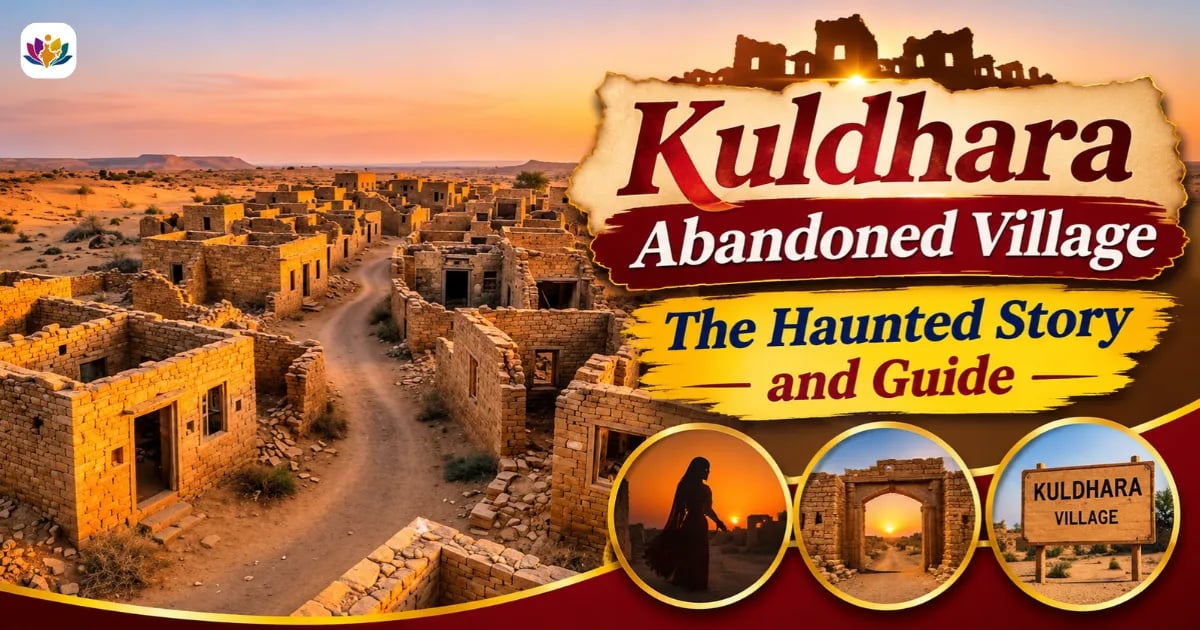
Kuldhara is a centuries-old abandoned village in the Thar Desert about 18 to 20 km southwest of Jaisalmer, once a prosperous township of the highly skilled Paliwal Brahmins and now a protected heritage monument managed by the Archaeological Survey of India. It is famous as a ghost town: a grid of straight lanes flanked by thousands of roofless golden sandstone houses, abruptly deserted overnight in the early 19th century and never successfully resettled since.
Today travellers come for its grid-like stone architecture, its deep silence and its enduring legends. It sits just off the main road toward the Sam Sand Dunes, which makes it an easy and popular addition to a desert day out from Jaisalmer. Our things to do in Jaisalmer guide places it among the city's essential sights, alongside the fort, the havelis and the dunes.
The history of Kuldhara village
Kuldhara was established in the late 13th century and grew into the hub of 84 surrounding Brahmin settlements. Its people, the Paliwals, were exceptional community planners, traders and agriculturalists who engineered advanced dry-land water management systems, allowing them to farm efficiently in the arid desert and build a genuinely prosperous township. The straight, well-planned lanes and the uniform layout of the houses you walk through today are evidence of that skill.
The prosperity ended abruptly. In the early 1800s, the entire population of Kuldhara, along with the people of 83 adjacent villages, is said to have vanished completely in a single night, leaving their homes standing empty. What drove such a sudden, coordinated exodus is the question that has given Kuldhara its fame and the answer comes in two versions: the popular legend and the historians' account.
The legend of Kuldhara: why was the village abandoned?
According to local folklore, the villain of the story is Salim Singh, the tyrannical Diwan or prime minister, of Jaisalmer. The legend holds that he set his eyes on the beautiful daughter of the village chief and threatened the community with exorbitant taxes if she was not given to him. To protect their honour and their daughter, the villagers of Kuldhara and the surrounding settlements are said to have fled together under the cover of darkness, abandoning everything.
The most famous part of the tale is what they supposedly did before leaving: cursed the land so that no one would ever be able to live in Kuldhara again. This curse and the idea that the ruins remain unsettled and haunted to this day, is what has fuelled Kuldhara's fame on television and social media. It is best enjoyed as the powerful piece of folklore it is, told and retold at the site, rather than as documented fact.
Is Kuldhara really haunted?
Kuldhara's reputation as a haunted ghost town is a matter of legend and popular belief rather than anything established and most of its eerie atmosphere comes simply from the profound silence and the roofless ruins standing empty in the desert. The site is open and safe to visit during the day and the "haunted" fame is largely a product of the curse legend and its retelling in the media.
Historians point to practical causes for the real abandonment rather than a supernatural one: severe droughts, dwindling water supplies and predatory taxation policies that together drove mass migration from the region. The truth is likely a combination of economic and environmental pressure. Whichever version you prefer, the silence of the place is genuine and visiting in daylight lets you take in the atmosphere and the history without the theatrics. Night entry, in any case, is strictly prohibited.
Things to see at Kuldhara village
For a field of ruins, Kuldhara has more to explore than first appears and knowing what to look for makes the visit far richer. The core sights can be covered comfortably in about an hour to an hour and a half.
The grid ruins: Walk down the remarkably straight, well-planned lanes flanked by thousands of roofless golden sandstone houses, the clearest evidence of the Paliwals' town planning.
The reconstructed Paliwal house: One traditional house has been fully restored by the government, so you can step inside and see the authentic multi-room layout, courtyards and kitchen structures used centuries ago.
The central temple: An ancient stone temple dedicated to a Hindu deity still stands strong amid the ruins, serving as the historical heart of the township.
The stepwells and city gates: Explore the surviving stone wells and the main entry arches that once guarded the prosperous town.
The reconstructed house is the highlight for many, as it brings the empty grid to life and shows how a Paliwal family actually lived. Take your time in the quiet lanes and the scale of what was abandoned slowly sinks in. If the ruins capture you, nearby Khaba Fort, covered below, makes a natural companion visit.
Kuldhara timings and entry fee
Kuldhara is open from 8:00 AM to 6:00 PM daily and night entry is strictly prohibited. There is a modest entry fee, with a separate charge to take a vehicle through the main gate. The amounts below are indicative and were correct at the time of writing; fees change, so reconfirm at the gate.
Category | Detail (at the time of writing) |
Timings | 8:00 AM to 6:00 PM daily; night entry prohibited |
Entry fee (Indian nationals) | Around ₹10 to ₹20 per person |
Entry fee (foreign nationals) | Around ₹50 to ₹100 per person |
Vehicle entry charge | Around ₹50 per car through the main gate |
Time required | About 1 to 1.5 hours |
The fees are small and the vehicle charge is worth paying as it lets you drive in rather than walk the access road in the heat. Treat the figures as a guide and carry some cash, as card and digital payments can be unreliable this far out of the city.
How to reach Kuldhara village from Jaisalmer
Kuldhara is about 18 to 20 km southwest of Jaisalmer city centre, situated just off the main road leading toward the Sam Sand Dunes, which makes it very easy to combine the two in one outing. The usual way to reach it is to hire transport from the city.
By private taxi: The most comfortable option and easily combined with the Sam Sand Dunes for a half-day or full-day desert trip.
By auto-rickshaw (tuk-tuk): A popular and economical choice; a round trip typically costs around ₹600 at the time of writing, so agree the fare before you set off.
Route | Approximate detail |
From Jaisalmer city centre | About 18 to 20 km southwest, off the Sam Sand Dunes road |
Round-trip tuk-tuk | Around ₹600 (agree the fare in advance) |
Natural combination | On the way to or from the Sam Sand Dunes |
Because Kuldhara sits on the Sam road, the most efficient plan is to visit it on the way out to or back from the dunes, which our Sam Sand Dunes and Jaisalmer desert guides cover. Jaisalmer itself is usually reached via Jodhpur, the gateway city, so the whole leg fits a Jodhpur-and-Jaisalmer desert route mapped in our Jodhpur 2 day itinerary guide, with the classic approaches covered in our Jaipur to Jodhpur distance and Udaipur to Jodhpur distance guides.
Best time to visit Kuldhara
The best time to visit Kuldhara is October to March, the cool winter season, when exploring the open, shadeless ruins is comfortable rather than punishing. This is the same peak window our best time to visit Jaisalmer guide recommends for the whole city and it is best to avoid the height of summer, when the desert heat makes walking the exposed site difficult.
Within the season, the late afternoon is ideal: you can explore the ruins in gentler light and then carry on to catch the sunset over the desert on your way to the Sam Sand Dunes, making a perfect combined evening. Early visits are quieter if you prefer solitude among the lanes. The same cool-season timing suits the wider Rajasthan trip, as our best time to visit Jodhpur guide covers for the gateway city.
Kuldhara and Khaba Fort
If the desert ruins capture your imagination, pair Kuldhara with Khaba Fort, about 15 minutes away, which is the natural companion to this trip. Khaba Fort sits above another vast, empty abandoned village and from its elevated position you get an incredible view down over the ruins spread out below, a different and dramatic perspective on the same Paliwal story.
Together, Kuldhara and Khaba make a compact, atmospheric half-day of desert heritage that complements the livelier Sam Sand Dunes nicely. Many travellers combine all three, visiting the two abandoned villages in the afternoon and finishing with the dunes at sunset. Where to base yourself for these outings, whether a desert camp or a city stay, is covered in our where to stay in Jaisalmer guide.
Travel tips for visiting Kuldhara
Pack your own water, a wide-brimmed hat and sunscreen, as the ruins are completely raw with no shops, vendors, shade or amenities on site.
Wear closed walking shoes rather than sandals, as the terrain is uneven, rocky and dusty.
Visit in the late afternoon so you can explore comfortably and continue to the Sam Sand Dunes for sunset.
Carry cash for the entry and vehicle fees and the tuk-tuk, as digital payments are unreliable out here.
Pay the small vehicle charge to drive through the gate rather than walking the access road in the heat.
Add nearby Khaba Fort, about 15 minutes away, for an elevated view over a second abandoned village.
Is Kuldhara village worth visiting?
Kuldhara is well worth visiting, especially if you enjoy history, heritage and atmospheric places with a story. It is not a grand monument but a hauntingly quiet field of planned ruins and its appeal lies in the mystery of the overnight exodus, the skill of the Paliwals who built it and the stillness of the desert around it. An hour or so among the lanes, with the reconstructed house and the central temple, is genuinely memorable.
Because it sits right on the road to the Sam Sand Dunes and pairs so easily with Khaba Fort, it slots effortlessly into a desert day out and adds real depth to a Jaisalmer trip that might otherwise be only forts and dunes. As part of the wider Rajasthan circuit through Jodhpur and Udaipur, mapped in our Udaipur 2 day itinerary and one week North India itinerary guides, it is a quietly unforgettable stop.
What to expect
A visit to Kuldhara delivers more atmosphere than spectacle. You can expect a short drive southwest from Jaisalmer, a modest entry gate and then straight, silent lanes of roofless golden sandstone houses stretching across the desert, with the restored Paliwal house, the old temple and the surviving wells and gates to explore. Allow about an hour to an hour and a half and let the quiet and the story do their work.
You should also expect a completely raw site with no shade, shops or facilities, uneven and dusty ground underfoot and strong sun outside winter, so come prepared with water, a hat and proper shoes. Time it for the late afternoon, pair it with Khaba Fort and the Sam Sand Dunes and Kuldhara becomes one of the most evocative afternoons in the whole Thar.
Plan your trip with us
Kuldhara is at its best as part of a well-planned desert day, timed so you explore the ruins in good light and reach the dunes for sunset, without wasting hours arranging transport or haggling at the gate. We built that into our Jaisalmer trips, with a comfortable private car and driver, Kuldhara and Khaba Fort paired with the Sam Sand Dunes and the whole day sequenced around the light.
Tell us your dates and group size and we will price it honestly around your standard rather than a fixed figure. Jaisalmer and its desert heritage slot into a wider Rajasthan journey on our Golden Triangle tours and our full range of Delhi Agra tours and the trip pairs beautifully with Jodhpur, whose mighty Mehrangarh Fort, sights in our things to do in Jodhpur guide, famous food and stays round out the desert leg, with Jaipur's forts in our Amber Fort guide and more ideas in our travel guides.
Want your Jaisalmer and Kuldhara trip planned around you? Message us on WhatsApp and Experience My India will build it for you.
Related guides
New Delhi tour: the capital's imperial landmarks and avenues.
Old Delhi tour: the Red Fort, Jama Masjid and Chandni Chowk.
Delhi day tour: the best of the capital in a day.
Experience My India has personally hosted 50,000+ travelers and the service he leads is rated 4.9 from 2,600+ reviews, operating since 2015. Delhi Agra Tour Packages is a unit of Experience My India.
Book Your Delhi - Agra Trip Today 📞 +91-7302265809 💬 WhatsApp: +91-7302265809 Rated 4.9★ / 2600+ Reviews Explore all: Delhi Agra Tour Packages |
What a Experiance My India
Complete Delhi-Agra services
Private AC Cabs
Comfortable AC cars with experienced local drivers for Delhi, Agra and Jaipur tours.
Local Expert Guides
Explore the Taj Mahal and historic monuments with knowledgeable local guides.
Handpicked Hotels
Comfortable stays near the Taj Mahal and prime locations across Delhi and Agra.
Delhi–Agra Tours
Well-planned same-day and multi-day tours covering the best attractions.
Golden Triangle
Experience Delhi, Agra and Jaipur together with carefully planned itineraries.
24/7 Travel Support
Get assistance throughout your journey from booking to your return.
Plan Your Trip
Get a free quote in 30 mins
100% Trusted & Verified
by 50,000+ Travellers since 2018
Why travellers choose Experience My India
What makes us different from other agencies
We plan and run every trip ourselves, so you get a private AC car, a local expert guide, an honest fixed price, and no reseller or touts in between. We have guided travelers and families since 2018 and hold a 5.0 star rating across 3 verified reviews.
What Our Travellers Say
Real reviews from real Travellers
“We booked our Jaisalmer tour package through Experience My India, and the experience was excellent. Abhay ji guided us throughout the trip and explained the fascinating history and haunted legends of Kuldhara Abandoned Village. His storytelling made the visit much more interesting. The cab was clean and comfortable, the hotel arrangements were very good, and the entire itinerary was managed smoothly. We really appreciated the team's hospitality and support.”
Rohan Mehta
Mumbai· 2026-10-12
“Our Jaisalmer trip with Experience My India was a memorable experience. Visiting Kuldhara was one of the highlights because Abhay ji explained the Paliwal community's history and the story behind the village's abandonment so clearly. Our driver was polite, the cab was well-maintained, and the hotel stay was comfortable. Everything was organised properly, and we never felt rushed during sightseeing. Highly satisfied with the service.”
Ananya Bose
Kolkata· 2026-01-13
“We had a lovely experience with Experience My India during our Jaisalmer holiday. Abhay ji was a knowledgeable and friendly guide who made Kuldhara Village more interesting with his explanations of its history and local legends. The cab service was punctual, the hotel was comfortable, and the sightseeing arrangements were handled professionally. The team remained helpful throughout our journey. It was a smooth and enjoyable holiday.”
Kunal Deshmukh
Pune· 2026-01-02
We booked our Jaisalmer tour package through Experience My India, and the experience was excellent. Abhay ji guided us throughout the trip and explained the fascinating history and haunted legends of Kuldhara Abandoned Village. His storytelling made the visit much more interesting. The cab was clean and comfortable, the hotel arrangements were very good, and the entire itinerary was managed smoothly. We really appreciated the team's hospitality and support.
Rohan Mehta
Mumbai
Our Jaisalmer trip with Experience My India was a memorable experience. Visiting Kuldhara was one of the highlights because Abhay ji explained the Paliwal community's history and the story behind the village's abandonment so clearly. Our driver was polite, the cab was well-maintained, and the hotel stay was comfortable. Everything was organised properly, and we never felt rushed during sightseeing. Highly satisfied with the service.
Ananya Bose
Kolkata
We had a lovely experience with Experience My India during our Jaisalmer holiday. Abhay ji was a knowledgeable and friendly guide who made Kuldhara Village more interesting with his explanations of its history and local legends. The cab service was punctual, the hotel was comfortable, and the sightseeing arrangements were handled professionally. The team remained helpful throughout our journey. It was a smooth and enjoyable holiday.
Kunal Deshmukh
Pune
We booked our Jaisalmer tour package through Experience My India, and the experience was excellent. Abhay ji guided us throughout the trip and explained the fascinating history and haunted legends of Kuldhara Abandoned Village. His storytelling made the visit much more interesting. The cab was clean and comfortable, the hotel arrangements were very good, and the entire itinerary was managed smoothly. We really appreciated the team's hospitality and support.
Rohan Mehta
Mumbai
Our Jaisalmer trip with Experience My India was a memorable experience. Visiting Kuldhara was one of the highlights because Abhay ji explained the Paliwal community's history and the story behind the village's abandonment so clearly. Our driver was polite, the cab was well-maintained, and the hotel stay was comfortable. Everything was organised properly, and we never felt rushed during sightseeing. Highly satisfied with the service.
Ananya Bose
Kolkata
Frequently Asked Questions
Quick answers to common questions
Kuldhara is a centuries-old abandoned village in the Thar Desert about 18 to 20 km southwest of Jaisalmer, once a prosperous township of the highly skilled Paliwal Brahmins and now a protected heritage monument managed by the Archaeological Survey of India. It is famous as a ghost town, a grid of straight lanes flanked by thousands of roofless golden sandstone houses, abruptly deserted overnight in the early 19th century and never successfully resettled since. Travellers come for its planned stone architecture, its deep silence and its enduring legends.
There are two versions. Local folklore says the tyrannical Diwan of Jaisalmer, Salim Singh, desired the village chief's daughter and threatened the community with crushing taxes, so the villagers of Kuldhara and 83 nearby settlements fled overnight to protect their honour, cursing the land so no one could live there again. Historians instead point to practical causes: severe droughts, dwindling water supplies and predatory taxation that together drove mass migration. The real reason is likely a combination of economic and environmental pressure rather than anything supernatural.
Kuldhara's reputation as a haunted ghost town is a matter of legend and popular belief rather than anything established. Most of its eerie feel comes simply from the profound silence and the roofless ruins standing empty in the desert and the "haunted" fame largely comes from the curse legend and its retelling on television and social media. The site is open and safe to visit during the day. Night entry is strictly prohibited in any case, so the experience is very much a daytime one of atmosphere and history.
Kuldhara is open from 8:00 AM to 6:00 PM daily. Night entry is strictly prohibited, so plan a daytime visit, ideally in the late afternoon so you can explore comfortably and then continue to the Sam Sand Dunes for sunset. You need only about an hour to an hour and a half to cover the core ruins, including the reconstructed Paliwal house, the central temple and the surviving wells and gates. Timings can change, so it is worth reconfirming locally before you set out.