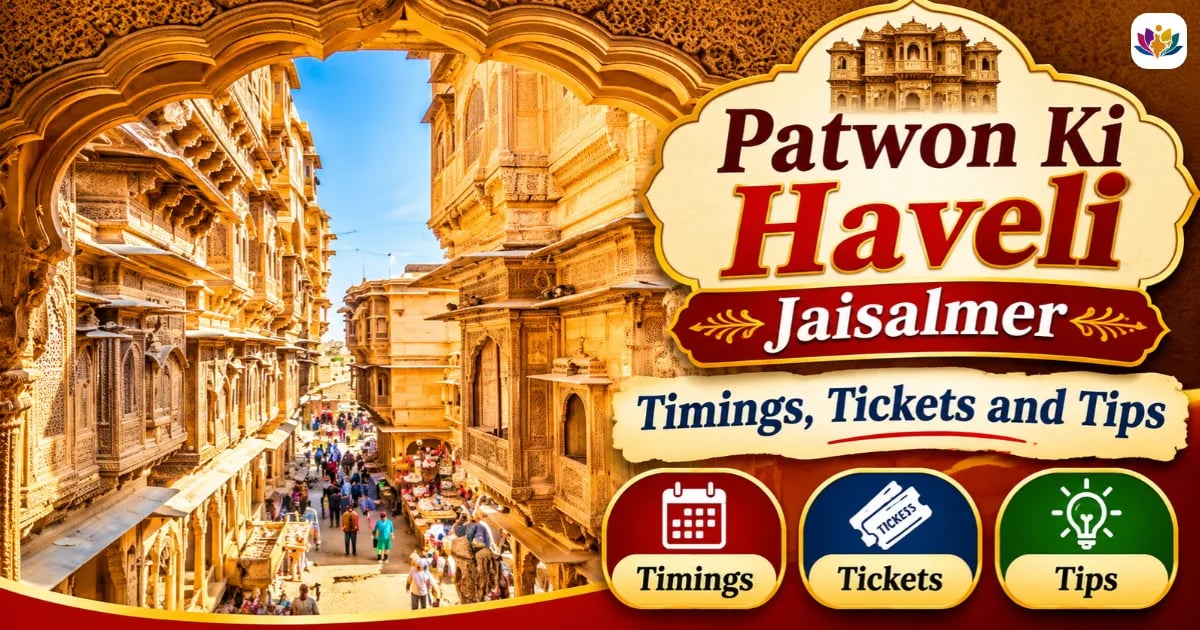
Quick Answer
Patwon Ki Haveli is a cluster of five interconnected 19th-century mansions in Jaisalmer, widely regarded as India's grandest and most intricately carved haveli complex. Commissioned in 1805 by trader Guman Chand Patwa, its golden sandstone facade and lace-like jharokhas are a highlight of the old city. Delhi Agra Tour Packages, a unit of Experience My India, includes it on its Jaisalmer trips.
Patwon Ki Haveli is the crown jewel of Jaisalmer's old city, a cluster of five interconnected mansions carved so finely that the stone seems to imitate lace. Built by a family of fabulously wealthy Silk Road traders, it is celebrated as the grandest haveli complex in India and its golden sandstone facade, some sixty latticed balconies deep, is one of the most photographed sights in all of Rajasthan. This guide from Delhi Agra Tour Packages covers the history, the architecture, what to see inside, the timings and tickets, how to reach it and the practical tips, so you can fit this remarkable mansion into your Jaisalmer trip, whether on its own or as part of a wider Rajasthan journey extended from a Golden Triangle tour.
I was born in Delhi and in more than 11 years planning trips across the region for Experience My India I have watched travellers stop dead in the lane at their first sight of the Patwa facade. It rewards an unhurried visit, so here is how to do it well.
Patwon Ki Haveli at a glance
Detail | Information |
What it is | A cluster of five interconnected 19th-century merchant mansions |
Location | Near Amar Sagar Pol, old walled city, Jaisalmer 345001; about 500 m north of Jaisalmer Fort |
Commissioned | 1805, by trader Guman Chand Patwa; built over nearly 50 years |
Timings | 9:00 AM to 5:00 PM, every day |
Best season | October to March |
Time required | About 1.5 to 2 hours |
Access | Narrow lanes; reach by auto-rickshaw or a 10 to 15-minute walk |
What is Patwon Ki Haveli?
Patwon Ki Haveli is a magnificent cluster of five interconnected 19th-century mansions in Jaisalmer, widely celebrated as the grandest and most intricately carved haveli complex in India. Built in brilliant yellow sandstone that glows golden under the desert sun, it was the home of a family of enormously wealthy traders and today serves as a living museum preserving the opulence, secrets and daily life of the Silk Road's elite merchants.
The complex is the architectural highlight of the old walled city and a must-see on any visit to Jaisalmer, which our things to do in Jaisalmer guide covers in full alongside the fort, the dunes and the city's other havelis. Its name simply means "the mansion of the brocade merchants", a nod to the trade that paid for all this stone lace.
The history of Patwon Ki Haveli
Patwon Ki Haveli was commissioned in 1805 by Guman Chand Patwa, a fabulously wealthy trader in gold and silver brocades and fine jewellery, whose business reached across the old Silk Road trade routes. Rather than a single house, he built five distinct but interconnected villas, one dedicated to each of his five sons and the whole complex took nearly 50 years to complete.
That half-century of construction and the wealth behind it, is why the haveli is so lavish and so large. The Patwas were among the richest merchant families of their day and the mansions were designed to display that standing to the world, from the carved facade down to the painted interiors. The result is less a home than a monument to mercantile Jaisalmer at its nineteenth-century peak, when the desert city sat astride the trade between India and Central Asia.
Patwon Ki Haveli architecture and jharokhas
The architecture of Patwon Ki Haveli is a unique blend of Rajput and Mughal styles, engineered beautifully to withstand the harsh Thar Desert climate. The builders used wood for the roofs and insulated mud for the flooring, keeping the rooms naturally cool in the desert heat and warmer in the cold season, a clever piece of climate-sensitive design centuries before air conditioning.
The glory of the complex is its facade.
The jharokhas: The exterior carries roughly 60 stunningly carved latticed balconies or jharokhas, each different, projecting over the narrow lane.
Stone like fabric: The screens are chiselled so finely that they mimic delicate lace or brocade, a deliberate nod to the family's trade in fine cloth.
The golden glow: In the right light, especially early morning, the yellow sandstone turns a deep gold, which is why the facade is so beloved by photographers.
Standing in the lane below and looking up at the tiers of carved balconies is the defining Patwon Ki Haveli experience and the reason the complex is considered the finest of its kind in India. The same honey-gold sandstone defines the whole of Jaisalmer, as our best time to visit Jaisalmer guide describes for the wider city.
Inside Patwon Ki Haveli: what to see
While some sections of the complex house offices for the Archaeological Survey of India or remain locked, the first of the five mansions is run as a privately restored museum, Kothari's Patwa Haveli, which holds the great majority of the interior exhibits. This is where most of your visit is spent, walking through richly decorated rooms that recreate the merchant family's world.
Lavish living rooms: The diwankhana, the formal court and living rooms where the family received guests and conducted business.
Secret vaults and rooms: Safe rooms built with hidden vaults and the traditional opium room, reflecting the customs and the wealth of the merchant era.
The Jain house temple: A private Jain house temple with exquisite wall murals and painted glasswork.
Vintage artefacts: An extensive collection of authentic 19th-century items, including ancient weights, intricate traditional locks and keys, vintage betel-nut slicers, old currencies, musical instruments and antique cameras.
The painted interiors, the glasswork and the sheer density of historical objects make the museum far more than an empty shell and it richly repays the time. Allow a good hour inside just for the exhibits and more if you enjoy old objects and photography.
Patwon Ki Haveli in Bollywood
One of the complex's most popular features is its expansive rooftop terrace, which offers panoramic views over the old city and across to Jaisalmer Fort. For many visitors the climb to the roof is the highlight, both for the view and for its screen fame.
The terrace famously served as a filming backdrop for the iconic song sequences in the Bollywood film Hum Dil De Chuke Sanam, which has made it a pilgrimage of sorts for fans of the movie. Whether or not you know the film, the rooftop is the best vantage point in this part of the old city and a wonderful place to take in the golden sprawl of Jaisalmer and the fort rising above it.
Patwon Ki Haveli timings and entry fee
Patwon Ki Haveli is open from 9:00 AM to 5:00 PM every day of the week. Tickets work in two parts, because the complex is split between the government (ASI) section and Kothari's privately run museum and there are separate camera fees. The amounts below are indicative and were correct at the time of writing; fees change, so reconfirm at the ticket desk.
Category | Detail (at the time of writing) |
Timings | 9:00 AM to 5:00 PM, every day |
ASI government section | Around ₹30 to ₹50 for Indians; ₹100 to ₹150 for foreigners |
Kothari's private museum | Around ₹150 for Indians; ₹300 for foreigners |
Camera fee | Around ₹50 to ₹100 for still cameras; higher for video |
Time required | About 1.5 to 2 hours |
Kothari's museum holds most of the interior exhibits, so it is the section worth paying for if you want the full experience. Treat the figures as a guide, carry some cash as digital payments can be unreliable and factor the camera fee in if you plan to photograph the interiors.
How to reach Patwon Ki Haveli
Patwon Ki Haveli is tucked inside a narrow lane within the old walled city, roughly 500 metres north of Jaisalmer Fort, at No. 3129 opposite Choora Paada near Amar Sagar Pol. The medieval alleys around it are tightly packed, so getting there takes a little planning.
The access catch: Four-wheeled vehicles cannot enter the narrow lanes around the haveli, so you cannot be dropped at the door by car.
By auto-rickshaw: The easiest way in, taking you close through the lanes.
On foot: A short 10 to 15-minute walk from the nearest major drop-off point at Patwa Chauraha, through the atmospheric old-city streets.
Route | Approximate detail |
From Jaisalmer Fort | About 500 m north, through the old city lanes |
Nearest vehicle drop-off | Patwa Chauraha, then a 10 to 15-minute walk |
Car access | Not possible in the narrow lanes; use an auto-rickshaw or walk |
Because the haveli sits right in the heart of the walled city, it combines naturally with the fort and the other old-city sights on foot. Jaisalmer itself is usually reached via Jodhpur, the gateway city, so the whole leg fits a Jodhpur-and-Jaisalmer route mapped in our Jodhpur 2 day itinerary guide, with the classic approaches in our Jaipur to Jodhpur distance and Udaipur to Jodhpur distance guides.
Best time to visit Patwon Ki Haveli
The best season to visit Patwon Ki Haveli is October to March, the cool winter months, when the pleasant daytime weather is perfectly suited to walking tours of the old city and climbing the haveli's multiple floors. This is the peak window. Our best time to visit Jodhpur guide also recommends the gateway city and the one to aim for across Rajasthan.
The best time of day is early morning, roughly 8:30 AM to 9:30 AM, arriving just before or right as the doors open. The morning sunlight catches the golden sandstone facade beautifully for photography and you will beat the large tour groups that fill the narrow lanes later in the day. An early start also leaves the rest of your day free for the fort, the other havelis or a trip out to the desert.
Travel tips for visiting Patwon Ki Haveli
Expect narrow, steep and uneven stone staircases between floors; the interior is unsuitable for wheelchairs and a real challenge for elderly visitors or anyone with knee trouble.
Wear comfortable, high-traction walking shoes for the ancient cobblestones and the multi-tier heritage floors.
If you want a guide, hire an officially certified one from the main booking desk and verify credentials, as the approach is crowded with touts and unlicensed guides.
Come early, around opening time, for the best light on the facade and the thinnest crowds.
Carry cash for the tickets and camera fee, as digital payments can be unreliable.
Just outside the entrance lanes, look for local vendors selling Dal Pakwan, a crisp, savoury and much-loved traditional Jaisalmer breakfast.
Is Patwon Ki Haveli worth visiting?
Patwon Ki Haveli is absolutely worth visiting and for most travellers it is one of the highlights of Jaisalmer, second only to the fort itself. It is the finest haveli complex in India and the combination of the lace-like carved facade, the lavishly decorated museum rooms, the hidden vaults and Jain temple and the rooftop view over the old city makes for a rich hour and a half to two hours. If you see only one mansion in Jaisalmer, this is the one.
Because it sits right in the walled city near the fort, it slots effortlessly into a morning of old-city sightseeing and it pairs with the desert sights and the wider Rajasthan circuit through Jodhpur and Udaipur, mapped in our Udaipur 2 day itinerary and one week North India itinerary guides. Go early, take your time with the carvings and the exhibits and it will be a memorable part of your trip.
What to expect
A visit to Patwon Ki Haveli delivers both spectacle and detail. You can expect to arrive on foot or by auto-rickshaw through the narrow old-city lanes, to be stopped in your tracks by the towering carved facade of some sixty jharokhas and then to climb through the richly decorated museum rooms, past vaults, a Jain house temple and cases of nineteenth-century objects, up to a rooftop with a sweeping view of the fort and city.
You should also expect narrow, steep staircases, crowded and tout-heavy approach lanes and busier conditions once the tour groups arrive, so an early start and comfortable shoes make a real difference. Plan about 1.5 to 2 hours, come at opening time, carry cash and Patwon Ki Haveli will be one of the most rewarding stops in the whole of Jaisalmer.
Plan your trip with us
Jaisalmer's old city is best explored on a well-sequenced morning, taking in Patwon Ki Haveli at opening time for the light and the quiet, then the fort and the other havelis before the heat and the crowds build. We build that into our Jaisalmer trips, with a knowledgeable local guide to unlock the history behind the carvings, the tickets and timing handled for you and the day paced around the desert light.
Tell us your dates and group size and we will price it honestly around your standard rather than a fixed figure. Jaisalmer and its heritage slot into a wider Rajasthan journey on our Golden Triangle tours and our full range of Delhi Agra tours and the trip pairs beautifully with Jodhpur, whose mighty Mehrangarh Fort, sights in our things to do in Jodhpur guide, famous food and stays round out the desert leg, with where to base yourself in Jaisalmer in our where to stay in Jaisalmer guide, Jaipur's forts in our Amber Fort guide and more ideas in our travel guides.
Want your Jaisalmer trip planned around you? Message us on WhatsApp and Experience My India will build it for you.
Related guides
New Delhi tour: the capital's imperial landmarks and avenues.
Old Delhi tour: the Red Fort, Jama Masjid and Chandni Chowk.
Delhi day tour: the best of the capital in a day.
Experience My India has personally hosted 50,000+ travelers and the service he leads is rated 4.9 from 2,600+ reviews, operating since 2015. Delhi Agra Tour Packages is a unit of Experience My India.
Book Your Delhi - Agra Trip Today 📞 +91-7302265809 💬 WhatsApp: +91-7302265809 Rated 4.9★ / 2600+ Reviews Explore all: Delhi Agra Tour Packages |
What a Experiance My India
Complete Delhi-Agra services
Private AC Cabs
Comfortable AC cars with experienced local drivers for Delhi, Agra and Jaipur tours.
Local Expert Guides
Explore the Taj Mahal and historic monuments with knowledgeable local guides.
Handpicked Hotels
Comfortable stays near the Taj Mahal and prime locations across Delhi and Agra.
Delhi–Agra Tours
Well-planned same-day and multi-day tours covering the best attractions.
Golden Triangle
Experience Delhi, Agra and Jaipur together with carefully planned itineraries.
24/7 Travel Support
Get assistance throughout your journey from booking to your return.
Plan Your Trip
Get a free quote in 30 mins
100% Trusted & Verified
by 50,000+ Travellers since 2018
Why travellers choose Experience My India
What makes us different from other agencies
We plan and run every trip ourselves, so you get a private AC car, a local expert guide, an honest fixed price, and no reseller or touts in between. We have guided travelers and families since 2018 and hold a 5.0 star rating across 3 verified reviews.
What Our Travellers Say
Real reviews from real Travellers
“We booked our Jaisalmer tour package through Experience My India, and the experience was wonderful. Abhay ji guided us throughout the trip and explained the history and beautiful architecture of Patwon Ki Haveli in a very interesting way. The carved jharokhas and museum interiors were amazing. Our cab was clean and comfortable, the hotel was excellent, and the entire sightseeing arrangement was well managed. Highly recommended!”
Rohit Agarwal
Lucknow· 2026-11-02
“Our Jaisalmer holiday with Experience My India was a memorable experience. Abhay ji was an excellent tour guide who helped us understand the history of Patwon Ki Haveli and its beautiful architecture. He gave us enough time to enjoy the place and take photographs. The hotel arrangements were comfortable, the cab service was punctual, and the overall coordination was smooth. We were very happy with the service.”
Neha Choudhary
Delhi· 2026-10-19
“We purchased a Rajasthan tour package from Experience My India, and Jaisalmer was one of our favourite destinations. Patwon Ki Haveli was truly impressive, especially its detailed sandstone carvings and traditional rooms. Abhay ji explained everything patiently and made the visit more interesting. The driver was polite, the vehicle was well maintained, and our hotel stay was comfortable. Everything was arranged professionally.”
Kunal Mehra
Chandigarh· 2026-10-02
We booked our Jaisalmer tour package through Experience My India, and the experience was wonderful. Abhay ji guided us throughout the trip and explained the history and beautiful architecture of Patwon Ki Haveli in a very interesting way. The carved jharokhas and museum interiors were amazing. Our cab was clean and comfortable, the hotel was excellent, and the entire sightseeing arrangement was well managed. Highly recommended!
Rohit Agarwal
Lucknow
Our Jaisalmer holiday with Experience My India was a memorable experience. Abhay ji was an excellent tour guide who helped us understand the history of Patwon Ki Haveli and its beautiful architecture. He gave us enough time to enjoy the place and take photographs. The hotel arrangements were comfortable, the cab service was punctual, and the overall coordination was smooth. We were very happy with the service.
Neha Choudhary
Delhi
We purchased a Rajasthan tour package from Experience My India, and Jaisalmer was one of our favourite destinations. Patwon Ki Haveli was truly impressive, especially its detailed sandstone carvings and traditional rooms. Abhay ji explained everything patiently and made the visit more interesting. The driver was polite, the vehicle was well maintained, and our hotel stay was comfortable. Everything was arranged professionally.
Kunal Mehra
Chandigarh
We booked our Jaisalmer tour package through Experience My India, and the experience was wonderful. Abhay ji guided us throughout the trip and explained the history and beautiful architecture of Patwon Ki Haveli in a very interesting way. The carved jharokhas and museum interiors were amazing. Our cab was clean and comfortable, the hotel was excellent, and the entire sightseeing arrangement was well managed. Highly recommended!
Rohit Agarwal
Lucknow
Our Jaisalmer holiday with Experience My India was a memorable experience. Abhay ji was an excellent tour guide who helped us understand the history of Patwon Ki Haveli and its beautiful architecture. He gave us enough time to enjoy the place and take photographs. The hotel arrangements were comfortable, the cab service was punctual, and the overall coordination was smooth. We were very happy with the service.
Neha Choudhary
Delhi
Frequently Asked Questions
Quick answers to common questions
Patwon Ki Haveli is a cluster of five interconnected 19th-century mansions in Jaisalmer, widely celebrated as the grandest and most intricately carved haveli complex in India. Built in brilliant yellow sandstone that glows golden in the desert sun, it was the home of a hugely wealthy family of brocade and jewellery traders and today serves as a living museum of the opulence and daily life of the Silk Road's elite merchants. Its lace-like carved facade of some sixty latticed balconies is one of the most photographed sights in all of Rajasthan.
Patwon Ki Haveli was commissioned in 1805 by Guman Chand Patwa, a fabulously wealthy trader in gold and silver brocades and fine jewellery whose business reached across the old Silk Road routes. Instead of a single house, he built five distinct but interconnected villas, one for each of his five sons and the whole complex took nearly 50 years to complete. That half-century of construction and the wealth behind it are why the haveli is so lavish and so large, a monument to mercantile Jaisalmer at its nineteenth-century peak.
Patwon Ki Haveli is open from 9:00 AM to 5:00 PM every day of the week. The best time to arrive is early morning, around 8:30 AM to 9:30 AM, just before or as the doors open, when the morning sun lights the golden facade beautifully for photography and you beat the large tour groups that crowd the narrow lanes later. Plan about 1.5 to 2 hours to explore the rooms, the exhibits and the rooftop thoroughly. Timings can change, so it is worth reconfirming locally before you set out.
Tickets come in two parts because the complex is split between the government (ASI) section and Kothari's privately run museum. At the time of writing, the ASI section costs roughly ₹30 to ₹50 for Indians and ₹100 to ₹150 for foreigners, while Kothari's private museum, which holds most of the interior exhibits, is around ₹150 for Indians and ₹300 for foreigners. Still-camera fees run about ₹50 to ₹100, with higher rates for video. These are indicative figures that change, so reconfirm at the ticket desk and carry cash.