Quick Answer
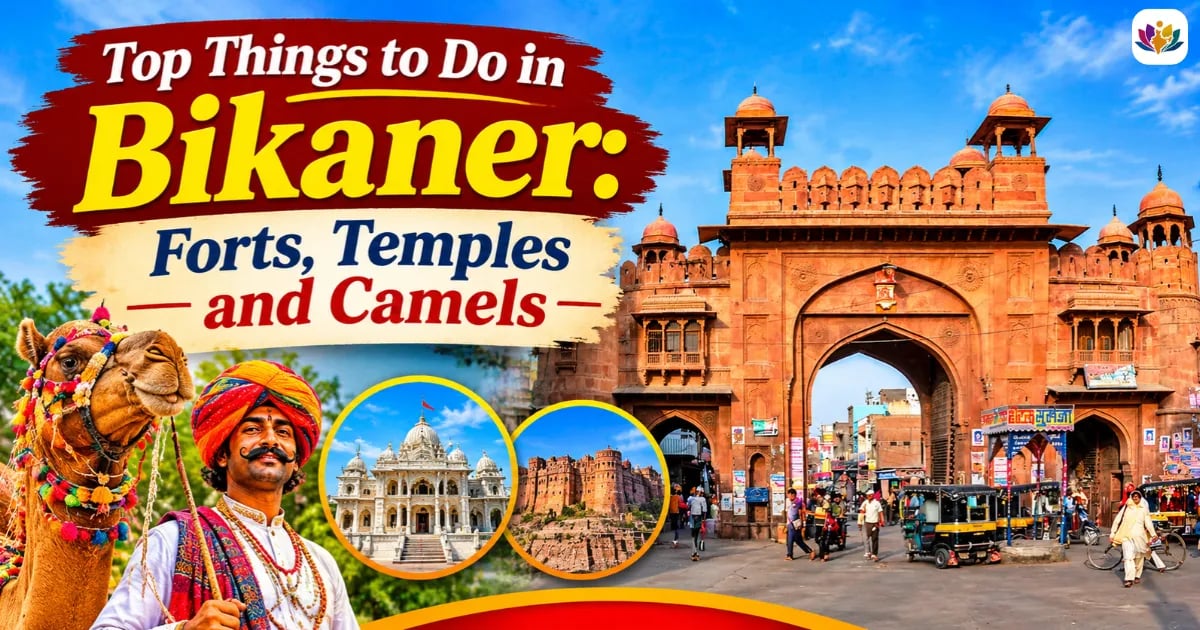
The best things to do in Bikaner are exploring the magnificent Junagarh Fort, visiting the Karni Mata rat temple at Deshnoke, admiring the Rampuria havelis and Lalgarh Palace, seeing the camel research centre and tasting the city's famous bhujia and sweets. Delhi Agra Tour Packages, a unit of Experience My India, builds custom Bikaner and Rajasthan trips.
Bikaner is one of Rajasthan's most rewarding and least crowded desert cities, a place of a magnificent sandstone fort, lavish palaces, carved merchant havelis, an extraordinary temple of holy rats and a camel culture found nowhere else, all wrapped up with the crisp, spicy snack that carries the city's name around the world. This guide from Delhi Agra Tour Packages rounds up the best things to do in Bikaner, with how to reach it, the best time to go and how long to stay, so you can plan a visit to this underrated gem, whether on its own or as part of a wider Rajasthan journey extended from a Golden Triangle tour.
I was born in Delhi and in more than 11 years planning trips across the region for Experience My India I have found Bikaner to be the city travellers most often overlook and most regret missing, as it has much of the grandeur of Jodhpur and Jaisalmer with a fraction of the crowds. Here is what to do there.
Things to do in Bikaner at a glance
Attraction | What it is |
Junagarh Fort | A magnificent, never-conquered fort of palaces and courtyards |
Karni Mata Temple, Deshnoke | The revered "rat temple", a place of deep faith |
Lalgarh and Laxmi Niwas Palaces | Red sandstone royal palaces, now part heritage hotels |
Rampuria Havelis | Carved red sandstone merchant mansions in the old city |
Camel research centre | A camel breeding farm with rides and camel-milk treats |
Bhandasar Jain Temple | An ornate Jain temple with fine frescoes |
Bikaner bazaars and food | Famous bhujia, namkeen and sweets |
What is Bikaner known for?
Bikaner is known for its grand desert fort and palaces, its unique camel culture, the famous Karni Mata rat temple and above all for Bikaneri bhujia, the spicy gram-flour snack that has made the city's name a household word across India. Founded in 1488 by Rao Bika, a Rathore prince, it grew into an important stop on the old caravan trade routes and that mercantile wealth paid for the carved havelis and lavish palaces you see today.
Compared with the better-known Rajasthan cities, Bikaner is relatively uncrowded, which is a large part of its charm. It makes a natural addition to a desert circuit with Jaisalmer and Jodhpur, the two nearest major cities, whose sights our things to do in Jodhpur and things to do in Jaisalmer guides cover. Here are the specific things to do.
Junagarh Fort: Bikaner's unconquered citadel
Junagarh Fort is the centrepiece of any visit to Bikaner, a magnificent fort begun in the late 16th century under Raja Rai Singh, a general of the Mughal emperor Akbar. Unusually for Rajasthan, it was built on the plains rather than a hilltop and it is famous for having never been conquered, its formidable walls and moat keeping out every attacker.
Inside, the fort is a treasury of palaces and courtyards accumulated over the centuries.
Opulent palaces: The Anup Mahal, Phool Mahal (Flower Palace), Karan Mahal and Chandra Mahal, richly decorated with mirror-work, gold leaf, lacquer and painted glass.
The Prachina Museum: Royal costumes, textiles and artefacts displayed within the fort.
Courtyards and carving: Exquisitely carved red and gold sandstone throughout, among the best preserved in Rajasthan.
Allow a couple of hours to explore the fort properly, ideally with a guide to make sense of the layered history. It is often compared favourably with the forts of Jodhpur and Jaisalmer precisely because it is so well preserved and so uncrowded; the mighty Mehrangarh Fort in Jodhpur makes a natural companion on a desert trip.
Karni Mata Temple: the rat temple at Deshnoke
About 30 km south of Bikaner at Deshnoke stands the Karni Mata Temple, one of India's most unusual and revered shrines, home to thousands of sacred rats, known as kabas, that are cared for and worshipped by devotees. For the faithful, the temple is a profoundly sacred place, dedicated to Karni Mata, a revered folk deity and the rats are believed to be the reincarnated souls of her devotees.
Visitors should approach it respectfully as the living place of worship it is.
A place of deep faith: It is an active, important pilgrimage site, so visit quietly and observe the customs.
Temple etiquette: Footwear is removed before entering and you walk among the rats; spotting a rare white rat is considered especially auspicious.
The architecture: A beautiful temple with marble and silver work, worth seeing in its own right.
The rat temple is a genuinely one-of-a-kind experience and a highlight for many visitors, though those uncomfortable around the animals should know what to expect. It lies on the road toward Jodhpur and Jaisalmer, so it fits easily into a wider desert itinerary.
Lalgarh Palace and Laxmi Niwas
On the northern edge of the city, Lalgarh Palace is a grand early 20th-century palace of red sandstone, built by Maharaja Ganga Singh, Bikaner's most celebrated ruler, in a blend of Rajput, Mughal and European (Indo-Saracenic) styles. Its filigree stone screens and ornate facades are the work of the same master carvers who built the city's havelis.
Lalgarh Palace: Houses the Sadul Singh Museum of royal memorabilia, with part of the complex run as a heritage hotel.
Laxmi Niwas Palace: The adjacent, even more lavish wing, now a luxury heritage hotel open for a look (and a splendid stay).
Even if you are not staying, the palaces are worth visiting for the architecture and the museum, which bring the era of Ganga Singh, the maharaja who modernised Bikaner, vividly to life. A heritage-hotel stay here is one of the special experiences the city offers.
Rampuria Havelis in the old city
The Rampuria Havelis are a cluster of magnificent carved mansions in Bikaner's old city, often called the pride of Bikaner, built by the wealthy Rampuria merchant family in richly carved red (dulmera) sandstone. Their facades, balconies and windows are so finely worked that the old city around them is one of the most atmospheric heritage quarters in Rajasthan.
Wandering the narrow lanes among the havelis, with their blend of Rajput, Mughal and even Victorian detailing, is one of the great free pleasures of Bikaner. The old city is also where you find the best of the city's food and bazaars, so combine a haveli walk with a snack stop. For the carving tradition at its grandest, the merchant mansions here rival the famous havelis of Jaisalmer, covered in our Jaisalmer guides.
The National Research Centre on Camel
Bikaner's desert setting has made it India's camel capital and the National Research Centre on Camel, on the city's outskirts, is a government camel breeding and research farm that is a genuinely fun and unusual visit. You can see different breeds of camel, watch the herds, take a short camel ride and, famously, try camel-milk products.
Camel rides: Short rides around the farm, popular with families.
Camel-milk treats: Camel-milk kulfi (ice cream) and lassi are the quirky highlight.
Best timing: Late afternoon, when the camels return to the centre, is the liveliest time.
It is an easy, offbeat outing and a highlight for children. Bikaner also hosts a colourful annual Camel Festival, usually in January (dates shift year to year), with camel parades, races and folk performances, well worth timing a visit around if you can.
Bhandasar Jain Temple and Bikaner's temples
The Bhandasar Jain Temple is Bikaner's most beautiful temple, a 15th to 16th-century Jain shrine famous for its intricate frescoes, mirror-work and gold-leaf paintings and for the local legend that ghee was used in its foundations. Its upper floors give lovely views over the old city and the artistry inside is exceptional.
Bhandasar Jain Temple: Ornate frescoes and carvings, with old-city views from the top.
Shiv Bari Temple: A 19th-century red sandstone Shiva temple with fine architecture, on the city's edge.
Devi Kund Sagar: The royal cenotaphs (chhatris) of Bikaner's rulers, a quieter heritage stop.
Together these give a rounded picture of Bikaner's religious and royal heritage beyond the headline fort and palaces. The Jain temple in particular is a must for anyone who enjoyed the fretwork of Rajasthan's other great temples and havelis.
Bikaner food: bhujia, sweets and bazaars
No visit to Bikaner is complete without eating your way through its famous food, as this is the home of Bikaneri bhujia, the crisp, spicy gram-flour snack sold all over India, along with a huge variety of namkeen (savoury snacks) and sweets. The old-city bazaars are the place to taste and buy them fresh.
Bhujia and namkeen: Buy it fresh from the shops where it is made; it is far better than the packaged version.
Sweets: Bikaner is also known for sweets such as rasgulla and ghevar; try them at a traditional sweet shop.
Bazaar shopping: The old-city markets are great for snacks, spices and local crafts.
Tasting bhujia at its source, warm and fresh, is a small revelation and the bazaars are an experience in themselves. Rajasthan's regional foods are a trip highlight everywhere; the famous dishes of nearby Jodhpur are covered in our famous food in Jodhpur guide.
How to reach Bikaner
Bikaner sits in northern Rajasthan and is well connected by road and rail, most often approached from Jaipur, Jodhpur or Delhi. It makes a logical point on a desert circuit between Jaisalmer and the eastern cities.
By road: Good highways link Bikaner to Jaipur, Jodhpur, Jaisalmer and Delhi; a private car is the most comfortable option.
By train: Bikaner has a well-connected railway station, including trains from Delhi, Jaipur and Jodhpur.
By air: Bikaner has a small airport with limited flights; Jodhpur and Jaipur are the larger gateways followed by a road transfer.
Route | Approximate detail |
From Jodhpur | A common road approach on a desert circuit |
From Jaipur | By road or rail, often the entry point from the Golden Triangle |
By rail | Well connected, including from Delhi, Jaipur and Jodhpur |
Because it links so naturally with the other desert cities, many travellers fold Bikaner into a Rajasthan loop with Jodhpur and Jaisalmer, using our Jodhpur 2 day itinerary and the desert routes in our Jaipur to Jodhpur distance and Udaipur to Jodhpur distance guides to plan the drive.
Best time to visit Bikaner
The best time to visit Bikaner is October to March, the cool season, when the desert weather is pleasant for sightseeing by day and comfortable at night. This is the peak window across the Rajasthan desert and it is the same timing as our best time to visit Jodhpur and best time to visit Jaisalmer guides recommended for the neighbouring cities.
It is best to avoid the height of summer, when the desert heat is extreme and midday sightseeing becomes difficult. If you can, time your visit for the annual Camel Festival, usually held in January, for a vivid cultural spectacle, though you should book accommodation well ahead for the festival dates. Winter nights can be cold in the desert, so carry a layer for the evenings.
Where to stay and how long to spend in Bikaner
One full day is enough to cover Bikaner's headline sights, the fort, a palace and the old city, while two days let you add the Karni Mata temple, the camel centre and a more relaxed pace. For most travellers on a Rajasthan circuit, a day and a night or two, is the right amount.
Heritage stays: Lalgarh and Laxmi Niwas palaces offer a memorable heritage-hotel experience.
Hotels and havelis: A good range of hotels and converted haveli guesthouses suits every budget.
One or two days: One day for the essentials, two for a fuller, unhurried visit.
Staying in a heritage palace or haveli is part of the Bikaner experience, so it is worth choosing accommodation with character. Where to base yourself in the neighbouring desert cities is covered in our where to stay in Jodhpur and where to stay in Jaisalmer guides.
Travel tips for visiting Bikaner
Give Junagarh Fort a couple of hours, ideally with a guide, as it is the richest sight in the city.
Approach the Karni Mata rat temple respectfully as an active place of worship and remove your footwear.
Visit the camel research centre in the late afternoon, when the herds return.
Buy bhujia and namkeen fresh from the old-city shops rather than packaged.
Visit between October and March and carry a layer for cold desert nights.
Book well ahead if you are timing your trip for the January Camel Festival.
Is Bikaner worth visiting?
Bikaner is absolutely worth visiting and for many travellers it is the pleasant surprise of a Rajasthan trip. It offers a magnificent, well-preserved and uncrowded fort, lavish palaces, some of the finest carved havelis in the state, a genuinely unique rat temple, a quirky camel culture and unforgettable food, all with a relaxed, authentic feel that the more touristy cities can lack. If you want Rajasthan's grandeur without the crowds, Bikaner delivers.
It slots perfectly into a desert circuit with Jaisalmer and Jodhpur and into a longer Rajasthan or northern India journey, as our Udaipur 2 day itinerary and one week North India itinerary guides show, with the Golden Triangle forts such as Jaipur's Amber Fort along the way. Add a day or two for Bikaner and you will be glad you did.
What to expect
A visit to Bikaner delivers Rajasthan's grandeur in a relaxed, uncrowded setting. You can expect to explore the magnificent Junagarh Fort and its painted palaces, wander the carved Rampuria havelis of the old city, visit the extraordinary Karni Mata rat temple at Deshnoke, meet the camels at the research farm, admire the Bhandasar Jain Temple and eat your fill of fresh bhujia and sweets, all without the heavy tourist crowds of the bigger cities.
You should also expect a desert climate, hot by day in the warmer months and cold on winter nights, some travel to reach the city and a temple experience with the famous rats that is not for everyone. Plan a day or two, go in the cool season, approach the temple respectfully and Bikaner will be a genuine highlight of your Rajasthan trip.
Plan your trip with us
Bikaner is best enjoyed as part of a well-planned desert circuit, with the fort, palaces, temple and camel farm sequenced sensibly and a comfortable car for the longer desert drives between cities. We build exactly that, pairing Bikaner with Jaisalmer and Jodhpur, arranging a heritage-palace stay if you want one and adding a knowledgeable local guide to unlock the history of the fort and havelis.
Tell us your dates and group size and we will price it honestly around your standard rather than a fixed figure. Bikaner and the Rajasthan desert slot into a wider journey on our Golden Triangle tours and our full range of Delhi Agra tours, with more trip ideas in our travel guides.
Want your Bikaner and Rajasthan trip planned around you? Message us on WhatsApp and Experience My India will build it for you.
Related guides
New Delhi tour: the capital's imperial landmarks and avenues.
Old Delhi tour: the Red Fort, Jama Masjid and Chandni Chowk.
Delhi day tour: the best of the capital in a day.
Experience My India has personally hosted 50,000+ travelers and the service he leads is rated 4.9 from 2,600+ reviews, operating since 2015. Delhi Agra Tour Packages is a unit of Experience My India.
Book Your Delhi - Agra Trip Today 📞 +91-7302265809 💬 WhatsApp: +91-7302265809 Rated 4.9★ / 2600+ Reviews Explore all: Delhi Agra Tour Packages |
What a Experiance My India
Complete Delhi-Agra services
Private AC Cabs
Comfortable AC cars with experienced local drivers for Delhi, Agra and Jaipur tours.
Local Expert Guides
Explore the Taj Mahal and historic monuments with knowledgeable local guides.
Handpicked Hotels
Comfortable stays near the Taj Mahal and prime locations across Delhi and Agra.
Delhi–Agra Tours
Well-planned same-day and multi-day tours covering the best attractions.
Golden Triangle
Experience Delhi, Agra and Jaipur together with carefully planned itineraries.
24/7 Travel Support
Get assistance throughout your journey from booking to your return.
Plan Your Trip
Get a free quote in 30 mins
100% Trusted & Verified
by 50,000+ Travellers since 2018
Why travellers choose Experience My India
What makes us different from other agencies
We plan and run every trip ourselves, so you get a private AC car, a local expert guide, an honest fixed price, and no reseller or touts in between. We have guided travelers and families since 2018 and hold a 5.0 star rating across 3 verified reviews.
What Our Travellers Say
Real reviews from real Travellers
“We booked our Bikaner and Rajasthan tour package through Experience My India, and the experience was wonderful. Abhay ji guided us throughout the trip and explained the history of Junagarh Fort, Rampuria Havelis and Karni Mata Temple in a very interesting way. The cab was clean and comfortable, the hotel was excellent, and the driver was polite. Everything was arranged properly, making our family trip very enjoyable. Highly recommended!”
Amit Khanna
Gurugram· 2026-10-21
“Our Bikaner trip with Experience My India was truly amazing. We especially enjoyed visiting Junagarh Fort, the beautiful old havelis and the famous Karni Mata Temple. Abhay ji was a fantastic guide who helped us understand the local culture and history. The hotel arrangements were comfortable, the cab service was punctual, and the entire team was very helpful. We returned with lovely memories.”
Sneha Deshmukh
Pune· 2026-09-29
“We had a fantastic Rajasthan holiday with Experience My India. Bikaner was one of our favourite stops, especially the camel research centre and the beautiful architecture of Lalgarh Palace. Abhay ji guided us with patience and shared interesting information about every place. The cab, hotel and sightseeing arrangements were all excellent. We did not have to worry about travel arrangements at any point. Thank you for such good service!”
Rajeev Nair
Kochi· 2026-11-01
We booked our Bikaner and Rajasthan tour package through Experience My India, and the experience was wonderful. Abhay ji guided us throughout the trip and explained the history of Junagarh Fort, Rampuria Havelis and Karni Mata Temple in a very interesting way. The cab was clean and comfortable, the hotel was excellent, and the driver was polite. Everything was arranged properly, making our family trip very enjoyable. Highly recommended!
Amit Khanna
Gurugram
Our Bikaner trip with Experience My India was truly amazing. We especially enjoyed visiting Junagarh Fort, the beautiful old havelis and the famous Karni Mata Temple. Abhay ji was a fantastic guide who helped us understand the local culture and history. The hotel arrangements were comfortable, the cab service was punctual, and the entire team was very helpful. We returned with lovely memories.
Sneha Deshmukh
Pune
We had a fantastic Rajasthan holiday with Experience My India. Bikaner was one of our favourite stops, especially the camel research centre and the beautiful architecture of Lalgarh Palace. Abhay ji guided us with patience and shared interesting information about every place. The cab, hotel and sightseeing arrangements were all excellent. We did not have to worry about travel arrangements at any point. Thank you for such good service!
Rajeev Nair
Kochi
We booked our Bikaner and Rajasthan tour package through Experience My India, and the experience was wonderful. Abhay ji guided us throughout the trip and explained the history of Junagarh Fort, Rampuria Havelis and Karni Mata Temple in a very interesting way. The cab was clean and comfortable, the hotel was excellent, and the driver was polite. Everything was arranged properly, making our family trip very enjoyable. Highly recommended!
Amit Khanna
Gurugram
Our Bikaner trip with Experience My India was truly amazing. We especially enjoyed visiting Junagarh Fort, the beautiful old havelis and the famous Karni Mata Temple. Abhay ji was a fantastic guide who helped us understand the local culture and history. The hotel arrangements were comfortable, the cab service was punctual, and the entire team was very helpful. We returned with lovely memories.
Sneha Deshmukh
Pune
Frequently Asked Questions
Quick answers to common questions
Bikaner is famous for its grand desert fort and palaces, its unique camel culture, the Karni Mata rat temple and above all for Bikaneri bhujia, the spicy gram-flour snack that has made the city's name known across India. Founded in 1488 by the Rathore prince Rao Bika, it grew wealthy on the old caravan trade routes, which paid for its magnificent Junagarh Fort, its lavish Lalgarh and Laxmi Niwas palaces and the finely carved Rampuria havelis of the old city. Relatively uncrowded compared with Jaipur, Jodhpur and Jaisalmer, it is one of Rajasthan's most rewarding and underrated destinations.
The top things to do are exploring Junagarh Fort and its painted palaces; visiting the Karni Mata rat temple at Deshnoke; admiring the Lalgarh and Laxmi Niwas palaces and the Sadul Singh Museum; wandering the carved Rampuria havelis of the old city; seeing the camels and trying camel-milk kulfi at the National Research Centre on Camel; visiting the ornate Bhandasar Jain Temple; and tasting the city's famous bhujia, namkeen and sweets in the old-city bazaars. Many visitors also time their trip for the January Camel Festival. One to two days covers the city comfortably.
Junagarh Fort is special because, unusually for Rajasthan, it was built on the plains rather than a hilltop and it is famous for having never been conquered, its walls and moat repelling every attacker. Begun in the late 16th century under Raja Rai Singh, a general of the Mughal emperor Akbar, it is a superbly preserved complex of opulent palaces, the Anup Mahal, Phool Mahal, Karan Mahal and Chandra Mahal, richly decorated with mirror-work, gold leaf and painted glass, along with the Prachina Museum. It is often rated among Rajasthan's finest forts precisely because it is so intact and so uncrowded.
The Karni Mata Temple at Deshnoke, about 30 km south of Bikaner, is one of India's most unusual and revered shrines, home to thousands of sacred rats, known as kabas, that are cared for and worshipped by devotees who believe them to be reincarnated souls. Dedicated to Karni Mata, a revered folk deity, it is a profoundly sacred and active place of worship, so visitors should approach it respectfully, remove their footwear and observe the customs. Spotting a rare white rat is considered especially auspicious. It is a genuinely one-of-a-kind experience, though those uncomfortable around the animals should know what to expect.