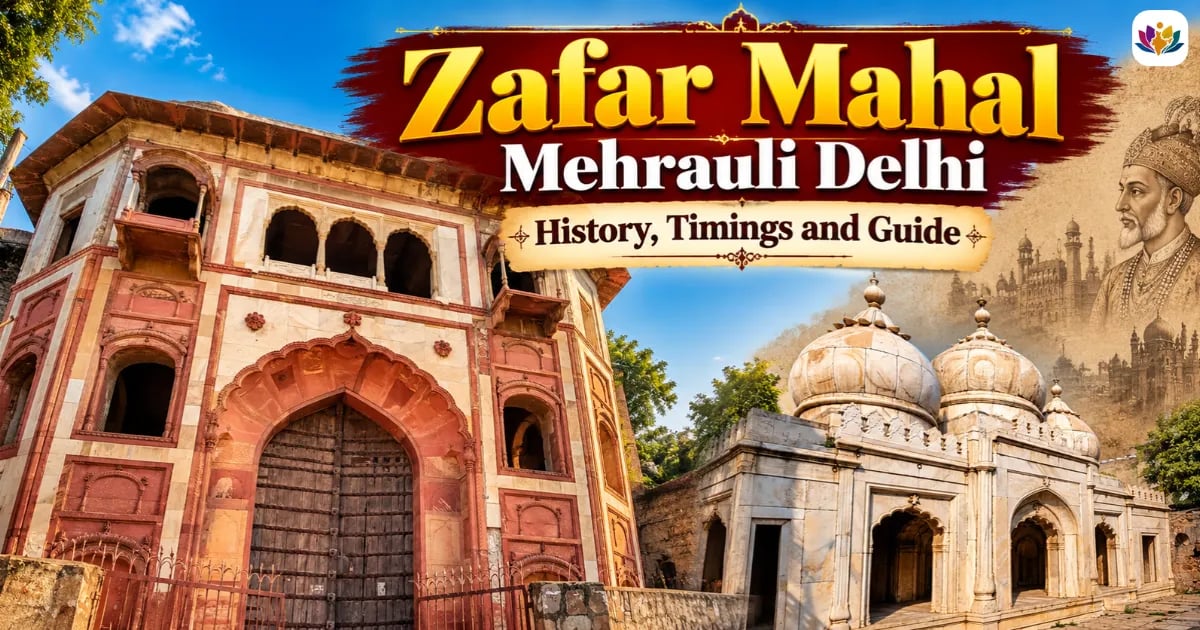
Quick Answer
Zafar Mahal in Mehrauli is the last monumental summer palace of the Mughal dynasty, built by Akbar Shah II in the 1820s with a grand Hathi Gate added by Bahadur Shah Zafar II in 1847 to 1848. It holds Mughal royal graves and an empty plot meant for the exiled last emperor. Free entry, open daily 10:00 AM to 6:00 PM. Delhi Agra Tour Packages, a unit of Experience My India, plans Delhi trips.
Zafar Mahal, tucked into the narrow lanes of Mehrauli village in south Delhi, is one of the most poignant and historically significant monuments in the capital, the last monumental summer palace ever built by the great Mughal dynasty, standing as a moving reminder of the final days of an empire. With its towering Hathi Gate, its royal graves and the empty plot where the last emperor wished to be buried, it is a place steeped in history and melancholy beauty. This guide from Delhi Agra Tour Packages covers Zafar Mahal in full, its history and builders, the royal graves, the architecture, the timings, the free entry and how to reach it, a deeply rewarding offbeat stop for anyone drawn to the history of Mughal Delhi on a Golden Triangle tour.
I was born in Delhi and in more than 11 years planning trips across the region for Experience My India I have taken history-loving travellers into the Mehrauli lanes to find this last Mughal palace, which moves everyone who learns its story. Here is the clear, practical guide to visiting.
Zafar Mahal at a glance
Detail | Information |
What it is | The last monumental summer palace of the Mughal dynasty |
Main palace | Built by Akbar Shah II, around the 1820s |
Hathi Gate | A 50-foot red-sandstone gate added by Bahadur Shah Zafar II, 1847 to 1848 |
Holds | Mughal royal graves and the empty plot of Bahadur Shah Zafar II |
Where | Mehrauli village, near the Dargah of Qutbuddin Bakhtiar Kaki, south Delhi |
Timings | Daily, 10:00 AM to 6:00 PM |
Entry | Free (no ticket required) |
About Zafar Mahal
Zafar Mahal, in the old village of Mehrauli in south Delhi, holds a unique and poignant place in history as the last monumental summer palace built by the Mughal dynasty. Raised in the twilight years of the empire, when the Mughal emperors still reigned in name from Delhi but had lost much of their real power, it is the final grand architectural flourish of a dynasty that had built the Taj Mahal and the Red Fort and it carries all the melancholy of an ending age.
What makes Zafar Mahal so moving is the layering of its history. Within its walls stand the graves of several Mughal emperors, a small and beautiful mosque and, most poignantly, the empty plot where the last emperor, Bahadur Shah Zafar, wished to be buried but never could. Combined with its striking Hathi Gate and its blend of architectural styles, this makes the palace one of the most atmospheric and historically resonant sites in the capital, hidden away in the Mehrauli lanes near the great dargah and a fine companion to the other monuments of the area, as our Jahaz Mahal Mehrauli Delhi guide covers the lovely Lodi-era pavilion nearby.
The history and builders of Zafar Mahal
The history of Zafar Mahal spans the last two reigns of the Mughal dynasty. The main palace was built in the early 19th century, around the 1820s, by the Mughal Emperor Akbar Shah II, as a summer retreat in the cool, green surroundings of Mehrauli, long a favoured resort of the court.
Its most iconic feature, however, was added a little later. The grand entrance gate, a towering 50-foot red-sandstone structure known as the Hathi Gate, so named because it was designed to be large enough to allow elephants to pass through, was added in 1847 to 1848 by Akbar Shah II's successor, the last Mughal emperor, Bahadur Shah Zafar II. This magnificent gate, from which the palace takes its name, is the grandest surviving element of the complex. The palace served as the royal residence during two great annual occasions in Mehrauli: the famous Phoolwalon Ki Sair, the festival of the flower sellers and the Urs, the annual commemoration, of the revered Sufi saint Hazrat Khwaja Qutbuddin Bakhtiar Kaki, whose dargah lies close by. So the palace was bound up with both the courtly and the spiritual life of Mehrauli.
History and builders | Detail |
Main palace | Built around the 1820s by Emperor Akbar Shah II |
Hathi Gate | A 50-foot red-sandstone gate, added 1847 to 1848 by Bahadur Shah Zafar II |
Royal use | Residence during the Phoolwalon Ki Sair and the Urs of Qutbuddin Bakhtiar Kaki |
Moti Masjid | A small marble mosque within the complex, built 1709 by Bahadur Shah I |
The tragic fate of Bahadur Shah Zafar
The most moving story attached to Zafar Mahal is that of the last Mughal emperor himself, Bahadur Shah Zafar II, which gives the palace its deep melancholy. Within the royal enclosure, beside the dargah, the emperor had a plot of ground prepared where he wished to be buried, close to the saint he revered, in the city that had been the heart of his dynasty for centuries.
It was not to be. After the great Revolt of 1857, in which the aged emperor became a reluctant figurehead, the victorious British deposed him and exiled him far from his homeland to Rangoon, in Burma, now Yangon in Myanmar, where he died in 1862 and was buried. His intended burial plot at Zafar Mahal, the sardgaah, remains empty to this day, a silent and deeply poignant symbol of the end of the Mughal dynasty and of an emperor who died in exile, far from the city and the resting place he longed for. To stand before that empty plot, knowing its story, is one of the most moving experiences in all of Delhi.
The royal graves and the Moti Masjid
Zafar Mahal is, in effect, the last royal burial ground of the Mughals and its precinct houses a delicate marble-screen or jaali, enclosure containing the graves of several key Mughal figures, which adds to the site's historic weight. Here lie the Emperor Bahadur Shah I, whose grave was built by his successor Jahandar Shah; the Emperor Shah Alam II, remembered for the tragedy of having been blinded by the Rohilla leader Ghulam Qadir; and the Emperor Akbar Shah II, the builder of the palace.
To see these imperial graves, gathered quietly behind their marble screens in this ruined palace, is to feel the whole long arc of the Mughal dynasty drawing to its close. Within the complex also stands the small and beautiful Moti Masjid or Pearl Mosque, a delicate marble mosque built in 1709 by the Emperor Bahadur Shah I, adding a note of serene grace to the historic enclosure. Together, the graves and the mosque make Zafar Mahal a place of profound historical resonance.
The architecture of Zafar Mahal
The architecture of Zafar Mahal is a fascinating reflection of its late-Mughal date, blending several styles in a way characteristic of the period. It is built of red sandstone with white marble accents, the classic Mughal palette, but it combines late-Mughal forms with Rajasthani and Bengali-style elements, including the distinctive curved Bengali roofs, in an eclectic mix typical of the dynasty's final architectural phase.
The towering Hathi Gate is the grandest and best-preserved element, a magnificent piece of red-sandstone building. Sadly, however, much of the rest of the palace is today in a state of severe neglect and ruin: significant portions of the upper floors, roofs and walls have collapsed or faded with time. In recent years, parts of the structure have received stabilisation support from conservation bodies, helping to preserve what remains. This ruined, faded state, far from diminishing the palace, adds to its melancholy atmosphere and its sense of a vanished world, though it means visitors should tread carefully among the old structures.
Zafar Mahal timings and entry
Zafar Mahal is open to visitors daily, from 10:00 AM to 6:00 PM and entry is completely free, with no ticket required. There is no dress code, though as the site adjoins a revered dargah and holds royal graves, a respectful manner and modest dress are appropriate.
The daytime hours give plenty of time to explore the Hathi Gate, the graves, the mosque and the ruined palace at a relaxed pace. The morning and the late afternoon are especially pleasant, with softer light on the red sandstone for photography. Because much of the structure is ruined and unstabilised, do take care while exploring, watch your footing among the old walls and floors and keep children close.
Timings and entry | Detail |
Opening hours | Daily, 10:00 AM to 6:00 PM |
Entry fee | Free (no ticket required) |
Dress code | None, though modest, respectful dress is appropriate |
Note | Much of the palace is ruined; take care while exploring |
Location and how to reach Zafar Mahal
Zafar Mahal stands in the narrow lanes of Mehrauli village, in south Delhi, about 300 feet west of the Ajmeri Gate of the Dargah of Qutbuddin Bakhtiar Kaki, deep in the historic heart of old Mehrauli. Its setting in the village lanes, beside the great dargah, is part of its atmosphere and it places the palace amid a wealth of other monuments.
By the Delhi Metro, the nearest station is Qutub Minar on the Yellow Line, from where you can take a short auto-rickshaw ride or walk into the village, as our Delhi metro guide for tourists covers using the metro to reach the city's sights. You can also reach it by taxi or auto-rickshaw. Because the palace is tucked into the maze of Mehrauli lanes, near the Qutub complex, the Yogmaya Temple and the Mehrauli Archaeological Park, it can be a little tricky to find the first time, so it helps to have a guide or driver who knows the area.
Location and how to reach | Detail |
Where | Mehrauli village lanes, about 300 feet west of the dargah's Ajmeri Gate |
Near | Dargah of Qutbuddin Bakhtiar Kaki, Qutub complex, Yogmaya Temple |
Nearest metro | Qutub Minar (Yellow Line), then a short auto or walk |
Note | Tucked in the village lanes; a guide or driver who knows the area helps |
Combine Zafar Mahal with Mehrauli's heritage
Zafar Mahal lies in one of the most history-rich quarters of all Delhi, which makes it wonderful to combine with the area's other great monuments into a rewarding day of heritage exploring, well off the usual tourist trail.
Close by is the lovely Lodi-era Jahaz Mahal pavilion by the Hauz-i-Shamsi tank and the vast spread of the Mehrauli Archaeological Park, with its hundred or more monuments, as our Mehrauli Archaeological Park guide covers that great open-air site. The world-famous Qutub Minar rises nearby, as our Qutub Minar ticket and timings guide covers that towering monument and the ancient Gandhak Ki Baoli, Delhi's oldest stepwell, is close too, as our Gandhak Ki Baoli Delhi guide covers that deep old well. Together, these sites make Mehrauli one of the most rewarding areas to explore in the capital, as our things to do in Delhi guide covers the full range of the city's attractions.
The best time to visit Zafar Mahal
Zafar Mahal can be visited year round, but the most comfortable season to explore Delhi and the Mehrauli monuments is the cooler period from about October to March, when the weather is pleasant for walking the village lanes and the ruined palace, as our best time to visit Delhi guide covers the seasons in the capital.
Within the day, the morning and the late afternoon are the loveliest times, with soft light on the red sandstone of the Hathi Gate and a safer, more pleasant visit than in the harsh midday sun. Mehrauli is at its most festive during the autumn Phoolwalon Ki Sair, the historic festival with which Zafar Mahal was long associated, so a visit around that time adds a special cultural dimension, though the palace itself is quiet and contemplative on most days.
How to plan your visit
A visit to Zafar Mahal takes only about half an hour to explore the Hathi Gate, the royal graves, the Moti Masjid and the ruined palace and to reflect on its history, so it is best combined with the other monuments of Mehrauli, such as Jahaz Mahal, the Qutub Minar and the archaeological park, into a rewarding half-day of heritage exploring. Because the palace is tucked into the village lanes, a private car with a driver who knows the area makes finding it and moving between the sites simple and stress-free.
Delhi is the gateway to the Golden Triangle and fits beautifully into a wider trip, as our one week North India itinerary guide maps out a route taking in Delhi, Agra, Jaipur and more.
Want your Delhi days planned, with Zafar Mahal, the monuments of Mehrauli and the great sights all sorted around you? Message us on WhatsApp and Experience My India will build it for you.
Tips for visiting Zafar Mahal
Learn the story of Bahadur Shah Zafar's empty burial plot before you go; it gives the visit its deep, moving resonance.
Visit in the morning or late afternoon for soft light on the red-sandstone Hathi Gate and a more comfortable, safer visit.
Entry is free with no ticket, but dress modestly and behave respectfully, as the site adjoins a dargah and holds royal graves.
Take care among the ruined walls and floors, watch your footing and keep children close.
The entrance is tucked into the Mehrauli village lanes, so allow extra time to find it or go with a guide or driver.
Combine the visit with nearby Jahaz Mahal, the Qutub Minar, Gandhak Ki Baoli and the archaeological park for a full half-day.
Visit respectfully, mindful of the adjoining dargah of Qutbuddin Bakhtiar Kaki and the royal graves.
What to expect
A visit to Zafar Mahal is a moving journey into the final chapter of the Mughal dynasty. You can expect a ruined but atmospheric last summer palace, dominated by its towering red-sandstone Hathi Gate, holding behind its marble screens the graves of Mughal emperors and the small, graceful Moti Masjid and, most poignantly, the empty plot where the last emperor, exiled and dying in distant Rangoon, wished to be laid to rest. It is a place of melancholy beauty and profound history, hidden in the Mehrauli lanes near the great dargah.
As a free, offbeat and deeply resonant monument, the very last palace of the Mughals, set amid the great heritage of Mehrauli, Zafar Mahal is a wonderful and affecting find for any traveller who loves history and seeks out the hidden depths of Delhi. With a little effort to find it, a respectful manner and a knowledge of its story, it rewards richly.
Plan your trip with us
A visit to Zafar Mahal, as part of a wider Delhi and Golden Triangle trip, is easiest and most enjoyable when the travel, the stays, the guide and the sightseeing are all arranged for you. That is what we do, a comfortable private car and an experienced driver who knows the lanes, a knowledgeable guide to bring the history to life, well-chosen stays and the whole trip planned around you.
Tell us your dates and group size and we will price it honestly around your standard rather than a fixed figure. You can combine Delhi with the classic circuit on our Golden Triangle tours and we can build it all within our wider Delhi Agra Tour Packages.
Related guides
New Delhi tour: the capital's imperial landmarks.
Old Delhi tour: the Red Fort, Jama Masjid and Chandni Chowk.
Delhi day tour: the best of the capital in a day.
Experience My India has personally hosted 50,000+ travelers and the service he leads is rated 4.9 from 2,600+ reviews, operating since 2015. Delhi Agra Tour Packages is a unit of Experience My India.
Book Your Delhi - Agra Trip Today 📞 +91-7302265809 💬 WhatsApp: +91-7302265809 Rated 4.9★ / 2600+ Reviews Explore all: Delhi Agra Tour Packages |
What a Experiance My India
Complete Delhi-Agra services
Private AC Cabs
Comfortable AC cars with experienced local drivers for Delhi, Agra and Jaipur tours.
Local Expert Guides
Explore the Taj Mahal and historic monuments with knowledgeable local guides.
Handpicked Hotels
Comfortable stays near the Taj Mahal and prime locations across Delhi and Agra.
Delhi–Agra Tours
Well-planned same-day and multi-day tours covering the best attractions.
Golden Triangle
Experience Delhi, Agra and Jaipur together with carefully planned itineraries.
24/7 Travel Support
Get assistance throughout your journey from booking to your return.
Plan Your Trip
Get a free quote in 30 mins
100% Trusted & Verified
by 50,000+ Travellers since 2018
Why travellers choose Experience My India
What makes us different from other agencies
We plan and run every trip ourselves, so you get a private AC car, a local expert guide, an honest fixed price, and no reseller or touts in between. We have guided travelers and families since 2018 and hold a 5.0 star rating across 3 verified reviews.
What Our Travellers Say
Real reviews from real Travellers
“Our Delhi heritage trip with Experience My India was smooth and memorable. Abhay ji guided us through Zafar Mahal in Mehrauli and shared fascinating stories about Mughal history and Bahadur Shah Zafar's final wish. The driver was polite, the cab service was excellent, and our hotel arrangements were comfortable. We appreciated the team's attention to detail and friendly service.”
Priyanka Nair
Kochi· 2026-10-15
“Experience My India arranged a lovely Delhi sightseeing package for our family. Abhay ji made our visit to Zafar Mahal special by explaining the royal graves, Moti Masjid, and the significance of the historic palace. The cab arrived on time, the hotel was comfortable, and the itinerary allowed us to explore without feeling rushed. Everything was managed professionally.”
Kunal Mehta
Surat· 2026-09-24
“Our trip with Experience My India was well planned from start to finish. Abhay ji was a fantastic guide at Zafar Mahal Mehrauli and helped us understand the monument's place in the final years of the Mughal dynasty. The driver was courteous, the cab was clean, and our hotel stay was pleasant. The team's service made our Delhi holiday relaxing and enjoyable.”
Manav Bhatia
Chandigarh· 2026-09-25
Our Delhi heritage trip with Experience My India was smooth and memorable. Abhay ji guided us through Zafar Mahal in Mehrauli and shared fascinating stories about Mughal history and Bahadur Shah Zafar's final wish. The driver was polite, the cab service was excellent, and our hotel arrangements were comfortable. We appreciated the team's attention to detail and friendly service.
Priyanka Nair
Kochi
Experience My India arranged a lovely Delhi sightseeing package for our family. Abhay ji made our visit to Zafar Mahal special by explaining the royal graves, Moti Masjid, and the significance of the historic palace. The cab arrived on time, the hotel was comfortable, and the itinerary allowed us to explore without feeling rushed. Everything was managed professionally.
Kunal Mehta
Surat
Our trip with Experience My India was well planned from start to finish. Abhay ji was a fantastic guide at Zafar Mahal Mehrauli and helped us understand the monument's place in the final years of the Mughal dynasty. The driver was courteous, the cab was clean, and our hotel stay was pleasant. The team's service made our Delhi holiday relaxing and enjoyable.
Manav Bhatia
Chandigarh
Our Delhi heritage trip with Experience My India was smooth and memorable. Abhay ji guided us through Zafar Mahal in Mehrauli and shared fascinating stories about Mughal history and Bahadur Shah Zafar's final wish. The driver was polite, the cab service was excellent, and our hotel arrangements were comfortable. We appreciated the team's attention to detail and friendly service.
Priyanka Nair
Kochi
Experience My India arranged a lovely Delhi sightseeing package for our family. Abhay ji made our visit to Zafar Mahal special by explaining the royal graves, Moti Masjid, and the significance of the historic palace. The cab arrived on time, the hotel was comfortable, and the itinerary allowed us to explore without feeling rushed. Everything was managed professionally.
Kunal Mehta
Surat
Frequently Asked Questions
Quick answers to common questions
Zafar Mahal, in the old village of Mehrauli in south Delhi, is the last monumental summer palace built by the Mughal dynasty. The main palace was built by Emperor Akbar Shah II around the 1820s and its towering Hathi Gate was added by the last emperor, Bahadur Shah Zafar II, in 1847 to 1848. The complex holds the graves of several Mughal emperors, a small mosque and the poignant empty plot where Bahadur Shah Zafar wished to be buried.
The main palace of Zafar Mahal was built in the early 19th century, around the 1820s, by the Mughal Emperor Akbar Shah II, as a summer retreat in Mehrauli. Its iconic 50-foot red-sandstone entrance, the Hathi Gate, named because it was built large enough for elephants to pass through, was added in 1847 to 1848 by his successor, the last Mughal emperor, Bahadur Shah Zafar II, from whom the palace takes its name.
Zafar Mahal is important as the last monumental summer palace of the Mughal dynasty, the final grand building of an empire that built the Taj Mahal and the Red Fort. It holds the graves of Mughal emperors including Bahadur Shah I, Shah Alam II and Akbar Shah II and the small Moti Masjid of 1709. Most poignantly, it contains the empty burial plot of the last emperor, Bahadur Shah Zafar, who died in exile, making it a deeply resonant symbol of the dynasty's end.
The Hathi Gate is the grand entrance to Zafar Mahal and its most iconic, best-preserved feature: a towering 50-foot red-sandstone gateway. It is called the Hathi Gate, meaning Elephant Gate, because it was designed to be large enough to allow elephants to pass through it. It was added in 1847 to 1848 by the last Mughal emperor, Bahadur Shah Zafar II and it is from this emperor that the whole palace takes its name, Zafar Mahal.