
Jantar Mantar Jaipur: Timings, Tickets & Guide 2026
Jantar Mantar Jaipur: Timings, Tickets & Guide 2026 image 1
Jantar Mantar Jaipur: Timings, Tickets & Guide 2026 image 2
Jantar Mantar Jaipur: Timings, Tickets & Guide 2026 image 3
Jantar Mantar Jaipur: Timings, Tickets & Guide 2026 image 4

Jantar Mantar Jaipur: Timings, Tickets & Guide 2026

4.8(1247)
2-3 hours
Sunrise / Sunset
Mughal Architecture
Tags:
jantar-mantarjaipursamrat-yantrasundialastronomical-instrumentsworld-heritage-sitejaipur-travelgolden-triangle

Plan your Jantar Mantar visit: 2026 entry fee and timings, the world's largest stone sundial, why a guide helps, and how it fits the Jaipur old city.

In a Nutshell

Jantar Mantar looks, at first glance, like a sculpture park, and that is exactly the trap. These are not abstract shapes but working astronomical instruments, built of stone at giant scale so they could measure time and track the heavens with the naked eye. The largest of them tells the time to within a couple of seconds using nothing but a shadow. Understood, it is one of the most remarkable places in Jaipur; unexplained, it can be baffling, which is why a guide matters here more than almost anywhere.

Details

Quick answer: Jantar Mantar at a glance

QuestionAnswer
What it is18th-century royal observatory, UNESCO World Heritage Site, 19 giant masonry instruments
Largest instrumentSamrat Yantra, world's largest stone sundial (27 metres tall)
TimingsDaily, roughly 9 AM to 4:30 or 5 PM
Best time11 AM to 2 PM (high sun, clearest shadows)
Entry fee (Indian)Around Rs 50
Entry fee (Foreign)Around Rs 200
Children under 7Free
Composite ticketIncluded in Jaipur composite ticket (2 days)
GuideStrongly recommended (or audio guide for about Rs 200)
Time to allow45 minutes to 1 hour
Jantar Mantar looks, at first glance, like a sculpture park, and that is exactly the trap. These are not abstract shapes but working astronomical instruments, built of stone at giant scale so they could measure time and track the heavens with the naked eye. The largest of them tells the time to within a couple of seconds using nothing but a shadow. Understood, it is one of the most remarkable places in Jaipur; unexplained, it can be baffling, which is why a guide matters here more than almost anywhere. Here is how to visit it well.

Details

Timings and best time to visit

DetailInformation
Open daysDaily
TimingsRoughly 9 AM to 4:30 or 5 PM
Last entryShortly before closing
Best timeBetween 11 AM and 2 PM (high sun, clearest shadows)
Time needed45 minutes to 1 hour
NoteLittle shade, carry water in warmer months

Details

Entry fees and tickets

TicketIndianForeign
Jantar Mantar entryaround Rs 50around Rs 200
Child under 7FreeFree
Jantar Mantar is included in the two-day Jaipur composite ticket along with Amber Fort, Hawa Mahal, Nahargarh and others, so you may already be covered if you are seeing several monuments. An audio guide is available for around Rs 200, and licensed guides are on site. Rates were revised in 2026, so confirm at the counter.

Why you want a guide

This is the one Jaipur monument where I always recommend a guide or the audio guide. The instruments are cryptic without explanation: a wall of curved marble scales means nothing until someone shows you how the shadow falling across it gives the time, the season or the position of a planet. With that explanation, the place comes alive and you understand what Jaipur's founder actually built. Without it, you walk past extraordinary science thinking it is decoration. The small cost of a guide is the best money you will spend here.

What you actually see

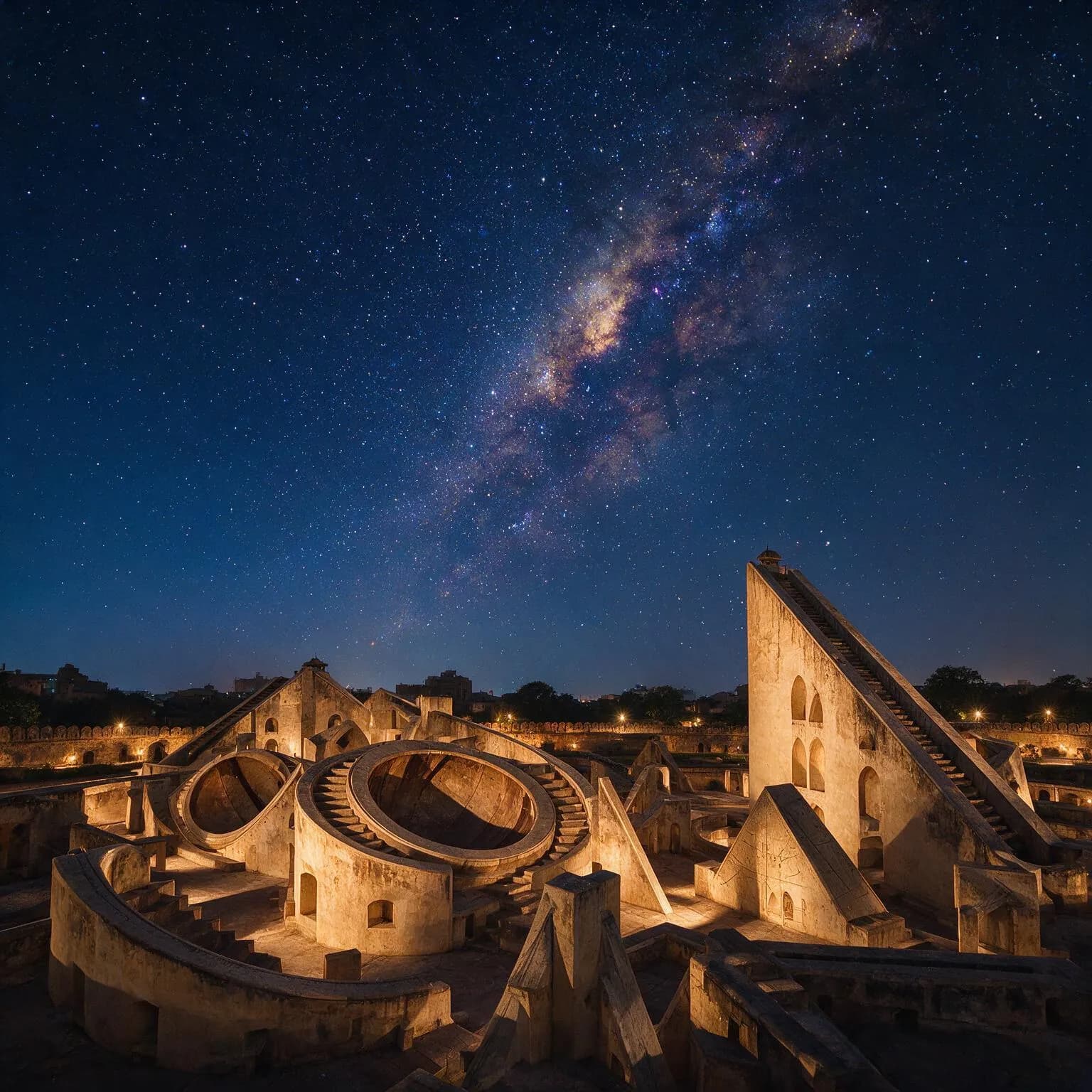
The centrepiece is the Samrat Yantra, the supreme instrument, a right-angled triangle some 27 metres tall whose shadow moves visibly along a curved scale, telling local time to within about two seconds. Around it stand the Jai Prakash Yantra, two hemispherical bowls that mirror the sky and locate the sun and stars; the Ram Yantra, cylindrical structures that measure the altitude and direction of celestial bodies; and the Rashivalayas, twelve instruments, one for each sign of the zodiac. Together, nineteen instruments make up the largest and best preserved of the observatories Jaipur's founder built.

A short history

Jantar Mantar was built by Maharaja Sawai Jai Singh II, the founder of Jaipur, between about 1728 and 1734. A ruler with a serious interest in astronomy, he built five such observatories across northern India, at Jaipur, Delhi, Ujjain, Mathura and Varanasi, and the Jaipur one is the largest and most complete. Its instruments were used to compile astronomical tables and to fix the local time, a role it served officially into the twentieth century. It was inscribed as a UNESCO World Heritage Site in 2010.

Getting there and how it fits a Jaipur day

Jantar Mantar is in the heart of the old city, right beside the City Palace and a short walk from Hawa Mahal, so the three form the natural old-city cluster after an early morning at Amber Fort. It is about 3 km from the railway station, easy by taxi or auto. Do the three on foot once you are in the walled city, and give Jantar Mantar the middle of the day when its instruments work best.

Visit Jantar Mantar with us

We are Experience My India, and Jantar Mantar is where our guides earn their keep, turning a field of puzzling stonework into a genuine wonder. We handle the timing for the clearest shadows and pair it with the City Palace and Hawa Mahal next door. On the Golden Triangle it follows Agra and the Taj Mahal. For the rest of the Pink City, start at the things to do in Jaipur hub, and first-time visitors may want our tours for first-time visitors. See live prices on our Delhi Agra tour packages, or message us on WhatsApp for a quote.

Enquire Now

Premium Experience

Ready to Explore
The Pink City?

Experience the Amber Fort, Hawa Mahal, City Palace, and the colorful bazaars of Jaipur with our expert-guided premium tours of Rajasthan's capital.

A
B
C
D
2,500+
4.9
Flexible itinerariesPrivate guidesBest price guarantee
Premium Tour Package
Featured Destination

Jaipur

Premium Tour Package

Premium

Questions

Frequently asked questions

4/4 visible

What are Jantar Mantar's timings?

Jantar Mantar is open daily, roughly 9 AM to 4:30 or 5 PM. Unusually, the middle of the day is the best time to visit, between about 11 AM and 2 PM, when the sun is high and the great sundials cast their clearest shadows. Allow 45 minutes to an hour. There is little shade, so carry water in the warmer months.

What is the Jantar Mantar entry fee in 2026?

Do you need a guide at Jantar Mantar?

What is the largest instrument at Jantar Mantar?

About the author

Abhay Sharma leads the Delhi Agra vertical at Experience My India and has spent more than five years planning and running trips across Agra, Delhi and the Golden Triangle. He was born and raised in Agra and is a third-generation guide, and he plans and runs the Golden Triangle itineraries this site describes. He writes and keeps these pages current. Read more on his author profile.

Explore more

Plan your Jantar Mantar trip with us

Plan Your Trip

Interested in Jantar Mantar Jaipur: Timings, Tickets & Guide 2026?

Chat with our travel team for a custom quote, or browse every package.

Related Attractions

1 attraction
1 related attractions
Premium Experience

Ready to explore Jantar Mantar Jaipur: Timings, Tickets & Guide 2026?

Book your private tour today and experience the magic of India's rich heritage.

Explore Tours
Verified GuideBest Price2,500+ Happy Travelers
Call us