

 Fatehpur Sikri, Agra
Anup Talao Fatehpur Sikri: History, Music and Legends
Anup Talao at Fatehpur Sikri near Agra is Akbar's music pool with four stone bridges. Its history, the Tansen and coin legends, timings and how to reach it.
Quick answer
Anup Talao is an ornamental square red sandstone pool with a central platform reached by four stone bridges, inside the imperial palace complex of Fatehpur Sikri, near Agra. Built by Akbar, it served as an open-air stage for music and poetry, its water and surrounding walls carrying sound across the courtyard and it is tied to the legend of the musician Tansen. Entry is part of the Fatehpur Sikri palace ticket and it opens daily from 6 AM to 6 PM. It features on our tours, run by a unit of Experience My India.
- #anup-talao
- #agra
- #agra-attractions
- #agra-travel
Anup Talao is one of the most charming corners of Fatehpur Sikri, a small ornamental pool with a carved island at its centre, reached by four little stone bridges, where the music of Akbar's court once played. It is modest in size but rich in story, tied to the legendary musician Tansen, to a famous tale of coins and to the ingenious way the Mughals used water to cool their palaces. Our team at Delhi Agra Tour Packages includes it on visits to Fatehpur Sikri on the Agra to Jaipur road and it is a natural part of a Golden Triangle tour through Delhi, Agra and Jaipur.
I am Abhay Sharma, a Golden Triangle guide since 2015 and the Anup Talao is one of the stops I most enjoy describing, because once you know what happened here, a quiet stone pool comes alive with music. This guide covers who built it and why, its use as a music stage and its clever acoustics, the famous legend of the coins, the four bridges and the cooling design, the ticket and timings and how to reach it. It is a small feature, but one of the most evocative at Fatehpur Sikri, the kind of place that casual visitors hurry past but that rewards anyone who stops to picture the scene it was built for.
Anup Talao at a glance
| Detail | Information |
|---|---|
| What it is | An ornamental square pool with a central platform |
| Also called | Kapur Talao or Char-Chamad, for its four bridges |
| Built by | Mughal Emperor Akbar |
| Built | Between 1575 and 1576 |
| Known for | A music stage, its acoustics and the legend of coins |
| Size | A square tank, 29 metres on each side |
| Entry | Part of the Fatehpur Sikri palace ticket |
| Open | Daily, sunrise to sunset, 6 AM to 6 PM |
Timings
| Detail | Information |
|---|---|
| Opening hours | Daily, sunrise to sunset, 6 AM to 6 PM |
| Fridays | Open, when the Taj Mahal is closed |
| Best hours | Early morning or late afternoon |
| Time needed | 10 to 15 minutes at the pool |
Entry fee
| Visitor | Price |
|---|---|
| Indian, SAARC and BIMSTEC | ₹40 per person |
| Foreign nationals | ₹610 per person |
| Children under 15 | Free |
| Covers | The whole Fatehpur Sikri palace complex |
How to reach
| Detail | Information |
|---|---|
| Location | Fatehpur Sikri, on NH-21, the Agra to Jaipur Highway |
| From Agra | 37 km west, a 1 hour drive |
| From Delhi | 210 km |
| Last stretch | Park at the base lot, take the shuttle, ₹30 per person |
What is the Anup Talao?
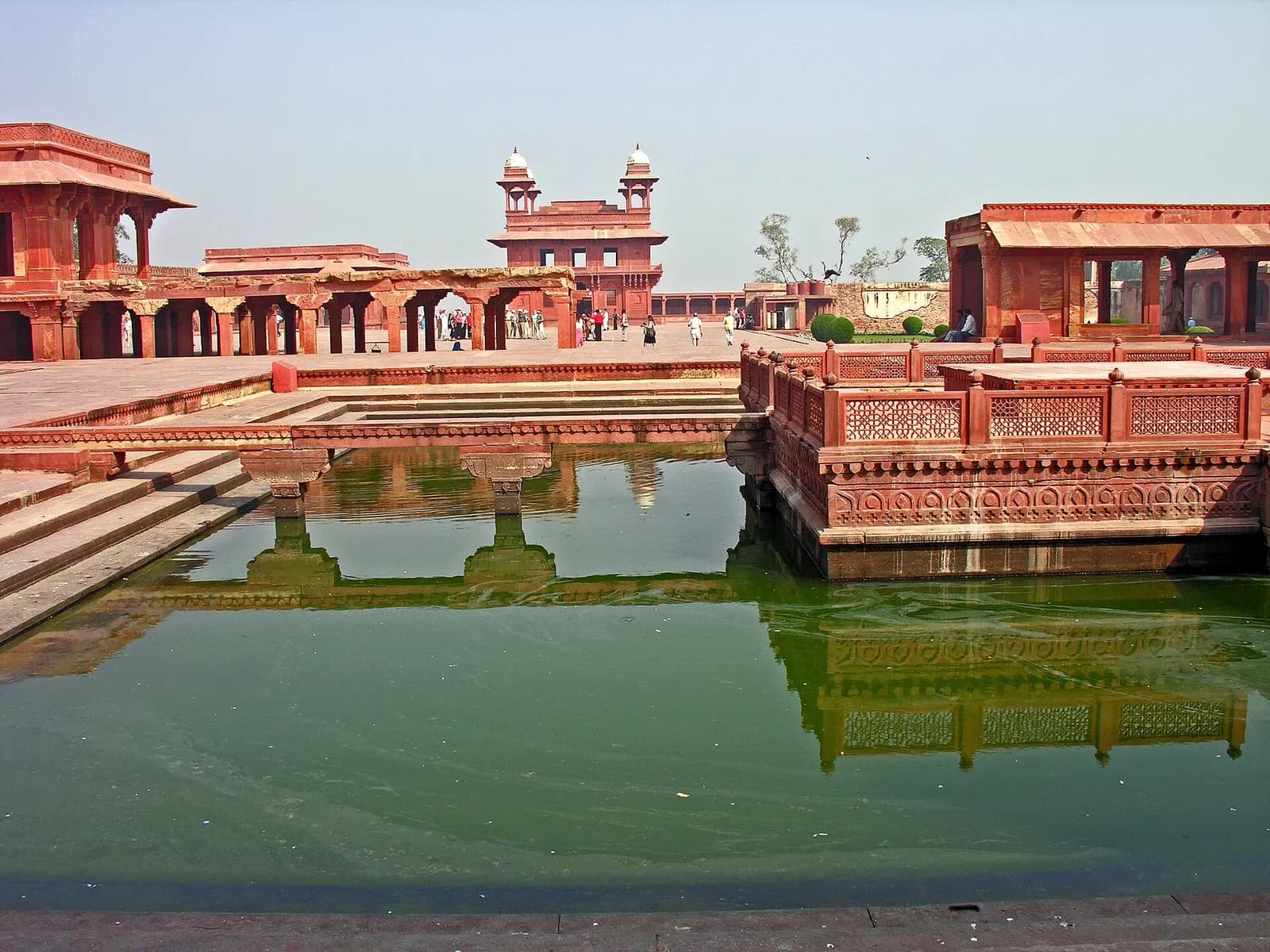
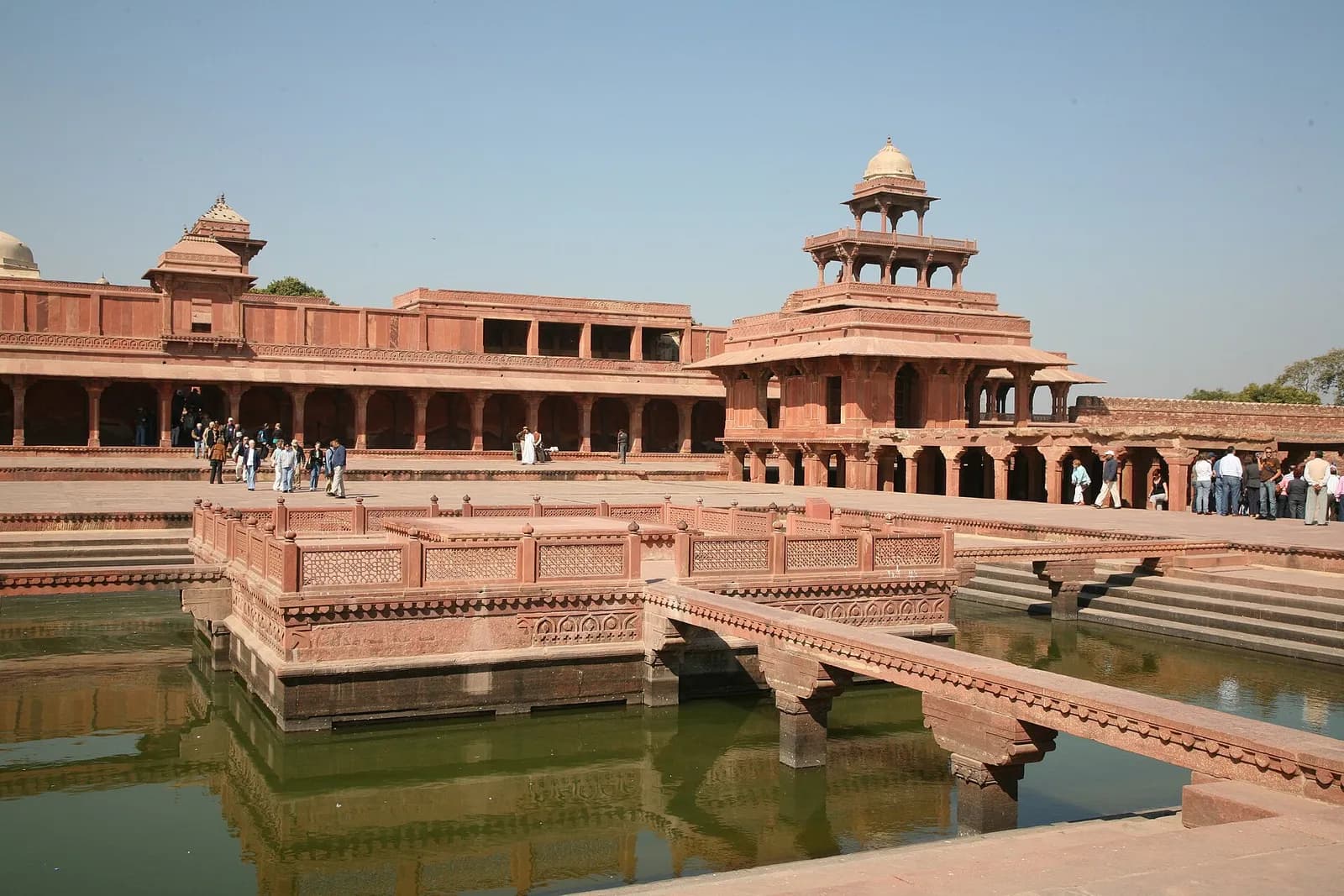
The Anup Talao is an ornamental, square red sandstone pool and pavilion located inside the imperial palace complex, the Mahal-i-Khass, of Fatehpur Sikri, in Uttar Pradesh. Built by the Mughal Emperor Akbar between 1575 and 1576, it is a square tank with a central carved stone platform at its heart, reached by four intricately carved stone bridges that extend from the middle of each side. It was not built for bathing or for water storage but purely for pleasure and ceremony, an open-air stage for music and poetry set within a shining sheet of still water. For a visitor, it is a small but exquisite feature, easy to pass by, yet one of the most atmospheric spots at Fatehpur Sikri once you know the music, the legends and the clever design behind it.
Several things make it special:
- A music stage on an island. The central platform, reached by four bridges, was a stage for musical performances surrounded by water.
- Remarkable acoustics. The surrounding structures and the water surface carried sound across the courtyard, amplifying the music naturally.
- A link to Tansen. It is tied by tradition to the legendary musician Tansen, one of Akbar's Nine Jewels.
- The legend of the coins. Popular lore says Akbar once filled the pool with gold, silver and copper coins, later given to the poor.
- A cooling device. The pool helped lower the temperature of the adjacent royal chambers during the fierce summers.
History and the names of the Anup Talao
The Anup Talao belongs to the heart of Akbar's private world at Fatehpur Sikri, set within the Mahal-i-Khass, the imperial palace complex and built between 1575 and 1576. Over time it has been known by more than one name. It was historically referred to as the Kapur Talao and also as the Char-Chamad, a name that refers to the four stone bridges that cross it to the central platform, a defining feature of its design. The pool sits among the most intimate buildings of the complex, directly north of the imperial apartments, so it was part of the emperor's personal domain rather than a public space. This setting is important to understanding it: the Anup Talao was a place of refined leisure for Akbar and his inner circle, a stage for the arts set within the private palace and its small scale and exquisite detail reflect that courtly, personal and pleasure-loving purpose. That it has survived, with its platform and its four bridges intact, lets us picture the cultured life of the court more vividly here than almost anywhere else at Fatehpur Sikri.
The music stage and its acoustics
The Anup Talao is best known as a stage for the arts and this is what gives it its magic. It served as an open-air stage for musical performances, poetry and artistic displays, with the musicians and poets performing from the central platform, surrounded on all sides by the still water. What made the setting extraordinary was its acoustics: the surrounding structures and the still surface of the water acted as natural amplifiers, carrying the sound across the courtyard so that music performed on the island platform filled the space around it. In an age before any artificial amplification, this was a sophisticated piece of design, turning architecture and water into an instrument in their own right. By tradition, the pool is associated with the greatest musician of Akbar's court, Tansen, one of the Navratnas or Nine Jewels, who is said to have performed here and it is easy to imagine his music drifting across the water in the evening. Whether or not every story attached to the pool is literally true, it was unquestionably a place where the finest music and poetry of the age were heard and standing beside it today, knowing this, a quiet stone tank becomes one of the most evocative spots in the whole city.
The setting of a performer on an island of stone, surrounded by water and ringed by the walls of the private palace, was itself part of the design. Sound behaves differently over water, carrying clearly and with a certain resonance and the Mughal builders seem to have understood this, placing the stage at the centre of the pool rather than at its edge. The audience, seated around the margins and in the surrounding pavilions, would have heard the music rise and spread across the still surface, an effect no ordinary courtyard could achieve. This marriage of architecture, water and music is one of the most refined ideas at Fatehpur Sikri and it shows how completely the arts were woven into the daily life of Akbar's court. For all the grandeur of the gateways and halls elsewhere in the city, it is this small pool, built for music, that best captures the cultured, pleasure-loving side of the emperor's private world.
The legend of the coins
One of the most famous stories at Fatehpur Sikri belongs to the Anup Talao. Popular lore states that Akbar once filled the pool to the brim with gold, silver and copper coins, a truly dazzling display of imperial wealth and that all these coins were later distributed among the poor and the needy of the city. Whether taken as history or as legend, the tale captures something real about Akbar's reputation, a ruler of immense wealth who was also remembered for his generosity and his concern for his subjects. It is the kind of story that brings a monument to life and it is one of the first things guides tell visitors at the pool. True or embellished, it has attached itself firmly to the Anup Talao and it is part of why this small tank holds such a large place in the lore of Fatehpur Sikri. For a visitor, it adds a glint of imagination to the quiet water: a pool once brimming with coins, emptied into the hands of the poor.
Stories like this one gathered around Akbar during and after his lifetime and it is worth reading them in that spirit. Akbar was a ruler who understood the power of display and of reputation and whether or not he ever literally filled the Anup Talao with coins, the act such a story describes, a show of boundless wealth turned to charity, fits the image he and his chroniclers cultivated. Fatehpur Sikri is full of such tales, of games played with living pieces, of debates between the faiths, of music that could light lamps and part of the pleasure of visiting is deciding for yourself where history ends and legend begins. The Anup Talao, small and quiet, carries more than its share of these stories, which is one reason it rewards a slower, more thoughtful visit than its modest size might suggest.
Architecture and the four bridges
The Anup Talao is a small masterpiece of Mughal design, both ornamental and ingenious:
- A square tank. The pool is a precise square, measuring 29 metres on each side, built of the local red sandstone that gives all of Fatehpur Sikri its warm colour.
- The central platform. At its heart stands a central carved stone platform, the stage on which musicians and poets performed, set like an island in the water.
- The four bridges. Four intricately carved stone bridges extend from the middle of each side to the central platform, the feature that gave the pool its alternative name, Char-Chamad.
- A passive cooling device. The pool functioned as a passive cooling system, the evaporating water lowering the ambient temperature of the adjacent royal chambers during the hot North Indian summer months.
This combination of beauty and practicality is characteristic of Mughal architecture at its best. The pool was at once a stage, an ornament and an air conditioner, cooling the emperor's private apartments while providing a setting for the arts and its four-bridge design is both elegant and symbolic, drawing every eye to the central platform at the heart of the water.
The cooling function is worth dwelling on, because it reflects a sophisticated understanding of how to live comfortably in a harsh climate. As water evaporates from a large surface, it draws heat from the surrounding air, lowering the temperature noticeably in the immediate vicinity and a pool of this size, set right beside the emperor's private apartments, would have made those rooms distinctly cooler on a summer evening. Combined with the shaded verandahs, the thick stone walls and the careful orientation of the buildings, the Anup Talao was one part of a whole system of passive climate control that the Mughals used across their palaces. That the same pool served as a music stage and an ornament as well as a cooling device is typical of the period's architecture, where a single feature was made to do several things at once and nothing was purely decorative or purely practical. It is this layering of beauty, pleasure and function that makes Mughal design so admired and the Anup Talao is a small, complete example of it.
What is around the Anup Talao
The Anup Talao sits among the most private and interesting buildings of Fatehpur Sikri, which is part of what makes it worth lingering over. It lies directly north of the imperial apartments, the Khwabgah, which were the emperor's own sleeping and living quarters, so the music and cooling of the pool served Akbar's most personal rooms. Immediately beside it stands the Hujra-i-Anup Talao, Akbar's private retreat, a small richly decorated chamber and nearby is the Pavilion of the Turkish Sultana, one of the most finely carved little buildings in the whole complex. Together these form a cluster of intimate, exquisite structures at the heart of the private palace, quite different in scale and feeling from the great public courtyards. Seeing the Anup Talao as part of this group, rather than on its own, gives the best sense of the refined, cultured private life of Akbar's court, with music on the water, a cool retreat alongside and some of the finest carving at Fatehpur Sikri all within a few steps.
The Pavilion of the Turkish Sultana, in particular, is worth seeking out while you are here, as its walls are covered in some of the most delicate relief carving anywhere in the complex, with intricate panels said to depict trees, birds and animals, a rare and beautiful survival. The Hujra-i-Anup Talao beside it was a private chamber where the emperor could withdraw and the Khwabgah, the house of dreams, held his sleeping quarters above, with the pool's cooling and music close at hand. Taken as a whole, this little quarter was the most private and refined part of the entire capital, the place where Akbar lived, rested and enjoyed the arts and the Anup Talao was its centrepiece. A visitor who understands this sees not an isolated pool but the heart of the emperor's personal world, which is what makes this corner of Fatehpur Sikri so rewarding to explore slowly.
Ticket price and entry
Access to the Anup Talao is included in the ticket for the Fatehpur Sikri royal palace complex, as it lies within the ticketed part of the site. The palace ticket costs ₹40 per person for Indian, SAARC and BIMSTEC citizens and ₹610 per person for foreign nationals, with children under 15 entering free and it covers the whole palace complex, so the same pass admits you to the Panch Mahal, the Diwan-i-Khas, Jodha Bai's Palace and the other enclosures. One important point specific to the Anup Talao is that walking onto the four stone bridges and the central platform is strictly prohibited, in order to protect the historic sandstone from damage, so the pool and its island are admired from the edge rather than crossed. You can buy the ticket at the counter or online in advance to save queuing. The nearby sacred complex, with the Jama Masjid and the Buland Darwaza, is free and separate from this palace ticket. These prices are current at the time of writing and are revised periodically, so reconfirm the latest rate when you plan your visit and our guide to Fatehpur Sikri covers the full site.
Timings and the best time to visit
The Anup Talao is open from sunrise to sunset, 6 AM to 6 PM, all days of the week, including Fridays, when the Taj Mahal is closed and Fatehpur Sikri makes an excellent alternative for the day. The best season to visit is between October and February, when the weather around Agra and Fatehpur Sikri is cool and comfortable for walking through the open-air complex, which has little shade and becomes very hot in the summer months. Within the day, early morning or late afternoon gives the softest light on the red sandstone and the water and the quietest conditions, before and after the main flow of tour groups. The pool itself takes only 10 to 15 minutes to see, but it is worth pausing to take in the setting, imagine the music and read the carving and to see it together with the surrounding private buildings. All timings are current at the time of writing and can change, so reconfirm before you travel and our notes on the best time to visit Agra cover the seasons across the region.
Rules and visiting tips
A few practical points help you enjoy the pool and help preserve it:
- Do not step onto the bridges. Walking onto the four stone bridges and the central platform is strictly prohibited to protect the historic sandstone, so view the pool and its island from the edge.
- See it with its neighbours. Take in the Anup Talao together with the Khwabgah, the Hujra-i-Anup Talao and the Pavilion of the Turkish Sultana, which stand right beside it.
- Hire a licensed guide. Official guides licensed by the ASI or UP Tourism at the ticket counters are helpful for understanding the layout and the stories of Akbar's court, which bring this small pool to life.
- Carry water and sun protection. The complex is open and largely unshaded, so bring water, a hat and sunscreen outside the cool months.
- Pause and imagine. This is a spot to slow down at, picturing the music on the water, rather than one to hurry past.
What to expect
Expect a small, quiet ornamental pool that means little at a glance and a great deal once you understand it. Physically, the Anup Talao is a modest square tank with a carved platform in the middle and four short bridges leading to it and a visitor who walks past without knowing its story may barely notice it. But pause and it becomes one of the most evocative places at Fatehpur Sikri: the stage where the court's music played, its acoustics carrying the sound across the water, the pool once said to have brimmed with gold and silver coins and the quiet cooling device for the emperor's own private rooms. Because you cannot walk onto the bridges, you view it from the edge, which is the best vantage point anyway for taking in the whole composition of water, bridges and platform. It sits among the finest small buildings of the private palace, so you will see it as part of a rich cluster rather than on its own. It takes only a few minutes, but with a little imagination or a good guide, it is one of the stops at Fatehpur Sikri that stays with you, a place where, with the stories in mind, you can almost hear the music of Akbar's court drifting across the water and down the centuries.
How to reach the Anup Talao
The Anup Talao is within the palace complex at Fatehpur Sikri, which lies 37 km west of Agra, a 1 hour drive and 210 km from Delhi, on the Agra to Jaipur road. The simplest way to visit is a private cab from Agra or a guided tour combining the city's monuments with Fatehpur Sikri, since the site sits on the Jaipur road. As with the rest of the complex, from the main parking area you take an electric golf cart or local shuttle up to the main entrance gate for ₹30 per person, keeping traffic away from the heritage core and from the gate it is a walk through the palace enclosures to the private quarters where the Anup Talao lies. Local buses and taxis also serve Fatehpur Sikri from Agra and the nearest railway station is at Fatehpur Sikri itself. Our guide on how to reach the Taj Mahal and Agra covers arrival into the city, from where the Fatehpur Sikri road begins and our list of places to visit in Fatehpur Sikri covers the wider site.
The Anup Talao in your Fatehpur Sikri and Agra trip
The Anup Talao is one of the stops on the half-day most visitors give to Fatehpur Sikri, seen as part of the ticketed palace complex and best taken in with the surrounding private buildings. The natural plan is to tour the palaces, the Diwan-i-Aam, the Diwan-i-Khas, the Panch Mahal, which faces the pool, Jodha Bai's Palace and the Anup Talao with its neighbours, in the cool of the morning, then cross into the free Jama Masjid courtyard for the Buland Darwaza and the Salim Chishti Dargah. Because Fatehpur Sikri lies on the road to Jaipur, it is easy to include on the way in or out of Agra, which suits a longer Golden Triangle route. For most travellers it pairs with a day in Agra for the Taj Mahal and the Agra Fort, with Fatehpur Sikri on a second day or en route. Those with more time can add the riverside Itimad-ud-Daulah and a sunset at Mehtab Bagh, while our Agra travel guide, our list of things to do in Agra and our notes on Taj Mahal history and facts add the wider Mughal context. Small as it is, the Anup Talao is one of the most memorable corners of Akbar's capital.
Plan your trip with us
If you would like to see the Anup Talao and Fatehpur Sikri with the logistics handled, the drive from Agra, the parking and shuttle, a government-approved guide and your palace ticket, let us help. We can build Fatehpur Sikri into your Agra itinerary as a half-day on the Jaipur road or a dedicated day trip, timed for the cool morning hours when the complex is quiet and the light is best. Our Delhi Agra tours cover the Taj Mahal, the Agra Fort and Fatehpur Sikri and travellers short on time often choose a full Golden Triangle tour through Delhi, Agra and Jaipur, which passes Fatehpur Sikri directly. For a relaxed visit, our Agra overnight tour from Delhi leaves room for the palaces and the shrine, while an early start with our sunrise Taj Mahal tour or a same day Agra tour from Delhi can be extended to include it. To plan a route that takes in the Anup Talao, message Abhay and the team directly on WhatsApp at +91 7302265809 or reach our team online and we will build an Agra and Fatehpur Sikri trip around it.
Related guides
Keep reading before you travel, these pair well with this guide:
Enquire Now
What our travellers say
“Our Golden Triangle honeymoon was flawless. Sunrise at the Taj with a private guide felt like a dream — every detail was handled.”
“As a first-time visitor to India, I felt completely safe and looked after. The driver and guide were superb professionals.”
“Travelling with two kids is hard, but they made it effortless. Great pacing, clean cars and zero surprises on price.”
“Booked the Agra day trip on short notice and it went off without a hitch. The guide's history knowledge made the Taj come alive.”
“Best decision of our India trip. Car was spotless, driver was punctual every single day, and the itinerary never felt rushed.”
“Organised a same-day Agra trip for my parents. Communication before and during the trip was excellent — genuinely stress-free.”
“Sunrise at the Taj Mahal was magical. Our guide spoke great English and answered every question with patience.”
“Three generations travelling together and everyone was comfortable — good vehicle, sensible stops, and no hidden costs.”
“I've used a few tour operators across Asia and this was among the smoothest. Fair pricing and they actually answer the phone.”
“Our custom Rajasthan-Agra combo was planned around our budget without cutting corners on comfort. Highly recommend.”
“Solo female traveller here — I felt safe throughout. The driver was respectful and the whole trip was timed perfectly.”
Ready to Explore
The Magic of Agra?
Experience the Taj Mahal at sunrise, explore the mighty Agra Fort, and discover the hidden gems of India's most beloved heritage city with our expert-guided premium tours.

Agra
Premium Tour Package
Questions
Frequently asked questions
Who built the Anup Talao?
The Anup Talao was built by the Mughal Emperor Akbar, between 1575 and 1576, within the private imperial palace complex of his capital Fatehpur Sikri. It was designed as an ornamental pool and an open-air stage for music and poetry.
What was the Anup Talao used for?
Is the Anup Talao connected to Tansen?
What is the legend of the coins at the Anup Talao?
Why is the Anup Talao also called Char-Chamad?
Can you walk on the bridges of the Anup Talao?
What is the Anup Talao ticket price?
What are the Anup Talao timings?
How big is the Anup Talao?
Where is the Anup Talao located?
Explore more
Plan your Anup Talao trip with us

Interested in Anup Talao Fatehpur Sikri: History, Music and Legends?
Chat with our travel team for a custom quote, or browse every package.
Related Attractions
9Anup Talao Fatehpur Sikri on the map
Open in Google MapsReady to explore Anup Talao Fatehpur Sikri: History, Music and Legends?
Book your private tour today and experience the magic of India's rich heritage.