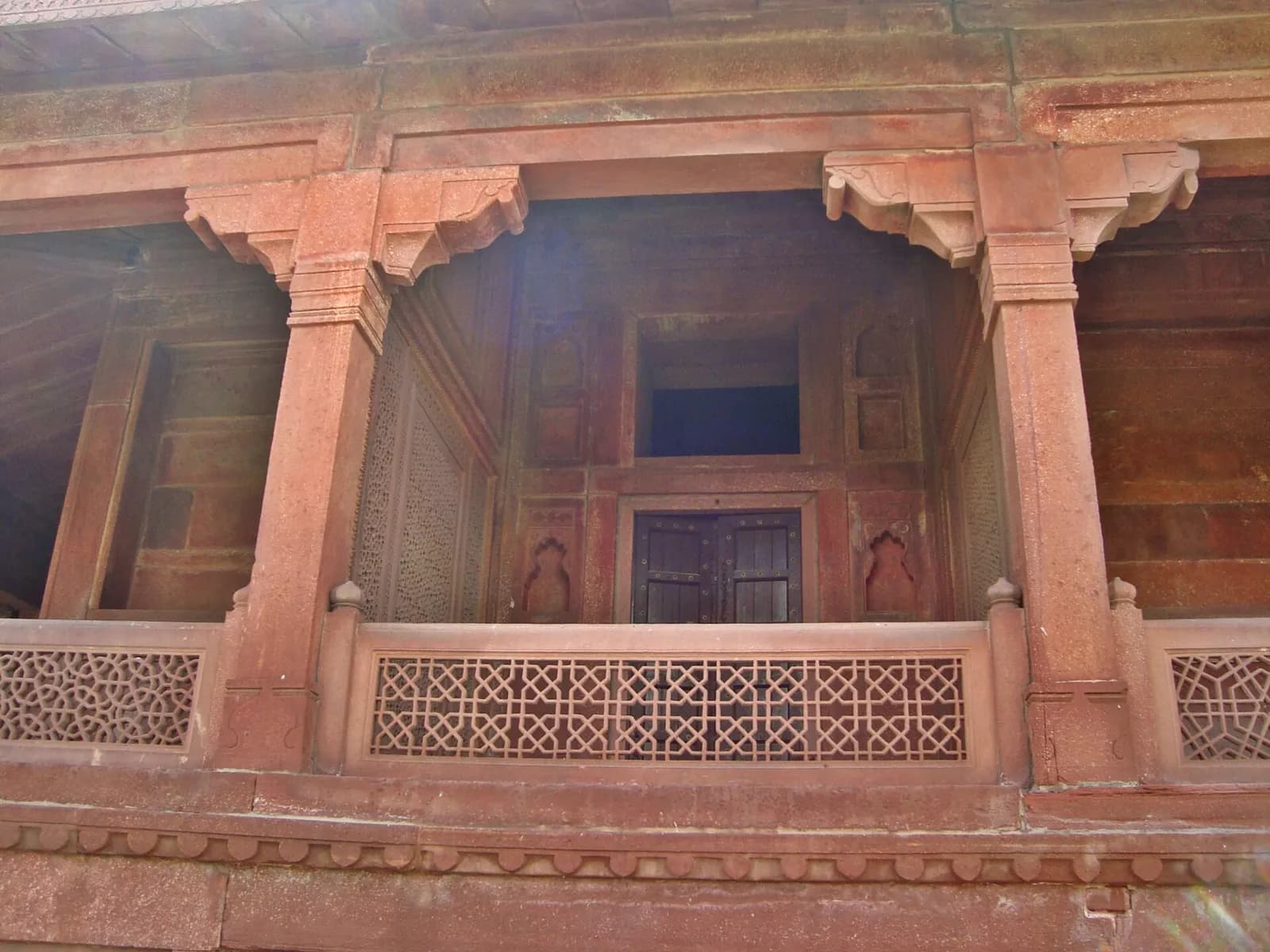
 Fatehpur Sikri, Agra
Diwan-i-Aam Fatehpur Sikri: History and Architecture
The Diwan-i-Aam at Fatehpur Sikri near Agra is Akbar's Hall of Public Audience. Its history, the layout, the timings, the ticket and how to reach it.
Quick answer
The Diwan-i-Aam or Hall of Public Audience, is the grand ceremonial courtyard at the eastern entrance to the royal palace complex at Fatehpur Sikri, near Agra. Built by Akbar in red Sikri sandstone, it is where the emperor sat each morning to hear petitions and dispense justice to the public. A vast colonnaded quadrangle with a raised throne pavilion, it is the first great space most visitors enter. Entry is part of the Fatehpur Sikri palace ticket, from ₹35 and it opens daily from 6 AM to 6 PM. It features on our tours, run by a unit of Experience My India.
- #diwan-i-aam
- #agra
- #agra-attractions
- #agra-travel
The Diwan-i-Aam is the great public forecourt of Akbar's capital, the vast colonnaded courtyard where the emperor met his people and it is the first major space you enter in the palace complex. Here, every morning, Akbar dispensed justice in person and the courtyard also served as a prayer ground and a stage for royal festivities, making it the beating civic heart of Akbar's capital and the one space at Fatehpur Sikri where the whole life of the city, public and ceremonial alike, came together in the open air. Our team at Delhi Agra Tour Packages includes it on visits to Fatehpur Sikri on the Agra to Jaipur road and it is a natural part of a Golden Triangle tour through Delhi, Agra and Jaipur.
I am Abhay Sharma, a Golden Triangle guide since 2015 and I like to begin a tour of the palace complex here, because the Diwan-i-Aam sets the scene for everything that follows: this is where the public world met the private one. This guide covers who built it and why, how Akbar used it for justice and prayer, its architecture and vast layout, its later restoration, the ticket and timings and how to reach it. One note to avoid confusion: this is the Diwan-i-Aam at Fatehpur Sikri, built by Akbar, not the better-known Diwan-i-Aam halls built later by Shah Jahan in the Red Fort at Delhi and in Agra Fort, which are different buildings.
Diwan-i-Aam at a glance
| Detail | Information |
|---|---|
| What it is | The Hall of Public Audience at Fatehpur Sikri |
| Meaning | Hall of Public Audience, where the emperor met the people |
| Built by | Mughal Emperor Akbar |
| Built | In 1573 |
| Material | Red Sikri sandstone |
| Location | Eastern entrance, Fatehpur Sikri palace complex, Agra |
| Entry | Part of the Fatehpur Sikri palace ticket |
| Open | Daily, sunrise to sunset, 6 AM to 6 PM |
Timings
| Detail | Information |
|---|---|
| Opening hours | Daily, sunrise to sunset, 6 AM to 6 PM |
| Fridays | Open, when the Taj Mahal is closed |
| Best hours | Right at 6 AM or after 4 PM |
| Time needed | 20 to 30 minutes for the Diwan-i-Aam |
Entry fee
| Visitor | Online | Cash at counter |
|---|---|---|
| Indian, SAARC and BIMSTEC | ₹35 | ₹50 |
| Foreign visitors | ₹550 | ₹600 to ₹610, including ADA toll |
| Children under 15 | Free | Free |
| Note | The Jama Masjid and Salim Chishti tomb are separate and free |
How to reach
| Detail | Information |
|---|---|
| Location | Fatehpur Sikri, off NH-21, the Agra to Jaipur Highway |
| From Agra | A 1 hour drive |
| Last stretch | Park at Gulab Bari base lot, take the shuttle, ₹10 to ₹30 |
| Full site | Allow 2 to 3 hours for all of Fatehpur Sikri |
What is the Diwan-i-Aam?
The Diwan-i-Aam, whose name means the Hall of Public Audience, is the grand ceremonial and administrative courtyard at the eastern entrance of the royal palace complex in Fatehpur Sikri, Uttar Pradesh. Built by the Mughal Emperor Akbar in 1573 out of local red Sikri sandstone, it served as the primary venue where the emperor dispensed justice, heard public petitions, celebrated festivals and, for a time, led congregational prayers. It is a vast rectangular courtyard enclosed by colonnades, with a raised throne pavilion in its western wall from which the emperor presided and it forms the threshold between the public world outside and Akbar's private quarters within. For a visitor, it is the first great space of the palace complex and an essential one, because it explains how the Mughal state actually met its people, face to face, in the open air. The idea that an emperor should make himself personally available to hear the grievances of ordinary people was central to the Mughal conception of just rule and the Diwan-i-Aam was the stage on which that idea was performed every day. To stand in it is to understand something important about how the empire worked, not only through armies and administration but through this daily, visible ritual of accessible justice.
Several things make it significant:
- The seat of public justice. This is where Akbar personally heard the complaints of ordinary citizens and officials and delivered his judgments.
- A vast open courtyard. The colonnaded quadrangle is one of the largest spaces at Fatehpur Sikri, built to hold crowds.
- The emperor's throne pavilion. A raised chamber in the western wall marked the emperor's seat and connected to the private palace behind.
- Screened for the royal women. Carved jali screens beside the throne let the women of the court watch proceedings unseen.
- The threshold of the palace. It acts as a buffer between the public outside and the private halls of the court to the west.
History and functions
The Diwan-i-Aam was built at the founding of Fatehpur Sikri and served several roles at the centre of Akbar's government and ceremonial life:
- Imperial justice and administration. Emperor Akbar sat in the western pavilion every morning to listen directly to complaints from common citizens and officials, delivering his judgments impartially, in the long Mughal tradition of the ruler as the final and most accessible source of justice for his subjects.
- A prayer ground. Until 1582, the expansive courtyard functioned as a major prayer ground, with the emperor facing east toward the worshippers while the western wall aligned with the qibla, the sacred direction of prayer towards Mecca.
- Royal ceremonies and celebrations. It hosted royal festivities and military victory celebrations and it was the setting for the wedding of Akbar's son in 1584.
- British-era restoration. In the early twentieth century, the Viceroy Lord Curzon commissioned extensive restoration of the courtyard and the Florentine artist Mennegatti was specifically hired to restore the intricate pietra dura inlay work and the decorative plaques around the throne recess.
These functions, judicial, religious and ceremonial, show how a single space could serve the many roles of Mughal kingship. The restoration under Curzon is worth noting too, as it is part of why the throne recess and its inlay survive in good condition today and it reflects the early efforts to preserve India's Mughal heritage.
The detail about the courtyard serving as a prayer ground until 1582 is especially telling, because it marks a turning point in Akbar's own religious thinking. In the early years of the capital the emperor led or attended congregational prayers here, with the whole open space turned towards the direction of Mecca, but around that date Akbar's spiritual path was moving towards the more universal, synthesising outlook that would define his later reign. That a single courtyard could be, in turn, a hall of justice, a mosque-like prayer ground and a stage for imperial weddings and victory celebrations shows how fluid the uses of such a space were and how closely the religious, the judicial and the ceremonial were bound together in Mughal kingship. The wedding of Akbar's son held here in 1584 would have filled the courtyard with colour and music, the great awnings stretched overhead, a very different scene from the sober morning sessions of justice, yet staged in the very same place. Few spaces at Fatehpur Sikri carried so many different meanings.
Architecture and layout
The Diwan-i-Aam is built on a grand scale, designed to impress and to accommodate crowds:
- The colonnaded quadrangle. The massive rectangular courtyard measures 112.38 metres by 55.20 metres, enclosed on all four sides by a raised, continuous red sandstone gallery or dalan, divided into 111 bays.
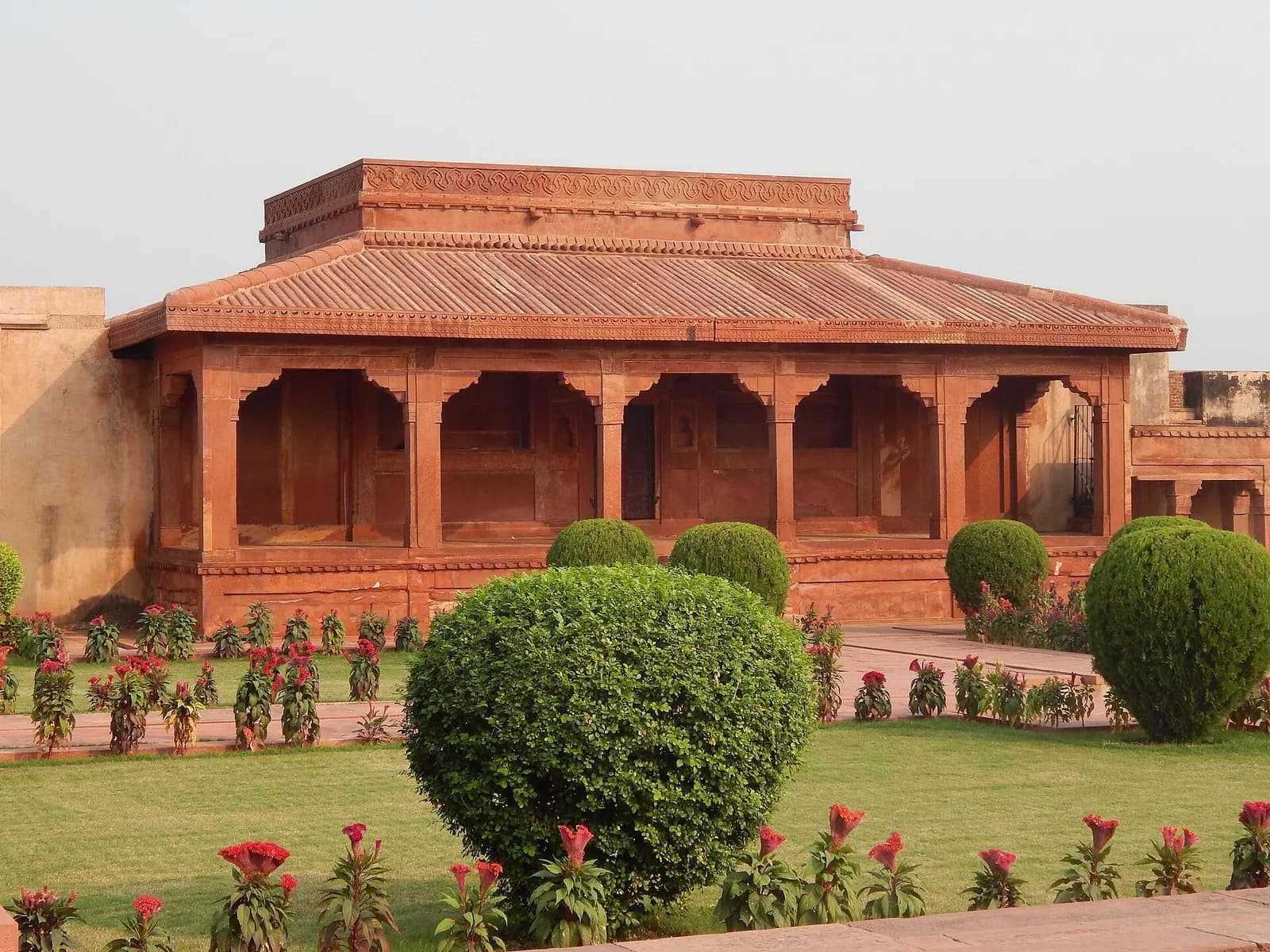
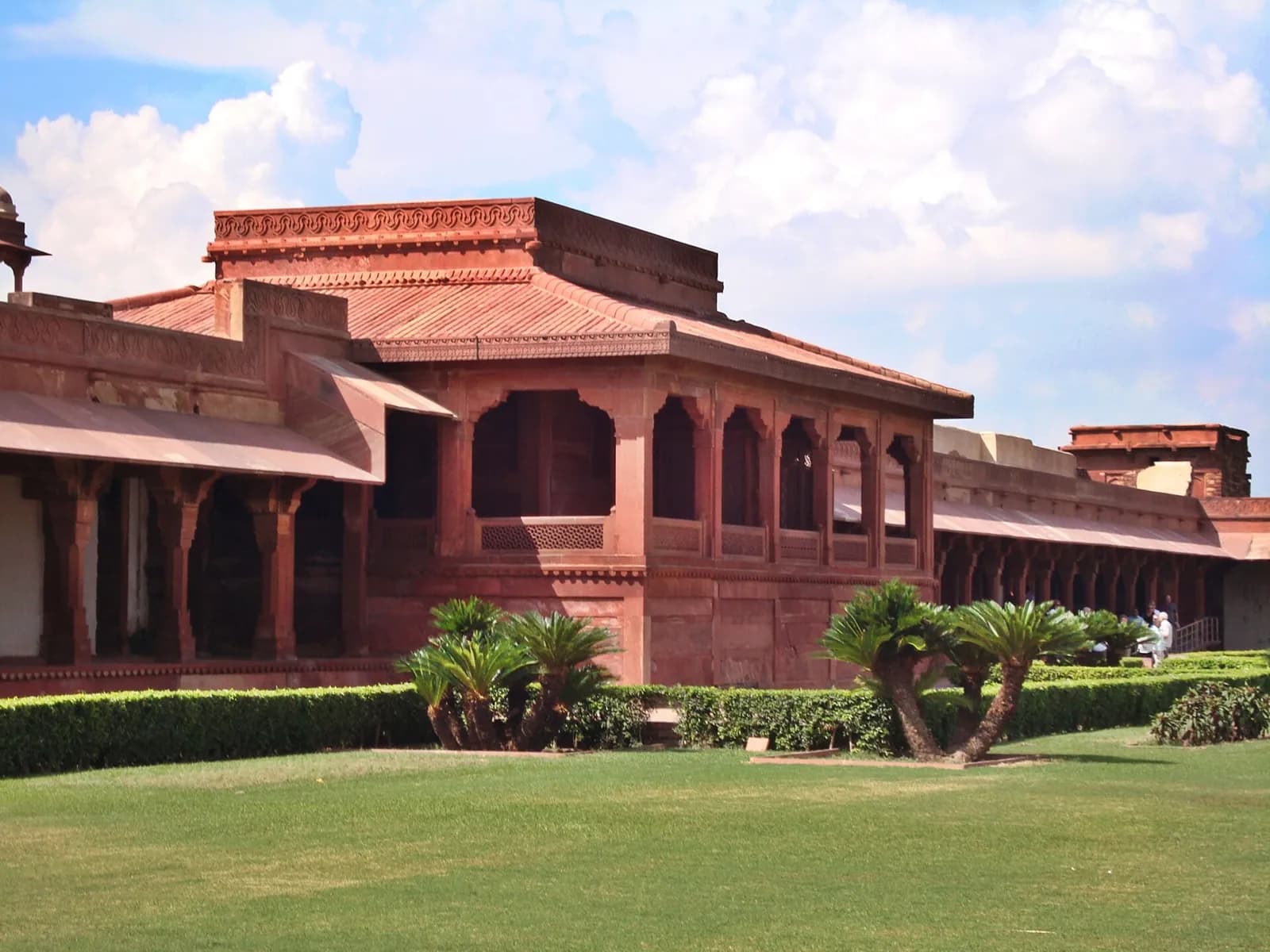
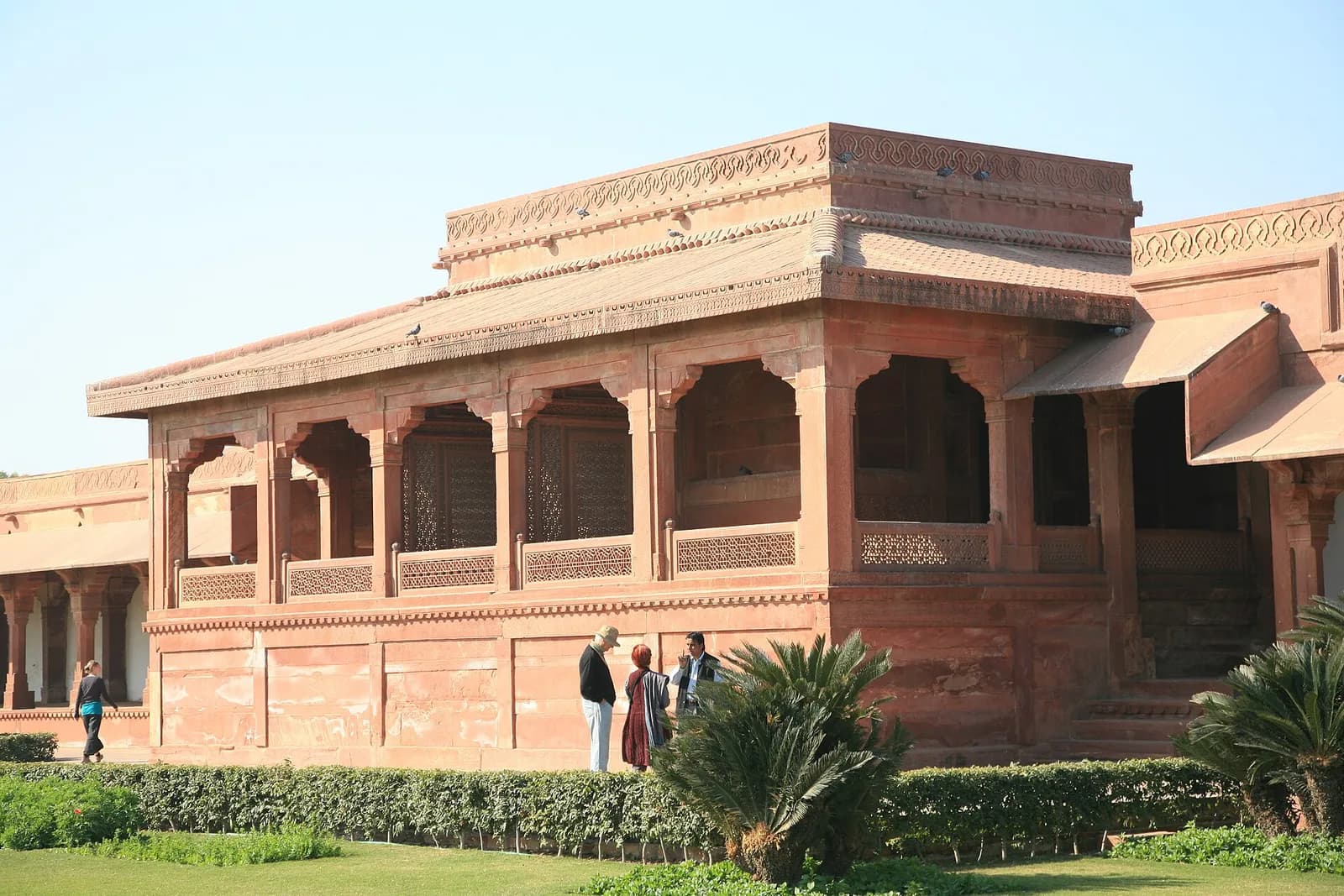
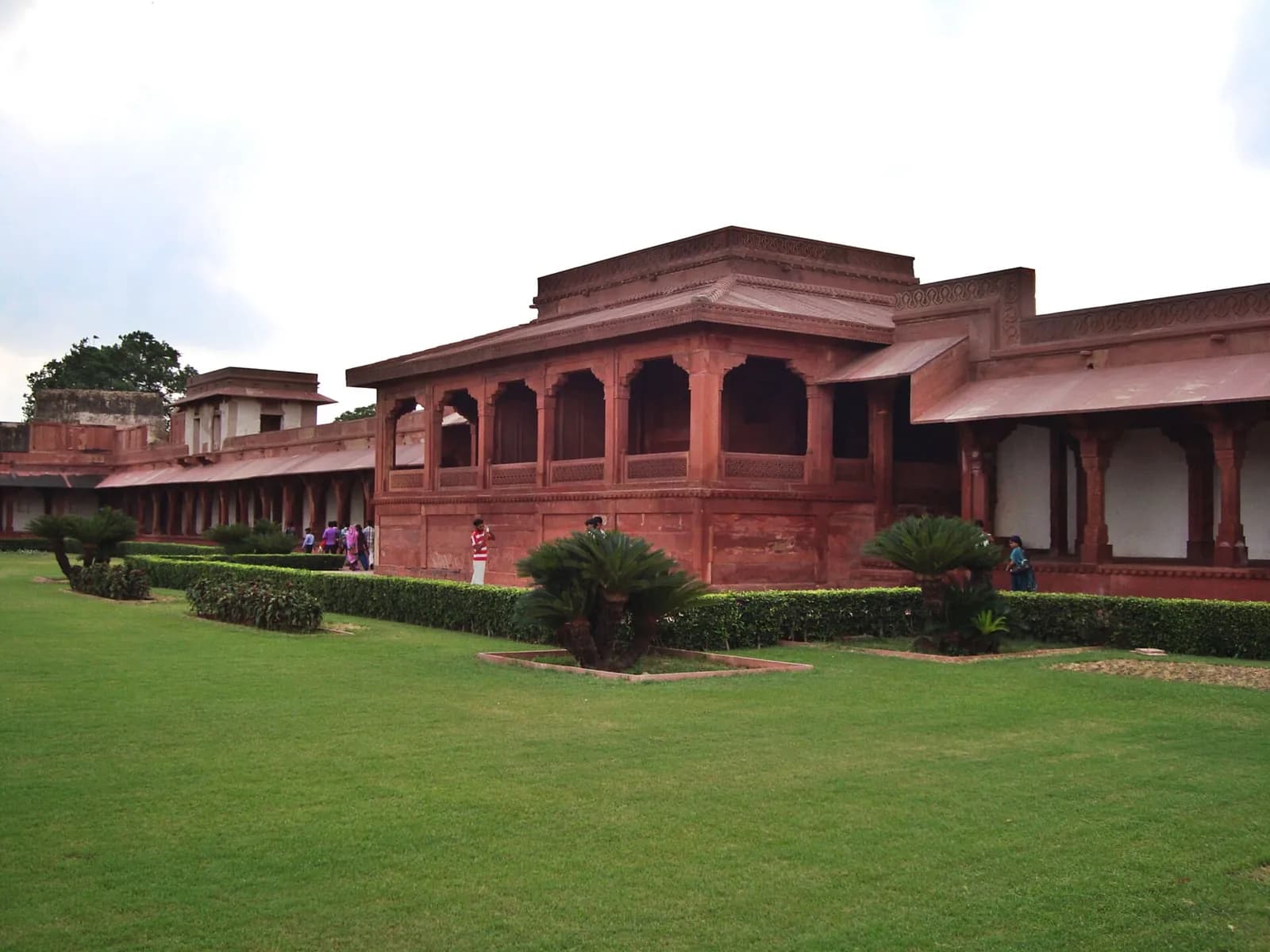
- The emperor's throne pavilion. Breaking the symmetry along the western wall is a raised, projecting royal chamber measuring 9.27 metres by 6.65 metres, with a pitched stone-tile roof, the khaprel, supported on brackets, connecting directly to the private palace complex behind.
- Perforated jali screens. Flanking the central throne seat are finely carved red sandstone jali screens, which allowed the royal women to observe the public court proceedings and ceremonies in complete privacy.
- Stone canopy rings. Large iron and stone rings remain embedded in the courtyard's stone pavement, to which attendants once tied ropes to pitch vast, colourful velvet and silk awnings, the shamianas, that shielded the waiting crowds from the sun.
- Roof walkways. The flat roofs of the surrounding cloisters served as elevated, screened passageways, allowing the women of the imperial harem to walk securely across the complex out of public view.
Together these features make the Diwan-i-Aam not just a courtyard but a carefully designed instrument of government and ceremony, built to stage the daily encounter between the emperor and his people while keeping the private world of the court discreetly screened.
The small human details are what bring the space to life. The iron and stone rings still set into the pavement are easy to walk past, but once you know their purpose, to anchor the ropes of the great velvet and silk awnings, you can picture the courtyard not as the bare stone expanse it is today but as a shaded, colourful hall of cloth, crowded with petitioners waiting in the shade on a hot morning. The screened roof walkways overhead, now empty, once carried the women of the harem silently across the complex, watching the life of the court below without being seen. The jali screens beside the throne, through which those same women could follow the proceedings, are a reminder that even the most public space at Fatehpur Sikri was shadowed by the private world behind it. Reading these clues, a visitor can reconstruct a vanished scene of imperial justice far more vivid than the empty courtyard first suggests, which is exactly why a knowledgeable guide adds so much here.
Diwan-i-Aam and Diwan-i-Khas: the difference
Visitors often want to know the difference between the Diwan-i-Aam and the Diwan-i-Khas, which stand close together at Fatehpur Sikri. The names hold the answer: Diwan-i-Aam means the Hall of Public Audience, the large open courtyard where the emperor appeared before the general public to hear petitions and give justice, while Diwan-i-Khas means the Hall of Private Audience, a small, intimate chamber where he met privately with ministers, envoys and scholars. The Diwan-i-Aam is vast and built for crowds; the Diwan-i-Khas is compact and built around a single carved pillar. The two express the twin faces of Mughal kingship, the emperor as a public figure accessible to his subjects and as the private head of his council. At Fatehpur Sikri the two sit within the same part of the complex, so you move naturally from the great public courtyard into the smaller private hall and seeing them in sequence makes the contrast between the public and private roles of the emperor vivid and clear.
It is worth adding that most of India's great Mughal forts followed this same pairing, each with its own Diwan-i-Aam and Diwan-i-Khas, so the two names recur at the Red Fort in Delhi, at Agra Fort and elsewhere. What makes the Fatehpur Sikri pair special is that they belong to Akbar's original, purpose-built capital rather than being inserted into an older fort and that the Diwan-i-Khas here, with its extraordinary single pillar, is unlike any other. Seeing the public courtyard and the private hall together, as Akbar's architects intended, is therefore a clearer lesson in the idea behind the pairing than you will get at forts where the two halls stand further apart or were built generations apart.
Location in the palace complex
The Diwan-i-Aam sits at the eastern threshold of the royal palace zone, acting as a buffer between the public outside world and Akbar's private quarters immediately to its west, which include the Diwan-i-Khas, the Panch Mahal and the Pachisi Courtyard. This placement was deliberate and tells you how the complex was meant to be entered and understood: a visitor or petitioner arriving from the east would first reach this great public courtyard, go no further than the emperor allowed, while the private world of the court lay screened beyond. For the modern visitor, the same logic makes the Diwan-i-Aam the natural starting point for a tour of the palace, after which you pass westward into the more intimate buildings. Its position at the entrance and its sheer size, make it the space that sets the scale and tone for everything that follows at Fatehpur Sikri.
This progression from public to private is one of the most satisfying things to notice as you walk the complex. The Diwan-i-Aam is grand, open and accessible, the face the empire turned to the world; immediately beyond it the buildings become smaller, more intimate and more exclusive, culminating in the private chambers where only the inner circle could go. The whole palace is laid out as a graded sequence of spaces, each more private than the last and the Diwan-i-Aam is the public threshold of that sequence. Entering here and moving westward, a visitor follows the same path that a petitioner or a courtier would have followed centuries ago and the sense of passing from the public world into the private heart of the court is one of the quiet pleasures of a Fatehpur Sikri visit.
Ticket price and entry
Access to the Diwan-i-Aam is covered under the main Archaeological Survey of India ticket for the Royal Palace Complex, so there is no separate charge for the courtyard. The palace ticket costs ₹35 online or ₹50 in cash at the counter for Indian, SAARC and BIMSTEC citizens and ₹550 online or ₹600 to ₹610 in cash, including the ADA toll, for foreign visitors, while children under 15 enter free. The ticket covers the whole palace complex, so the same pass admits you to the Diwan-i-Khas, the Panch Mahal, Jodha Bai's Palace and the other enclosures. Buying online in advance is both cheaper and quicker, letting you skip the counter queue and the saving is worth having given that the online rate is noticeably lower than the cash price at the gate. Keep your ticket to hand, as it is checked at the entrances to the palace complex and remember that it is a single ticket for the whole ticketed site rather than a charge per building, so there is nothing more to pay once you are inside. Note that the adjacent Jama Masjid and the Tomb of Salim Chishti have separate, free entry and are not part of this palace ticket, so you can visit the sacred complex at no cost whether or not you buy the palace ticket. These prices are current at the time of writing and are revised periodically, so reconfirm the latest rate when you plan your visit and our guide to Fatehpur Sikri covers the full site and its ticketing in detail.
Timings and the best time to visit
The Diwan-i-Aam is open daily from sunrise to sunset, 6 AM to 6 PM, including on Fridays, when the Taj Mahal is closed and Fatehpur Sikri makes an excellent alternative for the day. The best season to visit is October to March, when daytime temperatures of 10 to 25 degrees Celsius make it comfortable to walk across the open sandstone courtyards, which offer very little shade and grow fierce in the summer heat. Within the day, arriving right at 6 AM or coming after 4 PM gives both the soft, golden light that suits the red sandstone and thinner crowds, before and after the main flow of tour groups. The courtyard itself takes 20 to 30 minutes to explore properly, taking in the throne pavilion, the jali screens and the scale of the quadrangle and you should allow 2 to 3 hours for the whole of Fatehpur Sikri. All timings are current at the time of writing and can change, so reconfirm before you travel and our notes on the best time to visit Agra cover the seasons across the region.
Rules and visiting tips
A few practical points help you make the most of the visit:
- Hire an official guide. Signage inside the courtyard is minimal, so hire an official, badge-carrying ASI or UP Tourism guide at the ticket counter near the Diwan-i-Aam, rather than the unlicensed touts near the mosque, to understand what you are seeing.
- Wear comfortable shoes. The complex involves extensive walking over stone slabs and steps, so sturdy, comfortable footwear is essential.
- Prepare for the sun. The central courtyard has very little shade, so carry water, sunglasses and a hat, especially outside the winter months.
- Tripods are restricted. Tripods require special permission and are generally not allowed, though handheld photography is fine.
- Start your tour here. As the entrance courtyard, it is the logical place to begin, before moving west into the private palaces.
What to expect
Expect a vast, open, dignified courtyard rather than a decorated building, a space whose impact comes from its scale and its history rather than from ornament. Standing in the middle of the quadrangle, surrounded by the long colonnades and looking towards the raised throne pavilion in the western wall, it is easy to imagine the crowds that once gathered here and the emperor seated above them dispensing justice. The details reward a closer look: the carved jali screens beside the throne, the iron and stone rings in the pavement that once held the great awnings and the delicately restored pietra dura inlay around the throne recess. Because it is open and largely unshaded, it can be hot and bright in the middle of the day, so an early or late visit in the cool season is far more comfortable and the low light is kinder to the red sandstone. As the first space in the palace complex, it does not take long to see, but it sets the scale for the whole site and is best understood with a guide or a little background. Approached this way, the Diwan-i-Aam is a powerful introduction to how the Mughal state met its people and the right place to begin a visit to Fatehpur Sikri. It asks a little imagination of the visitor, since the courtyard today is stripped of the awnings, the crowds and the ceremony that once filled it, but that imaginative effort is well repaid and it makes the rest of the palace complex far easier to read.
How to reach the Diwan-i-Aam
The Diwan-i-Aam is at the eastern entrance of the Fatehpur Sikri palace complex, which lies off NH-21, the Agra to Jaipur Highway and is easily reachable by taxi or UPSRTC bus from Agra, a 1 hour drive or from Bharatpur. As with the rest of the site, private cars must park at the Gulab Bari or base, parking lot, from where official CNG and electric shuttle buses ferry visitors up to the ticket gate near the Diwan-i-Aam for ₹10 to ₹30, keeping traffic away from the heritage core. Since the ticket counter and the main entrance are right by the Diwan-i-Aam, it is usually the first building you reach. For most travellers a private cab from Agra or a guided tour combining the city's monuments with Fatehpur Sikri is the simplest option. Our guide on how to reach the Taj Mahal and Agra covers arrival into the city, from where the Fatehpur Sikri road begins and our list of places to visit in Fatehpur Sikri covers the wider site.
The Diwan-i-Aam in your Fatehpur Sikri and Agra trip
The Diwan-i-Aam is the starting point of the half-day most visitors give to Fatehpur Sikri and it is usually the very first space you enter in the ticketed palace complex. The natural plan is to begin here at the public courtyard, then move west through the Diwan-i-Khas, the Pachisi Courtyard, the Panch Mahal and Jodha Bai's Palace in the cool of the morning, before crossing into the free Jama Masjid courtyard for the Buland Darwaza and the Salim Chishti Dargah, so that your route follows the logic of the site from public to private to sacred. Because Fatehpur Sikri lies on the road to Jaipur, it is easy to include on the way in or out of Agra rather than as a separate trip, which suits a longer Golden Triangle route. For most travellers it pairs with a day in Agra for the Taj Mahal and the Agra Fort, which has its own, later Diwan-i-Aam built by Shah Jahan, with Fatehpur Sikri on a second day or en route. Those with more time can add the riverside Itimad-ud-Daulah and a sunset at Mehtab Bagh, while our Agra travel guide, our list of things to do in Agra and our notes on Taj Mahal history and facts help you place it in the wider Mughal story. As the gateway to the whole palace, the Diwan-i-Aam is quite simply where every Fatehpur Sikri visit begins.
Plan your trip with us
If you would like to see the Diwan-i-Aam and Fatehpur Sikri with the logistics handled, the drive from Agra, the parking and shuttle, a government-approved guide and your palace ticket, let us help. We can build Fatehpur Sikri into your Agra itinerary as a half-day on the Jaipur road or a dedicated day trip, timed for the cool morning hours when the site is quiet and the light is best. Our Delhi Agra tours cover the Taj Mahal, the Agra Fort and Fatehpur Sikri and travellers short on time often choose a full Golden Triangle tour through Delhi, Agra and Jaipur, which passes Fatehpur Sikri directly. For a relaxed visit, our Agra overnight tour from Delhi leaves room for the palaces and the shrine, while an early start with our sunrise Taj Mahal tour or a same day Agra tour from Delhi can be extended to include it. To plan a route that takes in the Diwan-i-Aam, message Abhay and the team directly on WhatsApp at +91 7302265809 or reach our team online and we will build an Agra and Fatehpur Sikri trip around it.
Related guides
Keep reading before you travel, these pair well with this guide:
Enquire Now
What our travellers say
“Our Golden Triangle honeymoon was flawless. Sunrise at the Taj with a private guide felt like a dream — every detail was handled.”
“As a first-time visitor to India, I felt completely safe and looked after. The driver and guide were superb professionals.”
“Travelling with two kids is hard, but they made it effortless. Great pacing, clean cars and zero surprises on price.”
“Booked the Agra day trip on short notice and it went off without a hitch. The guide's history knowledge made the Taj come alive.”
“Best decision of our India trip. Car was spotless, driver was punctual every single day, and the itinerary never felt rushed.”
“Organised a same-day Agra trip for my parents. Communication before and during the trip was excellent — genuinely stress-free.”
“Sunrise at the Taj Mahal was magical. Our guide spoke great English and answered every question with patience.”
“Three generations travelling together and everyone was comfortable — good vehicle, sensible stops, and no hidden costs.”
“I've used a few tour operators across Asia and this was among the smoothest. Fair pricing and they actually answer the phone.”
“Our custom Rajasthan-Agra combo was planned around our budget without cutting corners on comfort. Highly recommend.”
“Solo female traveller here — I felt safe throughout. The driver was respectful and the whole trip was timed perfectly.”
Ready to Explore
The Magic of Agra?
Experience the Taj Mahal at sunrise, explore the mighty Agra Fort, and discover the hidden gems of India's most beloved heritage city with our expert-guided premium tours.

Agra
Premium Tour Package
Questions
Frequently asked questions
Who built the Diwan-i-Aam at Fatehpur Sikri?
It was built by the Mughal Emperor Akbar, in 1573, as the Hall of Public Audience at his capital Fatehpur Sikri. This is distinct from the later Diwan-i-Aam halls built by Shah Jahan in the Red Fort at Delhi and in Agra Fort.
What was the Diwan-i-Aam used for?
What does Diwan-i-Aam mean?
What is the difference between Diwan-i-Aam and Diwan-i-Khas?
What is the Diwan-i-Aam ticket price?
What are the Diwan-i-Aam timings?
How big is the Diwan-i-Aam courtyard?
Where is the Diwan-i-Aam located?
Was the Diwan-i-Aam restored?
How far is the Diwan-i-Aam from Agra?
Explore more
Plan your Diwan-i-Aam trip with us

Interested in Diwan-i-Aam Fatehpur Sikri: History and Architecture?
Chat with our travel team for a custom quote, or browse every package.
Related Attractions
9Diwan-i-Aam Fatehpur Sikri on the map
Open in Google MapsReady to explore Diwan-i-Aam Fatehpur Sikri: History and Architecture?
Book your private tour today and experience the magic of India's rich heritage.