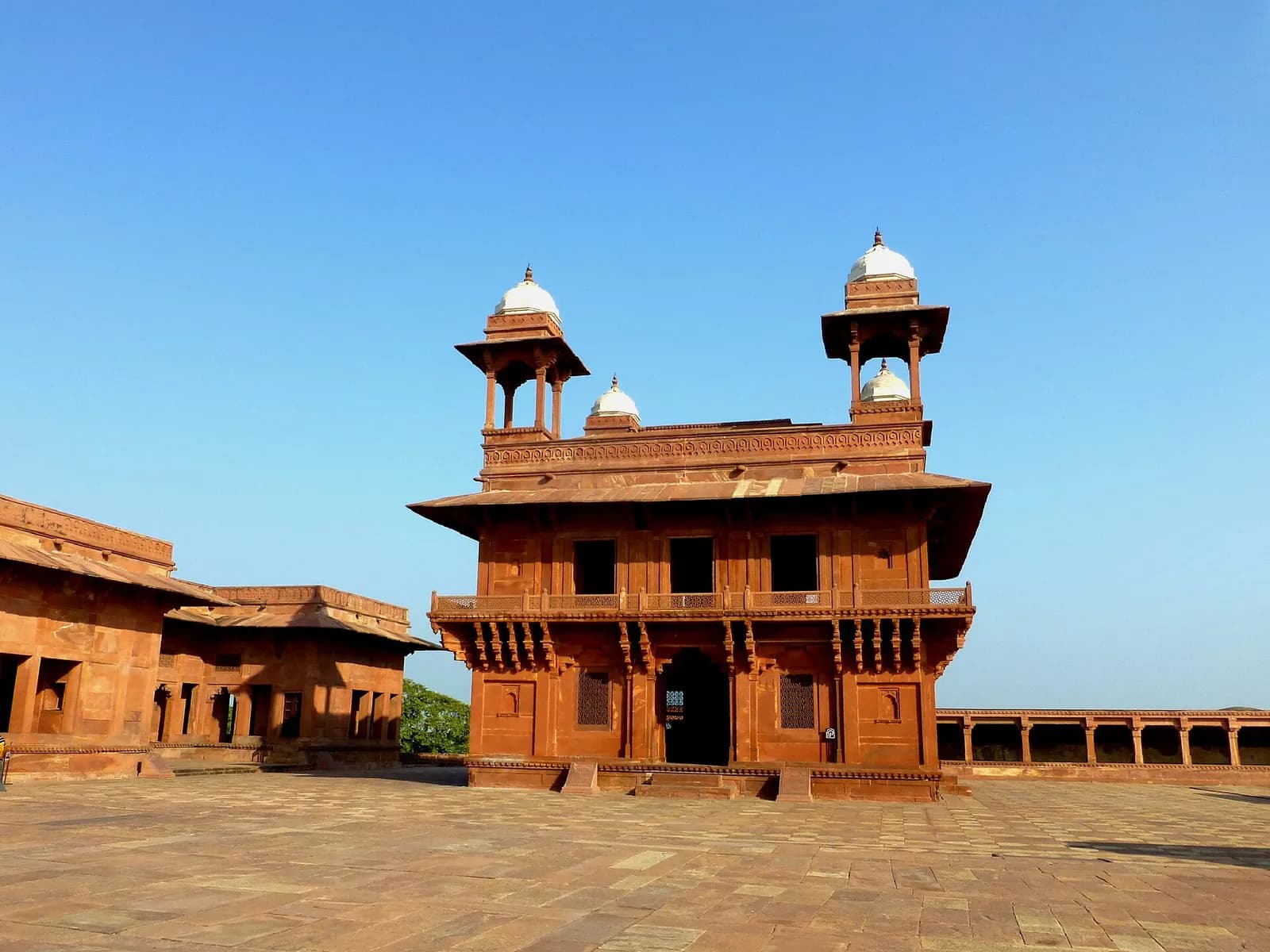
 Fatehpur Sikri, Agra
Diwan-i-Khas Fatehpur Sikri: The Central Pillar and History
The Diwan-i-Khas at Fatehpur Sikri near Agra is Akbar's Hall of Private Audience with a carved central pillar. Its history, architecture, timings and ticket.
Quick answer
The Diwan-i-Khas or Hall of Private Audience, is one of the most famous buildings at Fatehpur Sikri, near Agra. Built by Akbar, this red sandstone pavilion is celebrated for its extraordinary carved central pillar, which flares into a circular stone platform linked to the corners by four diagonal walkways. Here the emperor held private councils and his famous interfaith debates. Entry is part of the Fatehpur Sikri palace ticket, at ₹50 for Indian visitors and ₹610 for foreign nationals. It features on our tours, run by a unit of Experience My India.
- #diwan-i-khas
- #agra
- #agra-attractions
- #agra-travel
The Diwan-i-Khas is one of the most ingenious and talked-about buildings in all of Fatehpur Sikri, a plain-looking pavilion that hides a single astonishing interior: one great carved pillar rising to a throne platform, reached by four stone bridges. It is a building full of meaning as well as beauty, designed to place Akbar literally at the centre of his empire and it was the setting for some of the most remarkable debates in Indian history. Our team at Delhi Agra Tour Packages includes it on visits to Fatehpur Sikri on the Agra to Jaipur road and it is a natural part of a Golden Triangle tour through Delhi, Agra and Jaipur.
I am Abhay Sharma, a Golden Triangle guide since 2015 and the Diwan-i-Khas is one of the buildings I most enjoy explaining, because its clever design only makes sense once you know what it was for. This guide covers who built it and why, the famous central pillar and its symbolism, the interfaith debates held here, the architecture, the ticket and timings and how to reach it. One note to avoid confusion: this is the Diwan-i-Khas at Fatehpur Sikri, Akbar's unique single-pillar hall, not the later Diwan-i-Khas halls of the same name in the Red Fort at Delhi, inside Agra Fort or at Amer Fort near Jaipur, which are different buildings altogether.
Diwan-i-Khas at a glance
| Detail | Information |
|---|---|
| What it is | The Hall of Private Audience at Fatehpur Sikri |
| Famous for | Its carved central pillar and four diagonal walkways |
| Built by | Mughal Emperor Akbar |
| Built | Between 1572 and 1585 |
| Material | Red Sikri sandstone |
| Location | Fatehpur Sikri palace complex, Agra, Uttar Pradesh |
| Entry | Part of the Fatehpur Sikri palace ticket |
| Open | Daily, sunrise to sunset, 6 AM to 6 PM |
Timings
| Detail | Information |
|---|---|
| Opening hours | Daily, sunrise to sunset, 6 AM to 6 PM |
| Fridays | Open, when the Taj Mahal is closed |
| Best hours | Right at 6 AM or after 4 PM |
| Time needed | 15 to 20 minutes inside the hall |
Ticket prices
| Visitor | Weekdays, Saturday to Thursday | Fridays |
|---|---|---|
| Indian citizens | ₹50 | ₹40 |
| SAARC and BIMSTEC nationals | ₹50 | ₹40 |
| Foreign tourists | ₹610 | ₹600 |
| Children under 15 | Free | Free |
How to reach
| Detail | Information |
|---|---|
| Location | Fatehpur Sikri, on NH-21, the Agra to Jaipur Highway |
| From Agra | 37 to 40 km west |
| Last stretch | Park at the base lot, take the shuttle to the gates |
| Full site | Allow 2 to 3 hours for all of Fatehpur Sikri |
What is the Diwan-i-Khas?
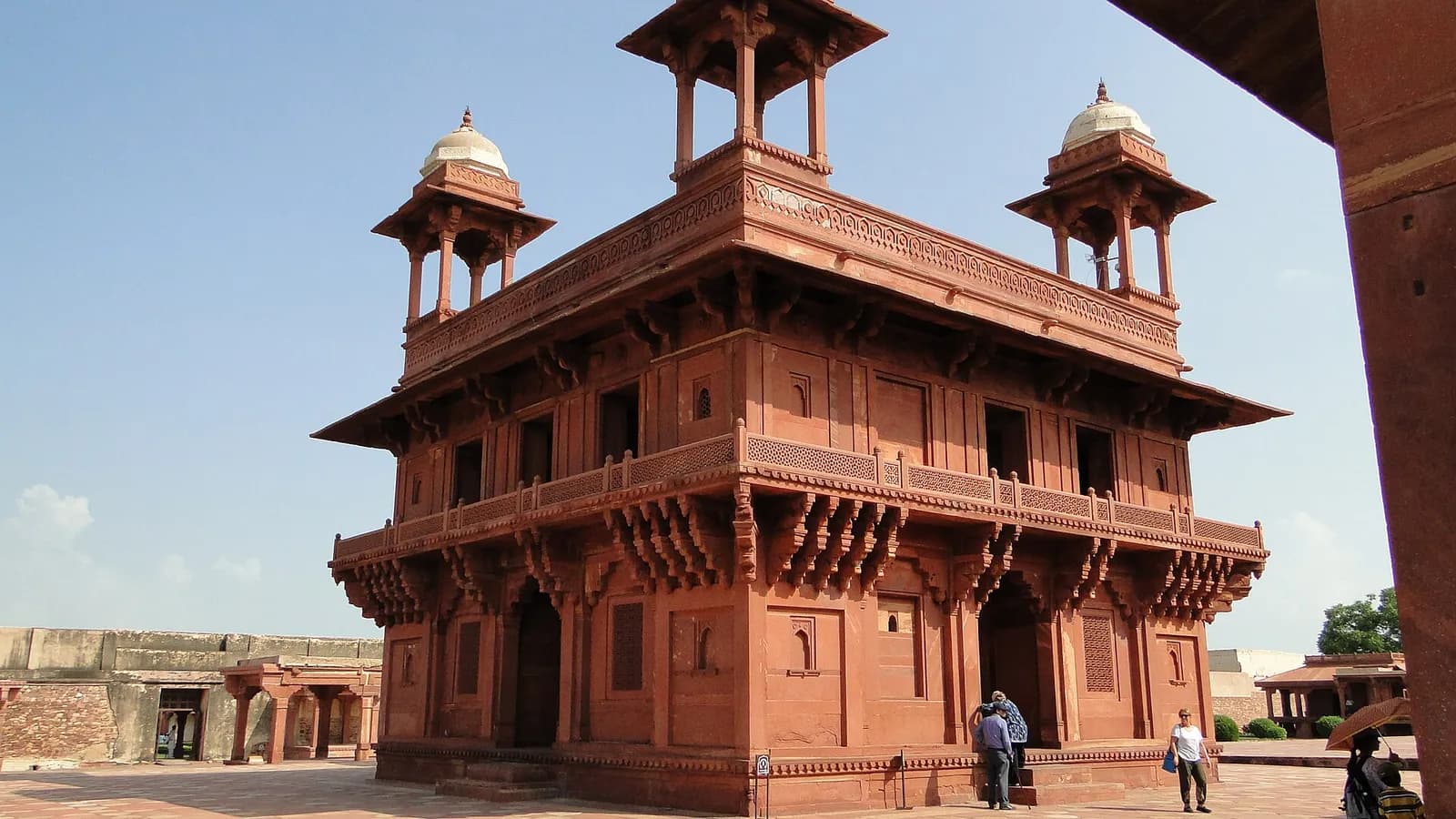
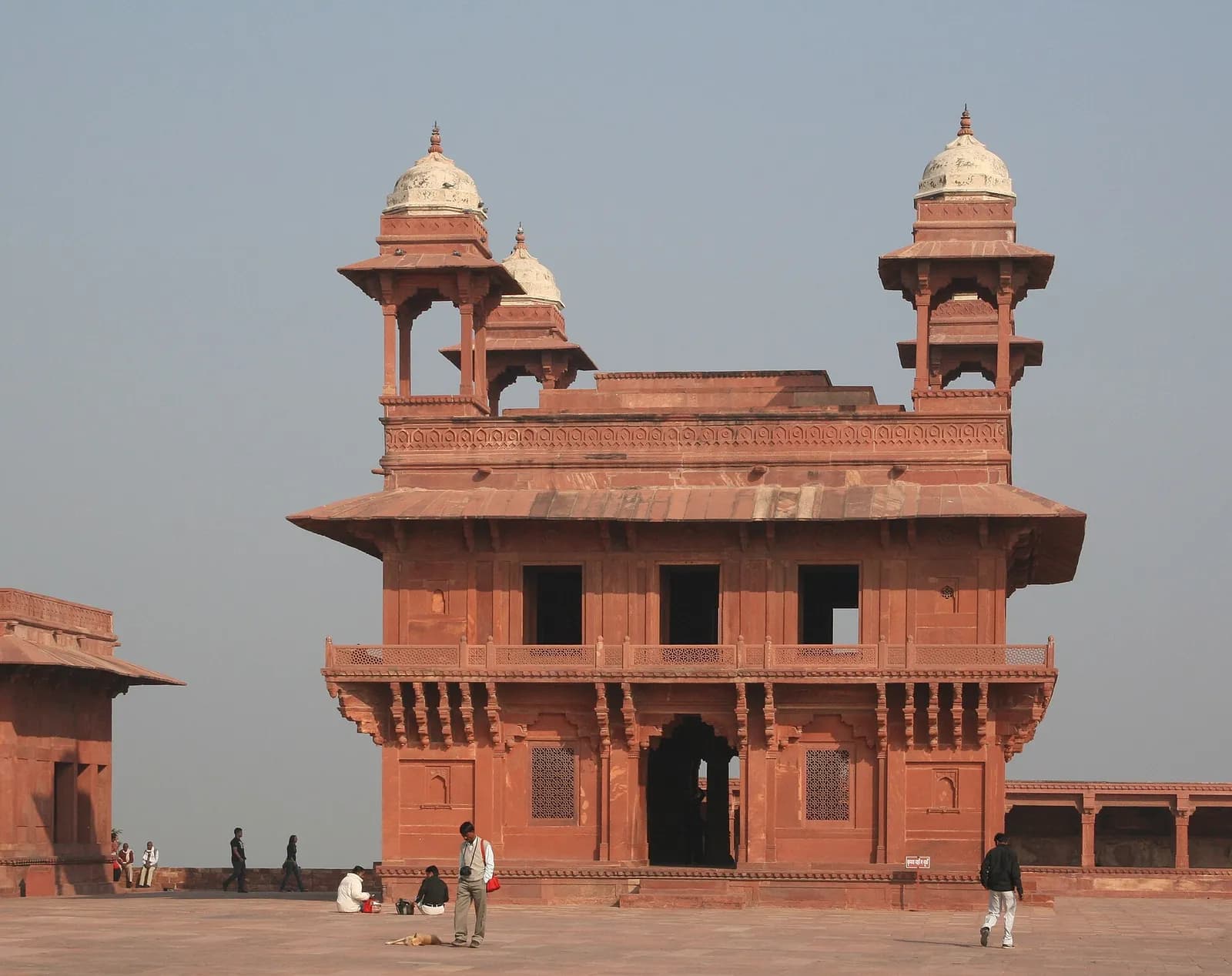
The Diwan-i-Khas, whose name means the Hall of Private Audience, is one of the most iconic structures inside the Fatehpur Sikri UNESCO World Heritage Site in Uttar Pradesh. Built between 1572 and 1585 by the Mughal Emperor Akbar, this red sandstone pavilion is world-famous for its extraordinary central carved pillar and the four suspended stone walkways that radiate from it high above the floor of the hall. Where the Diwan-i-Aam nearby was the hall of public audience, open to the people, the Diwan-i-Khas was its private counterpart, where the emperor met privately and informally with his closest advisors, foreign envoys and scholars. For a visitor, it is a building that surprises: unremarkable from the outside, it reveals indoors one of the most original architectural ideas in Mughal India and understanding it is one of the real pleasures of a Fatehpur Sikri visit.
Several things make it remarkable:
- A single, extraordinary pillar. The whole interior is organised around one great carved column that opens into a circular throne platform.
- Four diagonal walkways. Narrow stone bridges run from the central platform to the four corners, a design found almost nowhere else.
- The setting for Akbar's debates. This intimate chamber hosted his famous discussions among scholars of many religions.
- A statement of power. Seated at the centre with his advisors at the corners, Akbar placed himself at the heart of the empire.
- A deceptive exterior. It looks like a plain two-storey pavilion from outside, hiding its soaring single-chamber interior.
The famous central pillar
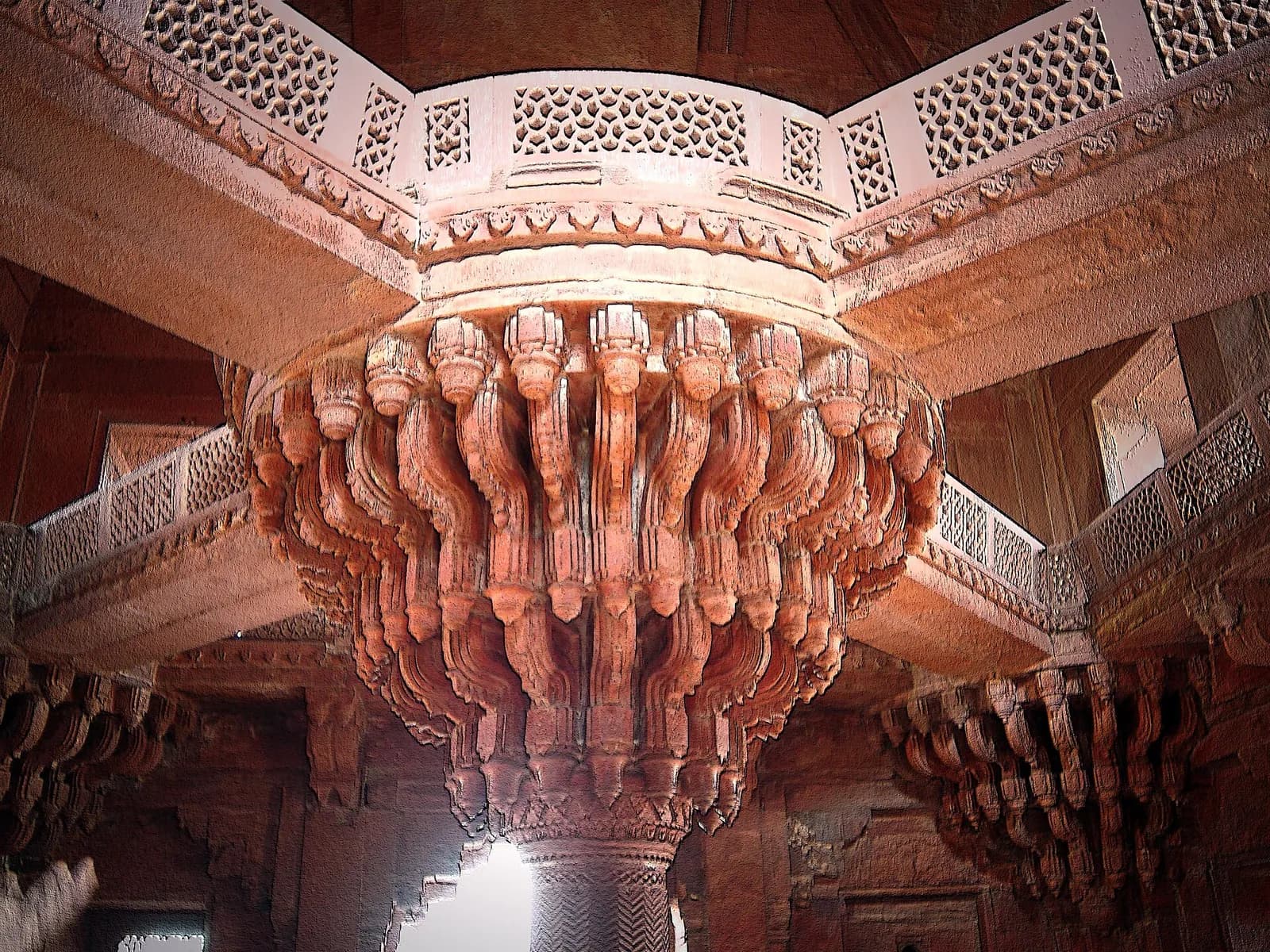
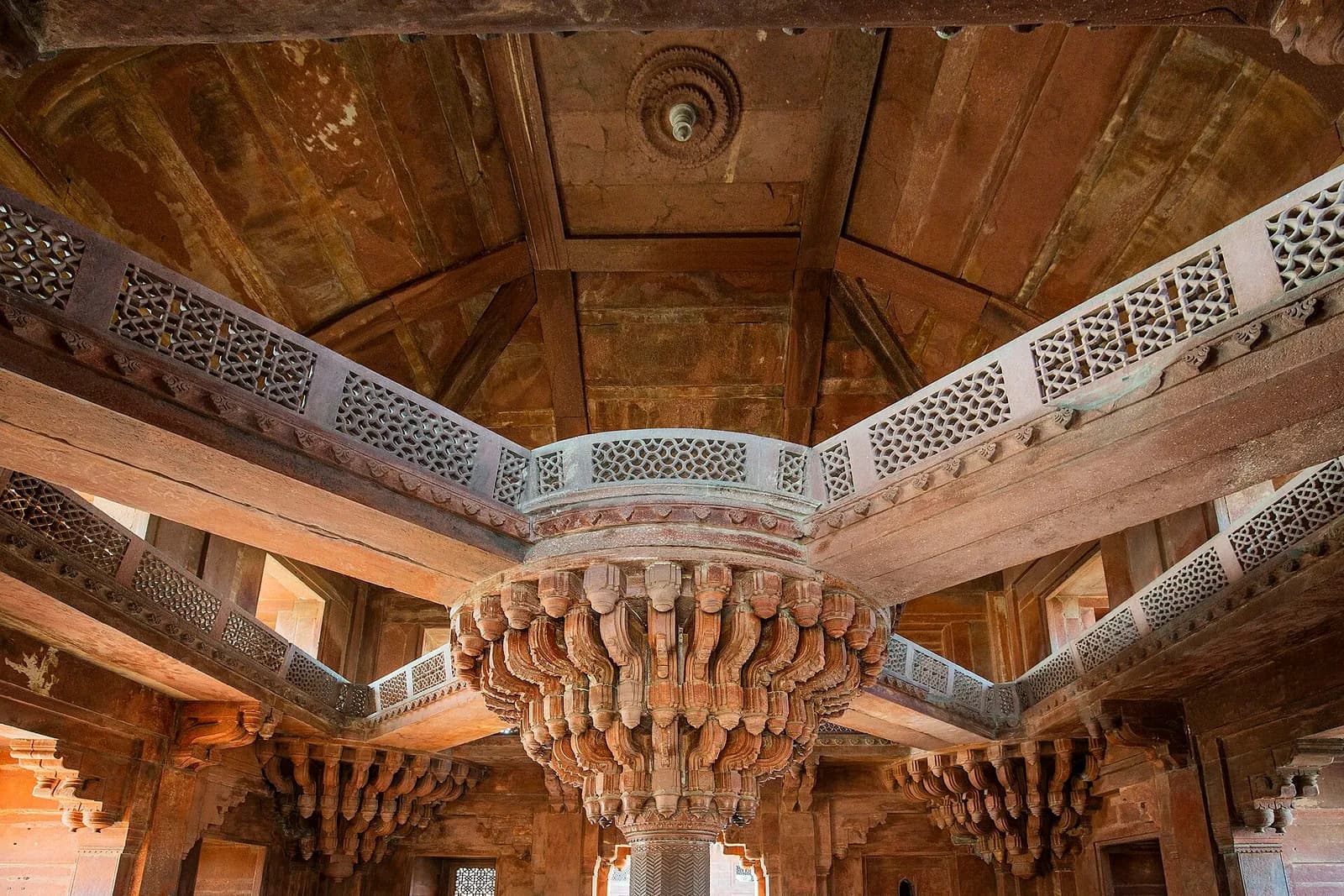
The central pillar is the reason the Diwan-i-Khas is so celebrated and it is unlike anything else at Fatehpur Sikri. At the heart of the chamber stands a massive, richly sculpted polygonal shaft that blends Hindu, Gujarati and Rajasthani temple motifs with Islamic geometry, a single column carrying the whole meaning of the building. At its top, the column flares dramatically outward through 36 intricately carved serpentine or voluted, brackets, which spread like the petals of a vast stone flower to support a circular platform, the throne platform, at the centre of the hall. From this raised platform, four narrow railed stone bridges radiate diagonally outward to balconies set into the four upper corners of the chamber. The design is as symbolic as it is beautiful: by seating himself on the elevated central platform while his advisors stood or sat in the four corners, Akbar visually placed himself at the very centre of his empire and above all factions, with every corner connected to him alone. It is one of the most powerful pieces of architectural symbolism in India, a throne room reduced to its essence and standing beneath it and looking up at the flaring brackets and the bridges overhead is the highlight of any visit to the building.
The carving of the pillar rewards a close look. Reading it from the base upward, you can see how the shaft moves through distinct stages, its lower section squared, then becoming polygonal, then round, each zone decorated with different bands of ornament drawn from several traditions, so that the single column is almost a summary of Indian carving in stone. The great bracket capital at the top, with its 36 curving members spreading outward, is both a structural device, distributing the weight of the platform and a visual flourish that turns the column into something like a blossoming tree or an opened flower. Scholars have long admired it as one of the most original columns in Indian architecture and it has no true parallel even elsewhere at Fatehpur Sikri, where invention was the rule. For the visitor, the pleasure is in seeing how a single functional element, a pillar holding up a platform, has been made to carry so much meaning and so much craft at once. It is the kind of detail that, once understood, you will remember long after the larger buildings have faded.
History and purpose
The Diwan-i-Khas was built in the golden years of Fatehpur Sikri and it served several roles at the heart of Akbar's court:
- Private royal audiences. Akbar used this hall to hold confidential meetings with his senior ministers, foreign ambassadors and visiting scholars, away from the public gaze of the Diwan-i-Aam.
- Interfaith philosophical debates. The intimate chamber is associated with the theological discussions Akbar encouraged among representatives of Hinduism, Islam, Christianity, Jainism and Zoroastrianism, part of his lifelong search for common ground between faiths.
- A symbol of imperial power. By seating himself on the raised central platform with advisors at the four corners, Akbar made the building a physical statement that the emperor stood at the centre of the empire, above all parties.
- The Jewel House theory. Some historical accounts and UNESCO records note that the building was also referred to as the Jewel House, where royal treasures and precious gems may have been inspected or stored.
These overlapping purposes, part council chamber, part debating hall, part statement of power and perhaps part treasury, are what make the Diwan-i-Khas so interesting. Above all, it is bound up with Akbar's remarkable openness to other faiths, which found expression here in debates that were truly extraordinary for their age and which fed directly into his broader personal philosophy of religious tolerance.
Those debates are worth dwelling on, because they are among the most striking things that ever happened in these walls. Akbar, though himself raised a Muslim, was genuinely curious about the beliefs of his subjects and of visitors to his court and he brought together learned men of many religions to discuss and defend their views in his presence. Hindu pandits, Muslim scholars, Jain monks, Zoroastrian priests and Christian missionaries from the Portuguese settlement at Goa all took part at one time or another and out of this long engagement with many faiths grew Akbar's own ideas of a universal tolerance, which shaped his reign and his architecture alike. That such conversations took place at all, in the sixteenth century, is remarkable and that the hall associated with them still stands gives the Diwan-i-Khas a significance far beyond its modest size. When you stand inside it, you are standing in a room where the idea of respect between religions was taken seriously by one of the most powerful rulers of his day.
Architecture and design
Part of the genius of the Diwan-i-Khas is how much it conceals. From the outside, the building appears to be a simple, symmetrical two-storey square pavilion, measuring 13.18 metres per side and built from the locally quarried red Sikri sandstone that gives all of Fatehpur Sikri its warm colour. The two rows of windows and the balanced facade suggest two floors inside. Yet stepping in reveals the trick: there is no separating floor at all, but a single, towering, open-ceiling room rising the full height of the building, with the great pillar at its centre and the walkways crossing the upper space. This sleight of hand, a two-storey exterior around a single soaring chamber, is a deliberate piece of design that makes the interior all the more startling. The flat terraced roof above is crowned at each corner by a pillared domed kiosk or chhatri and ornate stone eaves, the chhajjas, shade the exterior walls in the characteristic manner of Akbar's architecture. Together these features make the Diwan-i-Khas a compact masterpiece, modest in size but endlessly inventive in conception.
The question of how the hall actually worked has long intrigued visitors and scholars alike. If the emperor sat on the central platform and his advisors stood at the four corner balconies, the arrangement would have placed him in a commanding and symbolic position, with the bridges allowing attendants or favoured figures to reach him across the open space. Some historians read the design more as a statement than a practical meeting layout, since a hall built around a single central throne is unlike any ordinary council chamber and this is part of why the building continues to be debated. Whatever the precise use, the effect is clear: everything in the room points inward and upward to that central platform and the architecture leaves no doubt about where authority sat. This blend of the practical and the symbolic, of a working audience hall and a piece of political theatre, is exactly what makes Akbar's architecture at Fatehpur Sikri so endlessly interesting to study.
Diwan-i-Khas and Diwan-i-Aam: the difference
Visitors often ask about the difference between the Diwan-i-Khas and the Diwan-i-Aam, which stand side by side at Fatehpur Sikri. The names tell the story: Diwan-i-Aam means the Hall of Public Audience, where the emperor appeared before the general public to hear petitions and dispense justice, while Diwan-i-Khas means the Hall of Private Audience, reserved for confidential meetings with ministers, envoys and scholars. The Diwan-i-Aam is a large open quadrangle built to hold crowds, whereas the Diwan-i-Khas is a small, intimate chamber built around its single pillar. The two together express the two faces of Mughal kingship, the emperor as a public figure accessible to his people and the emperor as the private head of a council and an empire. At Fatehpur Sikri the two sit directly adjacent, the Diwan-i-Khas at the northern edge of the main administrative courtyard beside the vast Diwan-i-Aam quadrangle, so you see both in a single walk and the contrast between them is easy to appreciate.
Ticket price and entry
Entry to the Diwan-i-Khas is included in the main ticket for the Fatehpur Sikri Royal Palace Complex, managed by the Archaeological Survey of India, so there is no separate charge for the building. The palace ticket costs ₹50 for Indian, SAARC and BIMSTEC citizens on weekdays, reduced to ₹40 on Fridays and ₹610 for other foreign tourists, reduced to ₹600 on Fridays, while children under 15 enter free. The ticket covers the whole palace complex, so the same pass admits you to the Panch Mahal, Jodha Bai's Palace and the other enclosures. You can buy tickets online in advance through the official ASI PayGov portal to skip the queues or at the physical counter near the Diwan-i-Aam entrance. Note that the adjacent sacred complex, with the Jama Masjid and the Buland Darwaza, has free entry and is separate from this palace ticket. These prices are current at the time of writing and are revised periodically, so reconfirm the latest rate when you plan your visit and our guide to Fatehpur Sikri covers the full site and its ticketing.
Timings and the best time to visit
The Diwan-i-Khas is open daily from sunrise to sunset, 6 AM to 6 PM, including on Fridays, when the Taj Mahal is closed and Fatehpur Sikri makes an excellent alternative for the day. The best season to visit is October to March, when the weather is cool and comfortable for walking the open sandstone courtyards, which offer little shade and grow very hot in summer. Within the day, arriving right at 6 AM or coming after 4 PM gives both softer light for photography, when the red sandstone glows and thinner crowds, before and after the main flow of tour groups. The building itself does not take long to see, 15 to 20 minutes inside the hall is enough to take in the pillar and the walkways, but it is worth pausing to understand what you are looking at. Allow 2 to 3 hours for the whole of Fatehpur Sikri. All timings are current at the time of writing and can change, so reconfirm before you travel and our notes on the best time to visit Agra cover the seasons across the region.
Location and what is nearby
The Diwan-i-Khas stands at the northern edge of the main administrative courtyard of Fatehpur Sikri, directly adjacent to the vast Diwan-i-Aam quadrangle, so the two halls of audience sit together as a pair. The building is surrounded by some of the most interesting structures in the complex, all within a one-minute walk: Ankh Michauli, traditionally identified as the Treasury, the small kiosk known as the Astrologer's Seat, the open Pachisi Courtyard where the emperor is said to have played the game of pachisi with living pieces and the five-storey Panch Mahal. This cluster of buildings around the courtyard makes the northern part of the palace complex especially rewarding and the Diwan-i-Khas is best seen as part of a short circuit that takes them all in. Seeing them together also helps you picture the daily working life of the court, from the public audience and the games court to the private council chamber and the treasury, all gathered around one great courtyard.
This concentration of buildings is one of the reasons the northern courtyard is the most atmospheric part of the whole palace. Standing in the middle of it, you are surrounded on all sides by the key institutions of Akbar's government, within a few steps of one another, which gives a vivid sense of how compact and interconnected the heart of the empire actually was. A guide can bring this to life, pointing out which building served which function and how the court would have moved between them through the day. Even without one, taking a slow turn around the courtyard, pausing at each structure before entering the Diwan-i-Khas, sets the hall in its proper context and makes its role as the private heart of a public place much easier to grasp.
Rules and visiting tips
A few practical points help you make the most of the visit:
- The walkways are not open to visitors. You can admire the central pillar and its brackets from the ground floor, but access to the upper diagonal bridges is restricted to preserve the delicate sandstone carvings, so the throne platform is viewed from below.
- Use only authorized guides. Hire only government-licensed guides wearing official ID badges near the ticket counter and ignore the persistent unlicensed touts outside the complex.
- Wear the right shoes. Wear comfortable walking shoes with good grip, as the sandstone floors can get slippery where they are polished and hot by midday.
- Carry water and sun protection. The courtyards are open and exposed, so bring drinking water and a hat, especially outside the winter months.
- Allow time to understand it. The building is small, but a few minutes spent taking in the symbolism of the pillar and walkways repays the visit many times over.
What to expect
Expect a small building with a big idea. From the courtyard the Diwan-i-Khas looks modest, even plain and some visitors walk past it without realising what is inside, which is exactly why a little knowledge transforms the experience. Step in, look up and the single great pillar with its flaring brackets and the four bridges crossing the upper air is genuinely striking, one of the cleverest interiors in Mughal architecture. Because the upper walkways are closed to protect the carving, you view the throne platform from the ground, which is the best vantage point anyway for taking in the whole design. It does not take long and it sits within a cluster of fascinating buildings around the northern courtyard, so you will see it as part of a short, rich circuit rather than on its own. The courtyards around it are open and hot at midday, so an early or late visit in the cool season is far more comfortable. Approached with an understanding of what it was for, the Diwan-i-Khas is one of the most intellectually satisfying stops at Fatehpur Sikri, a building where architecture, power and philosophy all meet together in a single carved pillar of red sandstone.
How to reach the Diwan-i-Khas
The Diwan-i-Khas is within the palace complex at Fatehpur Sikri, which sits 37 to 40 km west of Agra along NH-21, the Agra to Jaipur Highway, an easy half-day trip from the city. The simplest way to visit is a private cab from Agra or a guided tour combining the city's monuments with Fatehpur Sikri, since the site lies on the Jaipur road. As with the rest of the complex, private vehicles must stop at the base parking lot, where authorized government shuttle buses transport visitors up to the monument gates, keeping traffic away from the heritage core. From the gates it is a short walk through the palace enclosures to the northern courtyard where the Diwan-i-Khas stands. Local buses between Agra's Idgah Bus Stand and Fatehpur Sikri also serve the town and the nearest railway station is at Fatehpur Sikri itself. Our guide on how to reach the Taj Mahal and Agra covers arrival into the city, from where the Fatehpur Sikri road begins and our list of places to visit in Fatehpur Sikri covers the wider site.
The Diwan-i-Khas in your Fatehpur Sikri and Agra trip
The Diwan-i-Khas is a key stop on the half-day most visitors give to Fatehpur Sikri, seen as part of the ticketed palace complex. The natural plan is to tour the palaces, taking in the Diwan-i-Aam, the Diwan-i-Khas, the Pachisi Courtyard, the Panch Mahal and Jodha Bai's Palace in the cool of the morning, then cross into the free Jama Masjid courtyard for the Buland Darwaza and the Salim Chishti Dargah, so you see the whole sweep of Akbar's capital. Because Fatehpur Sikri lies on the road to Jaipur, it is easy to include on the way in or out of Agra rather than as a separate trip, which suits a longer Golden Triangle route. For most travellers it pairs with a day in Agra for the Taj Mahal and the Agra Fort, which has its own, later Diwan-i-Khas, with Fatehpur Sikri on a second day or en route. Those with more time can add the riverside Itimad-ud-Daulah and a sunset at Mehtab Bagh, while our Agra travel guide, our list of things to do in Agra and our notes on Taj Mahal history and facts help you place it in the wider Mughal story. Within Fatehpur Sikri, the Diwan-i-Khas is the building whose meaning most rewards a closer look.
Plan your trip with us
If you would like to see the Diwan-i-Khas and Fatehpur Sikri with the logistics handled, the drive from Agra, the parking and shuttle, a government-approved guide and your palace ticket, let us help. We can build Fatehpur Sikri into your Agra itinerary as a half-day on the Jaipur road or a dedicated day trip, timed for the cool morning hours when the site is quiet and the light is best. Our Delhi Agra tours cover the Taj Mahal, the Agra Fort and Fatehpur Sikri and travellers short on time often choose a full Golden Triangle tour through Delhi, Agra and Jaipur, which passes Fatehpur Sikri directly. For a relaxed visit, our Agra overnight tour from Delhi leaves room for the palaces and the shrine, while an early start with our sunrise Taj Mahal tour or a same day Agra tour from Delhi can be extended to include it. To plan a route that takes in the Diwan-i-Khas, message Abhay and the team directly on WhatsApp at +91 7302265809 or reach our team online and we will build an Agra and Fatehpur Sikri trip around it.
Related guides
Keep reading before you travel, these pair well with this guide:
Enquire Now
What our travellers say
“Our Golden Triangle honeymoon was flawless. Sunrise at the Taj with a private guide felt like a dream — every detail was handled.”
“As a first-time visitor to India, I felt completely safe and looked after. The driver and guide were superb professionals.”
“Travelling with two kids is hard, but they made it effortless. Great pacing, clean cars and zero surprises on price.”
“Booked the Agra day trip on short notice and it went off without a hitch. The guide's history knowledge made the Taj come alive.”
“Best decision of our India trip. Car was spotless, driver was punctual every single day, and the itinerary never felt rushed.”
“Organised a same-day Agra trip for my parents. Communication before and during the trip was excellent — genuinely stress-free.”
“Sunrise at the Taj Mahal was magical. Our guide spoke great English and answered every question with patience.”
“Three generations travelling together and everyone was comfortable — good vehicle, sensible stops, and no hidden costs.”
“I've used a few tour operators across Asia and this was among the smoothest. Fair pricing and they actually answer the phone.”
“Our custom Rajasthan-Agra combo was planned around our budget without cutting corners on comfort. Highly recommend.”
“Solo female traveller here — I felt safe throughout. The driver was respectful and the whole trip was timed perfectly.”
Ready to Explore
The Magic of Agra?
Experience the Taj Mahal at sunrise, explore the mighty Agra Fort, and discover the hidden gems of India's most beloved heritage city with our expert-guided premium tours.

Agra
Premium Tour Package
Questions
Frequently asked questions
Who built the Diwan-i-Khas at Fatehpur Sikri?
It was built by the Mughal Emperor Akbar, between 1572 and 1585, as the Hall of Private Audience at his capital Fatehpur Sikri. It is famous for its single carved central pillar and the four diagonal walkways that lead to the corners of the chamber.
What was the Diwan-i-Khas used for?
What does Diwan-i-Khas mean?
What is special about the central pillar of the Diwan-i-Khas?
What is the difference between Diwan-i-Khas and Diwan-i-Aam?
What is the Diwan-i-Khas ticket price?
What are the Diwan-i-Khas timings?
Can you go up to the walkways inside the Diwan-i-Khas?
Where is the Diwan-i-Khas located?
Is the Diwan-i-Khas the same as the one in the Red Fort?
Explore more
Plan your Diwan-i-Khas trip with us

Interested in Diwan-i-Khas Fatehpur Sikri: The Central Pillar and History?
Chat with our travel team for a custom quote, or browse every package.
Related Attractions
9Diwan-i-Khas Fatehpur Sikri on the map
Open in Google MapsReady to explore Diwan-i-Khas Fatehpur Sikri: The Central Pillar and History?
Book your private tour today and experience the magic of India's rich heritage.