 Gwalior Road, south Agra, Agra
Firoz Khan Khwajasara Tomb Agra: Visitor Guide
Visiting the Tomb of Firoz Khan Khwajasara in South Agra, the red sandstone Mughal mausoleum with no marble? Its history, timings and how to reach.
Quick answer
The Tomb of Firoz Khan Khwajasara is a 17th-century Mughal mausoleum in South Agra, built in 1647 entirely of red and grey sandstone. It is unusual for having no white marble, no Quranic calligraphy and a two-storey gateway attached directly to the tomb. An ASI-protected monument off the tourist circuit, entry is free and it features on our Agra tours, run by a unit of Experience My India.
- #firoz-khan-tomb
- #agra
- #agra-attractions
- #agra-travel
The Tomb of Firoz Khan Khwajasara is one of Agra's true hidden gems, a striking red sandstone mausoleum built by a powerful Mughal courtier for himself, standing almost forgotten by a historic water tank in the south of the city. For lovers of Mughal architecture and quiet, crowd-free history, it is a remarkable find. Our team at Delhi Agra Tour Packages includes it for travellers who want to go well beyond the famous monuments and it adds an offbeat layer to a Golden Triangle tour through Delhi, Agra and Jaipur.
I am Abhay Sharma, a Golden Triangle guide since 2015 and this tomb is the kind of place I love to show curious travellers. It gives you a rare marble-free Mughal mausoleum, an unusual attached gateway, intricate stone carvings of flowers, lotuses and swans with not a word of calligraphy and the story of a eunuch nobleman who ran Shah Jahan's imperial household. This guide covers everything you need, the history, the striking architecture, the free entry and timings and how to reach it. Note that this is the Agra tomb of Firoz Khan Khwajasara, not the Delhi tomb of Firoz Shah Tughlaq.
Firoz Khan's Tomb at a glance
| Detail | Information |
|---|---|
| What it is | A 17th-century red sandstone Mughal mausoleum |
| Built | In 1647, by Firoz Khan for himself |
| Known for | No white marble, no calligraphy, attached gateway |
| Location | Tal Firoz Khan, Madhu Nagar, South Agra |
| Open | Sunrise to sunset, 6 AM to 6 PM |
| Entry | Free |
| Protected by | Archaeological Survey of India |
| Time needed | 30 to 45 minutes |
Timings
| Detail | Information |
|---|---|
| Opening hours | Sunrise to sunset, 6 AM to 6 PM |
| Ticket counter | None |
| Crypt access | Lower crypt usually locked or restricted |
| Time needed | 30 to 45 minutes |
Like other minor ASI-protected monuments in Agra, the tomb generally follows sunrise-to-sunset hours, 6 AM to 6 PM and it has no ticket counter. Because it sits off the main tourist circuit and receives very few visitors, the lower crypt containing the actual grave is generally kept locked or restricted and the main gate can occasionally be closed if the local caretaker is away. Plan on 30 to 45 minutes for the upper terrace and the carvings. These timings are current at the time of writing and depend on the caretaker, so a mid-morning visit is the safest.
Entry fee
| Visitor | Entry fee |
|---|---|
| Indian citizens | Free |
| Foreign tourists | Free |
| Ticket counter | None on-site |
Entry to the Tomb of Firoz Khan is typically free, as the monument has no ticket counter. It is an ASI-protected Monument of National Importance, but being off the tourist circuit it is not actively ticketed or staffed like the major sites. There are no official guides, ticket offices or facilities on-site, so come self-sufficient with your own water and anything else you may need. This information is current at the time of writing.
How to reach Firoz Khan's Tomb
| Detail | Information |
|---|---|
| Location | Conservancy Road, Madhu Nagar, South Agra |
| Beside | The Tal Firoz Khan water tank, off NH-44 |
| From central Agra | 5 km south |
| Nearest station | Agra Cantt Railway Station, close by |
What is the Tomb of Firoz Khan?
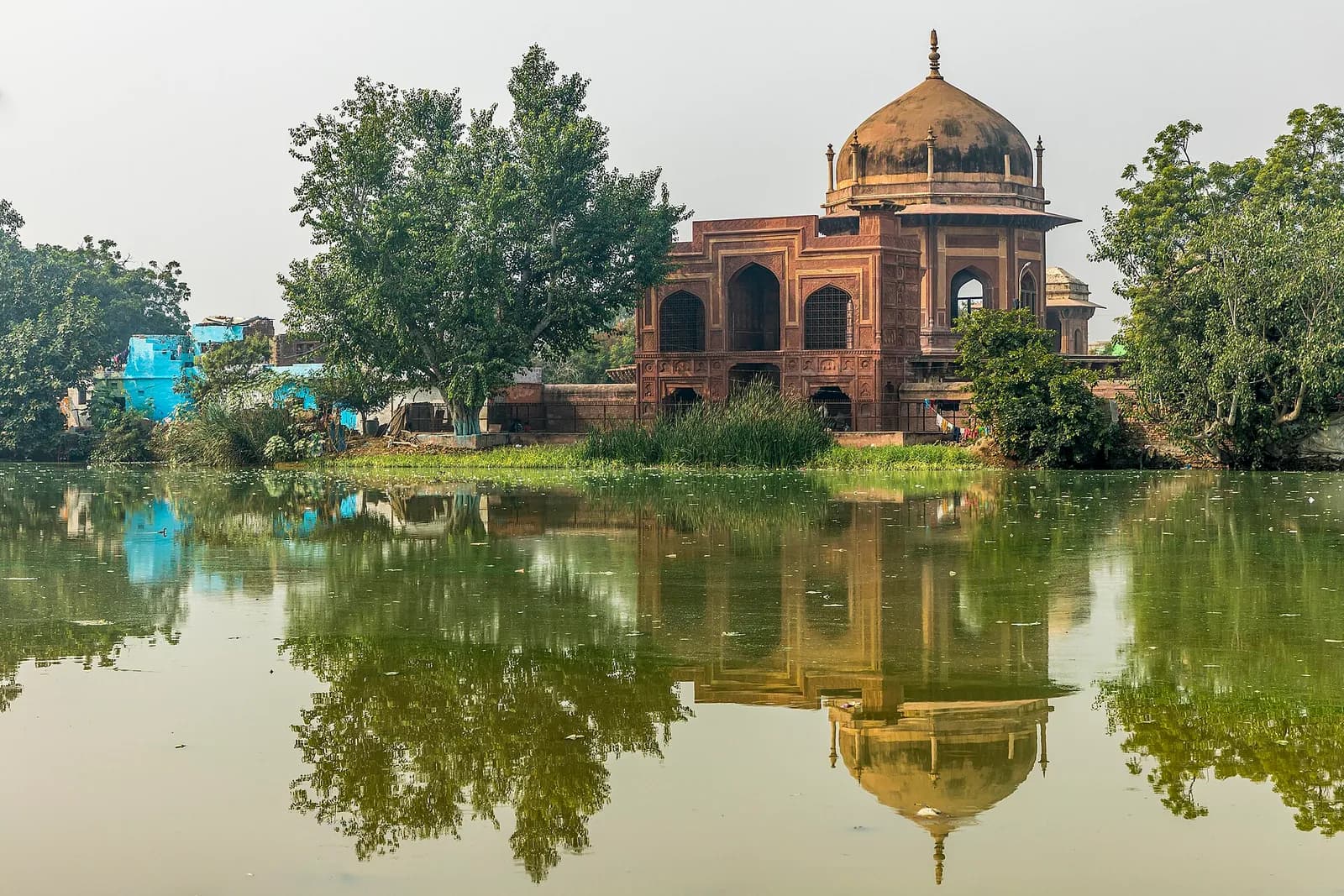
The Tomb of Firoz Khan Khwajasara is a 17th-century Mughal mausoleum located in the Tal Firoz Khan area of South Agra, Uttar Pradesh. Built entirely out of red and grey sandstone in 1647, it stands out in Mughal architecture for its attached two-storey eastern gateway, its complete lack of white marble and its absence of calligraphic inscriptions. It was commissioned by Firoz Khan, a powerful courtier of Shah Jahan, as his own resting place during his lifetime and it survives today as a protected monument far from the tourist crowds, little changed and little visited. For those who make the short trip south, it offers a rare chance to study fine Mughal stonework in peace and to encounter a monument that quietly breaks several of the rules its grander contemporaries followed.
Several things make it special:
- No white marble. Unlike the Taj Mahal and its peers, the tomb uses only red and grey sandstone, giving it a very different, earthier character.
- No calligraphy. Stone carving is the only ornament, with a complete absence of the Quranic inscriptions usual on Mughal tombs.
- An attached gateway. Its two-storey entrance gateway is joined directly to the tomb, rather than standing separate as at most mausoleums.
- A courtier's self-built tomb. It was built by Firoz Khan for himself, following the Mughal custom of preparing one's own resting place.
- A true hidden gem. ASI-protected but off the circuit, it is almost crowd-free and free to enter, a rare chance to have a Mughal monument to yourself.
Who was Firoz Khan Khwajasara?
The man behind the tomb is as interesting as the building and his story opens a window onto the inner workings of the Mughal court.
- A eunuch nobleman. Firoz Khan Khwajasara was a prominent eunuch nobleman, military commander and courtier who served under the Emperors Jahangir and Shah Jahan.
- Caretaker of the imperial harem. As a Khwajasara, he served as the chief administrative officer and caretaker of Shah Jahan's imperial harem, the Raniwas or serai, managing its accounts, supplies and staff duties.
- Honoured with a high title. For his service he was also honoured with the title of Diwan-i-Kul, a mark of his standing at court.
- A self-built resting place. Following the Mughal tradition of preparing one's own resting place, Firoz Khan commissioned and built the mausoleum during his lifetime and was buried here after his death in October 1647.
This background matters because it explains both the tomb and its unusual character. Khwajasaras, the eunuch officials of the Mughal court, held positions of great trust and real power, running the imperial household and its finances and Firoz Khan's rise to the title of Diwan-i-Kul shows how far such a figure could climb. That he could commission a substantial stone mausoleum for himself, in the imperial capital, speaks to his wealth and status. The tomb is therefore not just a fine piece of architecture but a rare physical trace of a class of court officials who are often overlooked in the grand narratives of emperors and queens.
The role of the Khwajasara is worth understanding, because it is unfamiliar to many visitors. In the Mughal court, the imperial harem, the Raniwas, was a vast and strictly guarded household of royal women, children, attendants and servants and it required its own administration, security and supply chain. Eunuch officials were entrusted with running it precisely because they could move between the inner and outer worlds of the palace in a way no other men could and the most capable of them became powerful figures controlling access, finances and information at the heart of the empire. Firoz Khan was one of these and his dual identity as both a trusted household officer and a military commander, honoured with the title Diwan-i-Kul, reflects the breadth of responsibility such men could hold. Seen in that light, his tomb is a monument to a whole world of court life that rarely leaves a visible trace, which gives this quiet building a significance well beyond its size. For visitors interested in the social history of the Mughals, not just their emperors, it is a rare and tangible connection to that hidden world.
Architecture of the tomb
The tomb is an unusual and accomplished piece of Mughal architecture and its details reward close attention:
- Material and palette. Unlike contemporary monuments such as the Taj Mahal, the tomb contains no white marble; it is built exclusively from red sandstone blended with grey stone to create natural colour contrasts.
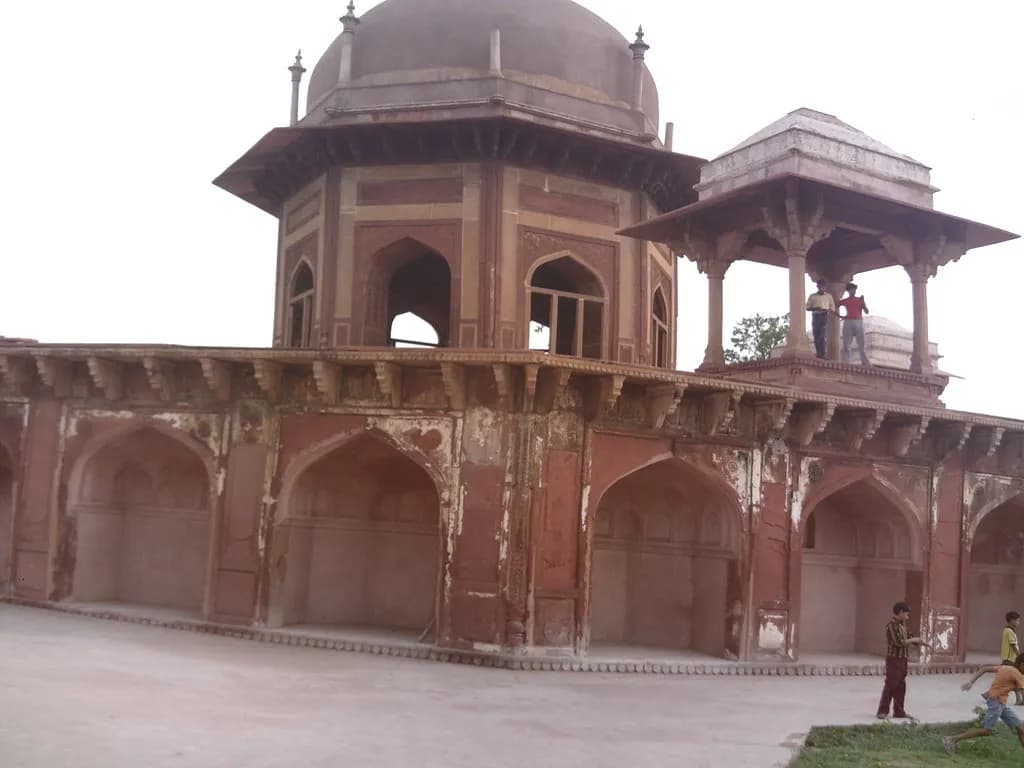
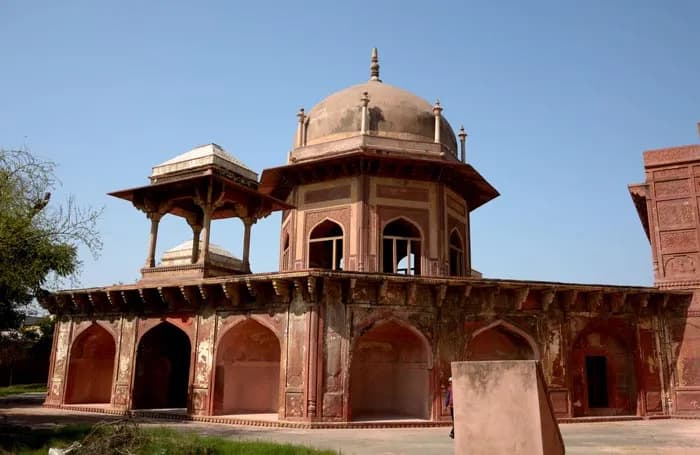
- A two-storey octagonal layout. The tomb sits on an octagonal plan where each side measures 42 feet, with the ground floor serving as a subsidiary crypt, the tahkhanah, that houses the actual grave, while the upper octagonal terrace forms the main storey.
- The attached eastern gateway. Instead of a detached entrance, a massive two-storey gateway is joined directly to the eastern side of the building and a broad staircase of 13 stone steps leads through this portal straight onto the upper terrace, an unusual and memorable way to enter.
- The central cenotaph pavilion. At the centre of the upper terrace stands an octagonal pavilion housing Firoz Khan's cenotaph, with arched openings on all eight sides, seven of them originally fitted with pierced stone jali screens and a hemispherical dome crowned with a kalash finial.
- Chaukhandis and a mosque. The north and south sides of the terrace carry four-pillared rectangular pavilions, the chaukhandis, with pyramidal roofs, while the western side houses a three-arched or trimukhi, mosque. The dome and pavilion roofs were originally covered in vibrant glazed tiles.
- Carvings without calligraphy. Stone carving is the sole ornament, with exterior mural panels of high-relief arabesques, geometric patterns, flower vases or guldastas and rare depictions of lotuses and swans and a total absence of Quranic calligraphy.
The overall effect is quietly impressive, a monument that achieves its beauty through form, proportion and carving rather than through costly marble and inlay. The lotuses and swans in particular are an unusual and delightful touch, hinting at influences beyond the strictly Islamic vocabulary of most Mughal tombs.
It is worth picturing how the tomb would have looked when new. Today the red and grey sandstone is weathered and bare, but originally the dome and the pavilion roofs were covered in vibrant glazed tiles, so the monument would have gleamed with colour against the sky, a very different sight from the austere stone you see now. The jali screens, the pierced stone lattices that once filled seven of the cenotaph pavilion's eight arches, would have cast intricate shadows across the grave, filtering the light in the way Mughal builders loved. Even stripped of its tiles and some of its screens, the building's logic is clear: a raised terrace reached through a grand gateway, a central domed pavilion for the cenotaph, flanking pavilions and a small mosque for prayer, all arranged with the careful symmetry that defines Mughal design. Reading these elements against the tomb's missing tilework and screens is part of the pleasure of a visit, letting you reconstruct in your mind the colourful monument its builder intended.
What makes this tomb unique
Among Agra's many Mughal tombs, Firoz Khan's stands apart for several reasons at once, which is what makes it so interesting to anyone who knows the usual conventions. First, the complete absence of white marble: built in the same era as the Taj Mahal, when marble was the prestige material for a great tomb, this mausoleum uses only red and grey sandstone, a striking and deliberate choice that gives it a warm, earthy presence quite unlike its gleaming contemporaries. Second, the lack of any Quranic calligraphy: where almost every Mughal tomb carries inscribed verses, here the ornament is purely carved stone, arabesques, geometric patterns, flower vases, lotuses and swans, with not a line of script. Third, the attached gateway: rather than the usual free-standing entrance gate set across a garden, the two-storey portal is built directly onto the tomb, an unusual plan that you climb through to reach the terrace. Together these features make the tomb a genuine oddity in the best sense, a monument that rewards anyone who enjoys spotting how and why a building departs from the norm. For students of Mughal architecture, it is a small masterclass in the road not taken.
There is an interesting question as to why a tomb of this date breaks so many conventions and while the records do not spell it out, the clues are suggestive. Built in the same decade as the Taj Mahal, when imperial tombs reached for white marble and inscribed scripture, Firoz Khan's mausoleum instead looks back to the red sandstone tradition of earlier Mughal and pre-Mughal building, the idiom of Akbar's age rather than Shah Jahan's. The decorative choices, carved flowers, vases, lotuses and swans in place of Quranic verse, give it an almost secular ornamental character unusual for a tomb. Whether this reflects the patron's personal taste, his status as a court official rather than royalty, the resources available to him or simply a conservative preference, the effect is a building that feels distinct from everything around it. For the visitor, the pleasure lies precisely in this difference: here is a Mughal tomb that quietly refuses the era's grandest fashions and is all the more memorable for it.
Timings, entry and on-site conditions
The practicalities here are simple but worth knowing, because this is not a managed tourist site. The tomb generally follows sunrise-to-sunset hours, 6 AM to 6 PM, like other minor ASI monuments in Agra and there is no ticket counter, so entry is typically free. Being off the main tourist circuit, it receives very few visitors, which is part of its charm but also means the site is lightly staffed. The lower crypt containing the actual grave is generally kept locked or restricted, so expect to explore the upper terrace and the exterior rather than the grave chamber and be aware that the main gate can occasionally be closed if the local caretaker is away. There are no ticket offices, restrooms, water stalls or official guides on-site, so bring your own water and plan a self-sufficient visit. For the best chance of finding it open, come in the mid-morning rather than at the very start or end of the day. These details are current at the time of writing.
What to expect at the tomb
Expect a quiet, slightly rough-around-the-edges encounter with real, unmanaged heritage rather than a polished attraction. You make your way through the narrow lanes of a local neighbourhood to the tomb beside its historic water tank and you will very likely have the monument to yourself. The reward is the chance to study the red sandstone carvings up close, climb the stairs through the attached gateway onto the terrace and admire the cenotaph pavilion and its jali screens in complete peace. Set your expectations honestly, though: the tomb sits in a built-up part of South Agra and urban encroachment and litter around the adjacent historic water tank affect the immediate surroundings, so it is best to keep your attention on the monument's upper terrace and carvings rather than the setting. There are no facilities and few other people. For the right traveller, someone who values authenticity, architecture and solitude over comfort and polish, it is a genuinely rewarding stop and the absence of crowds makes the fine stonework all the more memorable and easy to photograph at leisure. For those who need amenities and a tidy setting, it may feel too raw, so come knowing which kind of visitor you are.
A short, practical frame helps. Think of a visit here less as a sightseeing stop and more as a small expedition to a piece of living history that the city has half-forgotten. The lanes to reach it are narrow and ordinary, the surroundings are workaday and the monument itself is quiet and sparsely tended, but that is exactly what makes standing alone on its terrace feel like a discovery rather than a queue. Bring water, wear sensible shoes for uneven ground, keep valuables close in the neighbourhood and allow a little patience in case the caretaker needs finding to open the gate. With those modest preparations, the tomb gives back far more than its obscurity suggests, a direct, unmediated encounter with 17th-century Mughal craftsmanship, with no barrier, no crowd and no entry fee between you and the carved stone.
Best time to visit
The best season is October to March, when the cooler weather makes the trip into South Agra and the open terrace comfortable. Within the day, the morning hours between 7 AM and 10 AM are ideal, both for the soft natural light that brings out the intricate red sandstone reliefs for photography and to avoid the midday heat on the shadeless terrace. A mid-morning visit also gives the best chance of finding the caretaker present and the gate open. The summer months are hot and best avoided for a site with no shade or facilities and the monsoon can make the lanes and the tank surroundings messy. For photographers especially, an early, clear winter morning is the time to come, when the low sun rakes across the carvings and the red stone glows. Our wider notes on the best time to visit Agra apply here too.
There is also a sensible way to sequence it within a day. Because the tomb sits in South Agra near the Cantonment and the great monuments are best in the early morning, the neat plan is to see the Taj Mahal or the Agra Fort first, then stop at Firoz Khan's Tomb afterwards on a mid-morning swing through the south of the city, while the light is still good for the carvings and the caretaker is likely to be around. This keeps the fragile early-morning window for the headline sights and uses the later morning for the quieter, shadeless tomb before the midday heat sets in. If you are a dedicated architecture or photography enthusiast, you might instead give the tomb its own early slot for the very best light, but for most visitors folding it into a broader South Agra morning is the efficient choice. Either way, avoid the late afternoon, when the gate is more likely to be shut.
How to reach Firoz Khan's Tomb and its location
The tomb stands on the western bank of a large historic water tank, the Tal Firoz Khan, on Conservancy Road in Madhu Nagar, just off the Agra to Gwalior Highway, NH-44, in South Agra. It lies close to the Agra Cantonment Railway Station and roughly 5 kilometres south of central Agra. Because it is tucked into a local neighbourhood down narrow, winding lanes, the easiest way to reach it is to hire a private cab or an auto-rickshaw from Agra Cantt or the Sadar Bazaar area, as drivers can navigate the approach that would be hard to find on your own. Our guide on how to reach the Taj Mahal and the city covers arrival into Agra, from where the tomb is a short drive south. Given its location near the Cantt station and the hotel district, it is simple to slot in without a long detour and travellers often fold it into an Agra overnight tour from Delhi or a same day Agra tour from Delhi for those with an interest in offbeat heritage.
Places to visit near Firoz Khan's Tomb
Firoz Khan's Tomb sits in South Agra near the Cantonment, so it combines easily with the city's main sights and the Sadar Bazaar area. The headline monuments are all a short drive away: the Taj Mahal and the Agra Fort are the essentials, with the riverside Itimad-ud-Daulah and the garden of Mehtab Bagh across the Yamuna and Fatehpur Sikri on the Jaipur road. Because the tomb is near the Agra Cantt station and Sadar Bazar, it pairs naturally with an evening of shopping and street food at that market after a morning of monuments. You could even combine it with a visit to the nearby Sadar Bazar for an evening of leather shopping and street food, since both lie in the same Cantonment quarter, making an efficient half-day that mixes offbeat heritage with everyday Agra life. For travellers who enjoy seeking out the city's quieter corners, our guides to hidden places to visit in Agra and lesser-known Agra monuments put Firoz Khan's Tomb among the best of them and our overview of Agra places of interest sets it in context.
Firoz Khan's Tomb in your Agra itinerary
Firoz Khan's Tomb fits an Agra itinerary as a short, offbeat stop for those with a genuine interest in Mughal architecture and history, rather than as a must-see for every visitor. Because it is small, free and takes only 30 to 45 minutes, it slots easily into a morning in South Agra, ideally before or after other sights near the Cantonment and it rewards those who appreciate seeing a monument that so clearly breaks the usual Mughal mould. On a Golden Triangle trip through Delhi, Agra and Jaipur, where Agra is often a single packed day, it is best added only if you have a specific interest in such places, since the famous monuments will fill most visitors' time. But for architecture enthusiasts, photographers and anyone collecting the city's hidden corners, it is a quietly satisfying addition, the kind of place that gives a repeat visitor to Agra something genuinely new to discover. Our Agra travel guide helps you decide how to fit it in among the city's monuments and markets.
Plan your trip with us
If you would like to find the Tomb of Firoz Khan, through the narrow lanes that defeat most first-time visitors and understand the history and architecture that make it special, let us arrange it. A knowledgeable guide and a driver who knows the approach turn a potentially tricky hidden-gem visit into an easy, rewarding stop and we can pair it with the main monuments and the Sadar Bazar area. Our Delhi Agra tours cover the Taj Mahal, the Agra Fort and the city's hidden heritage and travellers short on time often choose a full Golden Triangle tour through Delhi, Agra and Jaipur or an early start with our sunrise Taj Mahal tour. To plan dates and a route that includes offbeat gems like this, message Abhay and the team directly on WhatsApp at +91 7302265809 or reach our team online and we will show you the Agra beyond the guidebooks, with help from our Agra metro notes for getting around.
Related guides
Keep reading before you travel, these pair well with this guide:
Enquire Now
What our travellers say
“Our Golden Triangle honeymoon was flawless. Sunrise at the Taj with a private guide felt like a dream — every detail was handled.”
“As a first-time visitor to India, I felt completely safe and looked after. The driver and guide were superb professionals.”
“Travelling with two kids is hard, but they made it effortless. Great pacing, clean cars and zero surprises on price.”
“Booked the Agra day trip on short notice and it went off without a hitch. The guide's history knowledge made the Taj come alive.”
“Best decision of our India trip. Car was spotless, driver was punctual every single day, and the itinerary never felt rushed.”
“Organised a same-day Agra trip for my parents. Communication before and during the trip was excellent — genuinely stress-free.”
“Sunrise at the Taj Mahal was magical. Our guide spoke great English and answered every question with patience.”
“Three generations travelling together and everyone was comfortable — good vehicle, sensible stops, and no hidden costs.”
“I've used a few tour operators across Asia and this was among the smoothest. Fair pricing and they actually answer the phone.”
“Our custom Rajasthan-Agra combo was planned around our budget without cutting corners on comfort. Highly recommend.”
“Solo female traveller here — I felt safe throughout. The driver was respectful and the whole trip was timed perfectly.”
Ready to Explore
The Magic of Agra?
Experience the Taj Mahal at sunrise, explore the mighty Agra Fort, and discover the hidden gems of India's most beloved heritage city with our expert-guided premium tours.

Agra
Premium Tour Package
Questions
Frequently asked questions
What is the Tomb of Firoz Khan in Agra?
It is a 17th-century Mughal mausoleum in the Tal Firoz Khan area of South Agra, built in 1647 entirely of red and grey sandstone. It is unusual for having no white marble, no Quranic calligraphy and a two-storey gateway attached directly to the tomb and it is an ASI-protected monument off the tourist circuit.
Who was Firoz Khan Khwajasara?
Why does the tomb have no white marble?
What are the Firoz Khan Tomb timings?
Is there an entry fee for the Tomb of Firoz Khan?
What makes the architecture of the tomb unusual?
Where is the Tomb of Firoz Khan located?
How do I reach Firoz Khan's Tomb?
When was the Tomb of Firoz Khan built?
Is the Tomb of Firoz Khan worth visiting?
Explore more
Plan your Firoz Khan's Tomb trip with us

Interested in Firoz Khan Khwajasara Tomb Agra: Visitor Guide?
Chat with our travel team for a custom quote, or browse every package.
Related Attractions
9Firoz Khan Khwajasara Tomb Agra on the map
Open in Google MapsReady to explore Firoz Khan Khwajasara Tomb Agra: Visitor Guide?
Book your private tour today and experience the magic of India's rich heritage.