
 Fatehpur Sikri, Agra
Hiran Minar Fatehpur Sikri: History of the Elephant Tower
Hiran Minar at Fatehpur Sikri near Agra is Akbar's Elephant Tower, studded with stone tusks. Who built it, the legend, the design, timings and how to reach it.
Quick answer
Hiran Minar, the Elephant Tower, is a 16th-century red sandstone tower built by Akbar on the northwestern edge of Fatehpur Sikri, near Agra, just beyond the Hathi Pol or Elephant Gate. Studded with stone spikes shaped like elephant tusks, it stands 21.34 metres or 70 feet, tall and is linked to the legend of Akbar's favourite elephant. The tower area is free to enter and it is open daily from 8 AM to 6 PM. It features on our Fatehpur Sikri and Agra tours, run by a unit of Experience My India.
- #hiran-minar
- #agra
- #agra-attractions
- #agra-travel
Hiran Minar is one of the most curious and least crowded monuments at Fatehpur Sikri, a tall red sandstone tower bristling with carved stone tusks, standing in an open field beyond the main palace. It carries a famous legend, that Akbar built it over the grave of his favourite elephant and it served several purposes in its day, from a royal viewing tower for watching polo to a lighthouse for travellers on the road. Our team at Delhi Agra Tour Packages includes it on visits to Fatehpur Sikri on the Agra to Jaipur road and it is a natural part of a Golden Triangle tour through Delhi, Agra and Jaipur.
I am Abhay Sharma, a Golden Triangle guide since 2015 and I like to end a tour of Fatehpur Sikri at the Hiran Minar, because it is quiet, strange and full of story, a complete change from the crowds at the gateway. This guide covers who built it and why, the elephant legend and its curious names, the stone-tusk architecture, the free entry and timings and how to reach it. One note to avoid confusion first: this is the Hiran Minar at Fatehpur Sikri near Agra, in India, not the far more searched Hiran Minar at Sheikhupura near Lahore, in Pakistan, which is a different and separate monument.
Hiran Minar at a glance
| Detail | Information |
|---|---|
| What it is | A red sandstone tower studded with stone elephant tusks |
| Name | Literally Antelope Tower, popularly the Elephant Tower |
| Built by | Mughal Emperor Akbar |
| Built | During Akbar's reign, 1571 to 1585 |
| Height | 21.34 metres or 70 feet |
| Location | Northwestern edge of Fatehpur Sikri, beyond the Hathi Pol |
| Entry | Free, as it is outside the ticketed palace zone |
| Open | Daily, 8 AM to 6 PM |
Timings
| Detail | Information |
|---|---|
| Opening hours | Daily, 8 AM to 6 PM |
| Wider complex | Sunrise to sunset |
| Climbing the tower | Often restricted by the ASI for safety |
| Best hours | 8 AM to 10 AM or 4 PM to 5:30 PM |
Entry fee
| Visitor | Price |
|---|---|
| Hiran Minar area | Free |
| Palace complex, Indian, SAARC and BIMSTEC | ₹50 or ₹40 on Fridays |
| Palace complex, foreign nationals | ₹610 or ₹600 on Fridays |
| Children under 15 | Free |
How to reach
| Detail | Information |
|---|---|
| Location | Fatehpur Sikri, on NH-21, the Agra to Jaipur Highway |
| From Agra | 37 to 40 km west, a 1 hour drive |
| Nearest station | Fatehpur Sikri Railway Station, 1 to 2 km away |
| From the palace | Walk downhill past the Diwan-i-Aam, through the Hathi Pol |
What is the Hiran Minar?
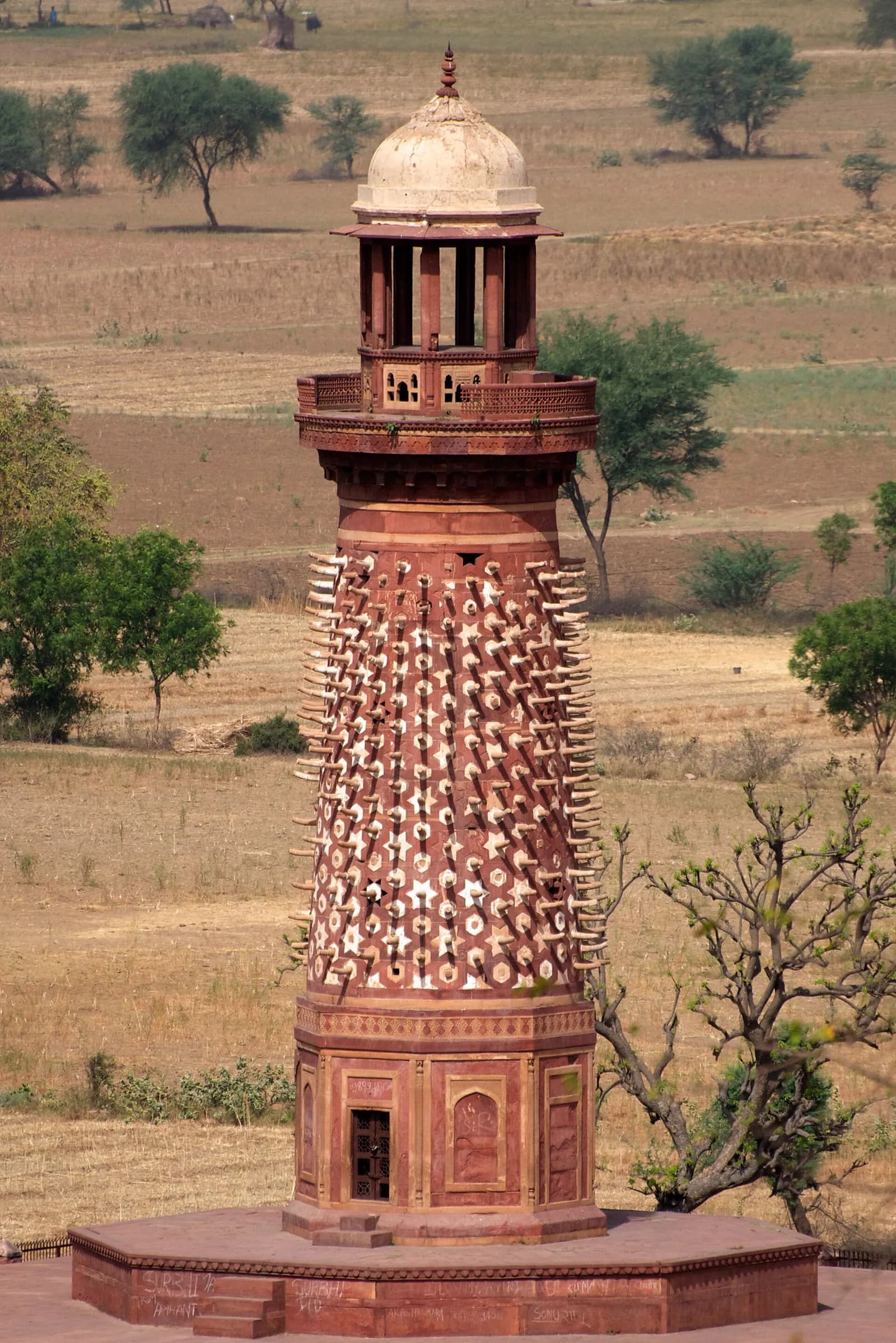
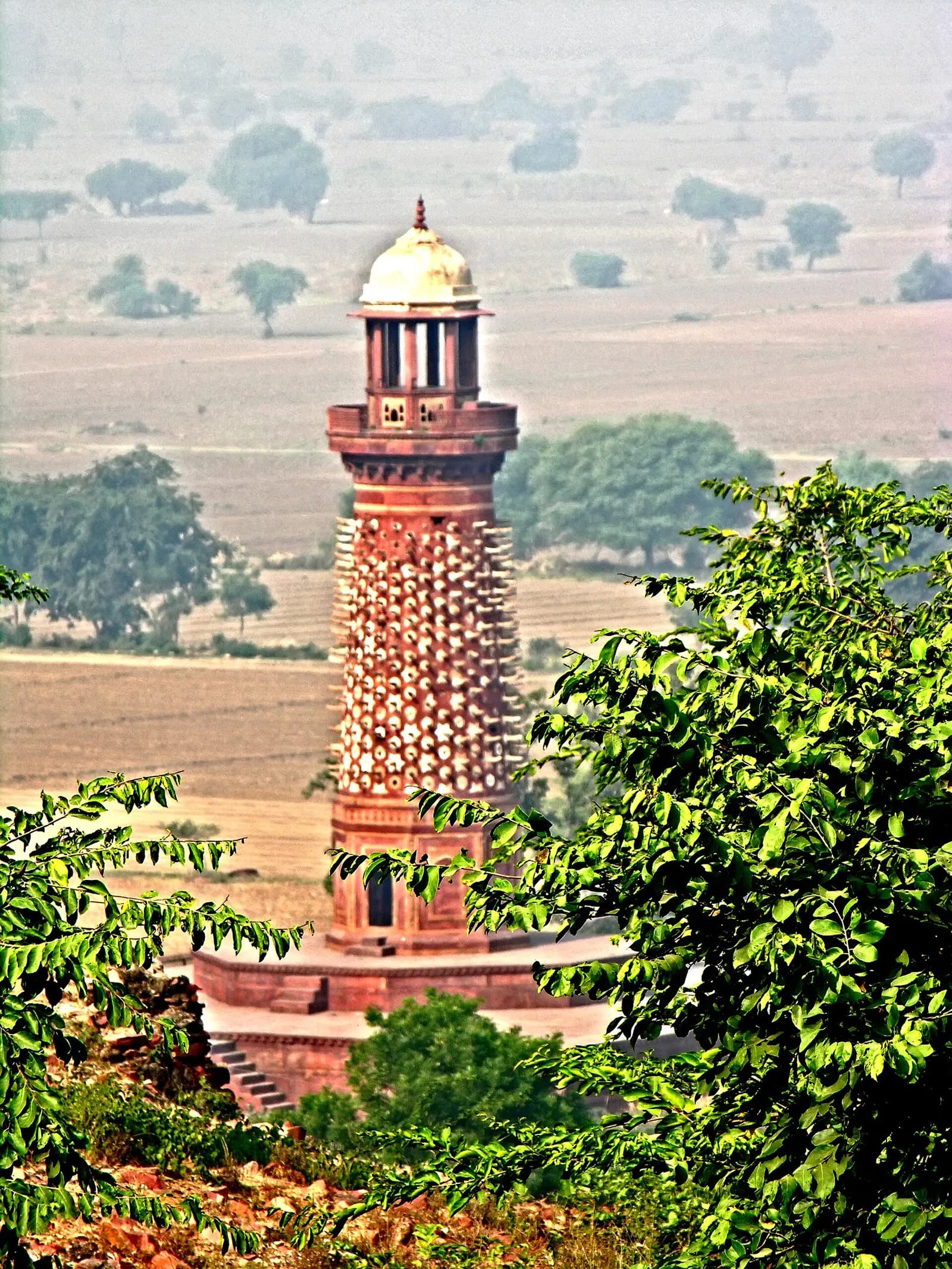
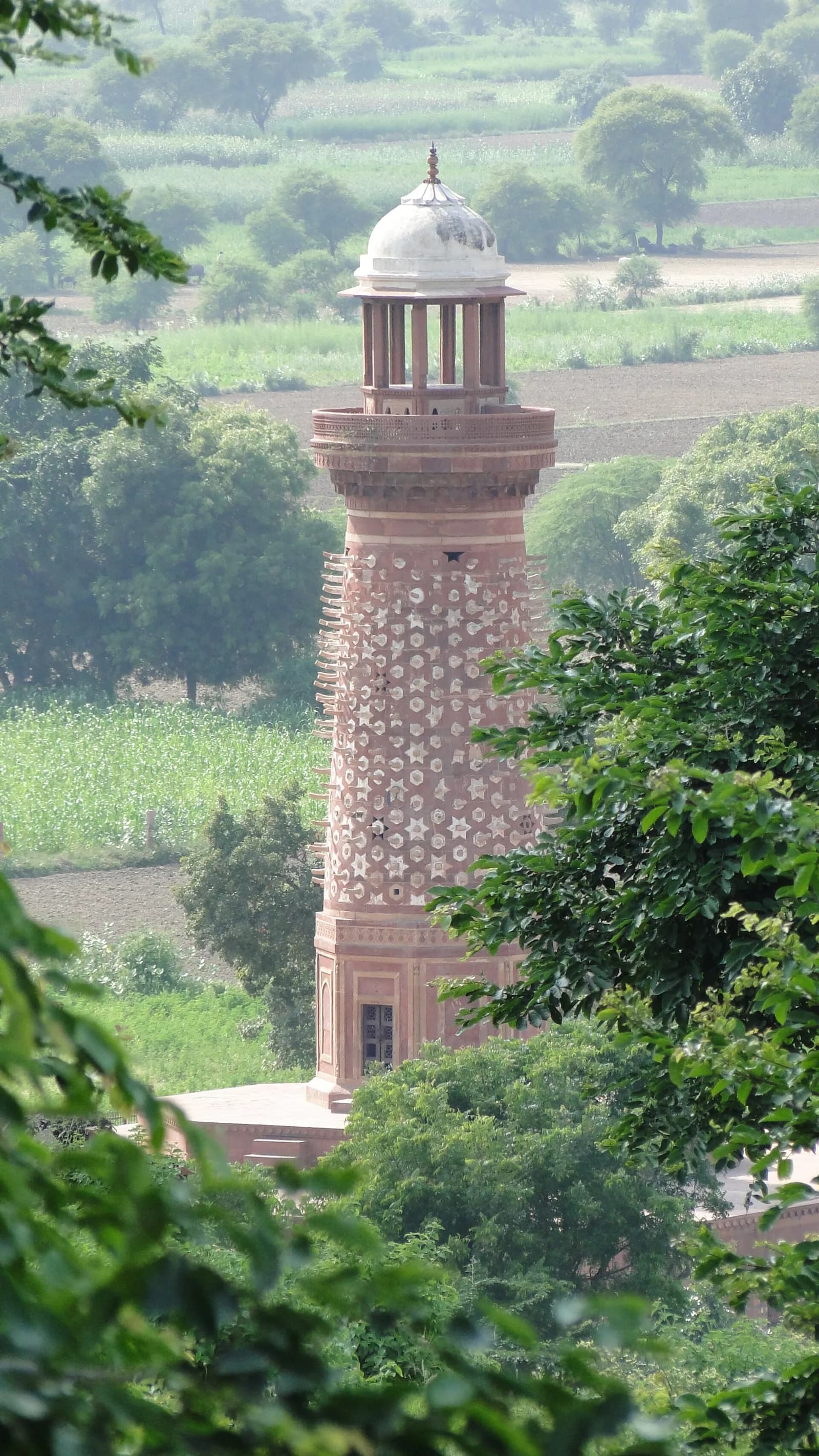
The Hiran Minar, literally the Antelope Tower but popularly known as the Elephant Tower, is a sixteenth-century Mughal monument built by the Emperor Akbar in Fatehpur Sikri, in Uttar Pradesh. It stands 21.34 metres or 70 feet, tall on the northwestern edge of the imperial palace complex, just beyond the Hathi Pol, the Elephant Gate. Its most striking feature is the ring upon ring of carved stone spikes, shaped like elephant tusks, that project from its cylindrical shaft, giving it an appearance unlike any other tower in India. Set slightly apart from the main palace in an open field, it is much quieter and less crowded than the central courtyards, which is part of its appeal. For a visitor, it is one of the most intriguing and atmospheric stops at Fatehpur Sikri, a monument wrapped in legend and set in peaceful, open surroundings on the quiet edge of the city.
Several things make it remarkable:
- Studded with stone tusks. Its shaft bristles with carved stone spikes shaped like elephant tusks, a design found nowhere else.
- The elephant legend. By popular tradition, Akbar built it over the grave of his favourite elephant, named Hiran.
- A tower of many uses. It served as a viewing tower, a lighthouse and a milestone, as well as a memorial.
- Quiet and uncrowded. Standing in an open field beyond the palace, it offers a peaceful contrast to the busy courtyards.
- Fine views. A spiral staircase once led to a rooftop kiosk with panoramic views over the ridge and plains.
History and the many purposes of the Hiran Minar
Built during Akbar's reign, between 1571 and 1585, the tower served several purposes, some documented and some legendary, which is part of what makes it so interesting:
- A memorial to a favourite elephant. Popular legend states that Akbar erected the tower over the burial site of his favourite elephant, named Hiran, which is the story most often told about it.
- A royal viewing tower. Positioned next to the ancient polo ground, the Chaughangah and a former artificial lake nearby, it served as an elevated pavilion from which the royal women could privately watch polo matches, animal fights and tournaments on the ground below.
- An antelope sanctuary. The name Hiran, meaning deer or antelope, is also linked to the Emperor Jahangir, who later converted the surrounding plains into a game preserve for antelopes.
- A lighthouse and milestone. Standing near the main highway leading towards Ajmer and Gujarat, the tower acted as a Kos Minar, a mile marker and as a beacon where lamps were lit at night to guide travellers along the route.
This layering of purposes, memorial, grandstand, game preserve and lighthouse, is unusual even by the standards of Fatehpur Sikri and it reflects how a single Mughal structure could serve the practical, the ceremonial and the sentimental all at once. Whether or not the elephant legend is literally true, the tower clearly stood at the meeting point of the palace, the sporting grounds and the open road, a landmark in every sense.
The elephant's place in Mughal life helps explain why such a memorial would be built at all. War elephants and ceremonial elephants were among the most prized possessions of a Mughal emperor, symbols of power and wealth and a favourite animal could be held in real affection as well as esteem. Akbar in particular was famous for his love of elephants and for the care with which the imperial stables were run, so a tower raised over a beloved elephant, true or not, fits what we know of him and of his court. The carved tusks that cover the shaft turn the whole tower into a kind of monument to the animal and standing beneath them it is easy to believe the story, whatever the historical record. Even taken purely as legend, it tells us something real about how the Mughals valued their elephants and about the sentimental streak in an emperor more often remembered for his conquests and his statecraft.
The elephant, the antelope and the name
The names of the towers are a story in themselves. Its formal name, Hiran Minar, translates as the Antelope Tower, from the word hiran, meaning deer or antelope, yet it is popularly and almost universally known as the Elephant Tower and the two names pull in different directions. The elephant association comes from the famous legend that Akbar built the tower over the grave of a beloved elephant called Hiran and it is reinforced by the carved stone tusks that stud the shaft and by its position just beyond the Hathi Pol, the Elephant Gate. The antelope association, meanwhile, points to the surrounding land, which under Jahangir became a preserve for antelopes and deer, so that the name may describe the setting rather than the monument. In truth both threads are woven into the place: an elephant remembered in stone, standing in what became an antelope park, beside a polo ground and a road. For the visitor, the double name is a neat reminder that the stories around a monument can be as rich and tangled as its history and that at Fatehpur Sikri legend and fact are often impossible to separate.
There is one more layer of confusion worth clearing up, which is that the name Hiran Minar is shared with a far more famous monument in Pakistan. The Hiran Minar at Sheikhupura, near Lahore, is a large Mughal tower and tank complex, also linked to Jahangir and to a beloved deer and it is a popular tourist and wedding-photography spot today. Because it dominates online searches for the name, many people looking for the Sheikhupura tower arrive at pages about the Fatehpur Sikri one and the reverse. The two are entirely separate monuments in different countries: this guide is about the Hiran Minar at Fatehpur Sikri, near Agra in India, a tall red sandstone tower studded with stone tusks, while the Sheikhupura Hiran Minar is a different structure altogether. Keeping the two apart saves a good deal of confusion when you are planning or reading about a visit.
Architecture and the stone tusks
The Hiran Minar is a striking piece of design, combining functional engineering with bold visual symbolism, all in red sandstone:
- A three-tiered base. The tower rises from a square platform, nearly 22 metres wide, into an octagonal terrace 1.2 metres high; the shaft itself is octagonal up to a height of 3.91 metres before transitioning into a smooth circular cylinder.
- Stone elephant tusks. The cylindrical exterior is decorated with alternating rows of carved hexagons and six-pointed stars and protruding from the centre of these geometric patterns are sculpted stone spikes shaped like elephant tusks, symbolising Mughal royal power.
- An interior staircase. A flat-topped doorway framed by sandstone panels leads to a narrow internal spiral staircase of 53 steps.
- A crowning pavilion. At the summit sits a circular balcony supported by heavy stone corbels and topped with a dome-shaped chhatri or kiosk, offering panoramic views of the Fatehpur Sikri ridge and the surrounding plains.
The stone tusks are what everyone remembers, an unusual and slightly surreal feature that gives the tower its popular name and its unmistakable silhouette. Whether they were meant as a tribute to the buried elephant, as a symbol of imperial power or as both at once, they make the Hiran Minar one of the most distinctive monuments at Fatehpur Sikri and they reward a close look at the carving around their bases.
The engineering of the tower is as thoughtful as its symbolism. The move from a square platform through an octagonal section to a round shaft is a classic device for carrying a tall, slender tower, distributing its weight gracefully and giving the eye a satisfying progression from base to summit. The internal spiral staircase, winding up through 53 steps to the rooftop kiosk, shows that the tower was meant to be climbed and used, not merely looked at and the heavy stone corbels that support the balcony at the top are a reminder of how such viewing platforms were built to hold a group of the court in safety. When it was open to the public, the climb rewarded visitors with one of the finest views at Fatehpur Sikri, out across the ridge, the ruined city and the plains beyond, the same wide panorama from which the royal women once watched the polo matches and the royal hunts. Even from the ground, you can read the logic of the design in its clean, rising lines.
Location and what is nearby
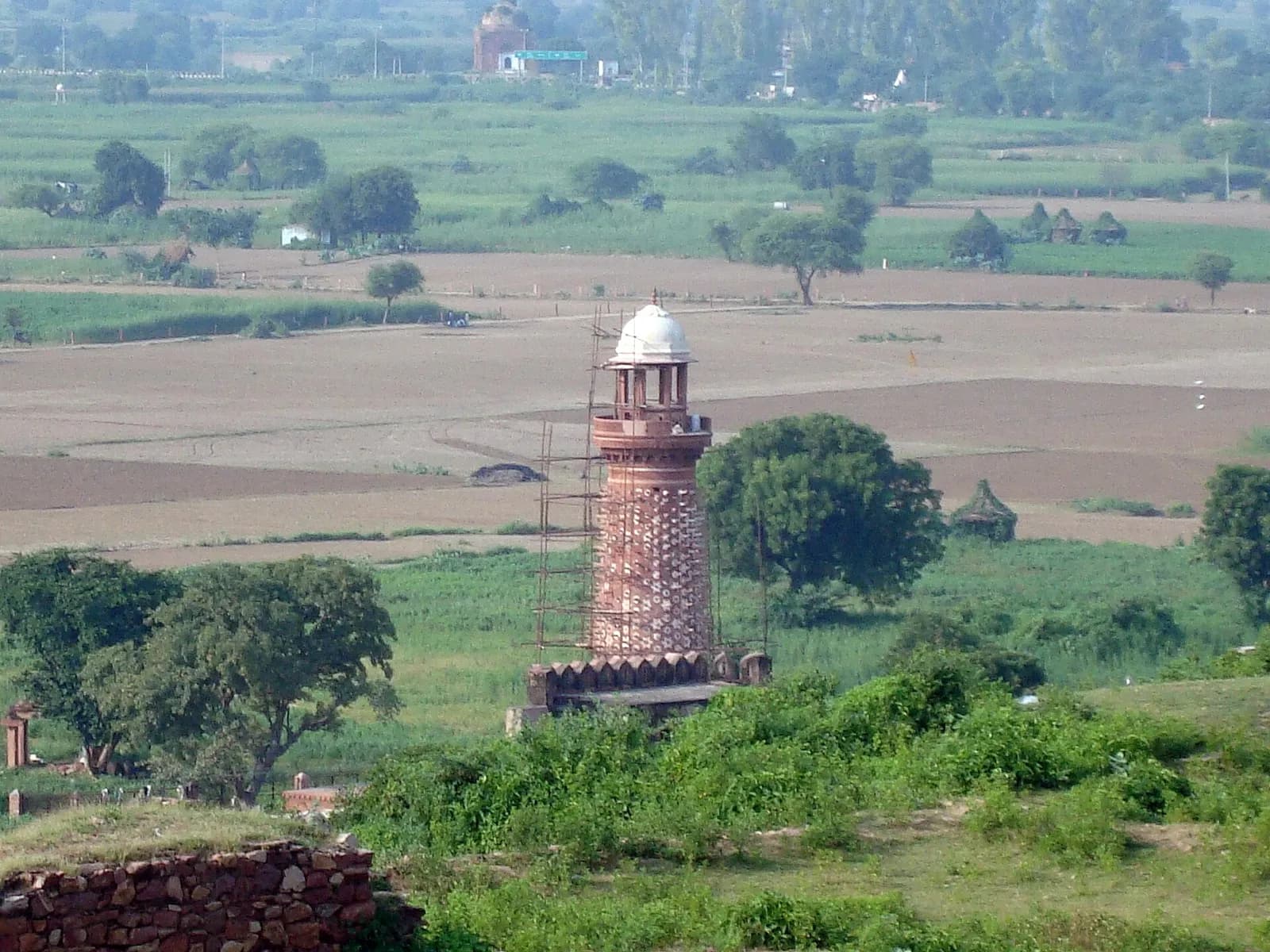
The Hiran Minar stands on the northwestern edge of the palace complex, just beyond the Hathi Pol, the Elephant Gate and slightly outside the main fortified enclosure in an open field. This setting is part of its character: because it lies beyond the ticketed core, it is much quieter and less crowded than the central courtyards and it is surrounded by open ground rather than walls and buildings. Several other features of this northwestern zone are close by and worth seeing on the same walk: the Hathi Pol itself, the great Elephant Gate through which you reach the tower and the Kabutar Khana, the Pigeon House, a structure built to shelter the emperor's pigeons. The ancient polo ground and the site of the former lake lie around the tower, so you can picture the sporting life that once took place here, with the royal women watching from the tower above. Seeing the Hiran Minar together with the Hathi Pol and the Kabutar Khana makes a rewarding short circuit of this quieter corner, away from the crowds that gather at the Buland Darwaza.
The open ground around the tower is worth taking in as part of the experience. Where the central palace is a dense cluster of buildings and courtyards, this northwestern edge opens out onto fields and sky and the former polo ground and lakebed give a sense of space that the rest of the site lacks. It is easy, standing here, to imagine the scene the tower was built to oversee: horses and players on the Chaughangah, water in the lake, the court watching from the balcony and beyond, the road running west towards Ajmer and Gujarat with the tower's lamps guiding travellers in at dusk. This combination of a strange, tusk-covered tower and a wide, quiet setting is quite unlike anything else at Fatehpur Sikri and it is why the Hiran Minar leaves such a strong impression despite being well off the main tourist route. For photographers and for anyone who values a little solitude, it is one of the most rewarding corners of the whole site.
Ticket price and entry
One of the attractions of the Hiran Minar is that it is free. Entry to the Hiran Minar area itself is free of charge, as it sits outside the ticketed central palace zone, in the open ground beyond the Hathi Pol. If you combine it with a visit to the main Fatehpur Sikri palace complex, as most people do, the Archaeological Survey of India ticket for that complex costs ₹50 for Indian, SAARC and BIMSTEC citizens, reduced to ₹40 on Fridays and ₹610 for foreign visitors, reduced to ₹600 on Fridays, with children under 15 entering free. So you can see the tower for nothing and pay only for the ticketed palaces if you wish to visit those too. One point to note is that public access to climb the interior staircase to the top balcony is frequently restricted by the ASI for preservation and safety, so you may be able to admire the tower only from the ground, which is in any case the best way to take in the stone tusks and the whole shape. These prices are current at the time of writing and are revised periodically, so reconfirm the latest rate when you plan your visit and our guide to Fatehpur Sikri covers the full site.
Timings and the best time to visit
The Hiran Minar is open daily from 8 AM to 6 PM, while the broader Fatehpur Sikri complex operates from sunrise to sunset, so the tower keeps slightly shorter hours than the palaces and mosque. The best season to visit is between October and March, when the daytime weather is pleasant for walking the open ground around the tower, which has no shade and becomes very hot in summer. Within the day, early mornings between 8 AM and 10 AM or late afternoons between 4 PM and 5:30 PM, offer soft golden light on the red sandstone that is ideal for photography and shows the carved tusks at their best, as well as cooler temperatures and fewer people. Because climbing the tower is often restricted, your visit is mostly about walking around the base and the nearby structures, which takes 20 to 30 minutes. Allow this as part of a wider 2 to 3 hour visit to Fatehpur Sikri. All timings are current at the time of writing and can change, so reconfirm before you travel and our notes on the best time to visit Agra cover the seasons across the region.
Rules and visiting tips
A few practical points help you make the most of the visit:
- Climbing is often restricted. Public access to the interior staircase and the top balcony is frequently closed by the ASI for preservation and safety, so plan to enjoy the tower from the ground.
- Enjoy the quiet. This is one of the calmest spots at Fatehpur Sikri, so it is a good place to slow down, away from the crowds at the gateway.
- See the neighbours. Combine the tower with the Hathi Pol and the Kabutar Khana, the Pigeon House, which lie close by in the same quiet zone.
- Carry water and sun protection. The open field has no shade, so bring water, a hat and sunscreen, especially outside the cool months.
- Hire a licensed guide. An ASI or UP Tourism guide can explain the layout and the stories, which turn a strange stone tower into a place full of meaning.
What to expect
Expect a quiet, curious and slightly mysterious monument rather than a grand one, set apart from the crowds in open country. Approaching from the palace, you pass through the Hathi Pol and come out into open ground, where the Hiran Minar stands alone, its shaft studded with rows of stone tusks, an odd and memorable sight that stops most people in their tracks. Because it lies outside the ticketed core and keeps the crowds at bay, it has a peaceful, almost melancholy atmosphere, very different from the bustle at the Buland Darwaza and that peace is a large part of its charm. You will usually see it from the ground, since climbing is often restricted, but the ground-level view is the best for taking in the tusks and the whole form and the surrounding open land lets you step back and photograph it whole. It does not take long and it pairs naturally with the Hathi Pol and the Pigeon House in this quiet corner. Come in the soft light of early morning or late afternoon, let the legends colour what you see and the Hiran Minar is a memorable and restful way to round off a visit to Fatehpur Sikri. Many travellers find that this quiet, curious tower, rather than the famous gateway, is the image of the city that stays with them longest afterwards.
How to reach the Hiran Minar
The Hiran Minar is at Fatehpur Sikri, 37 to 40 km west of Agra, a 1 hour drive along NH-21, the Agra to Jaipur Highway. You can reach Fatehpur Sikri by private cab or state bus from Agra's Idgah Bus Stand or by local train to the Fatehpur Sikri Railway Station, which lies 1 to 2 km from the monument, closer to the Hiran Minar than to the main palace. From the main Fatehpur Sikri complex, the simplest way to reach the tower is to walk downhill past the Diwan-i-Aam and through the Hathi Pol archway, which brings you out at the open ground where the tower stands. As with the rest of the site, private cars park at the base parking area, from where a shuttle or a walk reaches the complex. For most travellers a private cab from Agra or a guided tour combining the city's monuments with Fatehpur Sikri is the simplest option. Our guide on how to reach the Taj Mahal and Agra covers arrival into the city, from where the Fatehpur Sikri road begins and our list of places to visit in Fatehpur Sikri covers the wider site.
The Hiran Minar in your Fatehpur Sikri and Agra trip
The Hiran Minar makes a fine, quiet end to the half-day most visitors give to Fatehpur Sikri, seen after the ticketed palaces and the free mosque. The natural plan is to tour the royal palace complex, the Diwan-i-Aam, the Diwan-i-Khas, the Panch Mahal and Jodha Bai's Palace, then the free Jama Masjid courtyard with the Buland Darwaza and the Salim Chishti Dargah and finally to walk out through the Hathi Pol to the Hiran Minar for a peaceful finish away from the crowds. Because Fatehpur Sikri lies on the road to Jaipur, it is easy to include on the way in or out of Agra, which suits a longer Golden Triangle route. For most travellers it pairs with a day in Agra for the Taj Mahal and the Agra Fort, with Fatehpur Sikri on a second day or en route. Those with more time can add the riverside Itimad-ud-Daulah and a sunset at Mehtab Bagh, while our Agra travel guide, our list of things to do in Agra and our notes on Taj Mahal history and facts add the wider Mughal context. For anyone who wants a calm, offbeat corner of the site, the Hiran Minar is quite simply the place to end.
Plan your trip with us
If you would like to see the Hiran Minar and Fatehpur Sikri with the logistics handled, the drive from Agra, the parking and shuttle, a government-approved guide and your palace ticket, let us help. We can build Fatehpur Sikri into your Agra itinerary as a half-day on the Jaipur road or a dedicated day trip, timed for the cool morning hours when the tower is quiet and the light is best. Our Delhi Agra tours cover the Taj Mahal, the Agra Fort and Fatehpur Sikri and travellers short on time often choose a full Golden Triangle tour through Delhi, Agra and Jaipur, which passes Fatehpur Sikri directly. For a relaxed visit, our Agra overnight tour from Delhi leaves room for the palaces, the mosque and the quieter corners, while an early start with our sunrise Taj Mahal tour or a same day Agra tour from Delhi can be extended to include it. To plan a route that takes in the Hiran Minar, message Abhay and the team directly on WhatsApp at +91 7302265809 or reach our team online and we will build an Agra and Fatehpur Sikri trip around it.
Related guides
Keep reading before you travel, these pair well with this guide:
Enquire Now
What our travellers say
“Our Golden Triangle honeymoon was flawless. Sunrise at the Taj with a private guide felt like a dream — every detail was handled.”
“As a first-time visitor to India, I felt completely safe and looked after. The driver and guide were superb professionals.”
“Travelling with two kids is hard, but they made it effortless. Great pacing, clean cars and zero surprises on price.”
“Booked the Agra day trip on short notice and it went off without a hitch. The guide's history knowledge made the Taj come alive.”
“Best decision of our India trip. Car was spotless, driver was punctual every single day, and the itinerary never felt rushed.”
“Organised a same-day Agra trip for my parents. Communication before and during the trip was excellent — genuinely stress-free.”
“Sunrise at the Taj Mahal was magical. Our guide spoke great English and answered every question with patience.”
“Three generations travelling together and everyone was comfortable — good vehicle, sensible stops, and no hidden costs.”
“I've used a few tour operators across Asia and this was among the smoothest. Fair pricing and they actually answer the phone.”
“Our custom Rajasthan-Agra combo was planned around our budget without cutting corners on comfort. Highly recommend.”
“Solo female traveller here — I felt safe throughout. The driver was respectful and the whole trip was timed perfectly.”
Ready to Explore
The Magic of Agra?
Experience the Taj Mahal at sunrise, explore the mighty Agra Fort, and discover the hidden gems of India's most beloved heritage city with our expert-guided premium tours.

Agra
Premium Tour Package
Questions
Frequently asked questions
Who built the Hiran Minar at Fatehpur Sikri?
It was built by the Mughal Emperor Akbar, during his reign between 1571 and 1585, on the northwestern edge of his capital Fatehpur Sikri. By popular legend it was raised over the grave of his favourite elephant, named Hiran.
What was the Hiran Minar built in memory of?
Why is it called both the Antelope Tower and the Elephant Tower?
What are the stone spikes on the Hiran Minar?
Is there an entry fee for the Hiran Minar?
What are the Hiran Minar timings?
Can you climb the Hiran Minar?
How tall is the Hiran Minar?
Where is the Hiran Minar located?
Is the Hiran Minar worth visiting?
Explore more
Plan your Hiran Minar trip with us

Interested in Hiran Minar Fatehpur Sikri: History of the Elephant Tower?
Chat with our travel team for a custom quote, or browse every package.
Related Attractions
9Hiran Minar Fatehpur Sikri on the map
Open in Google MapsReady to explore Hiran Minar Fatehpur Sikri: History of the Elephant Tower?
Book your private tour today and experience the magic of India's rich heritage.