

 Sikandra, Agra
Mariam's Tomb Sikandra Agra: Timings, Tickets and History
Visiting Mariam's Tomb at Sikandra, Agra, the red sandstone mausoleum of Akbar's queen and Jahangir's mother? Its history, timings, tickets and how to reach.
Quick answer
Mariam's Tomb at Sikandra is the red sandstone mausoleum of Mariam-uz-Zamani, Emperor Akbar's chief Rajput queen and the mother of Emperor Jahangir, who built it between 1623 and 1627. Set in a quiet Mughal garden 1 km from Akbar's Tomb, it is open every day including Friday. It features on our Agra tours, run by a unit of Experience My India.
- #mariam-tomb
- #agra
- #agra-attractions
- #agra-travel
Mariam's Tomb is one of Agra's quietest and most overlooked monuments, the resting place of a Rajput princess who became the most honoured queen of the Mughal court. Our team at Delhi Agra Tour Packages folds it into Sikandra mornings and it sits naturally on any Golden Triangle tour through Delhi, Agra and Jaipur, especially for arrivals from the Delhi side.
I am Abhay Sharma, a Golden Triangle guide since 2015 and I love bringing history lovers here because so few tourists ever come. This is the tomb of the queen popularly remembered as Jodha Bai, the Rajput wife of Akbar and mother of his heir, a woman of extraordinary standing whose son turned a Lodi-era pavilion into her mausoleum. This guide gathers everything I would tell a visitor beforehand, who she was, the history and architecture, the timings and tickets and how to reach it in the Sikandra cluster.
Mariam's Tomb at a glance
| Detail | Information |
|---|---|
| Whose tomb | Mariam-uz-Zamani, Akbar's Rajput queen, Jahangir's mother |
| Built by | Emperor Jahangir, between 1623 and 1627 |
| Location | Sikandra, Mathura Road, 1 km from Akbar's Tomb |
| Material | Red sandstone, a square flat-roofed structure |
| Managed by | Archaeological Survey of India |
| Open | All seven days, including Friday |
| Time needed | 30 to 60 minutes |
| Best season | October to March |
Mariam's Tomb timings
| Detail | Information |
|---|---|
| Open | All seven days, including Friday |
| Hours | Sunrise to sunset, 6 AM to 6 PM |
| Time needed | 30 to 60 minutes |
Mariam's Tomb is open every day from sunrise to sunset, 6 AM to 6 PM, including Fridays when the Taj Mahal is closed, which makes it a good Friday sightseeing option alongside Akbar's Tomb next door. There is no weekly closed day, so it fits any Agra schedule. These timings are current at the time of writing and can change, so reconfirm before a special trip.
Entry fee
| Visitor | Gate rate | Online rate | Extra |
|---|---|---|---|
| Indian citizens | ₹25 | ₹20 | None |
| SAARC and BIMSTEC nationals | ₹25 | ₹20 | None |
| Other foreign nationals | ₹300 | ₹250 | ₹500 ADA toll |
| Children under 15 | Free | Free | None |
Physical ticket counters are no longer operated at the gate, so you must book entry passes online through the official Archaeological Survey of India PayGov portal or by scanning the QR code at the entrance. Foreign nationals also pay a one-time ₹500 Agra Development Authority toll, valid the same day across the major Agra monuments including the Taj Mahal, the Agra Fort and Akbar's Tomb and waived on Fridays. These prices are current at the time of writing and are revised periodically, so reconfirm before you travel.
How to reach Mariam's Tomb
| From | Route |
|---|---|
| Akbar's Tomb | 1 km away, a very short hop |
| By road | On Mathura Road, NH-19, in Sikandra |
| By auto, e rickshaw or cab | From Agra Cantt, Idgah Bus Stand or the Taj area |
| Nearest metro | Sikandra extension is under development; road transit is direct |
What is Mariam's Tomb?
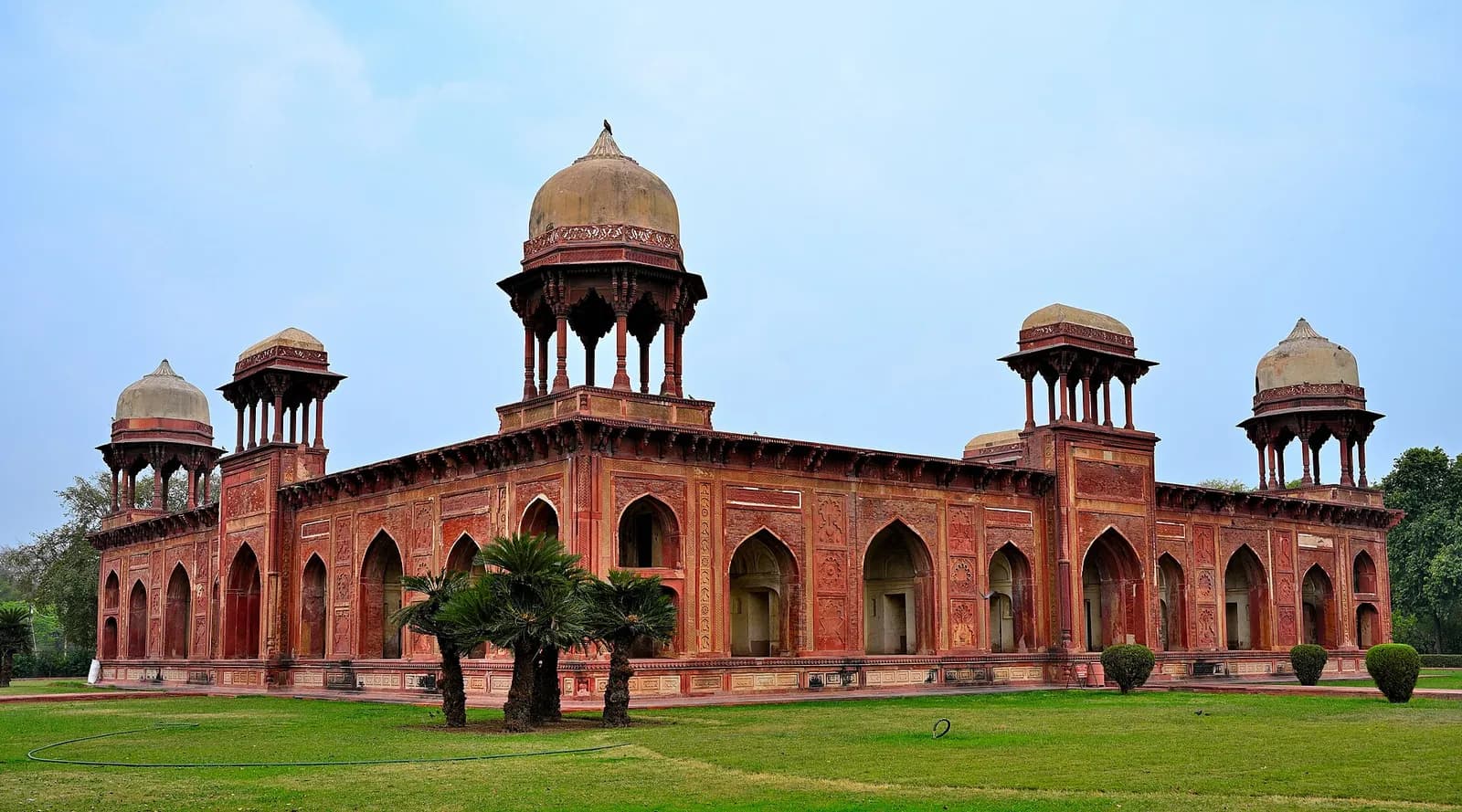
Mariam's Tomb, officially the Tomb of Mariam-uz-Zamani, is the early 17th-century red sandstone mausoleum of Emperor Akbar's chief Rajput consort and Emperor Jahangir's mother, standing in a tranquil Mughal garden just off National Highway 19 in Sikandra, 1 km from Akbar's Tomb. Built by Jahangir between 1623 and 1627 in honour of his mother, it is a square, flat-roofed monument of finely carved red sandstone, crowned by white-domed corner chhatris and set in a walled garden, remarkable both for the woman it commemorates and for its unusual two-dynasty history. Quiet and uncrowded, it is a rewarding stop for anyone interested in the Rajput and Mughal story. For the visitor, it offers a very different experience from the city's famous marble monuments, a chance to study fine Mughal stonework in peace and to connect with one of the most intriguing women of the imperial age.
Several things make it special and they are worth drawing out:
- The tomb of a legendary queen. The resting place of Mariam-uz-Zamani, the Rajput queen popularly remembered as Jodha Bai and the mother of Emperor Jahangir.
- Built by an emperor for his mother. Raised by Jahangir between 1623 and 1627 as a mark of deep respect.
- A two-dynasty monument. Originally a Lodi-era pleasure pavilion, later remodelled into a Mughal mausoleum.
- Hindu and Islamic fusion. Red sandstone carved with Islamic geometry alongside Hindu motifs like lotus flowers, bells and chains.
- Peaceful and uncrowded. One of the quietest major monuments in Agra, ideal for unhurried photography.
Who was Mariam-uz-Zamani?
Understanding this monument means understanding the remarkable woman it honours. Born Heer Kunwari and referred to in popular accounts as Harka Bai or Jodha Bai, she was a Rajput princess of Amer who married Emperor Akbar in 1562 and gave birth to his successor, Jahangir. Her marriage was part of the alliance between the Mughals and the Rajputs that helped Akbar build and hold his empire and as the mother of the heir she rose to become one of the most honoured figures at the imperial court, granted the title Mariam-uz-Zamani, meaning Mary of the Age. Historical accounts describe her as a woman of real power in her own right, who held senior rank, controlled significant wealth and was even involved in overseas trade, far more than the romantic legend usually suggests.
A few points are worth knowing about her:
- A Rajput princess of Amer. She came from the ruling house of Amer, near modern Jaipur and her marriage to Akbar sealed a crucial Mughal and Rajput alliance.
- Mother of the emperor. She gave birth to Prince Salim, who became Emperor Jahangir, which gave her lasting status and influence at court for the rest of her life.
- Popularly called Jodha Bai. Later tradition and popular culture often call her Jodha Bai, though historians debate the exact name and she is the figure most people mean by it.
- Honoured above other queens. She is the only wife of Akbar buried in close proximity to his own mausoleum at Sikandra, a clear and public sign of her exceptional standing among his many queens.
History of Mariam's Tomb
The story of this monument spans two dynasties and more than a century, which makes it unusual even by Agra's standards.
The story runs in clear stages:
- A Lodi-era pavilion. The structure originally began as an open pleasure pavilion, a baradari, built in the 1490s during the reign of Sikandar Lodi, well before the Mughals.
- Remodelled by Jahangir. After Mariam-uz-Zamani died in 1623, her son Emperor Jahangir remodelled the old pavilion into her permanent mausoleum, completing it by 1627.
- Honouring his mother. Jahangir raised the tomb as a mark of deep respect for the queen who had borne and guided him.
- Proximity to Akbar. She is the only wife of Akbar buried so close to his own mausoleum at Sikandra, reflecting her exceptional status in the imperial court.
That two-dynasty history is the detail I always share, because it is so unusual. The bones of a pre-Mughal Lodi pavilion were absorbed into a Mughal royal tomb, so in walking here you are moving through more than a century of Indian history layered into a single building.
Jahangir's choice to remodel an existing pavilion rather than build from scratch tells its own story. He was a great builder and could have raised anything he wished for his mother, so reusing the old Lodi baradari was a deliberate decision, perhaps a mark of respect for the garden she had known, perhaps simply a practical use of a fine existing structure. Either way, the result is a monument that feels rooted in its site, grown out of an older building rather than imposed on the land, which gives it a quiet, settled character quite different from the grand set-piece tombs of the era.
The relationship between mother and son adds the emotional layer. Jahangir owed his very claim to the throne in part to his mother's Rajput lineage and her standing at court and building her tomb so close to his father Akbar's own great mausoleum was a public statement of her importance. In a dynasty that often saw bitter rivalry between fathers, sons and brothers, this tomb is a rare and tender gesture of filial devotion set in stone.
Mariam's Tomb architecture
Mariam's Tomb has a character quite different from the famous domed mausoleums and the features below reward a slow look.
- No central dome. Unlike the Taj Mahal or Humayun's Tomb, Mariam's Tomb has no great central dome and is instead a square, flat-roofed structure.
- Hindu and Islamic fusion. The exterior is veneered in finely carved red sandstone panels combining geometric Islamic patterns with traditional Hindu sculptural motifs such as lotus flowers, bells and chains.
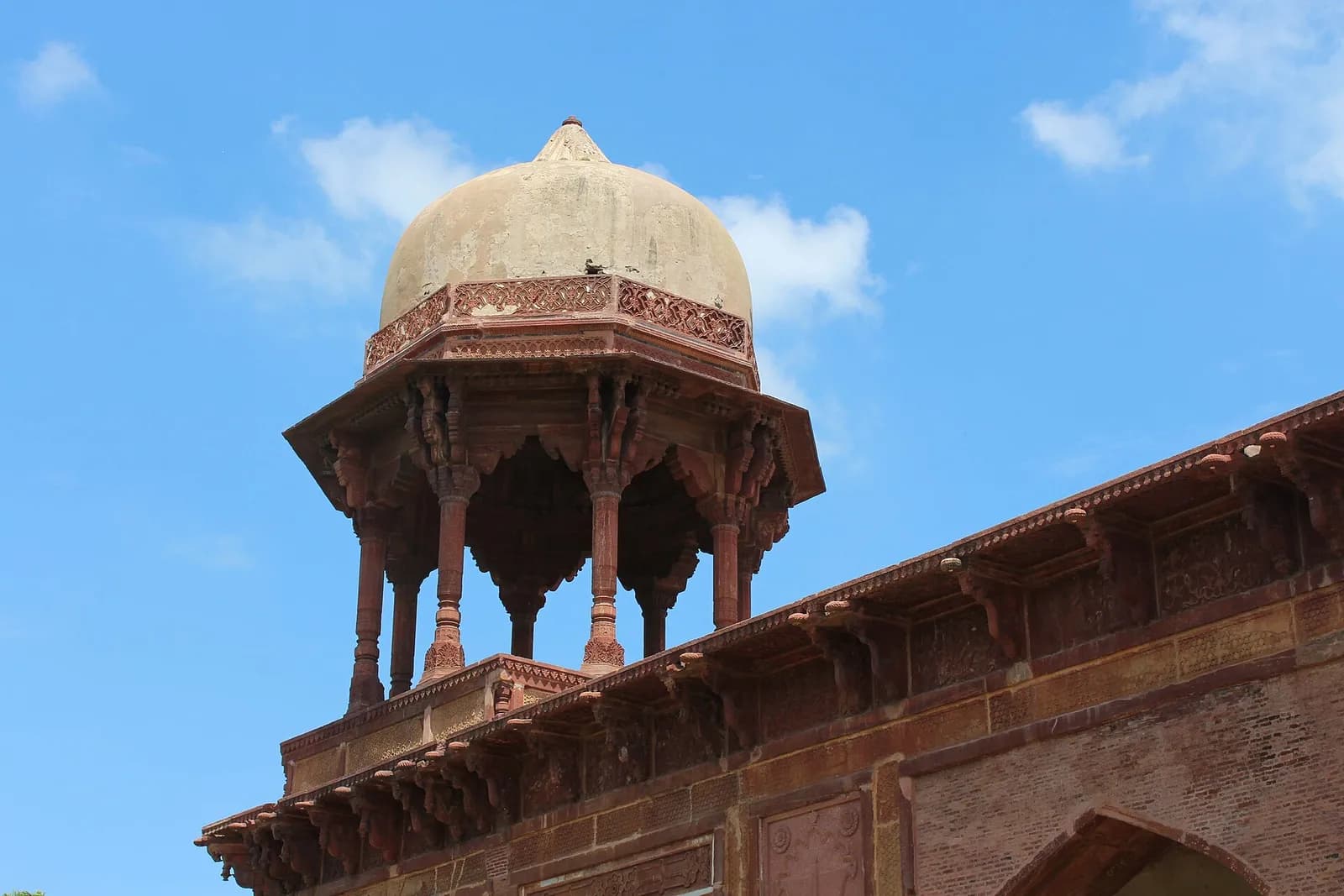
- Corner chhatris. Four massive octagonal towers topped with white marble-domed chhatris crown the corners of the roof, paired with rectangular pavilions along the sides.
- Three distinct tombstones. The three-storey layout holds three markers for the empress, her actual grave in a subterranean crypt closed to the public, a replica cenotaph on the ground floor and an open-air cenotaph on the rooftop terrace.
- Natural climate control. Thick four-foot walls and a crisscrossing grid of forty ground-floor chambers keep the interior naturally cool and still hold faint traces of Mughal painted plaster.
The Hindu and Islamic fusion is the architectural heart of the monument and it is fitting. This is the tomb of a Rajput Hindu princess who became a Mughal queen, so the blend of lotus flowers and bells with Islamic geometry is not just decoration but a reflection of who she was and of Akbar's broader spirit of cultural union. Look closely at the carved panels and you will see two traditions meeting in the same stone.
The three-tombstone arrangement is another feature worth seeking out and it follows an old Mughal convention. The empress's actual grave lies in the quiet subterranean crypt, closed to visitors, while a replica cenotaph on the ground floor and an open-air one on the roof terrace stand in for it above. The idea is that the real resting place stays undisturbed in the cool earth while symbolic markers receive the visitor's attention, a thoughtful separation of the private and the public that you also find at the Taj Mahal and other great tombs.
Do not overlook the forty ground-floor chambers either. This dense grid of small rooms, built behind walls four feet thick, works as a natural cooling system, keeping the interior comfortable even in the Agra heat and in a few of them you can still make out faint traces of the painted plaster that once decorated the whole tomb. Walking through this cool, dim honeycomb of chambers is one of the quiet pleasures of a visit and a reminder of how cleverly Mughal builders worked with the climate.
Mariam's Tomb ticket price and entry fee
Mariam's Tomb is an affordable and easy stop, with one practical quirk: there are no physical ticket counters at the gate any more. You book your entry pass online through the official Archaeological Survey of India PayGov portal or by scanning the QR code at the entrance, so it helps to have a working phone and payment method ready. For Indian, SAARC and BIMSTEC visitors it is ₹25 at the gate rate or ₹20 online and for foreign tourists it is ₹300 or ₹250 online, plus the one-time ₹500 Agra Development Authority toll that is valid the same day across the major Agra monuments and waived on Fridays. Children under 15 enter free and booking online is the cheaper option for every category of visitor. Plan on 30 to 60 minutes for a visit. These figures are current at the time of writing and change periodically, so reconfirm before you travel.
Rules and facilities at Mariam's Tomb
A few practical points shape a comfortable visit, so keep these in mind:
- Book online. With no counters at the gate, have the ASI PayGov pass or the QR payment ready on your phone.
- Carry a light. Use your phone flashlight near the dimly lit interior stairwells and ground-floor chambers.
- Facilities inside. There are basic restrooms and free drinking water stations within the complex, though food stalls outside are scarce.
- Respect the monument. The crypt holding the queen's grave is closed to the public, so view the cenotaphs on the ground floor and roof instead.
What to expect at Mariam's Tomb
Expect a calm, uncrowded red sandstone monument in a walled garden rather than a bustling tourist site. You enter the walled charbagh garden with the square tomb at its centre, its corners crowned by white-domed chhatris and you can walk the ground-floor galleries, study the finely carved red sandstone panels and climb to the rooftop terrace with its open-air cenotaph. The interior is cool and dim, a welcome relief in warm weather and the quiet means you can take your time over the carvings and the photography without the crowds of the Taj Mahal. It is a short visit of 30 to 60 minutes, best enjoyed slowly by travellers who appreciate history and fine stonework over grand spectacle, rather than those only chasing a headline sight.
What strikes most visitors is simply how peaceful it is. While the Taj Mahal and the Agra Fort heave with people, you may well have Mariam's Tomb almost to yourself, free to wander the galleries, trace the carved panels with your eye and sit in the garden without a crowd in sight. For photographers this is a gift, as you can frame the symmetrical facade and the corner chhatris cleanly, without stray visitors in the shot. It is the kind of place that rewards travellers willing to step a little off the standard route and many who make the effort count it among their favourite quiet discoveries in Agra.
Best time to visit Mariam's Tomb
The best season is October to March, when Agra's weather is pleasant for walking in the garden. Within the day, come in the early morning or the late afternoon, when golden light brings out the detail in the red sandstone carvings and the monument is at its most photogenic. Harsh midday sun flattens the carving and the summer heat is tiring on the open garden, so the end of the day is far better. Because Mariam's Tomb is so quiet at any hour, you rarely have to plan around crowds, only around the light. A dawn start also lets you fold it neatly into a Sikandra morning with Akbar's Tomb next door, seeing both while the air is cool and the light is soft, before the day warms up and the central monuments fill. Our wider notes on the best time to visit Agra apply closely here.
How to reach Mariam's Tomb and its location
Mariam's Tomb stands directly on Mathura Road, NH-19, in Sikandra on the northwestern outskirts of Agra, which makes it an easy stop when driving in from Delhi or Mathura. Auto rickshaws, e rickshaws and app-based cabs such as Uber and Ola run frequently from Agra Cantt Railway Station, the Idgah Bus Stand and the Taj Mahal area, so reaching Sikandra is straightforward. On the metro, the Agra network's priority corridor currently serves the Taj Mahal and Agra Fort area, while the Sikandra extension on the Yellow Line is still under development, so road transit remains the direct way to reach Sikandra for now. Because it sits right on the Delhi highway beside Akbar's Tomb, it is a natural first or last Agra stop for travellers on the Delhi route. Our sunrise Taj Mahal tour works well before a drive out to Sikandra and travellers staying over often add it to an Agra overnight tour from Delhi.
Places to visit near Mariam's Tomb
Mariam's Tomb belongs to the Sikandra cluster, so it combines beautifully with the nearby landmarks rather than the central monuments. Just 1 km away stands the great mausoleum of Akbar himself, her husband, covered in our guide to Akbar's Tomb, which is the natural pairing for any Sikandra visit. Close by are the Kanch Mahal, a handsome Mughal pavilion and the Gurudwara Guru Ka Taal, a revered Sikh shrine in a historic stepped tank, described in our guide to Guru Ka Taal. Together these let you cover all of Sikandra's landmarks in a single half-day trip on the Delhi side of Agra and because they sit so close together, you can move between them in minutes rather than fighting cross-city traffic. The cluster gives you a great imperial tomb, the tomb of the emperor's queen, a glass palace pavilion and a revered gurudwara within a short radius, a surprising depth of history for a corner of Agra that most visitors drive straight past on their way into the city. You can read more in our overviews of places to visit near the Taj Mahal and lesser-known Agra monuments.
Visiting tips for Mariam's Tomb
A few notes I give every group before we go:
- Have your online pass ready. There are no ticket counters, so book on the ASI PayGov portal or use the QR code at the gate.
- Come for the light. Early morning or late afternoon gives the best glow on the red sandstone carvings.
- Bring a phone light. The interior stairwells and chambers are dim.
- Pair it with Akbar's Tomb. The great emperor's mausoleum is only 1 km away, so see the two together.
- Enjoy the quiet. This is one of Agra's most peaceful monuments, perfect for unhurried photography.
- Carry a snack. Food stalls just outside are scarce, though there is free drinking water inside the complex.
Hiring a guide at Mariam's Tomb
Because the monument is unlabelled and its story is easy to miss, a good guide adds a great deal here, explaining who Mariam-uz-Zamani was, the truth and the legend behind the Jodha Bai name and how a Lodi-era pavilion became a Mughal queen's tomb. A guide can also point out the Hindu motifs hidden among the Islamic geometry and lead you safely through the dim chambers. If you are visiting the Sikandra cluster together, one guide for the morning makes the whole area flow and our guided tours handle exactly this, connecting Mariam's Tomb to Akbar's Tomb next door so the mother-and-emperor story comes alive.
The story of Mariam-uz-Zamani is one that genuinely benefits from a knowledgeable guide, because so much of it is tangled with legend. The popular Jodha Bai name, the romantic retellings in film and television and the real historical record of a shrewd, wealthy and influential Rajput queen who owned trading ships and held land in her own right are not always the same thing. A good guide can separate the history from the Bollywood version and give you a far richer sense of who this remarkable woman actually was, which turns a quiet tomb into one of the more fascinating stops of an Agra trip.
Mariam's Tomb in your Golden Triangle itinerary
Mariam's Tomb is a connoisseur's stop rather than a headline and it is most convenient on a Golden Triangle trip because it sits right on the Agra to Delhi highway at Sikandra. Travellers driving down from Delhi can pair it with Akbar's Tomb as their first Agra stops, while those heading back can make them the last. A classic Agra day still centres on the Taj Mahal and the Agra Fort, with Sikandra added as a quiet, uncrowded contrast and a chance to meet the women and emperors behind the famous monuments. It rounds out the dynastic story beautifully alongside Fatehpur Sikri, Akbar's capital and the eastern bank tombs like Itimad-ud-Daulah and Mehtab Bagh, so that by the end you have seen not just the great buildings but the people who shaped them. Our Agra travel guide ties these together.
Plan your trip with us
If you would like the Sikandra cluster done well, with Mariam's Tomb and Akbar's Tomb arranged around the light and a comfortable car waiting, let us carry the load. We shape the day so you see the famous monuments and the quiet gems without the stress of navigating Agra yourself and we can fit Sikandra neatly into your arrival or departure from the Delhi side. Our Delhi Agra tours combine Mariam's Tomb and its neighbours with the Taj Mahal and Agra Fort and travellers short on time often choose our same day Agra tour from Delhi or a full Golden Triangle tour that threads Delhi, Agra and Jaipur. To plan dates, prices and inclusions, message Abhay and the team directly on WhatsApp at +91 7302265809 or reach our team online.
Related guides
Keep reading before you travel, these pair well with this guide:
Enquire Now
What our travellers say
“Our Golden Triangle honeymoon was flawless. Sunrise at the Taj with a private guide felt like a dream — every detail was handled.”
“As a first-time visitor to India, I felt completely safe and looked after. The driver and guide were superb professionals.”
“Travelling with two kids is hard, but they made it effortless. Great pacing, clean cars and zero surprises on price.”
“Booked the Agra day trip on short notice and it went off without a hitch. The guide's history knowledge made the Taj come alive.”
“Best decision of our India trip. Car was spotless, driver was punctual every single day, and the itinerary never felt rushed.”
“Organised a same-day Agra trip for my parents. Communication before and during the trip was excellent — genuinely stress-free.”
“Sunrise at the Taj Mahal was magical. Our guide spoke great English and answered every question with patience.”
“Three generations travelling together and everyone was comfortable — good vehicle, sensible stops, and no hidden costs.”
“I've used a few tour operators across Asia and this was among the smoothest. Fair pricing and they actually answer the phone.”
“Our custom Rajasthan-Agra combo was planned around our budget without cutting corners on comfort. Highly recommend.”
“Solo female traveller here — I felt safe throughout. The driver was respectful and the whole trip was timed perfectly.”
Ready to Explore
The Magic of Agra?
Experience the Taj Mahal at sunrise, explore the mighty Agra Fort, and discover the hidden gems of India's most beloved heritage city with our expert-guided premium tours.

Agra
Premium Tour Package
Questions
Frequently asked questions
Who was Mariam-uz-Zamani?
Mariam-uz-Zamani, born Heer Kunwari and popularly remembered as Jodha Bai, was a Rajput princess of Amer who married Emperor Akbar in 1562 and became the mother of his successor, Jahangir. As the mother of the heir she rose to be one of the most honoured queens of the Mughal court, holding senior rank and considerable wealth in her own right.
Who built Mariam's Tomb and when?
Is Mariam-uz-Zamani the same as Jodha Bai?
What is the Mariam's Tomb ticket price?
What are the Mariam's Tomb timings?
How far is Mariam's Tomb from Akbar's Tomb?
Why does Mariam's Tomb have no dome?
Is Mariam's Tomb worth visiting?
How much time do I need at Mariam's Tomb?
Why is Mariam-uz-Zamani buried near Akbar?
What does the name Mariam-uz-Zamani mean?
Is Mariam's Tomb crowded?
Are there facilities at Mariam's Tomb?
Can I combine Mariam's Tomb with Akbar's Tomb?
Explore more
Plan your Mariam's Tomb trip with us

Interested in Mariam's Tomb Sikandra Agra: Timings, Tickets and History?
Chat with our travel team for a custom quote, or browse every package.
Related Attractions
9Mariam's Tomb Sikandra Agra on the map
Open in Google MapsReady to explore Mariam's Tomb Sikandra Agra: Timings, Tickets and History?
Book your private tour today and experience the magic of India's rich heritage.