 Fatehpur Sikri, Agra
Panch Mahal Fatehpur Sikri: History, Architecture and Pillars
The Panch Mahal at Fatehpur Sikri near Agra is Akbar's five-storey pillared palace. Its history, 176 pillars, architecture, timings, ticket and how to reach.
Quick answer
The Panch Mahal is a five-storey open-air red sandstone pavilion inside the royal palace complex of Fatehpur Sikri, near Agra. Built by the Mughal Emperor Akbar as a breezy pleasure palace for the court, it rises in five receding tiers supported by 176 carved pillars, each floor smaller than the one below. Entry is part of the Fatehpur Sikri palace ticket, at ₹50 for Indian visitors and ₹610 for foreign nationals. It features on our Fatehpur Sikri and Agra tours, run by a unit of Experience My India.
- #panch-mahal
- #agra
- #agra-attractions
- #agra-travel
The Panch Mahal is one of the most recognisable and unusual buildings at Fatehpur Sikri, a tapering five-tier tower of columns that looks quite unlike any enclosed palace, open to the breeze on every side. Built for pleasure and for catching the wind, it was a place for the emperor and the royal women to relax and take in the view and today it is one of the highlights of the ticketed palace complex. Our team at Delhi Agra Tour Packages includes it on visits to Fatehpur Sikri on the Agra to Jaipur road and it is a natural part of a Golden Triangle tour through Delhi, Agra and Jaipur.
I am Abhay Sharma, a Golden Triangle guide since 2015 and the Panch Mahal is one of my favourite things to show guests at Fatehpur Sikri, because its clever, airy design tells you so much about how the Mughal court actually lived. This guide covers who built it and why, its remarkable architecture of five tiers and 176 pillars, the floor-by-floor layout, the ticket and timings and how to reach it. One note to avoid confusion: this is the Panch Mahal palace at Fatehpur Sikri near Agra, in Uttar Pradesh, not the Panchmahal district in Gujarat, nor the Panch Mahal at Jhansi Fort, nor any of the places that share the name elsewhere in India.
Panch Mahal at a glance
| Detail | Information |
|---|---|
| What it is | A five-storey open-air pillared pleasure palace |
| Location | Royal palace complex, Fatehpur Sikri, Agra, Uttar Pradesh |
| Built by | Mughal Emperor Akbar |
| Built | In the late 16th century, between 1569 and 1574 |
| Pillars | 176 carved columns across five tiers |
| Purpose | A breezy retreat and wind catcher for the court |
| Entry | Part of the Fatehpur Sikri palace ticket |
| Open | Sunrise to sunset, 6 AM to 6 PM |
Timings
| Detail | Information |
|---|---|
| Opening hours | Daily, sunrise to sunset, 6 AM to 6 PM |
| Seasonal note | Hours may vary slightly by season |
| Best hours | Early morning at sunrise or late afternoon |
| Time needed | 30 to 45 minutes for the Panch Mahal and its courtyards |
Entry fee
| Visitor | Price |
|---|---|
| Indian, SAARC and BIMSTEC | ₹50 per person, ₹40 on Fridays |
| Foreign nationals | ₹610 per person, ₹600 on Fridays |
| Children under 15 | Free |
| Covers | The whole Fatehpur Sikri palace complex, Panch Mahal included |
How to reach
| Detail | Information |
|---|---|
| Location | Fatehpur Sikri, on NH-21, the Agra to Jaipur Highway |
| From Agra | 37 to 40 km west |
| Last stretch | Park at the base station, take the shuttle to the entrance |
| Full site | Allow 3 to 4 hours for all of Fatehpur Sikri |
What is the Panch Mahal?
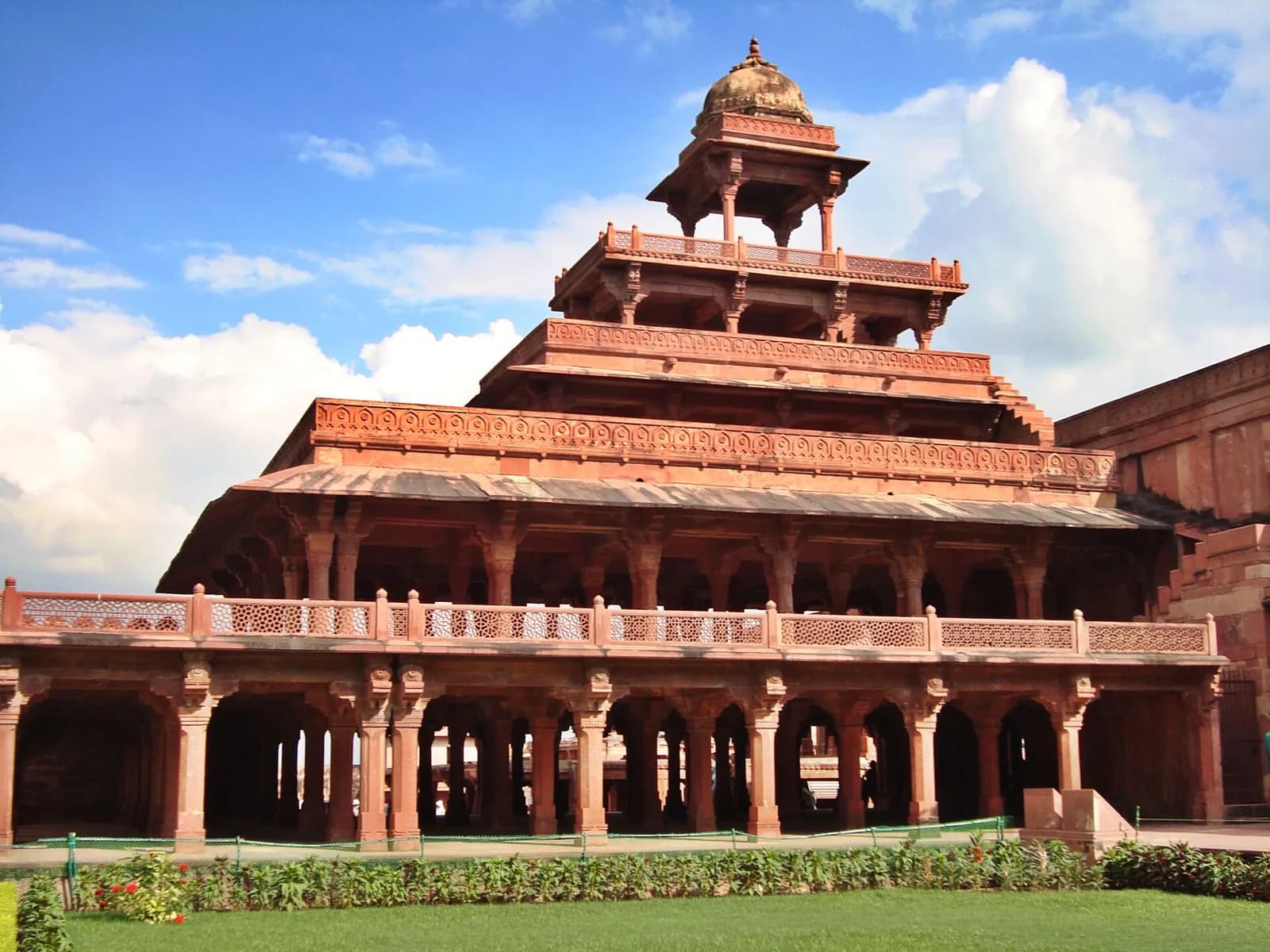
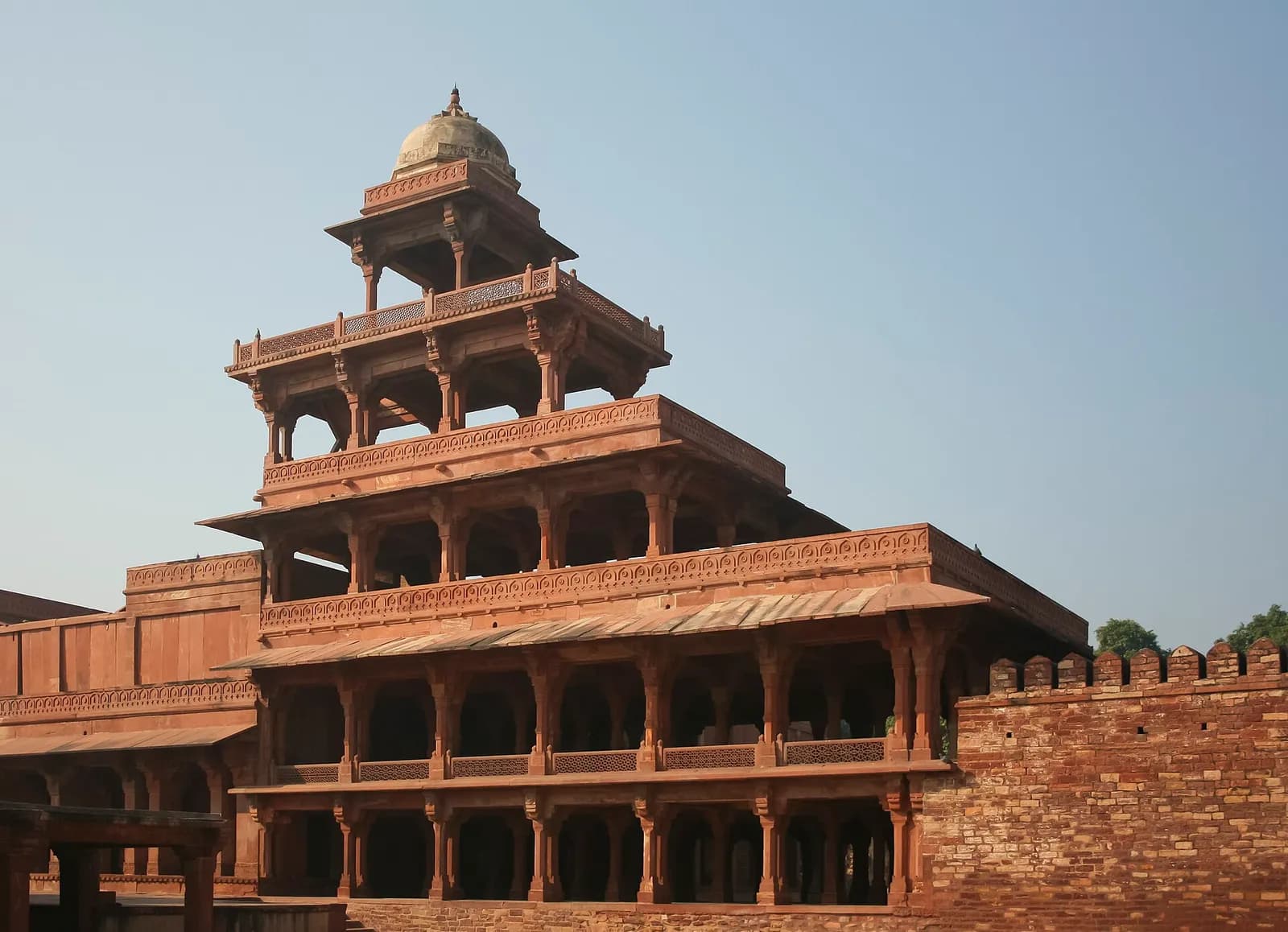
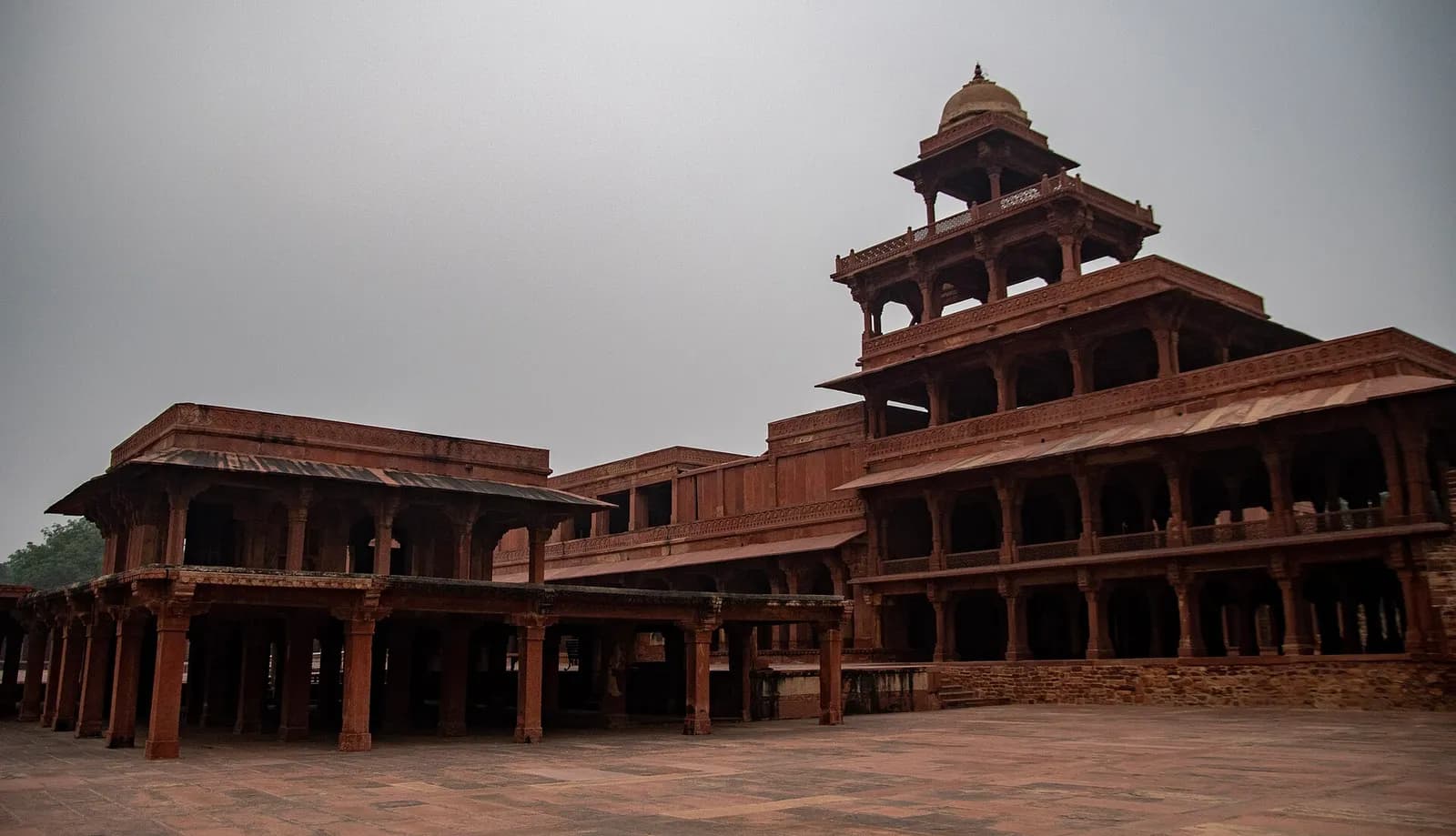
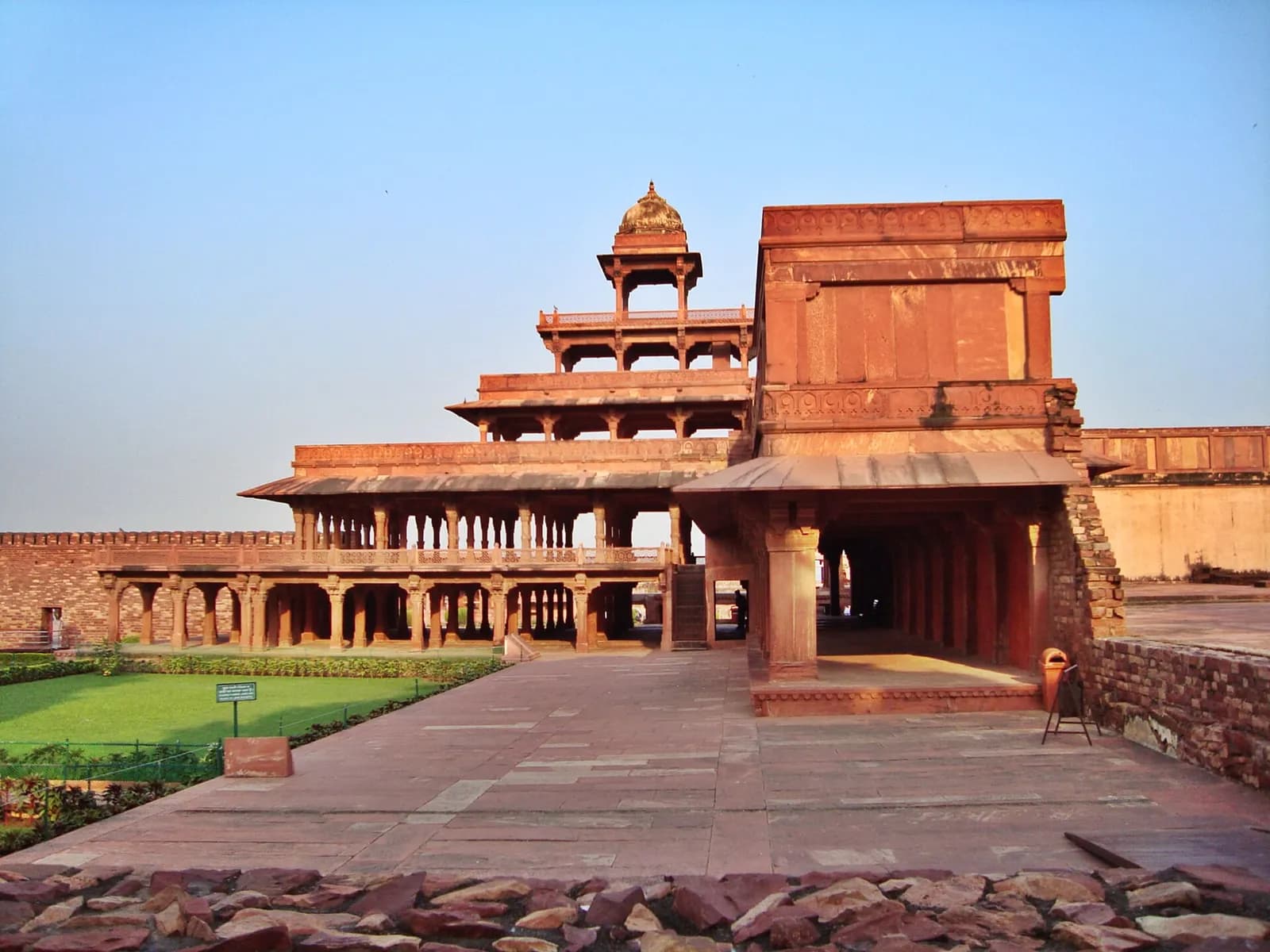
The Panch Mahal is an iconic five-storey open-air red sandstone pavilion inside the royal palace complex of Fatehpur Sikri, in Uttar Pradesh. Commissioned by the Mughal Emperor Akbar in the late 16th century, between 1569 and 1574, it served as a breezy pleasure palace and viewing tower, a kind of wind catcher or badgir, for the emperor and the royal women of the court. Its name means the five-storey palace and its form is unmistakable: an entirely columnar structure that rises in five receding tiers, each one smaller than the one below, with no walls to speak of, only rows of carved pillars open to the air. For a visitor, it is one of the most photographed and best-loved buildings at Fatehpur Sikri and it stands within the ticketed palace complex near the ornamental Anup Talao pool. Of all the structures in Akbar's capital, it is probably the one people picture first, its stepped outline having become something of an emblem of the whole site and it is certainly the one that best repays the climb to the top.
Several things make it remarkable:
- An open, columnar design. Unlike enclosed Mughal palaces, it has almost no walls, just tiers of pillars open to the breeze on every side.
- Five receding tiers. It rises like a stepped pyramid, each floor set back and smaller than the last, ending in a single domed kiosk at the top.
- 176 carved pillars. The whole structure is carried on 176 columns, no two on the ground floor alike, blending several artistic traditions.
- Built for the breeze. It worked as a wind catcher and a cool retreat, a place to relax and watch the court below.
- A royal viewing gallery. Screened in its day, it let the women of the court watch festivities and enjoy the evening air unseen.
History and purpose of the Panch Mahal
The Panch Mahal was built during Akbar's reign, when Fatehpur Sikri served as the Mughal capital and its purpose was as much social as architectural:
- A royal retreat. The structure acted as an architectural transition between the semi-public Daulat Khana courtyard and the private Zenana, the royal harem quarters, a bridge between the public and private worlds of the palace.
- An entertainment hub. It faces the ornamental Anup Talao pool, which was once filled with water and used as an open-air stage for classical musical performances by court legends such as Tansen, one of Akbar's famed Nine Jewels.
- Privacy and purdah. In its original state, intricate stone lattice screens or jaalis, stood between the outer pillars, so that royal women could enjoy the cool evening breezes and watch the court festivities below without being seen by the public.
These screens are now gone, which is why the Panch Mahal appears so open today, but in Akbar's time it would have been a more private, screened retreat. Understanding this helps you read the building: it was not a grand hall for ceremony but a comfortable, airy place for leisure, music and the quiet life of the court, placed exactly where the public palace gave way to the private.
The placement is worth pausing on, because at Fatehpur Sikri nothing was arranged by accident. Sitting between the Daulat Khana, where the emperor conducted the semi-public business of the court and the Zenana, the secluded world of the royal women, the Panch Mahal was a kind of threshold, a building both halves of the palace could share. From its tiers, screened from view, the women of the court could look out over the Anup Talao and the courtyards where music was played and festivities held, taking part in the life of the court without breaking the conventions of purdah that governed it. In an age when royal women lived largely out of public sight, a building like this, open to the air and the view yet private behind its screens, was a thoughtful solution to a real social need. That it was also the coolest, breeziest spot in the palace only added to its appeal and it is easy to picture the court gathering here on a warm evening, music drifting up from the water below.
Architecture: five tiers and 176 pillars
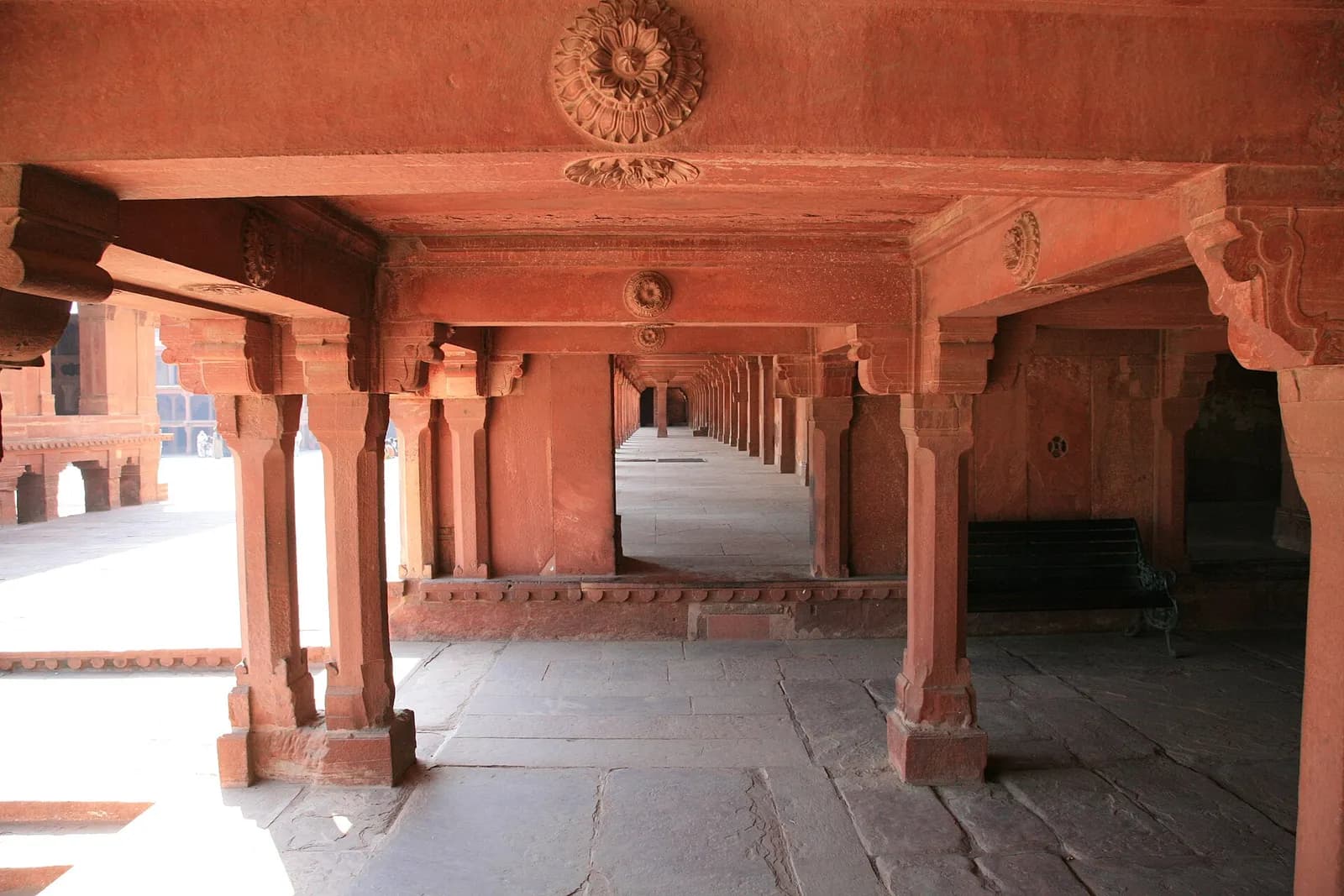
The Panch Mahal is a masterpiece of open, columnar design and its architecture is the main reason visitors are drawn to it. Unlike the enclosed palaces elsewhere in the complex, it is completely columnar and rises in five receding tiers, a tapering, pyramidal silhouette modelled in part after the stepped form of the traditional Buddhist vihara or monastery, architecture. A neat detail of its proportions is that its total height is said to equal the length of its ground floor, giving it a balanced, deliberate shape. The whole is carried on 176 intricately carved columns and as each floor rises it decreases in both size and pillar count, so the building steps inward as it climbs. The columns themselves are a showcase of fusion, carrying Persian, Hindu, Jain and Buddhist motifs, a reflection of the many traditions Akbar drew together at his capital and on the ground floor no two are alike.
The five floors and their pillars
| Floor | Pillars | Key feature |
|---|---|---|
| Ground floor | 84 | 84 entirely non-identical carved columns, 84 being an auspicious number in Hindu tradition |
| First floor | 56 | A spacious open terrace with ornate brackets |
| Second floor | 20 | Continues the asymmetrical, stepped-back pyramidal silhouette |
| Third floor | 12 | Narrows sharply, catching the higher breezes |
| Fourth floor, the top | 4 | A single domed kiosk or chhatri, with panoramic views over the fort and plains |
The progression is beautifully logical, from 84 pillars on the ground floor up through 56, 20 and 12 to just 4 at the summit, adding up neatly to the 176 that carry the whole. The ground floor's 84 columns, every one carved differently, are a particular delight for anyone who looks closely and the number itself was long considered auspicious. At the very top, the lone domed chhatri gives the finest view at Fatehpur Sikri, out across the palace complex, the Jama Masjid and the surrounding plains and it is easy to imagine the court gathering there to catch the evening wind.
The craftsmanship rewards a closer look than most visitors give it. Because the ground-floor columns are each carved differently, walking among them is like reading a catalogue of the decorative traditions Akbar's artisans had mastered, with motifs borrowed from Hindu and Jain temple pillars sitting beside Persian and Islamic forms, all worked in the warm red sandstone of the region. The brackets that support the terraces above are themselves finely cut and in several places you can still see the sockets and fittings where the lattice screens once stood between the pillars, a reminder that the building we see is only the frame of the more private, screened pavilion it once was. The absence of those screens changes the experience entirely: what was once a shaded, filtered interior is now wide open, flooded with light and air, which is why photographers love it but also why a little imagination is needed to picture it as the court knew it. Either way, it is a building that reveals more the longer you spend with it.
The design and its influences
What makes the Panch Mahal so interesting is how openly it wears its mixed inspirations. The stepped, tapering form recalls Buddhist vihara architecture, the pillars and their carving draw on Hindu and Jain temple traditions and the overall idea of an airy, screened pavilion for the court reflects Persian and Central Asian ideas of the garden pavilion and the wind catcher. This blending was entirely characteristic of Akbar, who gathered craftsmen and ideas from across his empire and beyond and whose capital at Fatehpur Sikri is one long demonstration of fusion in stone. The building's practical genius lies in its openness: with screens between the pillars and nothing to block the air, it would have been among the coolest and most pleasant spots in the palace on a hot evening, catching whatever breeze there was from any direction. In that sense it was a piece of climate-sensitive design centuries before the term existed, beautiful and comfortable at once.
The comparison with a stepped temple tower is more than skin deep. The receding tiers, each set back from the one below, create a strong vertical rhythm that draws the eye upward to the single kiosk at the summit, much as a vihara or a temple shikhara does and yet the whole thing is stripped of walls and left open, which is entirely a Mughal idea of the pleasure pavilion. This marriage of a borrowed form with a new purpose is exactly what makes Fatehpur Sikri such an interesting place architecturally: Akbar's builders were not copying any single tradition but inventing a new one from many and the Panch Mahal is one of the clearest statements of that approach. It is worth standing back from it, at the edge of the courtyard, to take in the stepped silhouette as a whole before climbing it and then looking again from the top, where the logic of the design, the diminishing floors, the catching of the breeze, the framing of the view, becomes obvious. Our notes on Taj Mahal history and facts trace how this Akbar-era sandstone experimentation led, a generation later, to the marble perfection of Shah Jahan's monuments.
Ticket price and entry
Entry to the Panch Mahal is included in the main Archaeological Survey of India ticket for the Fatehpur Sikri palace complex, so there is no separate charge for the building itself. The palace ticket costs ₹50 for Indian, SAARC and BIMSTEC citizens, reduced to ₹40 on Fridays and ₹610 for foreign nationals, reduced to ₹600 on Fridays, while children under 15 enter free. The ticket covers the whole palace complex, so the same pass that admits you to the Panch Mahal also covers the Diwan-i-Khas, Jodha Bai's Palace and the other enclosures and you can book it in advance through the official ASI online ticketing portal or buy it at the monument counter. Booking online saves time at the gate, which is worth doing on a busy day and the small Friday reduction is a minor bonus if your visit happens to fall on that day. Note that the sacred complex nearby, with the Jama Masjid, the Buland Darwaza and the Salim Chishti Dargah, is free and separate from this palace ticket, so you could in principle see those for nothing and buy the palace ticket only for the Panch Mahal and the other enclosures. In practice almost everyone visits both halves together, since they sit side by side and the single palace ticket is the one purchase you need for the whole ticketed part of the site. Keep your ticket to hand, as it is checked at the palace entrances. These prices are current at the time of writing and are revised periodically, so reconfirm the latest rate when you plan your visit and our guide to Fatehpur Sikri covers the full site and its ticketing.
Timings and the best time to visit
The monument complex is open daily from sunrise to sunset, 6 AM to 6 PM, though seasonal hours may vary slightly, so the Panch Mahal is best seen within daylight. For the most rewarding visit, come between October and March, when the weather is pleasant for wandering the open courtyards, which can be very hot in the summer months. Within the day, arriving early in the morning at sunrise or coming late in the afternoon, gives both the best natural light for photography, when the red sandstone glows warmest and cooler, more comfortable temperatures for climbing the tiers. These hours are also quieter, before and after the main flow of tour buses, so you can enjoy the building and its views without the crowds. The middle of the day sees the largest groups and the harshest light, when the open courtyards offer little shade and the sandstone throws back the heat, so if your schedule allows only a midday visit, carry water and plan to keep moving between the shaded parts of the complex. A sunrise visit has the added reward of the quiet: standing at the top of the Panch Mahal in the early light, with the capital spread out below and few others about, is as close as you can come to experiencing it as the court once did. Allow 30 to 45 minutes to explore the Panch Mahal and its surrounding courtyards and 3 to 4 hours for the entire Fatehpur Sikri complex if you intend to see it properly. All timings are current at the time of writing and can change, so reconfirm before you travel and our notes on the best time to visit Agra cover the seasons across the region.
Rules and accessibility
A few practical points help you plan a smooth visit:
- Tripods are not allowed. Camera tripods are prohibited inside the complex, though handheld photography is fine, so plan your shots accordingly.
- Use only licensed guides. Hire only government-licensed guides near the ticket counter and politely decline the unofficial touts who gather at the site.
- Ground level is step-free. The site features step-free pathways and wheelchair-accessible entrances at ground level, so the palace complex is navigable for most visitors.
- The upper tiers mean stairs. Climbing the five storeys of the Panch Mahal itself involves staircases, so the higher floors and the rooftop kiosk are reached on foot.
- Carry water and sun protection. The courtyards are open and exposed, so bring water, a hat and sunscreen, especially outside the winter months.
What to expect
Expect an airy, elegant building that rewards a slow look rather than a quick glance. From the courtyard, the Panch Mahal reads as a graceful stepped tower of columns and the pleasure of it is in the detail: the carving on the 84 ground-floor pillars, the way each tier steps back and the view that opens up as you climb towards the rooftop kiosk. Because the screens are long gone, it is completely open, so it feels light and breezy and on a clear morning the red sandstone against a blue sky is a photographer's delight. It sits within the ticketed palace complex alongside the Diwan-i-Khas, Jodha Bai's Palace and the Anup Talao pool, so you will see it as part of a wider walk through Akbar's capital rather than on its own. The site is busy in the middle of the day, so an early or late visit is calmer and cooler. It does not take long, 30 to 45 minutes is enough for the building itself, but it is one of the most characterful stops at Fatehpur Sikri and the view from the top is the best on the site. Come in the cool season, climb to the kiosk and the Panch Mahal gives you both a lesson in Mughal design and the finest panorama of the whole complex. For many visitors it is the single building they remember most clearly from Fatehpur Sikri, as much for the view and the breeze at the top as for the elegance of the stepped tiers seen from below.
How to reach the Panch Mahal
The Panch Mahal is within the palace complex at Fatehpur Sikri, 37 to 40 km west of Agra along NH-21, the Agra to Jaipur Highway, which makes it an easy half-day trip from the city. The simplest way to visit is a private cab from Agra or a guided tour that combines the city's monuments with Fatehpur Sikri, since the site sits on the Jaipur road. As with the rest of the complex, private vehicles must park at the base station, from where authorized battery-operated buses shuttle visitors up to the monument entrance, keeping traffic away from the heritage core. From the entrance it is a short walk through the palace enclosures to reach the Panch Mahal. Local buses between Agra's Idgah Bus Stand and Fatehpur Sikri also serve the town for those on a budget and the nearest railway station is at Fatehpur Sikri itself, a short ride from the complex. Our guide on how to reach the Taj Mahal and Agra covers arrival into the city, from where the Fatehpur Sikri road begins and our list of places to visit in Fatehpur Sikri covers the wider site.
The Panch Mahal in your Fatehpur Sikri and Agra trip
The Panch Mahal is one of the key stops on the half-day most visitors give to Fatehpur Sikri, seen as part of the ticketed palace complex. The natural plan is to tour the palaces, the Diwan-i-Khas, Jodha Bai's Palace, the Anup Talao and the Panch Mahal, in the cool of the morning, then cross into the free Jama Masjid courtyard for the Buland Darwaza and the Salim Chishti Dargah, so that you see both the secular and the sacred halves of Akbar's capital. Because Fatehpur Sikri lies on the road to Jaipur, it is easy to include on the way in or out of Agra rather than as a separate trip, which is why it works so well on a longer Golden Triangle route. For most travellers it pairs with a day in Agra for the Taj Mahal and the Agra Fort, with Fatehpur Sikri and its palaces on a second day or en route. Those with more time can add the riverside Itimad-ud-Daulah and a sunset at Mehtab Bagh, while our Agra travel guide and our list of things to do in Agra help you fit the pieces together. Within Fatehpur Sikri, the Panch Mahal is the building to climb for the best view of all.
Plan your trip with us
If you would like to see the Panch Mahal and Fatehpur Sikri with the logistics handled, the drive from Agra, the parking and shuttle, a government-approved guide and your palace ticket, let us help. We can build Fatehpur Sikri into your Agra itinerary as a half-day on the Jaipur road or a dedicated day trip, timed for the cool morning hours when the site is quiet and the light is best. Our Delhi Agra tours cover the Taj Mahal, the Agra Fort and Fatehpur Sikri and travellers short on time often choose a full Golden Triangle tour through Delhi, Agra and Jaipur, which passes Fatehpur Sikri directly. For a relaxed visit, our Agra overnight tour from Delhi leaves room for the palaces and the shrine, while an early start with our sunrise Taj Mahal tour or a same day Agra tour from Delhi can be extended to include it. To plan a route that takes in the Panch Mahal, message Abhay and the team directly on WhatsApp at +91 7302265809 or reach our team online and we will build an Agra and Fatehpur Sikri trip around it.
Related guides
Keep reading before you travel, these pair well with this guide:
Enquire Now
What our travellers say
“Our Golden Triangle honeymoon was flawless. Sunrise at the Taj with a private guide felt like a dream — every detail was handled.”
“As a first-time visitor to India, I felt completely safe and looked after. The driver and guide were superb professionals.”
“Travelling with two kids is hard, but they made it effortless. Great pacing, clean cars and zero surprises on price.”
“Booked the Agra day trip on short notice and it went off without a hitch. The guide's history knowledge made the Taj come alive.”
“Best decision of our India trip. Car was spotless, driver was punctual every single day, and the itinerary never felt rushed.”
“Organised a same-day Agra trip for my parents. Communication before and during the trip was excellent — genuinely stress-free.”
“Sunrise at the Taj Mahal was magical. Our guide spoke great English and answered every question with patience.”
“Three generations travelling together and everyone was comfortable — good vehicle, sensible stops, and no hidden costs.”
“I've used a few tour operators across Asia and this was among the smoothest. Fair pricing and they actually answer the phone.”
“Our custom Rajasthan-Agra combo was planned around our budget without cutting corners on comfort. Highly recommend.”
“Solo female traveller here — I felt safe throughout. The driver was respectful and the whole trip was timed perfectly.”
Ready to Explore
The Magic of Agra?
Experience the Taj Mahal at sunrise, explore the mighty Agra Fort, and discover the hidden gems of India's most beloved heritage city with our expert-guided premium tours.

Agra
Premium Tour Package
Questions
Frequently asked questions
Who built the Panch Mahal?
The Panch Mahal was built by the Mughal Emperor Akbar, in the late 16th century between 1569 and 1574, as part of his capital at Fatehpur Sikri. It was designed as a breezy pleasure palace and viewing tower for the emperor and the royal women of the court.
Why was the Panch Mahal built?
How many pillars does the Panch Mahal have?
How many storeys does the Panch Mahal have?
What is the architecture style of the Panch Mahal?
What is the Panch Mahal ticket price?
What are the Panch Mahal timings?
Where is the Panch Mahal located?
Can you climb the Panch Mahal?
How far is the Panch Mahal from Agra?
Explore more
Plan your Panch Mahal trip with us

Interested in Panch Mahal Fatehpur Sikri: History, Architecture and Pillars?
Chat with our travel team for a custom quote, or browse every package.
Related Attractions
9Panch Mahal Fatehpur Sikri on the map
Open in Google MapsReady to explore Panch Mahal Fatehpur Sikri: History, Architecture and Pillars?
Book your private tour today and experience the magic of India's rich heritage.