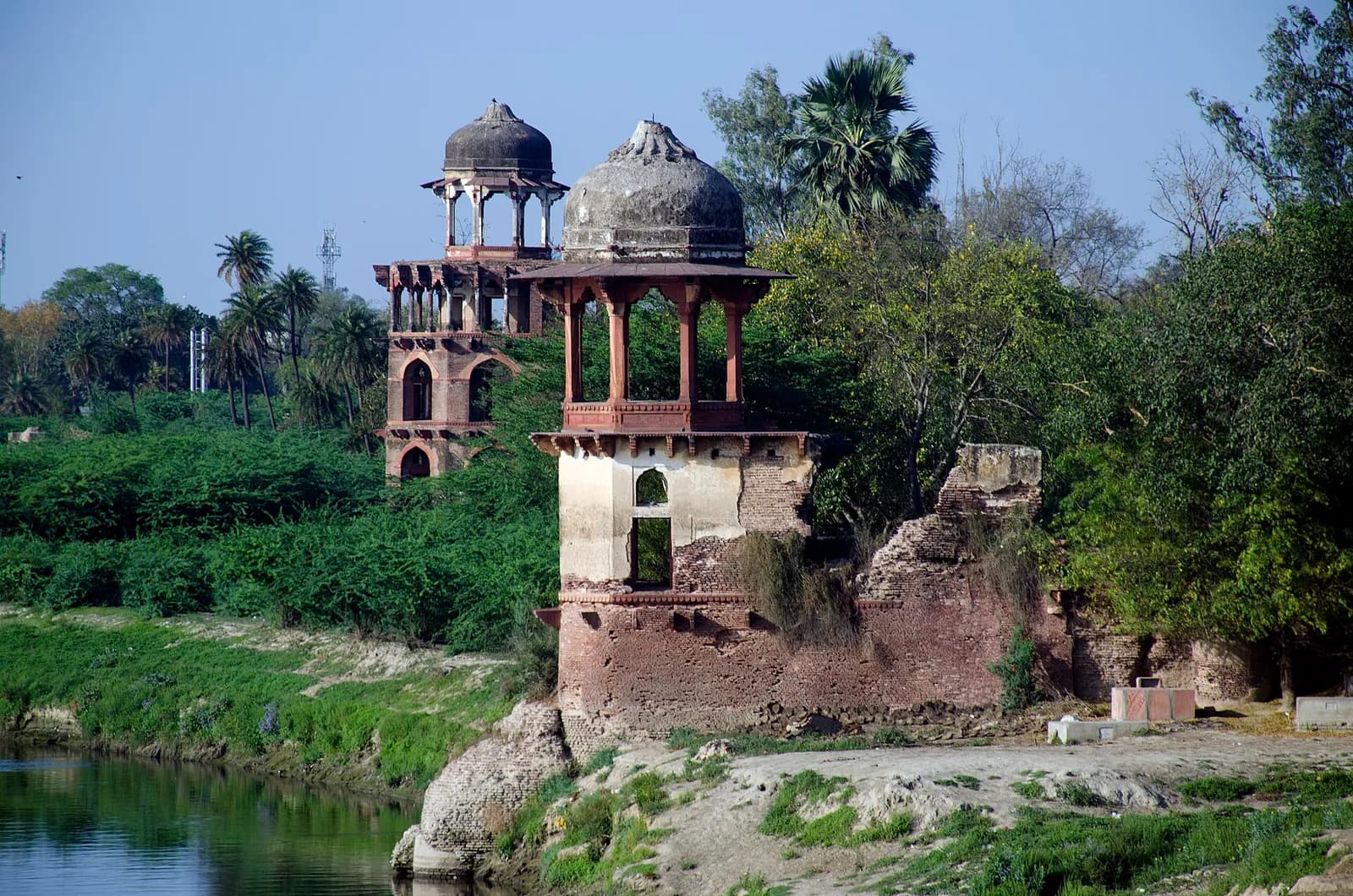
 East bank of the Yamuna, Agra
Ram Bagh Agra: India's Oldest Mughal Garden, Timings and History
Visiting Ram Bagh in Agra, India's oldest Mughal garden laid out by Babur? Its history, timings, tickets, the terraces, how to reach and best time to visit.
Quick answer
Ram Bagh originally Aram Bagh, is India's oldest surviving Mughal garden, laid out by Emperor Babur in the 1520s on the eastern bank of the Yamuna in Agra. It introduced the Persian charbagh paradise-garden design that later shaped the Taj Mahal and it opens every day from sunrise to sunset. It features on our Agra tours, run by a unit of Experience My India.
- #ram-bagh
- #agra
- #agra-attractions
- #agra-travel
Ram Bagh is where the whole Mughal garden story in India begins, a shady riverfront retreat built by the dynasty's founder almost a century before the Taj Mahal rose downstream. Our team at Delhi Agra Tour Packages folds it into unhurried eastern bank days and it sits naturally on any Golden Triangle tour through Delhi, Agra and Jaipur.
I am Abhay Sharma, a Golden Triangle guide since 2015 and I send history lovers here precisely because so few tourists know it exists. This is the garden Babur built to escape the Indian heat, where his body rested for nearly nine years before being carried home to Kabul and whose charbagh blueprint echoes in every Mughal garden that followed. Few places in Agra reward a little background knowledge as richly as this one, because what looks at first like a simple shaded park is in fact the root of the entire Mughal garden tradition. This guide gathers everything I would tell a visitor beforehand, the history and the terraces, the timings and tickets, what to expect today and how to fold it into a trans-Yamuna circuit.
Ram Bagh at a glance
| Detail | Information |
|---|---|
| Original name | Aram Bagh, the Garden of Rest |
| Claim to fame | India's oldest surviving Mughal garden |
| Laid out by | Emperor Babur, founder of the Mughal Empire |
| Built | 1520s, between 1526 and 1528 |
| Location | Firozabad Road, east bank of the Yamuna, Agra |
| Managed by | Archaeological Survey of India |
| Open | All seven days |
| Time needed | 45 minutes to 1 hour |
| Best season | October to March |
Ram Bagh timings
| Detail | Information |
|---|---|
| Open | All seven days |
| Hours | Sunrise to sunset, 6 AM to 6 PM |
| Time needed | 45 minutes to 1 hour |
Ram Bagh is maintained by the Archaeological Survey of India and stays open every day of the week, from sunrise to sunset, 6 AM to 6 PM. There is no closed day, so it fits any Agra schedule, including Friday when the Taj Mahal is shut. These timings are current at the time of writing and can change, so reconfirm before a special trip.
Entry fee
| Visitor | Entry fee |
|---|---|
| Indian, SAARC and BIMSTEC nationals | 25 rupees per person |
| Foreign nationals | 300 rupees per person |
| Children under 15 | Free, all nationalities |
Foreign nationals pay an additional Agra Development Authority toll of 500 rupees, which is exempt on Fridays and valid across the major Agra monuments on the same day, so if you already paid it at the Taj Mahal or the Agra Fort, keep your receipt and you will not pay it twice. Tickets are available at the entrance counter or online through the official ASI portal. These prices are current at the time of writing and are revised periodically, so reconfirm before you travel.
How to reach Ram Bagh
| From | Route |
|---|---|
| Taj Mahal | 5 to 8 km north on the eastern bank |
| Itimad-ud-Daulah (Baby Taj) | 3 km southwest |
| By auto, e rickshaw or cab | From Agra Fort, Agra Cantt or Yamuna Kinara Road |
| Location | Firozabad Road, the Agra to Aligarh Road |
What is Ram Bagh?
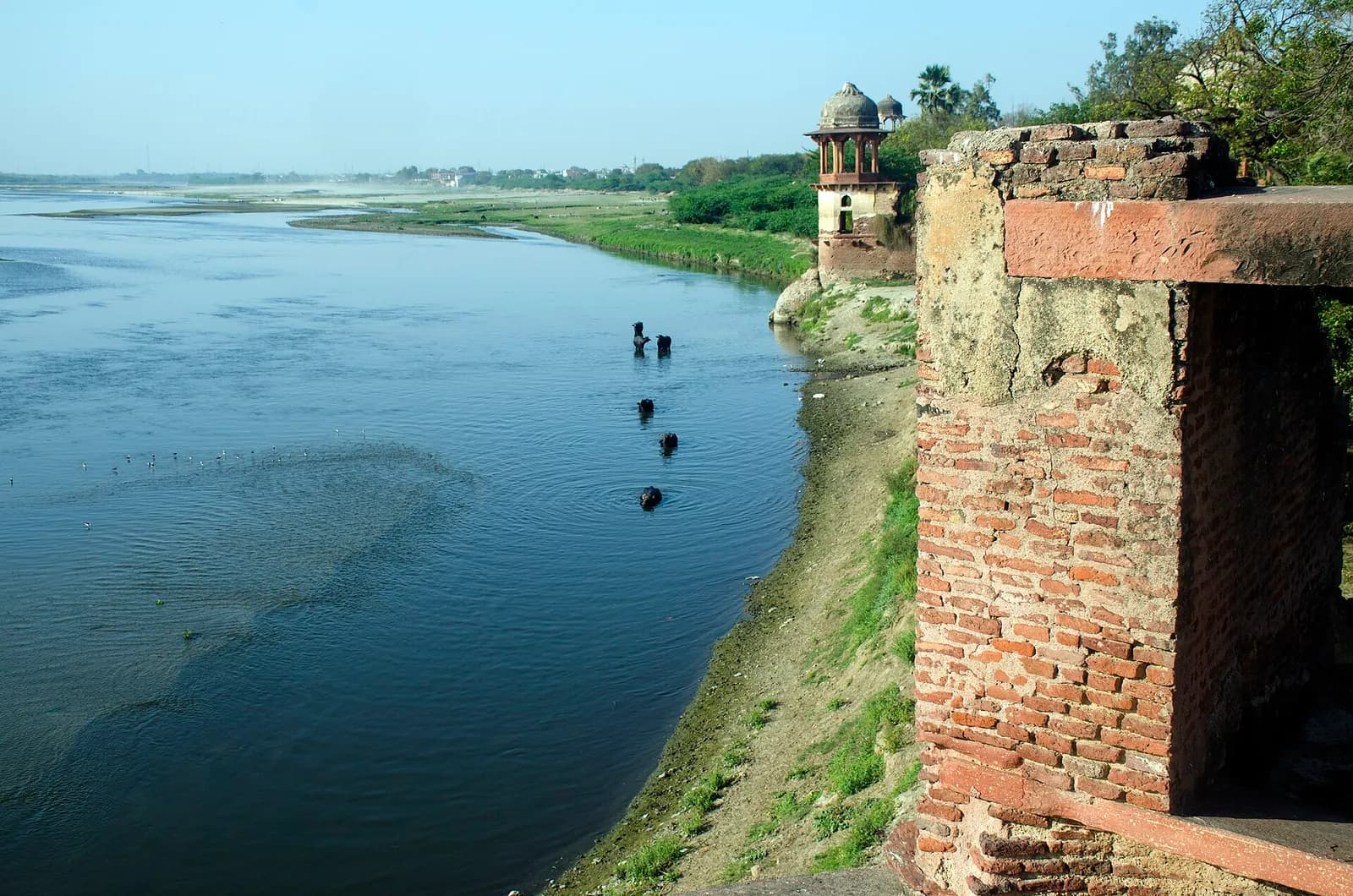
Ram Bagh originally called Aram Bagh, meaning the Garden of Rest and also known as Bagh-i-Gul Afshan, the Flower-Scattering Garden, is India's oldest surviving Mughal garden, laid out by Emperor Babur, the founder of the Mughal Empire, in the 1520s. Set on the eastern or left, bank of the Yamuna in Agra, it introduced the Persian charbagh paradise-garden blueprint to India, the four-quartered design that later culminated in the gardens of the Taj Mahal. In other words, this quiet, shady garden is where the entire Mughal garden tradition in India begins. Every formal Mughal garden that came after it, the terraces of Kashmir, the riverfront gardens of Agra and above all the great charbagh that frames the Taj Mahal, traces its lineage back to the ideas Babur planted here on the banks of the Yamuna.
For the visitor, that makes Ram Bagh far more significant than its modest, weathered appearance suggests. You are not looking at a grand monument but at a founding idea, the moment the Mughals first laid out their vision of paradise as a garden on Indian soil. Understanding that transforms a short walk through the trees into a walk through the very beginning of a tradition that would produce some of the most beautiful buildings in the world.
Several things make it special and they are worth drawing out:
- India's oldest Mughal garden. The first and oldest surviving charbagh in the country, laid out by Babur himself.
- The blueprint for the Taj. It introduced the Persian paradise-garden design that every later Mughal garden, including the Taj Mahal's, would follow.
- Babur's own retreat. Built by the dynasty's founder as a cool riverfront escape from the Indian heat.
- A royal resting place. Babur's body lay here for nearly nine years before being moved to Kabul.
- Peaceful and green. A shady, tree-filled garden that offers a calm break from Agra's crowded monuments.
History of Ram Bagh
The story of Ram Bagh runs from the very first Mughal emperor through centuries of renaming and it is one of the richest histories of any garden in India.
The story runs in clear stages:
- Babur's oasis from the heat. Dissatisfied with the dust and intense summer heat of northern India after arriving from Central Asia, Babur built this riverfront retreat to recreate the terraced, running-water gardens of Kabul and Samarkand.
- Babur's temporary tomb. When Babur died in Agra in December 1530, his body was temporarily buried inside Ram Bagh for nearly nine years before his widow moved his remains to his final resting place in Kabul, Afghanistan.
- Nur Jahan and Jahangir's renovation. In the early 1600s, Empress Nur Jahan and Emperor Jahangir extensively redesigned the garden, adding riverside pavilions, cascades and subterranean chambers and renaming it Bagh-i-Nur Afshan, the Light-Scattering Garden.
- How it became Ram Bagh. When the Marathas controlled Agra between 1775 and 1803, the historic name Aram Bagh gradually shifted in local usage to Ram Bagh, a name that stuck through the British colonial era into modern times.
That slow drift from Aram Bagh to Ram Bagh is the detail guests always enjoy, because it shows how a place can quietly change its name over centuries while keeping its soul. The garden you walk today carries all of these layers at once, Babur's original vision, Nur Jahan's refinements and the Maratha-era renaming.
The link to Babur himself is what makes the history so moving. He was the first Mughal emperor, a descendant of both Timur and Genghis Khan, who swept down from Central Asia and won an empire, yet found the heat and dust of the Indian plains hard to bear. The gardens he had known in Kabul and Samarkand, cool, terraced, full of running water and fruit trees, were what he missed most and Ram Bagh was his attempt to recreate that lost world on the Yamuna. When he died, it was fitting that his body should rest here first, in the garden that most reminded him of home, before the long journey back to Kabul where he lies today.
Nur Jahan's later touch adds another royal layer. The same empress who built the Baby Taj for her father downstream turned her eye to this older garden too, adding pavilions, cascades and cool underground chambers, so that Ram Bagh carries the fingerprints of two of the most important figures in Mughal history, the dynasty's founder and its most powerful empress.
Ram Bagh architecture and garden layout
Ram Bagh is not a flat, symmetrical garden but a cleverly engineered terraced one and the features below reward a slow walk.
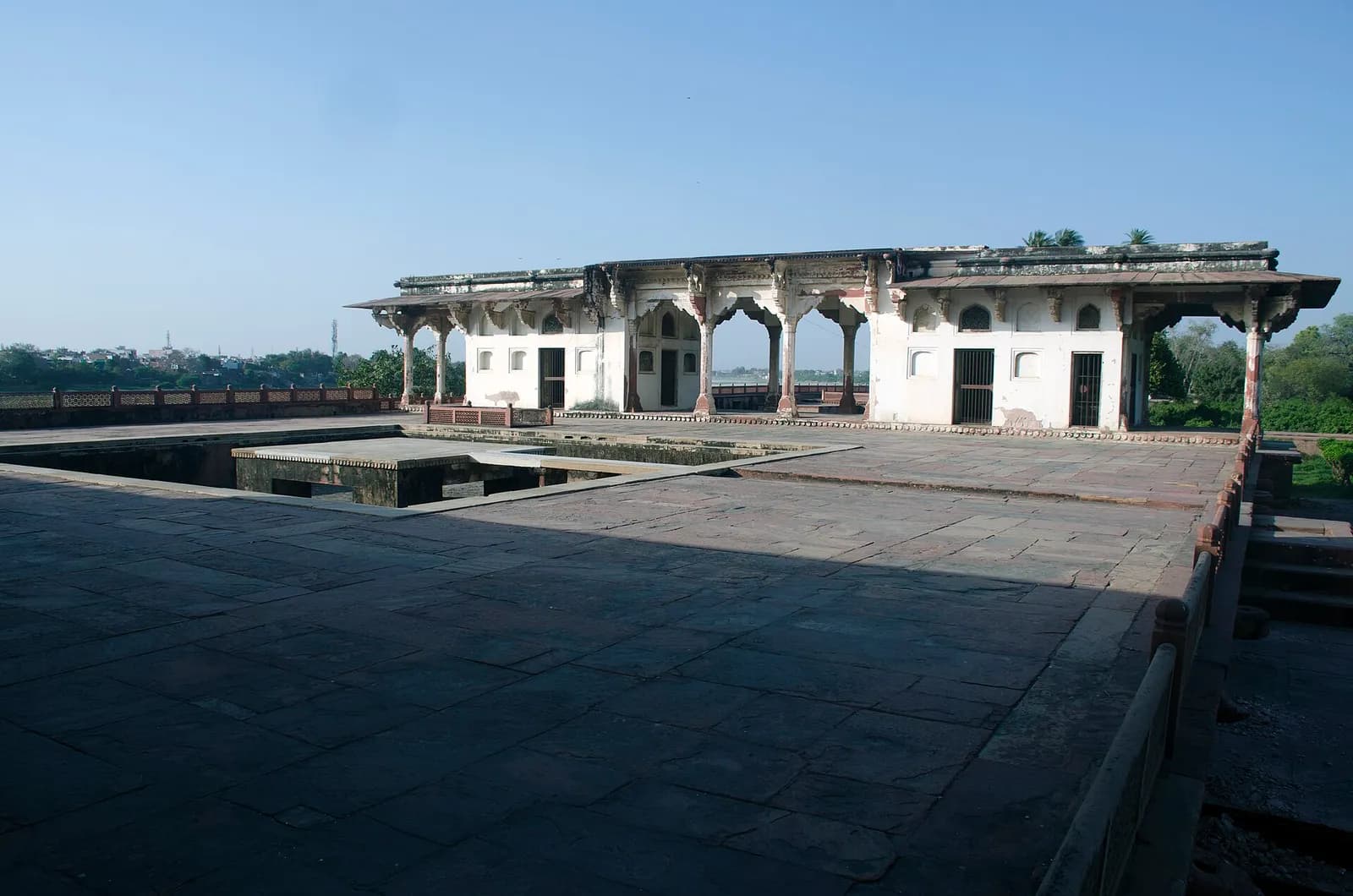
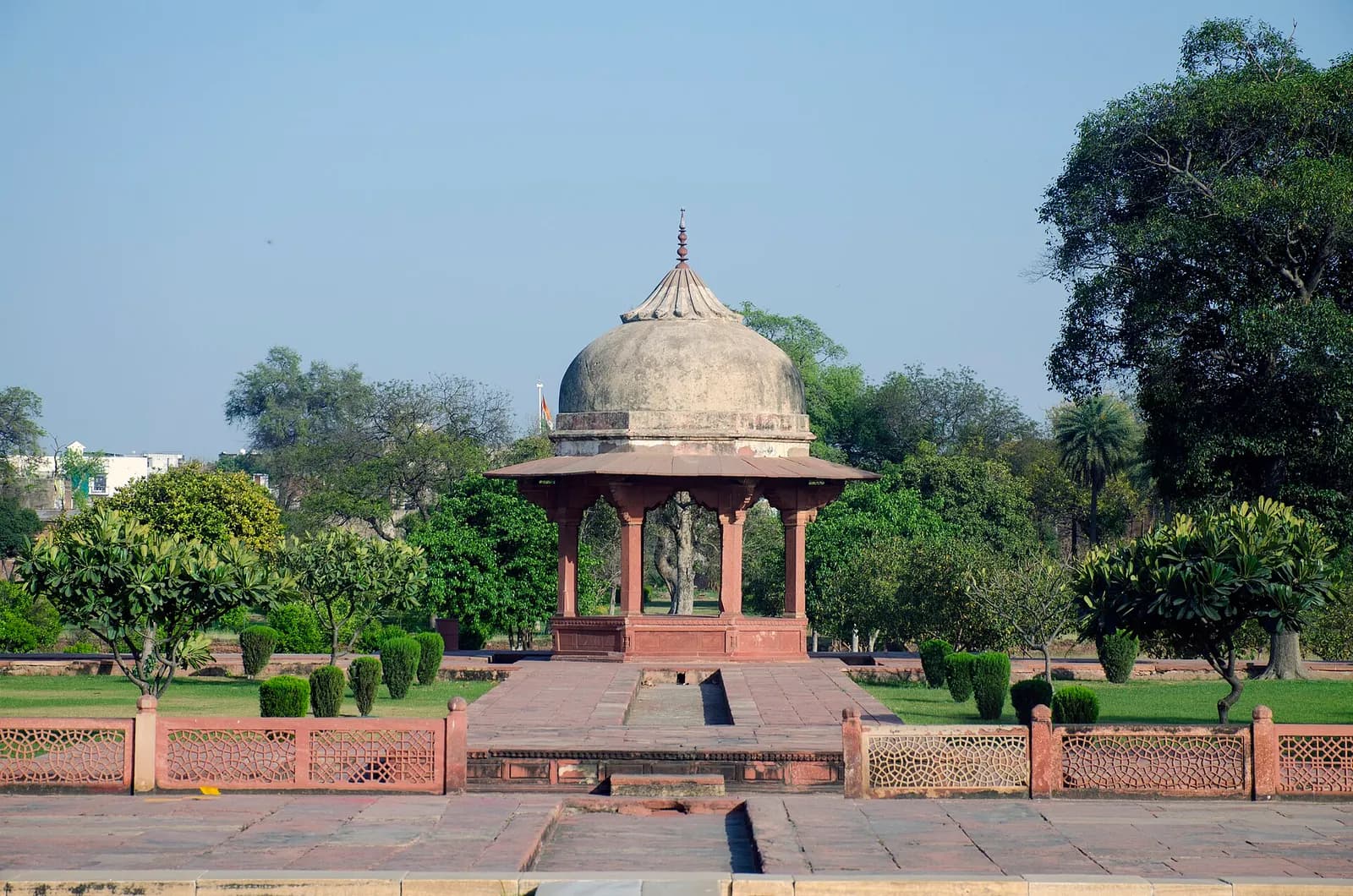
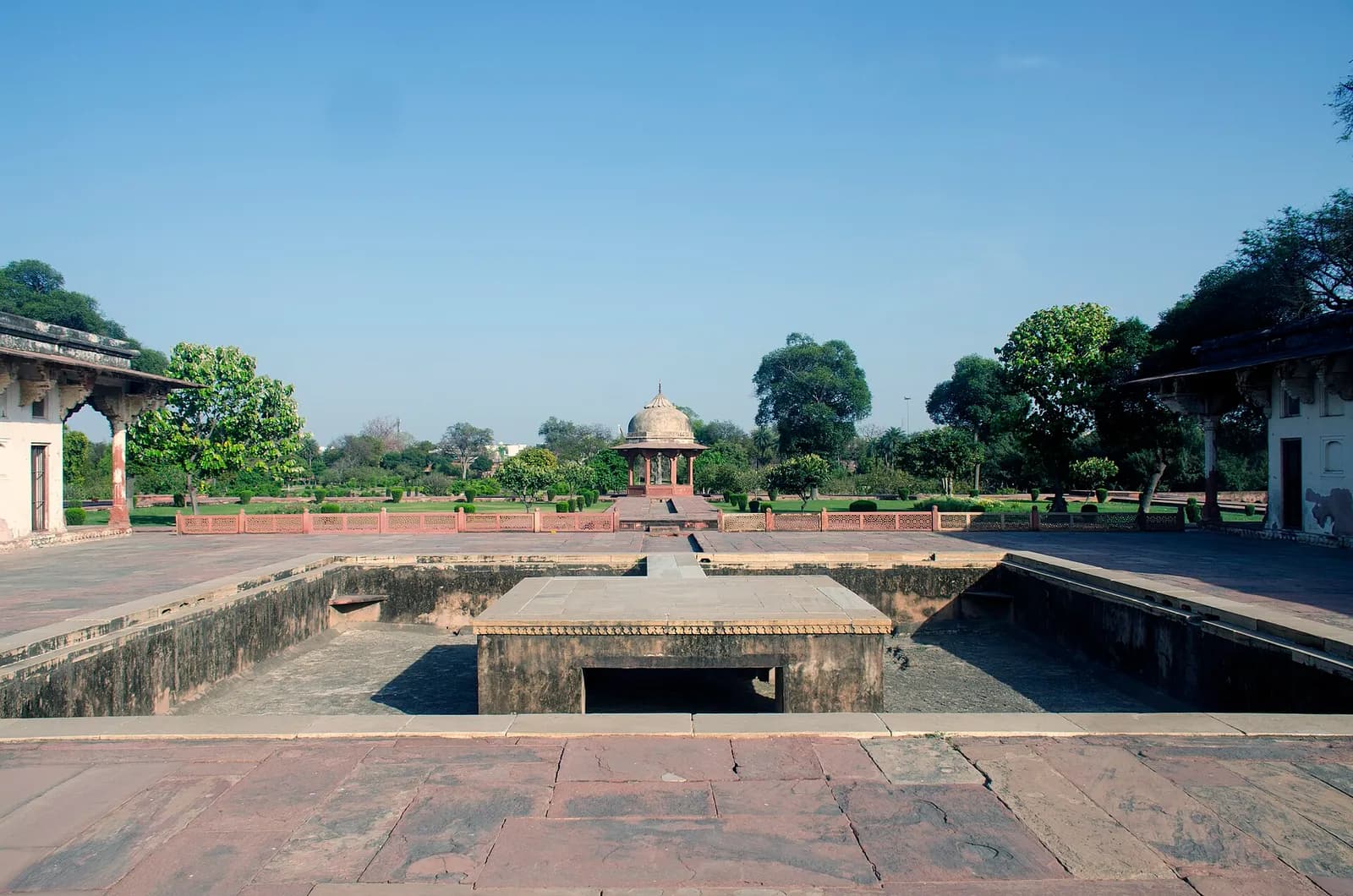
- Three-tiered terraced design. Unlike the flat, symmetrical gardens that came later, the garden rises across three distinct levels along the Yamuna bank, a lower level of flowerbeds and orchards, a middle level of stone-paved walkways and water channels and an upper riverfront terrace holding pavilions and water tanks.
- Hydraulic and cooling engineering. Water drawn from the Yamuna by traditional Persian wheels, the rahat, fed raised stone channels, stepped water chutes, the chadars and sunken reflection pools, creating natural evaporative cooling throughout the grounds.
- Riverfront pavilions and tahkhanas. Two main red sandstone pavilions, the baradaris, stand on the upper terrace overlooking the river and beneath them sit underground chambers, the tahkhanas, designed to stay cool during Agra's scorching summers.
- The Mughal hammam. On the northeastern side, steps lead down to the remains of a vaulted royal bathhouse, considered one of the earliest Mughal bathhouses built in India.
- Enclosure and corner towers. High perimeter walls with octagonal corner towers, the burjs, crowned by pillared chhatris, frame the garden and guard the riverfront view.
Engineering is the quiet marvel here. Long before electric pumps, Mughal builders lifted river water with ox-driven wheels and let it run and fall through the garden to cool the air, a system you can still read in the stone channels and chutes underfoot. The underground tahkhanas take the same idea further, giving the royal family a cool retreat during the worst of the summer and they are a reminder that these gardens were engineered for comfort as much as beauty.
The three-tiered layout is worth understanding as you walk, because it is what sets Ram Bagh apart from the flat, perfectly symmetrical gardens that came later. By stepping the garden down toward the river in levels, the builders could move water from the upper terrace downward through chutes and channels, using gravity to carry the cooling flow across the whole site. The lowest level held the orchards and flowerbeds, the middle level the paved walkways and running water and the upper riverfront terrace the pavilions where the royal family sat to catch the breeze off the Yamuna. It is a design shaped entirely by the realities of the Indian climate and once you see the logic of it, the garden reads like a machine for making shade and coolness.
The riverfront pavilions and their hidden chambers are the highlight for most visitors who take the time to look. The red sandstone baradaris on the upper terrace framed the view across the river, while the tahkhanas beneath them, reached by steps, stayed cool through the hottest months. Add the vaulted remains of one of the earliest Mughal bathhouses in India on the northeastern side and you have a surprisingly complete picture of how a Mughal pleasure garden actually worked, not just as a place of beauty but as a liveable royal retreat.
Ram Bagh ticket price and entry fee
Ram Bagh is an easy and affordable monument to add to an Agra day. At the time of writing, entry was 25 rupees for Indian, SAARC and BIMSTEC visitors and 300 rupees for foreign nationals, with children under 15 free. Foreign visitors also pay the Agra Development Authority toll of 500 rupees, which is exempt on Fridays and valid across the major Agra monuments the same day, so a receipt from the Taj Mahal or the Agra Fort covers you here too. Tickets are sold at the entrance counter or online through the official ASI portal and you should plan on 45 minutes to 1 hour for a relaxed visit. These figures are current at the time of writing and change periodically, so reconfirm before you travel.
What to expect at Ram Bagh today
I always set expectations honestly here. Outside restoration periods the ancient water channels are usually dry, so you will not see the cascades running as they once did. What you will find instead is a dense canopy of old trees, weathered stone terraces and quiet riverfront pavilions that offer a genuinely peaceful break from Agra's crowded monuments. This is a garden for atmosphere and history rather than grand spectacle, a shady, green, contemplative space where you can imagine Babur resting after his campaigns. Seen with the right expectations, it is one of the calmest and most evocative corners of Agra and the tree cover makes it pleasant even when the famous monuments are baking in the sun.
In the early morning you will often share the garden only with local walkers who come for the quiet and the river air, which gives it a lived-in, neighbourhood feel quite unlike the ticketed bustle of the Taj and the Fort. Birdsong, old trees and the soft light on the stone terraces make it a restorative stop in the middle of an intense sightseeing day. I tell guests to treat Ram Bagh as a pause rather than a performance, somewhere to slow down, sit in the shade for a few minutes and absorb the fact that they are standing in the oldest Mughal garden in the country.
Rules and facilities at Ram Bagh
A few simple rules and realities shape a visit, so keep these in mind:
- Photography. Personal photography is allowed freely across the garden, so bring a camera for the terraces and pavilions.
- Prohibited items. Outside food, littering and drones are not allowed.
- Facilities. There are basic seating and shaded pathways inside, but no cafes, restrooms or shops on site, so carry your own water and anything else you need.
- Footing. The terraces and old stone paths are uneven in places, so wear comfortable shoes.
Best time to visit Ram Bagh
The best season is October to March, when the weather is comfortable and the garden is at its greenest. Within the day, come in the early morning, from 6:30 AM to 9 AM or in the late afternoon, from 4 PM to 5:30 PM. Morning hours bring cool river breezes, soft light and local walkers and the tree-filled garden is especially lovely before the day heats up. Harsh midday sun and the summer months are far less pleasant, so aim for the end of the day. A dawn visit also pairs neatly with a sunrise at the Taj Mahal, letting you cross to the quiet eastern bank while the light is still soft and the air still cool, before the tour buses fill the main monuments. Our wider notes on the best time to visit Agra apply closely here and because the garden is quiet and affordable, it is easy to time your visit for the cool hours.
How to reach Ram Bagh and its location
Ram Bagh stands on Firozabad Road, the Agra to Aligarh Road, on the eastern bank of the Yamuna, 5 to 8 km north of the Taj Mahal and 3 km northeast of Itimad-ud-Daulah. It is easily reached by auto rickshaw, e rickshaw or private cab from the Agra Fort, Agra Cantt or along the Yamuna Kinara Road. Just north of Ram Bagh stands a lesser-known gem, Battish Khamba, meaning the 32 Pillars, a 17th-century red sandstone tower built during Jahangir's reign, worth a quick look if you have time and an appetite for the truly offbeat. One practical note for this quiet corner of Agra, ask your driver to wait while you explore, as hailing a return rickshaw directly outside the garden can take a little while away from the main tourist routes. If Ram Bagh is part of a fuller Agra plan, it pairs naturally with an eastern bank morning and our sunrise Taj Mahal tour works well before a crossing to this side of the river. Travellers staying over often add it to an Agra overnight tour from Delhi.
Places to visit near Ram Bagh: the trans-Yamuna circuit
Ram Bagh is the northern anchor of Agra's trans-Yamuna heritage trail, so the smartest way to see it is as the first stop on a left-bank loop heading south. From here you move down the same bank to Chini ka Rauza, the tiled Porcelain Tomb 1.5 km south, then to Itimad-ud-Daulah, the Baby Taj, 2.5 km south and finally to Mehtab Bagh, opposite the Taj Mahal, for the classic sunset view. String these together and you have a single relaxed half day on the quiet side of the river, away from the crowds. The beauty of starting at Ram Bagh is chronological as well as geographical, you begin with the oldest Mughal garden, built by the dynasty's founder and work your way down the bank through later tombs and gardens toward the Taj Mahal itself, so the circuit doubles as a walk through Mughal history in the order it unfolded. Done in the second half of the day, it ends perfectly with the Taj glowing gold across the water from Mehtab Bagh at sunset. You can read more in our overview of places to visit near the Taj Mahal and our list of lesser-known Agra monuments and dig into the tiled tomb next door in our guide to Chini ka Rauza.
Visiting tips for Ram Bagh
A few notes I give every group before we go:
- Come in the cool hours. Early morning or late afternoon makes the garden far more pleasant and brings the best light.
- Carry water. There are no cafes or shops on site, so bring your own.
- Manage expectations. The water channels are usually dry, so come for the trees, terraces and history rather than running cascades.
- Look for the tahkhanas and hammam. The underground chambers and the old bathhouse are easy to miss but reward a little exploring.
- Add Battish Khamba. The 32 Pillars tower just north is a quick, offbeat extra for the curious.
Hiring a guide at Ram Bagh
Because Ram Bagh is unlabelled and much of its story is invisible at first glance, a good guide adds a great deal here, explaining how Babur built it, why the terraces and water channels mattered and how this single garden became the template for every Mughal garden that followed, including the Taj Mahal's. The engineering of the Persian wheels, chutes and cool underground chambers also comes alive with someone to point it out. If you are doing the whole trans-Yamuna circuit, a single guide for the morning works better than hiring separately at each stop, since the eastern bank sites share one continuous Mughal story. Our guided tours handle exactly this, so you get one knowledgeable person for the whole loop, from Ram Bagh in the north down to the Mehtab Bagh sunset.
Ram Bagh in your Golden Triangle itinerary
Ram Bagh is a historian's stop rather than a headline, so it works best added to an eastern bank morning or afternoon alongside the bigger Agra sights. A classic Agra day sees the Taj Mahal at sunrise and the Agra Fort through the morning, then crosses the river for the quieter gardens and tombs, with Ram Bagh as the northern start of the loop. For travellers who want to understand how the Mughals thought about gardens before they ever saw the Taj, it is the perfect prologue and it pairs beautifully with Fatehpur Sikri and our wider Agra travel guide for a trip that goes beyond the two famous monuments.
On a tight schedule, even half an hour in Ram Bagh is worth building in, because it costs little, sits on the eastern bank route and adds real historical depth to a day that might otherwise be only the Taj and the Fort. On a fuller trip, it anchors a leisurely eastern bank loop that balances the intensity of the headline monuments with something green, quiet and reflective. Either way, Ram Bagh is the kind of stop that turns a standard Agra visit into a proper journey through Mughal history, from the dynasty's very first garden to its greatest tomb and that is exactly the sort of day we love to build for our guests.
Plan your trip with us
If you would like the quiet, historic side of Agra done well, with the eastern bank gardens and tombs arranged around the cool hours and a comfortable car waiting, let us carry the load. We shape the day so you see the famous monuments and the hidden gems without the stress of navigating Agra's roads yourself. Our Delhi Agra tours combine Ram Bagh and its neighbours with the Taj Mahal and Agra Fort and travellers short on time often choose our same day Agra tour from Delhi or a full Golden Triangle tour that threads Delhi, Agra and Jaipur. To plan dates, prices and inclusions, message Abhay and the team directly on WhatsApp at +91 7302265809 or reach our team online.
Related guides
Keep reading before you travel, these pair well with this guide:
Enquire Now
What our travellers say
“Our Golden Triangle honeymoon was flawless. Sunrise at the Taj with a private guide felt like a dream — every detail was handled.”
“As a first-time visitor to India, I felt completely safe and looked after. The driver and guide were superb professionals.”
“Travelling with two kids is hard, but they made it effortless. Great pacing, clean cars and zero surprises on price.”
“Booked the Agra day trip on short notice and it went off without a hitch. The guide's history knowledge made the Taj come alive.”
“Best decision of our India trip. Car was spotless, driver was punctual every single day, and the itinerary never felt rushed.”
“Organised a same-day Agra trip for my parents. Communication before and during the trip was excellent — genuinely stress-free.”
“Sunrise at the Taj Mahal was magical. Our guide spoke great English and answered every question with patience.”
“Three generations travelling together and everyone was comfortable — good vehicle, sensible stops, and no hidden costs.”
“I've used a few tour operators across Asia and this was among the smoothest. Fair pricing and they actually answer the phone.”
“Our custom Rajasthan-Agra combo was planned around our budget without cutting corners on comfort. Highly recommend.”
“Solo female traveller here — I felt safe throughout. The driver was respectful and the whole trip was timed perfectly.”
Ready to Explore
The Magic of Agra?
Experience the Taj Mahal at sunrise, explore the mighty Agra Fort, and discover the hidden gems of India's most beloved heritage city with our expert-guided premium tours.

Agra
Premium Tour Package
Questions
Frequently asked questions
Who built Ram Bagh and when?
Ram Bagh was laid out by Emperor Babur, the founder of the Mughal Empire, in the 1520s, between 1526 and 1528, on the eastern bank of the Yamuna in Agra. It is the oldest surviving Mughal garden in India, built almost a century before the Taj Mahal.
What was the old name of Ram Bagh?
Why is it called Ram Bagh now?
What is the Ram Bagh ticket price?
What are the Ram Bagh timings?
How far is Ram Bagh from the Taj Mahal?
Is Ram Bagh worth visiting?
What can I see inside Ram Bagh?
How much time do I need at Ram Bagh?
What else can I see near Ram Bagh?
Is Ram Bagh the same as the Taj Mahal gardens?
Does Ram Bagh have running water today?
Is Ram Bagh good for a quiet, offbeat visit?
Can I combine Ram Bagh with a Taj Mahal sunrise?
Explore more
Plan your Ram Bagh trip with us

Interested in Ram Bagh Agra: India's Oldest Mughal Garden, Timings and History?
Chat with our travel team for a custom quote, or browse every package.
Related Attractions
9Ram Bagh Agra on the map
Open in Google MapsReady to explore Ram Bagh Agra: India's Oldest Mughal Garden, Timings and History?
Book your private tour today and experience the magic of India's rich heritage.