


 Agra Cantonment, Agra
St George's Cathedral Agra and the City's Historic Churches
Visiting the churches of Agra? Here is a guide to St George's Cathedral, Akbar's Church and more, with their history, free entry, timings and how to reach them.
Quick answer
St George's Cathedral is one of North India's oldest Protestant churches, built in 1828 in the Agra Cantonment, with English Gothic architecture and historic military memorials. Agra also holds several other landmark churches, from Akbar's Church of 1598 to the grand Cathedral of the Immaculate Conception. Entry to all of them is free and they feature on our Agra tours, run by a unit of Experience My India.
- #st-georges-cathedral
- #agra
- #agra-attractions
- #agra-travel
Agra is famous for its Mughal monuments, but tucked into the Cantonment and Civil Lines are some of North India's oldest churches, spanning from the late 16th century to the early 20th and almost no tourists ever see them. From a Jesuit church built on land gifted by the emperor Akbar to a Gothic cathedral raised for British troops, they tell a quieter, fascinating side of the city's story, one that stretches across four centuries and several faiths, denominations and architectural styles. Our team at Delhi Agra Tour Packages includes them for travellers who want to go beyond the obvious and they fit easily into a Golden Triangle tour through Delhi, Agra and Jaipur.
I am Abhay Sharma, a Golden Triangle guide since 2015 and these churches are among my favourite surprises to show curious visitors. St George's Cathedral, with its soldiers' rifle-rest pews, Akbar's Church from 1598, the vast Cathedral of the Immaculate Conception and the pretty pink St Mary's, together reveal an Agra few know exists. This guide covers St George's in detail, then the city's other historic churches, with the history, the free entry, the timings and how to reach them. Entry to every one is free.
Agra's churches at a glance
| Church | Year | Denomination | Open |
|---|---|---|---|
| St George's Cathedral | 1828 | Protestant (CNI) | Sunday 9 AM for interior |
| Akbar's Church | 1598 to 1600 | Roman Catholic | Mon to Sat, 11 AM to 6 PM |
| Cathedral of the Immaculate Conception | 1848 | Roman Catholic | Daily, 9 AM to 6 PM |
| St John's Church | 1855 | Protestant (CNI) | Tue to Sun, 10 AM to 9 PM |
| St Mary's Church | 1923 | Roman Catholic | Mass hours, morning and evening |
St George's Cathedral timings
| Detail | Information |
|---|---|
| Exterior grounds | Daily until 5 PM |
| Interior | Best on Sunday from 9 AM, at the service |
| Weekdays | Sanctuary usually locked, ask the caretaker |
| Time needed | 30 to 45 minutes |
The grounds of St George's Cathedral are accessible daily until 5 PM, but the main sanctuary is usually kept locked on weekdays to protect the interior. The best time to see inside is on a Sunday morning during the 9 AM church service or by politely asking the on-site caretaker to unlock the doors. These timings are current at the time of writing and depend on the caretaker and the parish, so a Sunday visit is the most reliable. Plan on 30 to 45 minutes for the cathedral and its memorials.
Entry fee
| Church | Entry fee |
|---|---|
| St George's Cathedral | Free |
| Akbar's Church | Free |
| Cathedral of the Immaculate Conception | Free |
| St Mary's and St John's | Free |
Entry to St George's Cathedral and all of Agra's major historic churches is completely free, with no tickets or counters. These are active places of worship maintained by their parishes, so there is no admission charge for visitors of any nationality and a small donation to a church you enjoy is a kind gesture but never required. This information is current at the time of writing.
How to reach the churches
| Church | Location |
|---|---|
| St George's Cathedral | Mall Road, Sadar Bazar, Agra Cantt |
| Akbar's Church and Immaculate Conception | Wazirpura Road, Civil Lines |
| St Mary's Church | Rakabganj |
| St John's Church | Hospital Road, Mantola |
St George's Cathedral, Agra
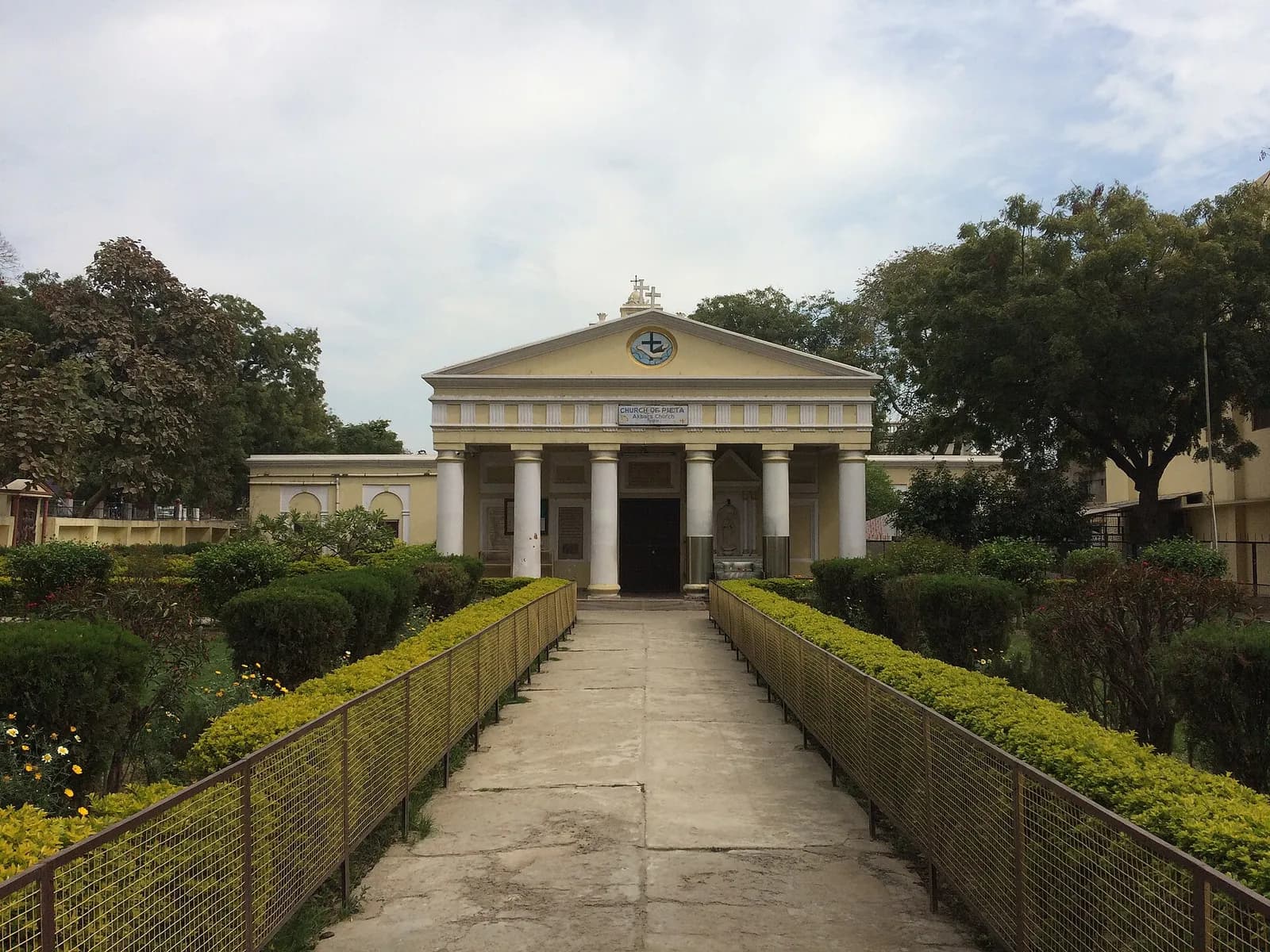
Located in the Agra Cantonment, St George's Cathedral is one of the oldest Protestant churches in North India and it is the natural starting point for exploring the city's Christian heritage. It was built in 1828, during the British Raj, by the Major General and engineer J. T. Boileau and served as a primary Anglican place of worship for British troops. The cathedral features classic English Gothic architecture, with a towering spire, stained-glass windows, a white marble altar and a carved bishop's chair, a handsome and dignified building that would not look out of place in an English town.
Several things make its interior special:
- Military memorials. The walls bear memorial plaques honouring British officers, soldiers of the East Surrey Regiment and the casualties of the 1843 Battle of Maharajpoor.
- Rifle-rest pews. The historic wooden pews still feature the carved notches and holes designed for British soldiers to rest their rifles during Sunday prayers, a remarkable and poignant detail.
- English Gothic design. The towering spire, stained glass and white marble altar give it the feel of a classic English parish church transplanted to India.
- A living cathedral. It remains an active CNI church, so a Sunday service is the best time to see it alive and open.
It stands on Mall Road, near the Eklavya Sports Stadium, in the Sadar Bazar area of the Agra Cantonment, which makes it easy to pair with a visit to the nearby market. Admission is free and while the grounds are open daily until 5 PM, the sanctuary is usually locked on weekdays, so aim for the Sunday 9 AM service or ask the caretaker to let you in.
The rifle-rest pews are the detail that stays with most visitors and they are worth seeking out. Built for a garrison congregation, the cathedral had to accommodate soldiers who carried their weapons even to worship, so the pews were fitted with carved notches and holes to hold their rifles upright during the service. It is a small thing, but it brings the building's history vividly to life, conjuring a Sunday morning two centuries ago when red-coated troops filled these benches. Together with the memorial plaques to officers and to the dead of the 1843 Battle of Maharajpoor, the interior reads almost as a record of the British military presence in Agra, which gives the cathedral a historical interest well beyond its architecture. For anyone curious about the colonial chapter of the city's past, half an hour inside St George's is genuinely illuminating.
Akbar's Church, Agra's oldest
Akbar's Church is the most historically remarkable of all and a genuine surprise for most visitors. It was built between 1598 and 1600 by Jesuit Fathers on land gifted by the Mughal Emperor Akbar himself, which makes it Agra's oldest Catholic church and one of the earliest in all of North India. That a Mughal emperor gave land for a Christian church speaks volumes about Akbar's famous religious tolerance and curiosity and the building blends Mughal, French and Portuguese styles as a result. It stands inside the Archdiocese of Agra compound on Wazirpura Road, in Civil Lines and entry is free, with opening hours of 11 AM to 6 PM from Monday to Saturday. For anyone interested in the meeting of the Mughal and European worlds, this modest church is one of the most significant sights in the city.
Its story is extraordinary when you pause on it. At the height of Mughal power, when Agra was one of the greatest cities on earth, the emperor Akbar not only tolerated but actively welcomed Jesuit missionaries at his court, debating religion with them and granting them land to build a church. The result is that a Christian church has stood in Agra since before the Taj Mahal was even conceived and this one predates the great monument by several decades. The blend of Mughal, French and Portuguese influences in its design mirrors that unusual origin, a European faith given form on Mughal soil with Mughal craftsmen. Few buildings anywhere capture the cosmopolitan openness of Akbar's Agra so directly and for visitors who know the story, standing inside Akbar's Church is a quietly powerful experience, a reminder that the city's history is far richer and more surprising than its famous white dome alone suggests.
Cathedral of the Immaculate Conception
Established in 1848, right next to Akbar's Church on Wazirpura Road, the Cathedral of the Immaculate Conception is the grandest of Agra's churches. It serves as the seat of the Roman Catholic Archdiocese of Agra and is one of the largest churches in all of Uttar Pradesh. Architecturally it is striking, combining grand Italian Baroque and Gothic elements with a prominent Russian-style dome, an unusual and memorable silhouette. Because it shares its compound with Akbar's Church, the two are effortless to visit together, giving you the oldest and the grandest of Agra's Catholic churches in a single stop. Entry is free and it is open daily from 9 AM to 6 PM. For visitors seeking the single most impressive church in the city, this is the one to prioritise.
The scale and ornament set it apart from the other churches. As the cathedral of the archdiocese, it was built to impress and to serve a large congregation and its mix of Italian Baroque and Gothic forms, crowned by the distinctive dome, gives it a grandeur closer to a European cathedral than to the modest parish churches elsewhere in the city. Inside, the proportions are generous and the atmosphere solemn and on a Sunday or feast day, filled with worshippers, it comes fully to life. Visiting it straight after the tiny, ancient Akbar's Church next door is a striking contrast, the humble seed of Agra's Catholic history beside the great institution it eventually grew into and the two together tell that story more vividly than either could alone. It is the obvious highlight for anyone with time for only one of the city's churches and its central Civil Lines location makes it simple to reach.
St Mary's Church
Constructed in 1923 in the Rakabganj area, St Mary's Church is a distinctive pink-hued colonial church known for its serene atmosphere and active local parish. Smaller and later than the great cathedrals, it has a quiet charm of its own and it remains a living, well-loved parish church rather than a monument. Entry is free, with daily morning services held from 6 AM to 6:30 AM and Sunday Masses at 8 AM and 5:30 PM. If you happen to be in the Rakabganj area, its pretty pink facade and peaceful interior make it a pleasant short stop, best timed around a service when the doors are open. As the newest of the churches here, built well into the 20th century, it reflects a later, settled phase of Christian life in Agra, a neighbourhood parish serving its own community rather than a grand institution or a garrison church. That gives it a warm, lived-in feel and its distinctive colour makes it one of the more photogenic of the city's churches from the outside.
St John's Church
Founded in 1855, near Hospital Road in Mantola, St John's Church is a historic Gothic-style Protestant church, an outstation of the same CNI tradition as St George's. It features intricate stonework and colonial-era memorials and it is generally more accessible than St George's during the week. Entry is free and it is generally open from 10 AM to 9 PM, Tuesday through Sunday, which makes it one of the easier churches to visit on a weekday when the others may be locked. Its fine stonework and quiet, historic atmosphere reward a short visit for anyone exploring the old city and Mantola area and it sits within reach of the old-city bazaars for those combining a church with some shopping. Founded in the mid-19th century, it belongs to the same wave of colonial-era church building as St George's and its Gothic lines and weathered memorials carry the same period atmosphere. Because it keeps longer and more regular opening hours than St George's, it is often the easier of the two Protestant churches to see inside on an ordinary day, which makes it a good choice for visitors who cannot time their trip to a Sunday.
A quick comparison of Agra's churches
With five historic churches to choose from, it helps to know how they differ. St George's Cathedral is the grand Protestant garrison church, best seen on a Sunday. Akbar's Church is the oldest and most historically significant, remarkable for its Mughal origins. The Cathedral of the Immaculate Conception is the largest and most architecturally impressive and the seat of the Catholic archdiocese. St John's Church is the most reliably open during the week, a fine Gothic Protestant church. And St Mary's is the prettiest and most peaceful, a pink colonial parish church best visited around a service. If your time is short, pair Akbar's Church and the Cathedral of the Immaculate Conception, which share a compound, with St George's in the Cantonment and you will have seen the oldest, the grandest and the most historic in a single outing. All five are free, so the only cost is your time. If you are choosing just one, let your interest guide you: history enthusiasts should not miss Akbar's Church, architecture lovers the Cathedral of the Immaculate Conception and those drawn to the colonial military past St George's with its rifle-rest pews. Photographers often favour the pink St Mary's for its exterior, while St John's rewards those who simply want a quiet, reliably open church to step into on a weekday. Whichever you pick, the scattered locations mean a short ride between them, so grouping two or three by area is the efficient approach.
The history of Christianity in Agra
The churches make far more sense against the backdrop of Agra's remarkable religious history. In the late 16th century, Agra was the capital of the Mughal empire and one of the greatest cities in the world and the emperor Akbar, famous for his interest in all faiths, invited Jesuit missionaries to his court and gave them land to build a church. That church, Akbar's Church of 1598, marks the beginning of a continuous Christian presence in the city that has lasted more than four centuries. Later, under British rule, Agra became an important military and administrative centre and the colonial era brought a new wave of church building for the troops and officials stationed here, from St George's Cathedral in 1828 to St John's in 1855 and the great Cathedral of the Immaculate Conception. The result is a city with churches spanning the Mughal, colonial and modern eras, Catholic and Protestant, European and Indian in style. For a visitor, touring them is a way to trace this layered history on the ground and to see an Agra that existed alongside and sometimes within, the world of the Mughal monuments.
This continuity is genuinely rare. Many Indian cities have colonial-era churches, but few can show an unbroken Christian thread running from the Mughal court itself, through the colonial garrison era, to the living parishes of today. Akbar's willingness to host Jesuits in the 1590s, the Armenian and European traders buried in the old Civil Lines cemetery, the garrison congregation of St George's and the busy modern Masses at St Mary's are all chapters of one long story. Seeing them in sequence, you watch Agra's Christian community grow from a handful of court missionaries into an established part of the city's fabric. It is a reminder that the Agra of the tourist brochures, all Mughal emperors and marble tombs, is only part of the picture and that the city has long been a meeting point of faiths and peoples. For the thoughtful traveller, that deeper, more cosmopolitan Agra is one of the real rewards of seeking out the churches.
What to expect
Expect quiet, dignified, living churches rather than ticketed tourist attractions and adjust your approach accordingly. These are, first and foremost, active places of worship maintained by small parishes, so some, especially St George's, are often locked outside service times and seeing the interiors can depend on timing your visit to a Mass or politely asking the caretaker. There are no ticket counters, no crowds and few other tourists, which is exactly the appeal: you may well have a centuries-old church entirely to yourself. The settings range from the leafy Cantonment to the busy Civil Lines compound shared by Akbar's Church and the Cathedral and the buildings themselves are genuinely beautiful, from English Gothic spires to a Russian-style dome. Come with respect, dress modestly, keep your voice low and treat each church as the sacred space it is and you will find them among the most peaceful and surprising corners of Agra. For history lovers and anyone curious about the city's European past, they are a quiet highlight.
A note on access is worth repeating, because it shapes the whole experience. The Catholic churches, Akbar's Church, the Cathedral of the Immaculate Conception and St Mary's, tend to keep regular hours or open around their Masses, so they are the easiest to see inside. The Protestant churches, St George's above all, are more often locked outside Sunday services, which is why a Sunday morning or a friendly word with the caretaker is the key to seeing their interiors. Rather than treat a locked door as a disappointment, plan around it: come on a Sunday or accept that you may admire some churches from the outside and others within. Either way, the buildings are rewarding and the caretakers and parish staff are generally welcoming to respectful visitors who show genuine interest. Going with realistic expectations and a little flexibility, turns a church tour of Agra into one of the most peaceful and distinctive half-days the city offers.
Best time to visit
The best season is October to March, when Agra's weather is pleasant for moving between the churches, which are spread across the Cantonment and Civil Lines. Timing within the week matters more here than for most sights, because opening hours vary by church. Sunday morning is ideal for St George's Cathedral, when the 9 AM service opens the interior and it also suits the Catholic churches, which hold Sunday Masses. For weekday visits, Akbar's Church and the Cathedral of the Immaculate Conception keep regular daytime hours on Wazirpura Road and St John's is open Tuesday to Sunday, so a weekday can still take in several. Try to visit the active churches around, but not disruptively during, a service, when the doors are open and the atmosphere is at its most authentic. Our wider notes on the best time to visit Agra apply to the churches too.
How to reach the churches
Agra's historic churches are spread across the central and Cantonment areas, all easy to reach by auto-rickshaw, e-rickshaw or app-based cab. St George's Cathedral is on Mall Road near the Eklavya Sports Stadium, in the Sadar Bazar area of the Agra Cantonment. Akbar's Church and the Cathedral of the Immaculate Conception share a compound on Wazirpura Road in Civil Lines, so you reach both at once. St Mary's is in Rakabganj and St John's is near Hospital Road in Mantola. None is far from the centre and our guide to the Agra Metro covers the growing network for those using it, while our notes on how to reach the Taj Mahal and the city help with arrival. Because the churches are scattered, a car with a driver is the most efficient way to see several in one outing and travellers often fold them into an Agra overnight tour from Delhi or a same day Agra tour from Delhi with a little time set aside.
Visitor etiquette and tips
A few notes will make your church visits smooth and respectful:
- Combine the Civil Lines churches. Akbar's Church and the Cathedral of the Immaculate Conception share the same compound on Wazirpura Road, so visit both together.
- Time it for access. St George's is usually locked on weekdays, so aim for the Sunday 9 AM service or ask the caretaker to unlock it.
- Dress modestly. There is no strict dress code, but modest clothing covering the shoulders and knees is appreciated in active places of worship.
- Keep silence inside. Maintain quiet inside, especially if a prayer service is under way.
- Ask before interior photos. Exterior photography is welcome everywhere, but always ask the caretaker or parish office before photographing inside the sanctuaries.
Agra's churches in your itinerary
Agra's churches fit an itinerary as an offbeat half-day for travellers who want more than the headline monuments. Because they are free and scattered across the Cantonment and Civil Lines, the sensible plan is to group them by area: St George's Cathedral with a stroll in the nearby Sadar Bazar and Akbar's Church with the Cathedral of the Immaculate Conception together on Wazirpura Road. A Sunday morning is the best window, since the services open the interiors. You can also pair St George's with the nearby Roman Catholic Cemetery and its Red Taj Mahal in Civil Lines for a themed morning of Agra's European heritage. On a Golden Triangle trip through Delhi, Agra and Jaipur, the churches add depth and surprise to a day otherwise spent on Mughal marble and for history lovers they are a genuine highlight. Our Agra travel guide and our lists of hidden places to visit in Agra and lesser-known Agra monuments place them among the city's best-kept secrets and with more time the Taj Mahal, the Agra Fort, the riverside Itimad-ud-Daulah, the garden of Mehtab Bagh and Fatehpur Sikri remain the essentials.
Plan your trip with us
If you would like to explore Agra's historic churches, with a driver who knows the Cantonment and Civil Lines and a plan that times your visits to when the doors are open, let us arrange it. Because several of the churches are locked outside service hours, a little local knowledge makes all the difference between a rewarding morning and a row of closed doors. Our Delhi Agra tours cover the Taj Mahal, the Agra Fort and the city's hidden heritage and travellers short on time often choose a full Golden Triangle tour through Delhi, Agra and Jaipur or an early start with our sunrise Taj Mahal tour. To plan dates and a route that includes the churches, message Abhay and the team directly on WhatsApp at +91 7302265809 or reach our team online and we will show you the Agra that most visitors miss.
Related guides
Keep reading before you travel, these pair well with this guide:
Enquire Now
What our travellers say
“Our Golden Triangle honeymoon was flawless. Sunrise at the Taj with a private guide felt like a dream — every detail was handled.”
“As a first-time visitor to India, I felt completely safe and looked after. The driver and guide were superb professionals.”
“Travelling with two kids is hard, but they made it effortless. Great pacing, clean cars and zero surprises on price.”
“Booked the Agra day trip on short notice and it went off without a hitch. The guide's history knowledge made the Taj come alive.”
“Best decision of our India trip. Car was spotless, driver was punctual every single day, and the itinerary never felt rushed.”
“Organised a same-day Agra trip for my parents. Communication before and during the trip was excellent — genuinely stress-free.”
“Sunrise at the Taj Mahal was magical. Our guide spoke great English and answered every question with patience.”
“Three generations travelling together and everyone was comfortable — good vehicle, sensible stops, and no hidden costs.”
“I've used a few tour operators across Asia and this was among the smoothest. Fair pricing and they actually answer the phone.”
“Our custom Rajasthan-Agra combo was planned around our budget without cutting corners on comfort. Highly recommend.”
“Solo female traveller here — I felt safe throughout. The driver was respectful and the whole trip was timed perfectly.”
Ready to Explore
The Magic of Agra?
Experience the Taj Mahal at sunrise, explore the mighty Agra Fort, and discover the hidden gems of India's most beloved heritage city with our expert-guided premium tours.

Agra
Premium Tour Package
Questions
Frequently asked questions
Is there an entry fee for Agra's churches?
No. Entry to St George's Cathedral and all of Agra's major historic churches is completely free, with no tickets or counters. They are active places of worship maintained by their parishes, open to respectful visitors of any nationality.
What is St George's Cathedral in Agra?
What is the oldest church in Agra?
Which is the biggest church in Agra?
What are the St George's Cathedral timings?
Did Akbar really give land for a church in Agra?
Can I take photos inside the churches?
How many historic churches can I visit in Agra?
Which Agra churches are open on weekdays?
Are Agra's churches worth visiting?
Explore more
Plan your St George's Cathedral trip with us

Interested in St George's Cathedral Agra and the City's Historic Churches?
Chat with our travel team for a custom quote, or browse every package.
Related Attractions
9St George's Cathedral Agra and the City's Historic Churches on the map
Open in Google MapsReady to explore St George's Cathedral Agra and the City's Historic Churches?
Book your private tour today and experience the magic of India's rich heritage.