Quick Answer
Begumpur Masjid, the Jam'i Masjid of Jahanpanah, is a vast 14th-century Tughlaq-era Friday mosque in Begumpur village, South Delhi, once the central mosque of Jahanpanah, the fourth city of Delhi. Now a quiet ASI-protected ruin with 64 domes, it is a superb offbeat heritage site. Delhi Agra Tour Packages, a unit of Experience My India, arranges Delhi tours.
In a quiet village in South Delhi stands one of the capital's most atmospheric and least-visited monuments: Begumpur Masjid, the great congregational mosque of the vanished city of Jahanpanah. Vast, austere and hauntingly empty, it is a favourite of heritage lovers. This guide from Delhi Agra Tour Packages covers the mosque's history, its uncertain origins, its striking Tughlaq architecture and how to visit, so you can add this hidden gem to your trip, whether on its own or alongside the great sights on a Golden Triangle tour.
I was born in Delhi and in more than 11 years guiding travellers across the region for Experience My India I have always loved the old Tughlaq monuments scattered through South Delhi and Begumpur Masjid, with its immense silent courtyard, is one of the most powerful of them all. Here is what to know.
Begumpur Masjid at a glance
Detail | Information |
What it is | A vast 14th-century Tughlaq Friday mosque, the Jam'i Masjid of Jahanpanah |
Also known as | Begumpuri Masjid; the congregational mosque of Jahanpanah |
Location | Begumpur village, South Delhi (near Malviya Nagar) |
Status | Inactive, partly ruined, protected by the ASI |
Notable | 64 domes; once the second-largest mosque in Delhi |
Time to allow | 45 minutes to 1 hour |
Best for | Offbeat heritage, history and photography |
What is Begumpur Masjid?
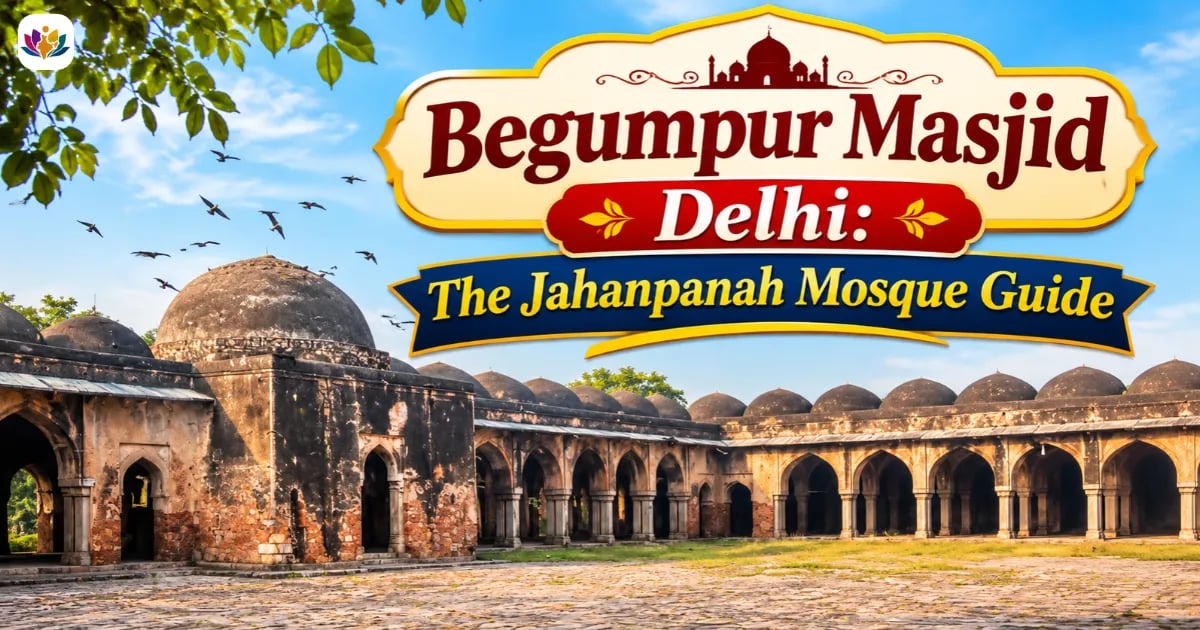
Begumpur Masjid, also known as the Begumpuri Masjid or the Jam'i Masjid of Jahanpanah, is a 14th-century Friday mosque in Begumpur village in South Delhi, near Malviya Nagar and the ruins of the Bijay Mandal palace. It was built as the central congregational mosque of Jahanpanah, the fourth of the medieval cities of Delhi and it is one of the most significant surviving monuments of the Tughlaq period.
Today it stands inactive and in a partly ruinous state, administered and protected by the Archaeological Survey of India. Vast and austere, it was historically the second-largest mosque in Delhi, surpassed only by older structures and, later, by Shah Jahan's great Jama Masjid in Old Delhi, which you can see on a guided Old Delhi tour. Its immense, silent courtyard and ring of domes make it a genuinely atmospheric place and a rewarding stop for anyone drawn to the deeper, older layers of Delhi's history, much like the nearby Hauz Khas complex of the same Tughlaq era.
The size and the 64 domes
The scale of Begumpur Masjid is its most immediate impression. The mosque measures roughly 94 by 90 metres, enclosing a vast internal courtyard of around 75 by 75 metres, a great open square ringed by arched cloisters, which gives the monument its remarkable sense of space and silence.
Feature | Detail |
Overall size | About 94 by 90 metres |
Courtyard | A vast open court of roughly 75 by 75 metres |
Domes | 64 domes across the roofline and prayer hall |
Historic rank | Once the second-largest mosque in Delhi, before Shah Jahan's Jama Masjid |
Across its roofline and prayer-hall structure, the mosque carries 64 domes, a striking feature that gives it a distinctive silhouette. Standing in the middle of the great empty courtyard, surrounded by the arched colonnades and the domes above, you get a powerful sense of the scale on which the Tughlaq rulers built and of the vanished city of Jahanpanah that once worshipped here. It is this combination of size, emptiness and age that makes Begumpur Masjid so memorable.
History and the builder debate
Begumpur Masjid was built during the Tughluq dynasty in the 14th century, as the central congregational mosque of Jahanpanah, the fourth medieval city of Delhi. Beyond that, however, its exact origins are a matter of genuine scholarly debate and we set out both main views here rather than pick one.
Some scholars attribute the mosque to Muhammad bin Tughlaq, who reigned from 1325 to 1351, around 1343, linking it directly to his planning of Jahanpanah. Other historical accounts attribute it instead to Khan-i-Jahan Maqbul Tilangani or his son Khan-i-Jahan Junan Shah, the powerful viziers of Firoz Shah Tughlaq, around 1387. Both attributions place it firmly in the Tughlaq century and the uncertainty is itself part of the monument's intrigue.
Period | What happened |
14th century | Built as the Friday mosque of Jahanpanah (builder debated, as above) |
Until early 18th century | Remained in active religious use |
After 1739 | Following Nadir Shah's sack of Delhi, villagers settled within the structure |
Around 1921 | The ASI evacuated the occupants after a roof collapse |
1947 | Briefly occupied by Partition refugees, then cleared |
The mosque's later history is as remarkable as its origins. It remained in active use until the early 18th century, but after the plundering of Delhi by Nadir Shah in 1739, local villagers turned the fortified structure into a residential settlement, living within its walls. The ASI intervened and evacuated the occupants around 1921, following a roof collapse and it was briefly occupied again by Partition refugees in 1947 before being cleared. This layered story of worship, settlement and preservation is written into the fabric of the building.
The architecture of Begumpur Masjid
Architecturally, Begumpur Masjid is a fine and powerful example of Tughluqid Indo-Islamic architecture, a style defined by austere, fortress-like strength rather than decorative richness. Its thick stone and rubble masonry walls, with minimal surface ornamentation, give it a stern, monumental character quite different from the softer, more decorated mosques that came later in Delhi's history.
The mosque is entered through a prominent central gateway or pishtaq, that rises boldly above the facade, leading to a multi-arched prayer hall. One of its rarer features is the Mullah Khana, an enclosed ladies' prayer section at the rear, topped with five small domes. Above the central prayer niche or mihrab, the mosque retains select Quranic inscriptions in classical thuluth script, drawn from Surah Al-Imran, among the few concessions to ornament in this otherwise severe and imposing structure. The fortress-like aesthetic links it to other Tughlaq-era monuments across the city, including those around the Qutub Minar and the old fort of Purana Qila.
Where is Begumpur Masjid and what is nearby?
Begumpur Masjid stands in Begumpur village in South Delhi, near Malviya Nagar, Sarvapriya Vihar and the Vijay Mandal Enclave, with the ruins of the Bijay Mandal palace, once part of the Jahanpanah complex, close by. Its village setting among South Delhi's lanes is part of its quiet, hidden character.
The area is rich in medieval heritage, so the mosque combines well with other sights for a rewarding day. The nearby Khirki Masjid, another great Tughlaq-era mosque and the Bijay Mandal ruins make natural companions, while the atmospheric Hauz Khas complex is also close. A little further afield, the serene Lotus Temple and the revered Kalkaji temple beside it and the busy Nehru Place market, are all in the wider South Delhi area. You can see the full range of the city's sights in our Delhi attractions guide.
Visiting: timings and entry
Begumpur Masjid is an ASI-protected monument, so it is generally open to visitors during daylight hours and is usually free to enter, like many of the city's smaller protected sites. However, precise ticketing and timings for a quiet, partly ruined site like this are best reconfirmed locally, as arrangements can vary.
Detail | Information |
Status | ASI-protected monument, inactive and partly ruined |
Timings | Generally daylight hours (reconfirm locally) |
Entry | Generally free (reconfirm locally) |
Time to allow | 45 minutes to 1 hour |
Allow around forty-five minutes to an hour to take in the great courtyard, the colonnades and the prayer hall at a relaxed pace. Because it is a little-visited site, you will often have the vast space almost to yourself, which is part of its appeal. For getting around the wider city, our travel guides and the Delhi attractions guide help you plan and our guide to must-visit places near Delhi within 50 km covers day trips further afield.
How to reach Begumpur Masjid
Begumpur Masjid is in Begumpur village in South Delhi, reached through local lanes near Malviya Nagar, so it is easiest to come by taxi or auto-rickshaw and walk the last short stretch into the village.
Detail | Information |
Area | Begumpur village, South Delhi (near Malviya Nagar) |
By taxi or auto-rickshaw | To the edge of Begumpur village, then a short walk in |
Nearby landmarks | Bijay Mandal ruins, Sarvapriya Vihar, Malviya Nagar |
Getting around Delhi | The Metro and local transport serve the South Delhi localities |
Because the mosque sits within a village of narrow lanes, it is best to reach the edge of Begumpur by road and continue on foot, asking locally for the masjid, which everyone knows. A private car with a driver makes it simple to combine Begumpur with the other heritage of South Delhi in one relaxed day, which is how we usually suggest seeing these scattered Tughlaq monuments.
Best time to visit
The best time to visit Begumpur Masjid is the cool season from about October to March, when exploring the open courtyard and the South Delhi lanes is comfortable and pleasant and the light is lovely for photography. Within the day, the softer light of the early morning or the late afternoon is the most beautiful on the austere stone and the quietest for enjoying the vast space.
The summer, from April to June, is very hot in Delhi and the open, shadeless courtyard offers little relief, so an early-morning visit is best then, while the monsoon, from July to September, brings some greenery and cooler air. Whatever the season, the mosque's quiet, uncrowded atmosphere means you can always enjoy it at a relaxed and contemplative pace.
Tips for visiting Begumpur Masjid
Reach the edge of Begumpur village by road and walk the last short stretch through the lanes.
Reconfirm timings and any entry arrangements locally, as this is a quiet, partly ruined site.
Visit in the early morning or late afternoon for the best light and the quietest atmosphere.
Allow around forty-five minutes to an hour to take in the great courtyard and prayer hall.
Combine it with other South Delhi heritage sites such as Khirki Masjid, Bijay Mandal and Hauz Khas.
Wear comfortable shoes for the village lanes and the uneven ground and carry water.
Visit respectfully, as this is a historic religious monument, even though it is no longer active.
What to expect
A visit to Begumpur Masjid is a powerful, atmospheric encounter with the Tughlaq age of Delhi, a vast and austere Friday mosque standing almost empty in a quiet South Delhi village. You can expect an immense open courtyard ringed by arched colonnades, 64 domes across the roofline, a bold central gateway and a severe, fortress-like beauty, along with the layered story of a mosque that was once the heart of a vanished city, later a village and now a protected ruin.
As an attraction it is monumental in scale yet hauntingly quiet and its reward is history, atmosphere and a real sense of discovery away from the crowds. Combined with the other medieval heritage of South Delhi, from Khirki Masjid to Hauz Khas, it makes a deeply rewarding day for anyone who wants to see beyond the obvious and touch the older, deeper Delhi.
Plan your trip with us
The scattered Tughlaq monuments of South Delhi, Begumpur Masjid among them, are far easier and richer to explore with a knowledgeable local guide who can find them, connect their stories and bring the lost city of Jahanpanah to life. We arrange it all, a comfortable private car and an experienced driver, a guide to lead you through the lanes and the history and a day planned around your interests.
Tell us your dates and group size and we will price it honestly around your standard rather than a fixed figure. A day in the capital slots neatly into our wider Delhi Agra Tour Packages and our Golden Triangle tours and the imperial side of the city is covered on our New Delhi tour.
Want your Delhi day planned around you? Message us on WhatsApp and Experience My India will build it for you.
Related guides
Delhi day tour: the best of old and new Delhi in a single day.
Red Fort: the great Mughal citadel of Old Delhi.
Humayun's Tomb: the early-Mughal garden tomb that shaped the Taj.
Experience My India has personally hosted 50,000+ travelers and the service he leads is rated 4.9 from 2,600+ reviews, operating since 2015. Delhi Agra Tour Packages is a unit of Experience My India.
Book Your Delhi - Agra Trip Today 📞 +91-7302265809 💬 WhatsApp: +91-7302265809 Rated 4.9★ / 2600+ Reviews Explore all: Delhi Agra Tour Packages |
What a Experiance My India
Complete Delhi-Agra services
Private AC Cabs
Comfortable AC cars with experienced local drivers for Delhi, Agra and Jaipur tours.
Local Expert Guides
Explore the Taj Mahal and historic monuments with knowledgeable local guides.
Handpicked Hotels
Comfortable stays near the Taj Mahal and prime locations across Delhi and Agra.
Delhi–Agra Tours
Well-planned same-day and multi-day tours covering the best attractions.
Golden Triangle
Experience Delhi, Agra and Jaipur together with carefully planned itineraries.
24/7 Travel Support
Get assistance throughout your journey from booking to your return.
Plan Your Trip
Get a free quote in 30 mins
100% Trusted & Verified
by 50,000+ Travellers since 2018
Why travellers choose Experience My India
What makes us different from other agencies
We plan and run every trip ourselves, so you get a private AC car, a local expert guide, an honest fixed price, and no reseller or touts in between. We have guided travelers and families since 2018 and hold a 5.0 star rating across 3 verified reviews.
What Our Travellers Say
Real reviews from real Travellers
“Our visit to Begumpur Masjid was one of the most memorable parts of our Delhi trip. Abhay ji was an excellent guide who explained the mosque's architecture, history and connection with the old city of Jahanpanah. Experience My India arranged a comfortable cab and a good hotel for our stay. Everything was properly managed, and we never had to worry about transport or sightseeing arrangements. We are very happy with their service.”
Roshni Mukherjee
Kolkata· 2026-10-02
“We booked our Delhi tour package with Experience My India, and the experience was wonderful. Abhay ji guided us through Begumpur Masjid and explained its Tughlaq-era history in such an interesting and easy-to-understand way. The cab was clean and comfortable, the driver was polite, and the overall arrangements were excellent. We also appreciated the smooth coordination throughout the trip. Highly recommended for anyone who wants to explore Delhi's historical places.”
Amitabh Sinha
Lucknow· 2026-10-16
“We had a lovely Delhi sightseeing experience with Experience My India. Abhay ji's guidance at Begumpur Masjid was excellent. He explained the mosque's historical importance and architectural features instead of simply taking us around the monument. The cab arrangements were comfortable, the hotel was good, and the staff stayed in touch whenever we needed assistance. We truly appreciated the team's hospitality and professional service.”
Saurabh Chatterjee
Bhubaneswar· 2026-09-17
Our visit to Begumpur Masjid was one of the most memorable parts of our Delhi trip. Abhay ji was an excellent guide who explained the mosque's architecture, history and connection with the old city of Jahanpanah. Experience My India arranged a comfortable cab and a good hotel for our stay. Everything was properly managed, and we never had to worry about transport or sightseeing arrangements. We are very happy with their service.
Roshni Mukherjee
Kolkata
We booked our Delhi tour package with Experience My India, and the experience was wonderful. Abhay ji guided us through Begumpur Masjid and explained its Tughlaq-era history in such an interesting and easy-to-understand way. The cab was clean and comfortable, the driver was polite, and the overall arrangements were excellent. We also appreciated the smooth coordination throughout the trip. Highly recommended for anyone who wants to explore Delhi's historical places.
Amitabh Sinha
Lucknow
We had a lovely Delhi sightseeing experience with Experience My India. Abhay ji's guidance at Begumpur Masjid was excellent. He explained the mosque's historical importance and architectural features instead of simply taking us around the monument. The cab arrangements were comfortable, the hotel was good, and the staff stayed in touch whenever we needed assistance. We truly appreciated the team's hospitality and professional service.
Saurabh Chatterjee
Bhubaneswar
Our visit to Begumpur Masjid was one of the most memorable parts of our Delhi trip. Abhay ji was an excellent guide who explained the mosque's architecture, history and connection with the old city of Jahanpanah. Experience My India arranged a comfortable cab and a good hotel for our stay. Everything was properly managed, and we never had to worry about transport or sightseeing arrangements. We are very happy with their service.
Roshni Mukherjee
Kolkata
We booked our Delhi tour package with Experience My India, and the experience was wonderful. Abhay ji guided us through Begumpur Masjid and explained its Tughlaq-era history in such an interesting and easy-to-understand way. The cab was clean and comfortable, the driver was polite, and the overall arrangements were excellent. We also appreciated the smooth coordination throughout the trip. Highly recommended for anyone who wants to explore Delhi's historical places.
Amitabh Sinha
Lucknow
Frequently Asked Questions
Quick answers to common questions
Begumpur Masjid, also called the Begumpuri Masjid or the Jam'i Masjid of Jahanpanah, is a vast 14th-century Friday mosque in Begumpur village, South Delhi. It was built as the central congregational mosque of Jahanpanah, the fourth of the medieval cities of Delhi, during the Tughluq dynasty. Now inactive and partly ruined, protected by the Archaeological Survey of India, it is historically important as once the second-largest mosque in Delhi and famous for its immense open courtyard and 64 domes. It is a superb offbeat heritage site.
This is genuinely debated among historians and both main views place it in the 14th-century Tughlaq period. Some scholars attribute it to Muhammad bin Tughlaq, who reigned from 1325 to 1351, around 1343, linking it to his planning of Jahanpanah. Others attribute it to Khan-i-Jahan Maqbul Tilangani or his son Khan-i-Jahan Junan Shah, the viziers of Firoz Shah Tughlaq, around 1387. We present both attributions rather than choose one, as the exact authorship remains uncertain, which is part of the monument's intrigue.
Begumpur Masjid is important as the central congregational mosque of Jahanpanah, the fourth medieval city of Delhi and as one of the finest surviving examples of Tughlaq-era architecture. Historically it was the second-largest mosque in the city, before Shah Jahan's Jama Masjid. Its vast courtyard, 64 domes and austere, fortress-like design make it architecturally significant and its layered later history, as a village settlement and refugee shelter before its preservation, adds to its importance as a window into centuries of Delhi's story.
Begumpur Masjid is very large, measuring roughly 94 by 90 metres overall and enclosing a vast internal courtyard of around 75 by 75 metres, a great open square ringed by arched colonnades. Across its roofline and prayer hall it carries 64 domes. This scale made it historically the second-largest mosque in Delhi, surpassed only by older structures and later by Shah Jahan's Jama Masjid. Standing in the centre of its empty courtyard gives a powerful sense of the scale on which the Tughlaq rulers built.