Quick Answer
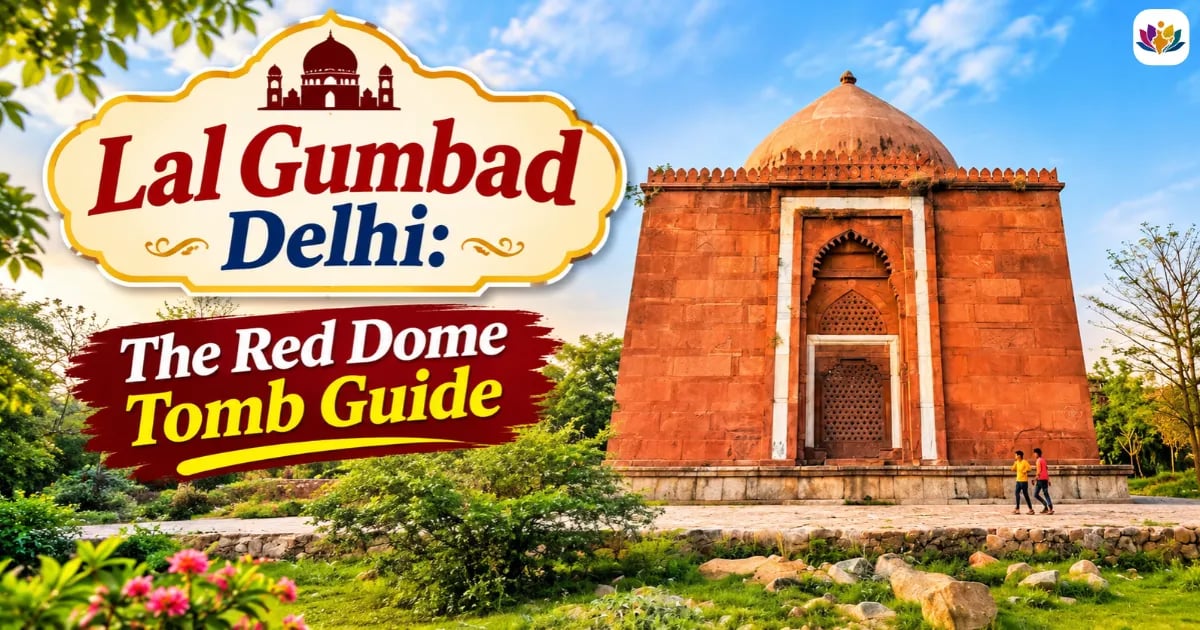
Lal Gumbad, the Red Dome, is a 14th-century Tughlaq-era Sufi mausoleum in Malviya Nagar, South Delhi, within the old Jahanpanah area. Built around 1397 in red sandstone, it is the tomb of the Sufi saint Shaikh Kabir-ud-Din Auliya. It is an ASI monument, free to enter, generally open 9 AM to 5 PM. Delhi Agra Tour Packages, a unit of Experience My India, arranges Delhi tours.
In a quiet corner of South Delhi, ringed by a modern neighbourhood, stands a striking red-sandstone tomb that most residents pass without a glance: Lal Gumbad, the Red Dome, a 14th-century Sufi mausoleum with a Tughlaq pedigree and a colourful legend of thieves. This guide from Delhi Agra Tour Packages covers the tomb's history, its architecture, the story behind its other name and how to visit, so you can add this offbeat monument to your trip, whether on its own or alongside the great sights on a Golden Triangle tour.
I was born in Delhi and in more than 11 years guiding travellers across the region for Experience My India I have always been drawn to these overlooked Tughlaq monuments of South Delhi and Lal Gumbad, glowing red among the trees, is one of the most characterful. Here is what to know.
Lal Gumbad at a glance
Detail | Information |
What it is | A 14th-century Tughlaq-era Sufi mausoleum, the Red Dome |
Also known as | Rakabwala Gumbad |
Location | Maharshi Dayanand Marg, Malviya Nagar, South Delhi (old Jahanpanah) |
Buried here | The Sufi saint Shaikh Kabir-ud-Din Auliya |
Built | Around 1397, in the Tughlaq era |
Status | ASI-protected; free entry; generally 9 AM to 5 PM |
Time to allow | 30 to 45 minutes |
What is Lal Gumbad?
Lal Gumbad, meaning the Red Dome, is a 14th-century Sufi mausoleum in Malviya Nagar, South Delhi, standing within the historic area of Jahanpanah, near Panchsheel Park. It is the final resting place of the respected Sufi saint Shaikh Kabir-ud-Din Auliya, a disciple of the famous Shaikh Nasiruddin Chirag-i-Dehli, which gives the tomb its spiritual importance within Delhi's rich Sufi heritage.
Built in bright red sandstone, from which it takes its name, the tomb is a fine and little-visited example of Tughlaq-era architecture, protected today by the Archaeological Survey of India. It sits close to other great monuments of the same period, including the vast Begumpur Mosque of Jahanpanah, making this pocket of South Delhi a rewarding area for anyone exploring the city's medieval layers, much like the nearby Hauz Khas complex built by the same Tughlaq dynasty.
History and the saint
Lal Gumbad was constructed around 1397 A.D., during the Tughlaq dynasty era and it is speculated to have been originally commissioned by Sultan Firoz Shah Tughlaq, though its exact patronage is not firmly settled. What is clear is its dedication: it serves as the tomb of the Sufi saint Shaikh Kabir-ud-Din Auliya, a disciple of Shaikh Nasiruddin Chirag-i-Dehli, one of the great Sufi masters of Delhi.
This spiritual lineage places Lal Gumbad firmly within the Sufi tradition that flourished in medieval Delhi and connects it to the nearby shrine of Chirag Dehli. The square tomb houses multiple internal graves, with about nine tombstones in all and the surrounding walled compound contains further open-air graves, suggesting that the site served a wider community of the faithful around the saint. It is this combination of Tughlaq royal architecture and living Sufi devotion that gives the monument its particular character.
Why is it called Rakabwala Gumbad?
Beyond its common name of Lal Gumbad, the tomb carries a second, more intriguing name: Rakabwala Gumbad. This comes from two iron rings or raqaabs, set into the western wall of the structure and from the colourful legend attached to them.
According to local tradition, these iron rings were used by thieves to scale the tomb and steal the original golden finial that once crowned its dome. Whether or not the story is literally true, the rings are still there to see and the tale has given the monument its memorable alternative name. It is exactly the kind of local legend that brings an old, silent ruin to life and it is well worth looking for the raqaabs on the western wall during your visit.
The architecture of Lal Gumbad
Architecturally, Lal Gumbad is a classic example of Tughlaq-style design, closely resembling the famous tomb of Ghiyasuddin Tughlaq at Tughlaqabad and it shares that era's distinctive stern, fortress-like aesthetic.
Feature | Detail |
Material | Bright red sandstone (giving the tomb its name) |
Walls | Signature Tughlaq inward-sloping (battered) walls |
Dome | A plastered dome, once crowned by a golden finial |
Form | A square main tomb housing about nine graves |
Compound | A walled enclosure with a gateway and ruined subsidiary structures |
The tomb's most recognisable Tughlaq features are its inward-sloping or battered, walls, which give it a solid, tapering strength and its plastered dome, the whole closely echoing the design of Ghiyasuddin Tughlaq's tomb. The square main chamber houses the graves within and the monument stands inside a walled compound entered through a gateway, with five ruined subsidiary or mosque structures and open-air graves in the surrounding grounds. Together these make Lal Gumbad not just a single tomb but a small historic complex and a fine illustration of the austere, red-sandstone architecture the Tughlaqs favoured, seen also around the Qutub Minar and at Purana Qila. It also stands in the long line of Delhi's great tombs that leads on to the Mughal masterpiece of Humayun's Tomb.
Where is Lal Gumbad and what is nearby?
Lal Gumbad stands on Maharshi Dayanand Marg in Malviya Nagar, within the old Jahanpanah area of South Delhi, near Panchsheel Park. Its location in a lived-in neighbourhood, surrounded by greenery, is part of its quiet, hidden character.
The area is dense with medieval heritage, so the tomb combines well with other sights. The vast Begumpur Mosque of Jahanpanah and the nearby Khirki Masjid, both great Tughlaq-era monuments, make natural companions, as does the shrine of Chirag Dehli associated with the saint's own teacher. A little further afield, the atmospheric Hauz Khas complex, the serene Lotus Temple, the revered Kalkaji temple beside it and the busy Nehru Place market are all in the wider South Delhi area. You can see the full range of the city's sights in our Delhi attractions guide.
Visiting: timings and entry
Lal Gumbad is an ASI-protected monument with free entry, generally open during the day. Note that the interior of the main tomb is typically kept locked, though it is sometimes opened on Thursdays, so you will usually view the monument from the outside and the compound.
Detail | Information |
Timings | Generally 9 AM to 5 PM, daily |
Entry | Free |
Interior | Main tomb usually locked; sometimes opened on Thursdays |
Time to allow | 30 to 45 minutes |
A visit takes about thirty to forty-five minutes, enough to walk the compound, admire the red-sandstone tomb and its sloping walls, find the iron rings on the western wall and take in the ruined subsidiary structures. Because the interior is often locked, do not count on seeing inside unless you happen to visit on a day it is open. For getting around the city, our travel guides help you plan and our guide to must-visit places near Delhi within 50 km covers day trips further afield.
How to reach Lal Gumbad
Lal Gumbad is in Malviya Nagar, a well-connected part of South Delhi, so it is easy to reach by Metro, taxi or auto-rickshaw.
Detail | Information |
Address | Maharshi Dayanand Marg, Malviya Nagar, South Delhi |
Nearest Metro | Panchsheel Park or Chirag Delhi |
Also near | Chirag Dilli bus stand |
By road | By taxi or auto-rickshaw to Malviya Nagar, then a short walk |
The nearest Metro stations are Panchsheel Park and Chirag Delhi and the Chirag Dilli bus stand is also close by, after which the tomb is a short ride or walk away. Because it sits within a residential neighbourhood, a little local guidance helps in finding it. A private car with a driver makes it simple to combine Lal Gumbad with the other scattered Tughlaq monuments of South Delhi in one relaxed day, which is how we usually suggest seeing them.
Best time to visit
The best time to visit Lal Gumbad is the cool season from about October to March, when exploring the compound and the South Delhi neighbourhood on foot is comfortable and the light is lovely on the red sandstone. Within the day, the softer light of the early morning or the late afternoon is the most beautiful for the tomb and the best for photography.
The summer, from April to June, is very hot in Delhi, so an early-morning visit is best then, while the monsoon, from July to September, brings cooler air and greenery to the grounds. If seeing the interior matters to you, try to visit on a Thursday, when the main tomb is sometimes opened, though this is not guaranteed. Being a quiet, little-visited spot, the monument can be enjoyed peacefully at almost any time.
Tips for visiting Lal Gumbad
Look for the two iron rings (raqaabs) on the western wall, the source of the Rakabwala Gumbad name and its thief legend.
Note that the main tomb interior is usually locked; visit on a Thursday for a chance to see inside.
Visit in the early morning or late afternoon for the best light on the red sandstone.
Allow about thirty to forty-five minutes for the tomb and its walled compound.
Combine it with other Jahanpanah heritage sites such as Begumpur Mosque and Khirki Masjid.
Visit respectfully, as this is the tomb of a revered Sufi saint.
Reach it via Panchsheel Park or Chirag Delhi Metro, then a short walk or ride.
What to expect
A visit to Lal Gumbad is a quiet, rewarding encounter with the Tughlaq and Sufi heritage of South Delhi, a striking red-sandstone tomb standing almost forgotten amid a modern neighbourhood. You can expect a square mausoleum with the sloping walls and plastered dome characteristic of its age, the tomb of a revered Sufi saint within a walled compound of ruined structures and old graves and the memorable detail of the iron rings on the western wall that gave rise to its thief legend and its name Rakabwala Gumbad.
As an attraction it is modest and offbeat rather than grand and its reward is history, atmosphere and a sense of discovery away from the crowds. Combined with the other medieval monuments of Jahanpanah, from Begumpur Mosque to Khirki Masjid, it makes a deeply rewarding day for anyone drawn to the older, quieter Delhi that lies beyond the famous sights.
Plan your trip with us
The scattered Tughlaq monuments of South Delhi, Lal Gumbad among them, are far easier and richer to explore with a knowledgeable local guide who can find them, connect their stories and bring the lost city of Jahanpanah to life. We arrange it all, a comfortable private car and an experienced driver, a guide to lead you through the neighbourhood and its history and a day planned around your interests.
Tell us your dates and group size and we will price it honestly around your standard rather than a fixed figure. A day in the capital slots neatly into our wider Delhi Agra Tour Packages and our Golden Triangle tours and this heritage quarter pairs well with a guided Old Delhi tour of the Red Fort and Chandni Chowk.
Want your Delhi day planned around you? Message us on WhatsApp and Experience My India will build it for you.
Related guides
New Delhi tour: the capital's imperial landmarks and avenues.
Delhi day tour: the best of old and new Delhi in a single day.
Red Fort: the great Mughal citadel of Old Delhi.
Experience My India has personally hosted 50,000+ travelers and the service he leads is rated 4.9 from 2,600+ reviews, operating since 2015. Delhi Agra Tour Packages is a unit of Experience My India.
Book Your Delhi - Agra Trip Today 📞 +91-7302265809 💬 WhatsApp: +91-7302265809 Rated 4.9★ / 2600+ Reviews Explore all: Delhi Agra Tour Packages |
What a Experiance My India
Complete Delhi-Agra services
Private AC Cabs
Comfortable AC cars with experienced local drivers for Delhi, Agra and Jaipur tours.
Local Expert Guides
Explore the Taj Mahal and historic monuments with knowledgeable local guides.
Handpicked Hotels
Comfortable stays near the Taj Mahal and prime locations across Delhi and Agra.
Delhi–Agra Tours
Well-planned same-day and multi-day tours covering the best attractions.
Golden Triangle
Experience Delhi, Agra and Jaipur together with carefully planned itineraries.
24/7 Travel Support
Get assistance throughout your journey from booking to your return.
Plan Your Trip
Get a free quote in 30 mins
100% Trusted & Verified
by 50,000+ Travellers since 2018
Why travellers choose Experience My India
What makes us different from other agencies
We plan and run every trip ourselves, so you get a private AC car, a local expert guide, an honest fixed price, and no reseller or touts in between. We have guided travelers and families since 2018 and hold a 5.0 star rating across 3 verified reviews.
What Our Travellers Say
Real reviews from real Travellers
“We booked our Delhi tour package with Experience My India, and the experience was excellent. Abhay ji guided us through Lal Gumbad and explained its Tughlaq-era history, the story of Shaikh Kabir-ud-Din Auliya and the interesting Rakabwala Gumbad legend. His knowledge made this lesser-known monument much more interesting. The cab was clean and comfortable, the driver was polite, and the hotel arrangements were very good. Highly recommended for anyone planning a Delhi heritage tour.”
Amit Deshmukh
Nagpur· 2026-09-28
“Experience My India made our Delhi trip comfortable and enjoyable. Our guide, Abhay ji, explained the history of Lal Gumbad beautifully, including why it is also called Rakabwala Gumbad. We appreciated that he did not rush the visit and gave us enough time to enjoy the monument and take photographs. The cab, hotel and sightseeing arrangements were all well managed. It was a pleasant experience for our family, and we would happily recommend their services.”
Nandita Iyer
Mysuru· 2026-10-15
“We booked our Delhi tour with Experience My India and were pleased with the complete service. Abhay ji was an excellent guide who made the visit to Lal Gumbad interesting with stories about the saint, the monument's architecture and its historical background. The cab arrived on time, the driver was courteous, and the hotel arrangements were also satisfactory. The team was helpful throughout the trip. A good choice for travellers who want a comfortable and well-organised Delhi tour.”
Prakash Soni
Jodhpur· 2026-11-01
We booked our Delhi tour package with Experience My India, and the experience was excellent. Abhay ji guided us through Lal Gumbad and explained its Tughlaq-era history, the story of Shaikh Kabir-ud-Din Auliya and the interesting Rakabwala Gumbad legend. His knowledge made this lesser-known monument much more interesting. The cab was clean and comfortable, the driver was polite, and the hotel arrangements were very good. Highly recommended for anyone planning a Delhi heritage tour.
Amit Deshmukh
Nagpur
Experience My India made our Delhi trip comfortable and enjoyable. Our guide, Abhay ji, explained the history of Lal Gumbad beautifully, including why it is also called Rakabwala Gumbad. We appreciated that he did not rush the visit and gave us enough time to enjoy the monument and take photographs. The cab, hotel and sightseeing arrangements were all well managed. It was a pleasant experience for our family, and we would happily recommend their services.
Nandita Iyer
Mysuru
We booked our Delhi tour with Experience My India and were pleased with the complete service. Abhay ji was an excellent guide who made the visit to Lal Gumbad interesting with stories about the saint, the monument's architecture and its historical background. The cab arrived on time, the driver was courteous, and the hotel arrangements were also satisfactory. The team was helpful throughout the trip. A good choice for travellers who want a comfortable and well-organised Delhi tour.
Prakash Soni
Jodhpur
We booked our Delhi tour package with Experience My India, and the experience was excellent. Abhay ji guided us through Lal Gumbad and explained its Tughlaq-era history, the story of Shaikh Kabir-ud-Din Auliya and the interesting Rakabwala Gumbad legend. His knowledge made this lesser-known monument much more interesting. The cab was clean and comfortable, the driver was polite, and the hotel arrangements were very good. Highly recommended for anyone planning a Delhi heritage tour.
Amit Deshmukh
Nagpur
Experience My India made our Delhi trip comfortable and enjoyable. Our guide, Abhay ji, explained the history of Lal Gumbad beautifully, including why it is also called Rakabwala Gumbad. We appreciated that he did not rush the visit and gave us enough time to enjoy the monument and take photographs. The cab, hotel and sightseeing arrangements were all well managed. It was a pleasant experience for our family, and we would happily recommend their services.
Nandita Iyer
Mysuru
Frequently Asked Questions
Quick answers to common questions
Lal Gumbad, meaning the Red Dome, is a 14th-century Sufi mausoleum in Malviya Nagar, South Delhi, within the historic Jahanpanah area near Panchsheel Park. Built around 1397 in the Tughlaq era, it is the tomb of the respected Sufi saint Shaikh Kabir-ud-Din Auliya, a disciple of Shaikh Nasiruddin Chirag-i-Dehli. Made of bright red sandstone, from which it takes its name, it is a fine, little-visited example of Tughlaq architecture, protected by the Archaeological Survey of India and is also known as Rakabwala Gumbad for a famous legend attached to it.
The name Lal Gumbad means Red Dome and it comes directly from the monument's construction in bright red sandstone, which gives the tomb its distinctive colour, unusual among the grey stone and rubble of many Tughlaq buildings. The red stone makes it stand out strikingly among the greenery of its South Delhi setting. The tomb also carries a second name, Rakabwala Gumbad, from the iron rings on its western wall, but it is most widely known simply as Lal Gumbad, the Red Dome, for its warm red-sandstone walls and dome.
The name Rakabwala Gumbad comes from two iron rings or raqaabs, set into the western wall of the tomb. According to local legend, these rings were used by thieves to scale the structure and steal the original golden finial that once crowned the dome. Whether or not the story is literally true, the iron rings are still visible on the western wall and the tale has given the monument this memorable alternative name. Looking for the raqaabs and recalling the legend is one of the small pleasures of a visit to the tomb.
Lal Gumbad was built around 1397 A.D., during the Tughlaq dynasty era. It is speculated to have been originally commissioned by Sultan Firoz Shah Tughlaq, though its exact patronage is not firmly established, so this is best treated as a strong likelihood rather than a certainty. What is clear is that it was built as the tomb of the Sufi saint Shaikh Kabir-ud-Din Auliya. Its Tughlaq-era date is reflected in its architecture, which closely resembles the tomb of Ghiyasuddin Tughlaq, the founder of that dynasty.