Quick Answer
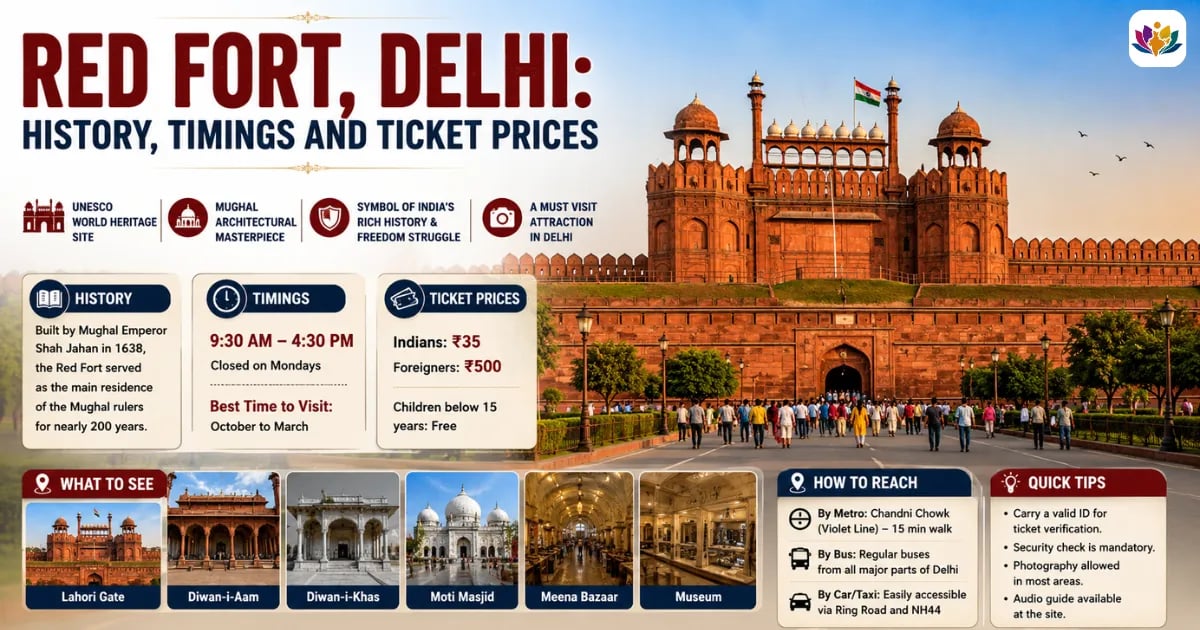
The Red Fort or Lal Qila, is the vast red sandstone Mughal fort in Old Delhi that Emperor Shah Jahan built between 1638 and 1648. A UNESCO World Heritage Site, it opens 9:30 AM to 4:30 PM daily except Monday, with entry ₹35 for Indians and ₹550 for foreigners and India's Prime Minister raises the flag here each Independence Day.
I was born and raised in Delhi and the Red Fort is the monument I have walked through more than any other in 11 years with Experience My India. Most visitors photograph the great red walls, wander the halls for twenty minutes and leave without knowing what they are looking at and that is a shame, because this fort was the throne room of an empire, the place a nation's flag first rose in 1947 and the scene of some of the most dramatic turns in Indian history. Here is the full story, the practical timings and tickets and exactly what to look for inside.
Book our Delhi Agra Tour Packages, a unit of Experience My India, Or message on WhatsApp at +91 7302265809, any day from 8 AM to 9 PM.
The history of the Red Fort
Shah Jahan and the new capital
In 1638 the emperor Shah Jahan, the same ruler who built the Taj Mahal, decided to move the Mughal capital from Agra to a brand-new city of his own on the banks of the Yamuna, which he named Shahjahanabad, today's Old Delhi. At its heart he raised a fortified palace, Qila-i-Mubarak, the Blessed Fort and it took a decade to complete, from 1638 to 1648. Its architect, Ustad Ahmad Lahori, is the same master associated with the Taj Mahal and the red sandstone walls he threw up run for about 2.5 km and rise as high as 33 metres, which is why it has been the Red Fort ever since.
The Mughal golden age and the Peacock Throne
For nearly two centuries this was the ceremonial and political centre of Mughal India. In the Hall of Private Audience stood the fabled jewelled Peacock Throne and on its wall a Persian couplet declared, "If there be a paradise on earth, it is this, it is this, it is this." The court's wealth was legendary and the Kohinoor diamond passed through these halls. It was a golden age, but it did not last: in 1739 the Persian ruler Nadir Shah sacked Delhi and carried the Peacock Throne away to Iran and the empire's long decline had begun.
Decline, the British and 1857
By the nineteenth century the Mughal emperor was a shadow ruler and in 1857 the last of the line, Bahadur Shah Zafar, became the reluctant figurehead of the great revolt against the British. When it was crushed, the British exiled him, looted the fort, demolished much of the inner palaces and gardens and turned the site into a military barracks. A great deal of what once made the Red Fort dazzle was lost then, which is why parts of it feel emptier today than the grandeur of the walls suggests.
The Red Fort and independence
The fort's story did not end with the Mughals. In 1945 the British held the famous Indian National Army trials here, which stirred the country. And on 15 August 1947, India's first Prime Minister Jawaharlal Nehru raised the national flag over the Lahori Gate, a tradition every Prime Minister has kept each Independence Day since. That is why, for Indians, the Red Fort is not just a monument but the very stage of the nation's freedom and UNESCO inscribed the complex as a World Heritage Site in 2007.
Red Fort timings and ticket prices in 2026
The Red Fort is open every day except Monday, so plan around that; it is one of the most common trip-ruining mistakes in Delhi.
Detail | Value | Notes |
Timings | 9:30 AM to 4:30 PM | Closed every Monday |
Entry, Indian | ₹35 | Children under 15 free |
Entry, foreigner | ₹550 | Small online discount |
Light & sound show | Evening, separate ticket | English & Hindi sessions |
Entry is around ₹35 for Indian visitors and ₹550 for foreign tourists, with children under 15 free and booking on the official Archaeological Survey of India portal gives a small discount and saves you the counter queue. The separate museums inside carry their own small charges. The evening light and sound show, which dramatises the fort's history in English and Hindi sessions, needs its own modestly priced ticket, so check the current show times and price before you plan your evening around it.
What to see inside the Red Fort
Do not just walk the walls. The Red Fort is a sequence of gateways, halls and palaces laid out along a central axis and knowing what each one was brings the empty rooms back to life.
Lahori Gate and Chatta Chowk
You enter through the Lahori Gate, the main western gateway that faces towards Lahore and it is from the rampart above it that the Prime Minister addresses the nation each Independence Day. Just inside runs the Chatta Chowk, a rare covered arcade bazaar where the royal household once bought silks, jewels and brocade and where you can still shop, for souvenirs now rather than court finery.
Naubat Khana, the drum house
Beyond the bazaar stands the Naubat Khana or drum house, where musicians played to announce arrivals and mark the hours; even princes had to dismount here out of respect. Upstairs there is a small museum and the carved sandstone facade repays a look.
Diwan-i-Am, the Hall of Public Audience
The Diwan-i-Am is the great pillared hall where the emperor sat in state to hear petitions and dispense justice, raised on a marble canopy set with fine pietra dura inlay, some panels of it Italian work. Picture it hung with silks and crowded with courtiers and the bare hall suddenly makes sense.
Diwan-i-Khas and the Peacock Throne
The Diwan-i-Khas, the Hall of Private Audience, is the jewel of the fort: a marble pavilion with inlaid flowers and once a silver ceiling, where the emperor received his most important guests and where the Peacock Throne stood before Nadir Shah took it. The paradise inscription still runs beneath its cornice and it remains the single most atmospheric room on the site.
The palaces: Khas Mahal, Rang Mahal and the Hammam
Along the river front lie the private palaces, linked by the Nahr-i-Behisht, the Stream of Paradise, a marble water channel that once cooled and connected the royal apartments. The Khas Mahal was the emperor's own residence, with the tower from which he showed himself to the people each morning; the Rang Mahal, the Palace of Colours, was the heart of the harem, with a carved marble lotus fountain; and the Hammam, the royal baths, glitters with inlaid marble and coloured glass.
Moti Masjid and the gardens
Tucked away is the Moti Masjid, the Pearl Mosque, a small, perfect white marble mosque that the emperor Aurangzeb added for his private prayers. Beyond it stretch the remains of the Hayat Bakhsh Bagh, the Life-Bestowing Garden, with its pavilions named for the monsoon months, a green, quiet end to the visit.
The light and sound show
In the evening the fort hosts a light and sound show that tells its story in a wash of coloured light and recorded voices, with separate English and Hindi sittings lasting about an hour. It is an atmospheric way to end a day in Old Delhi, especially in the cooler months. Because timings and prices change with the season, confirm the current schedule before you go and book ahead on busy evenings.
How to reach the Red Fort
The Red Fort stands in Old Delhi, directly opposite the lanes of Chandni Chowk. The easiest way there is the Delhi Metro: the Lal Qila station on the Violet Line lets you out almost at the gate and Chandni Chowk on the Yellow Line is about a kilometre away through the market. Autos and cycle-rickshaws are everywhere and because the fort sits within a few minutes of Jama Masjid and Chandni Chowk, it makes most sense to do all three together in one Old Delhi morning.
Best time to visit and how long you need
Come between October and March and go early in the day for softer light and thinner crowds, remembering the Monday closure. Allow about two hours to see the halls and palaces at a comfortable pace or a little longer if you take in the museums. Wear comfortable shoes for the long walk along the central axis, carry water in the warmer months and hire only an official, ID-carrying guide, since the fort is far more rewarding with someone to explain what each hall once was.
Want the Red Fort brought to life with a licensed guide, along with Jama Masjid and Chandni Chowk in one smooth morning? Message me on WhatsApp with your dates and I will set it up.
Combining the Red Fort with the rest of Delhi
The Red Fort is best seen as part of Old Delhi rather than on its own, since Jama Masjid, Chandni Chowk and its street food are all a short walk away.
The simplest way to do the trio properly, with the history explained and the touts kept at bay, is an Old Delhi half-day tour. If you want the whole capital in a day, a full Delhi city tour adds the New Delhi monuments too and you can plan the rest yourself with our guide to the best places to visit in Delhi. Travelling on to see the Taj as well? Line the fort up with a Delhi, Agra and Jaipur Golden Triangle tour, check the Taj Mahal's timings and ticket prices and read how far Delhi is from Agra so you can plan the drive. You can also browse our full range of Delhi Agra tours and Experience My India will build the days around you.
Red Fort or Agra Fort? Do not confuse the two
This trips people up constantly, because both are great red sandstone Mughal forts. The Agra Fort, about 230 km away in Agra, is the older of the two, begun by Akbar from 1565 and it is where Shah Jahan himself was later imprisoned by his son, gazing out at the Taj Mahal he had built. The Delhi Red Fort is Shah Jahan's own later creation, the palace of his new capital. If Agra is on your trip, the Agra Fort and the best places to visit in Agra are well worth a separate day and our verified local guides cover both cities.
Experience My India. He has personally hosted 50,000+ travelers and the service he leads is rated 4.9 from 2,600+ reviews, operating since 2015. Delhi Agra Tour Packages is a unit of Experience My India.
Book Your Delhi - Agra Trip Today 📞 +91-7302265809 💬 WhatsApp: +91-7302265809 Rated 4.9★ / 2600+ Reviews Explore all: Delhi Agra Tour Packages |
What a Experiance My India
Complete Delhi-Agra services
Private AC Cabs
Comfortable AC cars with experienced local drivers for Delhi, Agra and Jaipur tours.
Local Expert Guides
Explore the Taj Mahal and historic monuments with knowledgeable local guides.
Handpicked Hotels
Comfortable stays near the Taj Mahal and prime locations across Delhi and Agra.
Delhi–Agra Tours
Well-planned same-day and multi-day tours covering the best attractions.
Golden Triangle
Experience Delhi, Agra and Jaipur together with carefully planned itineraries.
24/7 Travel Support
Get assistance throughout your journey from booking to your return.
Plan Your Trip
Get a free quote in 30 mins
100% Trusted & Verified
by 50,000+ Travellers since 2018
Why travellers choose Experience My India
What makes us different from other agencies
We plan and run every trip ourselves, so you get a private AC car, a local expert guide, an honest fixed price, and no reseller or touts in between. We have guided travelers and families since 2018 and hold a 5.0 star rating across 3 verified reviews.
What Our Travellers Say
Real reviews from real Travellers
“Our Red Fort and Old Delhi tour with Experience My India was perfectly organized. Abhay Sharma planned a smooth itinerary covering Red Fort, Jama Masjid, and Chandni Chowk without wasting time in traffic. The private car was comfortable, the hotel selection was excellent, and our licensed guide explained every monument with fascinating stories that made history come alive.”
Nitin Joshi
Udaipur· 24/3/2026
“We booked our Delhi sightseeing through Experience My India after reading Abhay Sharma's guide, and it was one of the best travel decisions we made. The driver was punctual, the guide was extremely knowledgeable, and the hotel was clean and conveniently located. Every detail was professionally managed, making our family trip completely stress-free.”
Priya Bansal
Chandigarh· 15/7/2026
“Experience My India provided outstanding service throughout our Delhi and Agra vacation. Abhay Sharma's itinerary was thoughtfully planned, giving us enough time at every attraction without feeling rushed. The premium car, experienced local guide, and excellent hotel arrangements made the journey comfortable from start to finish. Highly recommended for first-time travelers.”
Rahul Naik
Goa· 2/8/2026
Our Red Fort and Old Delhi tour with Experience My India was perfectly organized. Abhay Sharma planned a smooth itinerary covering Red Fort, Jama Masjid, and Chandni Chowk without wasting time in traffic. The private car was comfortable, the hotel selection was excellent, and our licensed guide explained every monument with fascinating stories that made history come alive.
Nitin Joshi
Udaipur
We booked our Delhi sightseeing through Experience My India after reading Abhay Sharma's guide, and it was one of the best travel decisions we made. The driver was punctual, the guide was extremely knowledgeable, and the hotel was clean and conveniently located. Every detail was professionally managed, making our family trip completely stress-free.
Priya Bansal
Chandigarh
Experience My India provided outstanding service throughout our Delhi and Agra vacation. Abhay Sharma's itinerary was thoughtfully planned, giving us enough time at every attraction without feeling rushed. The premium car, experienced local guide, and excellent hotel arrangements made the journey comfortable from start to finish. Highly recommended for first-time travelers.
Rahul Naik
Goa
Our Red Fort and Old Delhi tour with Experience My India was perfectly organized. Abhay Sharma planned a smooth itinerary covering Red Fort, Jama Masjid, and Chandni Chowk without wasting time in traffic. The private car was comfortable, the hotel selection was excellent, and our licensed guide explained every monument with fascinating stories that made history come alive.
Nitin Joshi
Udaipur
We booked our Delhi sightseeing through Experience My India after reading Abhay Sharma's guide, and it was one of the best travel decisions we made. The driver was punctual, the guide was extremely knowledgeable, and the hotel was clean and conveniently located. Every detail was professionally managed, making our family trip completely stress-free.
Priya Bansal
Chandigarh
Frequently Asked Questions
Quick answers to common questions
The Red Fort was built by the Mughal emperor Shah Jahan between 1638 and 1648, as the palace fort of his new capital, Shahjahanabad, in what is now Old Delhi. Its architect is associated with the Taj Mahal.
The Red Fort is open from 9:30 AM to 4:30 PM, every day except Monday. The evening light and sound show runs separately after dark, with its own ticket and schedule.
No. The Red Fort is closed every Monday. Along with the Lotus Temple and Akshardham, which also close on Mondays, it is a common trap, so plan a Monday around the sites that stay open.
Entry is around ₹35 for Indian visitors and ₹550 for foreign tourists, with children under 15 free. Booking online on the ASI portal gives a small discount and skips the counter queue.