Mughal History Golden Triangle Tour | Private
Mughal History Golden Triangle Tour | Private image 1
Mughal History Golden Triangle Tour | Private image 2
Mughal History Golden Triangle Tour | Private image 3
Mughal History Golden Triangle Tour | Private image 4

Mughal History Golden Triangle Tour | Private

4.8(1247)
2-3 hours
Sunrise / Sunset
Mughal Architecture
Tags:
mughal-historygolden-triangletaj-mahalhumayuns-tombbaby-tajhistorian-led-tourdelhi-agraheritage-culture

Honest: most "Mughal" tours skip the buildings that tell the story and sell the Taj as a love-story photo. The dynasty in order, historian-led. From Rs 72,000 pp.

In a Nutshell

Experience My India runs a private, historian-led Mughal history tour across the Golden Triangle, tracing the dynasty in order from Babur to Aurangzeb through Delhi and Agra, from Rs 72,000 per person. You see the Taj Mahal last, after its prototype (Humayun's Tomb) and its draft (the Baby Taj), so you can actually read it, and you get the real, complicated history rather than the greeting-card love story.

Details

Quick facts

FactDetail
What it isA private, historian-led Mughal history tour of Delhi and Agra, the genuinely Mughal circuit
Price fromRs 72,000 per person (about 6 days, four-star, twin sharing) [VERIFY]
The core routeDelhi and Agra, with Fatehpur Sikri and Sikandra; Jaipur optional and honestly labelled Rajput
The methodThe dynasty in chronological order, buildings as chapters, the Taj seen last
The key insightThe Taj is the climax of a century: Humayun's Tomb, then the Baby Taj, then the Taj
The history, honestlyTolerance and orthodoxy, building and imprisonment, not a sanitised love story
The guideA history specialist, not a monument-facts recital, with myths corrected
Amber Fort (if Jaipur added)Jeep ascent, never the elephant, on welfare grounds

The usual "Mughal" tour, versus a real one

This is the whole page, so we will be blunt about it.

Details

The usual "Mughal" Golden Triangle, versus a real Mughal history tour

The usual "Mughal" Golden TriangleA real Mughal history tour
The routeDelhi, Agra, Jaipur, with Jaipur sold as MughalThe genuinely Mughal circuit: Delhi and Agra, with Fatehpur Sikri and Sikandra; Jaipur optional and labelled Rajput
The TajA love-story photo stop, seen first or in isolationThe climax, seen after its prototype and its draft so you can read it
The orderMonuments in no sequence, no narrativeThe dynasty in chronological order, each building a chapter
The historySanitised into a romanceThe real thing: conquest, tolerance under Akbar, orthodoxy under Aurangzeb, a son who imprisoned his father
The guideA recital of dates and dimensionsA history specialist who tells the story and corrects the myths
The difference is not more sites; it is sense. A Mughal tour that shows you the Taj on day one and Humayun's Tomb on day three has told you the ending before the beginning. We put the story in order, which costs nothing and changes everything.

Read the Taj by seeing its drafts first

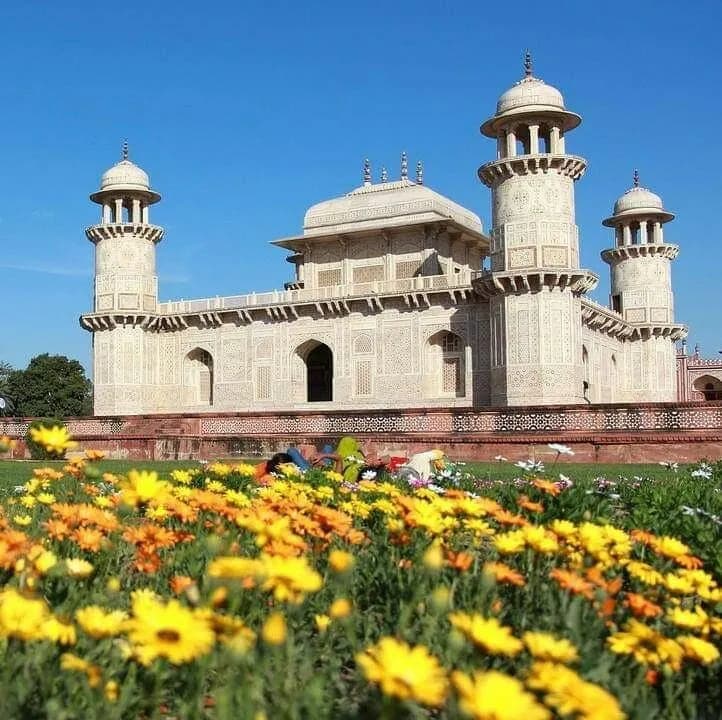
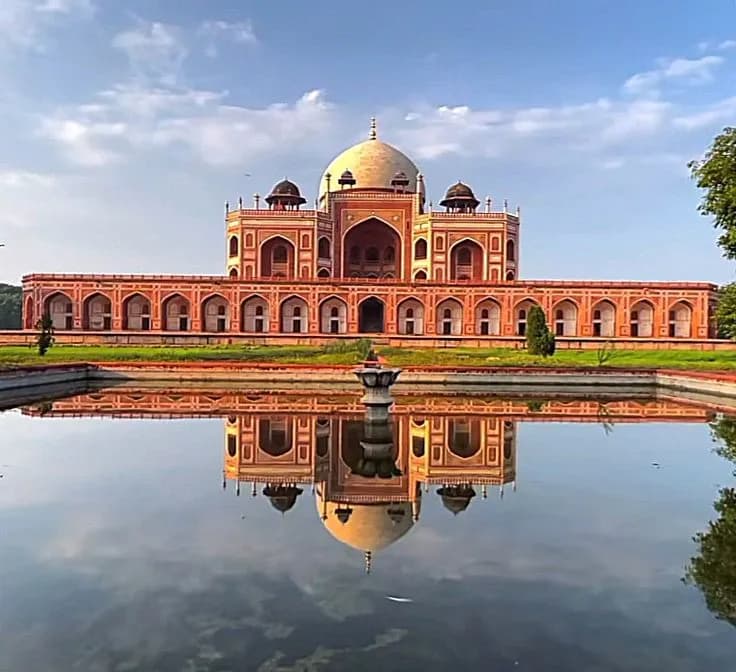
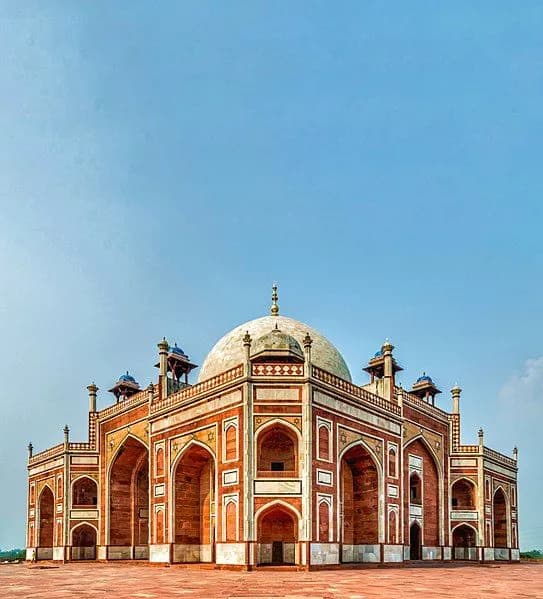
This is the standout idea of the whole trip, and it is genuine art history, not a gimmick. The Taj Mahal did not appear from nowhere; it is the perfected end of an evolving form: Humayun's Tomb, Delhi (completed around 1572). The first grand Mughal garden-tomb, a domed mausoleum set in a four-part paradise garden, in red sandstone and marble. This is the template. Everything the Taj does, this did first, in rougher form. It is also where the last Mughal emperor was captured in 1857, so the dynasty's architecture and its end meet in one place. Itimad-ud-Daulah, the Baby Taj, Agra (1622 to 1628). Built by the empress Nur Jahan for her father, this is the first major Mughal building faced entirely in white marble and the first with extensive pietra dura, the inlaid semi-precious stonework. It is, quite literally, the draft of the Taj: the materials and the technique, tried at small scale a few years before. The Taj Mahal, Agra (1632 to 1653). Now you can see it for what it is: the marble of the Baby Taj, the garden-tomb form of Humayun's Tomb, and the pietra dura, all brought to a perfection that took a century and the wealth of an empire to reach. See these three in this order and the Taj stops being a pretty picture you already knew and becomes the moment a hundred years of ambition arrived. That is the difference a themed, ordered tour makes.

The Taj is not only a love story

The romance is real: Shah Jahan built the Taj for Mumtaz Mahal, who died bearing their fourteenth child. But the greeting-card version leaves out the history that makes the Mughals genuinely fascinating, and we tell it straight: The throne was won in blood. Shah Jahan took power after a war of succession, as was normal for the dynasty. The builder was imprisoned by his son. Aurangzeb deposed and confined his father Shah Jahan in Agra Fort for his last years, from where, the story goes, he could see the Taj across the river. Two opposite emperors. Akbar built a philosophy of tolerance and even a syncretic court religion; Aurangzeb, a few decades later, was rigidly orthodox. The same dynasty produced both, and both left their mark on stone. The Black Taj and other myths. The legend that Shah Jahan planned a black-marble mirror-image tomb across the river is almost certainly just that, a legend, and we say so rather than repeat it as fact. None of this diminishes the Taj. It makes it the centre of a real and complicated human story, which is far better than a postcard.

About Jaipur, honestly

The classic Golden Triangle adds Jaipur, and Jaipur is wonderful, but it is a Rajput city founded in 1727, well after the Mughal peak, by the Kachwaha dynasty. Its connection to the Mughals is as allies and generals, not as Mughal architecture; the Kachwaha ruler Man Singh was one of Akbar's great commanders. So on a Mughal history tour, we treat Jaipur as optional, and if you add it, we frame it truthfully as the story of the Rajput allies of the Mughals, seen at Amber Fort, rather than pretending its palaces are Mughal. Honesty about what is and is not Mughal is part of the point.

Your route, day by day (about 6 days, chronological)

Day 1 (Delhi): arrive. Airport pickup and hotel, and an evening briefing on the dynasty you are about to follow, so the next days have a spine. Overnight Delhi. Day 2 (Delhi): the frame of the story. Humayun's Tomb first, the Taj's prototype and the place the last emperor was captured, so the arc is set from the start. Then the Purana Qila, linked to Humayun and Sher Shah, and Shah Jahan's Delhi: the Red Fort and the Jama Masjid of Shahjahanabad, with a walk through the old city. Nizamuddin Dargah for the Sufi thread that runs through Mughal Delhi. Overnight Delhi. Day 3 (Delhi to Agra): Akbar, and the seat of power. Drive to Agra (about 3.5 to 4.5 hours). On arrival, Sikandra, the tomb of Akbar, the emperor who built the empire's tolerant high point. Then Agra Fort, the Mughal seat, and the place Aurangzeb imprisoned his own father with a view of the Taj. Overnight Agra. Day 4 (Fatehpur Sikri, and the draft): Akbar's city and the Baby Taj. A morning at Fatehpur Sikri (about an hour from Agra), Akbar's purpose-built capital of red sandstone, abandoned within a generation, where the Buland Darwaza, the Diwan-i-Khas and Salim Chishti's tomb tell the story of Akbar's ideas and ambition. In the afternoon, the Itimad-ud-Daulah, the Baby Taj, the marble-and-pietra-dura draft that comes just before the masterpiece. Overnight Agra. Day 5 (Agra): the climax. The Taj Mahal at sunrise, now readable after its prototype and its draft, with the time and the guide to actually understand what you are seeing rather than only photograph it. Mehtab Bagh across the river in the late afternoon, where we tell you the truth about the Black Taj legend. Overnight Agra. Day 6 (Agra): depart, or on to the Rajput allies. Depart from Agra or Delhi, or continue to Jaipur (about 4.5 hours via Fatehpur Sikri) for the honestly-labelled Rajput chapter, the Kachwaha allies of the Mughals at Amber Fort, added as two further nights. Add Jaipur for the Rajput story, or a Delhi day for the Qutub complex and pre-Mughal Delhi, each as a named extension.

Fine print

What is included

Included

  • A private, history-specialist guide who tells the dynasty as a story, not a facts recital
  • Accommodation at your chosen tier, twin sharing, named properties confirmed before you pay
  • Private air-conditioned car with driver throughout
  • Airport and hotel transfers
  • Daily breakfast
  • Monument entry at each traveller's correct rate, pre-booked to skip the queue
  • The chronological sequencing that lets you read the Taj, at no extra cost, because it is just better planning
  • All tolls, parking, fuel, driver allowance; 5 percent GST

Excluded

  • The 5-star and palace tier, quoted separately as named upgrades
  • Lunches and dinners
  • The Rs 200 Taj mausoleum inner-chamber ticket unless requested
  • Camera and video fees at the monuments
  • The optional Jaipur or extra Delhi extension
  • Tips; travel insurance; personal shopping
  • Any sanitising of the history into a pure love story, which is excluded on principle

Transparent pricing

Per person, twin sharing, with a 20 percent service margin and 5 percent GST already inside the number. A history-specialist guide is the core of this tour, and priced into it. These are a starting floor. [VERIFY all figures at booking.]
Tier5-day (Delhi and Agra)6-dayForeign national (6-day)
Four-starRs 60,000 [VERIFY]Rs 72,000 [VERIFY]About Rs 74,600 [VERIFY]
Five-star, for comparisonRs 75,000 [VERIFY]Rs 90,000 [VERIFY]About Rs 92,600 [VERIFY]
We print the four-star line deliberately. The four-star trip sees the identical monuments with the same specialist guide; the honest difference is only the hotel, and on a history tour the guide matters far more than the thread count. Foreign nationals add roughly Rs 2,600 for the higher monument fees (Taj Rs 1,100 vs Rs 50, Agra Fort Rs 650 vs Rs 50, Fatehpur Sikri, Humayun's Tomb, Sikandra and the Baby Taj) [VERIFY the current rates]. Foreigners also pay a Rs 500 ADA toll at Agra, waived on Fridays. OCI cardholders pay Indian rates with the physical card; under-15s enter the Taj free. Single supplement [VERIFY] per day.

Our promise

Why choose Experience My India for Mughal history

1
We tell the dynasty in order, so the Taj lands as a climax, not a checkbox.
2
We use a history specialist, not a monument-facts recital, and we correct the myths rather than repeat them.
3
We are honest about what is Mughal and what is not, including that Jaipur is Rajput.
4
We sequence the drafts before the masterpiece, Humayun's Tomb and the Baby Taj before the Taj, at no extra cost.
5
We tell the real, complicated history, which is more interesting than the postcard, not less.
6
Jeep at Amber, never the elephant, if you add the Rajput chapter, on welfare grounds.
7
[OWNER: add one verifiable credential, for example a named guide's history qualification or a museum or heritage partnership, only if real]

Honest note

This trip is NOT for you if

  • You only want the photograph. If the Taj at sunrise is all you are after, a standard tour is quicker; this trip is for the story behind it.
  • You want a light, uncomplicated day out. We tell the real history, including its darker turns, rather than a soft romance.
  • You want to tick Jaipur as "Mughal". We will include it, but honestly, as the Rajput allies, not as Mughal architecture.
  • You dislike walking and reading monuments closely. This is a slower, deeper trip built around understanding, not covering ground.
  • You want the elephant ride at Amber. We do not offer it at any tier, on welfare grounds.

Preparation

Before you go

🎒Packing List

  1. 1.Read a short dynasty timeline before you arrive, or let us send one; even a page makes the trip richer.
  2. 2.Trust the order; resist the urge to see the Taj first, because seeing it last is the whole method.
  3. 3.Book the Taj for a non-Friday and go at sunrise, when it is coolest and clearest.
  4. 4.Ask your guide the hard questions; the honest answers are the best part.
  5. 5.Give the sites time; this is not a trip for racing between photo stops.
  6. 6.Consider the Delhi Qutub extension if you want the pre-Mughal context of the Delhi Sultanate.

Enquire Now

Premium Experience

Ready to Explore
Incredible India?

Explore the rich heritage, stunning monuments, and vibrant culture of India with our expert-guided premium tours.

A
B
C
D
2,500+
4.9
Flexible itinerariesPrivate guidesBest price guarantee
Premium Tour Package
Featured Destination

India

Premium Tour Package

Premium

Questions

FAQ

6/6 visible

What makes this different from a normal Golden Triangle tour?

Order, honesty and a history specialist. We follow the Mughal dynasty in chronological sequence through the buildings that tell its story, so you see the Taj last, after its prototype and its draft, and understand it rather than only photograph it. We also tell the real history, not a sanitised love story, and we are honest that Jaipur is Rajput, not Mughal.

Is the Taj Mahal really just a love story?

Why do you see the Taj on the last day?

Is Jaipur part of a Mughal history tour?

Do I need to know Mughal history already?

Is the Taj Mahal closed on any day?

See the Taj the way it was meant to be understood

A historian-led Mughal history tour from Rs 72,000 per person: the dynasty in order, the Taj seen last after its prototype and its draft, the real complicated history told straight, and honesty about what is Mughal and what is Rajput.

Explore more

Related pages

Plan Your Trip

Interested in Mughal History Golden Triangle Tour | Private?

Chat with our travel team for a custom quote, or browse every package.

Related Attractions

3
3 related attractions
Premium Experience

Ready to explore Mughal History Golden Triangle Tour | Private?

Book your private tour today and experience the magic of India's rich heritage.

Explore Tours
Verified GuideBest Price2,500+ Happy Travelers
Call us