 Sikandra, Agra
Akbar's Tomb Sikandra Agra: Timings, Tickets and History
Visiting Akbar's Tomb at Sikandra, Agra, the great emperor's five-tiered mausoleum? Its history, timings, ticket prices, the deer park and how to reach.
Quick answer
Akbar's Tomb at Sikandra is the grand mausoleum of the third Mughal emperor, Akbar the Great, begun by Akbar himself and completed by his son Jahangir in 1613. Set in a 119-acre walled garden where deer and peacocks roam, 10 km northwest of Agra, it is open every day including Friday. It features on our Agra tours, run by a unit of Experience My India.
- #akbar-tomb-sikandra
- #agra
- #agra-attractions
- #agra-travel
Akbar's Tomb is the monument where you meet the greatest of the Mughal emperors, a vast five-tiered mausoleum standing in a deer park on the edge of the city. Our team at Delhi Agra Tour Packages folds it into Agra days and it sits naturally on any Golden Triangle tour through Delhi, Agra and Jaipur, especially for arrivals from the Delhi side.
I am Abhay Sharma, a Golden Triangle guide since 2015 and this is a monument I love for its calm scale and its story. Akbar planned his own resting place, his son Jahangir finished it and the whole design fuses Hindu, Islamic, Jain, Buddhist and Christian motifs, a monument in stone to Akbar's belief in universal peace. This guide gathers everything I would tell a visitor beforehand, the history and the architecture, the timings and tickets, the deer park and how to reach it on the Delhi road.
Akbar's Tomb at a glance
| Detail | Information |
|---|---|
| Whose tomb | Akbar the Great, third Mughal emperor |
| Built by | Begun by Akbar, completed by Jahangir in 1613 |
| Location | Sikandra, Mathura Road, 10 km northwest of Agra |
| Garden | A 119-acre charbagh with deer and peacocks |
| Managed by | Archaeological Survey of India |
| Open | All seven days, including Friday |
| Time needed | 1 to 1.5 hours |
| Best season | October to March |
Akbar's Tomb timings
| Detail | Information |
|---|---|
| Open | All seven days, including Friday |
| Hours | Sunrise to sunset, 6 AM to 6 PM by season |
| Ticket counters close | 30 minutes before sunset |
| Time needed | 1 to 1.5 hours |
Akbar's Tomb is open every day from sunrise to sunset, 6 AM to 6 PM depending on the season, with the ticket counters closing 30 minutes before sunset. Crucially, unlike the Taj Mahal it stays open every day including Friday, which makes it an ideal Friday sightseeing stop. These timings are current at the time of writing and can change, so reconfirm before a special trip.
Entry fee
| Visitor | Entry fee |
|---|---|
| Indian, SAARC and BIMSTEC nationals | ₹30 at the counter, ₹25 online or on Fridays |
| Foreign nationals | ₹310 at the counter, ₹300 on Fridays or with a same-day Taj ticket, ₹260 online |
| Children under 15 | Free, all nationalities |
For Indian, SAARC and BIMSTEC visitors the entry is ₹30 at the counter or ₹25 if booked online or visited on a Friday. For foreign tourists it is ₹310 at the counter, which includes the ₹10 Agra Development Authority toll, dropping to ₹300 on Fridays or with a same-day Taj Mahal ticket and ₹260 if booked online. Children under 15 enter free. These prices are current at the time of writing and are revised periodically, so reconfirm before you travel.
How to reach Akbar's Tomb
| From | Route |
|---|---|
| Agra Cantt Railway Station | 10 km, a 20 to 30 minute drive |
| Taj Mahal | 15 km, a 30 to 40 minute drive |
| By road | On the Agra to Delhi Highway, NH-19, at Sikandra |
| By local bus | City buses and tempos to Sikandra Chauraha |
What is Akbar's Tomb?
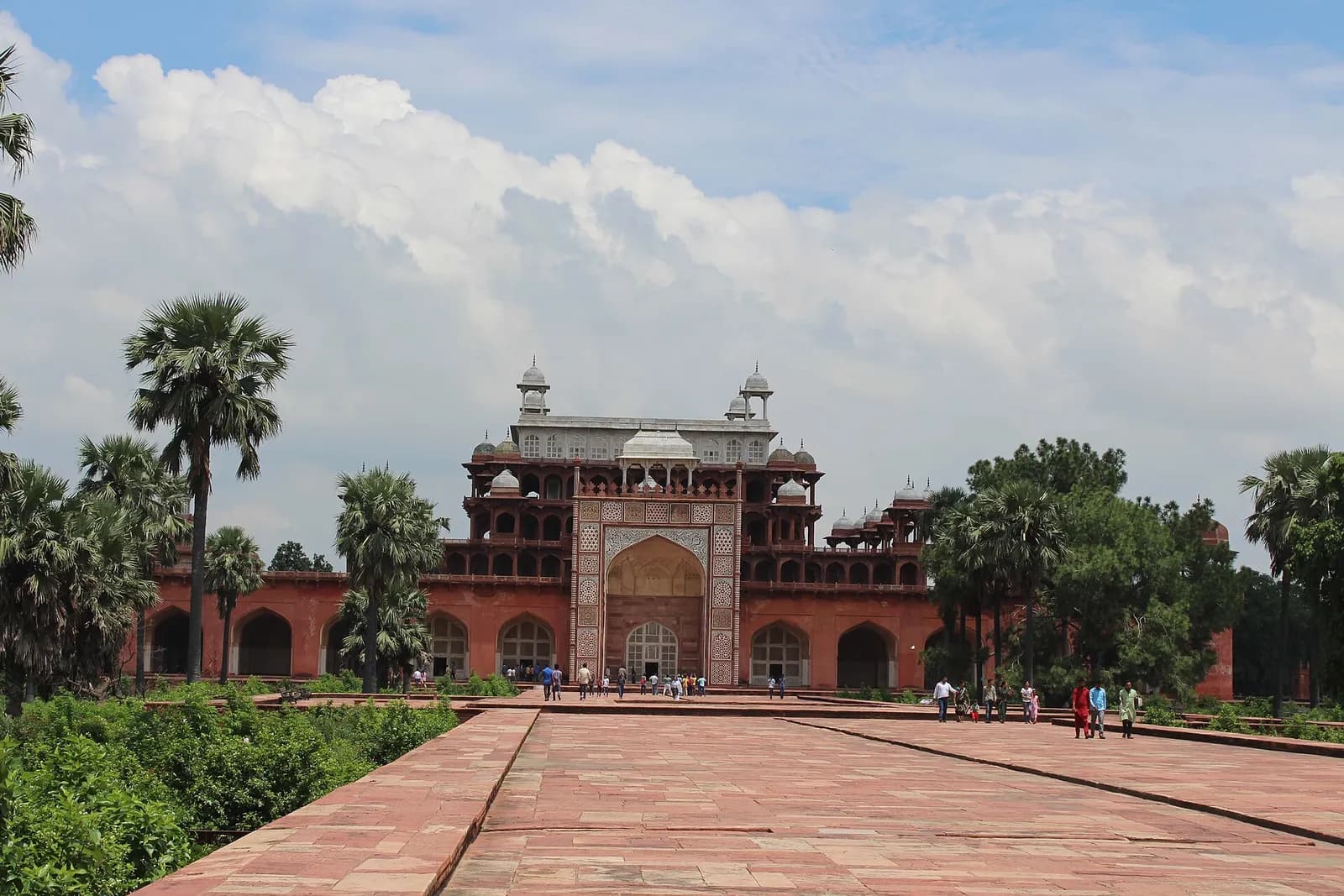
Akbar's Tomb in Sikandra is the grand 17th-century mausoleum of the third Mughal emperor, Akbar the Great, standing inside a sprawling 119-acre walled garden 10 km northwest of Agra's city centre. Begun by Akbar himself and completed by his son, Emperor Jahangir, in 1613, it is one of the largest and most important Mughal monuments in Agra, a vast five-tiered structure set among formal gardens where blackbucks, spotted deer and peacocks roam freely. More than a tomb, it is a statement of Akbar's philosophy, deliberately blending the artistic motifs of many faiths. For the visitor, it offers a very different experience from the city's famous marble monuments, a vast, green, unhurried estate where history and wildlife meet.
Several things make it special and they are worth drawing out:
- The tomb of Akbar the Great. The resting place of the most celebrated of all Mughal emperors, who planned it himself.
- A unique five-tiered design. Not a domed tomb but a stepped, pyramid-like structure unlike any other major Mughal mausoleum.
- A monument to tolerance. Its design fuses Islamic, Hindu, Buddhist, Jain and Christian motifs, reflecting Akbar's philosophy of universal peace.
- A deer park setting. A 119-acre charbagh garden where blackbucks, spotted deer, peacocks and monkeys live among the ruins.
- Open on Fridays. Unlike the Taj Mahal, it is open all week, making it a perfect Friday stop.
History of Akbar's Tomb
The story of this tomb is the story of Akbar himself, the emperor who expanded the Mughal Empire and tried to unite its many faiths and of the son who completed his father's final monument.
The story runs in clear stages:
- A self-planned resting place. Following the Timurid and Central Asian tradition, Akbar selected the site and began the design of his own mausoleum during his lifetime.
- Completion by Jahangir. After Akbar died in 1605, his son Jahangir took over the project, modified several upper sections and completed the complex in 1613.
- Plunder and restoration. In the late 17th and 18th centuries the tomb was looted by Jat rebels, who stripped away gold, silver and precious carpets and it was later extensively restored in the early 1900s under Viceroy Lord Curzon.
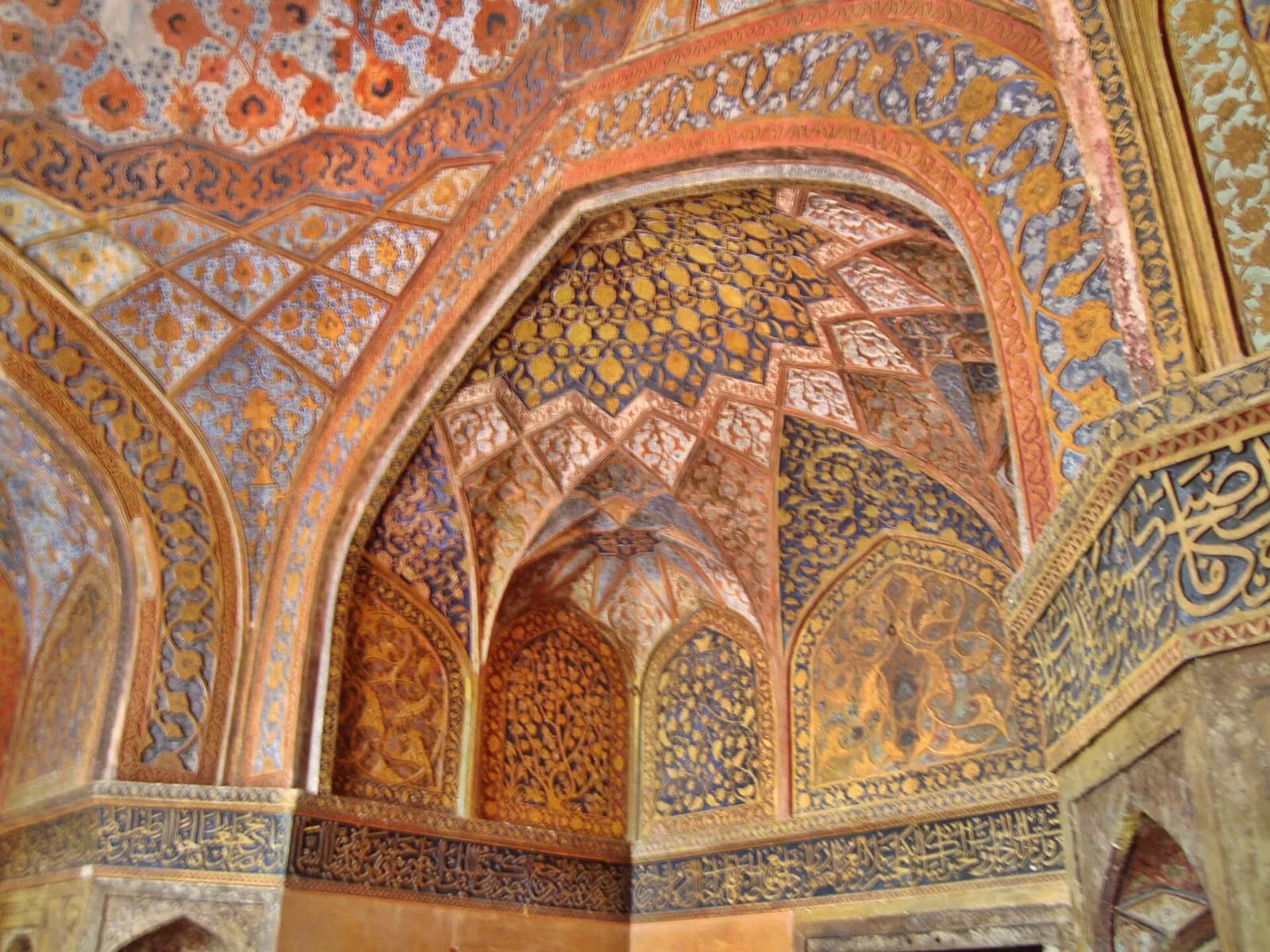
- A symbol of religious harmony. Reflecting Akbar's philosophy of Sulh-i-Kul, universal peace, the monument deliberately fuses Islamic, Hindu, Buddhist, Jain and Christian artistic motifs.
That philosophy of Sulh-i-Kul is the key to understanding the whole monument. Akbar genuinely tried to govern his vast, diverse empire through tolerance rather than force of faith and he had this belief built into his own tomb, where the symbols of many religions sit side by side. Few mausoleums anywhere are such a direct statement of their occupant's values.
Akbar himself deserves a moment, because this is his monument and his character shaped it. He came to the throne as a young man and over a long reign built the Mughal Empire into one of the great powers of the world, not only through conquest but through a genuinely open approach to religion and governance. He held debates between scholars of different faiths, married across religious lines and even founded a syncretic faith of his own. A ruler of that cast of mind was never going to accept a conventional domed tomb and the unusual, many-layered design at Sikandra reflects a man who thought differently about almost everything.
The later history adds a note of poignancy. The looting of the tomb by Jat rebels in the turbulent decades after the empire weakened saw its treasures stripped away, a reminder of how far Mughal power had fallen by then. That the monument was later rescued and restored, notably under Lord Curzon in the early 1900s, means the version you walk today is the result of careful conservation as much as original construction and it is now safeguarded by the Archaeological Survey of India for future generations.
Akbar's Tomb architecture
Akbar's Tomb breaks the usual Mughal mould in fascinating ways and the features below reward a slow look.
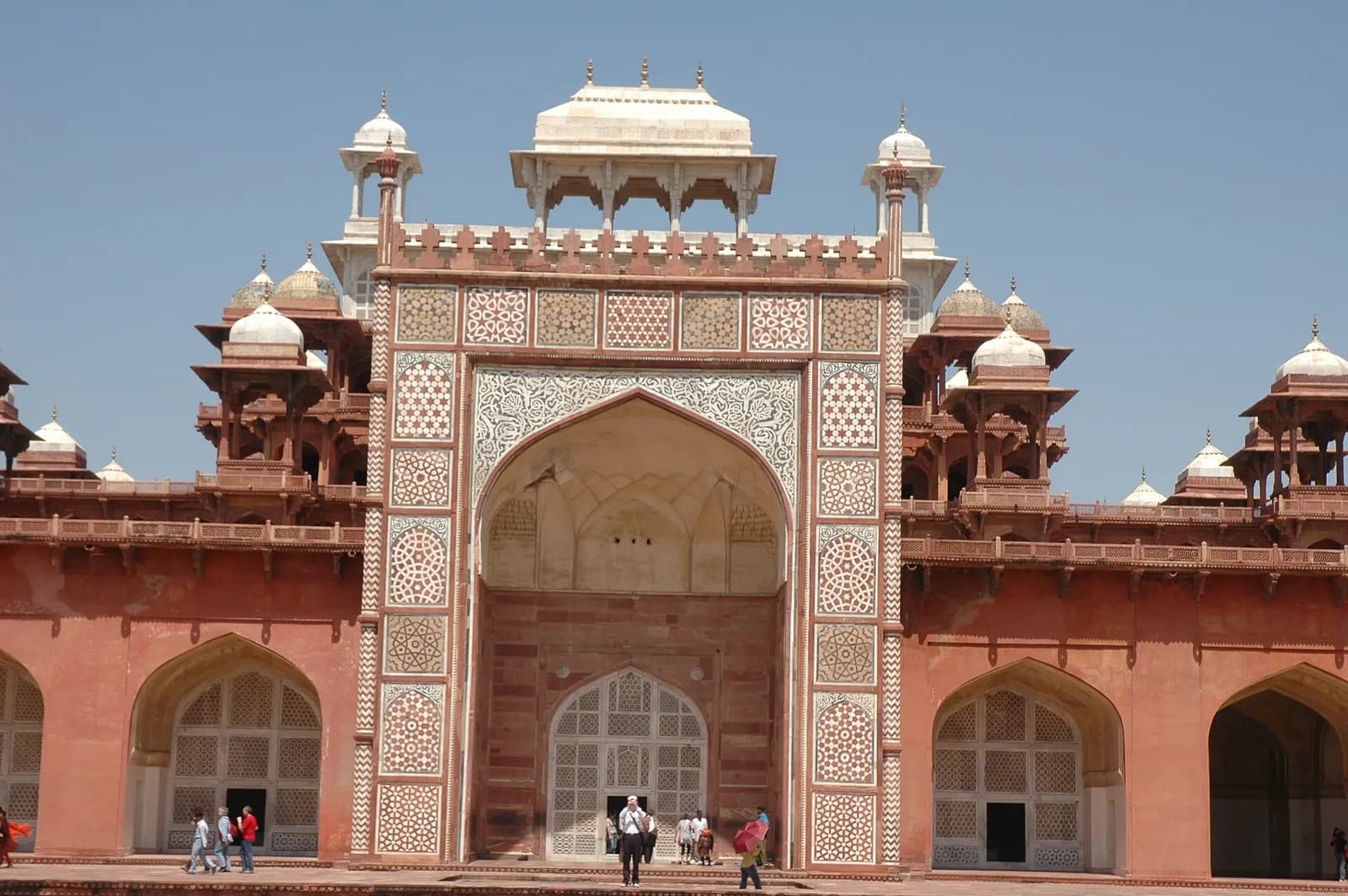
- The five-tiered truncated pyramid. Unlike traditional Mughal tombs crowned by a grand dome, the mausoleum rises in five receding storeys, resembling a stepped pyramid or a multi-tiered palace.
- Red sandstone and white marble. The lower four storeys are built of deep red sandstone with pillared chhatris, while the open-air fifth storey is entirely white marble with delicate jali lattice screens.
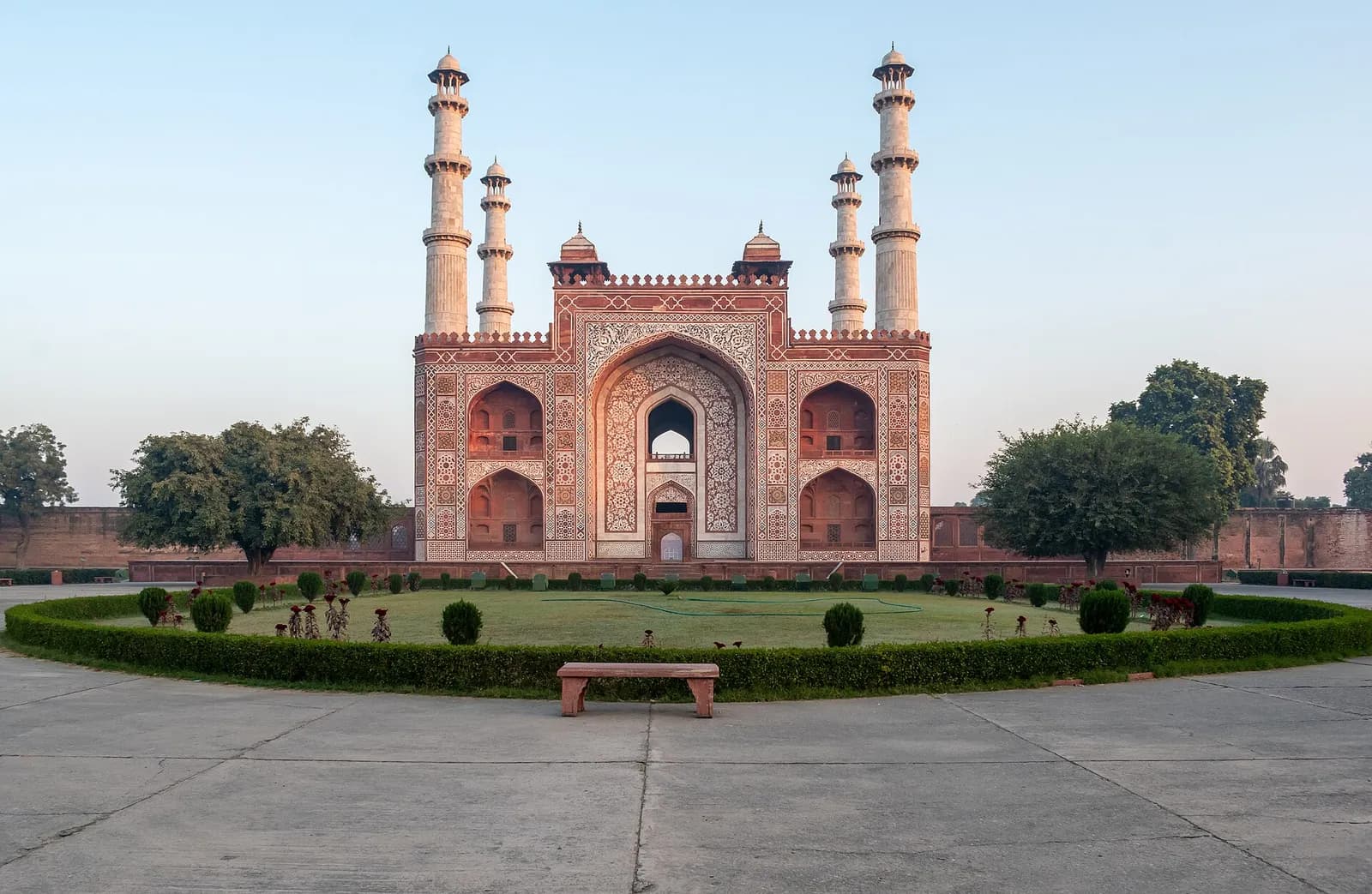
- The Buland Darwaza, the south gate. The main entrance is a monumental red sandstone gateway inlaid with geometric white marble and Persian calligraphy, crowned by four tall white marble minarets, the earliest surviving corner minarets in Mughal architecture, which later inspired the Taj Mahal.
- The underground crypt and false cenotaph. A long, dim, sloped corridor leads down to the quiet, austere underground chamber holding Akbar's actual remains, while a richly carved false marble cenotaph sits open to the sky on the top marble terrace.
- The 119-acre charbagh garden. The mausoleum stands at the centre of a classic four-part Persian garden of raised water channels and paved walkways, where blackbucks, spotted deer, peacocks and monkeys roam freely.
The four corner minarets on the Buland Darwaza are the detail I always point out, because they are genuinely important. These are the earliest surviving corner minarets in Mughal architecture and the idea of framing a gateway and later a tomb, with four tall minarets would reach its perfect expression a generation later at the Taj Mahal. In that sense Akbar's Tomb is one of the places where the Taj Mahal was quietly being invented.
The five-tiered form itself is worth dwelling on, because there is nothing else quite like it among the great Mughal tombs. Where the Taj Mahal and the Baby Taj aim for a single, serene, dome-crowned silhouette, Akbar's Tomb climbs in stages like a palace or a stepped pyramid, each receding storey ringed with open pavilions and chhatris. The lower tiers in warm red sandstone give way to the pure white marble of the topmost, open-air level, so the building seems to lighten as it rises toward the sky. Climbing through it, you move from the solid, grounded lower storeys up to the airy marble terrace where the false cenotaph sits open to the heavens, a deliberate progression from earth toward the divine that rewards taking the stairs slowly.
The contrast between the two cenotaphs is one of the monument's quiet lessons. The ornate marble cenotaph on the top terrace is a symbolic marker, carved and exposed to the sky, while the emperor's actual remains lie far below in a plain, dim chamber at the end of the sloping corridor. That journey from the bright, decorated terrace down into the austere crypt is a moving one and it captures something of the Mughal attitude to death, splendour above and simplicity below.
Akbar's Tomb ticket price and entry fee
Akbar's Tomb is an affordable and rewarding stop and the pricing has a few useful quirks worth knowing. For Indian, SAARC and BIMSTEC visitors, entry is ₹30 at the counter, but only ₹25 if you book online or visit on a Friday. For foreign tourists, it is ₹310 at the counter, including the ₹10 Agra Development Authority toll, dropping to ₹300 on Fridays or if you show a same-day Taj Mahal ticket and ₹260 if booked online. Children under the age of 15 enter free. Because the Friday and same-day-Taj concessions actually make it cheaper on the day the Taj Mahal is closed, it is one of the smartest Friday choices in Agra. Booking online is the cheapest option for both Indian and foreign visitors and saves you queueing at the counter. Plan on 1 to 1.5 hours for a visit. These figures are current at the time of writing and change periodically, so reconfirm before you travel.
The deer park and wildlife at Akbar's Tomb
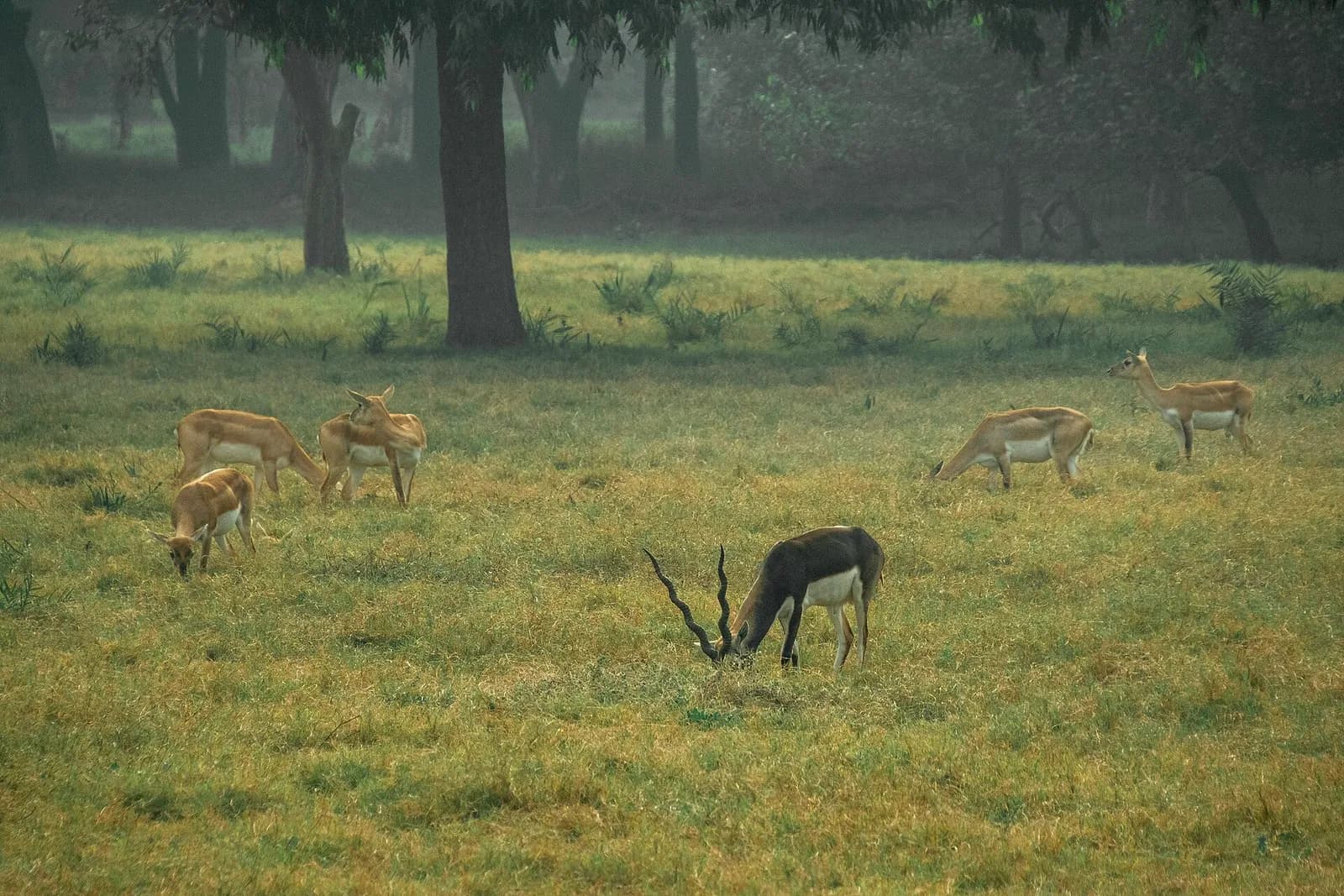
One of the great surprises of Akbar's Tomb is that it doubles as a wildlife garden. The vast 119-acre charbagh is home to herds of blackbuck and spotted deer, along with peacocks and troops of monkeys, all living among the lawns and water channels. Arriving in the early morning or late afternoon, you will often see the deer grazing quietly as the light turns golden on the red sandstone, a genuinely magical scene that few of Agra's monuments can offer. There is also a famous acoustic trick inside the dark corridor leading down to Akbar's crypt, where a soft hum or word directed toward the domed ceiling is amplified into a deep, resonant sound, which a guide will happily demonstrate. Between the wildlife and the acoustics, this is a monument that engages more than just the eye. Keep a respectful distance from the blackbuck and deer, which are shy and move quietly so as not to startle them and you will be rewarded with some of the most peaceful wildlife watching available anywhere in a Mughal monument.
Rules and what to carry at Akbar's Tomb
A few practical points shape a comfortable visit, so keep these in mind:
- Watch your belongings. Langurs and rhesus macaques gather near the entrance and gardens, so avoid carrying loose food or shiny objects in your hand.
- No feeding the wildlife. Keep your distance from the deer and monkeys and do not feed them.
- Carry water. The garden is large and open, so bring your own drinking water, especially in the warmer months.
- Respect the crypt. The underground chamber holding Akbar's remains is a quiet, austere space, so keep noise down out of respect.
What to expect at Akbar's Tomb
Expect scale, calm and a touch of the wild rather than the dense crowds of the Taj Mahal. You enter through the great Buland Darwaza gateway into the enormous garden, with the five-tiered tomb rising ahead and deer often grazing on the lawns. You can climb through the receding storeys, walk down the long dim corridor to the austere crypt where the emperor truly lies and come back up to the open marble terrace with its carved false cenotaph beneath the sky. It is a spacious, unhurried monument that rewards an hour or more of wandering and because it sits out at Sikandra on the Delhi road, it is far quieter than the central sites. For many visitors the combination of grand Mughal architecture and roaming wildlife makes it a quietly memorable highlight.
The sense of space is the biggest difference from the Taj Mahal experience. Here you are not funnelled through security into a crowded enclosure but set loose in a huge green garden, free to wander the lawns, approach the deer at a respectful distance and explore the tomb at your own pace. Families with children often love it for exactly this reason, as the open space and the animals keep younger visitors engaged in a way that a single building cannot. It is also a welcome change of rhythm in a packed Agra itinerary, a place to breathe and slow down between the intensity of the Taj and the Fort.
Best time to visit Akbar's Tomb
The best season is October to March, when Agra's weather is comfortable for walking through the large open garden without the summer heat. Within the day, come in the early morning, from 7 AM to 9 AM or the late afternoon, from 4 PM to 5:30 PM, when soft golden light falls on the red sandstone and the wildlife is most active. These are also the times you are most likely to see the blackbuck and deer out on the lawns, as the animals rest in the shade through the hottest part of the day. Harsh midday sun flattens the light and drives the wildlife out of sight, so the ends of the day are far better for both photography and sightings. A visit timed for the golden hour, with the deer grazing and the red sandstone glowing, is one of the quiet pleasures of Agra that most tour groups never make time for. Our wider notes on the best time to visit Agra apply closely here.
How to reach Akbar's Tomb and its location
Akbar's Tomb stands at Sikandra on Mathura Road, the Agra to Delhi Highway, NH-19, 10 km northwest of Agra's centre. By car, taxi or auto rickshaw it is a 20 to 30 minute drive from Agra Cantt Railway Station and a 30 to 40 minute drive from the Taj Mahal. Because it sits right on the Delhi highway, it is also the perfect first or last Agra stop for travellers driving to or from Delhi, letting you see it without a detour. Regular city buses and shared tempos run along MG Road and NH-19 directly toward Sikandra Chauraha, which is a short walk from the entrance gate, making it accessible even on a budget. If Akbar's Tomb is part of a fuller Agra plan, it pairs naturally with the Sikandra cluster and our sunrise Taj Mahal tour works well before a drive out this way. Travellers staying over often add it to an Agra overnight tour from Delhi.
Places to visit near Akbar's Tomb
Sikandra has its own little cluster of sights, so Akbar's Tomb combines well with a few nearby stops rather than the central monuments. Just outside the eastern wall of the complex stands the Kanch Mahal, a fine Mughal pavilion included in the same ticket, so do not miss it on your way out. Less than 1 km away lies the Tomb of Mariam-uz-Zamani, Akbar's wife, covered in our guide to Mariam's Tomb and close by is the Guru Ka Taal Gurudwara, a revered Sikh shrine in a historic stepped tank, described in our guide to Guru Ka Taal. Together these make a rewarding half day on the Delhi side of Agra and because they cluster so closely, you can see all of them without much driving between stops. The combination of a great imperial tomb, the tomb of Akbar's wife, a glass palace pavilion and a revered gurudwara, all within a short radius, gives this corner of Agra a surprising depth that rewards travellers who venture beyond the central monuments. You can read more in our overviews of places to visit near the Taj Mahal and lesser-known Agra monuments.
Visiting tips for Akbar's Tomb
A few notes I give every group before we go:
- Come for the light and the deer. Early morning or late afternoon gives golden light and the best wildlife sightings.
- Guard your things from monkeys. Keep food and shiny objects out of sight near the gate and gardens.
- Try the crypt acoustics. Ask your guide to demonstrate the resonant echo in the corridor down to Akbar's chamber.
- Do not skip the Kanch Mahal. It is just outside the eastern wall and included in your ticket.
- Use the Friday saving. The entry is cheaper on Fridays, when the Taj Mahal is closed, so it is a smart Friday stop.
- Book online if you can. Online tickets are the cheapest option and save you time at the counter.
Hiring a guide at Akbar's Tomb
Because the monument is unlabelled and its symbolism is easy to miss, a good guide adds a great deal here, explaining Akbar's philosophy of Sulh-i-Kul, pointing out the Hindu, Jain and Christian motifs woven into the design and demonstrating the famous crypt acoustics. A guide can also tell the story of how Jahangir completed his father's tomb and how its corner minarets anticipated the Taj Mahal. Engage only a government approved guide showing a valid identity card and agree the scope and fee before you start. If you are visiting the Sikandra cluster together, one guide for the morning makes the whole area flow.
Akbar's reign is one of the richest stories in Indian history and a knowledgeable guide can bring it to life as you walk the tiers, from his religious debates and his policy of tolerance to the way his grandson Shah Jahan would later perfect the architectural ideas tried here. Our guided tours handle exactly this, giving you one person who can connect Sikandra to the Taj Mahal, the Agra Fort and Fatehpur Sikri so that the whole Mughal story hangs together rather than feeling like a series of unrelated monuments. For many guests, it is that connecting narrative, as much as any single building, that makes an Agra trip memorable.
Akbar's Tomb in your Golden Triangle itinerary
Akbar's Tomb is especially convenient on a Golden Triangle trip, because it sits right on the Agra to Delhi highway at Sikandra. Travellers driving down from Delhi can make it their very first Agra stop, seeing the great emperor's tomb before reaching the city, while those heading back can make it the last. A classic Agra day still centres on the Taj Mahal and the Agra Fort, with Sikandra added as a calm, uncrowded contrast and a chance to see the Mughal wildlife gardens that most visitors never experience. It also rounds out the dynastic story alongside Fatehpur Sikri, Akbar's own capital and the eastern bank tombs like Itimad-ud-Daulah and Mehtab Bagh. Our Agra travel guide ties these together.
Plan your trip with us
If you would like the great emperor's tomb and the Sikandra cluster done well, with the timing judged for the light and the wildlife and a comfortable car waiting, let us carry the load. We shape the day so you see the famous monuments and the quieter gems without the stress of navigating Agra yourself and we can fit Sikandra neatly into your arrival or departure from the Delhi side. Our Delhi Agra tours combine Akbar's Tomb with the Taj Mahal and Agra Fort and travellers short on time often choose our same day Agra tour from Delhi or a full Golden Triangle tour that threads Delhi, Agra and Jaipur. To plan dates, prices and inclusions, message Abhay and the team directly on WhatsApp at +91 7302265809 or reach our team online.
Related guides
Keep reading before you travel, these pair well with this guide:
Enquire Now
What our travellers say
“Our Golden Triangle honeymoon was flawless. Sunrise at the Taj with a private guide felt like a dream — every detail was handled.”
“As a first-time visitor to India, I felt completely safe and looked after. The driver and guide were superb professionals.”
“Travelling with two kids is hard, but they made it effortless. Great pacing, clean cars and zero surprises on price.”
“Booked the Agra day trip on short notice and it went off without a hitch. The guide's history knowledge made the Taj come alive.”
“Best decision of our India trip. Car was spotless, driver was punctual every single day, and the itinerary never felt rushed.”
“Organised a same-day Agra trip for my parents. Communication before and during the trip was excellent — genuinely stress-free.”
“Sunrise at the Taj Mahal was magical. Our guide spoke great English and answered every question with patience.”
“Three generations travelling together and everyone was comfortable — good vehicle, sensible stops, and no hidden costs.”
“I've used a few tour operators across Asia and this was among the smoothest. Fair pricing and they actually answer the phone.”
“Our custom Rajasthan-Agra combo was planned around our budget without cutting corners on comfort. Highly recommend.”
“Solo female traveller here — I felt safe throughout. The driver was respectful and the whole trip was timed perfectly.”
Ready to Explore
The Magic of Agra?
Experience the Taj Mahal at sunrise, explore the mighty Agra Fort, and discover the hidden gems of India's most beloved heritage city with our expert-guided premium tours.

Agra
Premium Tour Package
Questions
Frequently asked questions
Who built Akbar's Tomb at Sikandra?
Akbar's Tomb was planned and begun by Emperor Akbar the Great himself during his lifetime, following the Timurid tradition. After he died in 1605, his son Emperor Jahangir took over, modified the upper sections and completed the mausoleum in 1613.
What are the Akbar's Tomb timings?
What is the Akbar's Tomb ticket price?
Is Akbar's Tomb open on Friday?
How far is Akbar's Tomb from the Taj Mahal?
Why is Akbar's Tomb not domed like other Mughal tombs?
Is Akbar actually buried at Sikandra?
What animals can I see at Akbar's Tomb?
How much time do I need at Akbar's Tomb?
What is the religious harmony in Akbar's Tomb design?
What is the Kanch Mahal near Akbar's Tomb?
Is Akbar's Tomb good for families and children?
Why is Akbar's Tomb a good Golden Triangle stop?
Explore more
Plan your Akbar's Tomb trip with us

Interested in Akbar's Tomb Sikandra Agra: Timings, Tickets and History?
Chat with our travel team for a custom quote, or browse every package.
Related Attractions
9Akbar's Tomb Sikandra Agra on the map
Open in Google MapsReady to explore Akbar's Tomb Sikandra Agra: Timings, Tickets and History?
Book your private tour today and experience the magic of India's rich heritage.