

 Fatehpur Sikri, Agra
Birbal's House Fatehpur Sikri: History and Architecture
Birbal's House at Fatehpur Sikri near Agra is a richly carved palace. Who really lived there, the history, the architecture, timings and how to reach it.
Quick answer
Birbal's House, also called Birbal Bhavan, is one of the most intricately carved red sandstone palaces at Fatehpur Sikri, near Agra. Built by Akbar, it is popularly named after his witty minister Raja Birbal, though historians say it was actually built for two of Akbar's senior queens, as no male courtier could live in the harem. It is famous for its carving and its ingenious cooling design. Entry is part of the Fatehpur Sikri palace ticket and it opens daily from 6 AM to 6 PM. It features on our tours, run by a unit of Experience My India.
- #birbal-house
- #agra
- #agra-attractions
- #agra-travel
Birbal's House is one of the hidden gems of Fatehpur Sikri, a small two-storey palace so densely and delicately carved that art historians compare its stonework to fine woodcarving or ivory. It carries one of the most interesting stories at the whole site, a famous name that history quietly corrects and it shows the real ingenuity of Mughal builders in keeping their rooms cool through the fierce northern summers. Our team at Delhi Agra Tour Packages includes it on visits to Fatehpur Sikri on the Agra to Jaipur road and it is a natural part of a Golden Triangle tour through Delhi, Agra and Jaipur.
I am Abhay Sharma, a Golden Triangle guide since 2015 and Birbal's House is one of the buildings I enjoy explaining most, because the famous name hides a more interesting truth. This guide covers who really lived here, the history and the origin of the name, the carving and the clever double-dome cooling, the ticket and timings and how to reach it. It is a small building, but one of the most rewarding to understand at Fatehpur Sikri and a good illustration of how much history a single modest palace can hold.
Birbal's House at a glance
| Detail | Information |
|---|---|
| What it is | A richly carved two-storey red sandstone palace |
| Popularly named after | Raja Birbal, Akbar's famous minister |
| Actually built for | Two of Akbar's senior queens |
| Built by | Mughal Emperor Akbar |
| Built | In 1571 |
| Famous for | Its intricate carving and double-dome cooling |
| Entry | Part of the Fatehpur Sikri palace ticket |
| Open | Daily, sunrise to sunset, 6 AM to 6 PM |
Timings
| Detail | Information |
|---|---|
| Opening hours | Daily, sunrise to sunset, 6 AM to 6 PM |
| Fridays | Open, when the Taj Mahal is closed |
| Upper floor | Closed to visitors, to protect the carving |
| Best hours | Late afternoon, 4 PM to 5:30 PM |
Entry fee
| Visitor | Online | Cash at counter |
|---|---|---|
| Indian, SAARC and BIMSTEC | ₹35 | ₹50 or ₹40 on Fridays |
| Foreign visitors | ₹550 | ₹600 to ₹610 or ₹600 on Fridays |
| Children under 15 | Free | Free |
| Covers | The whole Fatehpur Sikri palace complex |
How to reach
| Detail | Information |
|---|---|
| Location | Fatehpur Sikri, on NH-21, the Agra to Jaipur Highway |
| From Agra | 40 km west, a 1 hour drive |
| Last stretch | Park at Gulab Bari base lot, take the shuttle, ₹10 to ₹30 |
| Full site | Allow 2 to 3 hours for all of Fatehpur Sikri |
What is Birbal's House?
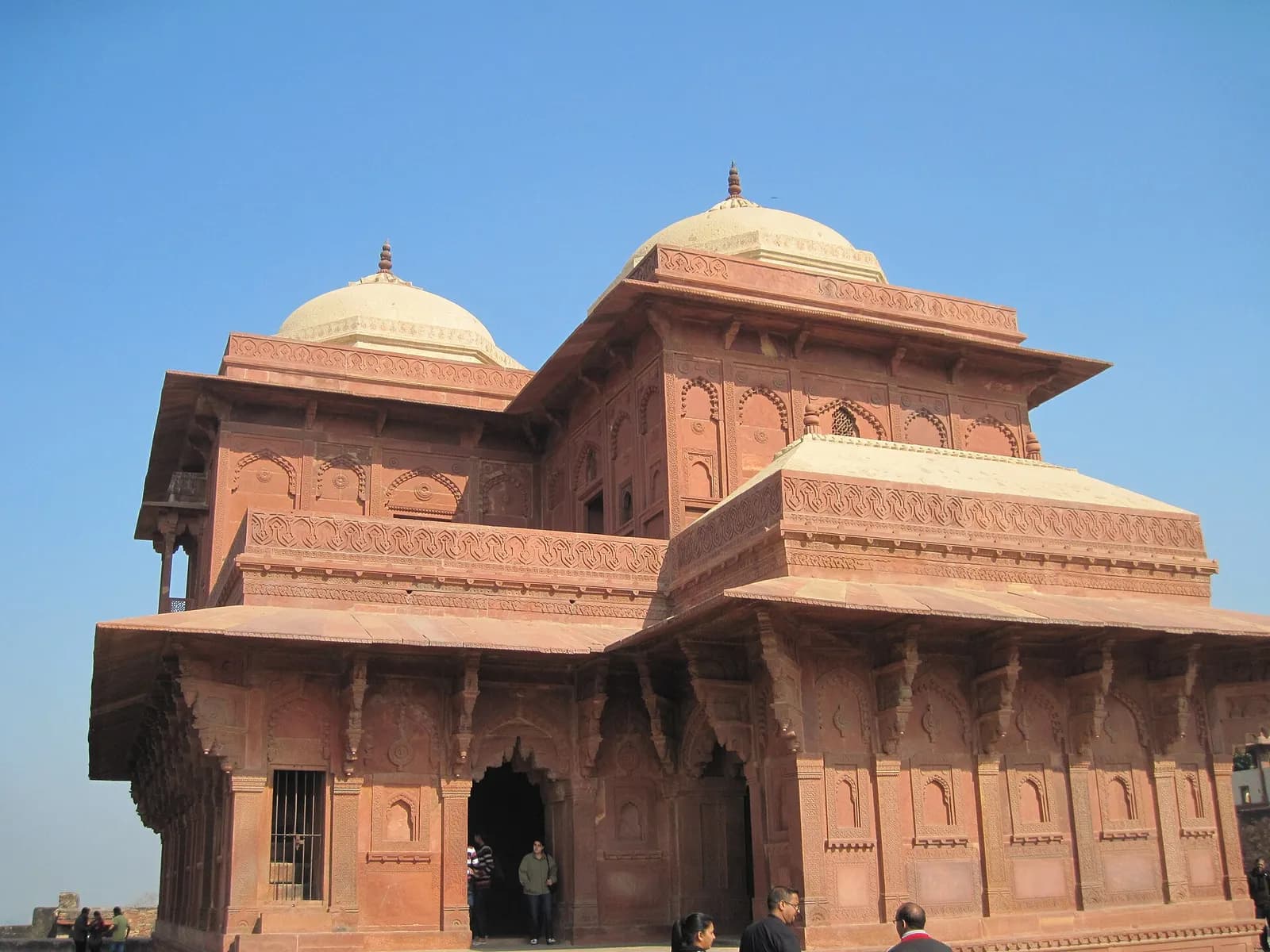
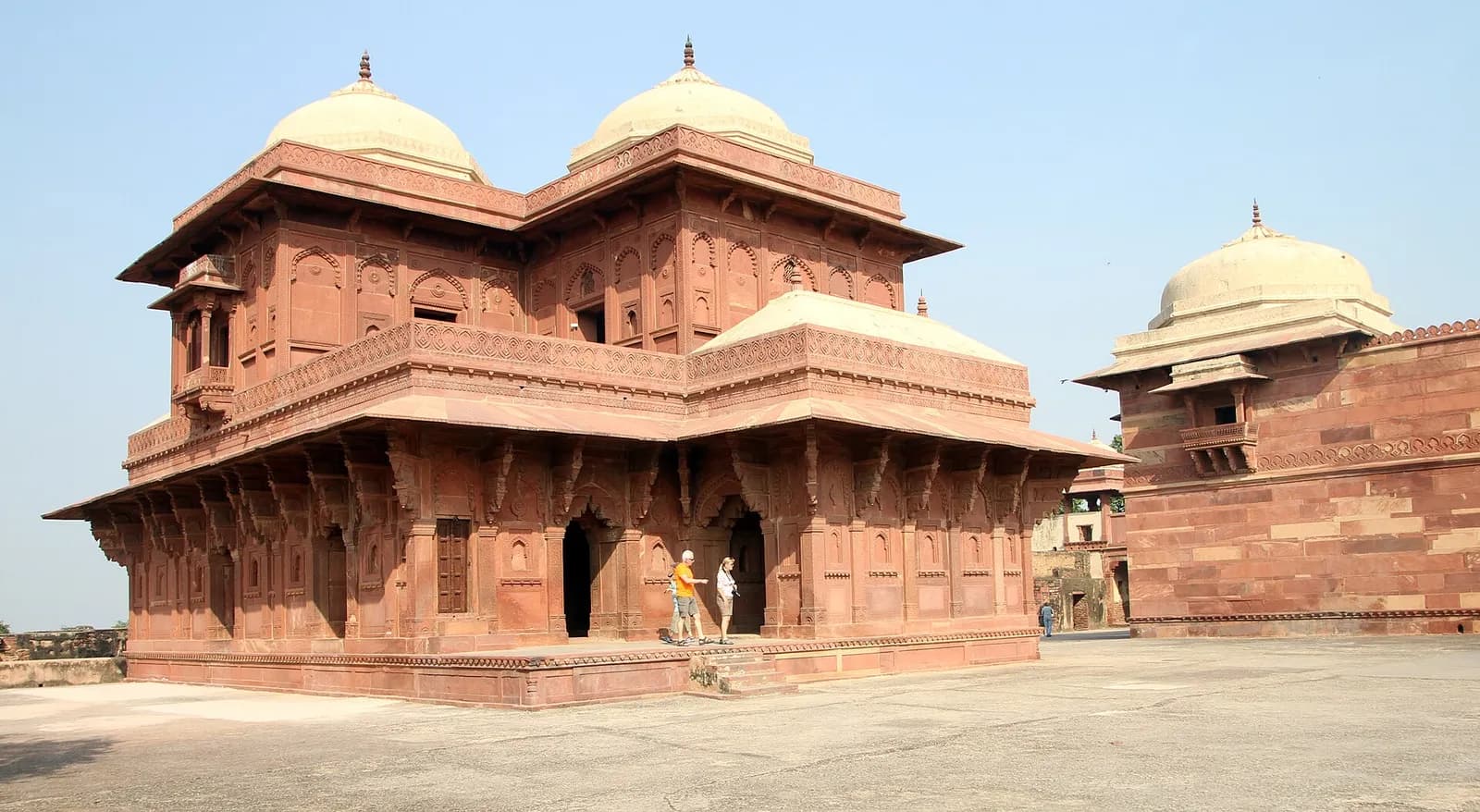
Birbal's House, also known as Birbal Bhavan or Birbal Mahal, is one of the most intricately carved two-storey red sandstone residences in the royal palace complex of Fatehpur Sikri, in Uttar Pradesh. Built in 1571 by the Mughal Emperor Akbar, it stands near the northwestern corner of Jodha Bai's Palace, inside what were once the strictly guarded imperial harem quarters, known as the Haramsara. It is a compact, symmetrical palace raised on a stone platform and its surfaces, inside and out, are covered with some of the finest stone carving at Fatehpur Sikri. For a visitor, it is a jewel-box of a building, easy to overlook for its size but extraordinary for its detail and it carries a story that makes it one of the more intriguing stops in the complex, where the name on the signboard and the truth of who lived here do not quite agree.
Several things make it special:
- Exceptional carving. Every wall, pillar and ceiling is covered in deep relief, so fine that it is compared to woodwork or ivory.
- A famous name that history corrects. It is popularly called Birbal's House, but was almost certainly built for Akbar's queens, not his minister.
- Clever cooling. Its double-dome design, with an insulating air cavity, kept the rooms cool through the summer heat.
- Hindu and Islamic fusion. The carving blends Gujarati, Rajasthani and Persian traditions, a hallmark of Akbar's capital.
- A harem palace. It sits within the private harem quarters, beside Jodha Bai's Palace, in the most secluded part of the complex.
Who really lived in Birbal's House?
The name is the most interesting thing about the building and it is worth being clear about. Local folklore attributes the mansion to Raja Birbal, Akbar's witty Hindu minister and one of the Navratnas, the Nine Jewels of his court, whose cleverness is still celebrated in countless folk tales across India. It is a charming story and it is why the building bears his name today. However, historians and the Archaeological Survey of India point out a basic problem with it: the palace stands inside the imperial harem, the Haramsara, where no adult male courtier, however favoured, could possibly have resided. The harem was reserved for the royal women and strictly guarded, so Birbal, a man and an outsider to the family, could not have lived here.
The historical reality is that this symmetrical two-suite palace was built for two of Akbar's senior chief consorts, Ruqaiya Sultan Begum and Salima Sultan Begum, each of whom occupied an identical, independent upper suite. The design makes this plain: two matching suites for two queens of equal standing. As for how Birbal's name became attached to it, historians suggest a few possibilities, that it arose from a misread Persian inscription referring to a royal title, that it reflects a connection between Birbal's daughter and the imperial household or that it is simply the result of centuries of tour-guide storytelling, a good tale repeated until it stuck. On this page we use the familiar name Birbal's House, by which the building is universally known and searched for, while being clear that it was in truth a palace of Akbar's queens. Knowing this makes the building far more interesting and it is a good reminder that the popular names of monuments are not always the historical ones.
The two queens for whom it was built were women of real standing. Ruqaiya Sultan Begum was Akbar's first wife and his chief consort, a cousin whom he had married young and Salima Sultan Begum was another senior royal wife, known in her own right as a cultured and learned woman. That the palace gives each of them an identical, independent suite tells you something about their equal rank and the careful etiquette of the harem, where precedence mattered greatly. It is a building designed to house two important women side by side without either taking precedence over the other, which is itself a small lesson in how the imperial household was organised. Set against this reality, the popular attribution to Birbal, charming as it is, rather sells the building short, since its true story, of two senior queens in a purpose-built double palace, is more interesting than the folk tale that replaced it.
Architecture and climate engineering
Birbal's House is a model of Mughal design, both beautiful and ingeniously practical, built on a large raised stone platform of local red Sikri sandstone and blending Gujarati, Rajasthani and Timurid-Persian building traditions:
- A two-storey symmetrical plan. The palace is laid out symmetrically, with matching halves reflecting its two equal royal suites.
- The ground floor. The lower level contains four interconnected square rooms, each measuring 5.13 metres or 16 feet 10 inches, on a side, with flat monolithic stone ceilings and two oblong entrance porches at the northwest and southeast corners, topped by triangular chhappar ceilings and pyramidal roofs.
- The upper suites. The second storey holds two diagonally opposite domed chambers paired with open terraces. Historically, perforated red sandstone jali screens enclosed these terraces and connected to a private screened viaduct leading towards Jodha Bai's Palace.
- The double-dome cooling system. Both upper rooms are crowned by hemispherical cupolas resting on octagonal drums with inverted lotus finials. The cupolas and the pyramidal porch roofs use a modified double-dome design, with an insulating air cavity between the inner and outer shells to keep the rooms cool during the scorching North Indian summers.
This double-dome cooling is the detail that most impresses visitors who understand it: a piece of climate engineering, centuries old, that kept the queens' rooms comfortable without any of the technology we rely on today. The screened viaduct to Jodha Bai's Palace is another telling feature, allowing the royal women to move privately between the two palaces, a reminder of how carefully the harem was planned for both comfort and seclusion.
The double-dome idea deserves a closer look, because it is the same principle, scaled down, that Mughal architects would later use on the grandest monuments, including the Taj Mahal, whose soaring profile depends on an inner and outer dome. Here at Birbal's House the purpose is practical rather than visual: the air trapped between the two shells acts as insulation, slowing the transfer of the sun's heat into the room below, so that the queens' chambers stay noticeably cooler than the baking stone outside. Combined with the deep chhajjas that shaded the walls, the jali screens that let air pass while blocking the glare and the thick stone construction, the building was a carefully tuned machine for comfort in a harsh climate. It is this blend of beauty and practicality ornament and engineering, that makes Mughal domestic architecture so admired and Birbal's House is a compact, legible example of it.
The carvings and stonework
If the design is clever, the carving is what takes the breath away. Every wall, pilaster, archway and ceiling panel, both inside and out, is covered in deep relief, with geometric, floral, arabesque and star patterns, along with the ancient swastika, an auspicious symbol in Indian tradition long predating its misuse elsewhere. The red sandstone is chiselled with such precision that art historians compare it to fine woodcarving or ivory work and the density of the ornament, covering almost every surface, is remarkable even by the standards of Fatehpur Sikri. Around the facade run broad, slanting stone sunshades, the chhajjas, which block rain and harsh sunlight and are supported by heavily sculpted brackets adorned with inverted lotus buds and scroll motifs. Projecting from the upper rooms are ornate overhanging balconies, the jharokhas, carried on twin stone brackets, which gave cool, shaded views out over the surrounding courtyards. Together these details make Birbal's House a showcase of the Hindu-Islamic carving tradition that defines Akbar's capital, where craftsmen from Gujarat and Rajasthan brought temple-carving skills to a Mughal building. It is a palace to be examined closely rather than glanced at and the more time you give it, the more it reveals.
The presence of the swastika motif among the carvings sometimes surprises visitors from abroad, so it is worth being clear about what it is. In India the swastika is one of the oldest and most widely used auspicious symbols, found across Hindu, Jain and Buddhist art for thousands of years as a sign of good fortune and wellbeing and it has nothing to do with the very different and much later use of a similar shape in twentieth-century Europe. Its appearance here, alongside lotus buds, stars and arabesques, is simply part of the Hindu decorative vocabulary that Akbar's craftsmen brought to the building and it sits comfortably beside the Islamic geometric and floral patterns. This easy mingling of Hindu and Islamic ornament on a single wall is characteristic of Fatehpur Sikri and of Akbar's whole approach and Birbal's House is one of the best places to see it at close quarters.
Location and what is nearby
Birbal's House stands in the northwestern zone of the royal palace complex, immediately adjacent to Jodha Bai's Palace, within the private harem quarters and it is surrounded by several other structures of the same area: the Stables, the Nagina Masjid, the small mosque of the harem and the Hathi Pol or Elephant Gate. This places it in the most secluded, residential part of Fatehpur Sikri, away from the public courtyards and the halls of audience, which is exactly what you would expect of a secluded palace built for the emperor's own queens. For the visitor, it means Birbal's House is best seen together with Jodha Bai's Palace and the other buildings of the harem quarter, as a single cluster that shows the private, domestic life of the court. Seeing them together also makes the logic of the complex clear, with the public buildings to the east and south and the private, residential ones here in the northwest, screened and guarded.
The cluster of buildings around Birbal's House tells its own story of how the harem functioned as a self-contained world. The Nagina Masjid, a small and elegant mosque, served the religious needs of the royal women without their having to leave the quarter; the Stables and the Hathi Pol, the Elephant Gate, mark the edge where this private zone met the working life of the palace; and Jodha Bai's Palace, the largest residence, anchors the whole. Walking among them, you get a vivid sense of a secluded community of royal women, with their own place of worship, their own screened passages between palaces and their own guarded gateways to the outside. It is one of the most atmospheric corners of Fatehpur Sikri precisely because it was built to be private and Birbal's House, finely carved and cleverly cooled, was one of its finest homes.
Ticket price and entry
Access to Birbal's House is covered under the single main Archaeological Survey of India ticket for the Fatehpur Sikri Royal Palace Complex, so there is no separate charge for the building. The palace ticket costs ₹35 online or ₹50 in cash at the counter for Indian, SAARC and BIMSTEC citizens, reduced to ₹40 in cash on Fridays and ₹550 online or ₹600 to ₹610 in cash, including the ADA toll, for foreign visitors, reduced to ₹600 on Fridays, while children under 15 enter free. The ticket covers the whole palace complex, so the same pass admits you to Jodha Bai's Palace, the Panch Mahal, the Diwan-i-Khas and the other enclosures. One point specific to Birbal's House is that visitors can freely walk through the ground floor rooms and the entrance porches to inspect the carved pilasters and ceilings, but access to the upper floor is closed by the ASI to protect the delicate stonework, so the queens' upper suites are admired from below and outside. Buying online in advance is cheaper and saves queuing. These prices are current at the time of writing and are revised periodically, so reconfirm the latest rate when you plan your visit and our guide to Fatehpur Sikri covers the full site.
Timings and the best time to visit
Birbal's House is open daily from sunrise to sunset, 6 AM to 6 PM, including on Fridays, when the Taj Mahal is closed and Fatehpur Sikri makes an excellent alternative for the day. The best season to visit is October to March, when the daytime weather is comfortable for walking the open sandstone courtyards. There is a particularly rewarding time of day for this building: visit in the late afternoon, between 4 PM and 5:30 PM, when the low western sunlight strikes the western facade directly and makes the deep red sandstone reliefs glow, throwing every carved detail into relief. This is the photographer's hour here and it shows the carving at its most dramatic. The building itself takes only 15 to 20 minutes to see, but it is worth timing your circuit of the complex so that you reach it in the late afternoon light. Allow 2 to 3 hours for the whole of Fatehpur Sikri. All timings are current at the time of writing and can change, so reconfirm before you travel and our notes on the best time to visit Agra cover the seasons across the region.
Rules, photography and conservation
A few practical points help you enjoy the building and help preserve it:
- The upper floor is closed. You can walk the ground floor rooms and porches freely, but the upper suites are closed by the ASI to protect the fine stonework, so they are viewed from outside.
- Do not touch the carvings. Avoid touching or leaning on the carved walls, as the oils from skin gradually wear down the soft sandstone and this is a building whose whole value is in its surface.
- Frame the whole elevation. Because Birbal's House sits in an open courtyard, you can step well back to frame the entire two-storey elevation and its twin cupolas in one shot.
- Use a zoom for the details. A zoom lens captures the upper jharokhas and the carved eave brackets that you cannot reach on foot.
- Hire a licensed guide. A badge-carrying ASI guide at the main ticket counter can explain the Hindu and Islamic motifs and the story of the building, which rewards the visit.
What to expect
Expect a small building that repays close attention far more than a quick glance. From a distance, Birbal's House is a neat, symmetrical two-storey palace with twin domed chambers on top; up close, it is a dense tapestry of carving that covers almost every surface and this contrast between the simple form and the rich detail is its chief delight. Knowing that it was built for two queens rather than for the minister whose name it bears adds a layer of interest and understanding the double-dome cooling turns the building from a pretty ruin into a piece of clever engineering. Because the upper floor is closed, you explore the ground-floor rooms and then step outside to admire the carving, the jharokhas and the cupolas from the courtyard, which is the best vantage point anyway. It takes only a few minutes and it sits within the harem cluster alongside Jodha Bai's Palace, so you will see it as part of a short circuit of the private quarters. Come in the late afternoon for the glowing light, give it the attention its carving deserves and Birbal's House is one of the small but memorable pleasures of Fatehpur Sikri. It is the kind of building that casual visitors walk past but that rewards anyone who stops, looks closely and knows its story, which is exactly what makes it a favourite of guides and returning travellers alike.
How to reach Birbal's House
Birbal's House is within the palace complex at Fatehpur Sikri, which sits 40 km west of Agra along NH-21, the Agra to Jaipur Highway, a 1 hour drive by taxi or UPSRTC bus. The simplest way to visit is a private cab from Agra or a guided tour combining the city's monuments with Fatehpur Sikri, since the site lies on the Jaipur road. As with the rest of the complex, private cars must park at the Gulab Bari base parking lot, from where official electric and CNG shuttle buses carry visitors up to the palace ticket gate for ₹10 to ₹30, keeping traffic away from the heritage core. From the gate it is a walk through the palace enclosures to the northwestern harem quarter where Birbal's House stands, near Jodha Bai's Palace. Local buses from Agra's Idgah Bus Stand also serve the town and the nearest railway station is at Fatehpur Sikri itself. Our guide on how to reach the Taj Mahal and Agra covers arrival into the city, from where the Fatehpur Sikri road begins and our list of places to visit in Fatehpur Sikri covers the wider site.
Birbal's House in your Fatehpur Sikri and Agra trip
Birbal's House is one of the stops on the half-day most visitors give to Fatehpur Sikri, seen as part of the ticketed palace complex and best combined with the neighbouring buildings of the harem quarter. The natural plan is to tour the palaces, taking in the Diwan-i-Aam, the Diwan-i-Khas, the Panch Mahal, Jodha Bai's Palace and Birbal's House in the cool of the morning or the glowing late afternoon, then cross into the free Jama Masjid courtyard for the Buland Darwaza and the Salim Chishti Dargah. The queens who lived here, Ruqaiya and Salima, were senior consorts alongside Akbar's Rajput queen Mariam-uz-Zamani, whose tomb at Sikandra you can read about in our guide to Mariam's Tomb. Because Fatehpur Sikri lies on the road to Jaipur, it is easy to include on the way in or out of Agra, which suits a longer Golden Triangle route. For most travellers it pairs with a day in Agra for the Taj Mahal and the Agra Fort, with Fatehpur Sikri on a second day or en route. Those with more time can add the riverside Itimad-ud-Daulah and a sunset at Mehtab Bagh, while our Agra travel guide and our notes on Taj Mahal history and facts add the wider Mughal context.
Plan your trip with us
If you would like to see Birbal's House and Fatehpur Sikri with the logistics handled, the drive from Agra, the parking and shuttle, a government-approved guide and your palace ticket, let us help. We can build Fatehpur Sikri into your Agra itinerary as a half-day on the Jaipur road or a dedicated day trip, timed for the cool morning hours or the glowing late afternoon when the carvings are at their best. Our Delhi Agra tours cover the Taj Mahal, the Agra Fort and Fatehpur Sikri and travellers short on time often choose a full Golden Triangle tour through Delhi, Agra and Jaipur, which passes Fatehpur Sikri directly. For a relaxed visit, our Agra overnight tour from Delhi leaves room for the palaces and the shrine, while an early start with our sunrise Taj Mahal tour or a same day Agra tour from Delhi can be extended to include it. To plan a route that takes in Birbal's House, message Abhay and the team directly on WhatsApp at +91 7302265809 or reach our team online and we will build an Agra and Fatehpur Sikri trip around it.
Related guides
Keep reading before you travel, these pair well with this guide:
Enquire Now
What our travellers say
“Our Golden Triangle honeymoon was flawless. Sunrise at the Taj with a private guide felt like a dream — every detail was handled.”
“As a first-time visitor to India, I felt completely safe and looked after. The driver and guide were superb professionals.”
“Travelling with two kids is hard, but they made it effortless. Great pacing, clean cars and zero surprises on price.”
“Booked the Agra day trip on short notice and it went off without a hitch. The guide's history knowledge made the Taj come alive.”
“Best decision of our India trip. Car was spotless, driver was punctual every single day, and the itinerary never felt rushed.”
“Organised a same-day Agra trip for my parents. Communication before and during the trip was excellent — genuinely stress-free.”
“Sunrise at the Taj Mahal was magical. Our guide spoke great English and answered every question with patience.”
“Three generations travelling together and everyone was comfortable — good vehicle, sensible stops, and no hidden costs.”
“I've used a few tour operators across Asia and this was among the smoothest. Fair pricing and they actually answer the phone.”
“Our custom Rajasthan-Agra combo was planned around our budget without cutting corners on comfort. Highly recommend.”
“Solo female traveller here — I felt safe throughout. The driver was respectful and the whole trip was timed perfectly.”
Ready to Explore
The Magic of Agra?
Experience the Taj Mahal at sunrise, explore the mighty Agra Fort, and discover the hidden gems of India's most beloved heritage city with our expert-guided premium tours.

Agra
Premium Tour Package
Questions
Frequently asked questions
Who built Birbal's House?
Birbal's House was built by the Mughal Emperor Akbar, in 1571, within the harem quarters of his capital Fatehpur Sikri. Despite the name, it was not built for or lived in by Raja Birbal, but for two of Akbar's senior queens.
Who really lived in Birbal's House?
Why is it called Birbal's House?
When was Birbal's House built?
What is special about the architecture of Birbal's House?
Can you go upstairs in Birbal's House?
What is the Birbal's House ticket price?
What are the Birbal's House timings?
Where is Birbal's House located?
Is Birbal's House worth visiting?
Explore more
Plan your Birbal's House trip with us

Interested in Birbal's House Fatehpur Sikri: History and Architecture?
Chat with our travel team for a custom quote, or browse every package.
Related Attractions
9Birbal's House Fatehpur Sikri on the map
Open in Google MapsReady to explore Birbal's House Fatehpur Sikri: History and Architecture?
Book your private tour today and experience the magic of India's rich heritage.