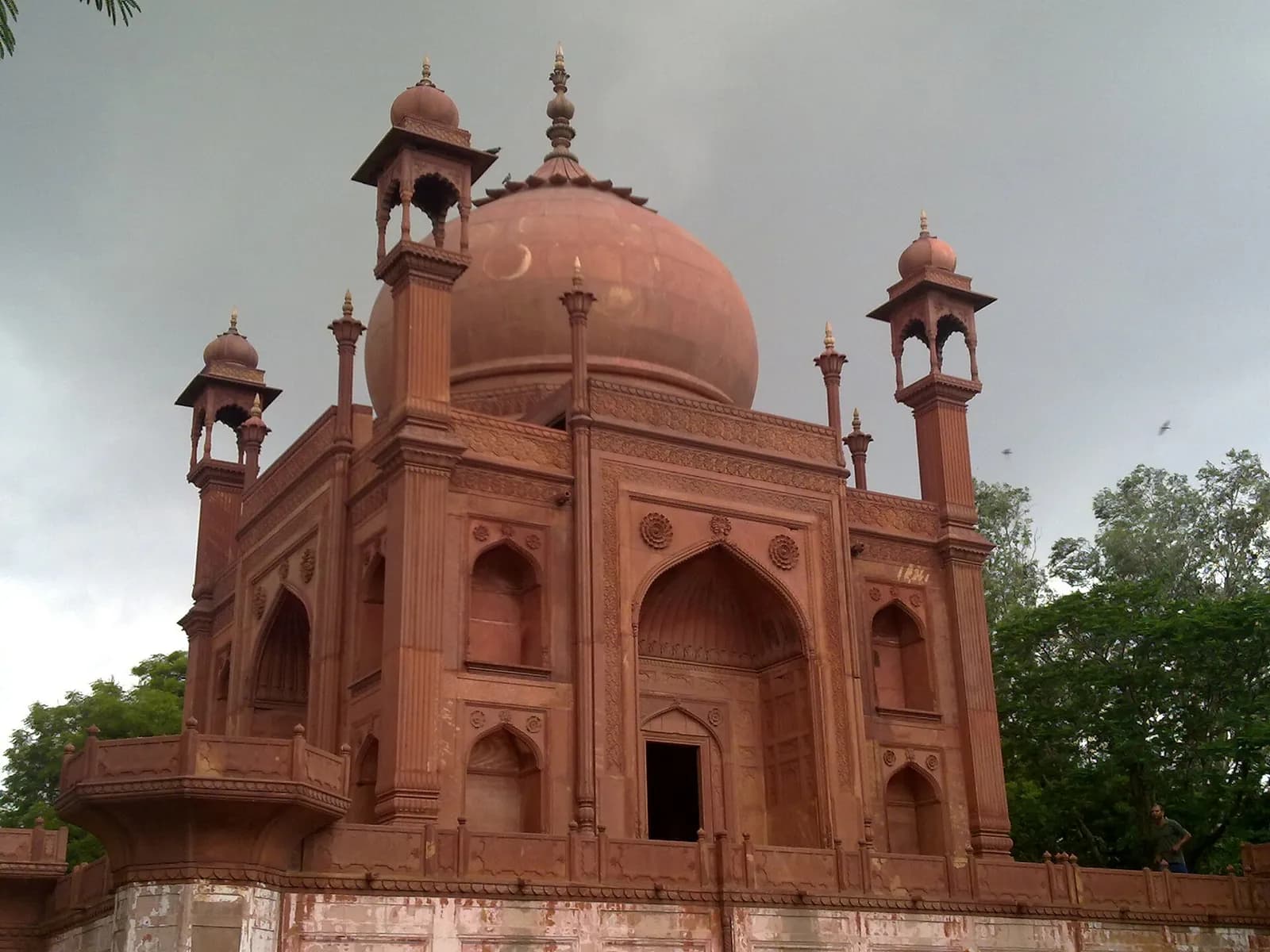
 Civil Lines, Agra
Red Taj Mahal Agra: John Hessing's Tomb Visitor Guide
Visiting the Red Taj Mahal, John Hessing's Tomb in Agra's Christian cemetery? Here are its history, timings, free entry, how to reach it and what to see.
Quick answer
The Red Taj Mahal, officially John Hessing's Tomb, is an 1803 red sandstone mausoleum built as a miniature replica of the Taj Mahal inside Agra's historic Roman Catholic Cemetery. A devoted wife, Anne Hessing, built it for her husband, a Dutch commander of the Agra Fort, reversing the famous Taj story. It is open daily, free to enter and open on Fridays when the Taj Mahal is closed. It features on our Agra tours, run by a unit of Experience My India.
- #red-taj-mahal
- #agra
- #agra-attractions
- #agra-travel
The Red Taj Mahal is one of Agra's most surprising hidden gems, a little red sandstone echo of the great white Taj, built not by an emperor for his queen but by a grieving wife for her European husband. Tucked inside a centuries-old Christian cemetery in Civil Lines, it is quiet, free and gloriously uncrowded. Our team at Delhi Agra Tour Packages loves sending curious travellers here and it is an easy, offbeat addition to a Golden Triangle tour through Delhi, Agra and Jaipur.
I am Abhay Sharma, a Golden Triangle guide since 2015 and the Red Taj Mahal is one of my favourite surprises to show visitors. It gives you a miniature Taj in warm red sandstone, a remarkable role-reversal love story, a 400-year-old Christian graveyard full of history and, best of all, it is open on Fridays when the main Taj is shut. This guide covers everything you need, the timings and free entry, the story of John Hessing, the architecture, the other historic graves and how to find it. Note that this is the red sandstone replica tomb, not the Red Fort.
Red Taj Mahal at a glance
| Detail | Information |
|---|---|
| What it is | A red sandstone miniature replica of the Taj Mahal |
| Official name | John Hessing's Tomb |
| Built | 1803, by Anne Hessing for her husband |
| Location | Roman Catholic Cemetery, Civil Lines, Agra |
| Open | Daily, 6 AM to 6 PM, including Fridays |
| Entry | Free |
| Height | 14 metres, around 46 feet |
| Time needed | 30 to 45 minutes |
Red Taj Mahal timings
| Detail | Information |
|---|---|
| Opening hours | 6 AM to 6 PM daily |
| Open on Fridays | Yes, unlike the Taj Mahal |
| Best time | Daylight hours, before the gates are locked |
| Time needed | 30 to 45 minutes |
The Red Taj Mahal is open daily from 6 AM to 6 PM, with some listings noting up to 8 PM, though visiting during daylight hours is best before the caretaker locks the gates. Crucially, it stays open all seven days of the week, including Fridays, when the main Taj Mahal is closed, which makes it a perfect Friday alternative. Plan to spend 30 to 45 minutes exploring the mausoleum and the surrounding historic graves. These timings are current at the time of writing and can vary with the caretaker's hours, so aim for the middle of the day to be safe.
Entry fee
| Visitor | Entry fee |
|---|---|
| Indian citizens | Free |
| Foreign tourists | Free |
| Caretaker tip (optional) | ₹50 to ₹100 to unlock the crypt |
Entry to the Red Taj Mahal is completely free for both Indian citizens and foreign tourists and there is no official ticket counter. If the inner chamber or the main gate is locked when you arrive, the resident caretaker will unlock it for you and offering a voluntary tip of ₹50 to ₹100 for unlocking the crypt or sharing local history is standard practice and much appreciated. This is a working cemetery rather than a ticketed monument, so treat the small tip as a courtesy. This information is current at the time of writing.
How to reach the Red Taj Mahal
| Detail | Information |
|---|---|
| Inside | Roman Catholic Cemetery, known as Padretola |
| Address | Nehru Nagar, Civil Lines, off MG Road |
| Landmark | Near Bhagwan Talkies |
| Ask drivers for | "Padretola Kabristan" or "Bhagwan Talkies" |
What is the Red Taj Mahal?
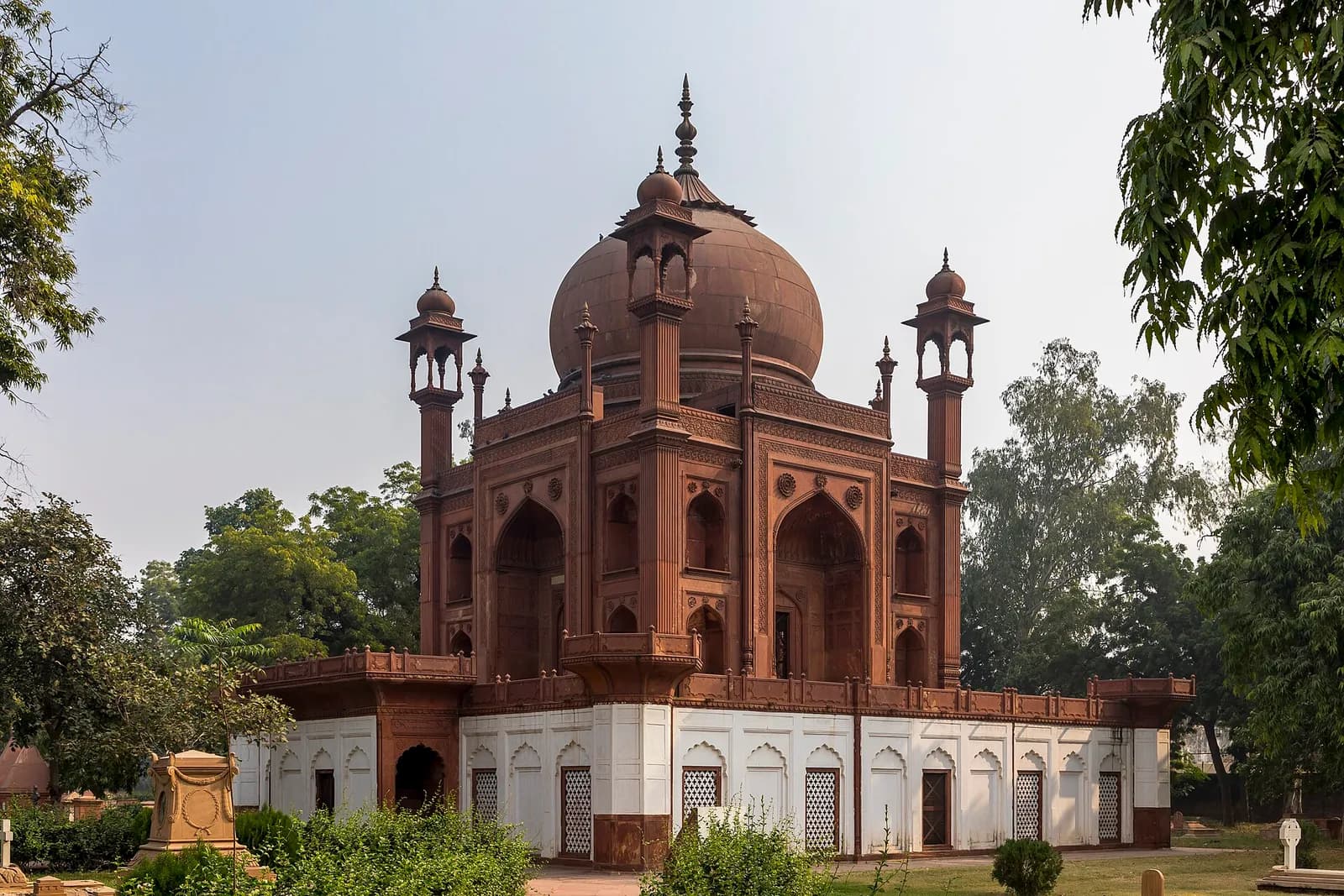
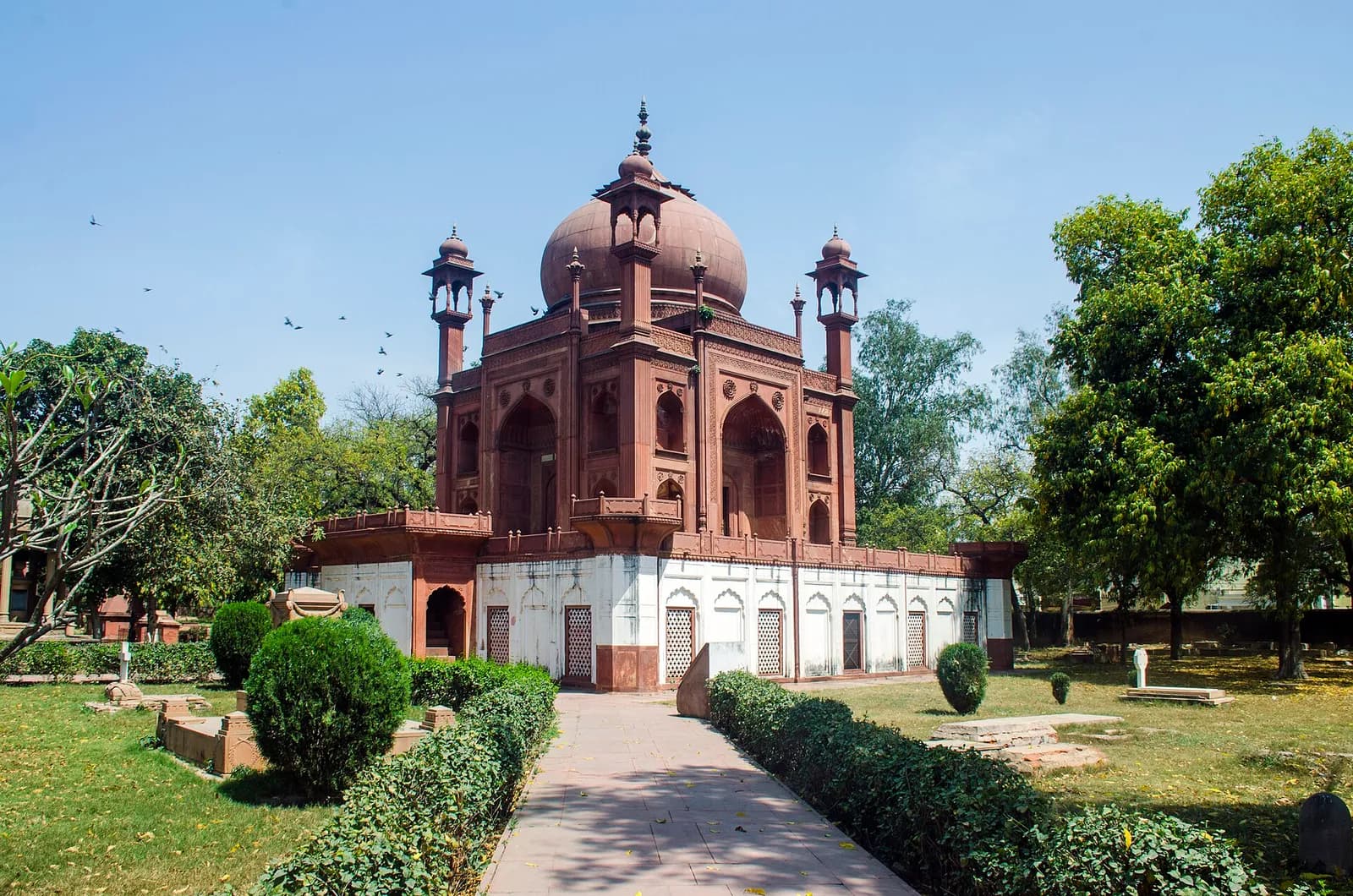
The Red Taj Mahal, officially John Hessing's Tomb, is an 1803 red sandstone mausoleum built as a miniature replica of the Taj Mahal, standing inside Agra's historic Roman Catholic Cemetery. It was commissioned by Anne Hessing in memory of her husband, the Dutch military commander Colonel John William Hessing and it is a rare pre-British monument that blends Mughal funerary design with European history. Where the great white Taj was built by the emperor Shah Jahan for his wife, the Red Taj reverses the roles entirely: here a devoted wife built a grand monument for her husband. Small, serene and almost unknown to the crowds who flock to the white Taj a few kilometres away, it is one of the most rewarding offbeat sights in Agra and one of the very few that rewards you with solitude rather than selfie queues.
Several things make the Red Taj Mahal special:
- A miniature Taj in red stone. It copies the classic Taj Mahal silhouette at a smaller scale, in warm red sandstone rather than white marble.
- A reversed love story. A wife built it for her husband, the mirror image of the emperor-and-queen story of the famous Taj.
- A European in Mughal Agra. It honours a Dutch mercenary who rose to become commandant of the Agra Fort, a fascinating slice of history.
- Open on Fridays. Unlike the Taj Mahal, it is open every day, making it the ideal Friday sightseeing option.
- Free and peaceful. Entry is free and the cemetery setting is quiet, a complete contrast to the monument crowds, so it is ideal for travellers seeking something calm and different.
The story of John Hessing
The real magic of the Red Taj Mahal is the human story behind it, which is worth knowing before you go.
- A Dutch soldier in India. He was born Jan Willem Hessing in Utrecht, in the Netherlands, in 1739 and came to India as a soldier for the Dutch East India Company.
- A European mercenary. He served as a mercenary for the Nizam of Hyderabad before joining the Maratha army under Mahadji Scindia and later Daulatrao Scindia.
- Commandant of the Agra Fort. For his loyalty and military skill, Daulatrao Scindia appointed Hessing the Commandant of the Agra Fort in 1799, a post he held until his death in July 1803, shortly before British forces captured the fort in the Second Anglo-Maratha War.
- A widow's tribute. Heartbroken by his passing, his widow Anne, along with their children, commissioned the mausoleum in 1803 at a reported cost of 5 lakh rupees.
This history gives the monument its depth. Hessing lived through a turbulent age, when European soldiers of fortune served Indian rulers and the Mughal, Maratha and British powers contested northern India and he rose to command the very Agra Fort that the British would soon seize. That his wife chose to honour him with a replica of the Taj Mahal, the supreme Mughal monument to love, shows how deeply the Taj had come to symbolise devotion even for Agra's European residents. The role reversal, a wife building for a husband, makes the Red Taj a quietly moving counterpoint to its famous white original.
The timing of Hessing's death adds a further poignancy. He died in July 1803, only months before the British defeated the Marathas and took control of Agra and its fort in the Second Anglo-Maratha War, so he passed away at the very end of the era of the European freelance commander serving an Indian prince. Within a year, the world he had lived and risen in had changed for good. His widow's decision to build a Taj in miniature, at a reported cost of five lakh rupees, a very large sum for the time, speaks both to the family's wealth and to the hold the Taj Mahal already had on the imagination as the ultimate expression of grief and love. It is easy, standing before the little red tomb, to feel the echo of that famous story playing out again on a smaller, more human scale, which is exactly what makes the monument so affecting to those who know its background.
Architecture of the Red Taj Mahal
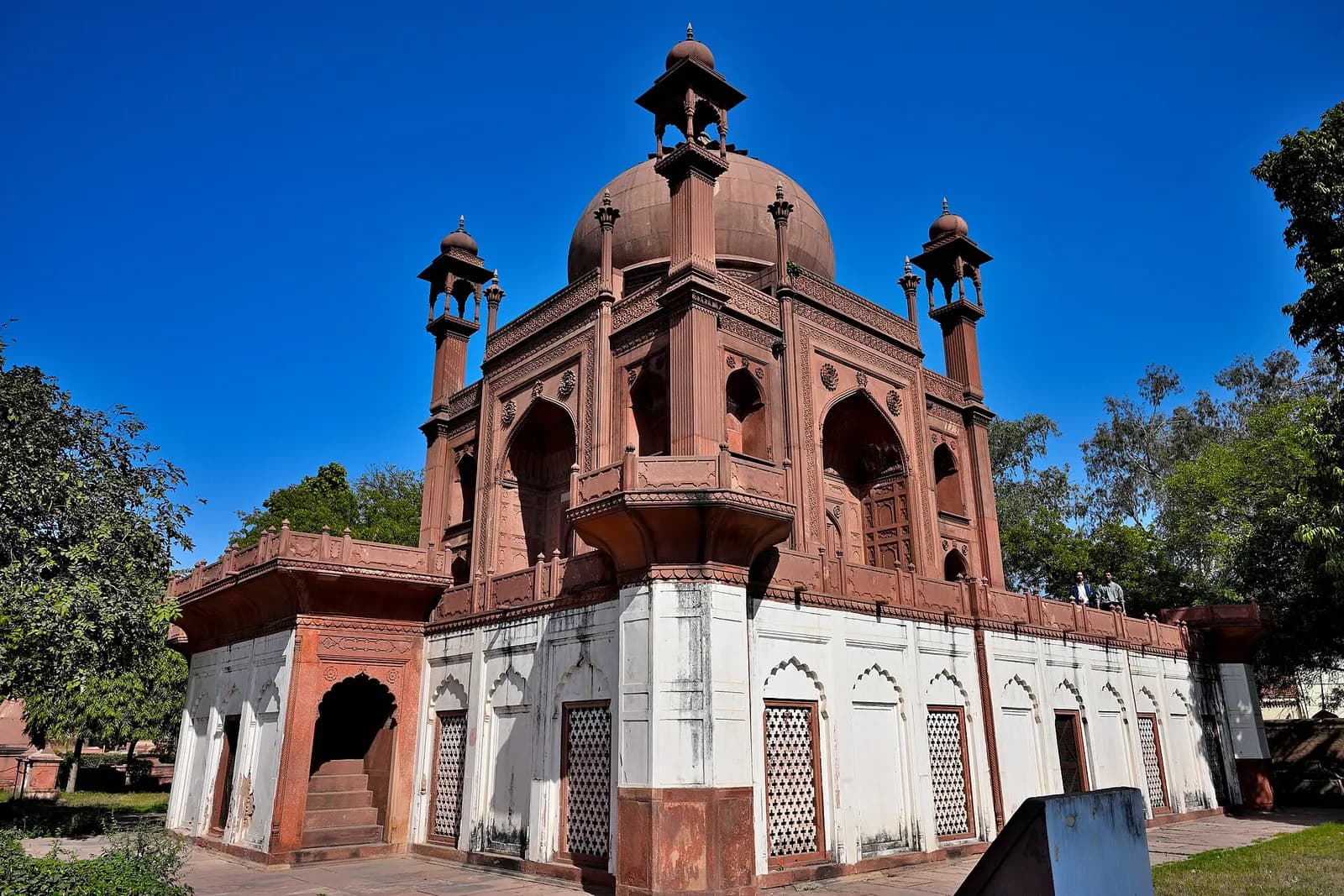
Standing 14 metres, around 46 feet, tall, the mausoleum borrows the classic Mughal silhouette of the Taj Mahal and adapts it to a smaller, square scale. Its details reward a close look:
- Red sandstone construction. Built entirely of warm red sandstone rather than white marble, the tomb lacks the semi-precious pietra dura inlays that decorate Shah Jahan's monument, giving it a plainer, earthier character.
- Platform and crypt. The structure rests on a square platform over 11 feet high, which houses an underground crypt containing the actual grave surrounded by a narrow corridor, with twin stairways on the western side leading up to the main terrace and octagonal platforms at all four corners.
- Facade and dome. Each of the four sides shows a central arched niche, the iwan, flanked by decorative alcoves and slender fluted turrets topped with square chhatris, the domed pavilions, while a bulbous double dome crowns the centre.
- A blend of faiths at the summit. The dome is topped by an inverted lotus and a Hindu-style kalash finial and then a Christian cross, a remarkable fusion of Mughal, Hindu and Christian symbolism in one monument.
- The missing minarets. Though designed as a scale replica of the Taj, the four corner minarets were never built, reportedly because of a shortage of funds.
The bilingual inscriptions are a special touch. The central hall contains Hessing's cenotaph, engraved with an English epitaph praising his character and service, while above the entrance are two Persian inscriptions, one expressing Anne Hessing's deep grief and another containing a chronogram that calculates to the year 1803. Together, the English and Persian words, the Mughal form and the Christian cross, make the Red Taj a monument of genuine cultural crossover, unlike anything else in Agra.
The Red Taj Mahal and the white Taj Mahal
Visitors naturally compare the Red Taj with its world-famous namesake and the contrasts are the point. The white Taj Mahal is vast, built of gleaming Makrana marble, decorated with intricate pietra dura inlay and raised by an emperor for his queen; the Red Taj is small, built of plain red sandstone, undecorated by inlay and raised by a widow for her husband. One is the most famous building on earth, the other an almost-hidden curiosity. Yet the Red Taj copies the essential Mughal form, the central arched niches, the double dome, the corner pavilions, so that standing before it you clearly recognise the Taj's shape in miniature. The missing minarets and the Christian cross at the summit mark where the copy departs from the original and the role reversal in the story gives it a poignancy all its own. Seeing both on the same trip is a lovely contrast, the sublime original and its heartfelt, human-scale echo and it deepens your appreciation of each.
The comparison also teaches you to read the Taj Mahal's form. Because the Red Taj strips away the dazzling marble and inlay, it lays bare the underlying architecture that both monuments share: the raised platform, the central domed chamber, the four identical facades with their great arched niches, the double dome and the corner pavilions. On the white Taj, the sheer beauty of the materials can distract from this structure; on the Red Taj, with nothing to dazzle you, you see the bones of the design clearly. In that sense the little tomb is almost an architectural diagram of its famous cousin, which makes it genuinely instructive as well as charming. The one great departure, the Christian cross atop a Hindu kalash and lotus, crowning a Mughal dome, is a detail you will find nowhere on the original and it alone is worth the visit for what it says about the mingling of cultures in old Agra.
Other graves in the cemetery
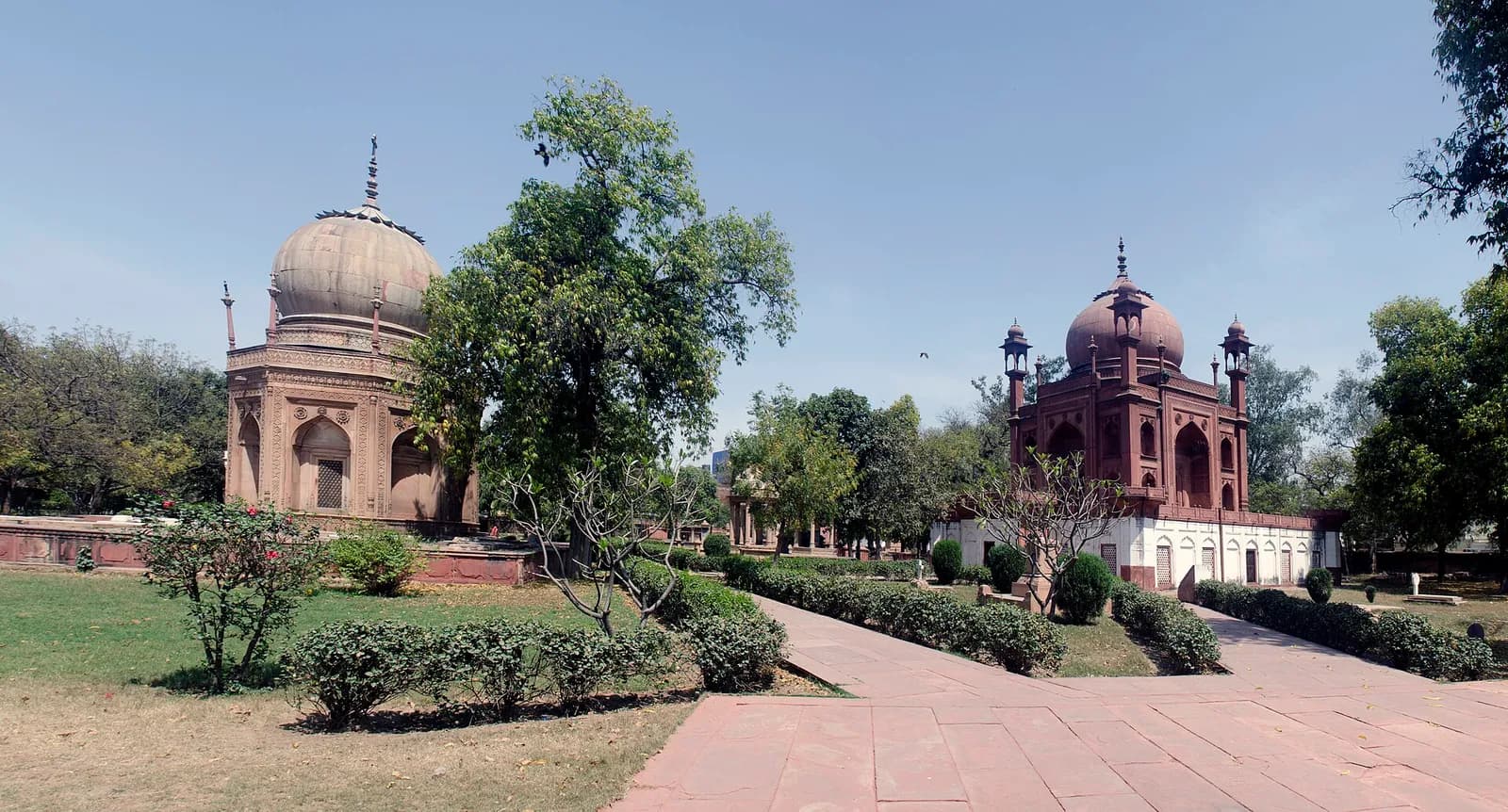
Part of the pleasure of visiting the Red Taj Mahal is the cemetery around it, which is North India's oldest Christian graveyard and a historic site in its own right. The 400-year-old Roman Catholic Cemetery holds several other notable Mughal-styled tombs worth seeking out as you walk. Among them is the grave of the Englishman Thomas Mildenhall, dated 1614 and the oldest in the cemetery and the tomb of Walter Reinhardt Sombre, the European mercenary husband of the famous Begum Samru. Beyond these, the graveyard contains over 80 Armenian Christian graves, a reminder of Agra's long-established Armenian trading community. Wandering among these weathered European and Armenian tombs, set in Mughal style under Indian skies, is a quietly fascinating experience and it tells a side of Agra's history, its centuries as a cosmopolitan trading and military city, that the great monuments do not. Treat the whole cemetery with respect due to an active burial ground and it rewards you with a peaceful, reflective hour.
These graves together tell a larger story. Long before the British, Agra was a magnet for traders, soldiers and adventurers from across Europe and the Armenian world, drawn by the wealth of the Mughal court and the opportunities of a great imperial city. The Armenians in particular formed an established and influential community here and their presence over the centuries left its mark in graves like these. The mix of an Englishman's 1614 tomb, a German-born mercenary's memorial, a Dutch commander's red Taj and scores of Armenian graves, all in one walled ground, is a vivid reminder that Mughal Agra was an international city, not a closed world. For a visitor, this gives the cemetery a significance well beyond the Red Taj itself and it is why heritage-minded travellers often find the graveyard as interesting as the monument at its heart. A slow, respectful wander, perhaps with the caretaker pointing out the notable graves, turns a quick photo stop into a genuine encounter with Agra's forgotten cosmopolitan past.
Timings, entry and the caretaker
The Red Taj Mahal is refreshingly simple to visit. It is open daily from 6 AM to 6 PM, with some listings noting hours up to 8 PM, but because the caretaker locks the gates, daylight hours are the safe bet. Its great practical advantage is that it is open all seven days, including Fridays, exactly when the main Taj Mahal is closed, so it is the perfect thing to see on a Friday in Agra. Entry is completely free for everyone, Indian or foreign and there is no ticket counter. The one local custom to know is the caretaker: if the inner chamber or the main gate is locked when you arrive, the resident caretaker will open it for you and a voluntary tip of ₹50 to ₹100 for unlocking the crypt or sharing the history is standard and well worth it, both as a courtesy and because the caretaker's stories add a great deal. Plan on 30 to 45 minutes for the tomb and the surrounding graves, a little longer if you let the caretaker walk you around and tell the stories, which is time well spent. These details are current at the time of writing and because the site runs on the caretaker's presence rather than fixed office hours, a midday visit is the surest way to find the gates open and the crypt accessible.
What to expect at the Red Taj Mahal
Expect a quiet, atmospheric, slightly melancholy place rather than a polished tourist attraction. You arrive down a narrow lane in a residential neighbourhood, step into an old walled cemetery and find the little red mausoleum rising among weathered graves and trees. There are no crowds, no touts and no ticket queues, just the caretaker, the birds and the hush of a centuries-old graveyard. It is a complete contrast to the white Taj and that is its charm: here you can stand alone before a miniature Taj, climb to the terrace, peer into the crypt and take unhurried photographs with no one else in the frame. The setting is simple and the monument modest, so come for the story, the atmosphere and the history rather than for grandeur. For travellers who enjoy offbeat corners, for photographers after a quiet shot and for anyone stuck in Agra on a Friday when the Taj is closed, it is a genuine find and most people leave charmed by its unexpected, human-scale beauty.
Set your expectations accordingly and you will not be disappointed. This is a small monument in a modest setting, not a grand attraction and there are no facilities, guides or crowds, which is precisely its appeal. The caretaker is the only staff and the experience is yours to make, climbing the terrace, reading the inscriptions, imagining the story behind each weathered grave. It suits the kind of traveller who likes to discover rather than tick off, who enjoys a little history and a quiet hour and who is happy to find beauty in the modest and the overlooked. If you arrive expecting another white Taj, you will misjudge it; if you arrive curious about a love story, a European soldier and a hidden corner of old Agra, you will find it one of the most charming stops in the city. For families, the story and the cemetery can genuinely capture children's imaginations and for photographers the red stone against green trees, with no crowds to clear, is a rare gift in a city as busy as Agra.
Best time to visit the Red Taj Mahal
The best season, as for all of Agra, is October to March, when the weather is pleasant for exploring the open cemetery. Within the day, aim for the morning or the earlier afternoon, in good daylight, both because the light is kind for photography and because the caretaker locks the gates toward evening. The site is quiet at all times, so you need not time your visit around crowds, but a Friday visit is especially smart, since the Red Taj is open while the main Taj Mahal is closed, letting you fill a day that would otherwise lose its headline sight. The monsoon can leave the cemetery grounds damp underfoot, so the dry months are more comfortable. Our wider notes on the best time to visit Agra apply here and for the main monument our guide on how to reach the Taj Mahal covers the rest of a Taj day.
How to reach the Red Taj Mahal and its location
The tomb sits inside the 400-year-old Roman Catholic Cemetery, known locally as Padretola or Padresanto, in Nehru Nagar, Civil Lines, tucked down a narrow lane off Mahatma Gandhi Road near Bhagwan Talkies. It is centrally located in Agra and easy to reach by auto-rickshaw, e-rickshaw or an app-based cab. The one tip that matters is what to tell your driver: ask for "Padretola Kabristan" or "Bhagwan Talkies" in Civil Lines, because some drivers may not recognise the name "Red Taj" immediately. Because it is central and near the well-known Bhagwan Talkies landmark, it is simple to combine with the other Civil Lines sights and the green public space of Paliwal Park is close by for a relaxed pairing. The site is a short ride from the Agra Fort and the main monuments, so it slots easily into a day and travellers often fold it into an Agra overnight tour from Delhi or a same day Agra tour from Delhi.
Visitor etiquette and tips
Because this is an active, sacred cemetery rather than a standard tourist park, a little courtesy goes a long way:
- Dress modestly and keep quiet. This is a working burial ground, so dress respectfully and keep noise levels low.
- Ask before photographing the crypt. Photography is permitted with no camera fees, but ask the caretaker before photographing the interior crypt.
- Carry a small tip. Keep ₹50 to ₹100 in cash for the caretaker who unlocks the chamber and shares the history.
- Mind the stairs. The cemetery paths are mostly flat at ground level, but reaching the tomb's upper terrace means climbing stairs.
- Come prepared. There are no public washrooms or ticket booths on-site, so plan accordingly and carry water.
Red Taj Mahal in your Agra itinerary
The Red Taj Mahal fits an Agra itinerary as a short, offbeat highlight and it is especially valuable on a Friday, when the main Taj Mahal is closed and many visitors are unsure what to do. Because it is central, free and takes only 30 to 45 minutes, it slots easily into a half-day alongside the Civil Lines sights or a visit to the Agra Fort, which Hessing himself once commanded. For history lovers, photographers and anyone who enjoys a story, it is a memorable contrast to the grandeur of the white Taj and the surrounding cemetery adds a layer of Agra's cosmopolitan past that few travellers ever see. When you turn back to the headline sights, the riverside Itimad-ud-Daulah, the garden of Mehtab Bagh for the Taj sunset and, with a full day, Fatehpur Sikri on the Jaipur road, complete the picture. On a Golden Triangle trip through Delhi, Agra and Jaipur, it is the kind of unexpected stop that makes a trip personal and memorable. Our Agra travel guide helps you fit it in and our lists of hidden places to visit in Agra and lesser-known Agra monuments put it among the city's best-kept secrets.
Plan your trip with us
If you would like to discover the Red Taj Mahal and the history of its remarkable cemetery, with a driver who knows the narrow lanes of Civil Lines and a plan that makes the most of a Friday in Agra, let us arrange it. We can pair the Red Taj with the Agra Fort that Hessing commanded, the Civil Lines sights and the main monuments, so your day flows smoothly. Our Delhi Agra tours cover the Taj Mahal, the Agra Fort and the city's hidden corners and travellers short on time often choose a full Golden Triangle tour through Delhi, Agra and Jaipur or an early start with our sunrise Taj Mahal tour. To plan dates and a route that includes the Red Taj Mahal, message Abhay and the team directly on WhatsApp at +91 7302265809 or reach our team online and we will build an Agra trip with its hidden gems as well as its icons.
Related guides
Keep reading before you travel, these pair well with this guide:
Enquire Now
What our travellers say
“Our Golden Triangle honeymoon was flawless. Sunrise at the Taj with a private guide felt like a dream — every detail was handled.”
“As a first-time visitor to India, I felt completely safe and looked after. The driver and guide were superb professionals.”
“Travelling with two kids is hard, but they made it effortless. Great pacing, clean cars and zero surprises on price.”
“Booked the Agra day trip on short notice and it went off without a hitch. The guide's history knowledge made the Taj come alive.”
“Best decision of our India trip. Car was spotless, driver was punctual every single day, and the itinerary never felt rushed.”
“Organised a same-day Agra trip for my parents. Communication before and during the trip was excellent — genuinely stress-free.”
“Sunrise at the Taj Mahal was magical. Our guide spoke great English and answered every question with patience.”
“Three generations travelling together and everyone was comfortable — good vehicle, sensible stops, and no hidden costs.”
“I've used a few tour operators across Asia and this was among the smoothest. Fair pricing and they actually answer the phone.”
“Our custom Rajasthan-Agra combo was planned around our budget without cutting corners on comfort. Highly recommend.”
“Solo female traveller here — I felt safe throughout. The driver was respectful and the whole trip was timed perfectly.”
Ready to Explore
The Magic of Agra?
Experience the Taj Mahal at sunrise, explore the mighty Agra Fort, and discover the hidden gems of India's most beloved heritage city with our expert-guided premium tours.

Agra
Premium Tour Package
Questions
Frequently asked questions
What is the Red Taj Mahal in Agra?
The Red Taj Mahal, officially John Hessing's Tomb, is an 1803 red sandstone mausoleum built as a miniature replica of the Taj Mahal inside Agra's historic Roman Catholic Cemetery. A widow, Anne Hessing, built it for her husband, a Dutch commander of the Agra Fort, reversing the famous Taj story.
Who was John Hessing?
Why is it called the Red Taj Mahal?
What are the Red Taj Mahal timings?
Is there an entry fee for the Red Taj Mahal?
Is the Red Taj Mahal open on Fridays?
Where is the Red Taj Mahal located?
What else is in the cemetery?
How do I reach the Red Taj Mahal?
Is the Red Taj Mahal worth visiting?
Explore more
Plan your Red Taj Mahal trip with us

Interested in Red Taj Mahal Agra: John Hessing's Tomb Visitor Guide?
Chat with our travel team for a custom quote, or browse every package.
Related Attractions
9Red Taj Mahal Agra on the map
Open in Google MapsReady to explore Red Taj Mahal Agra: John Hessing's Tomb Visitor Guide?
Book your private tour today and experience the magic of India's rich heritage.