


Amrit Udyan (Mughal Gardens) Delhi: Timings and Guide
Visiting Amrit Udyan, the former Mughal Gardens in Delhi? When it opens, free entry and booking, the gardens, black roses, nearest metro and visitor tips.
In a Nutshell
“Amrit Udyan, long known as the Mughal Gardens, is the magnificent 15 acre garden of the Rashtrapati Bhavan, the President's estate in New Delhi. Designed by Edwin Lutyens, it blends English lawns with Mughal canals, terraced fountains and famous rose collections and it opens to the public only for seasonal editions, chiefly the spring bloom from around February to March. Entry is free but needs an advance online slot, it is closed on Mondays and it is reached from the Central Secretariat metro. It features on our Delhi tours, run by a unit of Experience My India.”
Amrit Udyan is one of Delhi's most beautiful seasonal attractions, a glorious spread of flowers, fountains and sculpted gardens behind the grand Rashtrapati Bhavan, open to the public only for a few special weeks each year. Catching it in full spring bloom is a genuine treat. Our team at Delhi Agra Tour Packages often helps guests time a Delhi visit around the garden's opening and it fits beautifully into a Golden Triangle tour through the capital.
I am Abhay Sharma, Delhi born and a Golden Triangle guide since 2015 and I always keep an eye on the garden's opening dates so my guests can enjoy it if their trip aligns. This guide gathers everything I would tell a visitor beforehand, checked against current information, including when it opens, the free booking, the gardens and how to reach it.
Details
Amrit Udyan at a glance
| Detail | Information |
|---|---|
| Location | Rashtrapati Bhavan estate, New Delhi, entry via Gate 35 |
| Former name | The Mughal Gardens, renamed Amrit Udyan in 2023 |
| Designed by | Sir Edwin Lutyens, for the Viceroy's House |
| Size | Around 15 acres of formal gardens |
| Known for | Spring flower blooms, rose collections, Mughal canals |
| Entry | Free, but needs an advance online slot; closed Mondays |
| Nearest metro | Central Secretariat (Yellow and Violet Lines) |
| Time needed | About 1.5 to 2 hours |
Amrit Udyan timings
| Detail | Information |
|---|---|
| Open to public | Only during seasonal editions, not year-round |
| Gate hours | 10:00 AM to 6:00 PM during the public openings |
| Last entry | Strictly 5:00 PM |
| Closed | Every Monday, for maintenance |
Amrit Udyan is not a year-round park. It opens to the public only for seasonal editions and during those openings the gates are open from 10:00 AM to 6:00 PM, with last entry strictly at 5:00 PM. It is closed every Monday for gardening upkeep. The opening windows and timings are announced each year, so always reconfirm the current dates before planning a visit.
Amrit Udyan entry and booking
| Item | Information |
|---|---|
| Entry fee | Free for all, Indian and foreign visitors |
| Booking | An advance digital entry slot via the official portal |
| Walk-in | Limited on-spot registration kiosks near Gate 35 |
| Entry gate | Exclusively through Gate 35, off North Avenue |
How to reach Amrit Udyan
| From | Route |
|---|---|
| Central Secretariat metro (Yellow and Violet) | A free shuttle from Gate 4 runs during the festival |
| Shivaji Stadium metro (Airport Express) | Also close, then a short auto |
| India Gate and central Delhi | A short auto or taxi ride |
| Entry point | Only via Gate 35, where North Avenue meets the estate wall |
What is Amrit Udyan (the Mughal Gardens)?
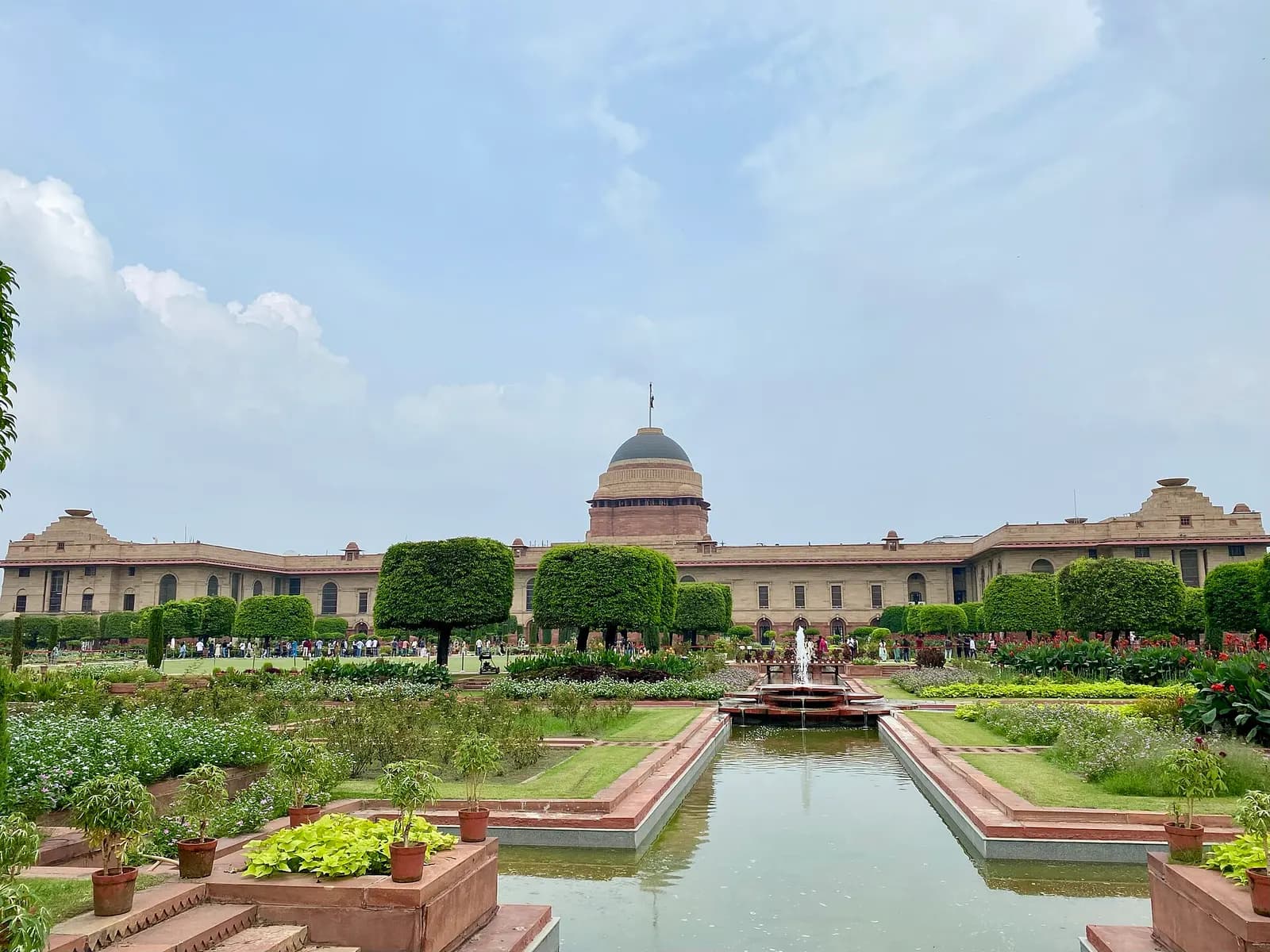
Amrit Udyan, for decades known as the Mughal Gardens, is the grand formal garden of the Rashtrapati Bhavan, the official residence of the President of India, in the heart of New Delhi. Spread across around 15 acres, it was designed by the British architect Sir Edwin Lutyens as part of the Viceroy's House, blending classical English flower lawns with the geometry, water channels and terraced fountains of the traditional Mughal garden, to create one of the most beautiful planned gardens in the country. Often described as the soul of the Rashtrapati Bhavan estate, it has been expanded and enriched over the years by successive Presidents, adding specialised botanical collections. Crucially, it is not an everyday public park: it opens to visitors only for celebrated seasonal editions, most famously the spring bloom, when the lawns blaze with colour.
Several things make it special and they are worth drawing out:
- A garden of the President's estate. The formal gardens of the Rashtrapati Bhavan, the soul of the grandest estate in the capital.
- A Lutyens masterpiece. Designed by Edwin Lutyens, fusing English lawns with Mughal canals, fountains and geometry.
- Spectacular seasonal blooms. Open only for a few weeks a year, chiefly the spring flowering, when thousands of blossoms are at their peak.
- Famous rose collections. Renowned beds of roses, including rare dark and premium varieties, in the circular garden.
- Specialised sub-gardens. Bonsai, herbal, wellness and children's gardens added by successive Presidents.
It is one of the most beautiful and sought-after seasons of the things to do in Delhi and a highlight among the important monuments of Delhi when it is open.
Amrit Udyan and Mughal Gardens: the name change
Many visitors ask whether Amrit Udyan and the Mughal Gardens are the same place and the answer is yes: they are one and the same garden under two names. The garden was universally known as the Mughal Gardens for decades, after the Mughal-style water channels and geometry that are a central part of its design and that name is still what many people search for and remember. In January 2023 it was officially renamed Amrit Udyan, meaning the Garden of Nectar, as part of the celebrations marking India's independence milestones. So if you have heard of the famous Mughal Gardens of Rashtrapati Bhavan, Amrit Udyan is exactly that garden, now under its new name. Both names refer to the same 15 acre garden on the President's estate and you will see both used, so there is no confusion to worry about: book for Amrit Udyan and you are visiting the Mughal Gardens. This guide uses the current name, Amrit Udyan, while noting the former name throughout, since both are still widely recognised.
History and design of Amrit Udyan
The garden's history is bound up with the building of New Delhi as the imperial capital in the early twentieth century. When Sir Edwin Lutyens designed the Viceroy's House, now the Rashtrapati Bhavan, he also laid out its gardens and for these he drew on two great traditions: the formal English flower garden, with its lawns and borders and the classical Mughal garden, with its symmetrical geometry, paved water channels and terraced fountains, the style seen in the great Mughal gardens of Kashmir and Agra. The result was a magnificent fusion, a garden at once English and Indian, which became famous as the Mughal Gardens. Over the decades since independence, successive Presidents of India have expanded and enriched it, adding new specialised gardens and botanical collections, so that it grew from Lutyens's original formal layout into the varied, 15 acre complex of today.
Described as the soul of the Rashtrapati Bhavan estate, the garden has long been one of the most prestigious green spaces in the country, tended to the highest standard and opened to the public for only a few weeks each year as a shared national treasure. Knowing this history, that the garden was conceived by Lutyens as the crowning green space of imperial Delhi and has been cherished and expanded by India's Presidents ever since, adds to the pleasure of a visit, for you are walking through a living piece of the capital's design heritage, now renamed Amrit Udyan.
When does Amrit Udyan open?
The single most important thing to understand about Amrit Udyan is that it is not open all year: it opens to the general public only for celebrated seasonal editions, so timing is everything. The most famous and spectacular is the winter and spring edition, when the annual flowers are in full bloom, which typically runs from around early February to late March and there is usually also a summer edition, typically from around mid-August to mid-September, along with other short themed openings that have been introduced in recent years. During these editions the garden is thrown open and draws huge crowds of Delhiites and visitors who come to see the blooms at their peak.
Because the exact opening and closing dates change every year and are announced by the Rashtrapati Bhavan administration ahead of each edition, you should always check the current dates before planning a visit, rather than relying on fixed dates. The spring edition, with its carpets of flowers and famous roses, is the one most worth catching and it is the reason many people time a Delhi trip for February or March. If your visit does not coincide with an opening, the garden will be closed to the public, so confirming the dates is the first step. Our team keeps track of the announced dates each year and can advise whether your travel window aligns. It is worth saying that the garden's popularity during the spring edition is immense, drawing large daily crowds, so the opening is both the most beautiful time to come and the busiest. The flowers are at their absolute peak for only a few weeks and the annual varieties are planted specifically for this flowering, so a visit timed to the bloom repays the effort of booking far more than a visit to an ordinary garden would. If your dates fall within an edition, treat it as a highlight worth prioritising; if they do not, the garden will simply be shut and it is better to know that in advance than to arrive at a closed Gate 35.
The sub-gardens of Amrit Udyan
Within its 15 acres, Amrit Udyan is divided into distinct garden styles, which visitors walk past along a single-direction loop trail, so a visit is a journey through several different kinds of garden:
- The Rectangular, Long and Terrace Gardens. The historic core was laid out by Lutyens, with paved stone water canals, low-cut hedges and rows of seasonal blossoms in the classic Mughal-English style.
- The Circular or Sunken Garden. A beautiful tiered, amphitheatre-style round garden with concentric beds of multi-coloured flowers, central fountains and the famous rare dark roses.
- The Bonsai and Herbal Gardens. Specialised zones added by former Presidents, showcasing decades-old miniature bonsai trees and a wide array of traditional Indian medicinal plants.
- The Arogya Vanam and Tactile Garden. A wellness-focused area of therapeutic aromatic herbs, with a sensory garden path designed specifically for visually impaired visitors.
- The Bal Vatika and Babbling Brook. A children's nature zone with a historic 225 year old Sheesham tree, custom treehouses and a meandering stone stream with sculptural water spouts.
This variety is a large part of the garden's charm: it is not simply one lawn of flowers but a sequence of beautifully distinct spaces, from the formal canals of the historic core to the children's treehouses and the wellness herb beds. Following the loop trail takes you through all of them in turn, so allow time to enjoy each rather than rushing to the main flowerbeds alone.
The black roses and the circular garden
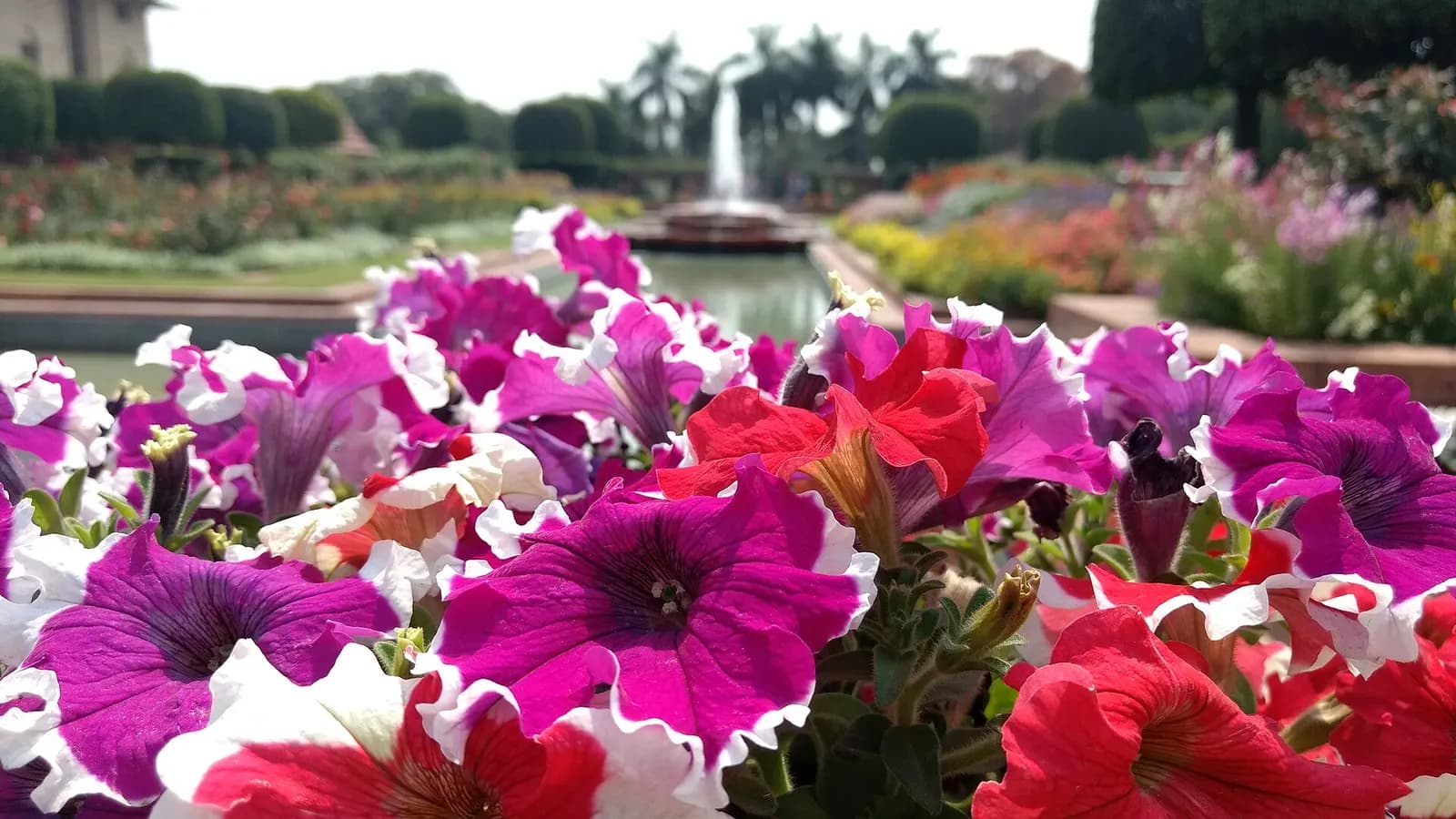
One of the most talked-about features of Amrit Udyan and a magnet for visitors and photographers, is its collection of roses, especially the rare dark varieties often described as black roses. These are displayed in the Circular or Sunken Garden, a striking tiered, amphitheatre-style round garden where concentric rings of multi-coloured flowerbeds step down towards central fountains, creating one of the most photogenic spots in the whole estate. Among the many rose varieties grown here are prized dark, almost black, premium roses that draw particular curiosity, as true black roses are famously elusive in nature. The circular garden as a whole, with its symmetry, its water and its banks of colour, is the showpiece of Amrit Udyan and the image most associated with it. For visitors, finding the dark roses and taking in the sunken garden from its rim is one of the highlights of a visit, so it is worth seeking out while you follow the loop. The rose collections are at their best during the spring edition, which is another reason that opening is the most rewarding to catch.
Bal Vatika, Arogya Vanam and the special gardens
Beyond the flowers and roses, some of the garden's most charming corners are the specialised spaces added over the years, which reward a little extra time:
- The Bal Vatika. A dedicated children's nature zone, highlighted by a historic 225 year old Sheesham tree, custom-built treehouses and a peaceful babbling brook, a meandering stone stream with sculptural water spouts, which delights younger visitors.
- The Arogya Vanam. A wellness garden laid out with therapeutic and aromatic herbs, celebrating India's tradition of medicinal plants.
- The Tactile Garden. A thoughtful sensory garden path designed specifically for visually impaired guests, so the garden can be experienced through touch and scent.
- The Bonsai and Herbal Gardens. Collections of decades-old miniature bonsai trees and traditional medicinal plants, added by former Presidents.
These spaces show how the garden has grown beyond Lutyens's formal design into something richer and more inclusive, with something for children, for wellness and for visitors of all abilities. The Bal Vatika in particular makes Amrit Udyan a lovely visit for families, while the Arogya Vanam and bonsai collections reward those with a botanical interest. Together they round out the garden well beyond its famous flowerbeds.
Amrit Udyan timings and entry
During its seasonal public openings, Amrit Udyan is open from 10:00 AM to 6:00 PM, with the absolute final entry strictly at 5:00 PM, so plan to arrive well before then. It is closed every Monday, when the garden is given over to gardening upkeep and grass trimming, so unlike a normal attraction, Monday is firmly off. Entry is completely free for everyone, Indian citizens and international tourists alike, which is wonderful, but, as explained below, you do need to secure an advance slot. Remember that outside the announced seasonal editions the garden is simply not open to the public, so the dates are the first thing to confirm. These timings apply during the public openings and can change, so reconfirm for the current edition before your visit, along with the exact opening and closing dates for that year.
How to book Amrit Udyan tickets (free passes)
Although entry to Amrit Udyan is free, you cannot simply walk up without planning and understanding the booking is key to a smooth visit:
- Book an advance slot online. You must secure a digital entry pass slot in advance through the official Rashtrapati Bhavan visitor portal. Booking for the following day's slots typically opens daily, so book early as slots are capped and go fast.
- Walk-in backup. For those without internet access, limited on-spot self-service registration kiosks operate near Gate 35, but long queues form quickly, especially at weekends, so this is a fallback rather than the ideal.
- It is still free. The advance slot carries no charge; the booking simply manages the crowds. There is no ticket price to pay.
The sensible approach is to book your free slot online in advance for a weekday if possible, print or save the pass and arrive in good time. Relying on the walk-in kiosks, especially on a weekend, can mean a long wait and no guarantee of entry if slots are full. Because the garden is so popular during the spring bloom, booking ahead is strongly advised. Reconfirm the current booking process on the official portal, as the system can change between editions.
Rules: what you can and cannot carry at Amrit Udyan
Security at the President's estate is strict and knowing the bag and item rules in advance saves hassle at Gate 35:
- Allowed inside. Mobile smartphones, personal wallets and purses, umbrellas and small baby bags with basic milk or water bottles for infants are permitted.
- Not allowed. Professional DSLR cameras, video recording gear, tripods, large backpacks, outside food and snacks and water bottles are prohibited.
- Cloakroom at Gate 35. An expansive security cloakroom at the Gate 35 plaza lets you deposit barred items before entering.
- One gate only. Tourists enter and exit exclusively through Gate 35, off North Avenue, not the usual Rashtrapati Bhavan museum gates.
Knowing these rules in advance is important, as the prohibition on DSLR cameras surprises many keen photographers; smartphone photography, however, is allowed, so you can still capture the blooms on your phone. Travel light, leave bulky bags and professional gear behind or use the cloakroom and carry only the permitted essentials through security.
Best time to visit Amrit Udyan
The best time to visit is, above all, during the spring edition, typically from around February to March, when the annual flowers and the famous roses are in full, spectacular bloom; this is the edition most worth planning a trip around. Within the opening, a weekday is far better than a weekend, as weekends and public holidays bring very large crowds and long queues, especially at the walk-in kiosks. Arriving soon after the 10:00 AM opening or later in the afternoon, helps avoid the midday peak and the cooler, softer light of morning and late afternoon is also best for the flowers and photographs. Since the garden only opens in the pleasant months anyway, the weather is generally comfortable during the editions. The key, as ever, is to confirm the current dates and book a weekday slot in advance. Our guide to the best time to visit Delhi sets out the seasons across the city in more detail.
How to reach Amrit Udyan (nearest metro and shuttle)
Amrit Udyan is within the Rashtrapati Bhavan estate in central New Delhi and visitors enter exclusively through Gate 35, where North Avenue meets the outer perimeter wall. The nearest metro stations are Central Secretariat, an interchange on the Yellow and Violet Lines and Shivaji Stadium on the Airport Express Line. Very conveniently, during the festival openings the Rashtrapati Bhavan administration typically runs free complimentary shuttle buses from Gate 4 of the Central Secretariat metro station straight to the Gate 35 entrance, which is the easiest way to arrive and avoids parking worries. App cabs and autos can also drop you near Gate 35. Because it sits in the heart of the imperial avenues, it combines naturally with the central sights and a guided New Delhi tour can fold it in alongside the surrounding landmarks during the opening season, while a broader Delhi day tour ties it into the full span of the capital.
Places to visit near Amrit Udyan
Amrit Udyan sits in the ceremonial heart of New Delhi, so it is easy to pair with nearby sights. The grand avenue from the Rashtrapati Bhavan leads down to the ceremonial India Gate, a short distance away and the central ring holds a cluster of further sights within easy reach: the great circle of Connaught Place, the ancient stepwell of Agrasen ki Baoli, the astronomical Jantar Mantar, the much loved Pracheen Hanuman Mandir and the serene Bangla Sahib Gurudwara.
For garden lovers, the city's other green spaces make natural companions, among them the historic Lodhi Garden and the landscaped Garden of Five Senses. A little further out, the capital's great monuments are an easy ride away: the serene Humayun's Tomb, the mighty Red Fort, the towering Qutub Minar and the modern Lotus Temple. Together these make Amrit Udyan a beautiful centrepiece for a central Delhi day during its opening season.
Amrit Udyan in your Delhi itinerary
For most visitors, Amrit Udyan works best as a highlight of a central Delhi day during its opening season, timed, of course, for one of the editions when it is open to the public. It is especially rewarding in the spring bloom and it pairs naturally with the surrounding imperial sights, India Gate and the central avenues, which lie close by. A sensible plan is to book a free weekday slot, take the shuttle from Central Secretariat, enjoy the loop through the gardens in the cooler morning and then continue to the nearby monuments. Because the garden is seasonal, it is worth building your Delhi itinerary around its dates if you are keen to see it, rather than hoping it will be open. For families, the Bal Vatika and its treehouses add appeal, while garden and flower lovers will want to linger over the roses and the sunken garden.
If Delhi is your gateway to the wider Golden Triangle, catching Amrit Udyan in bloom is a special bonus, a glimpse of the grandeur of the President's estate and a Lutyens masterpiece, before you travel on to the Mughal gardens and monuments of Agra and Jaipur. Many of my guests who visit during the spring edition count it among the loveliest mornings of their trip and it offers a serene, colourful contrast to the stone monuments elsewhere.
Travel tips for visiting Amrit Udyan
A few pointers make the visit smoother and more rewarding:
- Confirm the opening dates first, as the garden opens only for seasonal editions, chiefly the spring bloom around February to March.
- Book a free slot online in advance, ideally for a weekday, as slots are capped and weekends are very crowded.
- Never plan a Monday visit, when the garden is closed for maintenance.
- Leave DSLR cameras and bags behind, as only smartphones and small essentials are allowed, with a cloakroom at Gate 35.
- Enter via Gate 35 only, off North Avenue, not the usual Rashtrapati Bhavan gates.
- Take the free shuttle from Gate 4 of Central Secretariat metro during the festival.
- Seek out the sunken garden and roses, the showpiece and the famous dark roses.
- Arrive early or late, for softer light, fewer crowds and better photographs.
If you would like a local guide to time your Delhi trip around Amrit Udyan and build it into a wider plan, message our team on WhatsApp at +91 7302265809 with your travel dates and group size and we will help.
Is Amrit Udyan worth visiting?
If your trip coincides with one of its openings, absolutely yes. When it is in bloom, Amrit Udyan is one of the most beautiful sights in Delhi, a glorious 15 acre spread of flowers, roses, fountains and sculpted gardens behind the grand Rashtrapati Bhavan and the fact that it is free and open only briefly each year makes seeing it feel special. For garden and flower lovers it is a must, for families the Bal Vatika adds charm and for anyone it is a serene, colourful contrast to the city's stone monuments. The one honest caveat is entirely about timing: outside the seasonal editions the garden is closed, so it is only worth planning for if your dates align and even then booking a slot in advance is essential. If your visit does fall during an opening, make the effort to go, ideally on a weekday morning in spring; it is one of the loveliest experiences the capital offers. I always check the dates for my guests, because catching it in bloom is well worth it.
Plan your trip with us
At Experience My India, through our Delhi and Golden Triangle travel desk, we design unhurried, well paced trips and keep track of seasonal highlights like Amrit Udyan, so that if your dates align we can build the garden into your plan and help with the free booking. Whether you want a relaxed set of Delhi Agra tours or a full Golden Triangle route through Delhi, Agra and Jaipur, we plan around your pace, your interests and the right season, with local guides who know the city's gardens, monuments and calendar. Share your dates and the kind of trip you have in mind through our enquiry page, tell us your group size and we will put together an honest, tailored plan rather than a rushed checklist.
Related guides
- Places to visit in Delhi, for the wider picture
- Hidden places to visit in Delhi, the city's quieter corners
- Nearby places to visit in Delhi, to extend your trip
Enquire Now
Ready to Explore
The Heart of Delhi?
Explore the Red Fort, Qutub Minar, Humayun's Tomb, and the vibrant streets of Old Delhi with our expert-guided premium tours of India's capital city.

Delhi
Premium Tour Package
Questions
Frequently asked questions
When does Amrit Udyan open to the public?
It opens only for seasonal editions, chiefly the spring bloom from around February to March, with a summer edition usually around August to September. The exact dates change each year and are announced ahead of each edition, so reconfirm.
Are Amrit Udyan and the Mughal Gardens the same place?
What are the timings of Amrit Udyan?
Is there an entry fee for Amrit Udyan?
How do I book Amrit Udyan tickets?
Which is the nearest metro station to Amrit Udyan?
Can I take a camera into Amrit Udyan?
Which gate is used to enter Amrit Udyan?
What are the black roses at Amrit Udyan?
Is Amrit Udyan worth visiting?
Explore more
Plan your Amrit Udyan (Mughal Gardens) trip with us

Photo credits
Photos from Wikimedia Commons, used under their licences:
- Photo 1 by Sidheeq, CC BY-SA 4.0
- Photo 2 by Tamjeed Ahmed, CC BY-SA 4.0
- Photo 3 by कृष्ण कान्त शर्मा, CC BY-SA 4.0
- Photo 4 by Laraib17, CC BY 4.0
- Photo 5 by Anita Mary P X, CC BY-SA 4.0
Interested in Amrit Udyan (Mughal Gardens) Delhi: Timings and Guide?
Chat with our travel team for a custom quote, or browse every package.
Related Attractions
9Ready to explore Amrit Udyan (Mughal Gardens) Delhi: Timings and Guide?
Book your private tour today and experience the magic of India's rich heritage.