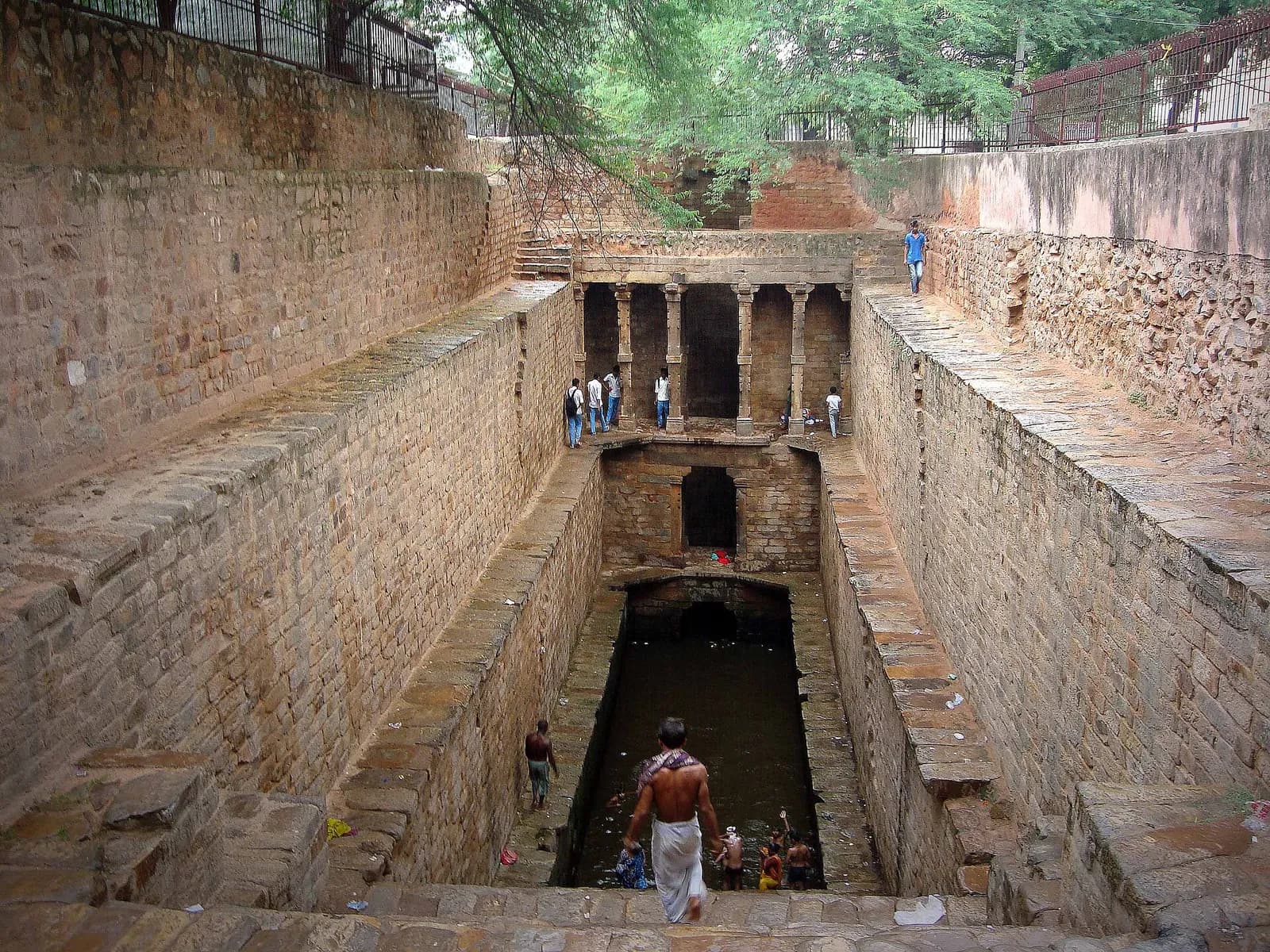
 Mehrauli, Delhi
Gandhak ki Baoli Delhi: History, Timings and Visitor Guide
Visiting Gandhak ki Baoli, Delhi's oldest stepwell, in Mehrauli? Its history under Iltutmish, the sulphur water, the diving well, timings, free entry and metro.
Quick answer
Gandhak ki Baoli in Mehrauli, South Delhi, is widely regarded as the oldest surviving stepwell in Delhi, built around 1230 during the reign of Sultan Iltutmish of the Slave dynasty. Legend says it was commissioned to supply water to the nearby Sufi saint Qutbuddin Bakhtiar Kaki and its name, from the Urdu for sulphur, comes from the pungent sulphurous spring that fed it, water once believed to cure skin ailments. A long, five-tiered linear stepwell, it later became famous as a diving well. It is free to enter, open through the day and reached from Qutub Minar metro. It features on our heritage Delhi tours, run by a unit of Experience My India.
- #gandhak-ki-baoli
- #delhi
- #gandhak-ki-baoli-delhi
- #delhi-attractions
- #delhi-travel
Gandhak ki Baoli is one of Delhi's most historic and atmospheric stepwells, the oldest in the city, tucked into the lanes of Mehrauli beside the shrine it was built to serve. For history lovers and those drawn to the city's quieter, offbeat heritage, it is a rewarding stop. Our team at Delhi Agra Tour Packages often includes it on a Mehrauli heritage walk and it adds a historic, atmospheric dimension to a wider Golden Triangle tour through the capital.
I am Abhay Sharma, Delhi born and a Golden Triangle guide since 2015 and I love bringing history-minded guests here, because few structures connect so directly to the earliest days of the Delhi Sultanate and to the city's great Sufi tradition as this, the oldest of all Delhi's stepwells. This guide gathers everything I would tell a visitor beforehand, checked against current information, including the history, the architecture, the timings and how to reach it.
Gandhak ki Baoli at a glance
| Detail | Information |
|---|---|
| Location | Ward 8, Mehrauli Village, South Delhi |
| Known as | The oldest surviving stepwell in Delhi; the Diving Well |
| Built | Around 1230, under Sultan Iltutmish |
| Named for | Its sulphurous or gandhak, spring water |
| Typology | A long, five-tiered linear stepwell |
| Entry | Free; a protected ASI monument |
| Nearest metro | Qutub Minar, then a short auto |
| Time needed | About 30 minutes |
Gandhak ki Baoli timings
| Detail | Information |
|---|---|
| Open | Daily, 10:00 AM to 5:00 PM |
| Setting | In the Mehrauli Village lanes, near the dargah |
| Time needed | About 30 minutes |
Gandhak ki Baoli is open daily, from 10:00 AM to 5:00 PM, in the lanes of Mehrauli Village. A visit, walking the length of the stepwell and taking in its tiers and galleries, takes about thirty minutes. These timings are current at the time of writing and can vary, so a daytime visit is best.
Entry fee
| Item | Information |
|---|---|
| Entry fee | Free for all visitors |
| Tickets | None; no ticket counters or passes |
| Water level | Seasonal; high in the monsoon, low in summer |
How to reach Gandhak ki Baoli
| From | Route |
|---|---|
| Qutub Minar metro (Yellow Line) | A short auto into Mehrauli Village |
| In Mehrauli | About 100 metres from Adham Khan's Tomb |
| Adjacent | Directly beside the Jahaz Mahal |
| By car | Difficult; the village lanes are narrow |
What is Gandhak ki Baoli?
Gandhak ki Baoli is a medieval stepwell or baoli, in Mehrauli Village in South Delhi, widely recognised as the oldest surviving stepwell in the entire city and a fine example of the early water-conservation architecture of the Delhi Sultanate. Built around 1230 during the reign of Sultan Iltutmish, one of the founding rulers of the Mamluk or Slave, dynasty, it was, by tradition, created to supply water to the revered Sufi saint Qutbuddin Bakhtiar Kaki, whose dargah lies nearby. It takes its name, Gandhak, the Urdu word for sulphur, from the distinctive sulphurous spring that fed it, water long believed to have healing properties. A long, five-tiered linear stepwell descending to a deep well shaft, lined with arcaded resting galleries, it later became famous in the colonial era as Delhi's premier diving well. Tucked into the Mehrauli lanes beside the Jahaz Mahal and the great dargah, it is a historic and atmospheric survival from the earliest days of Muslim Delhi.
Several things make it special and they are worth drawing out:
- The oldest stepwell in Delhi. Dated to around 1230, it is widely regarded as the oldest surviving baoli in the city.
- A gift for a saint. Built, by legend, to supply water to the great Sufi saint Qutbuddin Bakhtiar Kaki in a time of water crisis.
- The sulphur water. Named for its pungent sulphurous spring, whose water was long believed to cure skin diseases.
- The diving well. Famous in the 19th and 20th centuries as a diving well, where local youths leapt from its ledges for coins.
- An Iltutmish monument. A rare surviving structure from the reign of one of the earliest and greatest sultans of Delhi.
It is one of the most historic and atmospheric of the offbeat things to do in Delhi and a fascinating lesser-known entry among the important monuments of Delhi.
History of Gandhak ki Baoli
The history of Gandhak ki Baoli reaches back to the very earliest decades of the Delhi Sultanate, which is what gives this stepwell its special distinction as the oldest in the city. It was constructed around 1230, at the peak of the reign of Sultan Shams-ud-din Iltutmish, the powerful ruler of the Mamluk or Slave, dynasty who did so much to establish the Sultanate as a lasting power and who also built the Hauz-i-Shamsi reservoir nearby. To find a structure surviving from his reign, eight centuries ago, is remarkable and it places Gandhak ki Baoli among the most venerable monuments in Delhi.
The stepwell's origin is tied, by historical tradition and local legend, to the city's great Sufi heritage. According to these accounts, the baoli was commissioned in response to a water crisis affecting the revered Sufi saint Hazrat Khwaja Qutbuddin Bakhtiar Kaki, whose dargah stands nearby in Mehrauli. On learning that the saint did not have sufficient water even to perform his daily ritual baths and ablutions, the Sultan is said to have immediately ordered the digging of a deep, multi-tiered reservoir to tap a permanent underground spring, so that the holy man and his followers would never want for water. Whether taken as history or as cherished legend, this story binds the stepwell intimately to the sacred life of Mehrauli and to the devotion of the early sultans to the Sufi saints. For the visitor, knowing that this ancient baoli was built eight centuries ago by one of Delhi's founding sultans and, by tradition, out of reverence for a beloved saint, gives it a depth of history and meaning that few monuments in the city can match.
Why is it called Gandhak ki Baoli?
The stepwell's evocative name has a very literal and sensory origin, which is worth explaining, as it points to the special quality of its water. The word gandhak is the Urdu term for sulphur and the baoli was so named because the underground spring that fed it carried a highly distinctive, pungent smell of natural sulphur. Anyone who came to draw or bathe in its water would have noticed this unmistakable sulphurous odour and so the stepwell became known simply as Gandhak ki Baoli, the sulphur stepwell.
This sulphurous quality was not seen as a drawback but, on the contrary, as the source of the water's special value. For centuries, the high sulphur concentration gave the water a reputation as therapeutic and healing and this belief shaped much of the baoli's later history and fame. The name, then, is a direct record of the water's chemistry and of the reason the well was treasured, a small but telling detail that distinguishes it from the city's other stepwells. For the visitor, knowing that the name means sulphur and why, is the key to understanding both the character of the water and the medicinal reputation that drew people here from far and wide, which is one of the most interesting aspects of the monument's story.
The sulphur water and the diving well
Two remarkable traditions grew up around the sulphurous water of Gandhak ki Baoli over the centuries and together they give the monument a rich and colourful human history beyond its architecture. The first is its reputation as a healing pool. Because of the high sulphur content of its water, the baoli came to be regarded as therapeutic and for centuries medieval and early-modern people travelled from distant villages to bathe in it, firmly believing that its distinctive chemical makeup could cure chronic skin diseases and infections. In an age before modern medicine, a sulphurous spring with such a reputation was a genuine draw and the baoli served as a kind of natural health resort as well as a water source.
The second tradition is the one that gave the stepwell its colonial-era nickname, the Diving Well. Through the 19th and 20th centuries, Gandhak ki Baoli became famous, particularly among British travellers, as Delhi's premier diving well, a place of spectacle and entertainment. Local youths from the village would stand on the upper stone ledges of the baoli and plunge down, dropping as much as forty or fifty feet into the deep pool below, to entertain visitors in exchange for small coins. This daring display became a well-known attraction and the image of young divers leaping into the ancient well is one of the enduring memories of the monument's more recent past. For the visitor, these two traditions, the healing sulphur water and the daring divers, bring the old stepwell vividly to life, showing how it served not only as a reservoir but as a place of healing, spectacle and community across the centuries.
Architecture of Gandhak ki Baoli
Architecturally, Gandhak ki Baoli is a fine and early example of the linear stepwell, built for the practical mastery of water rather than for ornament and its features reward a knowing look. It is classed as a Nanda or linear, stepwell, meaning it descends in a single straight line rather than around a shaft and its key elements are worth noting:
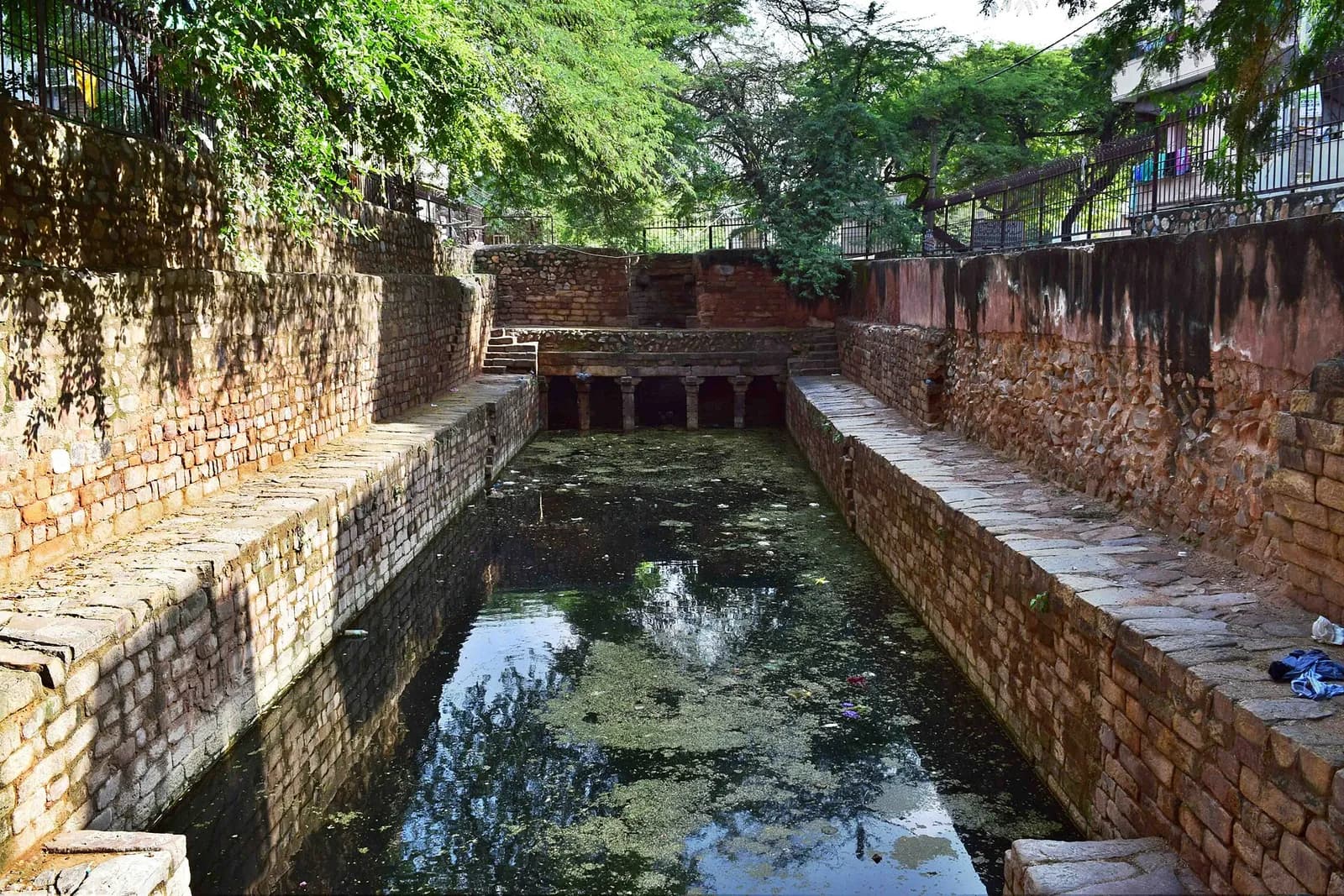
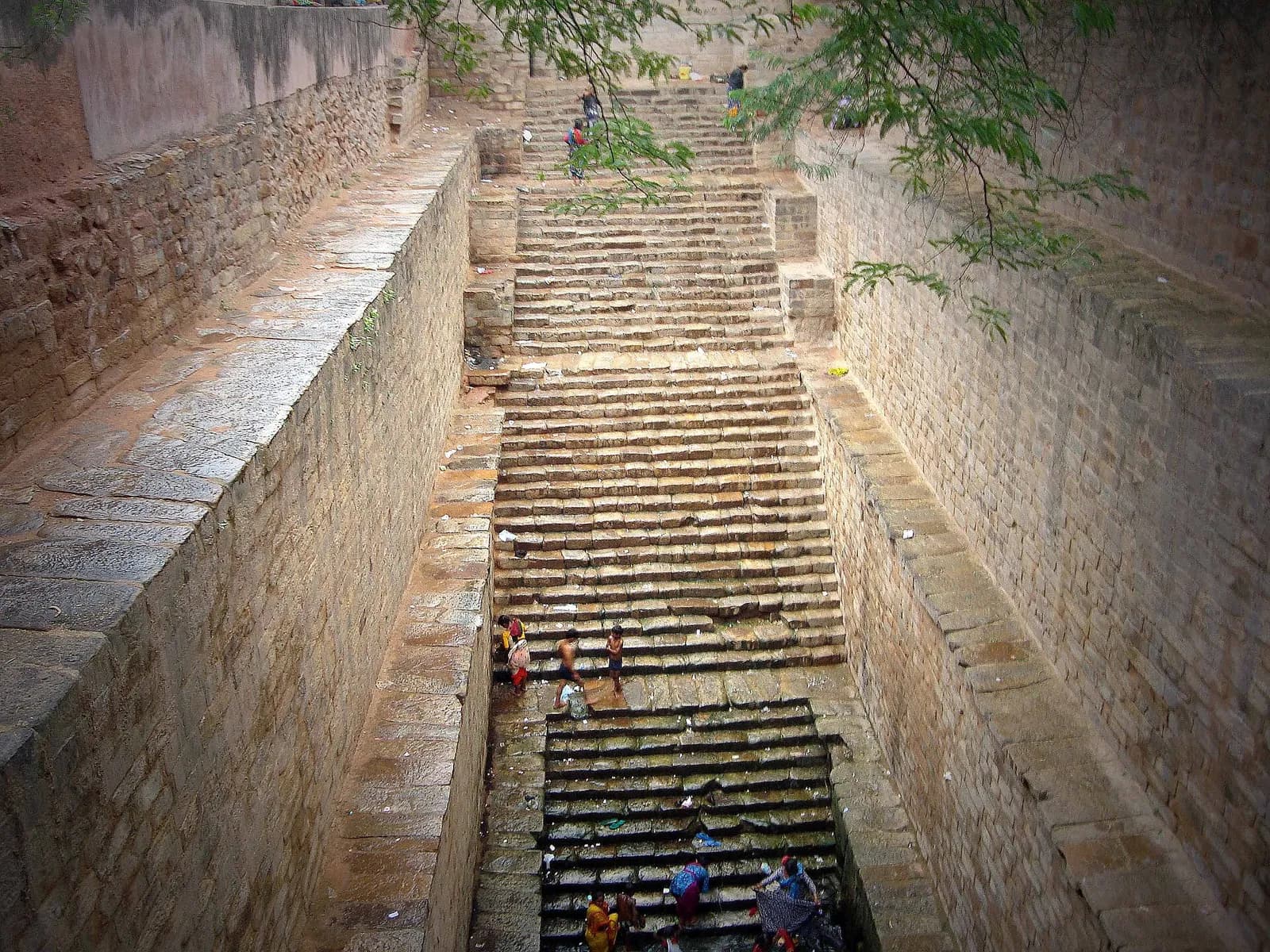
- The linear descent. A single grand descending staircase, extending roughly forty metres in length and twelve metres in width, runs systematically from north to south down to the water.
- The five tiers. The structure is built as a massive five-tiered descent that narrows progressively as it plunges down toward the water table.
- The rubble masonry and bracing. It is built of coarse, rugged local quartzite rubble bound with lime-sand mortar and the intermediate landing pavilions, historically called kutas, act as structural cross-beams, bracing the side walls against the great pressure of the surrounding soil.
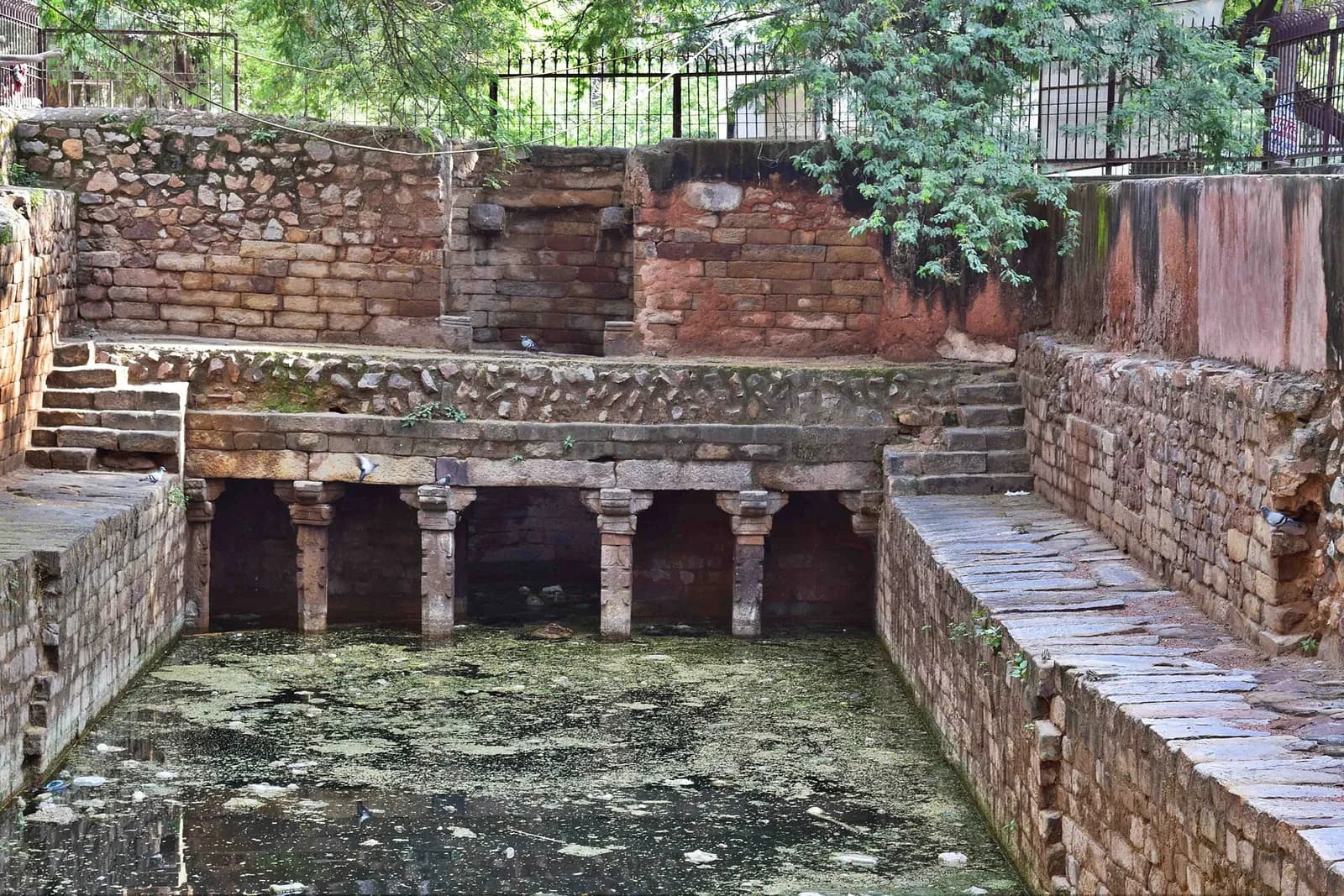
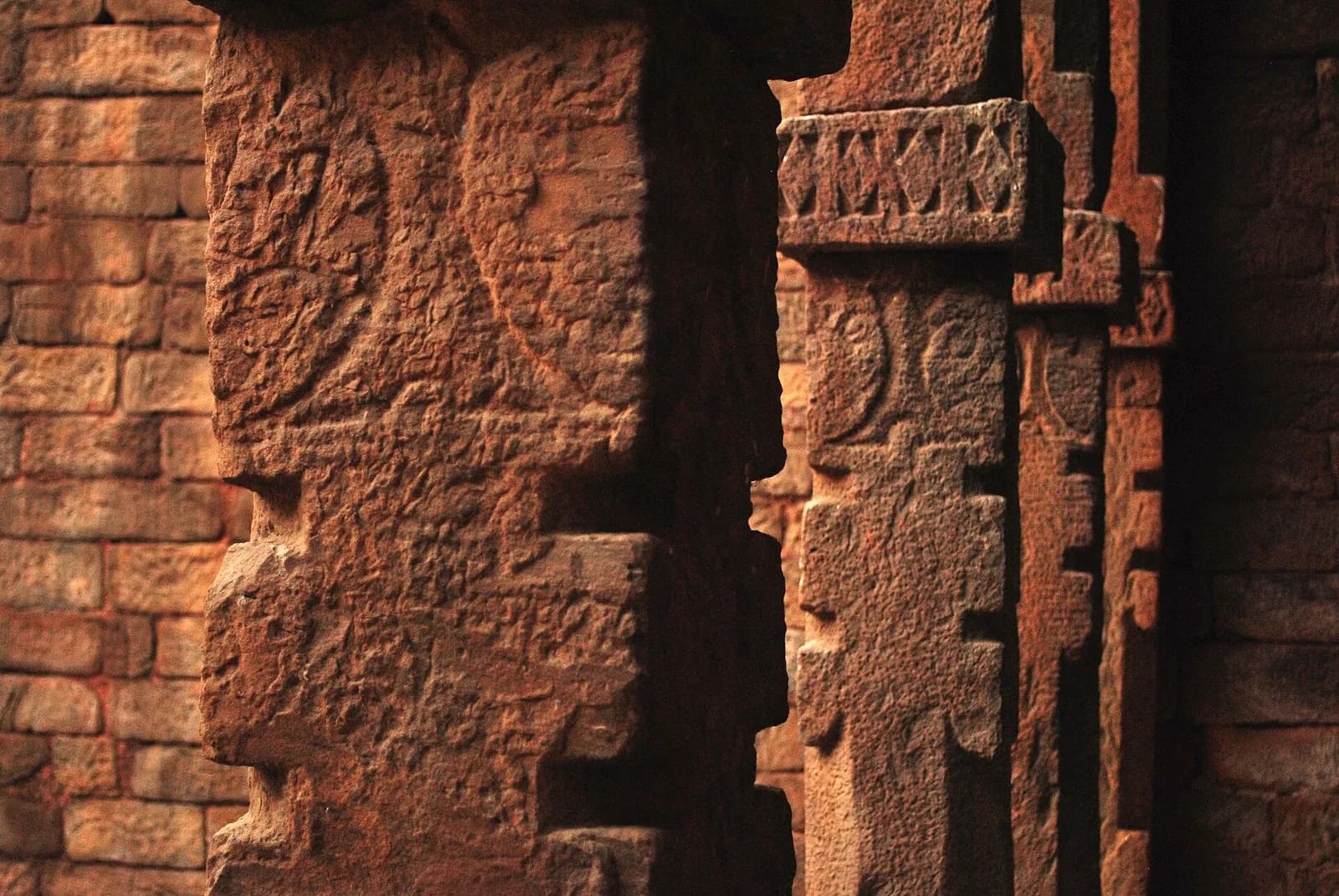
- The arcaded galleries. The upper and intermediate storeys carry rows of stone columns forming shaded, arcaded corridors, which served as cool resting chambers for travellers, monks and locals escaping the summer heat.
- The southern well shaft. At the far southern end of the descending steps sits a massive, deep cylindrical well shaft connecting directly to the underground water channel.
The overall impression is of a powerful, functional and ingenious piece of medieval engineering, its long stepped descent, bracing pavilions and shaded galleries all designed to reach, store and make usable the precious water of the sulphur spring, while also offering cool refuge from Delhi's fierce heat. The plain, rugged quartzite construction speaks of its early Sultanate date, before the refined sandstone and marble of later ages and the clever use of the landing pavilions as structural braces shows the sophistication of early stepwell design. Knowing what to look for, the linear descent, the five narrowing tiers, the bracing kutas, the arcaded resting galleries and the deep southern shaft, turns a visit into an appreciation of one of the oldest and most ingenious water structures in Delhi.
The state of the stepwell today
It is helpful for visitors to understand the current condition of Gandhak ki Baoli, which is shaped above all by the changing water table and by the pressures of its urban setting. The stepwell is highly dependent on seasonal rainfall, so its appearance changes dramatically through the year: during and after the monsoon, the water levels rise significantly and the baoli becomes a deep green pool, while in the peak of summer the water table recedes drastically, sometimes leaving the lower stone tiers completely dry and exposed. This seasonal rhythm means the baoli presents a very different face depending on when you visit and it is part of the living character of the monument.
Despite its protected status under the Archaeological Survey of India, the baoli faces the structural and environmental challenges common to the city's historic stepwells. The water is often covered with heavy layers of green duckweed and the well suffers from silt accumulation and debris washing in from the surrounding urban encroachments of the dense Mehrauli village. Major desilting drives by heritage bodies have helped restore the original twelve-metre depth and clear the structure, but persistent vigilance is needed to protect the old rubble walls from weathering and to keep the well clean. For the visitor, this means Gandhak ki Baoli is best appreciated as a genuine, lived-in historic structure rather than a pristine showpiece and knowing its seasonal nature, greenest after the rains, driest in summer, helps you understand what you are seeing and set your expectations for the visit accordingly.
What to expect at Gandhak ki Baoli
A visit to Gandhak ki Baoli is quiet, historic and atmospheric, tucked into the dense old lanes of Mehrauli Village and knowing what to expect helps you appreciate it. The baoli sits in the heart of Mehrauli Village, about a hundred metres from Adham Khan's Tomb and directly beside the Jahaz Mahal, so reaching it involves threading through the narrow, busy village lanes to the monument entrance. Once there, you can walk the length of the great linear stepwell, descending in stages, take in the five tiers, the bracing pavilions and the shaded arcaded galleries and look down to the deep southern well shaft and the water below. The experience is one of quiet exploration of an ancient and ingenious structure, absorbing its long history and its connection to the saint and the sulphur spring. The visit takes about thirty minutes.
The character of the visit depends a good deal on the season, as the water is high and green after the monsoon and low or dry in high summer, so the baoli looks quite different at different times of year. The setting is historic and atmospheric but also lived-in, surrounded by the dense village and the water is often covered in duckweed, so it is a genuine, slightly rough-edged heritage site rather than a manicured one. It is best visited in daylight, with care taken on the old, uneven steps and it combines naturally with the neighbouring Jahaz Mahal, Adham Khan's Tomb and the wider Mehrauli heritage. The mood, with the ancient stepped descent, the shaded galleries and the long history of saints, healing and divers, is deeply evocative. Come to know the story, prepare for the village lanes and a working historic monument and Gandhak ki Baoli rewards you with a real sense of the deep past of Delhi.
Gandhak ki Baoli timings and entry
Gandhak ki Baoli is open daily, from 10:00 AM to 5:00 PM, in the lanes of Mehrauli Village and entry is completely free for all visitors, with no ticket counters or passes. A visit, walking the length of the stepwell and taking in its tiers and galleries, takes about thirty minutes. A few points help in planning: the water level is strongly seasonal, high and green after the monsoon and low or even dry in peak summer, so the baoli looks different through the year; the surrounding village lanes are narrow and busy; and the old steps are uneven, so a daytime visit with careful footing is wise. Because it sits right beside the Jahaz Mahal and close to Adham Khan's Tomb and the Mehrauli Archaeological Park, it is easily combined with the wider Mehrauli heritage. These timings and conditions are current at the time of writing and can vary, so plan a daytime visit and reconfirm if your plans depend on exact hours.
Visiting tips
A few pointers make the visit smoother and more rewarding:
- Know the story first, the oldest stepwell in Delhi, Iltutmish and the saint and the sulphur water, as they bring the baoli to life.
- Come in daylight. The stepwell and the village lanes are best and most safely seen in good light.
- Mind the season. The water is high and green after the monsoon and low or dry in summer, so expect a different look at different times.
- Take care on the steps. The old stone steps are uneven, so descend carefully.
- Combine it with the neighbours. The Jahaz Mahal is right beside it and Adham Khan's Tomb and the Mehrauli Archaeological Park are close by.
- Allow about 30 minutes, more for the wider Mehrauli heritage.
The key point is simply to come in daylight, with the story in mind and to treat Gandhak ki Baoli as part of a walk through the rich Mehrauli heritage, taking in the neighbouring monuments. Done so, the oldest stepwell in Delhi rewards you with a vivid and atmospheric connection to the earliest days of the city's medieval history.
Best time to visit Gandhak ki Baoli
The best time to visit is the cooler months, from October to March and within the day the late morning or afternoon within the opening hours, for comfortable weather in the Mehrauli lanes and good light on the stepwell. A pleasant winter day is ideal, often with a reasonable level of water still in the baoli after the monsoon and comfortable temperatures for exploring. The post-monsoon months, from roughly September to November, show the baoli at its fullest and greenest, while the peak of summer can leave the lower tiers dry and exposed, which, while less picturesque, does reveal more of the structure. The summer heat itself is best avoided and the monsoon, though it fills the well beautifully, can make the steps slippery. Allow about half an hour and combine it with the wider Mehrauli heritage. Our guide to the best time to visit Delhi sets out the seasons across the city in more detail.
How to reach Gandhak ki Baoli (nearest metro)
Gandhak ki Baoli is in Ward 8 of Mehrauli Village in South Delhi, tucked into the old lanes near the Qutub Minar complex, about a hundred metres from Adham Khan's Tomb and directly adjacent to the Jahaz Mahal. The nearest metro station is Qutub Minar on the Yellow Line, from which visitors can take a short auto-rickshaw ride into Mehrauli Village to reach the monument entrance. Because the baoli sits within the dense, narrow village lanes, driving a large vehicle right up to it is difficult, so the metro and a short auto, followed by a little walking through the lanes, is the easiest approach. Set in the historic heart of Mehrauli, it pairs naturally with a Delhi day tour or a heritage-focused New Delhi tour that takes in the Qutub complex and the Mehrauli monuments.
Places to visit near Gandhak ki Baoli
Gandhak ki Baoli sits in Mehrauli, one of the richest historical quarters in all of Delhi, so it is surrounded by remarkable monuments and combines beautifully into a Mehrauli heritage day. Right beside it stands the enchanting ship palace of Jahaz Mahal and about a hundred metres away rises the dramatic Adham Khan's Tomb, while the sprawling Mehrauli Archaeological Park, with its many tombs and the beautiful Rajon ki Baoli, lies close by. Just beyond rises the towering Qutub Minar, the great medieval victory tower. For another of Delhi's great stepwells to compare, the central Agrasen ki Baoli is well worth seeing.
A ride away, the capital's other landmarks round out a full picture of the city: the mighty Red Fort and old city, the serene Humayun's Tomb, the ceremonial India Gate, the lotus-shaped Lotus Temple and the old fort of Purana Qila. For more history, the citadel of Feroz Shah Kotla, the great circle of Connaught Place, the astronomical Jantar Mantar and the historic Hauz Khas Fort complete the sweep of Delhi's past.
Gandhak ki Baoli in your Delhi itinerary
For most visitors, Gandhak ki Baoli works best as a historic, atmospheric stop within a Mehrauli heritage outing rather than a destination on its own, since the stepwell takes about half an hour and sits amid a cluster of remarkable monuments. The natural plan is to combine it with its immediate neighbours, the Jahaz Mahal right beside it and Adham Khan's Tomb a short walk away, along with the Mehrauli Archaeological Park and the Qutub Minar complex, for one of the richest heritage days in the city. It is a stop for travellers with a genuine interest in history, architecture and the city's deep past, rather than for those chasing only the headline sights and it rewards knowing its story as the oldest stepwell in Delhi and its links to the great saint and the sulphur spring.
If Delhi is your gateway to the wider Golden Triangle, Gandhak ki Baoli offers a direct and tangible connection to the earliest days of the Delhi Sultanate, eight centuries ago and to the deep tradition of stepwell building in India, a form you will meet again on a grander scale in Rajasthan and Gujarat. Many of my history-minded guests find it moving to stand at the oldest stepwell in the city, knowing its ties to Iltutmish, to the saint Bakhtiar Kaki and to centuries of healing and spectacle and it adds a quietly profound note to a Mehrauli day before the journey on to Agra and Jaipur.
Travel tips for visiting Gandhak ki Baoli
A few pointers make the visit smoother and more rewarding:
- Know the story first, the oldest stepwell in Delhi, built under Iltutmish for the saint and the sulphur water, as they are the heart of the visit.
- Come in daylight, within the 10:00 AM to 5:00 PM hours, for good light and safe footing.
- Visit after the monsoon for the fullest well, from around September to November or accept a drier look in summer.
- Take care on the old uneven steps and descend attentively.
- Combine it with the Jahaz Mahal and Adham Khan's Tomb, its immediate neighbours and the Mehrauli park.
- Reach it via Qutub Minar metro, then a short auto into Mehrauli Village.
- Allow about 30 minutes for the stepwell.
If you would like a local guide to bring the history of Gandhak ki Baoli and the Mehrauli heritage to life, message our team on WhatsApp at +91 7302265809 with your travel dates and group size and we will shape the day for you.
Is Gandhak ki Baoli worth visiting?
For history lovers and those drawn to the city's deep past and quiet heritage, yes, it is a rewarding and atmospheric stop. There are few structures in Delhi as old as this, the oldest surviving stepwell in the city, built eight centuries ago under one of its founding sultans and fewer still with so rich a human story, from its legendary origin as a gift of water to a beloved saint, to its sulphur water famed for healing, to its colourful fame as a diving well. Set amid the historic monuments of Mehrauli, beside the Jahaz Mahal, it is a genuine link to the beginnings of medieval Delhi. Entry is free. The honest note is that it is a working, lived-in historic structure in the dense village lanes, its water often green with duckweed and its level changing with the seasons, rather than a pristine or grand attraction, so its appeal rests on an interest in history and atmosphere. But for the curious, history-minded traveller who knows its story and sees it as part of the wider Mehrauli heritage, it is one of the most venerable and evocative monuments in the whole city and I love showing it to guests with a feeling for the deep past.
Plan your trip with us
At Experience My India, through our Delhi and Golden Triangle travel desk, we design unhurried, well paced trips that make room for historic, atmospheric stops like Gandhak ki Baoli and the Mehrauli heritage, not just the headline monuments and we know how to navigate the old lanes and tell the stories that bring the ruins to life. Whether you want a relaxed set of Delhi Agra tours or a full Golden Triangle route through Delhi, Agra and Jaipur, we plan around your pace, your interests and the right season, with local guides who know the history. Share your dates and the kind of trip you have in mind through our enquiry page, tell us your group size and we will put together an honest, tailored plan rather than a rushed checklist.
Related guides
- Places to visit in Delhi, for the wider picture
- Hidden places to visit in Delhi, the city's quieter corners
- Nearby places to visit in Delhi, to extend your trip
Enquire Now
What our travellers say
“Our Golden Triangle honeymoon was flawless. Sunrise at the Taj with a private guide felt like a dream — every detail was handled.”
“As a first-time visitor to India, I felt completely safe and looked after. The driver and guide were superb professionals.”
“Travelling with two kids is hard, but they made it effortless. Great pacing, clean cars and zero surprises on price.”
“Booked the Agra day trip on short notice and it went off without a hitch. The guide's history knowledge made the Taj come alive.”
“Best decision of our India trip. Car was spotless, driver was punctual every single day, and the itinerary never felt rushed.”
“Organised a same-day Agra trip for my parents. Communication before and during the trip was excellent — genuinely stress-free.”
“Sunrise at the Taj Mahal was magical. Our guide spoke great English and answered every question with patience.”
“Three generations travelling together and everyone was comfortable — good vehicle, sensible stops, and no hidden costs.”
“I've used a few tour operators across Asia and this was among the smoothest. Fair pricing and they actually answer the phone.”
“Our custom Rajasthan-Agra combo was planned around our budget without cutting corners on comfort. Highly recommend.”
“Solo female traveller here — I felt safe throughout. The driver was respectful and the whole trip was timed perfectly.”
Ready to Explore
The Heart of Delhi?
Explore the Red Fort, Qutub Minar, Humayun's Tomb, and the vibrant streets of Old Delhi with our expert-guided premium tours of India's capital city.

Delhi
Premium Tour Package
Questions
Frequently asked questions
What are the timings of Gandhak ki Baoli?
It is open daily from 10:00 AM to 5:00 PM, in the lanes of Mehrauli Village. A visit takes about 30 minutes. Reconfirm, as timings can vary.
What is the entry fee for Gandhak ki Baoli?
Who built Gandhak ki Baoli and when?
Why is it called Gandhak ki Baoli?
Is Gandhak ki Baoli the oldest stepwell in Delhi?
Why was it called the Diving Well?
Which is the nearest metro station to Gandhak ki Baoli?
Is Gandhak ki Baoli worth visiting?
Explore more
Plan your Gandhak ki Baoli trip with us

Interested in Gandhak ki Baoli Delhi: History, Timings and Visitor Guide?
Chat with our travel team for a custom quote, or browse every package.
Related Attractions
9Gandhak ki Baoli Delhi on the map
Open in Google MapsReady to explore Gandhak ki Baoli Delhi: History, Timings and Visitor Guide?
Book your private tour today and experience the magic of India's rich heritage.