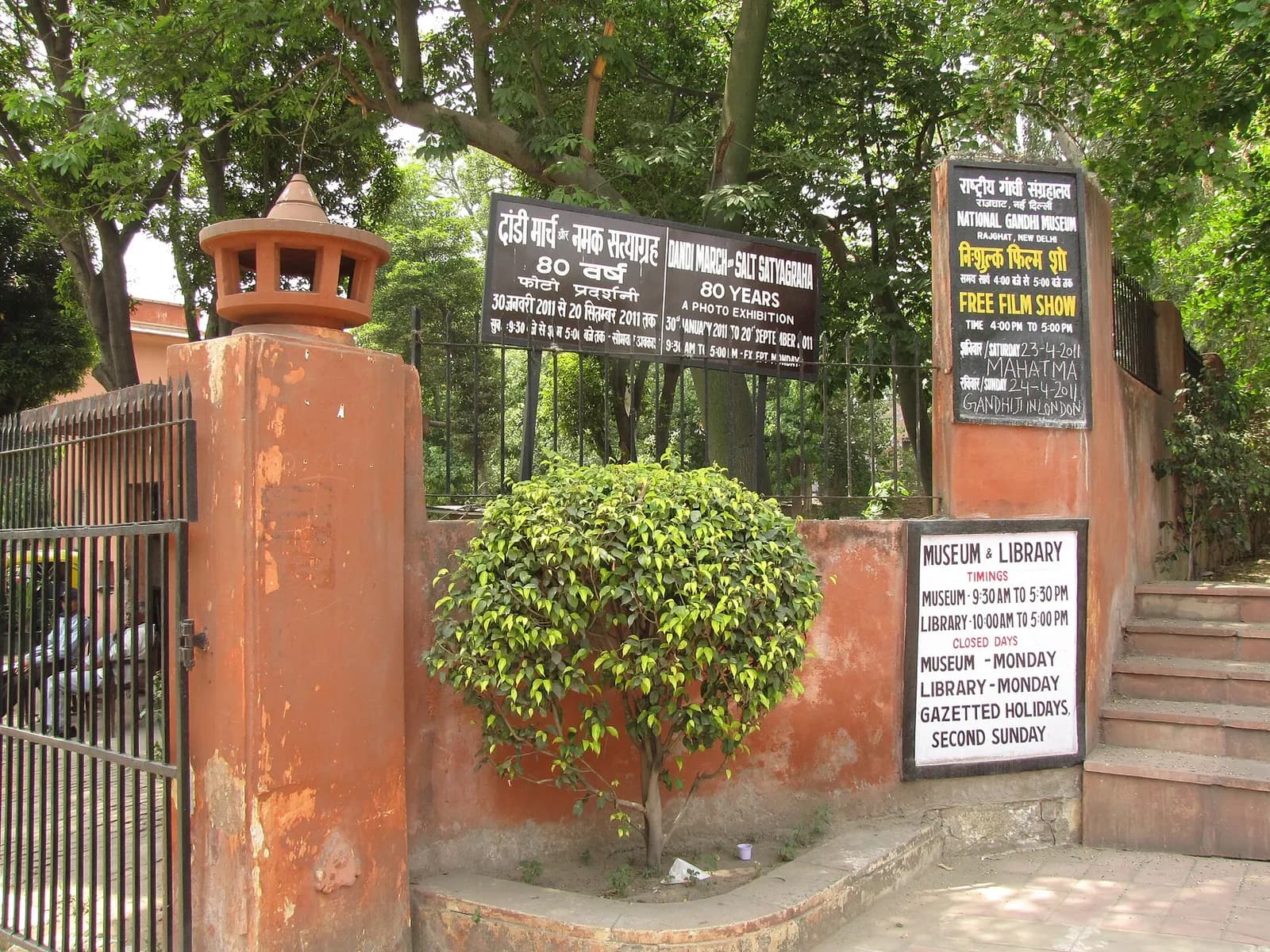
National Gandhi Museum Delhi: Timings and Visitor Guide
Visiting the National Gandhi Museum opposite Raj Ghat in Delhi? Timings, which day it is closed, free entry, the galleries, the relics and nearest metro.
In a Nutshell
“The National Gandhi Museum in Delhi, directly opposite Raj Ghat, is the world's foremost collection of original relics of Mahatma Gandhi, holding over 200 of his personal belongings, thousands of historic photographs and tens of thousands of pages of his writings. Its most moving exhibit is the blood-stained cloth he was wearing when he was assassinated, alongside his spectacles, watch and spinning wheels. Opened in 1961, it is free to enter, open Tuesday to Sunday and a short walk or rickshaw ride from the Delhi Gate metro. It features on our Delhi tours, run by a unit of Experience My India.”
The National Gandhi Museum is one of Delhi's most moving and significant museums, a quiet, dignified home for the personal relics and writings of the Father of the Nation, standing across the road from the spot where he was cremated. For anyone interested in Gandhi, India's freedom movement or the philosophy of non-violence, it is deeply affecting. Our team at Delhi Agra Tour Packages often pairs it with Raj Ghat on a central Delhi circuit and it fits thoughtfully into a Golden Triangle tour through the capital.
I am Abhay Sharma, Delhi born and a Golden Triangle guide since 2015 and I often bring guests here after Raj Ghat, because seeing Gandhi's actual belongings makes his life and sacrifice feel vividly close. This guide gathers everything I would tell a visitor beforehand, checked against current information, including the timings, the free entry, the galleries and how to reach it.
Details
National Gandhi Museum at a glance
| Detail | Information |
|---|---|
| Location | Opposite Raj Ghat, Jawaharlal Nehru Marg, Delhi |
| Opened | 1961, in its permanent building of 1959 |
| Known for | The world's foremost collection of Gandhi relics |
| Holdings | 200+ personal items, 6,000 photos, 30,000+ pages of writings |
| Entry | Free; no booking needed; closed Mondays |
| Nearest metro | Delhi Gate (Violet Line), a 10 to 12 minute walk |
| Time needed | About 1 to 2 hours |
| Bonus | A major Gandhi research library on site |
National Gandhi Museum timings
| Detail | Information |
|---|---|
| Open | Tuesday to Sunday, 10:00 AM to 5:00 PM |
| Closed | Every Monday |
| Holidays | Open on most national holidays, except Holi and Diwali |
The museum is open Tuesday to Sunday from 10:00 AM to 5:00 PM and is closed on Mondays. Unusually for a Delhi museum, it stays open on most national gazetted holidays, closing only for Holi and Diwali. Timings can change, so reconfirm and allow one to two hours for the galleries.
Entry and photography
| Item | Information |
|---|---|
| Entry fee | Free for all, Indian and foreign visitors |
| Booking | None required; no passes or tokens |
| Photography | Smartphone photos allowed; no flash or video indoors |
| Facilities | Free parking, souvenir counter, wheelchair access |
How to reach the National Gandhi Museum
| From | Route |
|---|---|
| Delhi Gate metro (Violet Line) | Exit Gate 4, a 10 to 12 minute walk or short rickshaw |
| Chandni Chowk metro (Yellow Line) | A nearby alternative |
| Raj Ghat | Directly opposite, across the road |
| By car or bus | Free parking for cars and tourist buses on site |
What is the National Gandhi Museum?
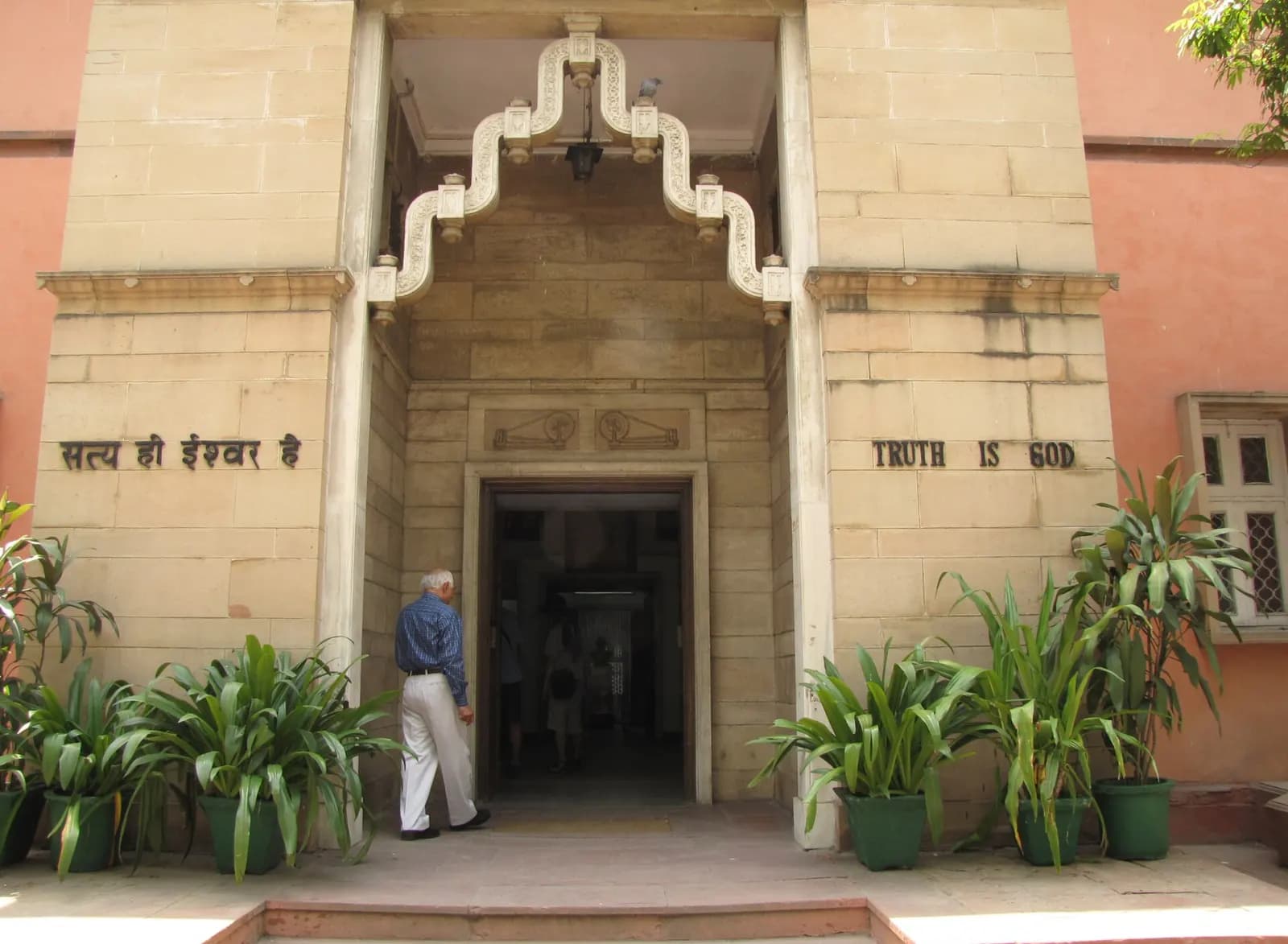
The National Gandhi Museum is the world's foremost repository of original relics and records of Mahatma Gandhi, the Father of the Nation, housed in a custom-built complex directly across the road from Raj Ghat, the site of his cremation, in central Delhi. It holds an extraordinary collection: over 200 of Gandhi's personal belongings, around 6,000 historic captioned photographs and more than 30,000 pages of his original handwritten letters, journals and speeches, along with a major research library. Through these objects and documents, arranged in themed galleries, the museum tells the story of Gandhi's life, his philosophy of non-violence and his central role in India's freedom struggle, in a way that is both scholarly and deeply moving. It is a place of quiet reflection as much as a museum, especially given its position opposite the spot where Gandhi was cremated.
Several things make it special and they are worth drawing out:
- The foremost Gandhi collection. The leading collection anywhere of original Gandhian relics, belongings and writings.
- Deeply personal relics. Gandhi's own spinning wheels, spectacles, watch, slippers and more, bringing his famously simple life vividly close.
- The martyrdom relics. The blood-stained cloth he wore when assassinated, his watch stopped at the moment and the urn that carried his ashes.
- A vast archive and library. Thousands of photographs, tens of thousands of pages of his writings and one of the world's top libraries on non-violence.
- A fitting setting. Standing directly opposite Raj Ghat, it pairs perfectly with a visit to his cremation memorial.
It is one of the most moving and meaningful of the things to do in Delhi and a significant site among the important monuments of Delhi.
History of the National Gandhi Museum
The museum's history began in the immediate aftermath of one of the darkest days in the nation's story. Following Gandhi's assassination on 30 January 1948, the work of gathering and conserving his personal belongings, manuscripts and other material began quietly in Mumbai, as those close to him sought to preserve the relics of his life. Over the following years the growing collection moved through various temporary buildings, including in Delhi, before finding its permanent home in a custom-built two-storey complex in 1959, positioned, with great symbolic fitness, directly across the road from Raj Ghat, Gandhi's cremation site. The museum was then formally opened to the public on 30 January 1961, the thirteenth anniversary of his death, by the first President of India, Dr Rajendra Prasad.
Since then it has grown into the apex institution of its kind, the foremost repository in the world of original Gandhian relics and records and a centre for the study of his life and thought. Its careful preservation of Gandhi's personal objects and writings, many of them fragile, has kept them available to the public and to scholars for generations. Knowing this history, that the collection was begun by devoted hands straight after the assassination and brought to rest opposite the place of his cremation, gives the museum its particular poignancy. It is not merely a display of artefacts but a considered act of national remembrance, built on the very ground most associated with Gandhi's final journey.
The Martyrdom Gallery
The most emotionally powerful part of the museum is the Martyrdom Gallery, which preserves the relics of Gandhi's assassination with great care and gravity and it is the section that affects visitors most deeply. Presented soberly, as objects of national memory rather than spectacle, the gallery holds:
- The blood-stained cloth. The original white loincloth, the dhoti and shawl, stained with dried blood, that Gandhi was wearing when he was shot, kept in a temperature-controlled glass display.
- A bullet. One of the bullets that took his life, preserved as a solemn record of the moment.
- The stopped watch. His pocket watch, which stopped at exactly 5:17 PM, the time of the attack, a detail that moves many visitors.
- His spectacles. The round spectacles are instantly associated with Gandhi, among his most personal possessions.
- The urn. The urn that carried his ashes, completing the gallery's account of his death.
Standing before these objects, especially the blood-stained cloth and the watch frozen at the moment of his death, is a profoundly affecting experience, collapsing the distance between a historic event and the present. It is a part of the museum best approached quietly and with respect, mindful that it commemorates the violent death of one of the most revered figures in the nation's history. For many visitors it is the most memorable and moving room in the museum.
The Commemorative Gallery and Gandhi's belongings
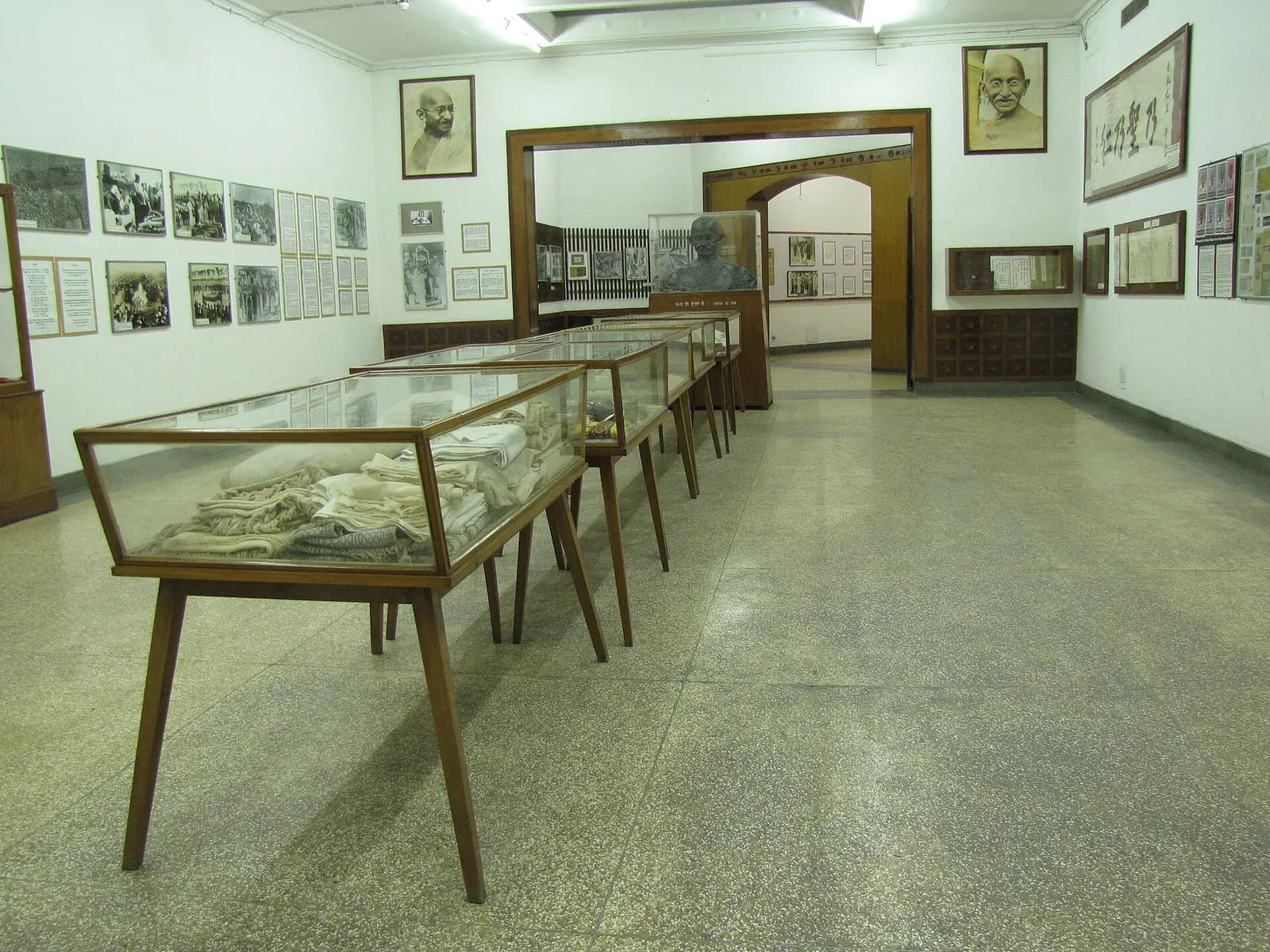
In quieter contrast to the Martyrdom Gallery, the Commemorative Gallery showcases Gandhi's famously meagre worldly possessions, a vivid illustration of the simplicity and self-sufficiency he preached and lived. Seeing how few things this towering historical figure owned is, in its own way, as striking as any grand monument. The gallery highlights:
- The spinning wheels. His original wooden spinning wheels, the charkhas, emblems of his message of self-reliance and the hand-spun khadi movement.
- His slippers and walking stick. The simple leather slippers and the walking stick that became part of his familiar image.
- A canvas bag and ivory toothpick. A plain canvas bag and even his ivory toothpick, among the humblest of personal effects.
These everyday objects, preserved and displayed, bring Gandhi's life down to a human and deeply relatable scale, showing a man who held the nation's destiny in his hands yet owned almost nothing. The charkhas in particular carry great symbolic weight, recalling his call for Indians to spin their own cloth as an act of independence. Together with the martyrdom relics, this gallery gives the museum its emotional range, from the simplicity of his life to the tragedy of his death and it leaves visitors with a strong sense of the character of the man behind the history.
The Sound and Heartbeat exhibit and photo galleries
Beyond the relic galleries, the museum offers more immersive and visual ways of connecting with Gandhi's life:
- The Sound and Heartbeat exhibit. A unique technological installation that lets visitors listen to a rhythmic digital pulse recreated from the original recorded electrocardiogram of Gandhi's own heartbeat, an unexpectedly intimate experience.
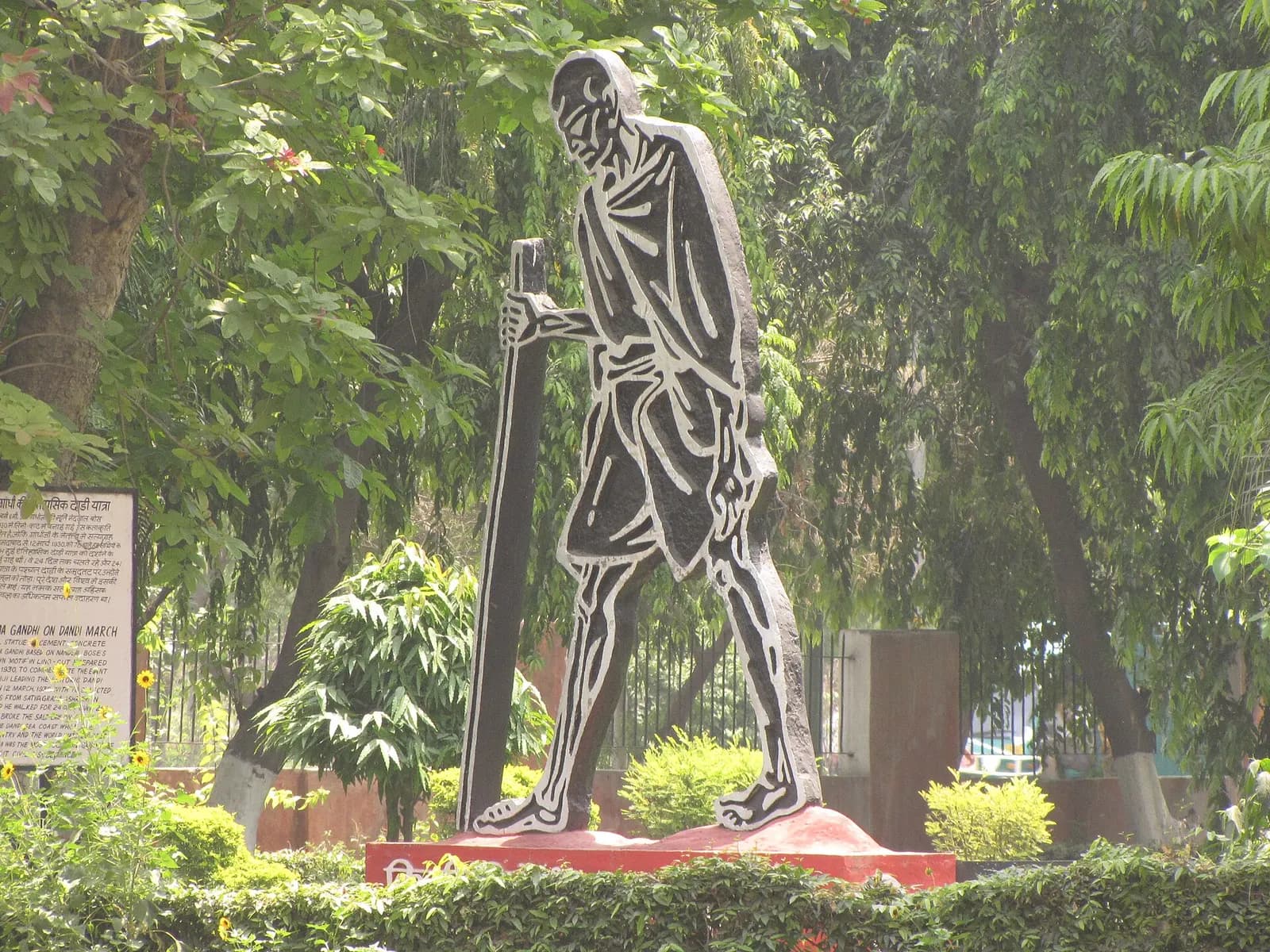
- The Photographic Gallery. Thousands of black-and-white and sepia-toned historic photographs mapping his journey from childhood and his legal career in South Africa through the Salt March and the milestones of the freedom movement.
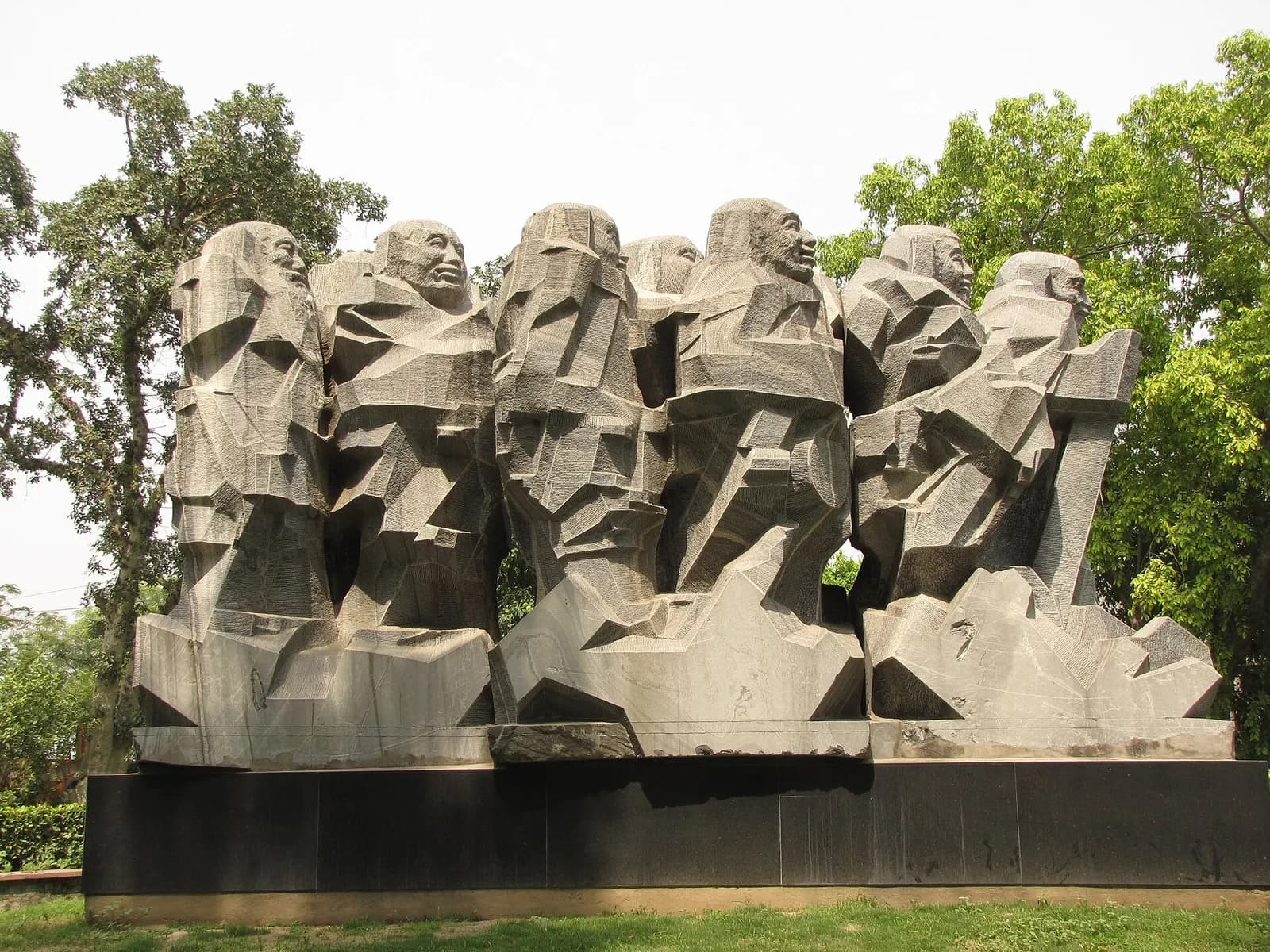
- The Art Gallery. A hall displaying sculptures, woodcuts and oil paintings created by peace artists from around the world, inspired by Gandhi and his message.
The Sound and Heartbeat exhibit is a particularly memorable and moving touch, offering a strangely direct connection to the man himself through the rhythm of his own heart. The photographic gallery, meanwhile, is a rich visual history of Gandhi's extraordinary life and of the freedom struggle he led, rewarding a slow look, while the art hall shows how his influence spread far beyond India to inspire artists and peace movements worldwide. Together these galleries broaden the museum from a display of relics into a fuller portrait of Gandhi's life, legacy and global significance.
The National Gandhi Library
Adjoining the museum galleries is the National Gandhi Library, which is a treasure in its own right and one of the world's largest specialised research libraries on anti-colonial movements and peace studies. It houses over 40,000 institutional books, magazines and bound academic papers and, remarkably, includes complete original print runs of the historic journals that Gandhi himself founded or edited, among them Young India, Harijan and Indian Opinion, primary sources of great value. As a result it functions as a critical global research hub for PhD scholars and others studying Gandhi, non-violent resistance and the independence movement. While the library is primarily a resource for researchers rather than a casual sightseeing stop, its presence underlines the museum's standing as a serious centre of Gandhian study, not merely a display of relics. For visitors with a deeper interest, knowing that the actual journals Gandhi edited are preserved here adds to the sense of standing at the documentary heart of his legacy. It makes the complex a place of scholarship as well as remembrance.
What to expect at the National Gandhi Museum
A visit to the National Gandhi Museum is a quiet, reflective experience and knowing what to expect helps you meet it in the right spirit. You arrive opposite the green expanse of Raj Ghat, enter the calm two-storey building and move through the themed galleries at your own pace, with no ticket to buy and rarely a crowd to contend with. The atmosphere is hushed and dignified, closer to a place of remembrance than a bustling museum and the exhibits are arranged to tell Gandhi's story in sequence, from his life and work to his death and legacy. The relics are displayed simply but with great care and the effect of seeing the actual objects, his spinning wheel, his spectacles, the cloth he died in, is far stronger than any photograph or textbook could convey.
Most visitors spend their time among the relic galleries, pause at the moving Martyrdom Gallery, take in the photographic and art halls and perhaps listen to the heartbeat exhibit, before stepping back out to cross to Raj Ghat. Because it is compact and uncrowded, the visit is unhurried and personal and many people find themselves lingering longer than they expected, absorbed by the intimacy of the objects. School groups and those with a serious interest in Gandhi come here, which adds to the thoughtful mood. Come with a little time and a reflective frame of mind, pair it with Raj Ghat opposite and the museum offers one of the most quietly powerful experiences in the city, bringing the life and values of the Father of the Nation vividly within reach.
Gandhi's legacy and the museum's message
Part of what gives the museum its depth is the sheer scale of the legacy it preserves. Mahatma Gandhi led India's freedom movement through the philosophy of non-violence or ahimsa and satyagraha, the insistence on truth, becoming one of the most influential figures of the twentieth century and an inspiration to movements for civil rights and justice across the world, from the American civil rights movement to anti-apartheid and beyond. The museum's relics and records are not simply curiosities but the material traces of that world-changing life and philosophy and the institution sees its mission as keeping Gandhi's ideas, as much as his objects, alive and accessible. The very simplicity of his belongings, the spinning wheel, the canvas bag, the few personal effects, is itself a statement of the values he preached: self-reliance, simplicity and the rejection of material excess.
For a visitor, understanding this wider legacy turns the visit from a look at old objects into an encounter with one of history's great moral lives. The museum invites reflection not only on Gandhi's role in India's independence but on the continuing relevance of non-violence and truth in a troubled world, which is why it draws thoughtful visitors and scholars from across the globe. Seeing his relics opposite the place of his cremation and grasping what he stood for, leaves many visitors genuinely moved and it is this combination of intimate objects and vast moral significance that makes the National Gandhi Museum so much more than an ordinary museum.
National Gandhi Museum timings and entry
The museum is open Tuesday to Sunday from 10:00 AM to 5:00 PM and is closed on Mondays, with the library keeping the same hours. Pleasingly and unlike most Delhi museums, it stays open on most national gazetted public holidays, closing only for the festivals of Holi and Diwali, so it is often a good choice on a holiday when other sites are shut. Entry is completely free for everyone, Indian and international visitors alike and no advance digital pass or registration token is required, so you can simply walk in during opening hours. A complete walk through the galleries takes roughly one to two hours. The museum also provides free outdoor parking for cars and tourist buses, a souvenir and heritage book counter and wheelchair-accessible pathways. These timings are current at the time of writing and can change, so reconfirm before a special trip, particularly around holidays.
Rules and photography at the National Gandhi Museum
A few simple rules, mainly around photography, help protect the delicate collection:
- Smartphone photos allowed. Casual handheld smartphone photography is permitted in the galleries, free of charge.
- No flash or video. Using a camera flash or capturing video inside the indoor display halls is prohibited, to protect the delicate textiles and historical documents.
- Handle with care. Do not touch the exhibits, many of which are fragile originals.
- Keep it respectful. As a place commemorating Gandhi's life and death, quiet, respectful conduct is expected.
- Use the facilities. Free parking, a souvenir counter and wheelchair access are available on site.
Knowing the no-flash, no-video rule in advance means you can still take simple photographs on your phone while helping to preserve the irreplaceable relics and papers. Otherwise the museum is relaxed and welcoming and the free entry and parking make it an easy and comfortable visit.
Best time to visit the National Gandhi Museum
The best time to visit is a weekday, when the museum is quietest and you can take in the galleries at a reflective pace, though it is rarely very crowded. Avoid Mondays, when it is closed, but remember that, unusually, it is open on most public holidays except Holi and Diwali, which can make it a rare open option on a holiday. In terms of season, the cooler months from October to March are the most pleasant for the walk from the metro and for combining the museum with the open-air Raj Ghat opposite; the galleries themselves are indoors. Arriving earlier in the day, soon after the 10:00 AM opening, gives a calm start and leaves time to pair the visit with Raj Ghat and the surrounding sights. A quiet weekday morning in the cooler season is close to ideal for absorbing the museum's moving collection. Our guide to the best time to visit Delhi sets out the seasons across the city in more detail.
How to reach the National Gandhi Museum (nearest metro)
The National Gandhi Museum stands on Jawaharlal Nehru Marg, directly opposite Raj Ghat, near the eastern edge of the old city in central Delhi and it is easy to reach. The nearest metro station is Delhi Gate on the Violet Line, from which exiting at Gate 4 leaves you with a brief 10 to 12 minute walk or a short cycle-rickshaw hop, down Jawaharlal Nehru Marg to the museum compound. Chandni Chowk station on the Yellow Line is another nearby option. App cabs and autos can drop you at the gate and there is free parking on site for cars and tourist buses if you drive. Because it sits right across from Raj Ghat and close to the old city, it combines naturally with that part of Delhi. A guided Old Delhi tour can fold it in alongside the Red Fort and the bazaars, while a broader New Delhi tour covers the imperial avenues.
Places to visit near the National Gandhi Museum
The National Gandhi Museum sits opposite Raj Ghat near the old city, so it is easy to pair with nearby sights. Directly across the road is Raj Ghat, Gandhi's cremation memorial, the most natural companion to the museum and the two together make an ideal combined Gandhi-themed half day. The mighty Red Fort and the bazaars of Old Delhi, with the revered Shri Gauri Shankar Mandir on Chandni Chowk, are a short ride away, as is the old fort of Purana Qila.
A little further out, the central landmarks are an easy ride away: the ceremonial India Gate, the great circle of Connaught Place, the ancient stepwell of Agrasen ki Baoli, the astronomical Jantar Mantar, the much loved Pracheen Hanuman Mandir and the serene Bangla Sahib Gurudwara. The capital's other great monuments, the serene Humayun's Tomb, the towering Qutub Minar and the modern Lotus Temple, round out a full picture of the city.
The National Gandhi Museum in your Delhi itinerary
For most visitors, the National Gandhi Museum works best paired with Raj Ghat directly opposite, as a combined Gandhi-themed stop of a couple of hours within an Old Delhi or central Delhi circuit. A natural plan is to visit Raj Ghat first, pay respects at the cremation memorial and then cross to the museum to see Gandhi's actual belongings and the story of his life, so that the memorial and the relics together give a complete sense of the man. Because the museum is compact, free and open even on most holidays, it is easy to slot in, though its moving, reflective character means it rewards a little quiet time rather than a rushed look. Those interested in Gandhi, the freedom movement or the philosophy of non-violence will find it one of the most resonant stops in the city.
If Delhi is your gateway to the wider Golden Triangle, the museum offers an intimate encounter with the Father of the Nation and the values of simplicity and non-violence he embodied, a thoughtful counterpoint to the Mughal and colonial monuments elsewhere. Many of my guests find seeing Gandhi's own spinning wheel, spectacles and the relics of his death unexpectedly powerful and it adds a human, reflective note to a trip before the journey on to Agra and Jaipur.
Travel tips for visiting the National Gandhi Museum
A few pointers make the visit smoother and more respectful:
- Pair it with Raj Ghat, directly opposite, for a complete Gandhi-themed half day.
- Avoid Mondays, when the museum is closed, but note it is open on most holidays except Holi and Diwali.
- Visit on a weekday morning, for a quiet, reflective experience.
- Use your phone, not flash or video, as flash and video are banned indoors to protect the relics.
- Allow 1 to 2 hours and approach the Martyrdom Gallery with respect.
- Come in the cooler months, which suit the walk from the metro and the open-air Raj Ghat.
- Use the free parking if driving, available for cars and buses.
- Walk or rickshaw from Delhi Gate metro, Gate 4, about 10 to 12 minutes.
If you would like a local guide to build the National Gandhi Museum into a wider Delhi plan, message our team on WhatsApp at +91 7302265809 with your travel dates and group size and we will shape the day for you.
Is the National Gandhi Museum worth visiting?
For anyone interested in Mahatma Gandhi, India's independence or the philosophy of non-violence, yes, very much so. It is the foremost collection of Gandhi's relics anywhere and seeing his actual spinning wheel, spectacles, watch and the blood-stained cloth from his assassination is a profoundly moving experience that no account can match. It is free, open even on most holidays and sits directly opposite Raj Ghat, so it pairs perfectly with his cremation memorial for a complete and meaningful visit. The honest note is that it is a reflective, relic-focused museum rather than a grand or lively attraction, so it suits visitors with an interest in history and a thoughtful frame of mind more than those seeking spectacle and the Martyrdom Gallery in particular should be approached with respect. For the right visitor, though, it is one of the most resonant stops in the capital and I recommend it warmly, especially combined with Raj Ghat.
Plan your trip with us
At Experience My India, through our Delhi and Golden Triangle travel desk, we design unhurried, well paced trips that make room for meaningful, reflective stops like the National Gandhi Museum and Raj Ghat, not just the grand monuments and we give them the time and context they deserve. Whether you want a relaxed set of Delhi Agra tours or a full Golden Triangle route through Delhi, Agra and Jaipur, we plan around your pace, your interests and the right season, with local guides who can tell the story of Gandhi and the freedom movement. Share your dates and the kind of trip you have in mind through our enquiry page, tell us your group size and we will put together an honest, tailored plan rather than a rushed checklist.
Related guides
- Places to visit in Delhi, for the wider picture
- Hidden places to visit in Delhi, the city's quieter corners
- Nearby places to visit in Delhi, to extend your trip
Enquire Now
Ready to Explore
The Heart of Delhi?
Explore the Red Fort, Qutub Minar, Humayun's Tomb, and the vibrant streets of Old Delhi with our expert-guided premium tours of India's capital city.

Delhi
Premium Tour Package
Questions
Frequently asked questions
What are the timings of the National Gandhi Museum?
It is open Tuesday to Sunday from 10:00 AM to 5:00 PM and is closed on Mondays. Unusually, it stays open on most national holidays, closing only for Holi and Diwali. Reconfirm, as timings can change.
What is the entry fee for the National Gandhi Museum?
Which is the nearest metro station to the National Gandhi Museum?
When was the National Gandhi Museum established?
What can you see at the National Gandhi Museum?
Which day is the National Gandhi Museum closed?
Is photography allowed at the National Gandhi Museum?
Where is the National Gandhi Museum located?
How is it different from Gandhi Smriti?
Is the National Gandhi Museum worth visiting?
Explore more
Plan your National Gandhi Museum trip with us

Interested in National Gandhi Museum Delhi: Timings and Visitor Guide?
Chat with our travel team for a custom quote, or browse every package.
Related Attractions
9Ready to explore National Gandhi Museum Delhi: Timings and Visitor Guide?
Book your private tour today and experience the magic of India's rich heritage.