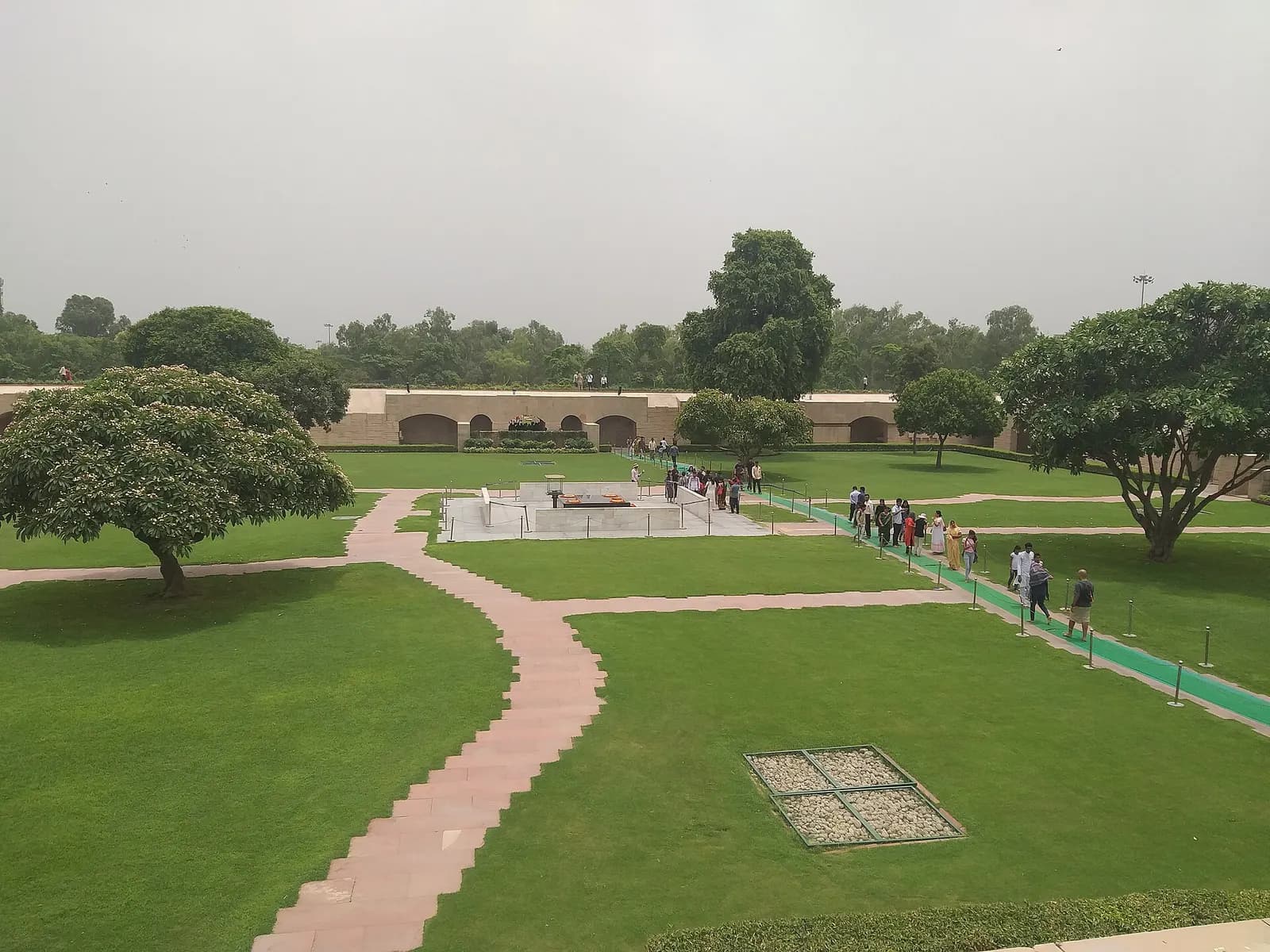
Raj Ghat Delhi: Timings, History and Complete Visitor Guide
Planning a Raj Ghat visit? Free entry, timings, the Gandhi memorial and eternal flame, the Friday prayer, nearby leaders' memorials, etiquette and metro.
In a Nutshell
“Raj Ghat on Ring Road in Delhi is the memorial marking the spot where Mahatma Gandhi was cremated in 1948. It is open every day, roughly 6:30 AM to 6:00 PM and entry is completely free. A simple black marble platform with an eternal flame sits in quiet gardens and a commemorative prayer is held each Friday. Allow 45 to 60 minutes and remove your shoes near the platform. Delhi Agra Tour Packages, a unit of Experience My India, pairs it with the Red Fort nearby.”
Raj Ghat is the quietest famous place in Delhi and that is exactly the point. On the banks of the Yamuna, a plain black marble platform marks the spot where Mahatma Gandhi was cremated in 1948 and the whole memorial is built around simplicity and silence, a deliberate contrast to the noise of the city outside its walls. For many visitors it is a moving, reflective pause between the grander monuments. If you are planning a trip, Delhi Agra Tour Packages is where I set the capital's sights in a sensible order and Raj Ghat pairs naturally with the Red Fort just nearby. It sits on our Golden Triangle tour routes as a short, meaningful stop in the heart of old Delhi.
I am Abhay Sharma, Delhi born and a Golden Triangle guide since 2015. Over 11 years I have taken more than 50,000 travellers around this city and Raj Ghat is a place that rewards a little understanding. Visitors sometimes arrive expecting a grand monument and are surprised by how simple it is, confuse it with the house where Gandhi was killed or miss the remarkable belt of other leaders' memorials right beside it. This guide fixes all of that. You will get the real timings and the free entry, the story of what happened here, the meaning behind the stark design, the etiquette that keeps the place sacred and the nearby Gandhi museums and memorials that complete the visit. It is free and open to all, as Gandhi's own life would suggest.
Raj Ghat at a glance
Here are the essentials before we go deeper.
| Detail | Information |
|---|---|
| What it is | The memorial marking Mahatma Gandhi's cremation site |
| Location | Ring Road, on the banks of the Yamuna, near the Red Fort |
| Cremation | 31 January 1948, the day after Gandhi's assassination |
| Architect | Vanu G. Bhuta |
| Structure | A simple, unroofed black marble platform with an eternal flame |
| Entry fee | Free, no ticket required |
| Time needed | 45 to 60 minutes |
| Best time | October to March, early morning or late afternoon |
Details
Timings
| Item | Detail |
|---|---|
| Opening hours | About 6:30 AM to 6:00 PM, every day |
| Note | Some sources list longer or seasonal hours, so confirm locally |
| Friday prayer | A commemorative prayer meeting is held each Friday |
| Anniversaries | Special prayers on 2 October and 30 January |
Details
How to reach
| Mode | Detail |
|---|---|
| Nearest metro | Delhi Gate (Violet Line), Exit Gate 4, a 10 to 12 minute walk |
| Alternative metro | Indraprastha (Blue Line), also close |
| By road | Ring Road, near the Red Fort and the Yamuna |
| Parking | A dedicated parking lot outside the main gate, nominal fee |
What is Raj Ghat and why is it so famous?
Raj Ghat is the national memorial to Mahatma Gandhi, the Father of the Nation, built on the spot beside the Yamuna where he was cremated on 31 January 1948, the day after he was assassinated. It is famous as one of the most sacred and solemn sites in the country, a place where heads of state, dignitaries from around the world and millions of ordinary citizens come to pay their respects. It is also famous for what it is not, there is no grand tomb or towering monument here, only a simple black platform and an eternal flame and that very simplicity is the memorial's power.
For a traveller, Raj Ghat offers something different from Delhi's forts and tombs, a quiet, reflective experience rather than a spectacle. It is a chance to stand at the resting place of one of the most influential figures of the twentieth century, in a calm garden setting and to feel the weight of the history. It takes less than an hour, it is completely free and it pairs easily with the Red Fort and the old city, which is why it belongs on any thoughtful list of things to do in Delhi.
Who was Mahatma Gandhi and why does Raj Ghat matter?
To understand why Raj Ghat is so revered, it helps to remember the man it honours. Mohandas Karamchand Gandhi, known to the world as Mahatma, meaning great soul, led India's struggle for independence from British rule through a philosophy of truth and non violence that he called satyagraha. Across decades of campaigns, from the Salt March to the Quit India movement, he mobilised millions not with weapons but with moral force and his methods went on to inspire civil rights and freedom movements around the world.
India won its independence in 1947, the cause Gandhi had given his life to and then, on 30 January 1948, he was assassinated in Delhi. The nation's grief was immense and the simple memorial at Raj Ghat became the focus of it. That is why the site matters so much, it is not merely a tomb but the resting place of the Father of the Nation, the man whose image appears on the Indian rupee and whose ideas still shape the country's sense of itself. Standing at the black platform, you are at the symbolic centre of modern India's conscience, which is a large part of why so many visitors find the place unexpectedly moving.
For international travellers in particular, Raj Ghat often lands harder than expected, because Gandhi's influence reached far beyond India. His philosophy of non violent resistance shaped the thinking of later leaders and movements across the world, so people arrive carrying their own sense of what he represents. Coming to the quiet spot where his life ended, after a trip full of grand palaces and forts, has a way of putting the whole of Delhi's long history into a different, more human perspective, which is something no photograph of the memorial quite captures.
What happened here and what is the story of Gandhi's cremation?
The story is one of the most significant in modern Indian history. On 30 January 1948, just months after India won its independence, Mahatma Gandhi was assassinated in Delhi. The following day, 31 January, his body was cremated on the banks of the Yamuna, at the spot that is now Raj Ghat, in the presence of an enormous grieving crowd. The site was chosen for the cremation and the memorial was later built to mark the exact place where it took place.
It is worth clearing up a common confusion here, because it trips up many visitors. Raj Ghat is where Gandhi was cremated. It is a different place from Gandhi Smriti, formerly Birla House, elsewhere in the city, which is where he was actually assassinated and which is now a separate museum. Both are Gandhi memorials worth visiting, but they mark different moments, the place of death and the place of cremation and planning them as two separate stops avoids disappointment. Raj Ghat became the model for a whole tradition of leader memorials along this stretch of the Yamuna, which is covered below.
What is the design and symbolism of Raj Ghat?
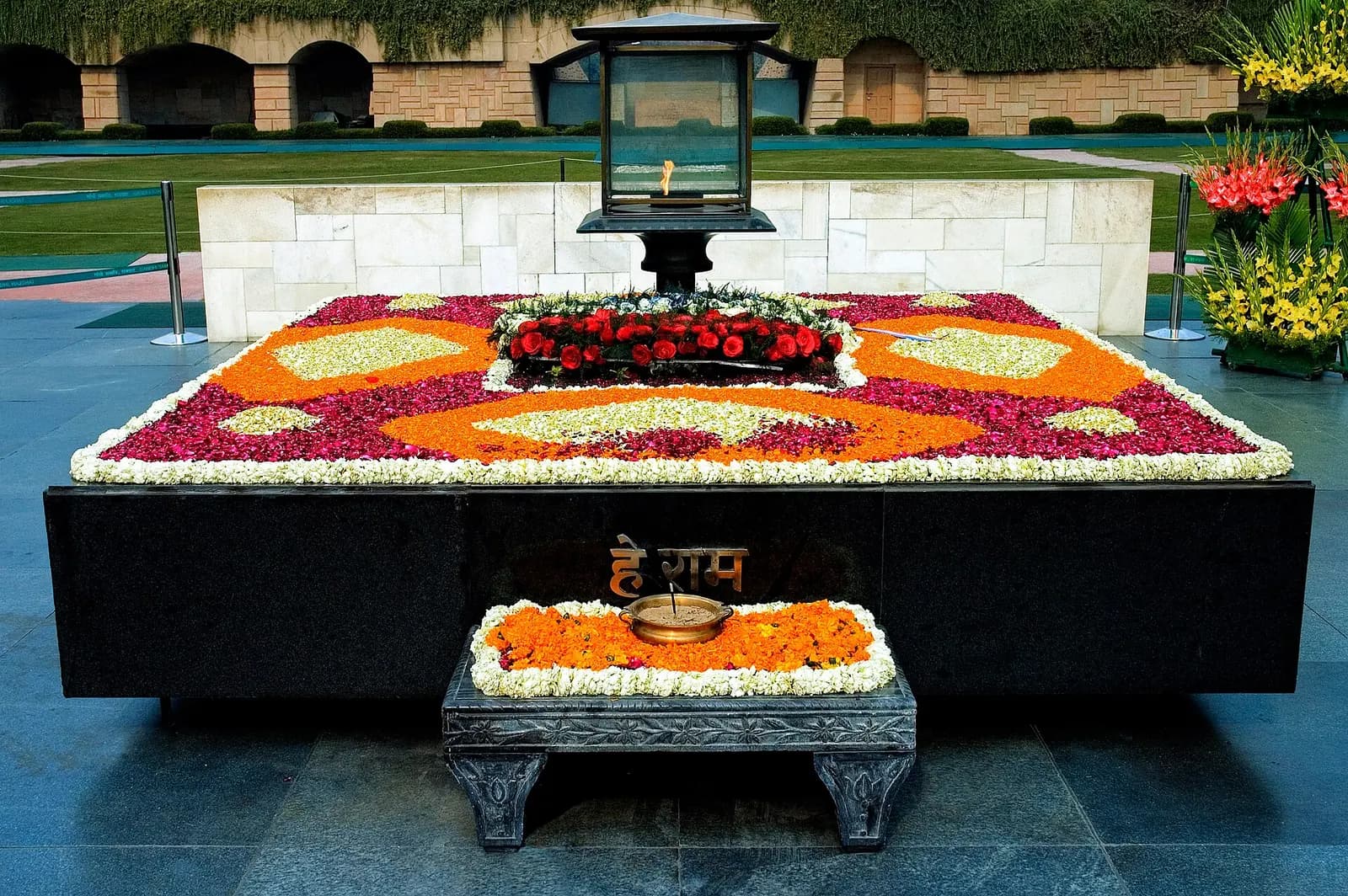
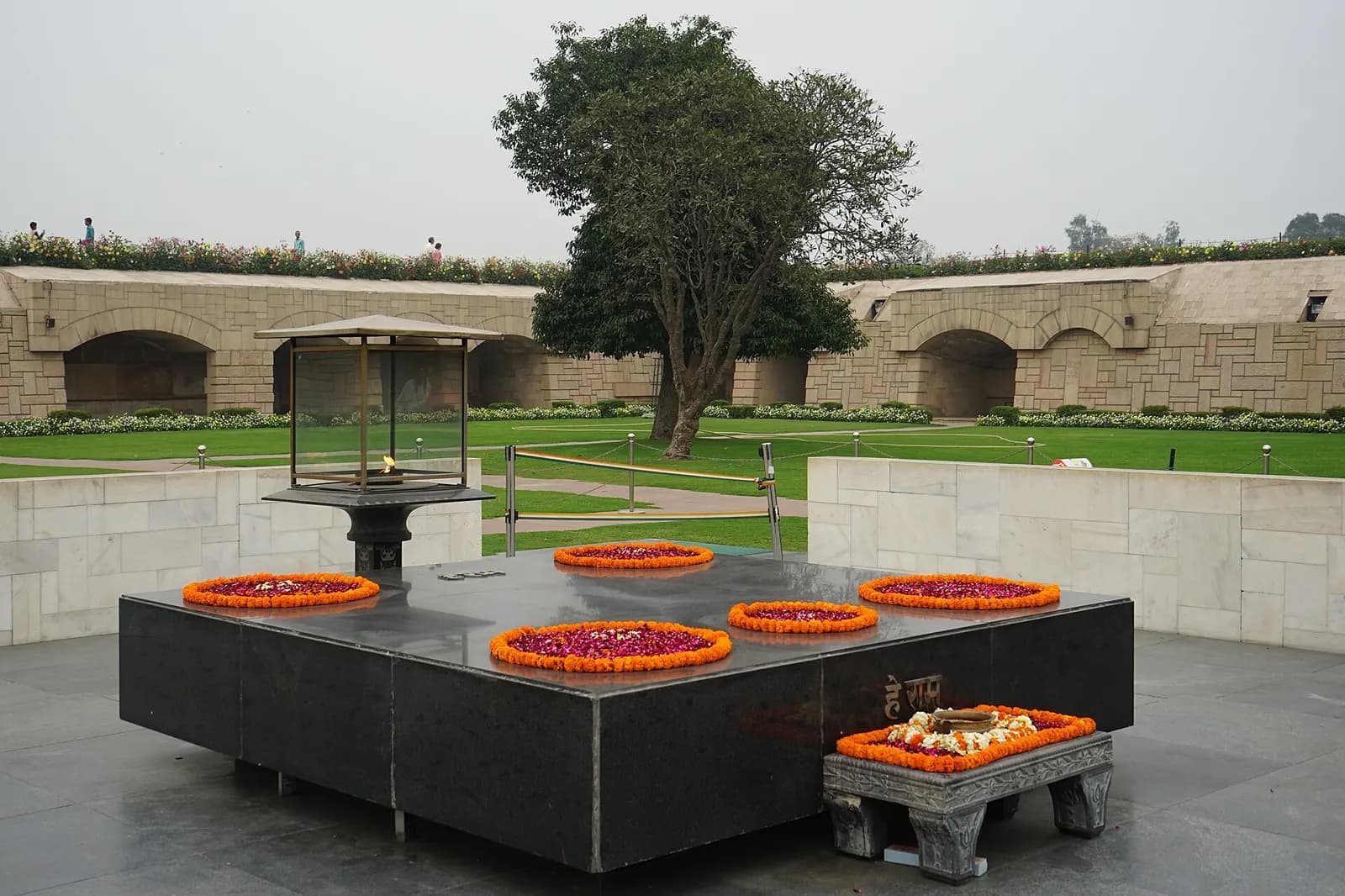
The design of Raj Ghat was deliberately, powerfully simple, intended to reflect the simplicity of Gandhi's own life and it was created by the architect Vanu G. Bhuta. The memorial is a plain, unroofed, square platform made of polished black marble, open to the sky, with no ornament and no structure above it. In a country of grand domes and carved tombs, that starkness is the whole statement, the opposite of pomp, in keeping with a man who owned almost nothing.
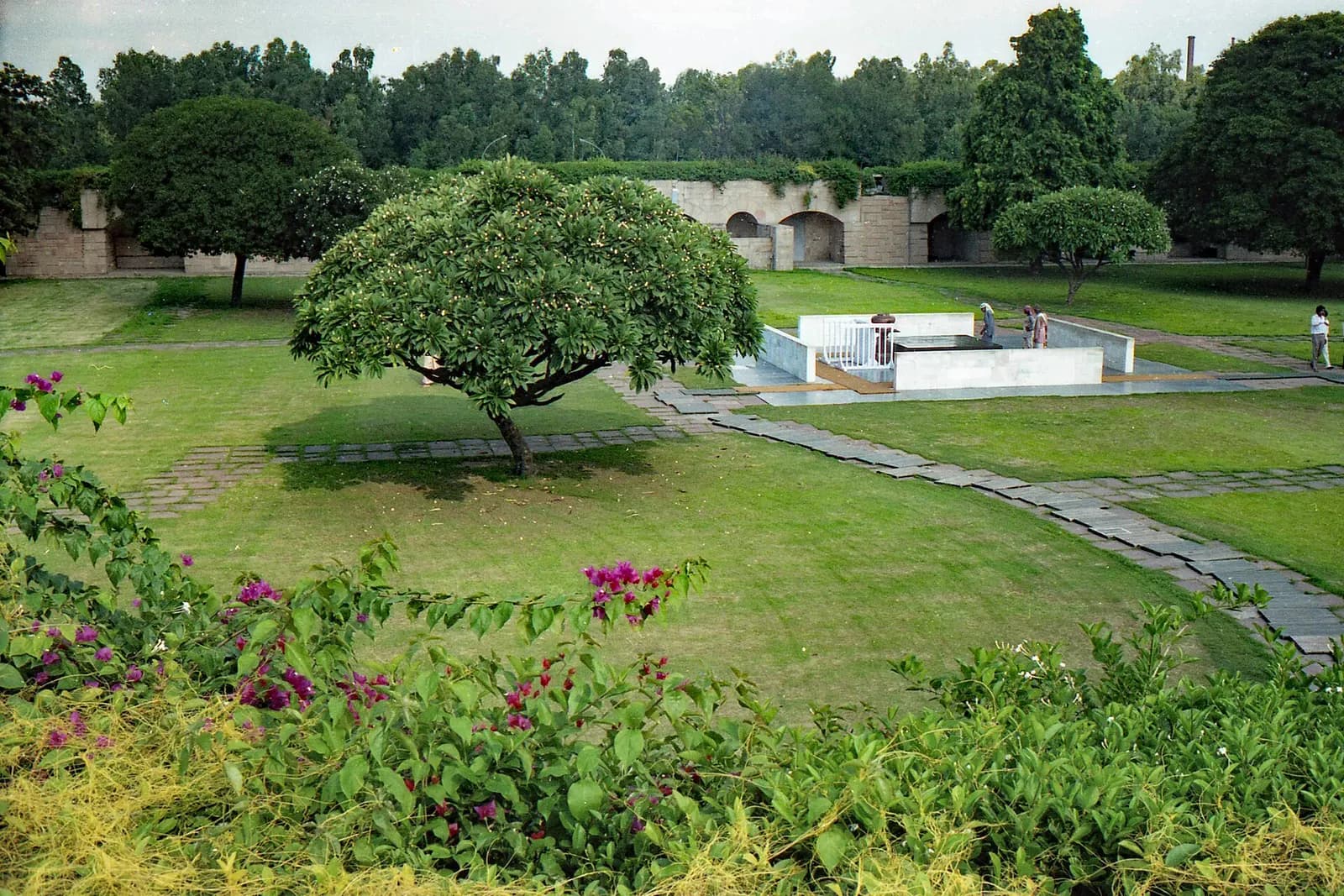
Two features give the platform its emotional charge. At one end burns an eternal flame, enclosed in glass, kept alight continuously as a symbol of Gandhi's enduring presence and ideals. And inscribed into the marble are the words He Ram, meaning Oh Ram or Oh God, believed to be the last words Gandhi uttered as he died. Around the central shrine lie manicured green lawns, earthen embankments and deep stone alcoves that buffer the memorial from the traffic outside, so that even a few steps in from the road, the city noise falls away and a genuine stillness takes over. The landscape is as much a part of the design as the platform, created to produce calm and reflection.
What are the Raj Ghat timings and entry fee?
Raj Ghat is open every day of the week, generally from about 6:30 AM to 6:00 PM and entry is completely free, for everyone, including foreign visitors. There is no ticket, no booking and no charge for the memorial lawns or the surrounding museums, which reflects the open, democratic spirit of Gandhi's own life. Some sources list slightly different or seasonal hours, a little earlier in the morning or later in the evening, so if you are planning a dawn or dusk visit it is worth confirming on the day.
One timing is worth planning around if it interests you. A special commemorative prayer meeting is held at the memorial every Friday, the day of the week on which Gandhi died and it is open to all visitors. Larger prayer ceremonies take place on his birth anniversary, 2 October and his death anniversary, 30 January, when national leaders and huge crowds gather. Because entry is free and the memorial is open daily, Raj Ghat is one of the easiest sights in the city to fit into any plan, with no logistics to arrange beyond simply turning up respectfully.
What happens at Raj Ghat on Gandhi's anniversaries?
Two days each year transform the quiet memorial into the focus of national attention. The first is 2 October, Gandhi's birthday, known as Gandhi Jayanti, a national holiday in India and also observed worldwide as the International Day of Non Violence. The second is 30 January, the anniversary of his assassination, observed as Martyrs' Day. On both, the President, the Prime Minister and other national leaders come to Raj Ghat to lay flowers and pay homage, prayers and devotional songs are held at the platform and on Martyrs' Day a two minute silence is observed across the country in the late morning.
Visiting dignitaries and heads of state from around the world are also brought to Raj Ghat as a matter of protocol, so the memorial regularly receives presidents and prime ministers paying their respects. For an ordinary visitor, these anniversary days mean the memorial is far more crowded and partly given over to official ceremony, so if you want a quiet, reflective visit, it is best to avoid 2 October and 30 January. If, on the other hand, you want to witness the nation honouring Gandhi, those are the days to come, as long as you expect heavy security and large crowds.
What is the etiquette for visiting Raj Ghat?
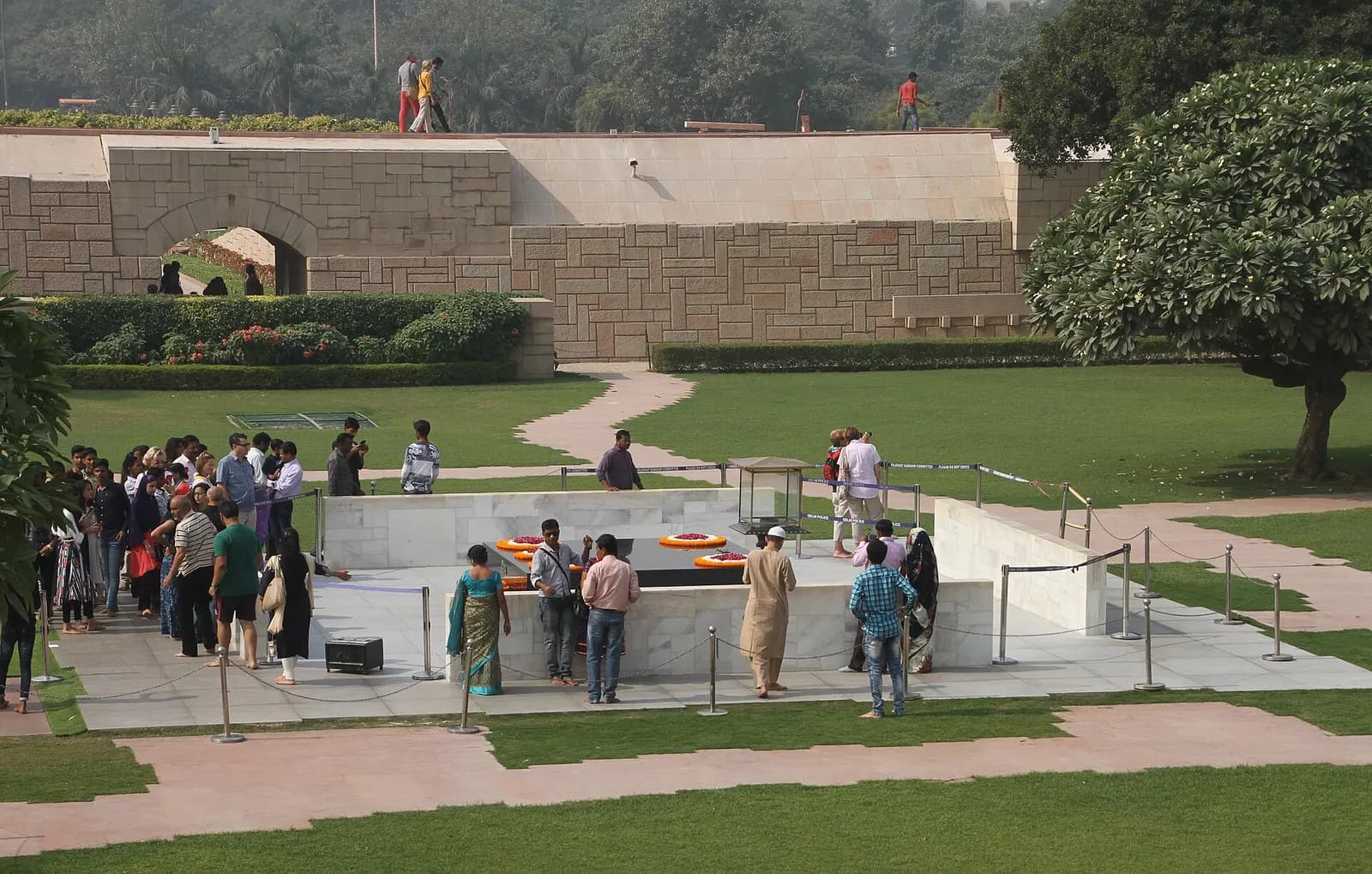
Raj Ghat is treated with the sanctity of a place of worship, so a little respect goes a long way and it is genuinely expected. The most important rule is footwear. Shoes are strictly prohibited near the central black marble platform, so you remove them at the designated shoe counter outside the inner wall before you approach and you can walk the inner pathways in your socks. Leaving your shoes is free, though a small voluntary tip to the caretaker is common and appreciated.
Beyond that, maintain decorum. Visitors are expected to walk quietly, speak in hushed tones and refrain from running, shouting or treating the immediate lawns as a picnic spot. Photography is permitted on the outer lawns and around the walls, where you will also find quotations from Gandhi inscribed, but taking casual selfies or posing disrespectfully near the eternal flame is firmly frowned upon and rightly so. None of this is onerous, it simply asks you to meet the place in the reflective spirit in which it was built. Dress modestly, move gently and give the memorial a few quiet minutes, which is the whole point of coming.
What are the nearby memorials of other leaders?
One of the most interesting things about Raj Ghat is that it set a precedent and the stretch of land beside it along the Yamuna became a belt of memorials to other great leaders of modern India. A short walk from Gandhi's samadhi you will find several of them, each named with meaning. Shantivan, the Forest of Peace, is the memorial of Jawaharlal Nehru, India's first Prime Minister. Vijay Ghat, the Victory Platform, honours the second Prime Minister, Lal Bahadur Shastri. Shakti Sthal, the Place of Strength, is the memorial of Indira Gandhi, marked by a striking rough monolithic stone rather than polished marble.
Together with other memorials nearby, these form a remarkable open air record of the founding generation of independent India, all within the same green belt beside the river. Visiting a few of them in sequence turns a single stop into a thoughtful morning of modern history and because they are all free and close together, it is easy to do. Most visitors focus on Raj Ghat itself, but if you have the time and the interest, walking on to Shantivan and the others adds real depth to the experience and is something many day tourists never do.
What are the Gandhi museums near Raj Ghat?
Your visit to Raj Ghat is only complete with the Gandhi museums right across the street, which bring his life and ideas to life beyond the bare memorial. Directly opposite stands the National Gandhi Museum, a rich collection of Gandhi's personal relics original photographs, his iconic spinning wheels or charkhas and many of his books and writings. It is free to enter and gives real substance to the man behind the memorial and it generally keeps its own daytime hours and closes on Mondays, so check before a Monday visit.
Beside it is Gandhi Darshan, a large pavilion set across many acres, with extensive photo exhibitions and audio visual displays tracing the history of India's freedom struggle and Gandhi's role in it. Together, the memorial and the two museums make a coherent whole, the place of cremation, the relics of the life and the story of the struggle, so I always encourage visitors to allow time for at least the National Gandhi Museum across the road rather than seeing only the platform. It deepens the visit from a quick photo stop into a genuine encounter with one of history's most remarkable lives.
How do you reach Raj Ghat?
Raj Ghat sits on Ring Road, on the banks of the Yamuna, just behind the Red Fort area, so it is central and easy to reach. The nearest metro is Delhi Gate on the Violet Line, from where Exit Gate 4 leaves you a 10 to 12 minute walk or a short auto rickshaw ride, from the memorial. The Indraprastha station on the Blue Line is another close option. Given how near it is to the Red Fort and Old Delhi, many visitors simply combine it with a visit there on the same outing.
By road, a spacious, dedicated parking lot sits directly outside the main entrance gates for a nominal fee, which makes Raj Ghat easier to reach by car than the congested old city nearby. Because it is close to the Red Fort and Chandni Chowk, it fits neatly into an Old Delhi circuit, which our Delhi day tour can handle and a broader New Delhi tour can take in the memorial belt and the museums together with the wider city.
When is the best time to visit Raj Ghat and how much time do you need?
Across the year, October to March is the comfortable season, when walking the open lawns is pleasant rather than hot. Within the day, early morning, soon after the 6:30 AM opening, is the loveliest time, cool, quiet and contemplative, with few other visitors and late afternoon is similarly calm with soft light. Avoid the middle of a summer day, when the open memorial offers little shade and expect larger crowds on weekends, national holidays and especially on the Gandhi anniversaries in October and January.
On time, allow 45 to 60 minutes for the memorial itself, walking the lawns, spending a quiet few minutes at the platform and reading the inscriptions. Add more if you cross to the National Gandhi Museum or walk on to the neighbouring memorials, which can easily extend the visit to a relaxed couple of hours of modern history. It is not a place to rush, since the stillness is the experience, but it is also compact, so it slots easily into a half day that includes the Red Fort. For the wider question of when to plan your trip, see our guide to the best time to visit Delhi.
What is there to see near Raj Ghat?
Raj Ghat sits on the edge of old Shahjahanabad, so it combines naturally with the Mughal heart of the city. The great Red Fort is close by and beyond it the lanes of Chandni Chowk and the mighty Jama Masjid, so a morning can easily take in the memorial, the fort, the market and a famous Old Delhi lunch from the street food nearby. The memorial belt of Shantivan, Vijay Ghat and the others is right beside Raj Ghat itself.
If you have more time, the city's deeper layers are within reach. The ramparts of Purana Qila, the stepwell of Agrasen ki Baoli and the serene lawns and tombs of Lodhi Garden all make easy additions, while across the city the Mughal splendour of Humayun's Tomb and the ancient Qutub Minar round out a fuller Delhi plan. Raj Ghat is the reflective pause at the centre of it all.
How does Raj Ghat fit into a Delhi or Golden Triangle itinerary?
For most visitors Raj Ghat is a short, meaningful stop within an Old Delhi morning, naturally paired with the Red Fort and Chandni Chowk, since all three sit close together on the same side of the city. The memorial provides a quiet, reflective counterpoint to the grandeur of the fort and the chaos of the market and together they make one of the richest and most varied mornings in Delhi. An afternoon in New Delhi, taking in India Gate and the imperial avenues, then balances the day.
If Delhi is your gateway to the wider Golden Triangle, Raj Ghat adds a layer of modern history to a trip otherwise full of Mughal monuments, a reminder of the India that emerged after the empires. Many of my guests fold it into a Delhi day before heading south to Agra for an early sunrise Taj Mahal tour and the Taj Mahal itself. Delhi for its sweep from the Mughal to the modern, Agra for its masterpiece and Jaipur for Rajasthan, tied into one trip, is the whole idea behind how we plan routes and a day or two more in the capital, with easy day trips within 50 km, rounds it out.
Is Raj Ghat accessible and good for families?
Raj Ghat is one of the more accessible major sights in Delhi. The grounds are flat, with paved pathways and broad lawns, so it is manageable for visitors with limited mobility and for older travellers, though note that the area immediately around the platform is entered in socks after leaving your shoes at the counter. There is parking at the gate and the walk in from the metro is short, which makes the practical side easy.
For families, it is a calm, free and genuinely educational stop and children generally take to the open lawns and the story of Gandhi, as long as they understand that this is a quiet, respectful place rather than a park to run and play in. Pairing the visit with the National Gandhi Museum across the road, with its spinning wheels and photographs, helps bring the history alive for younger visitors. Basic facilities such as drinking water are available and because the whole visit is short and free, it slots easily into a family day that also takes in the Red Fort nearby, which is exactly how many of my guests do it.
Travel tips for visiting Raj Ghat
A few pointers make the visit smoother and more respectful. Come early in the morning or late in the afternoon in the cooler months for the calmest, most reflective experience and expect crowds on weekends and the Gandhi anniversaries. Remove your shoes at the counter before approaching the platform, walk the inner paths in your socks and keep your voice low, since this is treated as a sacred space. Dress modestly, photograph the lawns and inscriptions rather than posing by the flame and give the memorial a few genuine minutes of quiet rather than rushing through. Cross the road to the National Gandhi Museum to understand the man behind the memorial and if you have time, walk on to the neighbouring leaders' memorials. Use the Delhi Gate metro, combine the visit with the Red Fort nearby and above all, approach Raj Ghat in the spirit of reflection it was built for, which is what makes it memorable.
Want Raj Ghat and the best of Old Delhi woven into one meaningful morning? Message our team on WhatsApp at +91 7302265809 and we will build it into a Delhi itinerary that flows.
Plan your trip with us
Raj Ghat is a short visit, but it is far richer when it sits in the right place in your day, paired with the Red Fort and the old city and understood in its context. At Experience My India we design trips that get that sequence right, so the reflective stop lands between the grander sights with the logistics handled. Whether you want a focused Old Delhi heritage morning or a full day across the capital, our Delhi Agra tours suit every style of traveller and our wider Golden Triangle tours carry the journey south to Agra and Jaipur. Tell us your travel dates and group size and we will shape a plan around you, with a licensed guide who brings the history to life. A dedicated Old Delhi tour is the easiest way to see Raj Ghat with the fort and the market in one go.
Related guides
Keep planning with these hand picked reads from our team:
- Important monuments of Delhi, a fuller rundown of the city's historic sites
- Lotus Temple, another serene, free and reflective stop in Delhi
Enquire Now
Ready to Explore
The Heart of Delhi?
Explore the Red Fort, Qutub Minar, Humayun's Tomb, and the vibrant streets of Old Delhi with our expert-guided premium tours of India's capital city.

Delhi
Premium Tour Package
Questions
Frequently asked questions
What are the Raj Ghat timings?
Raj Ghat is open every day, generally from about 6:30 AM to 6:00 PM. Some sources list longer or seasonal hours, so confirm for an early morning or evening visit. A prayer meeting is held each Friday.
Is there an entry fee for Raj Ghat?
What is Raj Ghat famous for?
What is the difference between Raj Ghat and Gandhi Smriti?
Who designed Raj Ghat?
What is written on the Raj Ghat memorial?
Do you have to remove your shoes at Raj Ghat?
Which is the nearest metro station to Raj Ghat?
What memorials are near Raj Ghat?
How much time do I need at Raj Ghat?
Is Raj Ghat worth visiting?
Explore more
Plan your Raj Ghat trip with us

Photo credits
Photos from Wikimedia Commons, used under their licences:
- Photo 1 by Humayunn Niaz Ahmed Peerzaada from Mumbai, India, CC BY-SA 2.0
- Photo 2 by Jan Bockaert, CC BY-SA 2.0
- Photo 3 by Hartmut Schmidt Heidelberg, CC BY-SA 4.0
- Photo 4 by Gerd Eichmann, CC BY-SA 4.0
- Photo 5 by हिंदुस्थान वासी, CC BY-SA 4.0
Interested in Raj Ghat Delhi: Timings, History and Complete Visitor Guide?
Chat with our travel team for a custom quote, or browse every package.
Related Attractions
9Ready to explore Raj Ghat Delhi: Timings, History and Complete Visitor Guide?
Book your private tour today and experience the magic of India's rich heritage.