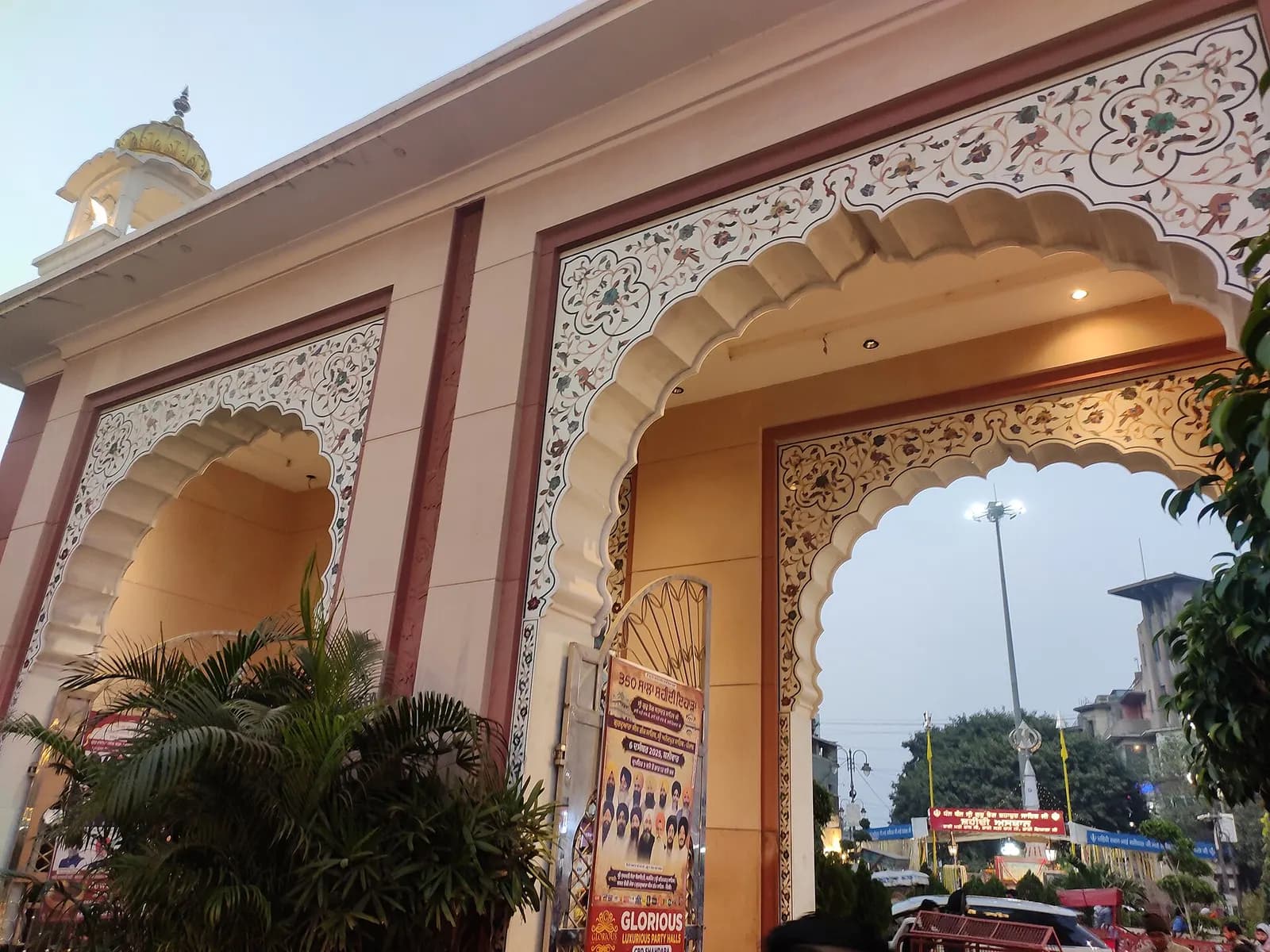
Gurudwara Sis Ganj Sahib Delhi: Timings and Visitor Guide
Visiting Gurudwara Sis Ganj Sahib in Chandni Chowk? Its history, timings, free langar, sacred relics, dress code, nearest metro and the best time to go.
In a Nutshell
“Gurudwara Sis Ganj Sahib in Chandni Chowk is one of the most sacred Sikh shrines in Delhi, marking the spot where the ninth Sikh Guru, Guru Tegh Bahadur, was martyred in 1675 on the orders of the Mughal emperor Aurangzeb for defending religious freedom. First built in 1783 and rebuilt in its present form around 1930, it is open to all around the clock, is free to enter, runs a continuous community kitchen and stands on the main Chandni Chowk avenue near the Red Fort. It features on our Delhi tours, run by a unit of Experience My India.”
Gurudwara Sis Ganj Sahib is a place of deep history and living faith, a golden domed shrine rising above the throng of Chandni Chowk on ground sanctified by one of the most moving episodes in Sikh history. Visiting it, with its relics, its hymns and its free kitchen feeding all comers, is one of the most meaningful experiences in Old Delhi. Our team at Delhi Agra Tour Packages often weaves it into an Old Delhi walk and it sits naturally on a Golden Triangle tour through the capital.
I am Abhay Sharma, Delhi born and a Golden Triangle guide since 2015 and I always bring guests here with a word about its story first, because knowing what happened on this spot transforms the visit. This guide gathers everything I would tell a visitor beforehand, checked against current information, including the timings, the dress code, the langar and how to reach it.
Details
Gurudwara Sis Ganj Sahib at a glance
| Detail | Information |
|---|---|
| Location | Chandni Chowk Road, Old Delhi, near the Red Fort |
| Marks | The martyrdom site of Guru Tegh Bahadur in 1675 |
| First built | 1783, by the Sikh leader Baghel Singh |
| Present structure | Completed around 1930 |
| Known for | A sacred Sikh shrine, sacred relics, a 24 hour langar |
| Entry | Free, open 24 hours |
| Nearest metro | Chandni Chowk (Yellow Line), a short walk |
| Time needed | About 45 minutes to 1 hour, longer with the langar and museum |
Sis Ganj Sahib timings
| Detail | Information |
|---|---|
| Open | 24 hours a day, every day |
| Most peaceful | Late night and early morning Gurbani recitations |
| Langar | Served around the clock, 24 hours |
The gurudwara is open to everyone 24 hours a day, every day of the year, so there are no closing hours to plan around. The atmosphere is especially serene during the late night and early morning hymn recitations, the Gurbani, when the crowds thin and the shrine is at its most contemplative. These arrangements are current at the time of writing and best reconfirmed.
Sis Ganj Sahib entry and rules
| Item | Information |
|---|---|
| Entry fee | Free for everyone |
| Head covering | Mandatory; free scarves provided at the entrance |
| Shoes | Deposited free at the managed shoe counters outside |
| Dress | Modest clothing; cloth wraps provided if needed |
| Photography | Not allowed inside the main prayer hall |
How to reach Sis Ganj Sahib
| From | Route |
|---|---|
| Chandni Chowk metro (Yellow Line) | A short walk of a few minutes to the gate |
| Lal Qila metro (Violet Line) | Also nearby, a short walk or rickshaw |
| The Red Fort | A few minutes by cycle-rickshaw or on foot |
| By cycle-rickshaw | The best way through the pedestrianised avenue |
What is Gurudwara Sis Ganj Sahib?
Gurudwara Sis Ganj Sahib is one of the holiest and most historically important Sikh shrines in Delhi, standing on the main avenue of Chandni Chowk in the old walled city. It marks the exact site where Guru Tegh Bahadur, the ninth of the ten Sikh Gurus, was publicly executed in 1675 and it is therefore a place of profound reverence for Sikhs and a deeply moving stop for any visitor. The name itself carries the story: Sis means head and the gurudwara marks the spot where the Guru was beheaded, with a companion shrine, Gurudwara Rakab Ganj, marking where his body was cremated.
Several things make it special and they are worth drawing out:
- A martyrdom site of the highest importance. The place where Guru Tegh Bahadur gave his life, among the most sacred grounds in Sikh history.
- Living relics. The preserved trunk of the banyan tree under which the Guru was martyred and the well he used during his imprisonment are kept within the shrine.
- A continuous free kitchen. A langar that runs 24 hours a day, feeding thousands of people of every background at no charge.
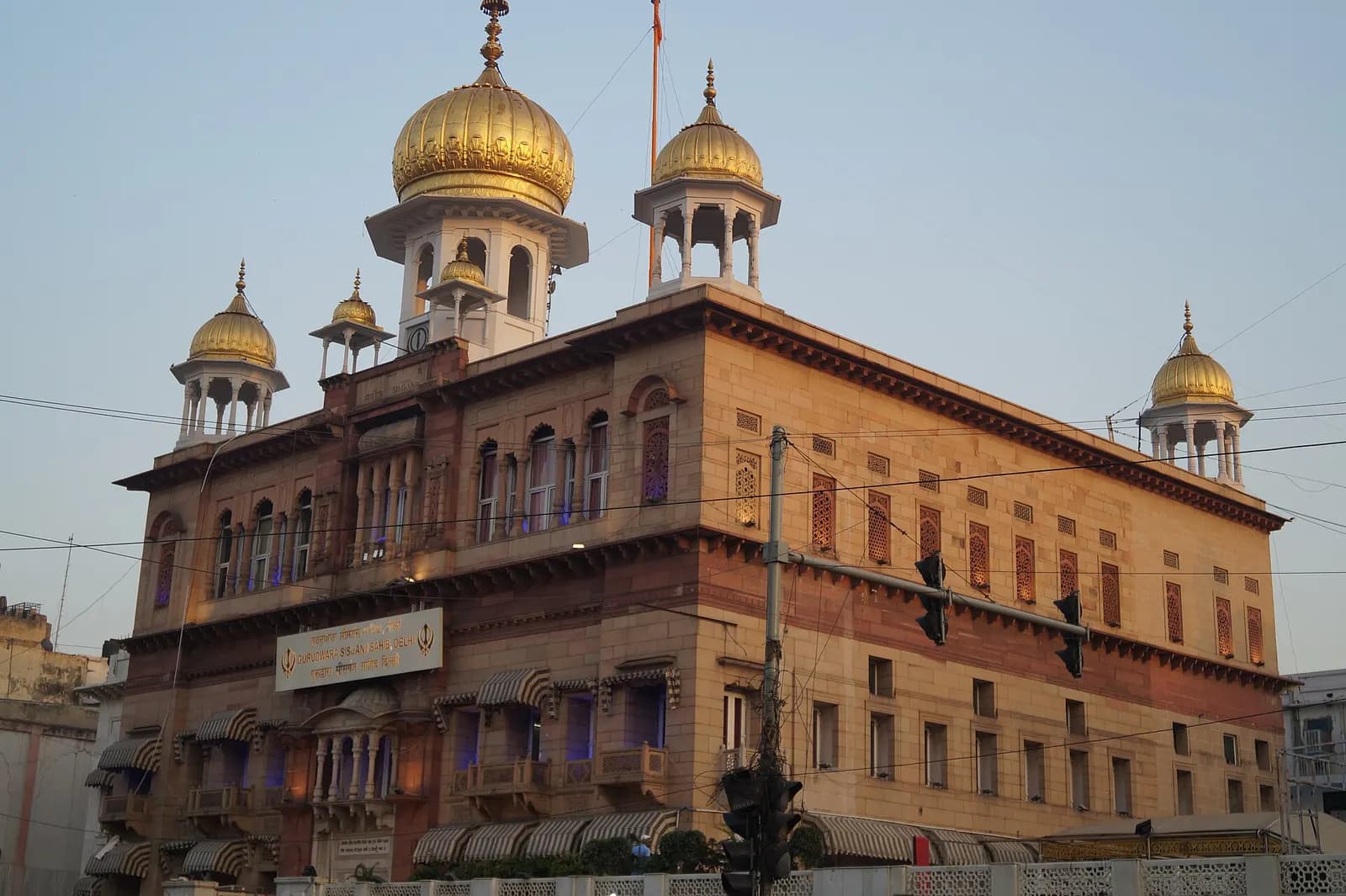
- A blend of Mughal and Sikh architecture. Golden domes, sandstone walls, mesh work windows and balconies, rising above the bustle of Chandni Chowk.
- Open to all, at all hours. Free to enter at any time of day or night, in the inclusive spirit of the Sikh faith.
It is among the most meaningful of the things to do in Delhi and ranks high on any list of the important monuments of Delhi.
History of Gurudwara Sis Ganj Sahib
The history of this gurudwara is inseparable from one of the defining events of Sikh history. In 1675, the ninth Sikh Guru, Guru Tegh Bahadur, was brought to Delhi and executed on the orders of the Mughal emperor Aurangzeb, on this very spot in Chandni Chowk, then the site of a Mughal kotwali, the city police station and prison. The ground on which the gurudwara stands originally held that notorious kotwali, where the Guru and his companions were kept in chains during their imprisonment. For more than a century afterwards the site remained under Mughal control and no shrine could be raised there.
The first gurudwara on the spot was established in 1783 by the Sikh military leader Baghel Singh, who marched into Delhi with his forces and reached a settlement with the Mughal emperor of the day, Shah Alam II, that permitted the building of shrines at the sites associated with the Gurus. The present sprawling multi storey structure, with its pavilions, balconies and golden domes, was added later and largely completed around 1930. The old Mughal kotwali on the site was demolished by the British in the aftermath of 1857 and the land was eventually handed over to the Sikh community, allowing the shrine to grow into the major complex seen today. By a tradition of respect, the Sikh Regiment of the Indian Army is said to pay its obeisance at Sis Ganj Sahib during its Delhi duties, a mark of the reverence in which the site is held. Knowing this long history, from the martyrdom through the kotwali to the handing over of the land, deepens every visit, for it explains why this unassuming spot on a busy market street is sacred ground.
The martyrdom of Guru Tegh Bahadur
At the heart of the gurudwara's meaning is the sacrifice of Guru Tegh Bahadur, which is worth understanding before you visit. In the 1670s, under Aurangzeb's policy of religious persecution, a group of Kashmiri Pandits, Hindus facing forced conversion to Islam, came to the Guru to plead for help. Guru Tegh Bahadur took up their cause, standing for the principle that every person has the right to follow their own faith, even though it was not his own community under threat. For this defence of religious freedom he was summoned to Delhi, imprisoned and, when he refused to abandon his stand or convert, publicly beheaded in 1675 on this spot. His martyrdom, in defence of the faith of others, is remembered as one of the great acts of principled sacrifice in Indian history and it earned him the title of protector of the weak. Alongside him, his close companions Bhai Mati Das, Bhai Sati Das and Bhai Dyal Das were tortured to death in front of him for refusing to abandon their faith and their sacrifice is honoured at the museum opposite. To stand in the gurudwara knowing this story, that a man died here rather than let others be forced from their religion, is to understand why it moves pilgrims and visitors alike so deeply.
Gurudwara Sis Ganj Sahib architecture
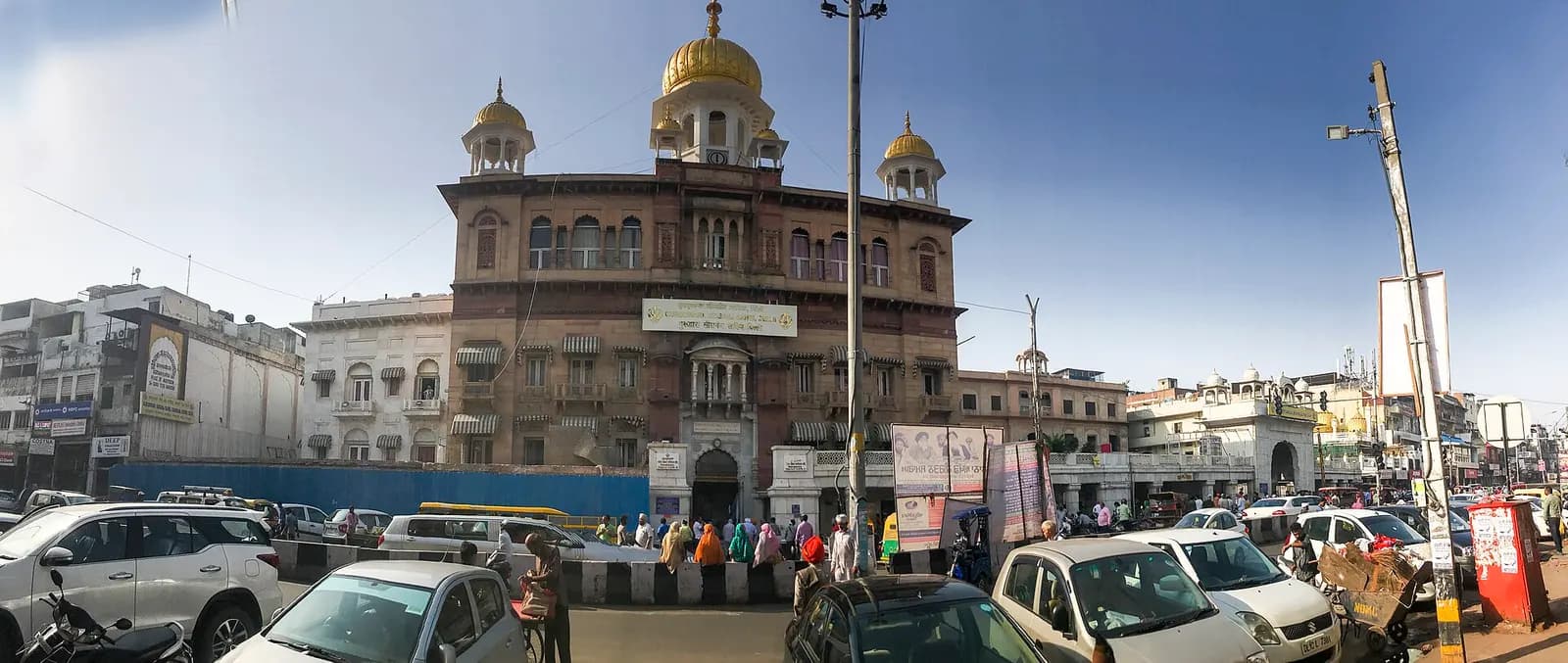
Architecturally, Sis Ganj Sahib is a striking blend of Mughal and traditional Sikh styles, which gives it a character distinct from the marble gurudwaras found elsewhere. Rather than the gleaming white marble of some Sikh shrines, it relies heavily on warm, earthy sandstone, in keeping with the Mughal buildings of the old city around it and it is crowned with majestic golden gilded domes that catch the light above the crowded avenue. The facade features elegant mesh work windows, heavy pavilions and balconies, the whole composition rising as a multi storey structure directly onto the bustle of Chandni Chowk.
The main features reward a look:
- The golden domes. Gilded domes that gleam above Chandni Chowk, the shrine's most visible signature from the street.
- Sandstone construction. Earthy red sandstone rather than marble, tying the gurudwara to the Mughal fabric of Old Delhi.
- Mesh work and balconies. Fine latticed windows, pavilions and balconies that blend Mughal and Sikh decorative traditions.
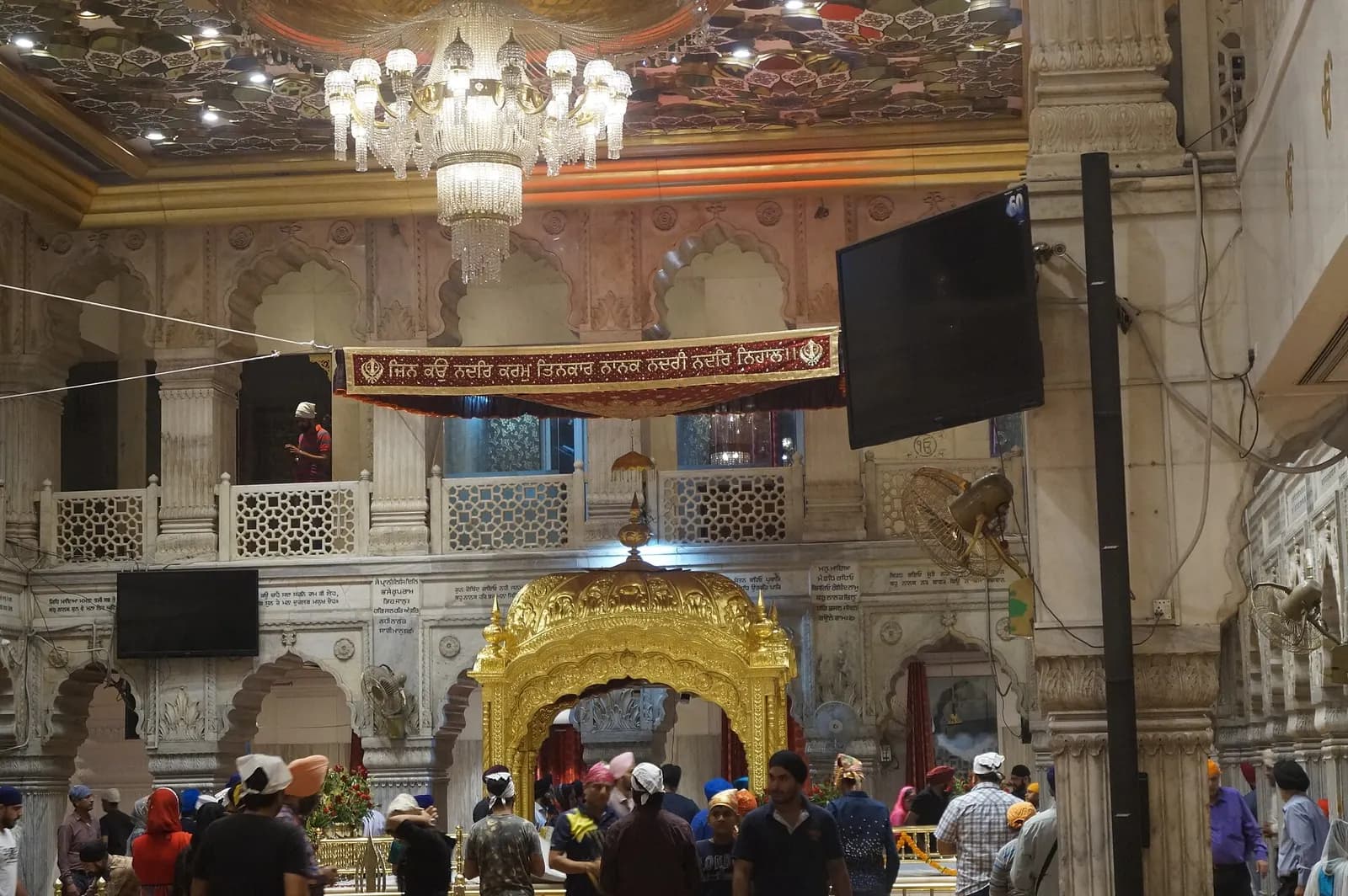
- The main prayer hall. The sanctum houses the Guru Granth Sahib, the Sikh holy scripture, where hymns are sung through the day and night.
The result is a building that feels both grand and rooted in its surroundings, neither hiding from the market around it nor overwhelmed by it, a golden crowned island of calm on one of the busiest streets in India.
Sacred relics inside Sis Ganj Sahib
Part of what makes a visit here so powerful is that the gurudwara preserves tangible relics connected directly to the Guru's final days, which you can see within the shrine:
- The banyan tree trunk. The actual trunk of the ancient banyan tree under which Guru Tegh Bahadur was martyred is carefully preserved within a glass enclosure inside the main shrine.
- The historical well. The old stone well from which the Guru drew water to bathe during his imprisonment still stands, intact, within the gurudwara.
These relics are not reconstructions but genuine survivals from the events of 1675 and standing before them, knowing their connection to the Guru's last days, is a deeply affecting experience for pilgrims and visitors of every faith. They anchor the abstract history in something you can actually see, which is why so many people find the visit stays with them.
The Bhai Mati Das Museum near Sis Ganj Sahib
Directly opposite the main entrance of the gurudwara stands the Bhai Mati Das Sati Das Museum, which is well worth the short extra time. The museum documents the sacrifices of Guru Tegh Bahadur and his closest disciples, Bhai Mati Das, Bhai Sati Das and Bhai Dyal Das, who were tortured to death in front of the Guru for refusing to give up their faith. Through paintings and displays it tells the story of their martyrdom and the wider history of Sikh sacrifice and it provides valuable context that makes the visit to the gurudwara itself far more meaningful. It is a sober and moving place rather than a cheerful one, but it rounds out the story in a way that a quick look at the shrine alone cannot and most visitors come away glad they stepped inside. Entry is typically free and it sits just across the road, so it is easy to combine with the gurudwara.
The langar at Gurudwara Sis Ganj Sahib
One of the most remarkable features of Sis Ganj Sahib and of Sikh gurudwaras in general, is the langar, the free community kitchen, which here runs 24 hours a day, seven days a week. In the langar hall, thousands of visitors each day, regardless of religion, caste, nationality or economic status, sit together on the floor as equals to share a hot, freshly cooked, completely free vegetarian meal, prepared and served by volunteers known as sevadars. The langar embodies the core Sikh principles of equality, service and community, the idea that everyone, from the wealthiest to the poorest, eats the same food side by side on the same floor. Taking part or simply witnessing it, is one of the most moving things a visitor can do here and it leaves a lasting impression of generosity and openness. If you do eat, it is respectful to sit with others, accept what is served and perhaps offer a little voluntary service or a donation, though nothing is expected. The langar is a living lesson in the values the gurudwara stands for.
What to expect at Sis Ganj Sahib
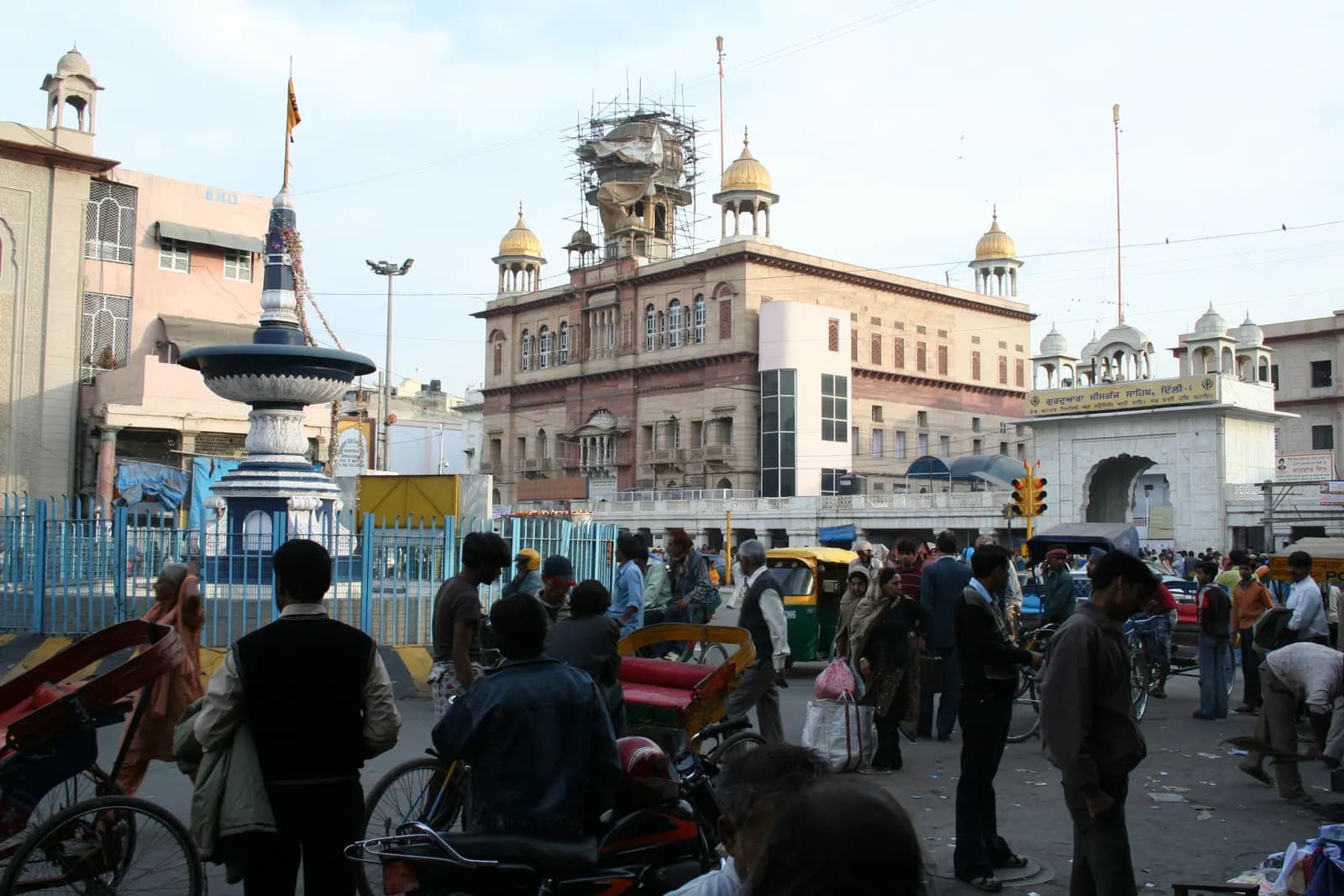
A visit to Sis Ganj Sahib is a study in contrasts and knowing what to expect helps you make the most of it. Outside, Chandni Chowk roars with its traffic of rickshaws, hawkers and shoppers, one of the most crowded and energetic streets in India. Then you reach the gurudwara, deposit your shoes at the counters, cover your head with a scarf and step inside and the change is immediate: the noise softens, the marble underfoot is cool and the air fills with the sound of hymns and the quiet movement of worshippers. The shrine is usually busy but never chaotic, with a calm ordered flow of people paying their respects, bowing before the Guru Granth Sahib and sitting a while to listen to the Gurbani.
Most visitors spend a little time in the main hall, take in the preserved banyan trunk and the old well, step across to the Bhai Mati Das Museum and then join or observe the langar. Volunteers move about quietly, serving water, tending the kitchen and helping visitors and the whole place runs on their selfless service. There is no pressure, no entry formality beyond the simple rules of respect and no charge for anything, which surprises many first time visitors. Whatever your faith, you are welcomed as an equal. People often arrive expecting a quick look and end up staying far longer, drawn in by the atmosphere and the sense of something genuine and generous at work. It is this combination, a sacred history, a living faith and an open door, that makes the experience linger in the memory.
Sis Ganj Sahib timings and entry fee
Gurudwara Sis Ganj Sahib is open to the public 24 hours a day, every day of the year and there is no entry fee of any kind; it is completely free for everyone, as Sikh shrines are. Because it never closes, you can visit at any hour, though the atmosphere is most serene during the late night and early morning hymn recitations, when the crowds of the day have gone. The langar, too, runs around the clock. The only things to prepare for are the simple rules of entry, covering your head, removing your shoes and dressing modestly, all of which are explained below and all of which the gurudwara helps you with, providing free head scarves and shoe counters. There is nothing to pay, though voluntary donations are welcomed and go towards the running of the shrine and the free kitchen. As always, treat these details as current at the time of writing and reconfirm if your plans depend on them.
Dress code and rules at Sis Ganj Sahib
As an active and sacred place of worship, the gurudwara asks visitors to observe a few simple but important rules of respect and it provides everything you need to follow them:
- Cover your head. All visitors, men and women, must keep their heads covered inside the premises. Free bandanas and headscarves are available in baskets near the steps.
- Remove your shoes. Footwear must be deposited at the free, managed shoe counters outside before you enter.
- Dress modestly. Shoulders and knees should be covered. If you arrive in shorts, volunteers will provide a cloth wrap to cover your legs.
- No photography inside. Photography is not allowed inside the main prayer hall housing the Guru Granth Sahib, to preserve its sanctity, though general exterior photos are fine.
- Be respectful. Move quietly, do not point your feet at the scripture and follow the lead of other worshippers.
Following these simple courtesies, all of which the gurudwara makes easy, lets you take part in the visit comfortably and respectfully, whatever your own faith.
Best time to visit Gurudwara Sis Ganj Sahib
Because the gurudwara is open around the clock, you can visit at any time, but some hours are more rewarding than others. The early morning and late night, during the Gurbani hymn recitations, are the most peaceful and atmospheric, when the shrine is quiet and the chanting fills the halls and these are the times I most recommend for a contemplative visit. The daytime, especially mid morning to evening, is livelier and busier, as Chandni Chowk around it hums with its markets, which has its own energy but less calm. In terms of season, the cooler months from October to March are far more comfortable for exploring Old Delhi on foot, since the summer heat and monsoon humidity in the crowded lanes can be draining. A winter morning, arriving early for the hymns and then stepping out into the waking market, is close to ideal. Our guide to the best time to visit Delhi sets out the seasons across the city in more detail.
How to reach Gurudwara Sis Ganj Sahib (nearest metro)
Sis Ganj Sahib sits right on the main Chandni Chowk avenue in Old Delhi, near the Red Fort and the easiest way to reach it by far is the metro. The Chandni Chowk station on the Yellow Line is only a short walk of a few minutes from the gate and the Lal Qila station on the Violet Line is also close by. From the Red Fort you can reach the gurudwara in a few minutes by cycle-rickshaw or on foot. It is important to know that driving a private car or taking a cab right to the entrance is effectively impossible: the main Chandni Chowk stretch is a pedestrianised no entry zone for cars and unauthorised parking can attract heavy traffic fines, so do not attempt to drive in. The sensible approach is the metro to Chandni Chowk, then a short walk or a characterful cycle-rickshaw ride through the lanes. A guided Old Delhi tour takes all of this off your hands and threads the gurudwara into the wider walled city.
Places to visit near Sis Ganj Sahib
Sis Ganj Sahib sits in the densest cluster of sights in Old Delhi, so it is easy to build a rich half day around it. It stands on Chandni Chowk itself, moments from the historic Sunehri Masjid and the famous Paranthe Wali Gali food lane and only a few minutes from the mighty Red Fort across the way. Along the same avenue stands the revered Shri Gauri Shankar Mandir, making it easy to see a Sikh and a Hindu shrine side by side and the great Jama Masjid mosque is a short rickshaw ride away, giving a remarkable trio of faiths within a few hundred metres.
A little further afield, the central landmarks are an easy ride away: the serene Bangla Sahib Gurudwara, the great circle of Connaught Place, the much loved Pracheen Hanuman Mandir, the ancient stepwell of Agrasen ki Baoli and the astronomical Jantar Mantar. The capital's other monuments, the towering Qutub Minar, the serene Humayun's Tomb, the ceremonial India Gate and the modern Lotus Temple and ISKCON Temple, round out a full picture of the city.
Sis Ganj Sahib in your Old Delhi itinerary
For almost every visitor, Sis Ganj Sahib belongs in an Old Delhi walk combined with the Red Fort, Chandni Chowk and the Jama Masjid, a cluster that captures the Mughal and spiritual heart of the capital within a few minutes of each other. A classic plan is the Red Fort first, then into Chandni Chowk, pausing at the gurudwara, the nearby Hindu temple and the mosque to take in three faiths on one street, with a stop for the legendary street food of the old lanes. Seeing the gurudwara early, when the hymns are most peaceful, is a lovely way to begin before the market fully wakes. This Old Delhi morning pairs beautifully with a central or New Delhi afternoon of the imperial avenues and later monuments, giving a full and balanced day. A guided New Delhi tour covers that second half of the city.
If Delhi is your gateway to the wider Golden Triangle, Sis Ganj Sahib adds a dimension that the forts and palaces do not, a glimpse of living faith and of the human story of courage and sacrifice behind the monuments. Many of my guests say it was the stop that moved them most in Delhi, precisely because it is not only beautiful but meaningful. Seeing it first, with its history, enriches everything that follows on a trip through Delhi, Agra and Jaipur.
Travel tips for visiting Sis Ganj Sahib
A few pointers make the visit smoother and more respectful:
- Cover your head with your own scarf or a free one from the baskets at the entrance.
- Be ready to remove your shoes at the free counters outside and carry socks for the stone floor.
- Dress modestly, covering shoulders and knees or use the cloth wraps provided.
- Visit early or late for the peaceful Gurbani hymns and the calmest atmosphere.
- Experience the langar, the free community meal and consider a little voluntary service or donation.
- Step into the Bhai Mati Das Museum opposite for the fuller story.
- Come by metro and rickshaw, since cars cannot enter the pedestrianised Chandni Chowk.
- Learn the story first, as knowing the martyrdom of Guru Tegh Bahadur transforms the visit.
If you would like a local guide to build Sis Ganj Sahib into a wider Old Delhi plan, message our team on WhatsApp at +91 7302265809 with your travel dates and group size and we will shape the day for you.
Is Gurudwara Sis Ganj Sahib worth visiting?
Without question, yes. It is one of the most meaningful places in all of Delhi, combining profound history, living faith and a setting in the heart of the old city's most famous street. For anyone interested in Sikhism or Indian history, it is essential, the very ground on which Guru Tegh Bahadur made his stand for religious freedom, with genuine relics of those events preserved inside. For the general visitor, it offers a moving and welcoming experience, open to all, free and crowned by the extraordinary generosity of the round the clock langar. Even those with no particular religious interest tend to find it one of the most affecting stops of their trip, both for the atmosphere and for the story it tells. Pair it with the Red Fort, the nearby temple and the Jama Masjid and you have one of the richest and most humane half days in the capital. I include it on almost every Old Delhi itinerary and guests rarely forget it.
Plan your trip with us
At Experience My India, through our Delhi and Golden Triangle travel desk, we design unhurried, well paced trips that give a place like Sis Ganj Sahib the time and context it deserves, rather than rushing past it and we help you experience Old Delhi, its shrines, its history and its food, with understanding. Whether you want a relaxed set of Delhi Agra tours or a full Golden Triangle route through Delhi, Agra and Jaipur, we plan around your pace, your interests and the right season, with local guides who know the story, the etiquette and the quiet hours. Share your dates and the kind of trip you have in mind through our enquiry page, tell us your group size and we will put together an honest, tailored plan rather than a rushed checklist.
Related guides
- Places to visit in Delhi, for the wider picture
- Hidden places to visit in Delhi, the city's quieter corners
- Nearby places to visit in Delhi, to extend your trip
Enquire Now
Ready to Explore
The Heart of Delhi?
Explore the Red Fort, Qutub Minar, Humayun's Tomb, and the vibrant streets of Old Delhi with our expert-guided premium tours of India's capital city.

Delhi
Premium Tour Package
Questions
Frequently asked questions
What are the timings of Gurudwara Sis Ganj Sahib?
It is open 24 hours a day, every day, with no closing time. The most peaceful hours are the late night and early morning, during the Gurbani hymn recitations.
What is the entry fee for Sis Ganj Sahib?
Which is the nearest metro station to Sis Ganj Sahib?
Why is Gurudwara Sis Ganj Sahib important?
What relics are kept at Sis Ganj Sahib?
What is the langar at Sis Ganj Sahib?
What is the dress code at Sis Ganj Sahib?
Can I take photos inside Sis Ganj Sahib?
What is the Bhai Mati Das Museum?
How do I get to Sis Ganj Sahib if cars cannot enter Chandni Chowk?
Is Gurudwara Sis Ganj Sahib worth visiting?
Explore more
Plan your Gurudwara Sis Ganj Sahib trip with us

Interested in Gurudwara Sis Ganj Sahib Delhi: Timings and Visitor Guide?
Chat with our travel team for a custom quote, or browse every package.
Related Attractions
9Ready to explore Gurudwara Sis Ganj Sahib Delhi: Timings and Visitor Guide?
Book your private tour today and experience the magic of India's rich heritage.