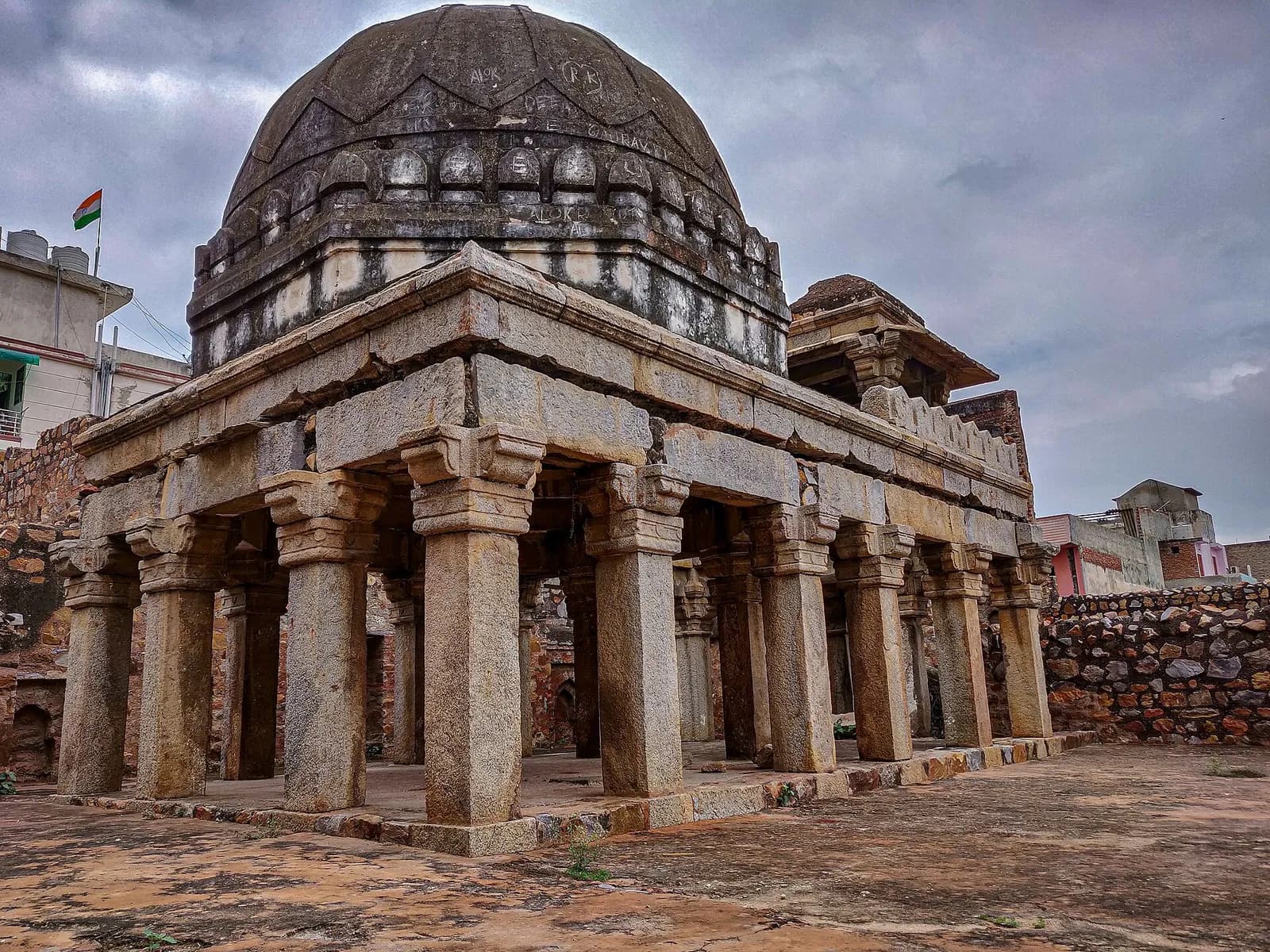
Zafar Mahal Delhi: History, Timings and Visitor Guide
Visiting Zafar Mahal in Mehrauli, the last Mughal palace? Its history, the Hathi Gate, the empty grave of the last emperor, timings, free entry and metro.
In a Nutshell
“Zafar Mahal in Mehrauli is recognised as the last monumental structure built by the Mughal Empire, a summer palace begun in the 1820s by Emperor Akbar Shah II and completed by the last emperor, Bahadur Shah Zafar. Its grandest feature is the towering Hathi Gate and its most poignant is the empty grave Bahadur Shah Zafar chose for himself but never used, as the British exiled him to Rangoon after 1857. Now a melancholy ruin buried in the lanes of Mehrauli beside a famous Sufi dargah, it is open daily and free to enter, reached from Qutub Minar metro. It features on our heritage Delhi tours, run by a unit of Experience My India.”
Zafar Mahal is one of Delhi's most evocative and poignant monuments, the final architectural footprint of the Mughals, a ruined summer palace steeped in the melancholy of the dynasty's last days. For history lovers and those drawn to the city's atmospheric, offbeat heritage, it is a deeply moving stop. Our team at Delhi Agra Tour Packages often includes it on a Mehrauli heritage walk and it adds a reflective, story-rich dimension to a wider Golden Triangle tour through the capital.
I am Abhay Sharma, Delhi born and a Golden Triangle guide since 2015 and few places move my history-minded guests as much as this one, the last palace of the Mughals, with the empty grave of the last emperor at its heart. This guide gathers everything I would tell a visitor beforehand, checking against current information, including the history, the architecture, the timings and how to reach it.
Details
Zafar Mahal at a glance
| Detail | Information |
|---|---|
| Location | Mehrauli Village, near Gole Kuan, South Delhi |
| Known as | The last monumental structure built by the Mughals |
| Begun | In the 1820s, by Akbar Shah II |
| Completed by | The last emperor, Bahadur Shah Zafar |
| Famous for | The Hathi Gate and the empty grave of Bahadur Shah Zafar |
| Entry | Free; an open ASI monument |
| Nearest metro | Qutub Minar, then an auto and a short walk |
| Time needed | About 45 minutes to an hour |
Zafar Mahal timings
| Detail | Information |
|---|---|
| Open | Daily, 10:00 AM to 6:00 PM, broadly sunrise to sunset |
| Access | Via the lanes of Mehrauli, past the dargah |
| Time needed | About 45 minutes to an hour |
Zafar Mahal is open daily, generally from 10:00 AM to 6:00 PM, broadly following standard ASI daylight hours from sunrise to sunset. A visit, taking in the gate, the mosque and the marble enclosure, takes about forty five minutes to an hour. Because the ruins are dilapidated, a bright daylight visit is strongly recommended. These timings are current at the time of writing and can vary, so reconfirm before a special trip.
Entry fee
| Item | Information |
|---|---|
| Entry fee | Free for all visitors |
| Tickets | None; no ticketing tokens on site |
| Note | An unmanicured, dilapidated ruin, not a polished site |
How to reach Zafar Mahal
| From | Route |
|---|---|
| Qutub Minar metro (Yellow Line) | An auto to the Mehrauli bus terminal or Adham Khan's Tomb |
| From the terminal | A 5 minute walk down the bazaar lane past the dargah |
| By car | Not possible to the ruins; the lanes are too narrow |
| On foot | Through the winding lanes of Mehrauli village |
What is Zafar Mahal?
Zafar Mahal is a 19th-century Mughal summer palace in the historic village of Mehrauli in South Delhi and it holds a unique and poignant place in history as the very last monumental structure built by the Mughal Empire. Built as a retreat for the imperial family away from the summer heat of the Red Fort, it was begun in the 1820s by Emperor Akbar Shah II and completed by his son, the last Mughal emperor Bahadur Shah Zafar, whose name it bears. The complex is famous above all for its towering Hathi Gate or Elephant Gate and for the deeply moving marble enclosure in its grounds that holds the tombs of several late Mughals and the empty grave Bahadur Shah Zafar chose for himself but, exiled after 1857, never came to occupy. Today the palace stands in a severe state of ruin, buried in the tight lanes of Mehrauli beside a great Sufi shrine, a melancholy and atmospheric relic of the dynasty's final days.
Several things make it special and they are worth drawing out:
- The last Mughal monument. Universally recognised as the last great structure built by the Mughal Empire, a poignant full stop to centuries of imperial building.
- A palace of two emperors. Begun by Akbar Shah II in the 1820s and completed by the last emperor, Bahadur Shah Zafar.
- The empty grave. The marble enclosure holds the vacant plot Bahadur Shah Zafar chose for himself, left forever empty after his exile to Rangoon.
- The majestic Hathi Gate. A towering red sandstone and marble gateway built for royal elephants to pass through, the complex's grandest feature.
- A festival and a dargah. The staging ground of the Phoolwalon ki Sair festival, set beside the revered dargah of Qutbuddin Bakhtiar Kaki.
It is one of the most atmospheric and historically resonant of the offbeat things to do in Delhi and a moving lesser-known entry among the important monuments of Delhi.
History of Zafar Mahal
The history of Zafar Mahal is, in effect, the history of the final chapter of the Mughal Empire, which is what gives this ruined palace its profound emotional weight. As the last monumental structure the dynasty built, it marks the very end of a line of imperial buildings that stretched back through the Taj Mahal and the Red Fort to the founding of the empire. Its story unfolds in the twilight of Mughal power:
- A summer retreat. The palace was built as a summer getaway for the imperial family, a cooler refuge in the historic village of Mehrauli, away from the heat of the Red Fort in the walled city.
- The two builders. It was begun in the 1820s by Emperor Akbar Shah II and later heavily expanded and completed by his son, the final Mughal emperor, Bahadur Shah Zafar, a poet-king who added its grandest elements.
- The cultural anchor. The palace served as the royal staging ground for the Phoolwalon ki Sair, the historic Festival of the Flower Sellers, a cross-communal celebration of interfaith harmony in Delhi that continues to this day.
- The end of the empire. After the failed uprising of 1857, the British deposed and exiled Bahadur Shah Zafar, bringing the Mughal dynasty to an end and the palace was left as its last, abandoned monument.
Taken together, this history makes Zafar Mahal a uniquely poignant place, the final flowering of Mughal architecture under a dynasty already in its twilight, built by the last emperors and then stranded by the empire's sudden fall. Bahadur Shah Zafar, who completed it, was as much a celebrated poet as a ruler, presiding over a brilliant late-Mughal cultural world even as real power slipped away and the palace breathes that bittersweet atmosphere of beauty in decline. For the visitor, knowing that this is where the long story of Mughal building came to its close, in a summer palace that outlived the empire that made it, lends every ruined wall a deep historical resonance.
The empty grave of Bahadur Shah Zafar
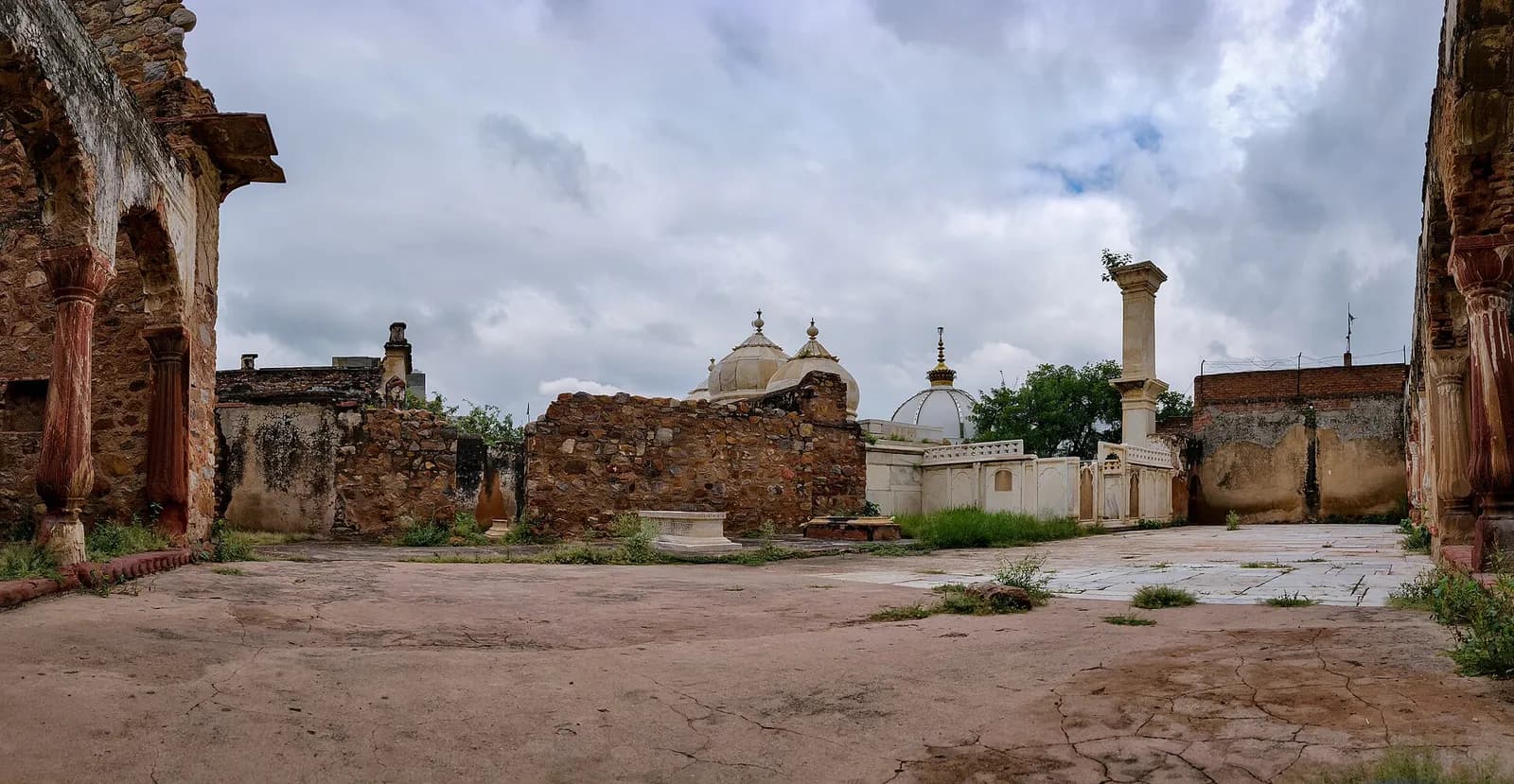
At the heart of Zafar Mahal and at the heart of its emotional power, lies one of the most poignant sights in all of Delhi: the empty grave of the last Mughal emperor. Within the palace grounds stands a beautifully carved white marble enclosure, a delicate screened space that holds the tombs of several later Mughal rulers, a quiet royal burial ground within the summer palace. Among these tombs is a small vacant plot, which Bahadur Shah Zafar had chosen and set aside as his own final resting place, intending to be buried here among his ancestors in the palace he had completed.
History, however, decreed otherwise, with heartbreaking finality. Following the failed uprising of 1857, in which the aged emperor had been reluctantly proclaimed the figurehead of the rebellion, the British deposed him and exiled him far from his homeland to Rangoon, in Burma, where he died in captivity in 1862, a broken poet-king longing for Delhi. He was buried in Rangoon and his chosen grave in Zafar Mahal was left empty, as it remains to this day, a silent and profoundly moving symbol of the fall of the Mughals and of an emperor who died in exile yearning for the city he loved. For many visitors, standing before this vacant marble plot, knowing the story of the king who chose it and never lay in it, is the most affecting moment of any visit to Delhi and it is the very soul of Zafar Mahal.
Architecture of Zafar Mahal
Architecturally, Zafar Mahal represents the last expression of Mughal building, a late and hybrid style that is nonetheless rich in beauty and its surviving features reward a close look. The complex combines several structures and materials and its key elements are worth seeking out:
- The Hathi Gate. The most majestic and imposing feature, a grand gateway added by Bahadur Shah Zafar in 1847 to 1848, built of deep red sandstone and white marble and rising some fifty feet, engineered deliberately tall so that royal elephants bearing covered howdahs could pass cleanly through it.
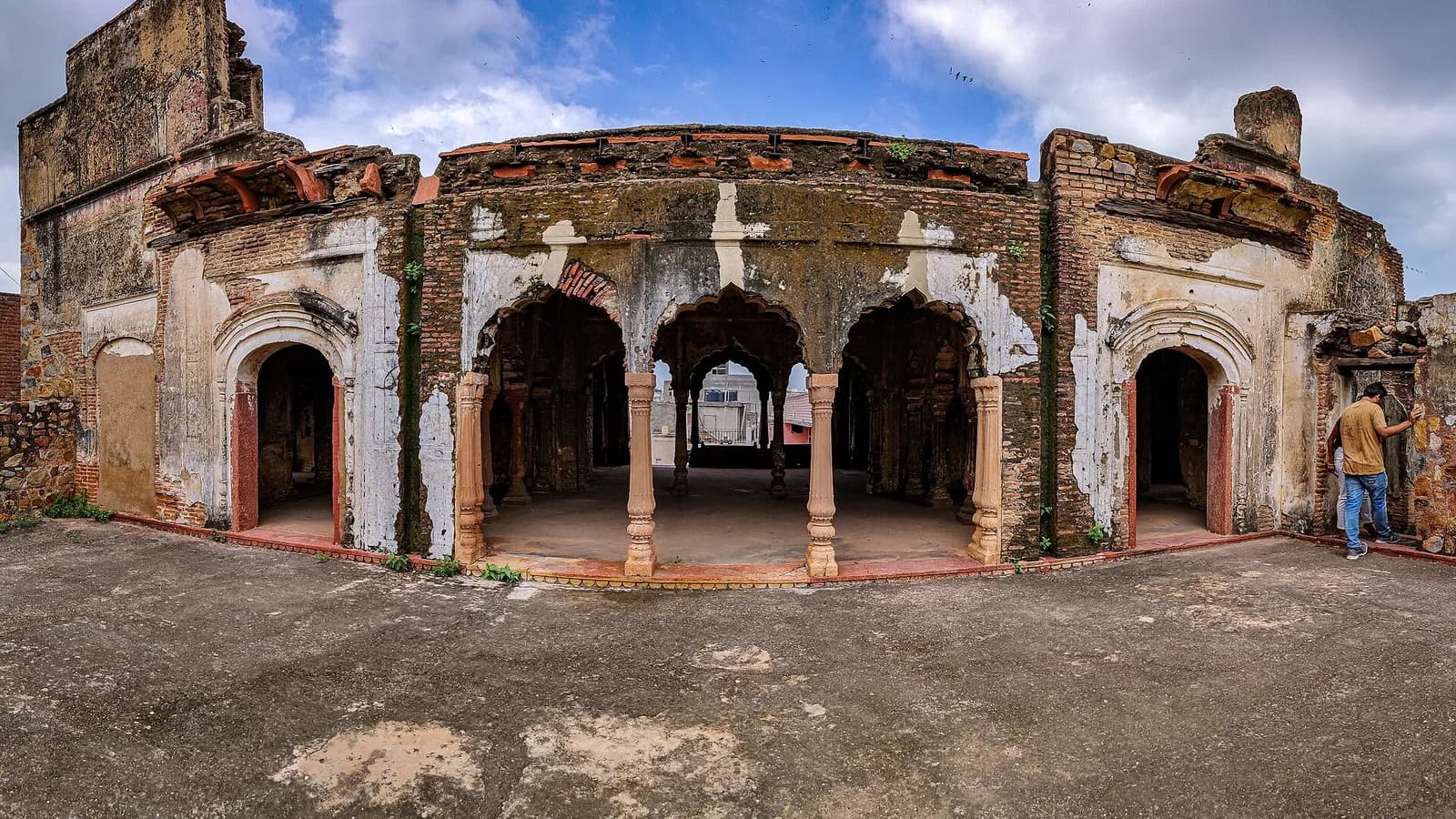
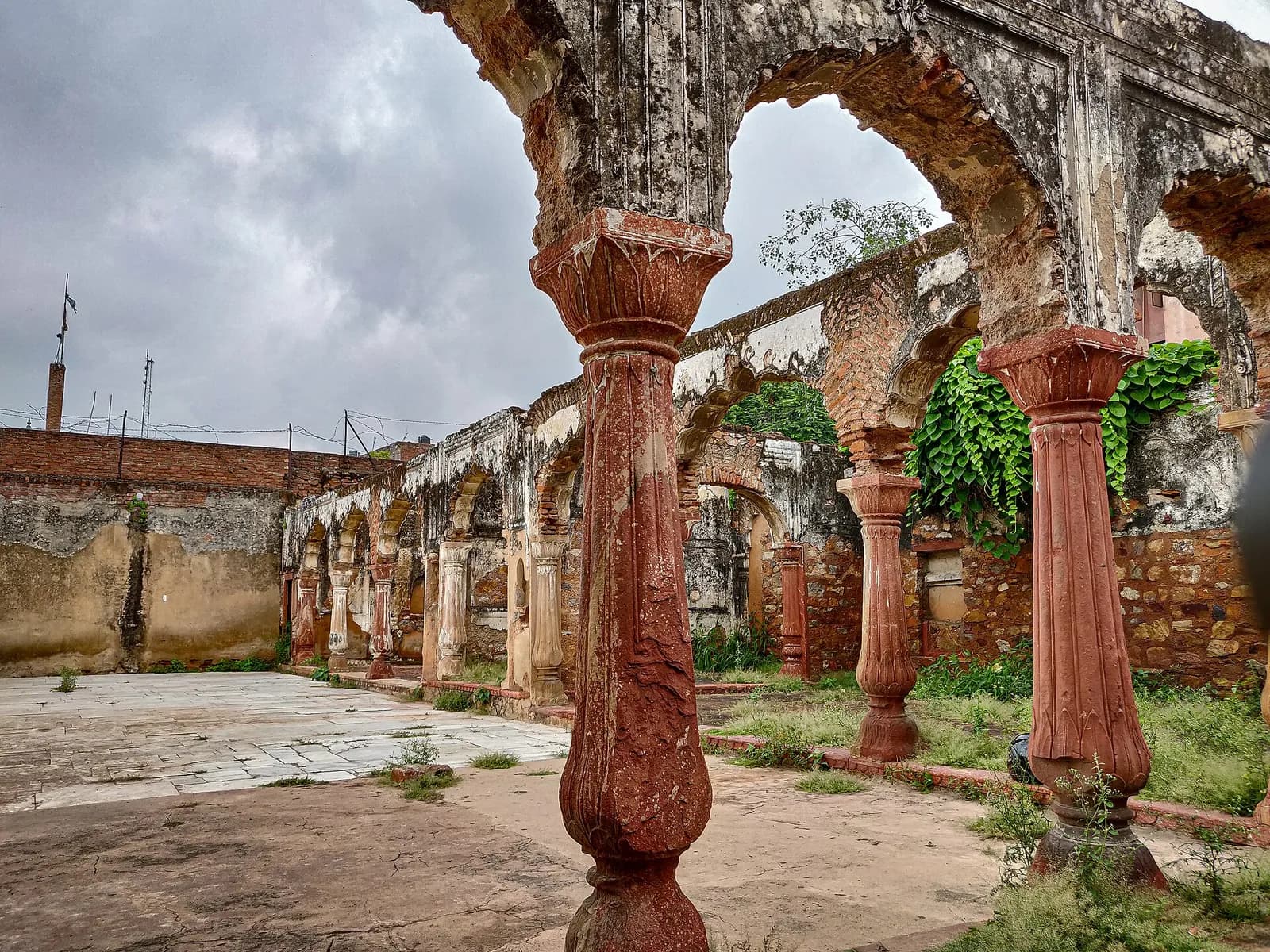
- The building fabric. A three-storey structure of intricate hybrid construction, using narrow lakhori bricks, grey stone and detailed lime plaster, with a facade of broad balconies, curving Bengali-style roofs and traditional multi-foliated arches.
- The Moti Masjid. A beautiful, pristine little private royal mosque of pure white marble within the compound, the Pearl Mosque originally completed by the earlier emperor Bahadur Shah I in 1709.
- The marble enclosure. The delicately carved white marble screened enclosure holding the royal tombs and Bahadur Shah Zafar's empty grave.
The overall impression is of a late-Mughal palace of real refinement, its Hathi Gate still magnificent and its Moti Masjid still gleaming, but overlaid with the melancholy of ruin, for much of the rest of the complex has fallen into severe decay. The curving Bengali roofs and multi-foliated arches show the mature, hybrid vocabulary of late Mughal design, while the materials, lakhori brick, grey stone, red sandstone and white marble, span the humble and the imperial. Knowing what to look for, the towering elephant gate, the white marble mosque, the Bengali roofs and the tomb enclosure, lets you read in the ruins both the beauty of the last Mughal architecture and the poignancy of its abandonment.
The state of the ruins
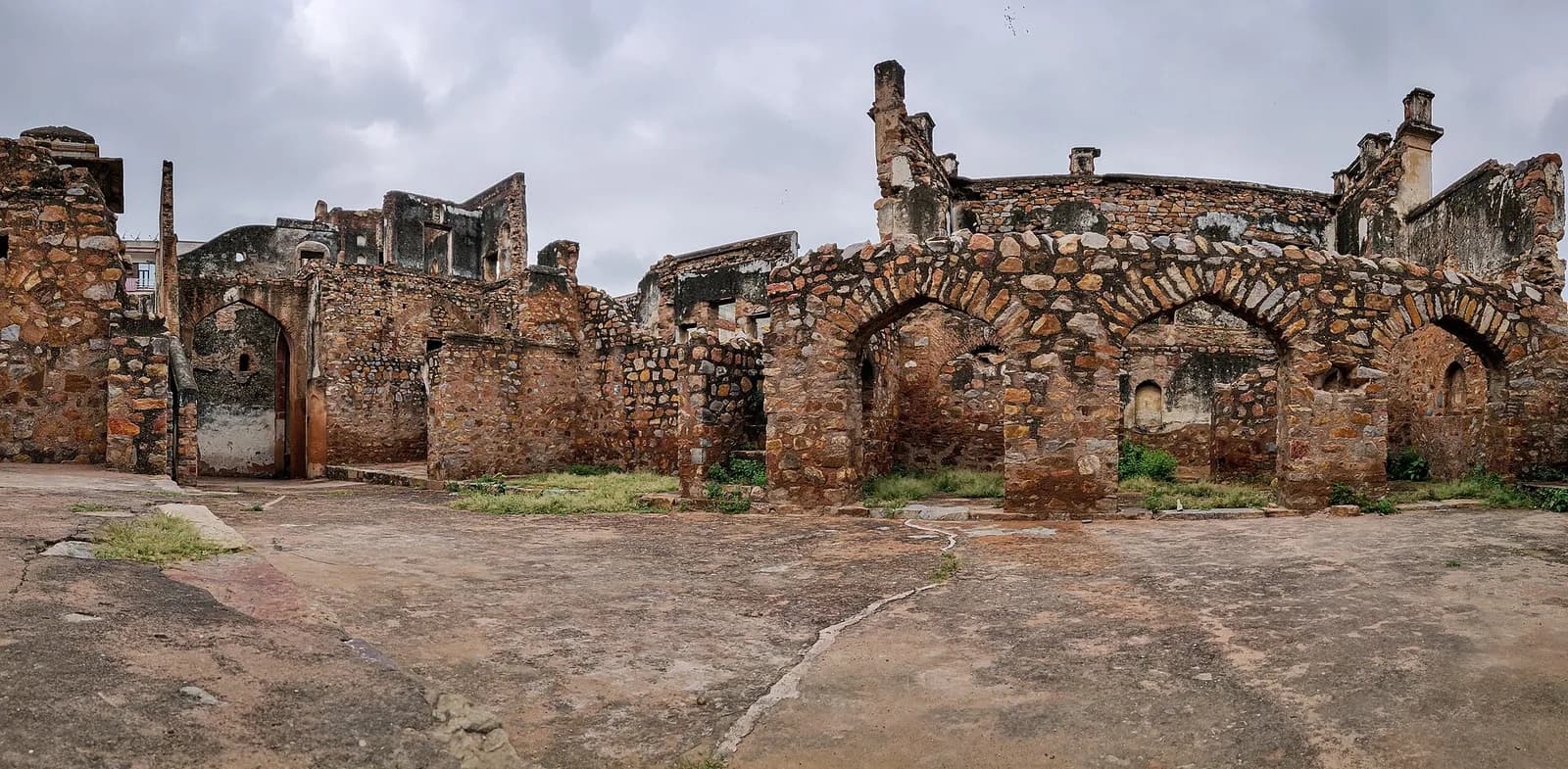
It is important for visitors to understand that Zafar Mahal is not a manicured, polished tourist monument like the great sites of central Delhi, but a palace in an advanced and often distressing state of ruin and this shapes the whole character of a visit. Unlike the carefully maintained Red Fort or Humayun's Tomb, Zafar Mahal stands in severe structural decay and neglect: its interior rooms, the houses of the princes and its stepwell or baoli, are heavily dilapidated and the encroaching masonry of the modern Mehrauli village has slowly boxed the monument in, pressing right up against its historic walls. The contrast with the splendour the palace once held and with its importance as the last Mughal monument, is stark and affecting.
This state of decay is, for many, part of the palace's melancholy power, a visible embodiment of the fall of the dynasty that built it, but it also means a visit calls for care and realistic expectations. The ruins are atmospheric and moving rather than grand and pristine and parts of the complex are fragile and unstable. The narrow internal stone staircases within the walls are steep, dark and uneven, so visitors should watch their footing carefully, avoid climbing onto unstable upper balconies and visit strictly in bright daylight. Understood for what it is, a poignant and genuine ruin rather than a restored showpiece, Zafar Mahal rewards the thoughtful visitor with an experience far more moving than many a grander site, precisely because it wears the marks of history and loss so openly.
The Phoolwalon ki Sair and the dargah
Beyond its imperial history, Zafar Mahal is bound up with one of Delhi's most beautiful living traditions and with one of its holiest Sufi shrines, which add further layers of meaning to the site. The palace served as the royal staging ground for the Phoolwalon ki Sair, the Festival of the Flower Sellers, a historic annual celebration that is one of the city's most cherished expressions of interfaith harmony. In this cross-communal festival, flower sellers and citizens of different faiths process together, offering floral tributes and fans at both a Hindu temple and the nearby Sufi dargah, in a shared celebration that the later Mughals patronised and that continues to be held in Mehrauli to this day, a living link between the palace and the city's syncretic culture.
The palace also sits directly adjacent to the highly revered dargah of Khwaja Qutbuddin Bakhtiar Kaki, one of the most important Sufi shrines in Delhi, so that the ruined royal palace and the living shrine share a wall and a sacred neighbourhood. This proximity is no accident: the late Mughals were deeply devoted to the saint, which is part of why they built their summer palace and chose their graves here. For the visitor, this setting enriches Zafar Mahal immeasurably, placing the last Mughal palace within a living landscape of faith and festival, where the melancholy of the ruined empire meets the continuing devotional life of Mehrauli. Because the dargah is an active place of worship and the palace contains royal graves, visitors should dress modestly and behave respectfully throughout.
What to expect at Zafar Mahal
A visit to Zafar Mahal is atmospheric, poignant and distinctly offbeat, quite unlike the polished monuments of central Delhi and knowing what to expect helps you make the most of it. The palace is buried deep within the tight, winding, maze-like residential lanes of historic Mehrauli village, so reaching it is itself an adventure through a living old quarter, past shops, homes and the great dargah, rather than an arrival at a formal monument gate. Once there, you enter through the magnificent Hathi Gate into a ruined complex where you can see the white marble Moti Masjid, the deeply moving marble tomb enclosure with Bahadur Shah Zafar's empty grave and the dilapidated remains of the palace rooms, all while absorbing the melancholy weight of the last Mughal monument. The visit takes about forty five minutes to an hour.
Because the complex is a genuine ruin, the experience is one of atmosphere and history rather than grandeur or facilities: the setting is raw, encroached upon by the village and in places fragile, which is part of its haunting appeal but calls for care. The steep, dark internal staircases should be navigated carefully, unstable balconies avoided and the visit confined to bright daylight. There are no real visitor facilities on site and the surrounding lanes are busy and narrow. The mood, with the empty grave, the ruined walls and the adjacent dargah, is one of profound melancholy and historical depth that many find deeply moving. Come to know the story, prepared for a walk through the Mehrauli lanes and a genuine ruin, dressed modestly for the sacred neighbourhood and Zafar Mahal offers one of the most affecting heritage experiences in the city.
Zafar Mahal timings and entry
Zafar Mahal is open daily, generally from 10:00 AM to 6:00 PM, broadly following the standard daylight hours of sunrise to sunset under which such ASI sites operate. Entry is completely free for all domestic and international visitors, with no ticketing tokens or counters on site. A visit takes about forty five minutes to an hour. Because the palace is in an advanced state of ruin, a few safety points are important: the narrow internal stone staircases are steep, dark and uneven, so watch your footing carefully, do not climb unstable upper balconies and visit strictly during bright daylight hours. As the ruins contain royal graves and sit directly against the walls of a major active Sufi dargah, visitors should dress modestly and behave respectfully throughout. Handheld smartphone photography is fully permitted, free of charge. These timings and conditions are current at the time of writing and can vary, so plan a daytime visit and reconfirm if your plans depend on exact hours.
Safety and etiquette
Because Zafar Mahal is a fragile ruin beside a sacred shrine, a few points help you visit safely and respectfully:
- Visit in bright daylight. The ruins and their dark, uneven staircases are best and most safely seen in good light, so avoid dusk.
- Watch your footing. The internal stone staircases are steep, dark and uneven, so step carefully and hold on where you can.
- Do not climb unstable balconies. Parts of the structure are fragile, so avoid clambering onto upper levels or unstable sections.
- Dress modestly. The palace holds royal graves and adjoins an active Sufi dargah, so dress and behave respectfully.
- Respect the neighbourhood. You reach the palace through a living village and past a revered shrine, so be courteous throughout.
- Allow 45 minutes to an hour and combine it with the other Mehrauli heritage.
Observing these points is both sensible and courteous, given the fragile state of the ruins and the sacred, lived-in character of the surroundings. Visited carefully and respectfully, Zafar Mahal rewards you with one of the most moving and atmospheric heritage experiences in Delhi, a genuine encounter with the last days of the Mughals.
Best time to visit Zafar Mahal
The best time to visit is the cooler months, from October to March and within the day the morning or the earlier afternoon, in bright daylight for both the atmosphere and the safe navigation of the ruins. A pleasant winter day is ideal, with comfortable temperatures for walking the Mehrauli lanes and good light on the red sandstone and white marble. The summer is hot and the narrow lanes are airless and the monsoon can make the old stone slippery, so the winter months are much the most comfortable. Because the ruins are best and most safely seen in good light, avoid late afternoon and dusk. Allow about an hour and ideally combine it with the other Mehrauli heritage, the Qutub Minar, the archaeological park and Jahaz Mahal, for a rich day in this historic quarter. Our guide to the best time to visit Delhi sets out the seasons across the city in more detail.
How to reach Zafar Mahal (nearest metro)
Zafar Mahal is buried in the lanes of Mehrauli village near Gole Kuan in South Delhi and reaching it takes a little navigation, which is part of its charm. The nearest metro station is Qutub Minar on the Yellow Line. Because the palace sits deep within extremely narrow walking alleys, it is not possible to drive a car or take a cab right up to the ruins, so the strategy is to take an auto-rickshaw from the metro station to the Mehrauli bus terminal or to Adham Khan's Tomb, the landmark also known as the Bhool Bhulaiya and from there to make a brief five-minute walk down the bazaar lane, past the entrance of the Bakhtiar Kaki dargah, to reach the Hathi Gate of Zafar Mahal. The walk through the old village lanes is atmospheric in itself. Set in the historic heart of Mehrauli, the palace pairs naturally with a Delhi day tour or a heritage-focused New Delhi tour that takes in the Qutub complex and the Mehrauli heritage.
Places to visit near Zafar Mahal
Zafar Mahal sits in Mehrauli, one of the richest historical quarters in all of Delhi, so it is surrounded by remarkable monuments and combines beautifully into a Mehrauli heritage day. Right nearby rises the towering Qutub Minar, the great medieval victory tower and the sprawling ruins of the Mehrauli Archaeological Park, while the enchanting Jahaz Mahal, the ship palace by the Hauz-i-Shamsi tank, is a short walk away. Its link to the last emperor connects it to the Red Fort, from which the imperial family came and the old city.
A ride away, the capital's other landmarks round out a full picture of the city: the serene Humayun's Tomb, the ceremonial India Gate, the old fort of Purana Qila and the citadel of Feroz Shah Kotla. For more history, the great circle of Connaught Place, the ancient stepwell of Agrasen ki Baoli, the astronomical Jantar Mantar and the historic Hauz Khas Fort complete the sweep of Delhi's past.
Zafar Mahal in your Delhi itinerary
For most visitors, Zafar Mahal works best as a poignant, atmospheric stop within a Mehrauli heritage outing rather than a destination on its own, given that the visit takes under an hour and that it rewards knowing its history. The natural pairing is with the other treasures of Mehrauli, the Qutub Minar, the archaeological park and Jahaz Mahal, all close by, which together make one of the richest heritage days in the city, spanning the medieval sultanate, the Mughals and their melancholy end. It is a stop for travellers with a genuine interest in history, in the Mughals and above all in the moving story of their last days, rather than for those chasing only the polished headline sights and it rewards reading the story of Bahadur Shah Zafar and his empty grave in advance.
If Delhi is your gateway to the wider Golden Triangle, Zafar Mahal offers a uniquely moving perspective on the end of the Mughal Empire, whose grandeur you will see at its height in the Taj Mahal and the forts of Agra, here glimpsed in its poignant final chapter. Many of my history-minded guests find the empty grave of the last emperor and the sight of the once-magnificent palace fallen into ruin amid the village, among the most affecting experiences of their whole trip and it adds a deeply reflective note to a Delhi exploration before the journey on to Agra, where the dynasty's greatest monuments await.
Travel tips for visiting Zafar Mahal
A few pointers make the visit smoother and more rewarding:
- Know the story first, the last Mughal monument and Bahadur Shah Zafar's empty grave, as they are the heart of the place.
- Come in the cooler months and in daylight, for comfort in the lanes and safe navigation of the ruins.
- Take an auto from Qutub Minar metro to the Mehrauli terminal or Adham Khan's Tomb, then walk in, as cars cannot reach the ruins.
- Watch your footing on the steep, dark staircases and do not climb unstable balconies.
- Dress modestly, as the palace holds royal graves and adjoins an active dargah.
- Seek out the Hathi Gate, the Moti Masjid and the empty grave, the key features.
- Combine it with the Qutub Minar, the archaeological park and Jahaz Mahal for a full Mehrauli day.
- Allow 45 minutes to an hour for the palace itself.
If you would like a local guide to bring the last days of the Mughals and the Mehrauli heritage to life, message our team on WhatsApp at +91 7302265809 with your travel dates and group size and we will shape the day for you.
Is Zafar Mahal worth visiting?
For history lovers and those drawn to Delhi's atmospheric, poignant heritage, yes, it is a deeply rewarding and moving stop. There are few places in the city with so powerful an emotional charge, the very last monument of the Mughal Empire, the towering Hathi Gate, the gleaming little Moti Masjid and above all the empty grave of the last emperor, who died in exile longing for the Delhi he never saw again. Entry is free and the setting in the historic Mehrauli lanes beside a great dargah is unforgettable. The honest note is that it is a genuine ruin in an advanced state of decay, boxed in by the village and requiring care on its fragile staircases, not a polished or convenient tourist site and its appeal rests on an interest in history and atmosphere rather than on grandeur or facilities. But for the curious, history-minded traveller who knows its story, it is one of the most moving places in all of Delhi, a palace where the long story of the Mughals comes to its quiet, melancholy close and I always encourage my guests to make time for it.
Plan your trip with us
At Experience My India, through our Delhi and Golden Triangle travel desk, we design unhurried, well paced trips that make room for poignant, history-rich stops like Zafar Mahal and the Mehrauli heritage, not just the headline monuments and we know how to navigate the old lanes and tell the stories that bring the ruins to life. Whether you want a relaxed set of Delhi Agra tours or a full Golden Triangle route through Delhi, Agra and Jaipur, we plan around your pace, your interests and the right season, with local guides who know the history. Share your dates and the kind of trip you have in mind through our enquiry page, tell us your group size and we will put together an honest, tailored plan rather than a rushed checklist.
Related guides
- Places to visit in Delhi, for the wider picture
- Hidden places to visit in Delhi, the city's quieter corners
- Nearby places to visit in Delhi, to extend your trip
Enquire Now
Ready to Explore
The Heart of Delhi?
Explore the Red Fort, Qutub Minar, Humayun's Tomb, and the vibrant streets of Old Delhi with our expert-guided premium tours of India's capital city.

Delhi
Premium Tour Package
Questions
Frequently asked questions
What are the timings of Zafar Mahal?
It is open daily, generally from 10:00 AM to 6:00 PM, broadly sunrise to sunset. A visit takes about 45 minutes to an hour and bright daylight is best for the ruins. Reconfirm before a special trip.
What is the entry fee for Zafar Mahal?
Why is Zafar Mahal famous?
Whose empty grave is at Zafar Mahal?
Who built Zafar Mahal?
Which is the nearest metro station to Zafar Mahal?
What is the Moti Masjid at Zafar Mahal?
Is Zafar Mahal worth visiting?
Explore more
Plan your Zafar Mahal trip with us

Interested in Zafar Mahal Delhi: History, Timings and Visitor Guide?
Chat with our travel team for a custom quote, or browse every package.
Related Attractions
9Ready to explore Zafar Mahal Delhi: History, Timings and Visitor Guide?
Book your private tour today and experience the magic of India's rich heritage.