Multi-Faith Golden Triangle | Experience My India
Multi-Faith Golden Triangle | Experience My India image 1
Multi-Faith Golden Triangle | Experience My India image 2
Multi-Faith Golden Triangle | Experience My India image 3
Multi-Faith Golden Triangle | Experience My India image 4

Multi-Faith Golden Triangle | Experience My India

4.8(1247)
2-3 hours
Sunrise / Sunset
Mughal Architecture
Tags:
multi-faithtaj-mahal-mosquefriday-closureibadat-khanaakbar-interfaithfatehpur-sikrispiritual-golden-triangle

Honest: the Taj shuts on Friday because it is a working mosque, and Akbar ran an interfaith forum at Fatehpur Sikri in 1575. From Rs 70,000 pp.

In a Nutshell

Experience My India runs the circuit across faiths, from Rs 70,000 per person (7-day, 4 star, twin sharing). Two facts sit on the standard tourist route, both hiding in plain sight, and between them they make the case for this trip better than any brochure could.

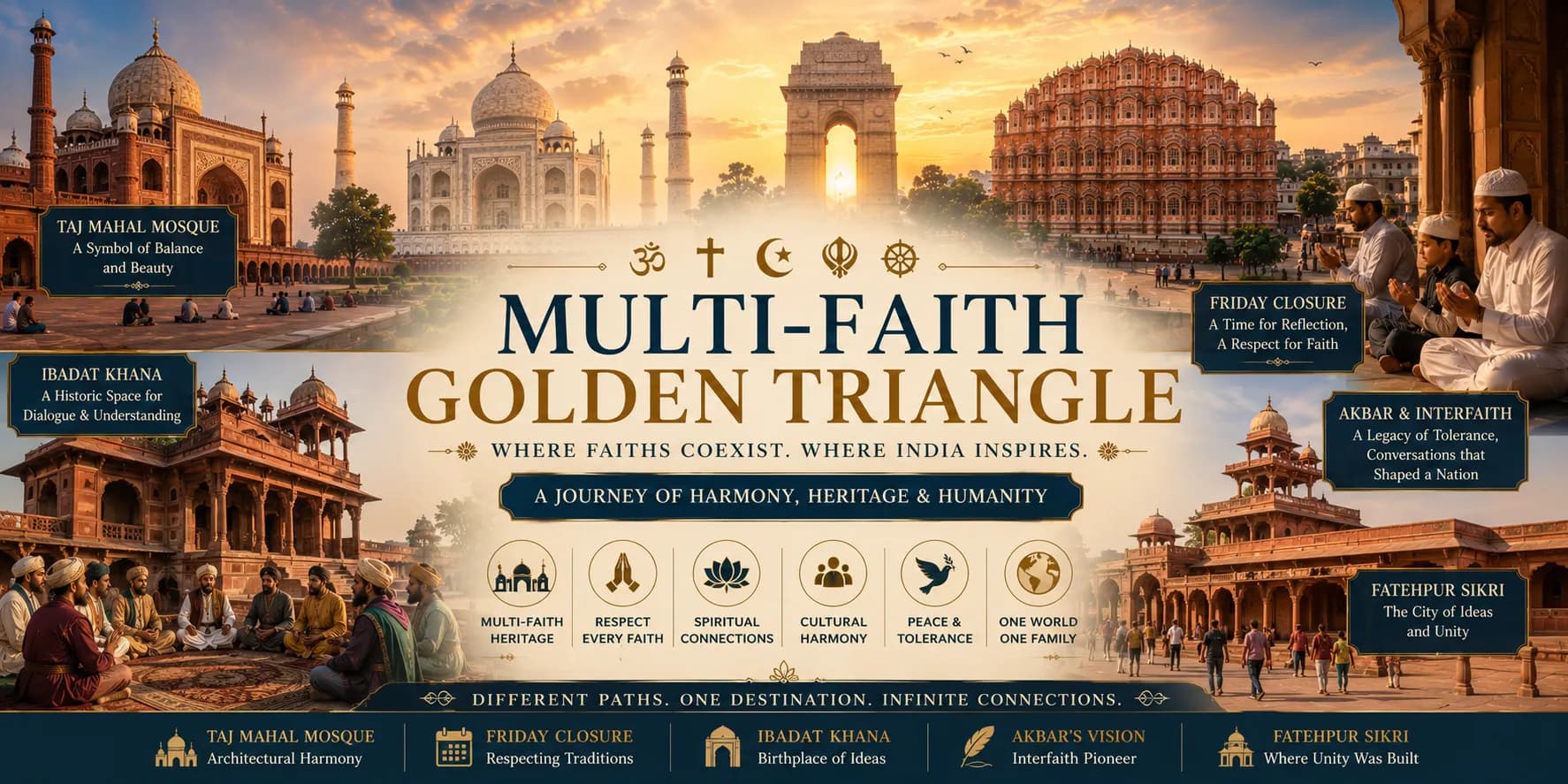
Experience My India runs the circuit across faiths, from Rs 70,000 per person (7-day, 4 star, twin sharing). Two facts sit on the standard tourist route, both hiding in plain sight, and between them they make the case for this trip better than any brochure could. One: the Taj Mahal closes on Friday because people are praying in it. Every tour page in India tells you the Friday closure like it is a scheduling nuisance. Almost none says why. The Taj is a mausoleum and a working mosque, and the mosque inside the complex has been in continuous religious use since it was built. Friday prayers have been held there for over 350 years. On Fridays the monument shuts to sightseers and local worshippers come to pray. That is not an administrative quirk. It is the most famous building on earth quietly remaining what it always was. Two: Akbar convened an interfaith forum at Fatehpur Sikri in 1575, and your coach parks next to it. He built the Ibadat Khana, the House of Worship, as a debating hall. It began as a Sunni assembly, and Akbar, dissatisfied with the narrowness of the arguments, opened it wider: by 1578 Hindus, Jains, Zoroastrians, Christian Jesuits and Jews were debating there, and accounts add Buddhists, Sikhs and even atheists. In 1579 he invited the first Jesuit mission to his court. They argued about the nature of God, about vegetarianism and the treatment of animals in Buddhism and Jainism, about monogamy, about Hindu philosophy, about Zoroastrian fire-worship. A multi-faith Golden Triangle is not a modern marketing idea. It is a 450-year-old one, and the site is already on your itinerary.

At a glance

Quick facts

Price from

Rs 70,000 per person (7-day, 4 star, twin sharing)

Why the Taj shuts on Friday

It is a working mosque. Prayers, not paperwork

How long

The mosque has been in continuous use since the 17th century

Friday access

Worshippers only, and limited. No sightseeing, whatever your passport

The Ibadat Khana

Akbar's debating hall, built 1575 at Fatehpur Sikri

Who debated there

Hindus, Jains, Zoroastrians, Jesuits, Jews, and reportedly atheists

The honest bit

Nobody is certain which building it was. The location is still disputed

Salim Chishti

The Sufi saint whose prediction of Jahangir's birth built the city

Our rule everywhere

No VIP, no paid darshan, no arranged access. The queue is the queue

Amber Fort

Jeep ascent, never the elephant, on welfare grounds

The Ibadat Khana, and why we will not point at it

Akbar built the Ibadat Khana in 1575, in his eagerness to understand religions other than his own. It started as a Sunni assembly, became a pan-Muslim one, and then opened to everyone. The recorded subjects of debate are extraordinarily specific and extraordinarily modern: the nature of God in Catholicism and Islam, vegetarianism, the treatment of animals in Buddhism and Jainism, monogamy, ancient Hindu philosophy, fire-worship in Zoroastrianism. In 1579 the first Jesuit mission arrived at the Mughal court under Father Rudolf Aquaviva. Accounts hold that the conclusion Akbar's circle reached was that all religions lead to the same goal. Now the part a guide with a flag will not tell you: the exact location of the Ibadat Khana at Fatehpur Sikri is still contentious. The historian Rezavi has argued that the structure known as the Daftarkhana may be it, on the evidence of its proximity to Akbar's residence, the Khwabgah, and of earlier excavations. It is not settled. So we will show you the candidate and tell you it is a candidate, rather than point confidently at a hall because you have paid for certainty. The debate happened. Which room it happened in is still an open question, and that is a more interesting fact than a fake answer. The Ibadat Khana was also not the Jama Masjid at Fatehpur Sikri, which is the congregational mosque, and not the marble dargah of Sheikh Salim Chishti, which is a tomb. Akbar built that dargah to honour the Sufi saint who predicted the birth of his son Jahangir, which is why the entire city exists where it does. Three different buildings, three different purposes, routinely blurred into one anecdote.

The Taj as a mosque, and what it means for your week

The Friday closure is the single most repeated fact about this circuit and the least explained. Here is the whole of it: The Taj complex contains a functioning mosque, in religious use since the 17th century, with Friday prayers observed there for more than 350 years. On Fridays the monument is closed to tourists entirely. Not the morning, not the evening. All day. Only local Muslim worshippers have access, and only for prayer. This applies identically to every visitor regardless of nationality or ticket. It is not a modern rule. It is the building continuing to do the job it was built for. Practical consequences we plan around: your Taj morning goes on a non-Friday, and your Friday goes to Mehtab Bagh, the 1652 garden across the river built expressly to look at the Taj, which is open when the monument is not. And a warning from operators that catches more people than you would think: time zones mean travellers sometimes land in India on a Friday without having realised it. Check your arrival day against the calendar, not against your departure date.

The route, faith by faith

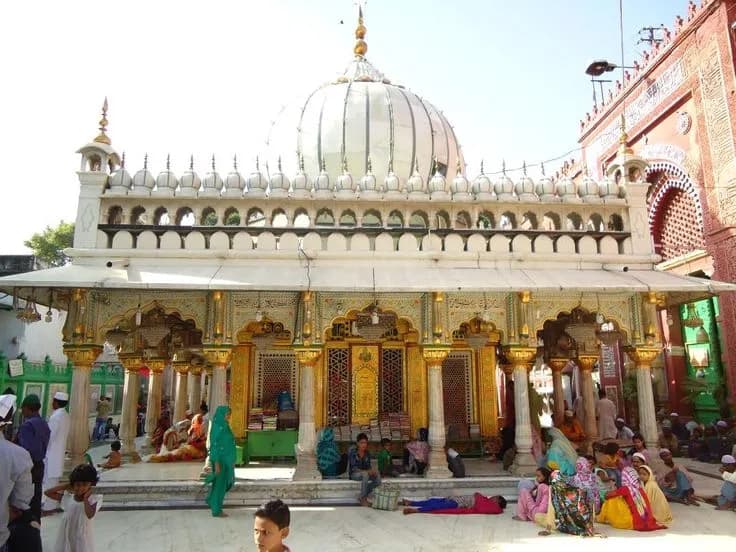
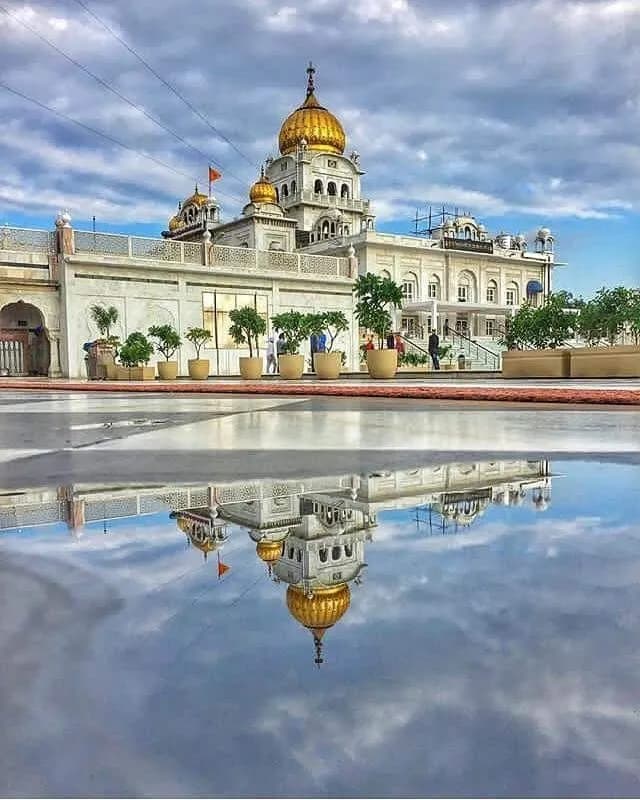
Delhi alone holds a density of living religions that most countries cannot manage, and Agra and Jaipur each add their own layer. What we build depends on you, but the raw material is: Delhi: a 17th-century congregational mosque, a Sufi dargah where qawwals still sing most evenings, a gurudwara whose kitchen feeds anyone who walks in, a Baha'i house of worship open to every faith and none, a Jain temple with a bird hospital attached, and colonial-era churches. Our sacred Delhi page goes into this properly. Agra: Mughal Islam at its most refined, and the Taj as what it actually is rather than what a postcard says. Fatehpur Sikri: the Ibadat Khana's disputed site, the Jama Masjid, and Salim Chishti's dargah, still receiving petitioners inside an abandoned imperial city. Jaipur: Hindu temples in daily use and Jain temples that most itineraries skip entirely. Optional: Braj for Krishna, or Ajmer and Pushkar for the great dargah and the Brahma temple, on our Mathura and Vrindavan and Ajmer and Pushkar pages.

The rules, which are conditions rather than tips

Cover your head, cover shoulders and knees. Carry a scarf; you will use it every day of this trip. Shoes off, repeatedly, everywhere. Ask before photographing anybody, and expect cameras to be barred in sanctums. These are not performances. Qawwali is worship you are permitted to sit inside. Langar is a meal, not an activity. No VIP, no paid darshan, no arranged access, anywhere on this trip. Where a restriction exists, it belongs to the institution and we will tell you about it before you book rather than at the door.

Day by day

Day by day itinerary (7 days)

Arrival, then two full days across Delhi's faiths: the mosque at dawn, the dargah in the evening for qawwali, the gurudwara at midday with time in the kitchen, the Baha'i temple's silence, the Jain temple, a church. Humayun's Tomb for the architecture that fathered the Taj. Overnight Delhi.

Fine print

What is included

Included

  • Accommodation, 4 or 5 star per tier, twin sharing (6 nights), three of them in Delhi
  • Private air-conditioned car with an experienced driver throughout
  • Airport pickup and drop
  • Daily breakfast
  • Guides briefed on conduct at working religious sites, not only on dates and dynasties
  • Monument entry at each traveller's correct rate, pre-booked
  • The jeep ascent at Amber
  • All tolls, parking, fuel, driver allowance
  • 5 percent GST

Excluded

  • Lunches and dinners
  • The Rs 200 Taj mausoleum inner-chamber ticket unless requested
  • Offerings and donations, which are yours to give or not
  • Tips
  • Travel insurance
  • Personal shopping
  • VIP or priority access at any shrine, which is excluded because it is not for sale
  • Entry to the Taj Mahal on a Friday, which is excluded because the mosque is in use
  • A confident identification of the Ibadat Khana, which is excluded because scholarship has not settled it

Transparent pricing

Per person, twin sharing, with a 20 percent service margin and 5 percent GST already inside the number.
Tier7-day8-day (add Braj or Pushkar)Foreign national (7-day)
4 starRs 70,000Rs 80,000Rs 72,700
5 starRs 105,000Rs 120,000Rs 107,700
Nearly every religious site on this trip is free to enter. You are paying for days, a car, and guides who can hold five traditions in their head without flattening any of them. Foreign nationals add about Rs 2,665 for the higher monument fees (Taj Rs 1,100 vs Rs 50, Agra Fort Rs 650 vs Rs 45, Fatehpur Sikri Rs 610 vs Rs 50, Amber Rs 550 vs Rs 100). OCI cardholders pay Indian rates with the physical card.

Our promise

Why choose Experience My India for the multi-faith trip

1
We explain the Friday closure instead of apologising for it. It is the best single fact on this circuit.
2
We take the Ibadat Khana seriously, including the part where nobody knows which building it was.
3
We separate the three Fatehpur Sikri buildings that every other guide blurs into one story.
4
Three nights in Delhi, because a city with this many faiths cannot be done in one.
5
No VIP, no paid darshan, anywhere. Access is the institution's to give, and it is usually free.

Honest note

This trip is NOT for you if

  • You want a comparative-religion lecture with a conclusion. We will show you the places and the history. What you make of it is not our business, and a tour operator is a poor authority on the nature of God.
  • You want certainty about the Ibadat Khana. Its location is disputed and we will say so rather than point at a wall.
  • You want the Taj on a Friday. Prayers are happening. Nobody's ticket outranks that.
  • You want guaranteed access everywhere. Institutions set their own rules and change them. Nizamuddin's inner sanctum is one example we tell women about before they book.
  • You want the elephant ride at Amber. We do not offer it, on welfare grounds. The jeep does the climb.

Preparation

Before you go

🎒Packing List

  1. 1.Check whether your arrival day is a Friday. Time zones catch people out, and it costs them the Taj.
  2. 2.Pack one good scarf. It is the most-used item on this itinerary, for everyone.
  3. 3.Wear shoes that come off standing up.
  4. 4.Tell us what you actually want. 'Multi-faith' covers a scholar of Sufism and a family who want to see a langar, and those are different weeks.
  5. 5.Ask about festival dates before booking. They transform these places, and not always toward what you imagined.
  6. 6.Cancellation follows our house slabs: 80 percent refunded more than 30 days out, 50 percent at 7 to 30 days, none under 7 days.

Enquire Now

Premium Experience

Ready to Explore
Incredible India?

Explore the rich heritage, stunning monuments, and vibrant culture of India with our expert-guided premium tours.

A
B
C
D
2,500+
4.9
Flexible itinerariesPrivate guidesBest price guarantee
Premium Tour Package
Featured Destination

India

Premium Tour Package

Premium

Questions

Frequently asked questions

6/6 visible

Why is the Taj Mahal closed on Fridays?

Because it is a working mosque, not only a mausoleum. The mosque inside the Taj complex has been in continuous religious use since the 17th century, and Friday prayers have been observed there for more than 350 years. On Fridays the monument closes to sightseers for the entire day and only local Muslim worshippers have access, for prayer. It is not a modern rule or an administrative decision; it is the building still doing what it was built for, and it applies to every visitor regardless of nationality.

Can tourists visit the Taj Mahal on Friday morning or evening?

What was the Ibadat Khana at Fatehpur Sikri?

Can you visit the Ibadat Khana today?

Is Fatehpur Sikri's dargah the same as the Ibadat Khana?

Can you arrange VIP or special darshan on a multi-faith tour?

The argument is older than the tour

A multi-faith Golden Triangle from Rs 70,000 per person: the Friday closure explained rather than apologised for, Akbar's debating hall discussed honestly including what nobody knows about it, three nights in Delhi, and no access sold that was never ours.

Explore more

Related pages

Plan Your Trip

Interested in Multi-Faith Golden Triangle | Experience My India?

Chat with our travel team for a custom quote, or browse every package.

5 related attractions
Premium Experience

Ready to explore Multi-Faith Golden Triangle | Experience My India?

Book your private tour today and experience the magic of India's rich heritage.

Explore Tours
Verified GuideBest Price2,500+ Happy Travelers
Call us