Quick Answer
Chausath Khamba, meaning 64 pillars, is a gleaming white-marble 17th-century Mughal mausoleum in Hazrat Nizamuddin Basti, New Delhi, the tomb of Mirza Aziz Koka, foster brother of Emperor Akbar. It is open daily 6 AM to 6 PM and entry is free. Delhi Agra Tour Packages, a unit of Experience My India, arranges Delhi tours.
Tucked into the historic lanes of Hazrat Nizamuddin, close to one of Delhi's most revered shrines, stands Chausath Khamba, a serene white-marble Mughal mausoleum whose name means sixty-four pillars. Often overlooked beside its famous neighbours, it is a quiet architectural gem. This guide from Delhi Agra Tour Packages covers what Chausath Khamba is, its history, its remarkable sixty-four-pillar design and how to visit, so you can add this hidden corner of Mughal Delhi to your trip, whether on its own or as part of a Golden Triangle tour.
I was born in Delhi and in more than 11 years guiding travellers across the region for Experience My India I have always loved the Nizamuddin quarter, where history layers upon history and Chausath Khamba, cool and luminous in white marble, is one of its loveliest surprises. Here is what to know.
Chausath Khamba at a glance
Detail | Information |
What it is | A white-marble 17th-century Mughal mausoleum of 64 pillars |
Meaning | Chausath Khamba means sixty-four pillars |
Who is buried | Mirza Aziz Koka, foster brother of Emperor Akbar |
Location | Hazrat Nizamuddin Basti, New Delhi |
Timings | Daily, 6 AM to 6 PM |
Entry fee | Free |
Time to allow | 30 to 45 minutes |
What is Chausath Khamba?
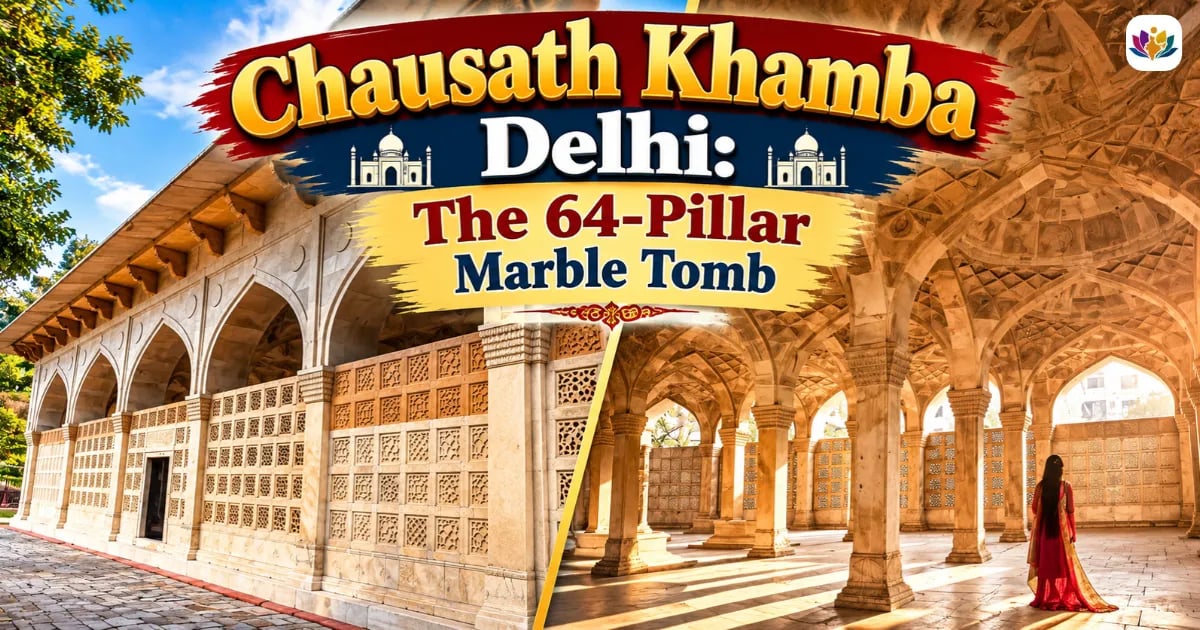
Chausath Khamba, which translates from Urdu and Hindi as sixty-four pillars, is a heritage 17th-century Mughal mausoleum built entirely of gleaming white marble, tucked into the bustling, historic lanes of the Hazrat Nizamuddin Basti in New Delhi. It is the final resting place of Mirza Aziz Koka, the foster brother of the Mughal emperor Akbar and is one of the quiet treasures of this deeply historic quarter of the city.
Though modest in scale beside the grand monuments of Delhi, Chausath Khamba is an architectural marvel in its own right, a cool, luminous marble pavilion whose sixty-four pillars and hidden domes reward a closer look. It sits in one of the most atmospheric parts of the capital, a short walk from the great Humayun's Tomb and makes a rewarding stop for anyone interested in Mughal history and architecture beyond the obvious sights.
History of Chausath Khamba
Chausath Khamba was built between 1623 and 1624, during the reign of the Mughal emperor Jahangir. It was commissioned by Mirza Aziz Koka, also known as Khan-i-Azam, as a family mausoleum and it became his own final resting place. Mirza Aziz Koka held an exalted position at the Mughal court, for he was the foster brother of the emperor Akbar and the son of Ataga Khan, a powerful noble of Akbar's court.
This close bond to the imperial family explains the monument's fine marble construction and its honoured position in the Nizamuddin area, close to the revered dargah of the Sufi saint Hazrat Nizamuddin Auliya. In recent years the structure and its grand forecourt were meticulously restored by the Aga Khan Trust for Culture, as part of the wider revival of the Nizamuddin heritage precinct, which has brought this and neighbouring monuments back to life for visitors to enjoy. It is a story that connects the highest circles of the Mughal court with the living spiritual heart of old Delhi.
The architecture and the sixty-four pillars
The great fascination of Chausath Khamba is its architecture, which is as clever as it is beautiful. True to its name, the pavilion is built around sixty-four square marble pillars that support the entire structure, giving the monument both its name and its airy, open character.
Feature | Detail |
The pillars | 64 square white-marble pillars supporting the structure |
The bays and domes | The pillars form 25 bays, each topped by a hidden dome |
Reverse domes | The domes are concealed beneath a perfectly flat outer roof |
The jaalis | Carved marble trellis screens casting light and shadow inside |
The forecourt | Includes the Urs Mahal, a stage for Sufi Qawwali and cultural events |
The sixty-four pillars create twenty-five bays and each bay is topped by a dome, but in a remarkable piece of design these are reverse domes that remain entirely hidden beneath a perfectly flat outer roof, so that the pavilion appears flat-topped from outside while being domed within. The outer walls are filled with beautifully carved marble trellised screens or jaalis, which cast ever-shifting patterns of light and shadow across the interior floor through the day, giving the white marble interior a quiet, meditative beauty. Out front, the restored courtyard includes the Urs Mahal, a stage area that hosts traditional Sufi Qawwali programmes and cultural events, keeping the monument alive as a living cultural space.
Where is Chausath Khamba and what is nearby?
Chausath Khamba is located in the Hazrat Nizamuddin Basti, one of the oldest and most atmospheric quarters of Delhi and its setting is a large part of its charm. It stands right next to the tomb of the legendary Urdu poet Mirza Ghalib and very close to the famous Hazrat Nizamuddin Dargah, the shrine of the Sufi saint, which draws devotees and the sound of qawwali every evening.
This places Chausath Khamba within easy reach of some of Delhi's greatest Mughal heritage. The magnificent Humayun's Tomb is close by and makes the natural pairing, while the old fort of Purana Qila and the heritage ruins of Hauz Khas are also within reach for a day of old Delhi. For a fuller day in the capital you can combine the area with the great sights across the city, from the Red Fort and the towering Qutub Minar to the modern landmarks of India Gate, the serene Lotus Temple and the magnificent Akshardham. You can see the full range of the city's sights in our Delhi attractions guide.
How to reach Chausath Khamba
Chausath Khamba is reached through the lanes of Nizamuddin West and while cars cannot go right up to it through the narrow basti, it is easy to reach the edge of the quarter by road or Metro and walk the short distance in.
Detail | Information |
Address | Nizamuddin West Lane, Nizamuddin Basti, New Delhi 110013 |
Nearest Metro | JLN Stadium (Violet Line) or Hazrat Nizamuddin (Pink Line) |
By road | To the edge of Nizamuddin West, then a short walk through the lanes |
Combine with | Humayun's Tomb and the Nizamuddin Dargah |
The nearest Metro stations are JLN Stadium on the Violet Line and Hazrat Nizamuddin on the Pink Line, each a short ride or walk from the basti. From there you walk into the atmospheric lanes, past the dargah and Ghalib's tomb, to reach the marble pavilion. Because it sits in a dense historic quarter, it is easiest and most rewarding to visit together with Humayun's Tomb and the Nizamuddin shrine and a private car with a driver makes moving between these sights simple. If you are planning a wider day, our guide to must-visit places near Delhi within 50 km covers options further afield.
Timings and entry fee
Chausath Khamba is an open, free monument, with no ticket required and it is accessible through daylight hours every day of the week.
Detail | Information |
Timings | 6 AM to 6 PM, all days |
Entry fee | Free, no tickets required |
Time to allow | 30 to 45 minutes |
Note | An active cultural space; events may be held in the forecourt |
Because entry is free and the monument is compact, a visit takes about thirty to forty-five minutes, a little longer if a cultural programme is underway in the Urs Mahal forecourt or if you linger over the play of light through the jaalis. It is open every day, which makes it easy to fit into any Delhi itinerary and the quiet early morning or the golden late afternoon are the loveliest times to see the marble.
Best time to visit Chausath Khamba
The best time to visit Chausath Khamba, as with all of Delhi's heritage sights, is the cool season from about October to March, when the weather is pleasant for walking the Nizamuddin lanes and exploring the wider area on foot. This is also the ideal season for the Red Fort, Humayun's Tomb and the rest of the city, so it fits naturally into a wider Delhi trip and our travel guides cover more on planning the season.
The summer, from April to June, is very hot in Delhi, so a visit then is best made in the early morning or evening, while the monsoon, from July to September, brings some relief. Within the day, the soft light of the morning or late afternoon is the most beautiful for the white marble and the shadow patterns of the jaalis and an evening visit lets you catch the qawwali at the nearby dargah, one of the great experiences of this quarter.
Tips for visiting Chausath Khamba
Combine your visit with the nearby Humayun's Tomb and the Hazrat Nizamuddin Dargah for a full morning or afternoon.
Visit in the cool season, October to March and in the soft morning or late-afternoon light.
Allow thirty to forty-five minutes, longer if a cultural programme is on in the forecourt.
Look up to appreciate the hidden reverse domes beneath the flat roof and the light through the jaalis.
Stay into the evening to catch qawwali at the adjoining Nizamuddin Dargah, an unforgettable experience.
Dress modestly, as this is a historic quarter with active religious sites all around.
Reach the area by Metro or car, then explore the Basti lanes on foot.
What to expect
A visit to Chausath Khamba is a serene, offbeat encounter with Mughal Delhi, a cool white-marble pavilion of sixty-four pillars hidden among the lanes of one of the city's most historic and spiritual quarters. You can expect a beautifully restored monument with its clever hidden domes and delicate marble jaalis, the tomb of a foster brother of the emperor Akbar, standing beside the tomb of the poet Ghalib and a short walk from the great Humayun's Tomb and the living shrine of Nizamuddin.
As an attraction it is modest in scale but rich in beauty and atmosphere and its reward is the quiet pleasure of fine Mughal architecture away from the crowds, deepened by the music and devotion of the surrounding basti. Combined with Humayun's Tomb and the Nizamuddin Dargah, it makes a memorable half-day that reveals a side of Delhi many visitors never discover.
Plan your trip with us
The Nizamuddin quarter rewards a knowledgeable guide more than almost anywhere in Delhi and a visit to Chausath Khamba, woven into a walk through the basti and its monuments and shrines, is far easier and richer with the logistics handled for you. We arrange it all, a comfortable private car and an experienced driver, a guide to lead you through the lanes and bring the Mughal story to life and a day planned around your interests.
Tell us your dates and group size and we will price it honestly around your standard rather than a fixed figure. A day in the capital slots neatly into our wider Delhi Agra Tour Packages and this quarter pairs beautifully with a guided Old Delhi tour of the Red Fort and Chandni Chowk.
Want your Delhi day planned around you? Message us on WhatsApp and Experience My India will build it for you.
Related guides
New Delhi tour: the capital's imperial landmarks, including Humayun's Tomb and Qutub Minar.
Delhi day tour: the best of old and new Delhi in a single day.
Golden Triangle tours: Delhi, Agra and Jaipur combined.
Experience My India has personally hosted 50,000+ travelers and the service he leads is rated 4.9 from 2,600+ reviews, operating since 2015. Delhi Agra Tour Packages is a unit of Experience My India.
Book Your Delhi - Agra Trip Today 📞 +91-7302265809 💬 WhatsApp: +91-7302265809 Rated 4.9★ / 2600+ Reviews Explore all: Delhi Agra Tour Packages |
What a Experiance My India
Complete Delhi-Agra services
Private AC Cabs
Comfortable AC cars with experienced local drivers for Delhi, Agra and Jaipur tours.
Local Expert Guides
Explore the Taj Mahal and historic monuments with knowledgeable local guides.
Handpicked Hotels
Comfortable stays near the Taj Mahal and prime locations across Delhi and Agra.
Delhi–Agra Tours
Well-planned same-day and multi-day tours covering the best attractions.
Golden Triangle
Experience Delhi, Agra and Jaipur together with carefully planned itineraries.
24/7 Travel Support
Get assistance throughout your journey from booking to your return.
Plan Your Trip
Get a free quote in 30 mins
100% Trusted & Verified
by 50,000+ Travellers since 2018
Why travellers choose Experience My India
What makes us different from other agencies
We plan and run every trip ourselves, so you get a private AC car, a local expert guide, an honest fixed price, and no reseller or touts in between. We have guided travelers and families since 2018 and hold a 5.0 star rating across 3 verified reviews.
What Our Travellers Say
Real reviews from real Travellers
“We booked our Delhi tour package with Experience My India, and the experience was excellent. Abhay ji guided us around Chausath Khamba and explained its Mughal history and beautiful marble architecture in a very interesting way. The cab was clean and comfortable, our hotel was well-maintained, and the overall arrangements were smooth. We really appreciated the team's friendly service.”
Rohan Mehta
Jaipur· 2026-10-23
“Our Delhi heritage trip with Experience My India was wonderful. Abhay ji was a very knowledgeable guide who helped us understand the history of Chausath Khamba, Mirza Aziz Koka and the Nizamuddin area. The sightseeing was well organised, the driver was polite, and the hotel arrangements were comfortable. Everything was handled professionally, making our family trip enjoyable.”
Sneha Kulkarni
Pune· 2026-10-03
“We had a lovely experience booking our Delhi tour through Experience My India. Chausath Khamba was one of our favourite stops because Abhay ji explained its 64 pillars and unique marble architecture so clearly. The cab service was punctual, the hotel was good, and the guide made every sightseeing stop interesting. We were happy with the service throughout our trip.”
Arvind Nair
Kochi· 2026-09-19
We booked our Delhi tour package with Experience My India, and the experience was excellent. Abhay ji guided us around Chausath Khamba and explained its Mughal history and beautiful marble architecture in a very interesting way. The cab was clean and comfortable, our hotel was well-maintained, and the overall arrangements were smooth. We really appreciated the team's friendly service.
Rohan Mehta
Jaipur
Our Delhi heritage trip with Experience My India was wonderful. Abhay ji was a very knowledgeable guide who helped us understand the history of Chausath Khamba, Mirza Aziz Koka and the Nizamuddin area. The sightseeing was well organised, the driver was polite, and the hotel arrangements were comfortable. Everything was handled professionally, making our family trip enjoyable.
Sneha Kulkarni
Pune
We had a lovely experience booking our Delhi tour through Experience My India. Chausath Khamba was one of our favourite stops because Abhay ji explained its 64 pillars and unique marble architecture so clearly. The cab service was punctual, the hotel was good, and the guide made every sightseeing stop interesting. We were happy with the service throughout our trip.
Arvind Nair
Kochi
We booked our Delhi tour package with Experience My India, and the experience was excellent. Abhay ji guided us around Chausath Khamba and explained its Mughal history and beautiful marble architecture in a very interesting way. The cab was clean and comfortable, our hotel was well-maintained, and the overall arrangements were smooth. We really appreciated the team's friendly service.
Rohan Mehta
Jaipur
Our Delhi heritage trip with Experience My India was wonderful. Abhay ji was a very knowledgeable guide who helped us understand the history of Chausath Khamba, Mirza Aziz Koka and the Nizamuddin area. The sightseeing was well organised, the driver was polite, and the hotel arrangements were comfortable. Everything was handled professionally, making our family trip enjoyable.
Sneha Kulkarni
Pune
Frequently Asked Questions
Quick answers to common questions
Chausath Khamba, meaning sixty-four pillars, is a heritage 17th-century Mughal mausoleum built entirely of white marble, in the Hazrat Nizamuddin Basti of New Delhi. It is the tomb of Mirza Aziz Koka, the foster brother of the emperor Akbar. The monument is famous for its sixty-four square marble pillars, its hidden reverse domes beneath a flat roof and its delicate carved marble screens. Standing next to the tomb of the poet Ghalib and near the Nizamuddin Dargah, it is a quiet architectural gem in one of Delhi's most historic quarters.
The name Chausath Khamba means sixty-four pillars in Urdu and Hindi and it describes the monument exactly: the marble pavilion is built around sixty-four square pillars that support the whole structure. These pillars create twenty-five bays, each topped by a dome, though the domes are cleverly hidden beneath a flat outer roof. The name captures the defining feature of this airy, open marble mausoleum and it is by this descriptive name that the tomb of Mirza Aziz Koka has long been known.
Chausath Khamba is the final resting place of Mirza Aziz Koka, also known as Khan-i-Azam, who commissioned it as a family mausoleum. He was a prominent figure at the Mughal court, the foster brother of the emperor Akbar and the son of Ataga Khan, a powerful noble of Akbar's court. The monument was built as his family tomb and became his own resting place and its fine marble construction reflects his exalted standing and close ties to the imperial family.
Chausath Khamba was built between 1623 and 1624, during the reign of the Mughal emperor Jahangir. It was commissioned by Mirza Aziz Koka as a family mausoleum. In recent years the monument and its grand forecourt were meticulously restored by the Aga Khan Trust for Culture, as part of the wider revival of the Nizamuddin heritage precinct. This restoration has returned the white-marble pavilion to its former beauty and made it and its neighbouring monuments, far more rewarding for visitors to explore today.