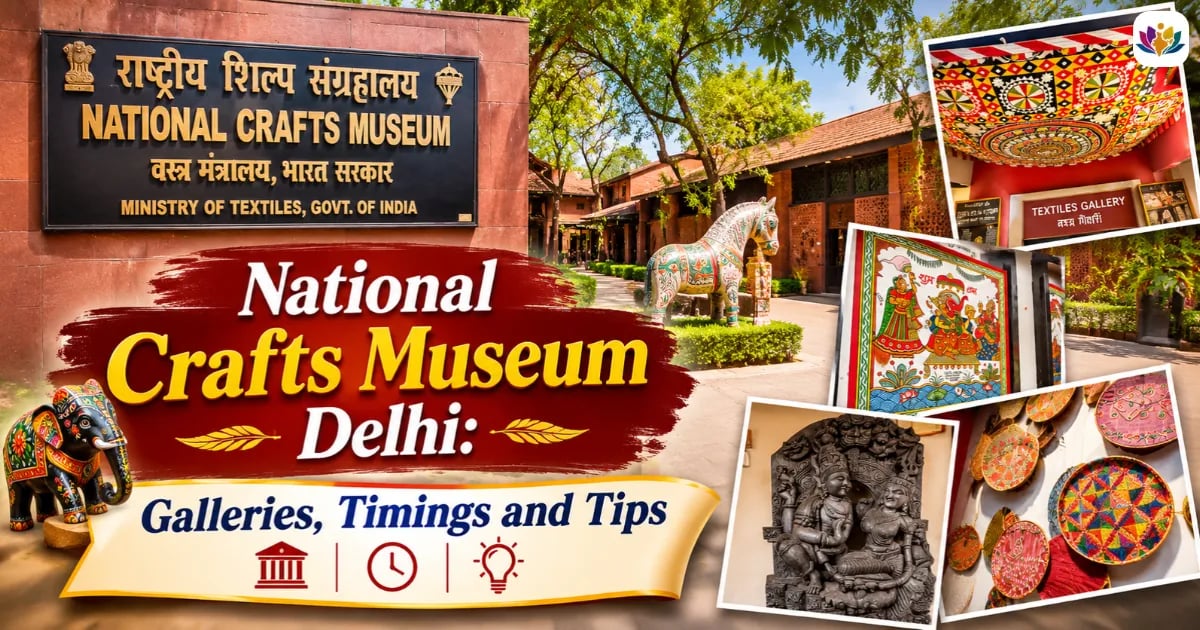
Quick Answer
The National Crafts Museum in Delhi, officially the National Handicrafts and Handlooms Museum, is one of India's largest living craft museums, with over 35,000 artefacts on a 5-acre campus designed by Charles Correa, opposite Purana Qila. It is open Tuesday to Sunday, free or ₹20 for Indians and ₹300 for foreign visitors. Delhi Agra Tour Packages, a unit of Experience My India, builds Delhi trips.
The National Crafts Museum is one of Delhi's most delightful and underrated sights, a living museum of Indian handicrafts where you can walk through a recreated rural village, watch master artisans at work, browse over 35,000 artefacts, and eat at one of the city's most celebrated cafes, all on a campus designed by the great architect Charles Correa. This guide from Delhi Agra Tour Packages covers the architecture and galleries, the live demonstrations and Café Lota, the timings, ticket price and nearest metro, and the practical tips, so you can plan your visit, whether on its own or as part of a wider Delhi trip on a Golden Triangle tour.
I was born in Delhi, and in more than 11 years planning trips across the region for Experience My India I have found the Crafts Museum to be the sight that most surprises visitors, a calm, green, hands-on contrast to the big monuments and a favourite with families and design lovers alike. Here is how to visit it well.
National Crafts Museum at a glance
Detail | Information |
Official name | National Handicrafts and Handlooms Museum (and Hastkala Academy) |
What it is | One of India's largest living craft museums; over 35,000 artefacts |
Designed by | Charles Correa, on a 5-acre village-like campus |
Location | Bhairon Marg, opposite Purana Qila, New Delhi |
Timings | Tuesday to Sunday; closed Mondays and national holidays |
Entry | Free or ₹20 for Indians; ₹300 for foreign nationals |
Nearest metro | Supreme Court (Blue Line), a 5-minute walk |
Visit duration | 2 to 3 hours |
National Crafts Museum key information
The essential visitor details in one place: timings, ticket price and how to reach. Figures are correct at the time of writing, so reconfirm before you go.
Timings
Detail | Information |
Indoor galleries | 10 AM to 6 PM |
Live craft demonstrations | 10 AM to 5:30 PM |
Reference library and admin | Monday to Friday, 9:30 AM to 6 PM |
Closed | Mondays and national holidays |
Entry fee and extras
Item | Price (at the time of writing) |
Indian citizens | Free, or a nominal ₹20 at select counters |
Foreign nationals | ₹300 per person |
Audio guide | ₹40 to ₹100 (often included for foreign tickets) |
Pottery wheel session | ₹50 to ₹100 |
How to reach
Mode | Detail |
Metro | Supreme Court station (Blue Line), a 5-minute walk to the Bhairon Marg entrance |
Road | Cab or auto to Bhairon Marg, opposite Purana Qila; no parking inside the compound |
What is the National Crafts Museum?
The National Crafts Museum, officially the National Handicrafts and Handlooms Museum and home to the Hastkala Academy, is one of India's largest living craft museums, housing over 35,000 rare handcrafted artefacts across a 5-acre campus in New Delhi. Designed by the renowned architect Charles Correa, it blends indoor exhibition galleries with a recreated open-air rural village, so it is as much an experience as a museum.
It is one of the most rewarding cultural stops in the capital, and it sits in the heart of Delhi's monument belt, directly opposite the old fort of Purana Qila and within easy reach of the landmarks gathered on our Delhi hub. Where the city's forts tell the story of empires, the Crafts Museum tells the story of its people and their making traditions.
Charles Correa architecture and the campus
The campus is a masterpiece of modern Indian architecture, and one of the most studied works of Charles Correa, so it draws architecture students as much as craft lovers. Completed between 1975 and 1990, Correa modelled the complex on a traditional Indian village street, rather than a conventional gallery block.
A village street in plan: A central pedestrian spine connects open-to-sky courtyards, shaded verandas and stepped platforms.
Rooted in tradition: The forms are inspired by temple complexes and river ghats, grounding a modern museum in Indian building traditions.
Indoor meets outdoor: Enclosed galleries open onto courtyards, so the visit flows between built rooms and open air.
This village-street idea is why the museum feels so different from a typical gallery, and why it is such a popular architecture case study. Walking the spine from courtyard to courtyard is a large part of the pleasure.
The village complex
Spanning the 5-acre site, the open-air village complex preserves 15 authentic, life-size rural dwellings, courtyards and shrines sourced from across India, so you can step straight from a Delhi afternoon into a Gujarati haveli or a Naga village. It is the heart of the museum's living character.
A Gujarat haveli: A reassembled wooden haveli, richly carved, from Gujarat.
Painted mud houses: Traditional mud huts with Warli and Mithila murals.
Tribal structures: Naga tribal buildings among the dwellings.
Wandering the village is especially good for families and photographers, and it is best enjoyed in the cool season when the open-air section is comfortable. Each dwelling is a window into a different region's way of life.
Galleries and collections
Alongside the village, the indoor galleries hold the bulk of the 35,000-strong collection, arranged by theme. Each gallery is a deep dive into a different strand of Indian craft.
Textile Gallery: Centuries-old handloom traditions, including Kashmiri jamawar and dushala shawls, Gujarati patola, Baluchari saris, Chamba rumals and Phulkari embroidery.
Bhuta Sculpture Gallery: One of the world's largest collections of dramatic jackfruit-wood sculptures from coastal Karnataka, used in Tulu ancestor and spirit worship.
Folk and Tribal Arts Gallery: Everyday and ceremonial objects, from Dokra metal castings and terracotta figurines to bamboo and cane crafts, puppets and masks.
Courtly Crafts Gallery: Ornate items made for royal households, including bidriware, ivory inlays, carved sandalwood, antique jewellery and decorative metalwork.
Cultic Objects Gallery: Ritual artefacts, temple carvings, bronze lamps, wooden ratha chariots and religious paintings from across India's faiths.
The Bhuta sculptures and the Textile Gallery are the standouts for many visitors, while the sheer range across the galleries gives a rare, panoramic view of Indian craft. Note that photography is not permitted inside these indoor galleries.
Live craft demonstrations and pottery
One of the museum's best features is that it is genuinely living: each month, some 50 master craftspeople from different Indian states are invited to demonstrate weaving, pottery, wood carving and folk painting live in the open courtyards. You can watch them work, talk to the makers, and buy their pieces directly, without middlemen.
The live demonstrations run from 10 AM to 5:30 PM, so there is almost always something being made during opening hours. Visitors can also try their own hand at the craft, with interactive pottery wheel sessions in the courtyard for ₹50 to ₹100, which children in particular love. Meeting the artisans and buying straight from them is, for many, the highlight of the visit.
Café Lota and the museum shop
The Crafts Museum is also known for its food and shopping, which you can enjoy even without a gallery ticket. Café Lota, set in the museum courtyard under a shaded pergola, is a celebrated restaurant serving inventive regional Indian dishes from across the country, and is a destination in its own right.
Café Lota: A much-loved courtyard restaurant of modern regional Indian cooking.
Lota Shop: The museum store, run under the Ministry of Textiles, selling curated, government-verified handicrafts, handloom textiles, books and souvenirs at fixed prices.
Fixed, fair prices: The shop's fixed pricing and verified crafts make it a reliable place to buy genuine handloom and handicraft.
Access to the outer courtyards, the artisan stalls and Café Lota does not require a gallery ticket, so you can drop in for the cafe and shop alone. The fixed-price, verified shop is a safe bet for authentic souvenirs.
National Crafts Museum timings
The museum is open Tuesday to Sunday and closed on Mondays and national holidays. The indoor galleries run from 10 AM to 6 PM, the live craft demonstrations from 10 AM to 5:30 PM, and the reference library and administration from 9:30 AM to 6 PM on Monday to Friday.
A visit takes 2 to 3 hours to comfortably explore the indoor galleries, walk through the village complex, watch the artisan demonstrations and dine at the cafe. Arrive by mid-morning to catch the demonstrations in full swing and to leave time for the village before the galleries close at 6 PM.
Entry fee and ticket price
Entry is free, or a nominal ₹20 at select counters, for Indian citizens, and ₹300 per person for foreign nationals, at the time of writing. That makes it one of the best-value cultural experiences in Delhi, especially for Indian visitors and families.
Optional audio guides are available for ₹40 to ₹100, and are often included with foreign-visitor tickets, while the courtyard pottery sessions cost ₹50 to ₹100. Importantly, access to the outer courtyards, the artisan stalls and Café Lota does not require a gallery ticket. Carry some cash and reconfirm the current rates on arrival, as charges can change.
How to reach the National Crafts Museum and nearest metro
The museum is on Bhairon Marg, directly opposite Purana Qila and adjacent to Bharat Mandapam, so it is easy to reach from central Delhi. The nearest metro station is Supreme Court, formerly Pragati Maidan, on the Delhi Metro Blue Line, a 5-minute walk from the Bhairon Marg entrance.
By car or auto, note that visitor parking is not permitted inside the museum compound, so use the paid public parking near Purana Qila or Bhairon Mandir. Because it sits in the monument belt, the cool season is the most comfortable time for the open-air campus, as our best time to visit Delhi guide explains, and it pairs well with day trips covered in our places near Delhi within 50 km guide.
Combining the Crafts Museum with nearby sights
The museum's location makes it easy to build into a full day in Delhi's monument belt. The most natural pairing is right across the road.
Directly opposite: The old fort of Purana Qila, one of Delhi's most atmospheric ruins.
The ceremonial core: The nearby India Gate and, a little further, the Red Fort and Humayun's Tomb.
The south: The Qutub Minar and the trails of the Mehrauli Archaeological Park.
For a change of pace, the serene Lotus Temple and Akshardham are magnificent, while the ruins of Hauz Khas Fort, the market at Nehru Place and the temple at Kalkaji Mandir show the city's everyday side.
Facilities, accessibility and rules
The museum is well set up for a comfortable, inclusive visit, and a few simple rules keep the collection safe. It is a thoughtfully run campus.
Accessibility: Wheelchair-accessible entrances and ramps, accessible restrooms, drinking-water stations and free wheelchairs at the reception desk.
Cloakroom: Large bags must be deposited at the cloakroom near the entrance.
Library and amphitheatre: A specialised reference library of over 10,000 volumes on Indian crafts and textiles, and an amphitheatre hosting seasonal folk music, dance and craft festivals.
The key rule concerns photography: still photography is free and allowed in the outdoor courtyards and the village complex, but photography and videography are strictly prohibited inside the indoor textile, jewellery and artefact galleries, to protect the delicate exhibits. Follow the signage and staff guidance.
Travel tips for visiting the National Crafts Museum
Visit on a weekday morning, Tuesday to Thursday between 10 AM and 12 noon, for quieter galleries.
Go between October and March, when the open-air village complex is comfortable.
Arrive by mid-morning to catch the live craft demonstrations, which run to 5:30 PM.
Photograph freely in the courtyards and village, but not inside the indoor galleries.
Use the Supreme Court metro, as there is no visitor parking inside the compound.
Leave time for Café Lota and the Lota Shop, both open without a gallery ticket.
Is the National Crafts Museum worth visiting?
The National Crafts Museum is absolutely worth visiting, and for many travellers it is the pleasant surprise of a Delhi trip. It combines a superb collection of over 35,000 crafts, a recreated rural village you can walk through, live artisans at work, a celebrated cafe and a trustworthy craft shop, all in an acclaimed Charles Correa campus. It is affordable, green, hands-on and far less crowded than the big monuments, a genuine change of pace.
As a cultural highlight opposite Purana Qila, it slots easily into a wider Delhi itinerary and a longer Golden Triangle or Rajasthan trip. Give it a couple of hours, pair it with the nearby monuments, and it adds real depth and warmth to your experience of the capital.
What to expect
A visit to the Crafts Museum is a relaxed, hands-on half-day. You can expect an acclaimed village-like campus by Charles Correa, indoor galleries of textiles, sculpture, folk, courtly and ritual crafts, an open-air village of 15 regional dwellings, live artisans demonstrating and selling their work, and the much-loved Café Lota and Lota Shop, all opposite Purana Qila.
You should also expect a Monday and national-holiday closure to plan around, a no-photography rule inside the indoor galleries, no parking within the compound, and an open-air section best enjoyed in the cool season. Allow 2 to 3 hours, go on a weekday morning, use the metro, and the museum is one of the most rewarding and characterful stops in the capital.
Plan your trip with us
The Crafts Museum is best enjoyed as part of a well-planned Delhi day, timed for the morning demonstrations and the cool hours in the village, and paired with Purana Qila and the nearby monuments. We build exactly that, with a comfortable private car, a knowledgeable guide and the day sequenced to avoid the Monday closure and the worst of the traffic.
Tell us your dates and group size and we will price it honestly around your standard rather than a fixed figure. Delhi sits at the start of our Golden Triangle tours and our full range of Delhi Agra tours, with more city ideas in our travel guides.
Want your Delhi and Crafts Museum visit planned around you? Message us on WhatsApp, or send an enquiry, and Experience My India will build it for you.
Related guides
New Delhi tour: the capital's imperial landmarks and avenues.
Old Delhi tour: the Red Fort, Jama Masjid and Chandni Chowk.
Delhi day tour: the best of the capital in a day.
About the author. Abhay Sharma is a Delhi-born travel guide with 11+ years planning and guiding the Golden Triangle for Experience My India. He has personally hosted 50,000+ travelers, and the service he leads is rated 4.9 from 2,600+ reviews, operating since 2015. Delhi Agra Tour Packages is a unit of Experience My India.
Book Your Delhi - Agra Trip Today 📞 +91-7302265809 💬 WhatsApp: +91-7302265809 Rated 4.9★ / 2600+ Reviews Explore all: Delhi Agra Tour Packages |
What a Experiance My India
Complete Delhi-Agra services
Private AC Cabs
Comfortable AC cars with experienced local drivers for Delhi, Agra and Jaipur tours.
Local Expert Guides
Explore the Taj Mahal and historic monuments with knowledgeable local guides.
Handpicked Hotels
Comfortable stays near the Taj Mahal and prime locations across Delhi and Agra.
Delhi–Agra Tours
Well-planned same-day and multi-day tours covering the best attractions.
Golden Triangle
Experience Delhi, Agra and Jaipur together with carefully planned itineraries.
24/7 Travel Support
Get assistance throughout your journey from booking to your return.
Plan Your Trip
Get a free quote in 30 mins
100% Trusted & Verified
by 50,000+ Travellers since 2018
Why travellers choose Experience My India
What makes us different from other agencies
We plan and run every trip ourselves, so you get a private AC car, a local expert guide, an honest fixed price, and no reseller or touts in between. We have guided travelers and families since 2018 and hold a 5.0 star rating across 3 verified reviews.
What Our Travellers Say
Real reviews from real Travellers
“I booked a Delhi sightseeing tour with Experience My India, and the experience was wonderful. Abhay ji helped us plan the day, including the National Crafts Museum and nearby attractions. The private cab was clean and comfortable, the driver was punctual, and the itinerary was arranged perfectly. We especially enjoyed watching the artisans demonstrate traditional Indian crafts.”
Arjun Malhotra
Chandigarh· 2026-10-22
“Our Delhi trip with Experience My India was very well organised. Abhay ji suggested including the National Crafts Museum in our sightseeing plan, and it turned out to be one of our favourite places. We enjoyed the village complex, textile galleries and live craft demonstrations. The cab service and overall arrangements were excellent.”
Sneha Iyer
Chennai· 2026-11-02
“We booked our Delhi tour package through Experience My India, and everything went smoothly. Abhay ji arranged a comfortable vehicle, a good hotel and a well-planned sightseeing itinerary. The visit to the National Crafts Museum was a lovely change from the usual monuments, especially seeing traditional artisans working on their crafts. Very happy with the service.”
Vikram Rathore
Jodhpur· 2026-09-13
I booked a Delhi sightseeing tour with Experience My India, and the experience was wonderful. Abhay ji helped us plan the day, including the National Crafts Museum and nearby attractions. The private cab was clean and comfortable, the driver was punctual, and the itinerary was arranged perfectly. We especially enjoyed watching the artisans demonstrate traditional Indian crafts.
Arjun Malhotra
Chandigarh
Our Delhi trip with Experience My India was very well organised. Abhay ji suggested including the National Crafts Museum in our sightseeing plan, and it turned out to be one of our favourite places. We enjoyed the village complex, textile galleries and live craft demonstrations. The cab service and overall arrangements were excellent.
Sneha Iyer
Chennai
We booked our Delhi tour package through Experience My India, and everything went smoothly. Abhay ji arranged a comfortable vehicle, a good hotel and a well-planned sightseeing itinerary. The visit to the National Crafts Museum was a lovely change from the usual monuments, especially seeing traditional artisans working on their crafts. Very happy with the service.
Vikram Rathore
Jodhpur
I booked a Delhi sightseeing tour with Experience My India, and the experience was wonderful. Abhay ji helped us plan the day, including the National Crafts Museum and nearby attractions. The private cab was clean and comfortable, the driver was punctual, and the itinerary was arranged perfectly. We especially enjoyed watching the artisans demonstrate traditional Indian crafts.
Arjun Malhotra
Chandigarh
Our Delhi trip with Experience My India was very well organised. Abhay ji suggested including the National Crafts Museum in our sightseeing plan, and it turned out to be one of our favourite places. We enjoyed the village complex, textile galleries and live craft demonstrations. The cab service and overall arrangements were excellent.
Sneha Iyer
Chennai
Frequently Asked Questions
Quick answers to common questions
The National Crafts Museum, officially the National Handicrafts and Handlooms Museum and home to the Hastkala Academy, is one of India's largest living craft museums, with over 35,000 rare handcrafted artefacts across a 5-acre campus in New Delhi. Designed by the renowned architect Charles Correa, it blends indoor exhibition galleries with a recreated open-air rural village, so it is as much an experience as a museum. It sits on Bhairon Marg, directly opposite Purana Qila, and showcases textiles, sculpture, folk and tribal art, courtly crafts and ritual objects, alongside live artisan demonstrations.
The museum is open Tuesday to Sunday and closed on Mondays and national holidays. The indoor galleries run from 10 AM to 6 PM, the live craft demonstrations from 10 AM to 5:30 PM, and the reference library and administration from 9:30 AM to 6 PM on Monday to Friday. A visit takes 2 to 3 hours to explore the galleries, walk the village complex, watch the demonstrations and dine at the cafe. Arrive by mid-morning to catch the demonstrations in full swing and to leave time for the village before the galleries close at 6 PM.
At the time of writing, entry is free, or a nominal ₹20 at select counters, for Indian citizens, and ₹300 per person for foreign nationals, making it excellent value. Optional audio guides cost ₹40 to ₹100 and are often included with foreign-visitor tickets, while courtyard pottery wheel sessions cost ₹50 to ₹100. Access to the outer courtyards, the artisan stalls and Café Lota does not require a gallery ticket, so you can visit the cafe and shop for free. Carry some cash and reconfirm the current rates on arrival, as charges can change.
The museum was designed by the renowned Indian architect Charles Correa, and it is one of his most studied works, a popular architecture case study. Completed between 1975 and 1990, Correa modelled the campus on a traditional Indian village street rather than a conventional gallery block, with a central pedestrian spine connecting open-to-sky courtyards, shaded verandas and stepped platforms inspired by temple complexes and river ghats. The design lets the visit flow between enclosed galleries and open courtyards, and it is a large part of why the museum feels so different from a typical gallery and draws architecture students as well as craft lovers.