Quick Answer
The Taj Mahal was built by the Mughal emperor Shah Jahan between 1632 and 1653 as a tomb for his beloved wife Mumtaz Mahal, who died in childbirth in 1631. Built in white marble by some 20,000 artisans, it is a UNESCO site and one of the New Seven Wonders of the World, and Shah Jahan is buried beside her inside.
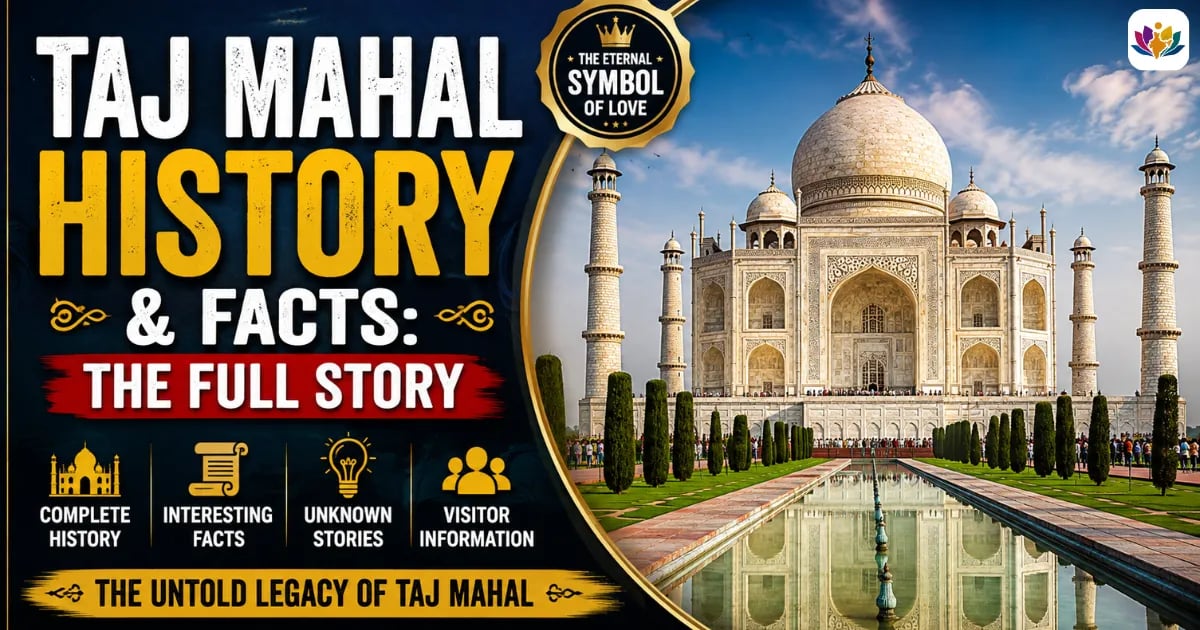
In short, the Taj Mahal is a tomb, the most beautiful in the world, built by the seventeenth-century Mughal emperor Shah Jahan for his wife Mumtaz Mahal after she died in childbirth. It took some twenty thousand workers around twenty-one years, from 1632 to 1653, to raise the white marble mausoleum, its gardens, gateway and mosque on the bank of the Yamuna in Agra. Behind its perfect symmetry lie a love story, a fallen emperor and a trove of remarkable facts, which is what this guide is about.
I was born in Delhi, and in 11 years guiding travelers to the Taj for Experience My India I have learned that the building means far more once you know its story. Visitors who arrive knowing only that it is famous leave genuinely moved once they understand whose grief built it and what they are actually looking at. So here is the full history of the Taj Mahal, followed by the facts and legends that make it endlessly fascinating.runs guided Taj Mahal tours
See all our Delhi Agra Tour Package or message on WhatsApp at +91 7302265809, any day from 8 AM to 9 PM.
The history of the Taj Mahal
Mumtaz Mahal and Shah Jahan's grief
The Taj Mahal begins with a love story. Shah Jahan, the fifth Mughal emperor, was devoted to his wife Arjumand Banu Begum, whom he called Mumtaz Mahal, the Jewel of the Palace. She was his constant companion, even on military campaigns, and in 1631, while giving birth to their fourteenth child, she died. Shah Jahan was said to be so stricken that his hair turned grey, and he resolved to build for her a monument the world had never seen, a tomb worthy of his grief and her memory. That resolve became the Taj Mahal.
Building the Taj, 1632 to 1653
Construction began around 1632 on a site beside the Yamuna in Agra. A workforce of roughly twenty thousand craftsmen, masons and labourers laboured for some twenty-one years, led by the chief architect Ustad Ahmad Lahauri, drawing artisans and materials from across the empire and beyond. The main mausoleum of gleaming white Makrana marble was largely finished around 1643, and the surrounding complex of gardens, gateway, mosque and walls completed by about 1653. The same emperor also built the Red Fort in Delhi, but the Taj remained his masterpiece.
Shah Jahan's imprisonment and death
The story has a poignant end. In 1658 Shah Jahan fell ill, and his son Aurangzeb seized the throne, imprisoning his father in the nearby Agra Fort. There the old emperor spent his last eight years, gazing across the river at the tomb he had raised for the wife he had lost. When he died in 1666, he was laid to rest beside Mumtaz inside the Taj Mahal, reunited with her at last, which is why the two rest together at the heart of the building today.
Taj Mahal quick facts
The essentials at a glance, before the more surprising details.
Fact | Detail |
Built by | Mughal emperor Shah Jahan |
In memory of | Mumtaz Mahal, his wife |
Built | 1632 to 1653 (about 21 years) |
Chief architect | Ustad Ahmad Lahauri |
Material | White Makrana marble, inlaid with 28 kinds of stone |
Location | Agra, on the bank of the Yamuna |
Workforce | Around 20,000 artisans and labourers |
Status | UNESCO World Heritage Site (1983); New 7 Wonders (2007) |
Fascinating facts about the Taj Mahal
The closer you look, the more remarkable the Taj becomes. These are the details that make guests gasp when I point them out.
The minarets lean outward on purpose
The four slender minarets around the tomb are not quite vertical: each leans very slightly outward, away from the mausoleum. This was deliberate, so that in the event of an earthquake the towers would fall away from the precious tomb rather than crash down onto it. It is one of many touches showing how carefully the builders thought about protecting the monument.
The tombs you see are not the real graves
Inside the main chamber stand two beautifully carved cenotaphs, but these are decoys. The actual graves of Shah Jahan and Mumtaz lie in a quiet crypt on the level below, closed to the public, in keeping with the Mughal tradition of not adorning the true resting place. The whole building is perfectly symmetrical with one deliberate exception: Shah Jahan's cenotaph, added later, sits off-centre beside Mumtaz's central one, the single asymmetry in an otherwise flawless design.
The marble changes colour through the day
The Taj is never quite the same colour twice. Its white marble takes on a soft pink blush at dawn, turns brilliant white under the midday sun, glows warm gold at sunset, and is said to shimmer silver-blue under a full moon. Some romantics say the changing hues mirror the changing moods of a woman; whatever the reason, it is why visiting at first light or on a moonlit night is such a different experience.
The pietra dura and the 28 stones
The flowers and calligraphy that seem painted onto the marble are in fact inlaid stone, a technique called pietra dura. Twenty-eight kinds of precious and semi-precious stones were set into the marble, gathered from across Asia: jade and crystal from China, turquoise from Tibet, lapis lazuli from Afghanistan, sapphire from Sri Lanka, carnelian from Arabia. Look closely and a single small flower may hold dozens of tiny inlaid pieces.
The optical illusions
The builders were masters of illusion. The great gateway frames the Taj so that it seems to loom larger as you first glimpse it and recede as you walk away. The Quranic calligraphy around the entrance is subtly enlarged as it rises, so that from the ground every line appears the same size. Even the outward tilt of the minarets helps them look perfectly straight from below. Nothing about the Taj is accidental.
The Black Taj and other myths
Legends cling to the Taj. The most famous is the Black Taj: the tale that Shah Jahan intended to build a mirror-image tomb of black marble for himself across the river, linked by a bridge, before Aurangzeb stopped him. Romantic as it is, historians find no solid evidence for it, and the blackened marble once seen across the water is now thought to be discoloured white stone. Equally persistent, and equally unproven, is the grisly story that the emperor had the craftsmen's hands cut off so they could never build its equal. There is no historical record of it; treat it as legend, not fact.
The design and layout
The Taj is not just the famous domed tomb but a whole planned complex. You pass through a grand red sandstone gateway into a classic charbagh, a four-part paradise garden split by watercourses, with a raised central pool that gives the perfect reflection. The mausoleum itself stands not in the middle of the garden but at the far end, on a raised marble platform above the river, so it is set against the sky. It is flanked by two red sandstone buildings, a working mosque to the west and, to the east, an identical mirror-image jawab built purely for symmetry. The central onion dome rises about 35 metres, and with its finial the monument stands roughly 73 metres tall, framed by the four corner minarets.
The Taj Mahal today
Nearly four centuries on, the Taj Mahal is among the most visited monuments on earth, drawing millions of visitors a year. It was made a UNESCO World Heritage Site in 1983 and named one of the New Seven Wonders of the World in 2007. Its great modern challenge is preservation: air pollution has yellowed the marble over time, so it is periodically cleaned with a traditional mud-pack, industry around it is restricted within a protected zone, and visitor numbers and the health of the Yamuna are carefully managed. It also opens for a limited number of moonlit night viewings each month, a magical and quieter way to see it.
Want to see the Taj Mahal with a guide who brings this whole story to life on the spot? Message me on WhatsApp with your dates and Experience My India will arrange it.
Planning your visit to the Taj Mahal
Once the history has you hooked, the practical side is easy. Check the Taj Mahal's timings and ticket prices, including the Friday closure and the night-viewing dates, and read how to reach the Taj Mahal for the gates and the last-mile rules. There is far more to the city too, as our guide to the best places to visit in Agra shows, and the Taj is the centrepiece of the full Golden Triangle itinerary with Delhi and Jaipur.
The loveliest way to see it is at first light on a sunrise Taj Mahal tour, or as part of our Golden Triangle tour with a car, driver and licensed local guides. You can also browse all our Delhi Agra tours to plan the trip your way.
Experience My India. He has personally hosted 50,000+ travelers and the service he leads is rated 4.9 from 2,600+ reviews, operating since 2015. Delhi Agra Tour Packages is a unit of Experience My India.
Book Your Delhi - Agra Trip Today 📞 +91-7302265809 💬 WhatsApp: +91-7302265809 Rated 4.9★ / 2600+ Reviews Explore all: Delhi Agra Tour Packages |
What a Experiance My India
Complete Delhi-Agra services
Private AC Cabs
Comfortable AC cars with experienced local drivers for Delhi, Agra and Jaipur tours.
Local Expert Guides
Explore the Taj Mahal and historic monuments with knowledgeable local guides.
Handpicked Hotels
Comfortable stays near the Taj Mahal and prime locations across Delhi and Agra.
Delhi–Agra Tours
Well-planned same-day and multi-day tours covering the best attractions.
Golden Triangle
Experience Delhi, Agra and Jaipur together with carefully planned itineraries.
24/7 Travel Support
Get assistance throughout your journey from booking to your return.
Plan Your Trip
Get a free quote in 30 mins
100% Trusted & Verified
by 50,000+ Travellers since 2018
Why travellers choose Experience My India
What makes us different from other agencies
We plan and run every trip ourselves, so you get a private AC car, a local expert guide, an honest fixed price, and no reseller or touts in between. We have guided travelers and families since 2018 and hold a 4.7 star rating across 3 verified reviews.
What Our Travellers Say
Real reviews from real Travellers
“Our Taj Mahal tour with Experience My India was perfectly organized from beginning to end. Abhay Sharma planned a smooth itinerary, arranged a luxury private car, comfortable hotel, and an excellent licensed guide who explained the fascinating history of the Taj Mahal in great detail. The entire experience felt premium, stress-free, and worth every rupee.”
Ashutosh Tiwari
Varanasi· 2026-07-23
“We booked our Delhi, Agra, and Jaipur holiday through Experience My India, and every service exceeded our expectations. Abhay Sharma handled our hotels, transportation, sightseeing schedule, and local guides professionally. Learning the history of the Taj Mahal from such an experienced guide made our visit unforgettable. Their hospitality throughout the tour was outstanding.”
Nisha Fernandes
Mangalore· 2026-03-26
“Experience My India provided excellent service throughout our Golden Triangle journey. Abhay Sharma created a well-balanced itinerary, booked quality hotels, arranged a clean and comfortable vehicle, and ensured we had knowledgeable guides at every destination. The Taj Mahal visit became much more meaningful because every historical detail was explained beautifully. Highly recommended for first-time visitors.”
Vikash Kumar
Ranchi· 2026-04-22
Our Taj Mahal tour with Experience My India was perfectly organized from beginning to end. Abhay Sharma planned a smooth itinerary, arranged a luxury private car, comfortable hotel, and an excellent licensed guide who explained the fascinating history of the Taj Mahal in great detail. The entire experience felt premium, stress-free, and worth every rupee.
Ashutosh Tiwari
Varanasi
We booked our Delhi, Agra, and Jaipur holiday through Experience My India, and every service exceeded our expectations. Abhay Sharma handled our hotels, transportation, sightseeing schedule, and local guides professionally. Learning the history of the Taj Mahal from such an experienced guide made our visit unforgettable. Their hospitality throughout the tour was outstanding.
Nisha Fernandes
Mangalore
Experience My India provided excellent service throughout our Golden Triangle journey. Abhay Sharma created a well-balanced itinerary, booked quality hotels, arranged a clean and comfortable vehicle, and ensured we had knowledgeable guides at every destination. The Taj Mahal visit became much more meaningful because every historical detail was explained beautifully. Highly recommended for first-time visitors.
Vikash Kumar
Ranchi
Our Taj Mahal tour with Experience My India was perfectly organized from beginning to end. Abhay Sharma planned a smooth itinerary, arranged a luxury private car, comfortable hotel, and an excellent licensed guide who explained the fascinating history of the Taj Mahal in great detail. The entire experience felt premium, stress-free, and worth every rupee.
Ashutosh Tiwari
Varanasi
We booked our Delhi, Agra, and Jaipur holiday through Experience My India, and every service exceeded our expectations. Abhay Sharma handled our hotels, transportation, sightseeing schedule, and local guides professionally. Learning the history of the Taj Mahal from such an experienced guide made our visit unforgettable. Their hospitality throughout the tour was outstanding.
Nisha Fernandes
Mangalore
Frequently Asked Questions
Quick answers to common questions
The Mughal emperor Shah Jahan built it in memory of his wife Mumtaz Mahal, who died in childbirth in 1631. It is her tomb, and Shah Jahan was later buried beside her inside it.
About 21 years. Construction began around 1632, the main mausoleum was largely complete by about 1643, and the full complex was finished by roughly 1653, using a workforce of around 20,000.
White Makrana marble from Rajasthan, inlaid with 28 kinds of precious and semi-precious stones from across Asia using the pietra dura technique, all set on a raised platform of red sandstone and marble.
Deliberately, so that in an earthquake they would fall away from the tomb rather than onto it. The slight tilt also helps them appear perfectly straight when viewed from the ground.