Agrasen ki Baoli Delhi: Timings, Entry, History and Visitor Guide
Planning Agrasen ki Baoli, Delhi's famous hidden stepwell? Get timings, free entry, the stone steps, the haunted legend, nearest metro and photo tips.
In a Nutshell
“Agrasen ki Baoli is a historic stepwell hidden among the high rises just off Connaught Place in New Delhi, about 60 metres long with more than a hundred stone steps descending through three levels of arched niches. Attributed by legend to the ancient king Agrasen and rebuilt in the 14th century, it is a protected monument, free to enter, open daily and hugely popular with photographers and film crews. The nearest metro is Barakhamba Road and it is looked after by a unit of Experience My India.”
Agrasen ki Baoli is one of Delhi's great surprises, a deep, dramatic medieval stepwell tucked down a quiet lane a few minutes from the roar of Connaught Place. Walk in and the city falls away, replaced by tiers of arches marching down into the earth. If you want a striking, free and genuinely atmospheric stop in central Delhi, this is one of my favourites. Our team at Delhi Agra Tour Packages often works it into a central Delhi morning and it slots easily around the bigger sights on a wider Golden Triangle tour.
I am Abhay Sharma, Delhi born and a Golden Triangle guide since 2015 and I love sending people to Agrasen ki Baoli because almost no first time visitor expects it. You turn off a busy road, walk down an unremarkable lane and suddenly there is this vast, silent well of stone steps opening beneath your feet. This guide gathers everything I would tell a guest before a visit, checked against current information, so you can find it easily and enjoy it safely.
Details
Agrasen ki Baoli at a glance
| Detail | Information |
|---|---|
| Location | Hailey Road, off Kasturba Gandhi Marg, near Connaught Place, New Delhi |
| Size | About 60 metres long and 15 metres wide |
| Steps | More than a hundred stone steps (counts vary, commonly given as 103 to 108) |
| Levels | Three visible tiers of arched niches |
| Built | Attributed by legend to King Agrasen, rebuilt in the 14th century |
| Entry fee | Free |
| Nearest metro | Barakhamba Road (Blue Line), a 5 to 7 minute walk |
| Time needed | About 30 to 45 minutes |
| Known for | Dramatic architecture, photography, film shoots and a haunted reputation |
Details
Agrasen ki Baoli timings
| Detail | Information |
|---|---|
| Opening days | Open all seven days |
| Timings | 9:00 AM to 5:30 PM |
| Weekly closure | None |
The stepwell is generally open from about 9:00 AM to 5:30 PM every day. Timings can shift slightly, so treat them as a guide and aim to arrive well before closing to enjoy it without being hurried.
Details
Entry ticket prices
| Visitor | Fee |
|---|---|
| Indian visitors | Free |
| Foreign nationals | Free |
| Children | Free |
| Still photography | Free (casual personal use) |
Entry is completely free, with no ticket, no counter and no online booking needed. Casual smartphone and still photography is free and very popular; tripods are not allowed and any professional or commercial filming needs prior permission from the Archaeological Survey of India.
Details
How to reach
| From | Route |
|---|---|
| Barakhamba Road metro (Blue Line) | A 5 to 7 minute walk via the connecting roads |
| Janpath metro (Violet Line) | Another close option, roughly a 7 to 9 minute walk |
| Rajiv Chowk metro (Blue and Yellow Lines) | About a 15 minute walk from the Connaught Place inner circle |
| By car | Street parking on Hailey Road is very limited; use a Connaught Place car park and walk or take an auto |
What is Agrasen ki Baoli and why is it famous?
Agrasen ki Baoli is a historic baoli or stepwell, a kind of deep well reached by a long descending staircase, built to store water and give access to it as the water table rose and fell through the seasons. This one is a tall, narrow, rectangular well with a grand flight of stone steps dropping through three levels of arched galleries, hidden in a lane among the office towers near Connaught Place. It is protected by the Archaeological Survey of India and is one of the most atmospheric and photogenic monuments in central Delhi.
It is famous for a few reasons that are worth spelling out:
- The drama of the descent. Rank upon rank of symmetrical arches step down into the earth, creating a striking, almost hypnotic perspective that is unlike anything else in the city centre.
- The hidden gem factor. It sits completely out of sight among modern high rises, so finding it feels like discovering a secret, which is a big part of its charm.
- Film and pop culture fame. It has featured in several Bollywood films, which turned a quiet heritage site into a must visit landmark for a younger crowd.
- The haunted reputation. Local urban legends about the stepwell being haunted give it an added thrill that draws the curious.
- It is free and central. A genuinely remarkable monument, at no cost, a few minutes from Connaught Place.
It belongs on any thoughtful list of things to do in Delhi and it is one of the best entries on any guide to the city's hidden places to visit.
What is the history of Agrasen ki Baoli?
The history of Agrasen ki Baoli is a mix of legend and architecture, because the hard records are thin. By tradition, the stepwell is linked to the legendary king Agrasen, an ancient and semi mythical ruler said to date to the era of the Mahabharata, which is why it carries his name. There is no firm documentary proof of that original foundation and it is best understood as cherished folklore rather than established fact.
What is clearer comes from the stone itself. Architectural historians read the present structure as a 14th century rebuild, raised during the Tughlaq or Lodi period of the Delhi Sultanate and widely credited to the Agrawal community, prosperous traders and financiers who trace their own descent from King Agrasen and who restored the baoli to its former glory. So the honest version of the story is a layered one: an ancient, legendary association with a famous king and a surviving medieval structure rebuilt by his reputed descendants several centuries ago. That blend of myth and history is part of what makes standing in it feel so evocative.
Old records hint at the layers too. The baoli has gone by other names over the centuries, including Ugrasen ki Baoli and, in some colonial era documents, a very different anglicised spelling, a reminder of how names drift as a city changes hands and languages. The Agrawal community that restored it traces its roots to the ancient town of Agroha and to King Agrasen himself, so the rebuilding was as much an act of ancestral pride as of public utility. For centuries afterwards the stepwell served its practical purpose, storing water and offering a cool, shaded gathering place, before the water table fell, the well dried and the surrounding fields gave way to the offices and apartments of modern Connaught Place. That it survived at all, hemmed in by high rises, is a small miracle of the city's heritage.
What is a baoli and why were stepwells built?
To appreciate Agrasen ki Baoli, it helps to know what a baoli was for. In a land of hot summers and a monsoon that arrives only once a year, storing water was a matter of survival and stepwells were an ingenious answer. Rather than a simple vertical well, a baoli was dug deep and lined with a long staircase, so that people could walk right down to the water level whatever the season, descending further in the dry months as the water fell and climbing back up after the rains. The best of them were far more than utilities. The cool, shaded lower levels offered relief from the heat and the galleries and landings became community spaces where people gathered, rested and socialised. Agrasen ki Baoli, with its tiered arches and deep, echoing well, is a fine surviving example of this old and very practical art, now dried up but still powerfully evocative of a time when water, architecture and daily life were woven together.
What does Agrasen ki Baoli look like and what can you see?
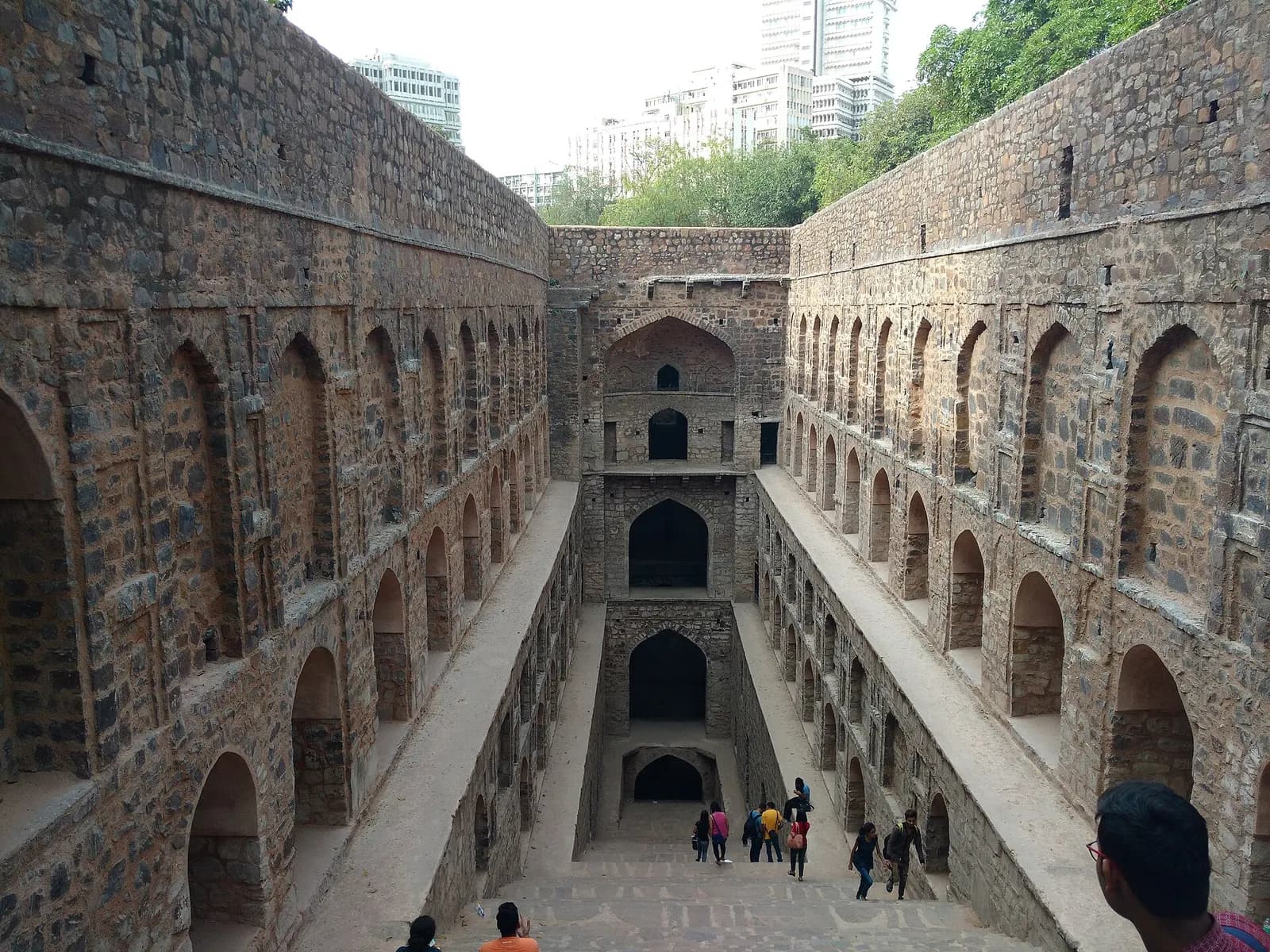
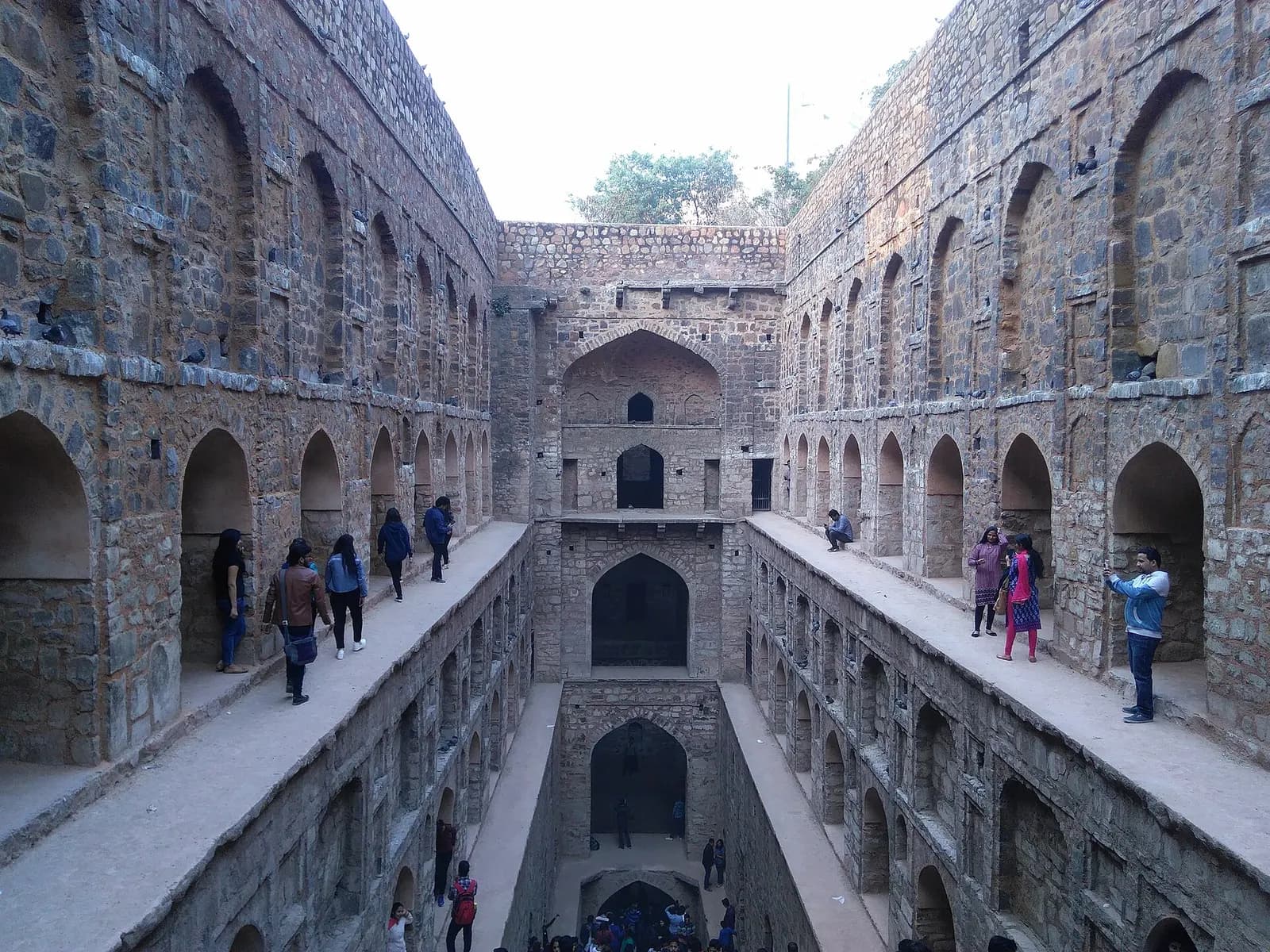
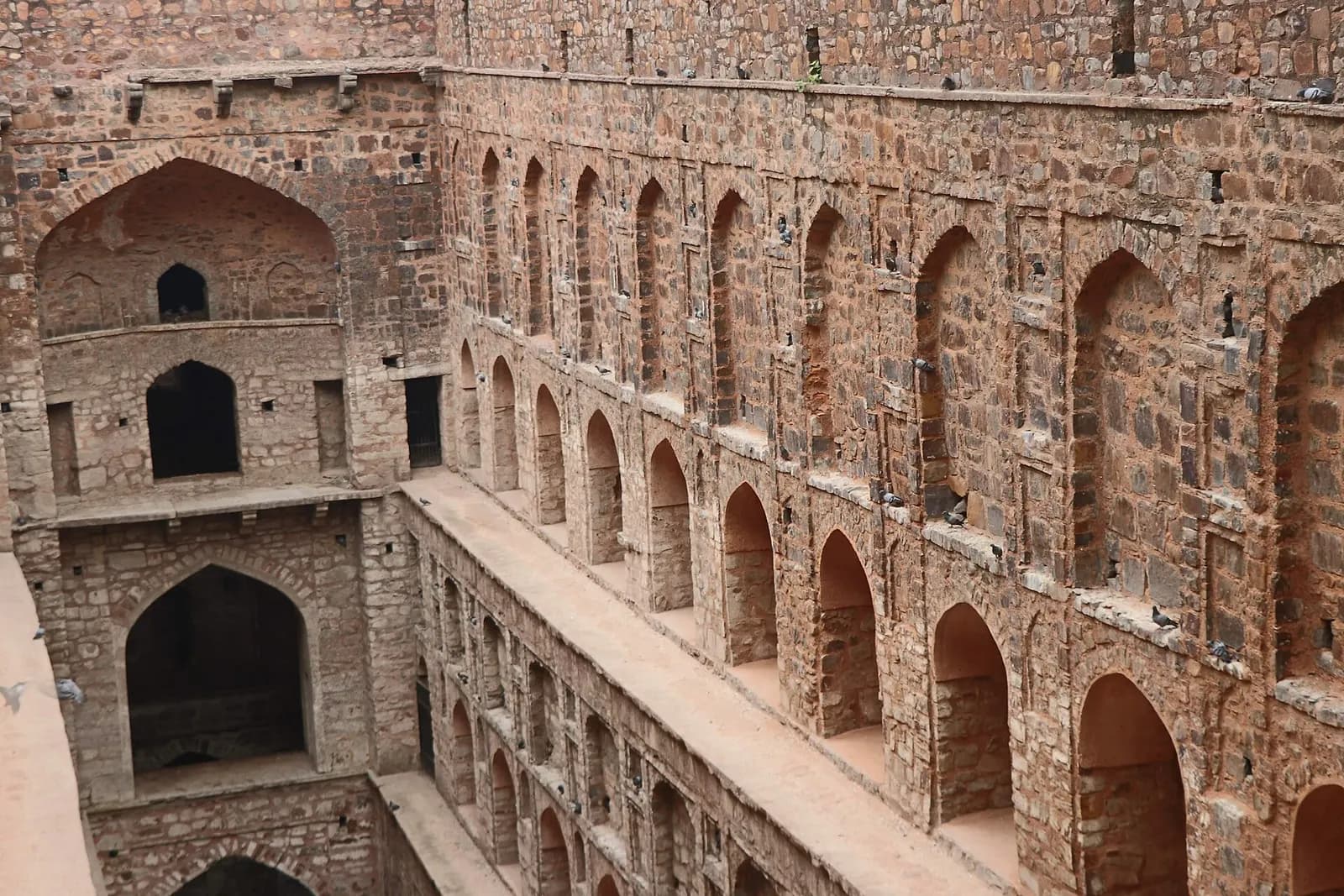
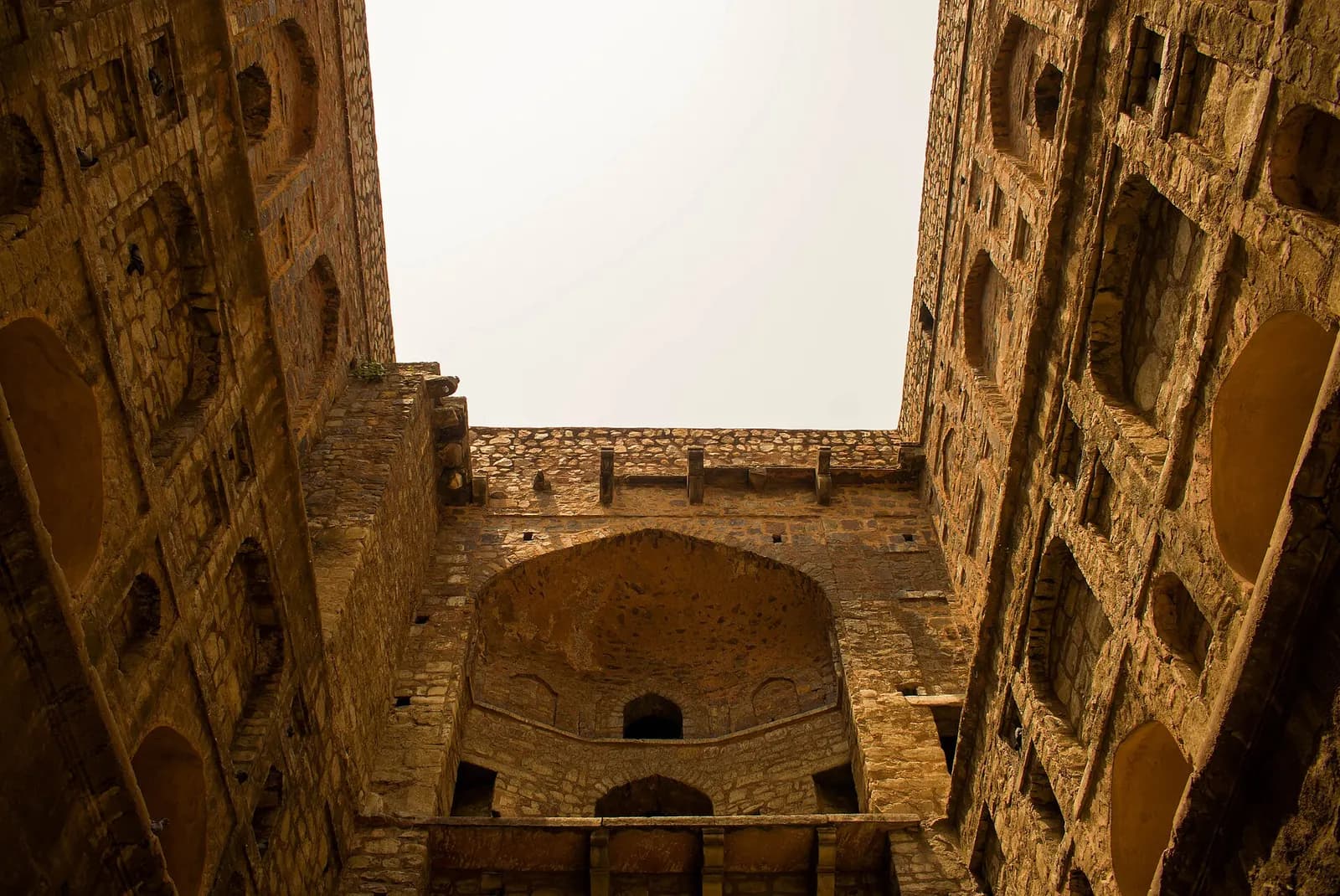
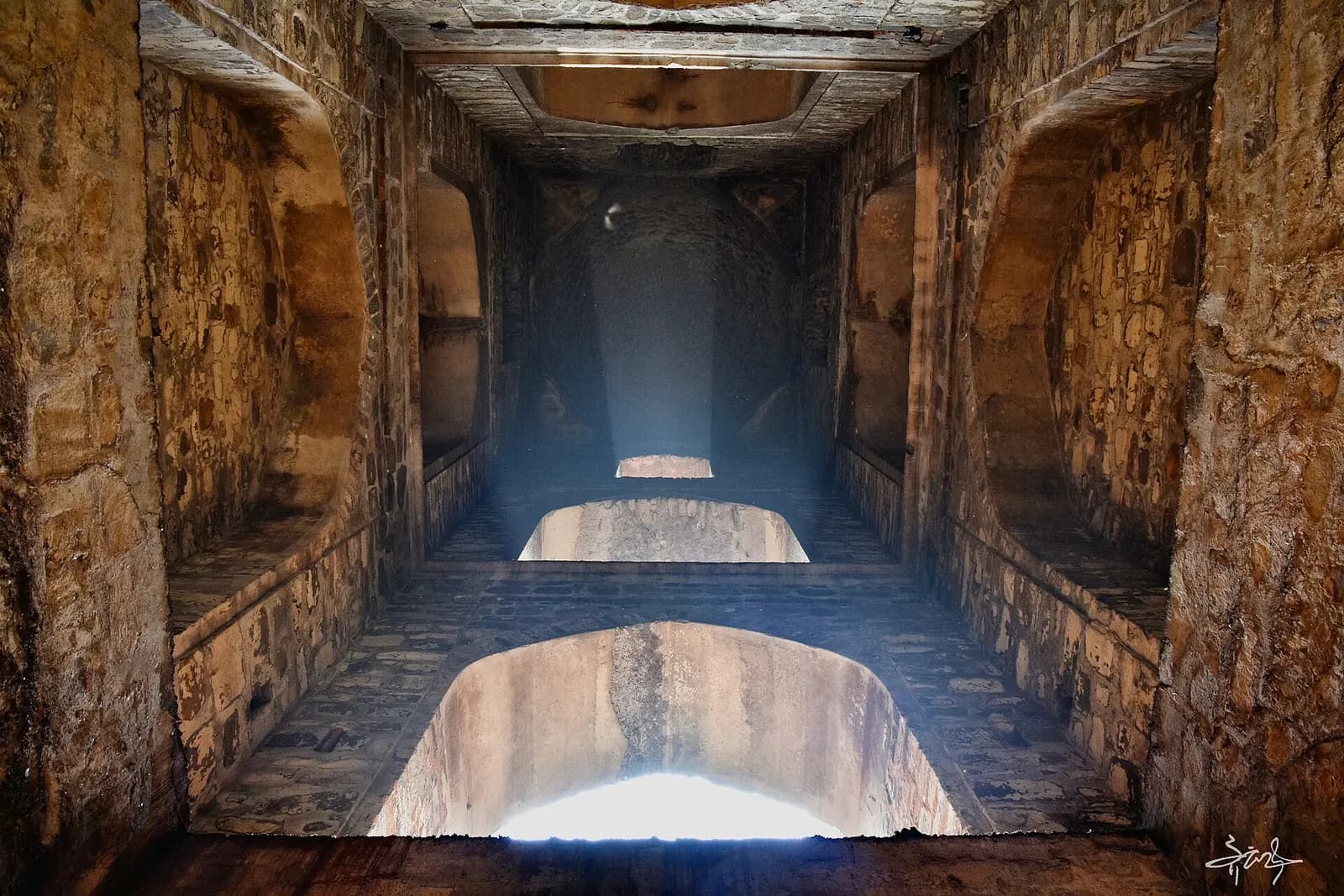
Architecturally, Agrasen ki Baoli is a long, rectangular stepwell rather than the circular kind, built in rubble masonry and stretching about 60 metres in length. A single grand staircase of more than a hundred steps descends from the entrance at one end down to the old well shaft at the other, dropping through three distinct levels. On both sides of the steps run symmetrical arched niches, chambers and passages, tier upon tier and it is this repeating rhythm of arches that gives the baoli its famous, almost graphic beauty.
The main things to look for as you explore:
- The three tiers of arched galleries lining the long descent, the signature view and the reason photographers love it.
- The deep well shaft at the far end, now dry, around which the whole structure is organised; the lowest level is gated off for safety.
- The small ruined mosque on a raised platform at the western end, with a roof carried on carved stone pillars, a reminder of the baoli's medieval context.
- The play of light and shade as you go down, with the noise of the city fading and the air cooling, level by level.
It is compact enough to take in quickly but rewarding enough to linger and every level offers a different frame of those endlessly repeating arches.
Part of what makes the architecture so satisfying is the careful symmetry. The niches on either side of the staircase mirror each other almost exactly, so that as you look down the long axis of the well the arches line up in a receding series, drawing the eye towards the dark shaft at the end. The masonry is plain rubble and stone rather than fine carving, which suits the baoli's workmanlike origins, yet the sheer repetition and proportion give it an elegance that more ornate monuments sometimes lack. Notice too how the light changes as you descend: the upper levels are bright and open to the sky, while the lower galleries fall into cool shadow, so the mood shifts with every flight of steps. Pause on one of the landings, where water would once have pooled in the monsoon and look back up at the city skyline framed by the ancient arches; that contrast of old and new, captured in a single glance, is the image most visitors carry away.
Which films were shot at Agrasen ki Baoli?
A big part of the stepwell's modern fame comes from the screen. Its dramatic, otherworldly look has made it a favourite backdrop for film makers and one film in particular turned it into a sensation with younger visitors. Productions associated with the site include:
- PK, the blockbuster starring Aamir Khan, the film most credited with making the baoli famous and bringing in a wave of new visitors.
- Sultan, the Salman Khan hit, which also used the stepwell as a location.
- Mom, the 2017 thriller starring Sridevi.
Several other Hindi films and countless music videos, photo shoots and social media reels have used it too, drawn by that unmistakable staircase of arches. If you have seen the baoli on screen and come to find it in person, you are in very good company and it is worth remembering that this film fame is relatively recent; for most of its long life it was a quiet, almost forgotten corner of the city.
Is Agrasen ki Baoli really haunted?
No, not in any real sense, but the legend is part of the fun. Agrasen ki Baoli regularly appears on lists of Delhi's most haunted places and the stories usually centre on the now dry well at the bottom. Old folklore claimed the black water once held there had a strange, hypnotic pull, drawing people to leap to their deaths and visitors sometimes report an eerie, heavy stillness as they descend into the deeper, darker levels. Much of that atmosphere has a simple explanation: the lower alcoves are home to hundreds of pigeons and bats, so the air fills with the echo of fluttering wings and soft sounds that feel unnerving in the gloom. The result is a site that is genuinely atmospheric and a little spooky in the best way, without anything to actually fear. Treat the haunted reputation as a colourful local legend and part of the experience, not a warning.
If anything, the legends are a gift to the site's modern fame. They give the baoli a frisson that draws curious visitors and ghost story fans alongside the architecture lovers and photographers and they feed the stream of reels and posts that keep it popular. Stand a little way down the steps on a quiet morning, with the city muffled above and the soft rustle of wings below and you can see how the stories took hold: the place has a stillness and a scale that the imagination fills in on its own. Enjoy that mood for what it is, a wonderfully evocative atmosphere and you will understand why Agrasen ki Baoli has become one of Delhi's most talked about hidden corners.
How does Agrasen ki Baoli compare to other Delhi stepwells?
Agrasen ki Baoli is the most famous stepwell in Delhi, but it is not the only one and knowing its cousins adds to the appreciation. The city and its surroundings hold several baolis, each with its own character. In the sprawling Mehrauli Archaeological Park to the south stands the Rajon ki Baoli, a grander, more ornamental stepwell from the Lodi period, often considered the most beautiful in Delhi and the nearby Gandhak ki Baoli, a simpler, older tank linked to the sultanate era. What sets Agrasen ki Baoli apart is not size or ornament but setting and drama: its long, narrow form, its rhythm of arches and above all its improbable location, swallowed by the modern city centre, give it a cinematic quality the others lack. Where the Mehrauli stepwells sit among ruins and greenery, Agrasen ki Baoli hides in plain sight behind office towers, which is exactly why its sudden appearance is so striking. If the baoli sparks an interest in stepwells, the ones at Mehrauli make a wonderful follow up, turning a single curiosity into a small theme running through a Delhi trip.
What are the Agrasen ki Baoli timings and entry fee?
Agrasen ki Baoli is open every day of the week, generally from about 9:00 AM to 5:30 PM, with no weekly closure. Because timings can occasionally shift, treat these as a guide and aim to arrive with time to spare before closing. Entry is completely free for everyone, Indian and foreign visitors alike, with no ticket, no counter and no online booking required, which makes it one of the best value sights in the whole city. Casual still and smartphone photography is free, but tripods are not permitted and any professional or commercial filming needs prior permission from the Archaeological Survey of India. A visit usually takes only about 30 to 45 minutes, which makes it an easy and rewarding addition to a central Delhi plan rather than a demanding stop. For a free monument of this quality, so close to the heart of the city, it is one of the best value experiences Delhi offers.
What is the best time to visit Agrasen ki Baoli?
The best time to visit is early in the morning, soon after it opens, roughly between 9:00 AM and 10:30 AM, if you want to experience the baoli in relative peace before the larger crowds of students, tourists and photographers gather later in the day. Early light also falls beautifully down the steps and brings out the texture of the stone, which photographers appreciate. By season, the cool months from October to March are the most comfortable, since Delhi summers are harsh, though the lower levels of the well do stay noticeably cooler than the street even on a warm day, which was part of the point of building it this way. If you are after those clean, crowd free shots of the arches, an early weekday morning is your best bet.
Is Agrasen ki Baoli worth visiting for photography?
Yes and for many visitors photography is the main draw. The repeating arches, the strong symmetry and the dramatic downward perspective make it one of the most photogenic spots in Delhi, equally loved for serious architectural photography and for reels and portraits. Smartphone photography is free and encouraged and the light changes character as you move down the levels, from bright at the top to moody and shadowed near the bottom. A few things are worth knowing so you get your shots without trouble:
- Tripods are not allowed, so plan for handheld shooting; the brighter upper levels make this easy.
- Go early for clean frames before the crowds, as the narrow steps fill up quickly on weekends.
- Mind other visitors on the steep, narrow staircase; it is a popular spot and courtesy keeps it pleasant for everyone.
- The lower levels are darker, so a steady hand or a wall to brace against helps.
What should you know before you go?
Agrasen ki Baoli is one of the easiest major sights in Delhi to visit, free, central and quick, but because it is a deep, old structure with steep steps and no modern safety fittings, a little care makes all the difference. It is well suited to most visitors, including families, as long as you take the descent slowly and keep an eye on children. A few practical points are worth keeping in mind:
- The steps are steep, uneven and narrow, with no side railings along the descent, so watch your footing carefully, especially with children or in sandals.
- The lowest level, near the old water shaft, is gated off for safety, so you can go a long way down but not all the way to the bottom.
- Carry water and expect little shade at the upper levels, though the descent cools as you go.
- It is quick to see, about 30 to 45 minutes, so pair it with nearby sights rather than planning a long visit.
- Parking is very limited on the narrow lane, so arriving by metro or auto is far easier than driving.
How do you reach Agrasen ki Baoli?
Agrasen ki Baoli is easy to reach but easy to miss, tucked down Hailey Road off the main roads near Connaught Place. By metro, the closest station is Barakhamba Road on the Blue Line, a five to seven minute walk away; Janpath on the Violet Line is another close option at roughly seven to nine minutes and the big Rajiv Chowk interchange is about a fifteen minute walk from the Connaught Place inner circle. Because street parking on Hailey Road is extremely limited and congested, the easiest approach by car is to use one of the authorised multi level car parks in Connaught Place and then walk or take a short auto to the lane.
Its central position, a short hop from Jantar Mantar and the government quarter, means it slots neatly into any central Delhi plan. If you are threading a wider route, a dedicated New Delhi tour can tie it together with the imperial sights, while a broader Delhi day tour folds the stepwell into the full span of the capital.
What is there to see near Agrasen ki Baoli?
Agrasen ki Baoli sits right in the heart of New Delhi, so it pairs effortlessly with plenty nearby. A twelve to fifteen minute walk down the connecting roads brings you to Jantar Mantar, the fascinating 18th century astronomical observatory, which makes a natural companion stop. Right next door is Connaught Place, the grand colonial era hub of shops, cafes and restaurants, perfect for a meal after your visit and the area is full of good food and coffee. Close by too is the serene Bangla Sahib Gurudwara, one of Delhi's most important Sikh shrines, with its golden dome and vast sacred pool.
A little further out, the heritage keeps coming. For another, wilder cluster of medieval ruins and stepwells, the sprawling Mehrauli Archaeological Park is superb, the leafy Hauz Khas complex pairs a lake and ruins with cafes and the lawns and tombs of Lodhi Garden make a lovely green contrast. Together these turn Agrasen ki Baoli into a natural stop on a rewarding central Delhi day and you can see the fuller picture in our guide to the important monuments of Delhi.
How does Agrasen ki Baoli fit into a Delhi itinerary?
For most visitors, Agrasen ki Baoli works best as a short, atmospheric stop of half an hour or so, folded into a central Delhi morning with Jantar Mantar, Connaught Place and Bangla Sahib all within easy reach. Because it is so quick to see, it is an ideal addition rather than a centrepiece, a surprising change of texture between the grander monuments. History and photography minded travellers often link it with the city's great sights, the towering Qutub Minar, the mighty Red Fort, the serene Humayun's Tomb, the imperial avenues of India Gate and the modern Lotus Temple, for a day that spans Delhi's whole range.
If Delhi is your gateway to the wider Golden Triangle, a stepwell like this adds a lovely, human scale note to a trip otherwise full of grand forts and tombs, a reminder of the everyday ingenuity behind the headline monuments. Many of my guests enjoy it precisely because it is unexpected, a quiet, cinematic pause in a busy sightseeing day. For the best season across the capital, our guide to the best time to visit Delhi is a useful companion and the roundup of places to visit in Delhi helps you build the rest of the day.
Travel tips for visiting Agrasen ki Baoli
A few pointers make the visit smoother and safer:
- Come early, soon after opening, to enjoy the baoli and photograph it before the crowds arrive.
- Wear sensible shoes and take the steep, railing free steps slowly; the surface is uneven.
- Leave the tripod at home, since it is not allowed; handheld smartphone photography is free and works well.
- Visit by metro from Barakhamba Road or Janpath, as parking on the lane is very limited.
- Pair it with nearby sights like Jantar Mantar and Connaught Place, since the baoli itself takes only 30 to 45 minutes.
- Enjoy the spooky atmosphere of the lower levels, but do not expect to reach the very bottom, which is gated off.
- Carry water and visit in the cooler months for the most comfortable experience.
If you would like a local to build Agrasen ki Baoli into a wider Delhi plan, message our team on WhatsApp at +91 7302265809 with your travel dates and group size and we will help you shape the day.
Plan your trip with us
At Experience My India, through our Delhi and Golden Triangle travel desk, we design unhurried, well paced trips that make room for hidden gems like Agrasen ki Baoli, not just the headline monuments. Whether you want a relaxed set of Delhi Agra tours or a full Golden Triangle route through Delhi, Agra and Jaipur, we plan around your pace, your interests and the right season, with local guides who know the quiet lanes as well as the famous landmarks. Share your dates and the kind of trip you have in mind through our enquiry page, tell us your group size and we will put together an honest, tailored plan rather than a rushed checklist.
Related guides
- Akshardham temple, for a very different, modern Delhi landmark
- Nearby places to visit in Delhi, to extend your day
Enquire Now
Ready to Explore
The Magic of Agra?
Experience the Taj Mahal at sunrise, explore the mighty Agra Fort, and discover the hidden gems of India's most beloved heritage city with our expert-guided premium tours.

Agra
Premium Tour Package
Questions
Frequently asked questions
What are the timings of Agrasen ki Baoli?
It is open every day, generally from about 9:00 AM to 5:30 PM. Timings can shift slightly, so aim to arrive with time to spare before closing.
What is the entry fee for Agrasen ki Baoli?
Which is the nearest metro station to Agrasen ki Baoli?
How many steps does Agrasen ki Baoli have?
Who built Agrasen ki Baoli?
Which films were shot at Agrasen ki Baoli?
Is Agrasen ki Baoli haunted?
How much time do I need at Agrasen ki Baoli?
Is Agrasen ki Baoli worth visiting?
Can you go to the bottom of Agrasen ki Baoli?
Are tripods or professional cameras allowed at Agrasen ki Baoli?
Explore more
Plan your Agrasen ki Baoli trip with us

Photo credits
Photos from Wikimedia Commons, used under their licences:
- Photo 1 by Sudhanshu5442, CC BY-SA 4.0
- Photo 2 by ANURAG SADHUKHAN, CC BY-SA 4.0
- Photo 3 by Kuldeep Maruvada, CC BY-SA 4.0
- Photo 4 by Mourya06, CC BY-SA 4.0
- Photo 5 by 齐云飞, CC BY-SA 4.0
Interested in Agrasen ki Baoli Delhi: Timings, Entry, History and Visitor Guide?
Chat with our travel team for a custom quote, or browse every package.
Related Attractions
9Ready to explore Agrasen ki Baoli Delhi: Timings, Entry, History and Visitor Guide?
Book your private tour today and experience the magic of India's rich heritage.