


Gurudwara Bangla Sahib Delhi: Timings, History and Visitor Guide
Visiting Gurudwara Bangla Sahib in Delhi? Timings, free entry, the Sarovar, langar, the Guru Har Krishan history, dress code, nearest metro and tips.
In a Nutshell
“Gurudwara Bangla Sahib is the most prominent Sikh shrine in central Delhi, near Connaught Place, instantly known by its golden dome, white marble halls and large sacred pool, the Sarovar. Linked to the eighth Sikh Guru, Har Krishan, who tended the sick here during an epidemic in the 1660s, it welcomes people of every faith free of charge, is open around the clock and serves a free community meal, the langar, to tens of thousands daily. The nearest metro is Patel Chowk and it is one of Delhi's most peaceful and moving places. It is explored on our Delhi tours, run by a unit of Experience My India.”
Gurudwara Bangla Sahib is an oasis of calm and kindness in the middle of busy central Delhi, where the continuous hymns, the shimmering pool and the vast free kitchen leave almost every visitor moved, whatever their faith. If you want to experience the living spirit of Sikhism and its ideals of service and equality, this is the place. Our team at Delhi Agra Tour Packages often includes a respectful visit for guests and it is a gentle highlight of any wider Golden Triangle tour.
I am Abhay Sharma, Delhi born and a Golden Triangle guide since 2015 and I always tell guests that Bangla Sahib is as much about feeling as sightseeing. This guide gathers everything I would tell a visitor beforehand, checked against current information, including the etiquette that makes a visit welcome and comfortable.
Details
Gurudwara Bangla Sahib at a glance
| Detail | Information |
|---|---|
| Location | Ashoka Road, near Connaught Place, central Delhi |
| Faith | Sikh gurudwara, open to all faiths |
| Known for | Golden dome, white marble, the Sarovar pool and free langar |
| Linked to | The eighth Sikh Guru, Har Krishan |
| Entry fee | Free |
| Open | 24 hours, every day |
| Nearest metro | Patel Chowk (Yellow Line) or Shivaji Stadium (Airport Express) |
| Time needed | 1 to 2 hours, more to share a meal or volunteer |
Gurudwara Bangla Sahib timings
| Detail | Information |
|---|---|
| Opening | Open 24 hours, 7 days a week, all year |
| Prayers and kirtan | Continuous devotional hymns through the day |
| Langar | Near-continuous; typical peak cycles about 9:00 AM to 3:00 PM and 7:00 PM to 10:00 PM |
| Museum | Baba Baghel Singh Museum, about 9:00 AM to 8:00 PM |
The gurudwara is open round the clock, every day of the year, with devotional kirtan streaming continuously. The free kitchen or langar, runs for most of the day with busier dining cycles around mid-morning to afternoon and evening. Timings for the museum and specific ceremonies can vary, so reconfirm if they matter to your visit.
Entry and etiquette
| Detail | Information |
|---|---|
| Entry fee | Completely free, including the langar |
| Head covering | Mandatory for everyone; free scarves provided |
| Footwear | Removed and left at the free Jora Ghar; walk through the foot-wash stream |
| Dress code | Modest, shoulders and knees covered |
| Photography | Not allowed inside the inner shrine or at the sacred pool steps |
Entry is completely free, as is the langar and the gurudwara welcomes visitors of every faith, caste and nationality. Observing the simple etiquette below is essential and makes your visit comfortable and respectful.
How to reach
| From | Route |
|---|---|
| Patel Chowk metro (Yellow Line) | The closest, about an 8 minute walk |
| Shivaji Stadium metro (Airport Express Line) | About a 6 minute walk |
| Rajiv Chowk metro (Blue and Yellow lines) | A 10 to 12 minute walk or short auto |
| By car | Via Ashoka Road or Baba Kharak Singh Marg; large free underground parking |
What is Gurudwara Bangla Sahib and why is it special?
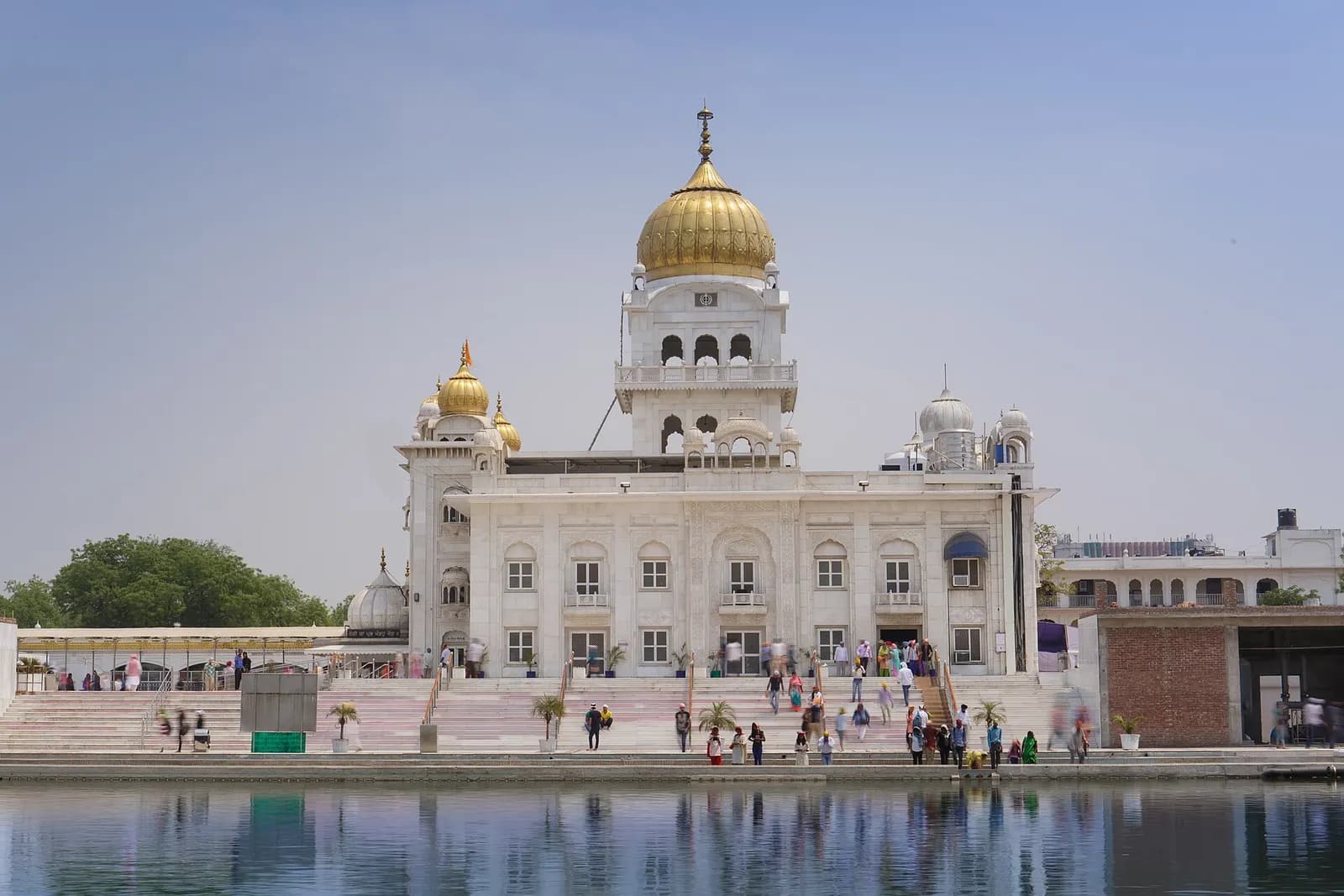
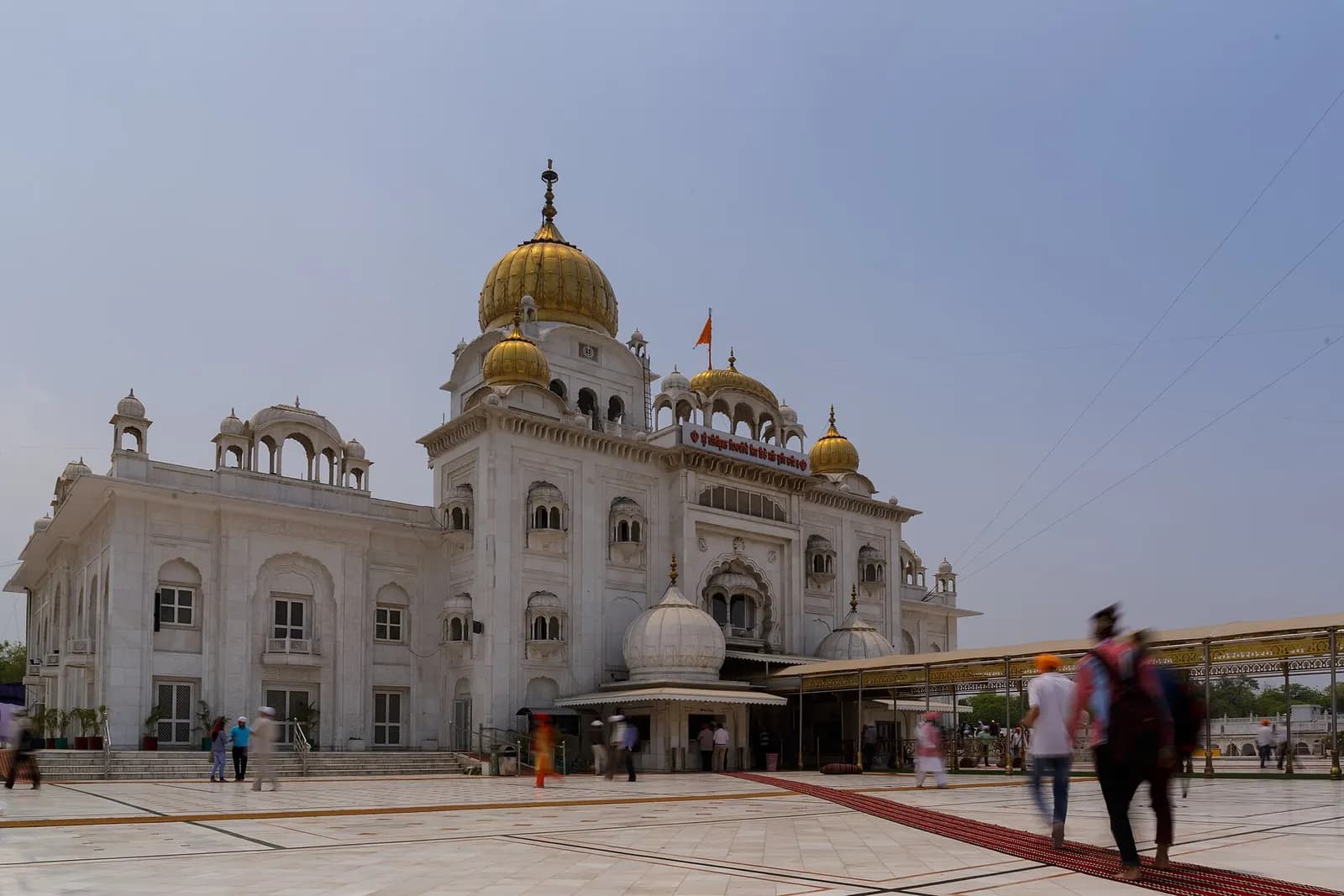
Gurudwara Bangla Sahib is the best known and most visited Sikh house of worship in Delhi, a serene white marble complex crowned by a golden dome in the heart of the city, close to Connaught Place. At its centre lies the main prayer hall, housing the Guru Granth Sahib, the Sikh holy scripture and beside it the large sacred pool, the Sarovar. Open to all around the clock and entirely free, it is at once a major pilgrimage site, a working centre of charity and service and a place of extraordinary peace amid the city's bustle.
It is special for several reasons worth spelling out:
- A living embodiment of Sikh values. Equality, service and hospitality to all are not just preached but practised here, visibly, every day.
- The golden dome and Sarovar. The gleaming dome, white marble halls and the still, sacred pool make it one of the most beautiful and photogenic sites in central Delhi.
- The langar. A vast free community kitchen feeds tens of thousands of people of every background daily, one of the most moving sights in the city.
- A healing history. Linked to Guru Har Krishan, who tended the sick here during an epidemic, the shrine and its holy water carry a deep tradition of healing.
- Welcome to all. People of every faith and none are warmly welcomed, free of charge, at any hour.
It belongs on any thoughtful list of things to do in Delhi and it is one of the most peaceful and uplifting of the spiritual places to visit in Delhi.
What is the history of Gurudwara Bangla Sahib?
The history of Bangla Sahib is deeply moving and it explains everything about the shrine's character. The site was originally a grand bungalow, a bangla, which is where the name comes from, belonging to Raja Jai Singh, a leading noble of the 17th century. In 1664 the eighth Sikh Guru, Sri Guru Har Krishan Ji, then only a child, came to Delhi and stayed here as his guest. During his stay a terrible epidemic of smallpox and cholera was ravaging the city and the young Guru is remembered for his selfless compassion, tending to the suffering and distributing fresh water from the bungalow's well to the sick. The water is said to have eased the pain of countless people. In caring for the afflicted the Guru himself contracted smallpox and he passed away here at the tender age of eight, a story of selfless service that lies at the very heart of the shrine's meaning.
The bungalow's well was later developed into the large holy Sarovar that visitors see today and its water is still regarded by devotees as sacred and healing. The shrine structure itself was built in 1783 by the Sikh general Sardar Baghel Singh, who constructed several gurudwaras in Delhi marking sites associated with the Gurus. Knowing this history, a child Guru giving his life in service during a plague, transforms a visit: the continuing free kitchen, the free medical facilities and the welcome to all are living continuations of that original act of compassion.
Who was Guru Har Krishan?
Guru Har Krishan was the eighth of the ten Sikh Gurus and one of the most beloved, remembered above all for his compassion despite his extreme youth. He became Guru as a small child and led the Sikh community only briefly before his death in Delhi at the age of eight. His short life is defined by the episode at Bangla Sahib, where, during the Delhi epidemic, he is said to have served the sick tirelessly, Sikh and non-Sikh alike, offering water and comfort, until he fell ill himself. For Sikhs he is a powerful example of seva, selfless service and of the idea that true greatness lies in humble compassion rather than age or power. He is often invoked with the words honouring him as the one whose very sight brings relief. Understanding who he was gives the whole gurudwara its emotional depth: the healing well, now the Sarovar, the free food and the free medical care all flow directly from the example of this child Guru and devotees come not only to pray but to feel close to his spirit of service.
It is worth placing him in the wider Sikh story. The Gurus led the community in succession over roughly two centuries, shaping a faith built on devotion to one God, equality of all people, honest work and selfless service to others. Guru Har Krishan's brief life distilled that last ideal, service, into a single, unforgettable act and the fact that he gave his life caring for strangers of all faiths during an epidemic is exactly why Bangla Sahib feels less like a monument and more like a working expression of compassion. The modern complex, with its enormous free kitchen and its low-cost hospital open to the whole public, is in a real sense the Guru's example continued across the centuries. When you see thousands being fed or treated here regardless of who they are, you are watching a 350-year-old act of kindness still rippling outward, which is a rare and powerful thing to witness.
What is a visit to Bangla Sahib like?
A visit to Bangla Sahib is calming and quietly moving in a way that catches many visitors by surprise. You arrive, cover your head, leave your shoes, rinse your feet in the shallow stream and step onto the cool marble of the great courtyard and almost at once the noise and rush of central Delhi fall away. The continuous sound of kirtan, hymns sung to harmonium and tabla, drifts across the complex, the golden dome gleams above the white marble and the still water of the Sarovar reflects the sky. People of every kind move about unhurriedly, some praying, some sitting by the pool, some simply sitting in the shade and there is a palpable sense of peace and welcome. Inside the main hall, devotees bow before the Guru Granth Sahib and sit on the floor to listen to the hymns; you are welcome to join them quietly or simply to observe with respect.
What stays with most visitors is the atmosphere of openness and service. Nobody is turned away, nobody is asked for money and everyone, rich or poor, Indian or foreign, of any religion, is treated exactly the same. Receiving a small portion of the sweet prasad, sharing the langar meal or watching volunteers at work gives a direct, humbling sense of the Sikh ideals in action. It is a place to slow down and feel rather than to tick off sights and an hour here can be one of the most restorative and meaningful parts of a trip to Delhi.
What can you see and do at Gurudwara Bangla Sahib?
The complex has several distinct parts and a visit naturally flows between them. The key features:
- The main prayer hall. A beautiful white marble hall under the golden dome, where the Guru Granth Sahib is enshrined and continuous kirtan, devotional singing, fills the air. You can sit quietly and absorb the atmosphere.
- The Sarovar. The expansive sacred pool, bordered by marble walkways and home to colourful fish, where devotees bathe or touch the holy water. Walking its calm perimeter is the heart of the experience.
- The langar hall. The vast, air-conditioned community dining hall where free vegetarian meals are served to all, seated together on the floor in long rows or pangat, a powerful expression of equality.
- The Baba Baghel Singh Museum. An on-site multimedia museum with rare Sikh paintings, weapons and artefacts and a short 3D film, telling the history of the Gurus and the shrine.
- Seva or volunteering. Visitors are welcome to take part in the selfless service that runs the gurudwara, from helping in the kitchen to washing dishes, a deeply rewarding experience.
Simply sitting by the Sarovar listening to the hymns or sharing a meal in the langar, is for many the most memorable part, more than any single sight.
What is the langar at Bangla Sahib?
The langar, the free community kitchen, is one of the most extraordinary things you will see in Delhi and it is central to the Sikh faith. Every single day, Bangla Sahib prepares and serves free, hot, freshly cooked vegetarian meals to tens of thousands of people, with estimates commonly in the range of 35,000 to 50,000 daily, swelling to far more, sometimes well over a hundred thousand, on major holidays. Everyone is welcome, regardless of faith, caste, class or nationality and all sit together on the floor in rows to eat as equals, which is the whole point: the langar is a living demonstration of the Sikh principles of equality, humility and selfless service. The scale is staggering, vast vats of dal and sabzi, thousands of rotis rolled and cooked, mountains of dishes washed, almost all of it by volunteers performing seva. You are warmly invited to eat and also, if you wish, to volunteer, even for a short while; rolling rotis or washing plates alongside the regulars is a humbling and uplifting experience that many travellers remember as the highlight of their trip. The meal is simple, wholesome and given freely, with no expectation of payment, though a voluntary donation is welcome.
What are the facilities at Gurudwara Bangla Sahib?
True to its founding spirit of service, Bangla Sahib offers a remarkable range of charitable facilities alongside the worship:
- Free langar. The community kitchen feeds tens of thousands daily, open to all.
- The Jora Ghar. Free, token-based shoe storage where you deposit footwear before entering.
- Free head scarves. Clean bandanas and scarves provided at the entrance for covering your head.
- Medical facilities. The complex runs an ultra-affordable dispensary and diagnostic centre offering low-cost healthcare to the public, including services such as dialysis and MRI scans, a modern continuation of the shrine's healing tradition.
- Yatri Niwas. Budget-friendly lodging managed by the committee for pilgrims travelling from across India and abroad.
- Large free parking. A big underground car park for two and four wheelers.
These facilities mean a visit is easy and comfortable and they are themselves a moving illustration of the gurudwara's commitment to serving all of humanity, not just its own community.
What are the dress code and rules at Bangla Sahib?
Because Bangla Sahib is an active, sacred place of worship, following its simple code of conduct is essential and doing so is easy and makes you welcome. The key rules:
- Cover your head. Everyone, men and women, must keep their head fully covered everywhere on the grounds. Free scarves are provided at the entrance or bring your own; ordinary hats and caps are not acceptable.
- Remove footwear. Leave your shoes and socks at the free Jora Ghar counter and walk through the shallow foot-washing stream before entering the main area.
- Dress modestly. Cover your shoulders and knees; sleeveless tops, shorts, short dresses and miniskirts are not allowed.
- Respect photography limits. Photography and video are not permitted inside the inner prayer shrine or around the sacred pool steps, out of respect for those praying.
- No intoxicants. Tobacco, alcohol and other intoxicants are strictly forbidden anywhere in the complex.
Follow these simple customs and you will find the community exceptionally warm and welcoming. The visit is free and any donation is entirely voluntary.
What are the Bangla Sahib timings and entry fee?
Gurudwara Bangla Sahib is open 24 hours a day, every day of the year, with devotional hymns streaming continuously, so you can visit at any hour and it is completely free to enter, to sit by the Sarovar and to eat in the langar. There are no tickets or charges of any kind. The free kitchen runs for most of the day, with busier dining cycles tentatively around 9:00 AM to 3:00 PM and 7:00 PM to 10:00 PM, though food is generally available near-continuously. The Baba Baghel Singh Museum is typically open around 9:00 AM to 8:00 PM. A standard visit takes one to two hours; if you choose to share a meal or to volunteer in the seva, allow two to three. Any donation you make is voluntary and the only things asked of you are respect and the simple dress and conduct rules. The complex is well equipped, with free shoe storage, scarves, parking and even medical facilities, so a visit is easy and comfortable at any time.
What is the best time to visit Gurudwara Bangla Sahib?
Because it is open around the clock, you can visit Bangla Sahib at any time, but a few moments are especially beautiful. Early morning, around dawn, is wonderfully peaceful and spiritual, with the Amrit Vela prayers and few crowds and the white marble glowing softly in the first light. The evening is equally special, when the whole complex and its golden dome are beautifully illuminated and the kirtan takes on a warm, intimate feel; many consider dusk and after dark the most atmospheric and photogenic time. By season, the cool months from October to March are the most comfortable for the open marble courtyards, which can be hot underfoot in summer and cold on a winter dawn, so dress for the weather. If you want to experience the langar, come around a mealtime; if you want calm and good light for photography of the exterior and Sarovar, early morning or evening on a weekday is ideal, as weekends and Sikh festival days bring very large crowds.
Major Sikh occasions, above all the birth anniversaries of the Gurus, Gurpurab and festivals such as Baisakhi, transform Bangla Sahib into a tide of devotion, with the complex decorated and illuminated, continuous processions and kirtan and the langar expanding to feed enormous numbers. Witnessing one of these is extraordinary, but be ready for dense crowds and long, slow movement. For a first visit, many travellers find a quiet early morning the most rewarding, when the marble is cool, the hymns are gentle and you can take in the Sarovar and the main hall in peace before the day builds. Whenever you come, allow a little unhurried time rather than rushing through, as the atmosphere, more than any single feature, is the real reason to visit.
How do you reach Gurudwara Bangla Sahib?
Bangla Sahib is very easy to reach in central Delhi and the metro is the best way to get there. The closest station is Patel Chowk on the Yellow Line, about an eight minute walk away and Shivaji Stadium on the Airport Express Line is even closer at around six minutes; the big Rajiv Chowk interchange is a ten to twelve minute walk or a short auto ride. By car it is easily reached via Ashoka Road or Baba Kharak Singh Marg and the gurudwara provides a large, free underground car park for two and four wheelers, which makes driving straightforward too.
Its central location, beside Connaught Place and close to India Gate and the government quarter, means it fits easily into any central Delhi plan. If you are threading a wider route, a dedicated New Delhi tour can tie it together with the imperial sights, while a broader Delhi day tour folds the shrine into the full span of the capital.
What is there to see near Gurudwara Bangla Sahib?
Bangla Sahib sits right in the heart of New Delhi, surrounded by sights. Immediately beside it is the Sacred Heart Cathedral and the colonial shopping circle of Connaught Place is a short walk away, close to the astronomical observatory of Jantar Mantar and the hidden stepwell of Agrasen ki Baoli. The grand avenue leading to India Gate is also close.
For those following a trail of Delhi's great places of worship, the nearby Birla Mandir on Mandir Marg, the hilltop Kalkaji Mandir and the ISKCON temple in the south and the modern Lotus Temple and Akshardham make a rich circuit. The great monuments of the city, the Red Fort, the Qutub Minar and Humayun's Tomb, are all a manageable ride away. Together these make Bangla Sahib a natural part of a central Delhi day and you can see the fuller picture in our guide to the important monuments of Delhi.
How does Gurudwara Bangla Sahib fit into a Delhi itinerary?
For most visitors, Bangla Sahib works beautifully as a calming, uplifting stop in a central Delhi day, easily combined with nearby Connaught Place, Jantar Mantar and India Gate. Because it is free, open at all hours and quick to see, it slots in effortlessly and timing a visit around a langar mealtime or setting aside a little time to volunteer, turns it into something more profound than ordinary sightseeing. Those exploring Delhi's spiritual side often link it with the city's other great places of worship across faiths, from temples to the Lotus Temple, for a moving picture of the capital's religious diversity. Travellers on a fuller itinerary can balance it with the grand historic monuments, the Red Fort and Humayun's Tomb, for a day that moves between history and living faith.
If Delhi is your gateway to the wider Golden Triangle, Bangla Sahib offers something no fort or palace can, a direct, heartfelt encounter with the Sikh ideals of equality and selfless service, embodied in that vast free kitchen feeding all comers. Many of my guests describe their visit and especially the langar, as the most humbling and memorable experience of their entire trip. For the best season across the capital, our guide to the best time to visit Delhi is a useful companion for planning the rest of your days in the capital.
Travel tips for visiting Gurudwara Bangla Sahib
A few pointers make the visit smooth and respectful:
- Carry or collect a head covering, as covering your head everywhere on the grounds is mandatory; free scarves are available at the entrance.
- Dress modestly, covering shoulders and knees and leave shoes at the free Jora Ghar, walking through the foot-wash stream.
- Come at dawn or in the evening for the most peaceful, beautiful atmosphere, the gentlest kirtan and the best light for photography.
- Experience the langar, sharing the free community meal and consider a little seva or volunteering, for a deeper experience.
- Do not photograph inside the inner shrine or at the sacred pool steps, out of respect for worshippers.
- Leave intoxicants behind, as tobacco, alcohol and all other intoxicants are strictly forbidden anywhere in the complex.
- Come by metro to Patel Chowk or Shivaji Stadium, both a short walk away or use the large free underground parking if driving.
- Keep belongings minimal and secure, as the shrine can be very crowded, especially at weekends and on festival days.
- Visit the Baba Baghel Singh Museum on site if you have time, for the history of the Gurus and the shrine told through paintings, artefacts and a short film.
If you would like a local to build Gurudwara Bangla Sahib into a wider Delhi plan, message our team on WhatsApp at +91 7302265809 with your travel dates and group size and we will help you shape the day.
Plan your trip with us
At Experience My India, through our Delhi and Golden Triangle travel desk, we design unhurried, well paced trips that make room for deeply moving experiences like a quiet hour at Gurudwara Bangla Sahib, not just the historic monuments. Whether you want a relaxed set of Delhi Agra tours or a full Golden Triangle route through Delhi, Agra and Jaipur, we plan around your pace, your interests and the right season, with local guides who know how to visit a gurudwara respectfully and can explain its meaning. Share your dates and the kind of trip you have in mind through our enquiry page, tell us your group size and we will put together an honest, tailored plan rather than a rushed checklist.
Related guides
- Nearby places to visit in Delhi, to extend your day
- Hidden places to visit in Delhi, more of the city's quieter corners
Enquire Now
Ready to Explore
The Heart of Delhi?
Explore the Red Fort, Qutub Minar, Humayun's Tomb, and the vibrant streets of Old Delhi with our expert-guided premium tours of India's capital city.

Delhi
Premium Tour Package
Questions
Frequently asked questions
What are the timings of Gurudwara Bangla Sahib?
It is open 24 hours a day, every day of the year, with continuous kirtan. The free langar runs for most of the day and the Baba Baghel Singh Museum is typically open about 9:00 AM to 8:00 PM.
Is there an entry fee for Gurudwara Bangla Sahib?
Which is the nearest metro station to Bangla Sahib?
What is the history of Bangla Sahib?
What is the langar at Bangla Sahib?
What is the dress code at Gurudwara Bangla Sahib?
Can non-Sikhs visit Bangla Sahib?
Can you take photos in Gurudwara Bangla Sahib?
What is the Sarovar at Bangla Sahib?
Is Gurudwara Bangla Sahib worth visiting?
Explore more
Plan your Gurudwara Bangla Sahib trip with us

Photo credits
Photos from Wikimedia Commons, used under their licences:
- Photo 1 by Thomas Fuhrmann, CC BY-SA 4.0
- Photo 2 by Dogagnon, CC BY-SA 4.0
- Photo 3 by Thomas Fuhrmann, CC BY-SA 4.0
- Photo 4 by Thomas Fuhrmann, CC BY-SA 4.0
- Photo 5 by Hindoli Mandal, CC BY-SA 4.0
Interested in Gurudwara Bangla Sahib Delhi: Timings, History and Visitor Guide?
Chat with our travel team for a custom quote, or browse every package.
Related Attractions
9Ready to explore Gurudwara Bangla Sahib Delhi: Timings, History and Visitor Guide?
Book your private tour today and experience the magic of India's rich heritage.