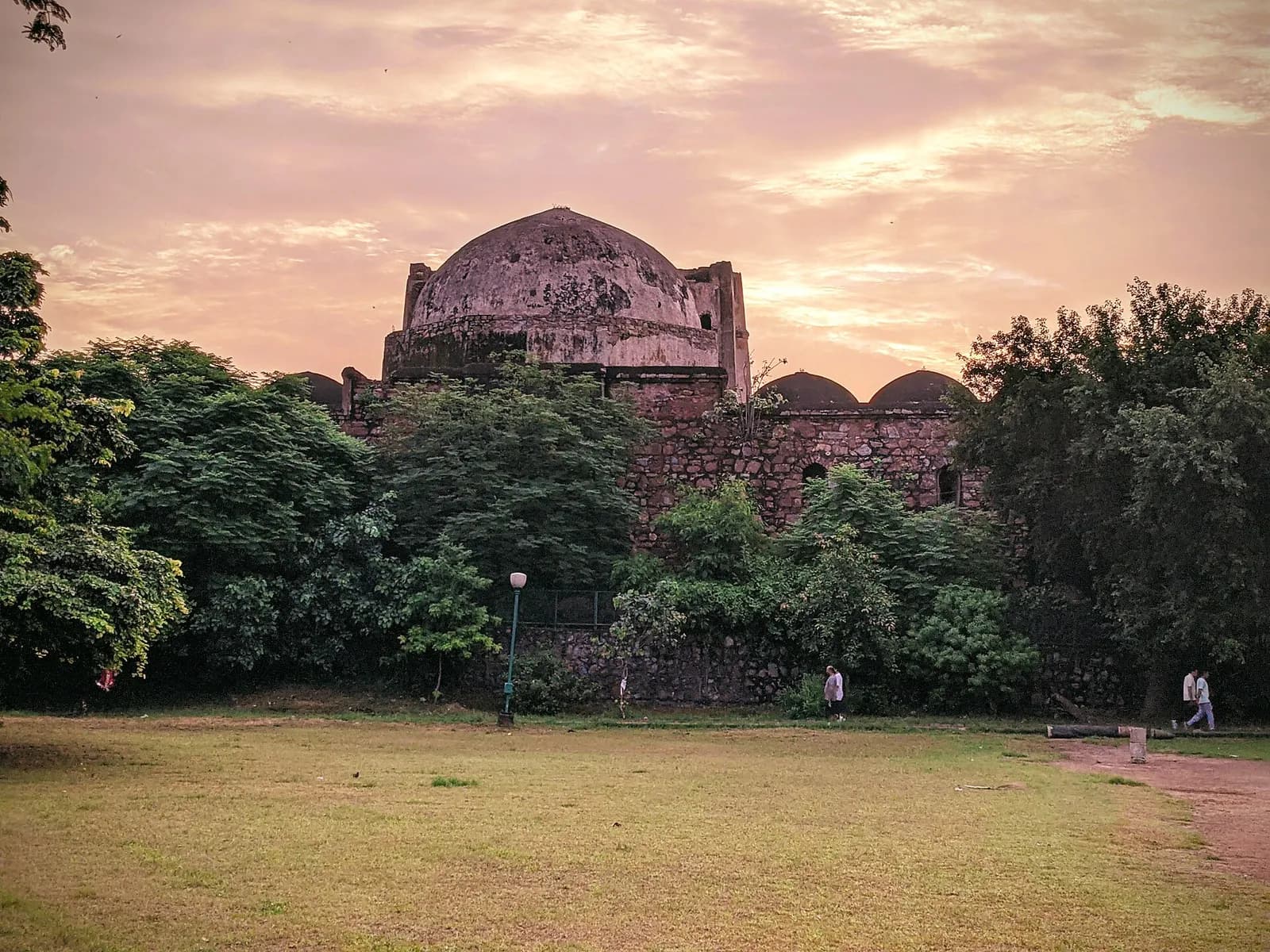
Begumpur Masjid, Jahanpanah: History, Architecture and Guide
Visiting Begumpur Masjid in South Delhi, the great Tughlaq mosque of Jahanpanah? Its history, the Nadir Shah refuge, the 64 domes, timings and how to reach.
In a Nutshell
“Begumpur Masjid, also called Begumpuri Mosque, is a vast 14th-century Tughlaq mosque in Begumpur village near Malviya Nagar in South Delhi, built as the grand congregational mosque of Jahanpanah, the fourth medieval city of Delhi. One of the largest historic mosques in the city, it is a fortress-like masterpiece of austere Tughlaq architecture, famous for its towering central archway, its courtyard ringed by 64 domed arcades and the story of villagers who sheltered inside its walls during Nadir Shah's sack of Delhi. Entry is free and the rooftop offers sweeping views. It features on our offbeat Delhi heritage tours, run by a unit of Experience My India.”
Begumpur Masjid is one of the most imposing and atmospheric of Delhi's hidden monuments, a colossal medieval mosque that most visitors never see, standing serene and empty in a South Delhi village. For the traveller drawn to great architecture, Sultanate history and the quiet grandeur of a monument off the tourist map, it is an unforgettable discovery. Our team at Delhi Agra Tour Packages loves to bring guests here for its scale and silence and it adds a powerful, scholarly depth to a wider Golden Triangle tour through the capital.
I am Abhay Sharma, Delhi born and a Golden Triangle guide since 2015 and Begumpur Masjid is one of the monuments I most love to surprise guests with, because nothing prepares you for the sheer scale and calm of its vast courtyard, ringed by scores of domes or for the extraordinary stories its walls hold, from a whole village sheltering inside to a rooftop view over the ruins of a lost imperial city. This guide gathers everything I would tell a visitor beforehand, checked against current information, including its history, its remarkable architecture, the tales of refuge within its walls and the timings and directions.
Details
Begumpur Masjid at a glance
| Detail | Information |
|---|---|
| Official name | Begumpuri Masjid (Jami Masjid of Jahanpanah) |
| Built | Around 1343 to the 1370s, Tughlaq era |
| Role | Grand congregational mosque of Jahanpanah city |
| Location | Begumpur village, near Malviya Nagar, South Delhi |
| Managed by | Archaeological Survey of India (ASI) |
| Known for | Vast Tughlaq mosque; towering pishtaq; 64 domes |
| Nearest metro | Malviya Nagar (Yellow Line) |
| Entry | Free |
Begumpur Masjid timings
| Detail | Information |
|---|---|
| Open | Every day |
| Hours | About 8:00 AM to 6:00 PM |
| Best time | Morning and late afternoon |
Begumpur Masjid is open every day, generally from around 8:00 AM to 6:00 PM. The early morning and late afternoon are the best times, for soft light on the stonework and cooler conditions in the open courtyard. These timings are current at the time of writing and can vary, so reconfirm before a special trip.
Entry fee
| Visitor | Fee |
|---|---|
| All visitors | Free; no ticket required |
How to reach Begumpur Masjid
| From | Route |
|---|---|
| Malviya Nagar metro (Yellow Line) | Nearest station, then a short walk or auto into Begumpur village |
| Within Begumpur village | A short walk down the lane past the local Mata Mandir |
| Bijai Mandal ruins | About 500 metres away |
| By car | Reachable; village lanes are narrow, so park nearby and walk |
What is Begumpur Masjid?
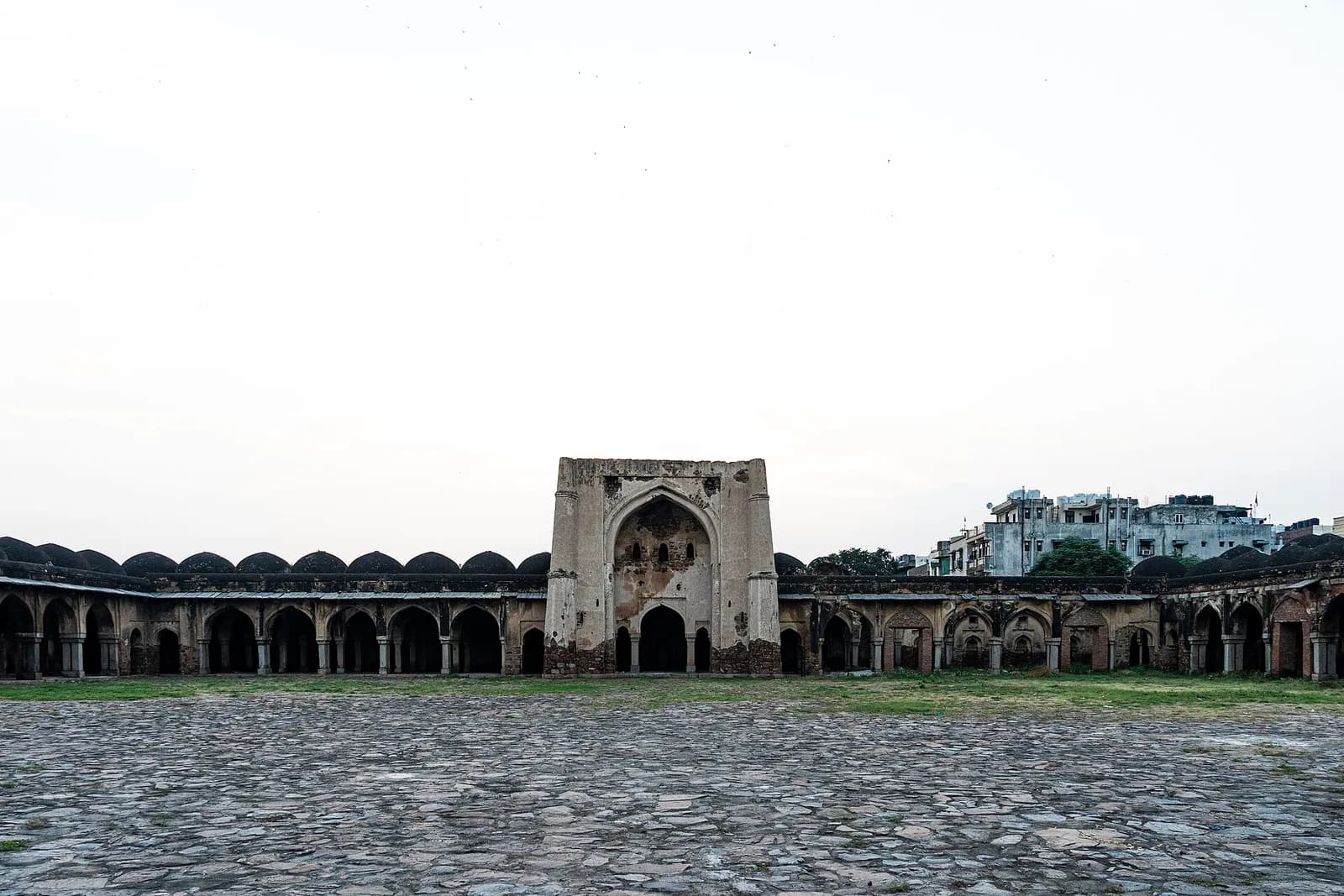
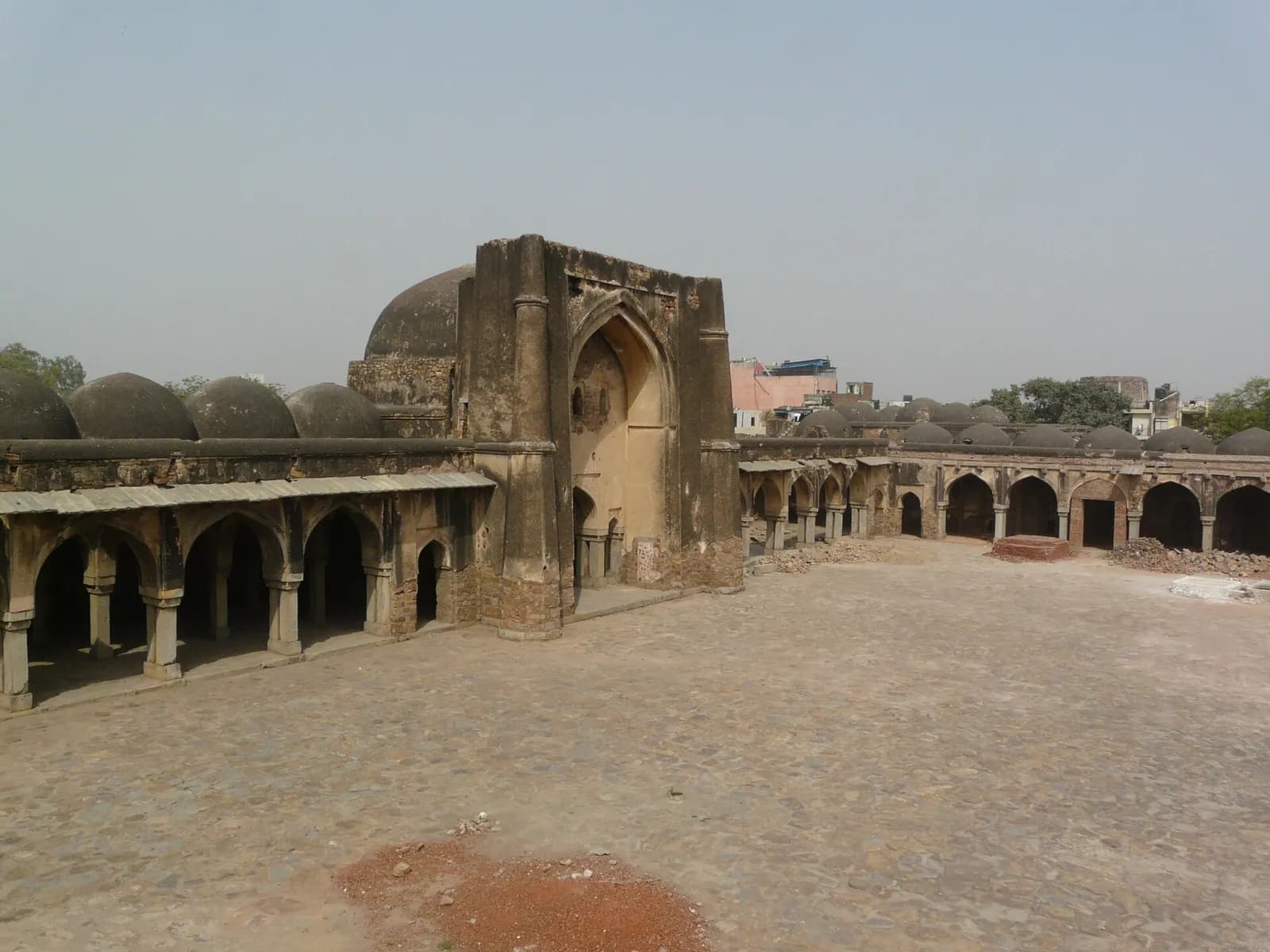
Begumpur Masjid, also known as the Begumpuri Mosque and historically as the Jami Masjid of Jahanpanah, is a vast 14th-century Tughlaq mosque in Begumpur village near Malviya Nagar in South Delhi, built as the grand imperial congregational mosque of Jahanpanah, the fourth of the medieval cities of Delhi. It is one of the largest historic mosques in the city, a monument of colossal scale and austere, fortress-like power, favouring structural geometry over ornament in the classic Tughlaq manner. Its vast open courtyard, measuring tens of metres across, is ringed on three sides by continuous arched cloisters crowned with a grid of 64 small domes, while the western prayer hall is dominated by an enormous central archway that hides the main dome behind it. Protected by the Archaeological Survey of India and standing largely empty and serene today, it is remembered not only for its architecture but for the extraordinary history of its walls, which once sheltered an entire village. For the visitor, it is one of the most impressive and least-known monuments in all of Delhi.
Several things make it remarkable and they are worth drawing out:
- A grand imperial mosque. Built as the main congregational mosque of Jahanpanah, the fourth medieval city of Delhi and among the largest in the city.
- Austere Tughlaq power. A fortress-like masterpiece of Tughlaq architecture, built for scale and strength rather than decoration.
- The towering pishtaq. A huge central archway dominates the prayer hall facade, flanked by sloping pylon-turrets.
- The 64 domes. The arcades around the vast courtyard are crowned by a grid of sixty-four small stone domes.
- A refuge in its walls. The mosque sheltered an entire village during Nadir Shah's sack of Delhi and remained a living enclosure for nearly two centuries.
It is one of the most rewarding of the hidden places to visit in Delhi and a magnificent find among the offbeat things to do in Delhi.
History of Begumpur Masjid
The history of Begumpur Masjid is the history of Jahanpanah, the ambitious medieval city of which it was the religious heart and knowing it gives the monument its full weight. The mosque belongs to the great building era of the Tughlaq dynasty in the 14th century:
- The date and the city. The mosque was built roughly between 1343 and the 1370s, as the grand congregational mosque of Jahanpanah, meaning Refuge of the World, the fourth city of Delhi, founded by the Tughlaqs.
- The question of patronage. Because no founding inscription survives, historians are divided on who built it. It is attributed either directly to Sultan Muhammad bin Tughlaq, as the chief mosque of his new capital or to Khan-i-Jahan Junan Shah, the prolific prime minister of Firoz Shah Tughlaq, who built many mosques.
- A centre of imperial worship. Whatever its patron, the mosque served as the great congregational space of Jahanpanah, where the court and the city gathered for prayer.
This history places Begumpur Masjid at the very centre of one of Delhi's lost imperial cities, built when the Tughlaqs were at the height of their power and ambition. The uncertainty over its patronage, whether the visionary and controversial Muhammad bin Tughlaq or the great builder-minister Khan-i-Jahan Junan Shah, is itself a reminder of how much of this period survives in stone rather than in records. That it was the Jami Masjid, the chief Friday mosque, of an entire imperial city explains its colossal scale and its commanding presence. For the visitor, knowing that this vast, empty mosque was once the thronging religious heart of a capital city, now almost entirely vanished around it, adds a deep sense of history and loss to its serene grandeur.
The refuge in the walls: Nadir Shah and the living village
One of the most extraordinary chapters in the mosque's long life came centuries after it was built, when its fortress-like walls served not for worship but for survival and it is a story that gives the monument a unique human dimension. The mosque became, improbably, a refuge and then a living village:
- The sack of 1739. When the Persian emperor Nadir Shah brutally sacked and plundered Delhi in 1739, the villagers of the region gathered their families, livestock and belongings and hid inside the high, fortress-like walls of the mosque and the Persian troops never thought to look within, saving the community.
- The walled village. After the sack, the villagers refused to leave. For nearly two centuries the great courtyard functioned as an enclosed walled village, filled with brick huts, shops and wells, a whole community living inside the imperial mosque.
- Later refuges. The mosque is said to have concealed refugees again during the upheavals of 1857 and after the ASI finally cleared the village in 1921 to protect the monument, it was briefly occupied once more by refugees during the Partition of 1947.
This history makes Begumpur Masjid far more than an architectural monument: its walls are a record of how ordinary people, across three centuries of upheaval, turned a place of worship into a place of shelter. The image of an entire village, with its huts and shops and wells, living inside the courtyard of a 14th-century imperial mosque for nearly two hundred years is one of the most remarkable in all of Delhi's history. For the visitor, knowing this transforms the empty, silent courtyard you see today, cleared of its village only in the 20th century, into a space layered with centuries of human life, survival and refuge and it is part of what makes the monument so moving.
Architecture of Begumpur Masjid
Architecturally, Begumpur Masjid is a towering masterpiece of Tughlaq Indo-Islamic design, celebrated for its scale, its geometry and its fortress-like power rather than for ornament and its features repay close attention. It is, above all, a benchmark of a whole architectural type:
- The Brhatmukhi design. The mosque is celebrated as an early Indian prototype of the Brhatmukhi or giant-faced, mosque, defined by an enormous towering central archway or pishtaq, in the centre of the western prayer hall facade, flanked by massive sloping pylon-turrets in the Central Asian tradition.
- The hidden dome. The giant pishtaq is so tall that it completely hides the main dome behind it from the courtyard, a dramatic and deliberate effect.
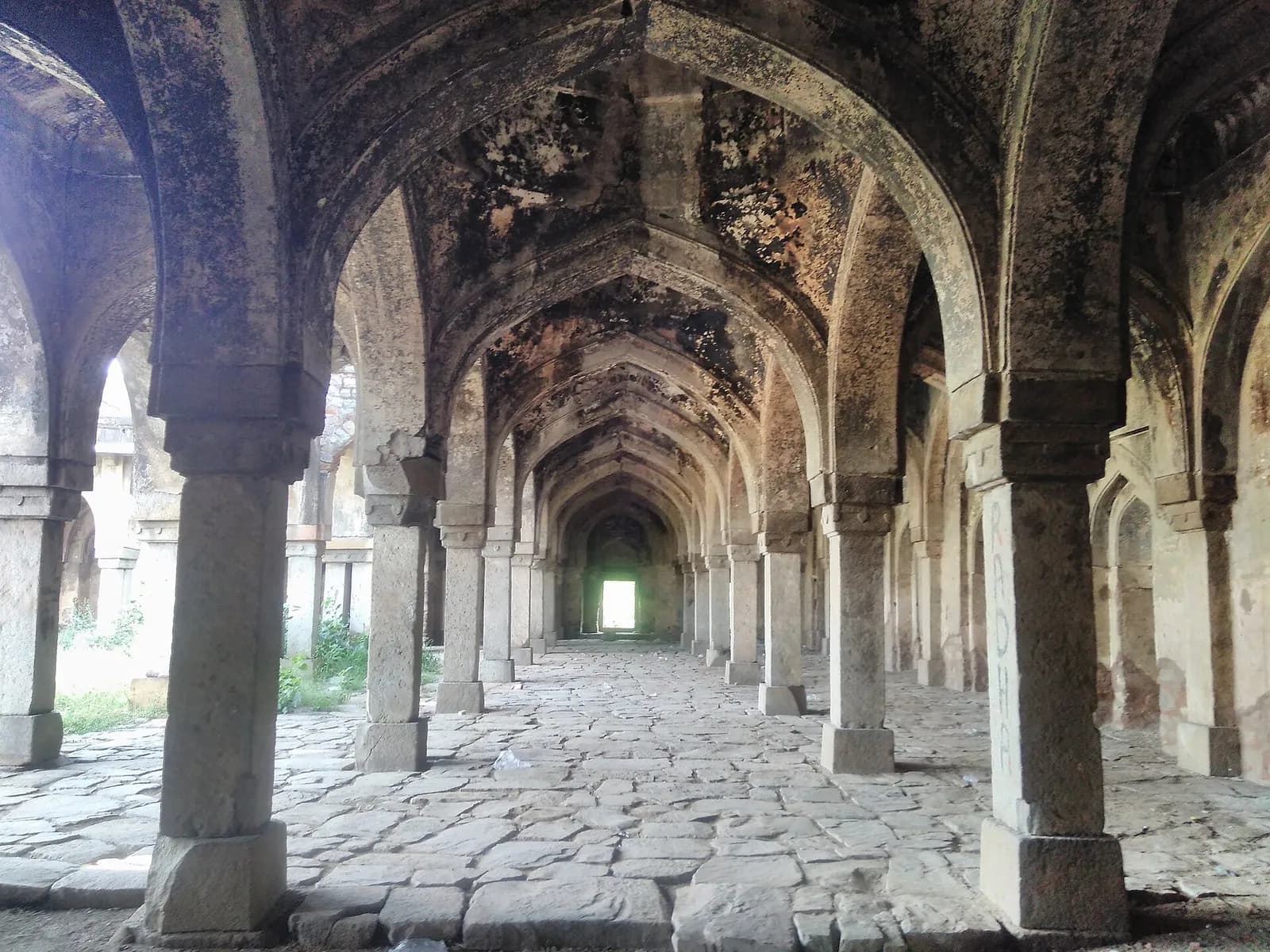
- The vast courtyard. The whole mosque measures roughly 94 by 90 metres, with an immense open courtyard or sahn, of around 75 by 65 metres, surrounded on three sides by continuous single-bay arched cloisters or riwaqs.
- The 64 domes. The roofs of the running arcades are crowned by a grid of sixty-four small stone domes, with a single great dome over the central prayer bay.
- The Mullah Khana. A separate double-storeyed private wing projects from the northern side, the Mullah Khana or zanana mosque, with five small rear domes, where the women of the royal Tughlaq household could attend prayers apart from the main congregation.
- Austere materials. The core is local grey quartzite rubble bound with lime mortar, with very little carving; the columns are plain, though rare fragments of incised white stucco and isolated cobalt-blue glazed tiles survive on the high corridor ceilings.
This combination makes Begumpur Masjid a landmark in the history of Indian mosque architecture, admired as a prototype of the giant-faced design that influenced later mosques and as a supreme example of the austere, powerful Tughlaq aesthetic that valued mass and geometry over decoration. The towering pishtaq, the vast colonnaded courtyard, the grid of domes and the fortress-like walls together create an impression of immense, serene strength. For the visitor, the pleasure lies in experiencing this scale and geometry directly, standing in the great empty courtyard surrounded by arcades and domes and in picking out the details, the hidden dome behind the pishtaq, the private ladies' wing and the surviving traces of stucco and blue tile that hint at how the austere interior was once finished.
The rooftop panorama
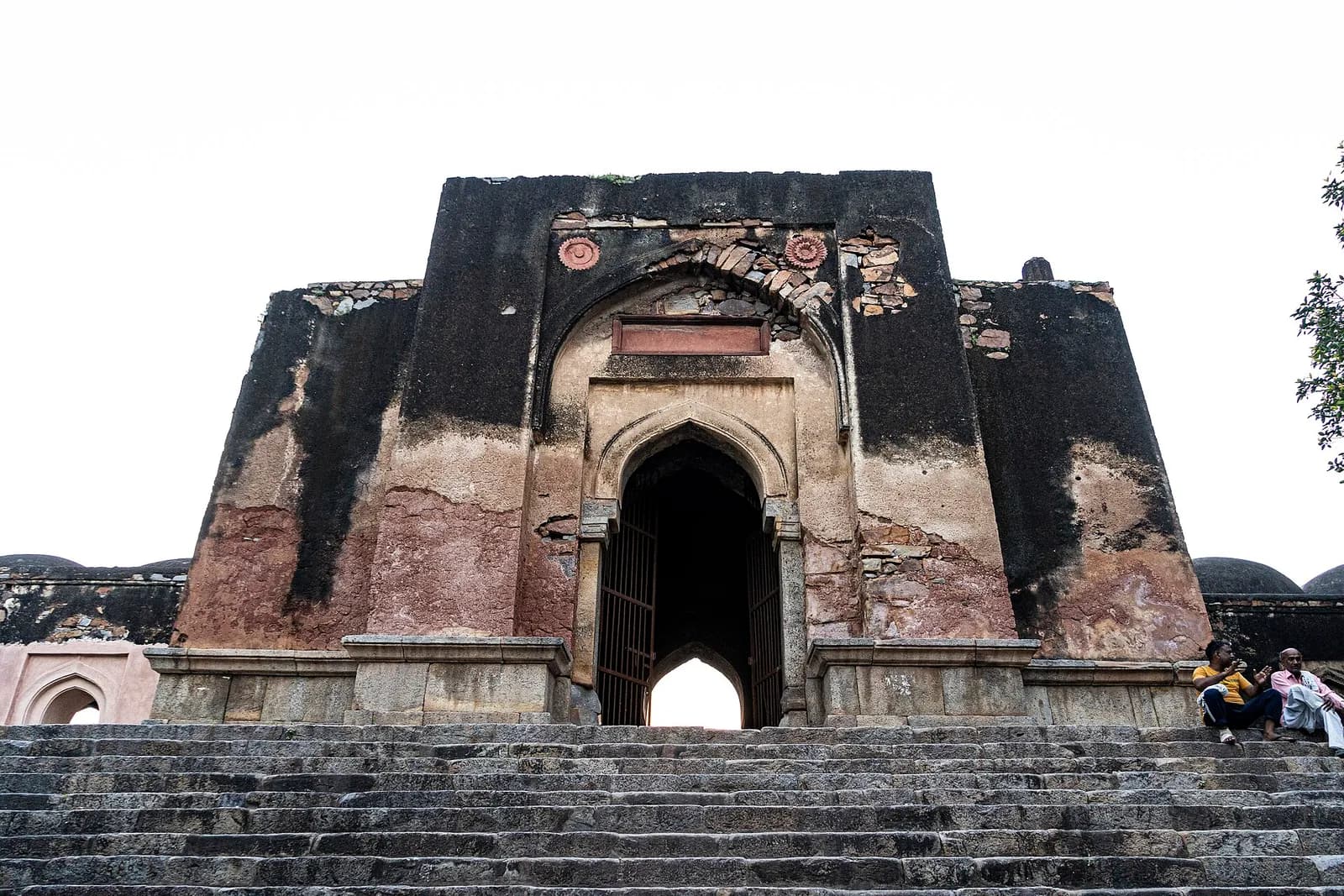
One of the special pleasures of a visit to Begumpur Masjid and something few monuments allow, is the chance to climb to the roof and it is well worth doing. Visitors are permitted to climb the narrow stone staircases built inside the eastern gateway walls up to the vast roof terrace. From the roof, you get an open, close-up view across the whole grid of sixty-four stone domes marching across the arcades, a striking and photogenic sight found nowhere else in the city and a direct line of sight to the adjacent Bijai Mandal tower, the surviving palace ruin of Jahanpanah. The rooftop gives a real sense of the mosque's enormous scale and of the vanished city that once surrounded it. For the visitor, the climb to the roof is a highlight of the visit, offering both a photographer's dream of domes receding into the distance and a historian's panorama over the fragments of a lost imperial capital and it is one of the reasons Begumpur Masjid rewards those who seek it out so richly.
Conservation and the mosque today
It is worth knowing something of the monument's modern condition, for its great age and scale have brought real structural challenges, met by careful conservation. Over the centuries, water logging and the settling of the foundations caused parts of the massive vaulted roof to collapse and to save the structure the ASI carried out a major restoration drive. Engineers built custom buttress walls and inserted heavy steel support pillars beneath the crumbling arches to halt the settlement of the foundations and re-routed seasonal rainwater away from the base walls to protect them. These measures have stabilised the great skeleton of the mosque, so that visitors can safely explore the courtyard, the arcades and the roof. The result is a monument that is substantially intact and deeply atmospheric, its austere stone surfaces weathered by centuries but its grand structure preserved. For the visitor, this means Begumpur Masjid can be enjoyed safely and fully today and the visible modern supports are a reminder of the ongoing effort required to keep such a vast and ancient building standing.
What to expect at Begumpur Masjid
A visit to Begumpur Masjid is impressive, peaceful and a little surprising, a complete contrast to the crowded major monuments and knowing what to expect helps you enjoy it. The mosque stands within the dense old fabric of Begumpur village, reached down a lane, so the first surprise is coming upon such a colossal monument tucked into a residential neighbourhood. Entering through the eastern gateway, you emerge into the vast, serene open courtyard, usually almost empty, surrounded by arched cloisters and crowned by domes, with the towering pishtaq rising ahead. Walking the courtyard and arcades to take in the scale, finding the private Mullah Khana wing, looking for the surviving stucco and blue tiles and climbing to the roof for the view over the domes and the Bijai Mandal tower is the essence of the visit, which takes about 45 minutes to an hour.
A few practical points help. As an ASI monument that is largely non-functional for regular worship, it is usually quiet, but it deserves respectful conduct as a historic religious building. The courtyard is open and exposed, so it is best visited in the cooler parts of the day and the cooler months and sensible shoes help on the stone and the rooftop stairs. The mosque sits in village lanes and is lightly signposted, so a little navigation is needed, with the local Mata Mandir a useful landmark on the way. For the visitor, the key is to come to Begumpur Masjid for its scale, its silence and its stories, giving yourself time to absorb the grandeur of the courtyard and to climb to the roof, ideally as part of a wider exploration of the Tughlaq monuments of South Delhi.
Visiting tips
A few pointers make a visit to Begumpur Masjid smoother and more rewarding:
- Climb to the roof. The stairs in the eastern gateway lead to a superb view over the 64 domes and the Bijai Mandal tower.
- Combine it with Bijai Mandal and Hauz Khas. The ruins of Jahanpanah and the Hauz Khas monuments are close by.
- Come in soft light and the cooler months, as the courtyard is open and exposed.
- Look for the hidden details, the private Mullah Khana wing and the surviving stucco and blue tiles.
- Wear sturdy shoes for the stone courtyard and the rooftop stairs.
- Respect the monument as a historic religious building.
- Use the Mata Mandir as a landmark when finding the lane into the mosque.
- Allow 45 minutes to an hour for the mosque and the roof.
The key point is to treat Begumpur Masjid as a monument to experience at scale, taking time in its great courtyard and on its roof and ideally pairing it with the other surviving fragments of Jahanpanah and the South Delhi Tughlaq monuments.
Best time to visit Begumpur Masjid
The best time to visit is during the cooler months, from October to March, when the vast open courtyard and the exposed rooftop are comfortable and within the day during the early morning or late afternoon, when the light is soft on the stone and the heat is gentler. A winter morning is ideal, cool and clear for exploring the courtyard and climbing to the roof for the view over the domes. The summer months are hot and the open courtyard offers little shade at midday and the monsoon can leave the stone slippery, so the winter window is clearly best. Because the mosque pairs so well with the other Tughlaq monuments of South Delhi, a cool-season day allows a fuller exploration of the area. Our guide to the best time to visit Delhi sets out the seasons across the city in more detail.
How to reach Begumpur Masjid (nearest metro)
Begumpur Masjid stands in Begumpur village near Malviya Nagar in South Delhi, tucked into the old residential lanes and is reached with a short walk. The nearest metro station is Malviya Nagar on the Yellow Line, from which it is a short walk or auto-rickshaw ride into Begumpur village, then a brief walk down the lane, passing the local Mata Mandir landmark, to the mosque's eastern gateway. The ruins of the Bijai Mandal palace, the surviving fragment of Jahanpanah, lie about 500 metres away and are easily combined. Because the mosque sits in narrow village lanes and is lightly signposted, the metro combined with a short walk, asking locally if needed, is the easiest approach, rather than driving right up to it. Set among the Tughlaq monuments of South Delhi, it fits naturally into a Delhi day tour or a heritage-focused New Delhi tour built around the lesser-known monuments of the south of the city.
Places to visit near Begumpur Masjid
Begumpur Masjid sits in South Delhi, surrounded by the fragments of medieval Jahanpanah and within easy reach of some of the city's finest monuments, so it makes an excellent part of a wider heritage outing. Right nearby, about 500 metres away, stands the Bijai Mandal, the ruined palace-tower of Jahanpanah and a short way off is the historic Hauz Khas Fort with its lake, tombs and madrasa. The great monuments of Mehrauli, including the world-famous Qutub Minar and the sprawling Mehrauli Archaeological Park with its Jamali Kamali mosque and many ruins, are close by, as is the medieval stepwell of Agrasen ki Baoli, while the mighty fort of Tughlaqabad lies to the south-east.
Further out, the capital's other great landmarks round out a full picture of the city: the towering Qutub Minar, the serene Humayun's Tomb, the mighty Red Fort, the ceremonial India Gate and the modern marvels of the Lotus Temple and Akshardham. For more of Delhi's history, the old citadel of Purana Qila, the astronomical Jantar Mantar and the ruins of Feroz Shah Kotla are well worth adding and our roundup of the important monuments of Delhi ties them together.
Begumpur Masjid in your Delhi itinerary
For most visitors, Begumpur Masjid works best as a highlight of a wider South Delhi heritage outing rather than a destination on its own, since it sits amid the scattered fragments of Jahanpanah and close to the Hauz Khas and Mehrauli monuments. A natural plan is to combine it with the nearby Bijai Mandal, the Hauz Khas complex and perhaps the fort of Tughlaqabad, for a day exploring the sturdy, austere world of Tughlaq Delhi. The mosque itself needs about 45 minutes to an hour, including the climb to the roof, but its colossal scale, its architectural importance and its extraordinary stories of refuge give it an impact out of all proportion to its obscurity and it adds a note of awe and discovery to a day of sightseeing. It suits the history enthusiast, the architecture lover and the traveller who wants the grand, empty, atmospheric monuments that most visitors never find.
If Delhi is your gateway to the wider Golden Triangle, Begumpur Masjid offers one of the most powerful experiences of the city's medieval past, a vast imperial mosque standing serene and almost empty in a village, holding centuries of history in its walls. Many of my guests find it one of the most memorable and unexpected stops of their trip, precisely because its scale and silence are so striking and so few visitors ever see it and it deepens their sense of the depth of Delhi's history before they travel on to Agra and Jaipur.
Travel tips for visiting Begumpur Masjid
A few pointers make a visit even better:
- Reach it via Malviya Nagar metro, then a short walk into Begumpur village past the Mata Mandir.
- Climb the eastern gateway stairs to the roof for the view over the domes and Bijai Mandal.
- Pair it with Bijai Mandal, Hauz Khas and the Mehrauli monuments for a full South Delhi day.
- Come in the cooler months and in soft light, as the courtyard is open and exposed.
- Wear sturdy shoes for the stone courtyard and rooftop stairs.
- Respect the monument as a historic religious building.
- Look for the Mullah Khana and surviving tilework among the architecture.
- Allow 45 minutes to an hour for the mosque and the roof.
If you would like a local guide to show you Begumpur Masjid and the lost city of Jahanpanah and tell the stories behind them, message our team on WhatsApp at +91 7302265809 with your travel dates and group size and we will shape the day for you.
Is Begumpur Masjid worth visiting?
Yes, for the history-minded and the curious traveller Begumpur Masjid is absolutely worth seeking out, one of the most impressive and rewarding hidden monuments in all of Delhi. There is nowhere else in the city where you can stand in so vast and serene a medieval courtyard, ringed by scores of domes and dominated by a towering archway, in a monument that was the grand mosque of a lost imperial city, that once sheltered an entire village within its walls and whose roof offers a sweeping view over the domes and the ruins of Jahanpanah. It is free to enter, usually almost empty and architecturally among the most important mosques in India. The caveats are small: it sits in village lanes that take a little finding, the courtyard is open and exposed and it is a quiet ruin rather than a polished attraction. For the traveller who wants the grand, atmospheric, deeply historic side of Delhi beyond the famous sights, Begumpur Masjid is a treasure and I recommend it warmly to guests with the curiosity to explore the city's medieval past.
Plan your trip with us
At Experience My India, through our Delhi and Golden Triangle travel desk, we design unhurried, well paced trips that make room for magnificent hidden monuments like Begumpur Masjid and the lost city of Jahanpanah and not just the famous sights, with guides who can explain the architecture and tell the extraordinary stories that bring such places to life and lead you to the ones tucked away in South Delhi's villages. Whether you want a relaxed set of Delhi Agra tours or a full Golden Triangle route through Delhi, Agra and Jaipur, we plan around your pace, your interests and the right season. Share your dates and the kind of trip you have in mind through our enquiry page, tell us your group size and we will put together an honest, tailored plan rather than a rushed checklist.
Related guides
- Places to visit in Delhi, for the wider picture
- Nearby places to visit in Delhi, to extend your trip
Enquire Now
Ready to Explore
The Heart of Delhi?
Explore the Red Fort, Qutub Minar, Humayun's Tomb, and the vibrant streets of Old Delhi with our expert-guided premium tours of India's capital city.

Delhi
Premium Tour Package
Questions
Frequently asked questions
What is Begumpur Masjid?
It is a 14th-century Tughlaq mosque in Begumpur village in South Delhi, built as the grand congregational mosque or Jami Masjid, of Jahanpanah, the fourth medieval city of Delhi. It is one of the largest historic mosques in the city.
Who built Begumpur Masjid?
What are the timings and entry fee?
Which is the nearest metro station?
Why is Begumpur Masjid architecturally important?
Is it true a whole village lived inside the mosque?
Can you go up to the roof?
Is Begumpur Masjid still used for prayers?
How much time do I need?
Explore more
Plan your Begumpur Masjid trip with us

Interested in Begumpur Masjid, Jahanpanah: History, Architecture and Guide?
Chat with our travel team for a custom quote, or browse every package.
Related Attractions
9Ready to explore Begumpur Masjid, Jahanpanah: History, Architecture and Guide?
Book your private tour today and experience the magic of India's rich heritage.