Bhuli Bhatiyari ka Mahal: History, Haunted Legend and Guide
Visiting Bhuli Bhatiyari ka Mahal, the famous haunted ruin in the Delhi Ridge forest? Its true history, the ghost legend, timings and how to reach.
In a Nutshell
“Bhuli Bhatiyari ka Mahal is a mid-14th-century Tughlaq hunting lodge hidden inside the Central Ridge Reserve Forest near Karol Bagh in Central Delhi, built around 1354 by Sultan Firoz Shah Tughlaq. Today it is far better known as one of Delhi's most famous haunted ruins, the subject of a ghost legend about a wronged medieval queen. By day it is a peaceful, forest-framed heritage site good for birdwatching and photography; it is strictly closed after about 5:00 PM for safety, as it sits deep in an isolated forest. Entry is free. It features on our offbeat Delhi heritage tours, run by a unit of Experience My India.”
Bhuli Bhatiyari ka Mahal is one of the most atmospheric and intriguing of Delhi's hidden ruins, a genuine 14th-century royal hunting lodge lost in a forest in the middle of the modern city, wrapped in one of the capital's most famous ghost stories. For the traveller drawn to offbeat heritage, forest walks and the folklore and legends of old Delhi, it is a fascinating daytime destination. Our team at Delhi Agra Tour Packages is glad to include it for guests who enjoy the stranger corners of the city and it adds an unusual, atmospheric note to a wider Golden Triangle tour through the capital.
I am Abhay Sharma, Delhi born and a Golden Triangle guide since 2015 and Bhuli Bhatiyari ka Mahal is one of the more unusual places I take curious guests, because it is two things at once: a real and little-known Tughlaq monument set in a beautiful patch of old forest and the focus of one of Delhi's best-loved urban legends. This guide gathers everything I would tell a visitor beforehand, checked against current information, including its true history, its architecture, the famous haunted legend and the important safety rules and the timings and directions.
Details
Bhuli Bhatiyari ka Mahal at a glance
| Detail | Information |
|---|---|
| What it is | A 14th-century Tughlaq royal hunting lodge (shikargah) |
| Built | Around 1354, by Sultan Firoz Shah Tughlaq |
| Location | Central Ridge Reserve Forest, near Karol Bagh, Central Delhi |
| Managed by | Department of Archaeology, Delhi Government |
| Known for | Tughlaq hunting lodge; famous haunted legend |
| Nearest metro | Jhandewalan (Blue Line) |
| Entry | Free |
| Important | Strictly closed after about 5:00 PM for safety |
Bhuli Bhatiyari ka Mahal timings
| Detail | Information |
|---|---|
| Open | Every day |
| Hours | About 8:00 AM to 5:30 PM |
| Strict closure | No entry after about 5:00 PM (sunset) |
Bhuli Bhatiyari ka Mahal is open every day, generally from around 8:00 AM to 5:30 PM, but entry is strictly banned after about 5:00 PM, at sunset, because the site sits deep in an isolated forest with no staff present after dark and the authorities enforce this firmly. Daytime is the only safe and permitted time to visit. These timings are current at the time of writing and can vary, so reconfirm before a trip.
Entry fee
| Visitor | Fee |
|---|---|
| All visitors | Free; no ticket required |
How to reach Bhuli Bhatiyari ka Mahal
| From | Route |
|---|---|
| Jhandewalan metro (Blue Line) | Nearest station; the forest entry track is close by |
| Near the Karol Bagh Hanuman statue | The forest path into the Ridge begins near here |
| Through the Central Ridge | A walk along the forest trail to the lodge |
| By car | Park near the forest edge; the lodge is reached on foot |
What is Bhuli Bhatiyari ka Mahal?
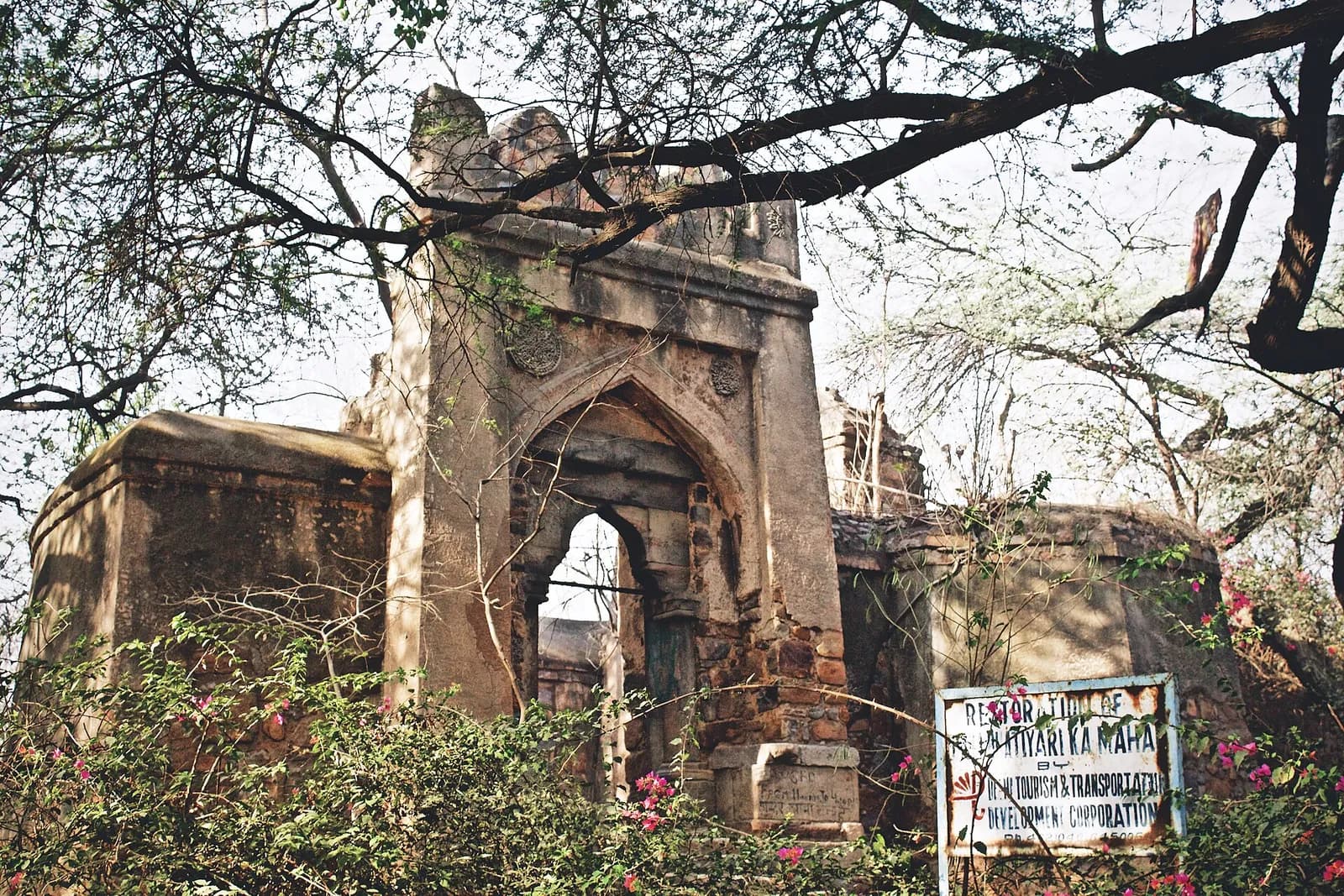
Bhuli Bhatiyari ka Mahal is a mid-14th-century royal hunting lodge, hidden deep inside the Central Ridge Reserve Forest near Karol Bagh in Central Delhi, built around 1354 during the reign of Sultan Firoz Shah Tughlaq. Historically it was a shikargah, a hunting lodge and resting inn, one of a network of forest outposts the Sultan built in the green belt around his capital, sharing its design with similar ridge monuments. Today, however, its real history is almost entirely overshadowed by its fame as one of Delhi's most celebrated haunted places, the setting of a well-known ghost legend and a magnet for dark-tourism and urban-legend enthusiasts. The truth is more interesting than the legend in its own way: a genuine, structurally intact Tughlaq hunting lodge, built of rugged quartzite stone in the austere style of its age, standing serene and forest-framed in the heart of the modern city. Protected by the Delhi Department of Archaeology and closed strictly after sunset for safety, it is by day a peaceful heritage site and a fine spot for a forest walk, birdwatching and photography and for the visitor it is one of the most atmospheric and unusual corners of Delhi.
Several things make it special and they are worth drawing out:
- A real Tughlaq hunting lodge. A genuine 14th-century royal shikargah built by Firoz Shah Tughlaq, not merely a ghost story.
- Hidden in a forest. Tucked deep in the Central Ridge Reserve Forest, a rare patch of old-growth jungle in the middle of Delhi.
- A famous haunted legend. One of the capital's best-known "haunted" sites, the subject of a popular ghost story and much urban folklore.
- A peaceful daytime sanctuary. By day, a sun-dappled, tree-framed ruin, wonderful for birdwatching and photography.
- Strictly day-only. Closed firmly after sunset for safety, as it sits isolated in the forest with no staff after dark.
It is one of the most intriguing of the hidden places to visit in Delhi and an unusual entry among the offbeat things to do in Delhi.
History of Bhuli Bhatiyari ka Mahal
Behind the ghost stories lies a genuine and interesting history, rooted in the Tughlaq dynasty's use of the forests around Delhi and knowing it gives the monument real substance. The lodge belongs to the prolific building era of Sultan Firoz Shah Tughlaq:
- The builder and the date. It was built around 1354 by Sultan Firoz Shah Tughlaq, one of the most prolific builder-rulers of the Delhi Sultanate, who raised countless monuments across the region.
- A hunting lodge, not a palace. It was never meant to be a grand palace or city, but was custom-built as a royal hunting lodge, a shikargah and resting inn, a sari, for the Sultan and his party.
- Part of a forest network. It formed one of a specialised network of green-belt forest outposts, sharing its design with similar ridge monuments, used by the court when hunting in the forests around the capital.
- Beside a medieval dam. It was positioned strategically on the edge of a large medieval earthen embankment or dam the Sultan built to capture forest rainwater, part of his famous attention to water works.
This history gives Bhuli Bhatiyari ka Mahal its true character as a piece of the working royal landscape of 14th-century Delhi, a place where the Sultan and his court rested and hunted in the forests that then surrounded the city. Firoz Shah Tughlaq's reign was marked by exactly this kind of practical building, hunting lodges, inns, dams and canals, alongside his grander monuments. For the visitor, knowing that this atmospheric ruin was once a busy royal hunting outpost, alive with the Sultan's hunting parties, horses and attendants, grounds the spooky legends in a real and fascinating past and makes the quiet forest setting feel like a genuine survival from the medieval age.
The meaning of the name
One of the enduring puzzles of the monument is its unusual name, Bhuli Bhatiyari and the question of where it comes from, which visitors often ask. There is no single agreed answer and several theories have grown up over the centuries:
- The Sufi theory. Early 20th-century scholars recorded that the site was associated with a Sufi saint or noble named Bu Ali Bakhtiyar, whose name, over centuries of local dialect, may have shifted into Bhuli Bhatiyari.
- The caretaker theory. Old imperial land records are said to mention a local administrator or caretaker named Boo Ali Bhatti, assigned by the state to maintain the lodge, whose name may have given the place its own.
- The folklore version. A popular romantic legend tells of a Rajasthani woman of the Bhatiyara clan named Bhuri who lost her way, "bhuli," in the dense Ridge jungle, took shelter in the ruins and lived there until her death.
These competing stories are part of the charm of the monument and the uncertainty is itself typical of old Delhi, where the real origins of a name are often lost and folk explanations fill the gap. Whether the name comes from a corrupted Sufi title, a historical caretaker or a romantic legend of a lost woman, it has given the lodge an air of mystery that feeds its reputation. For the visitor, the tangle of theories is a reminder of how history and folklore intertwine around Delhi's ruins and it adds to the sense of stepping into a place where the past is half-remembered and half-imagined.
Architecture of Bhuli Bhatiyari ka Mahal
Architecturally, Bhuli Bhatiyari ka Mahal is a good and well-preserved example of austere Tughlaq design, built for rugged function rather than ornament and its features are worth noticing beyond the ghostly atmosphere. True to the Tughlaq style, it shuns delicate decoration in favour of sturdy stone:
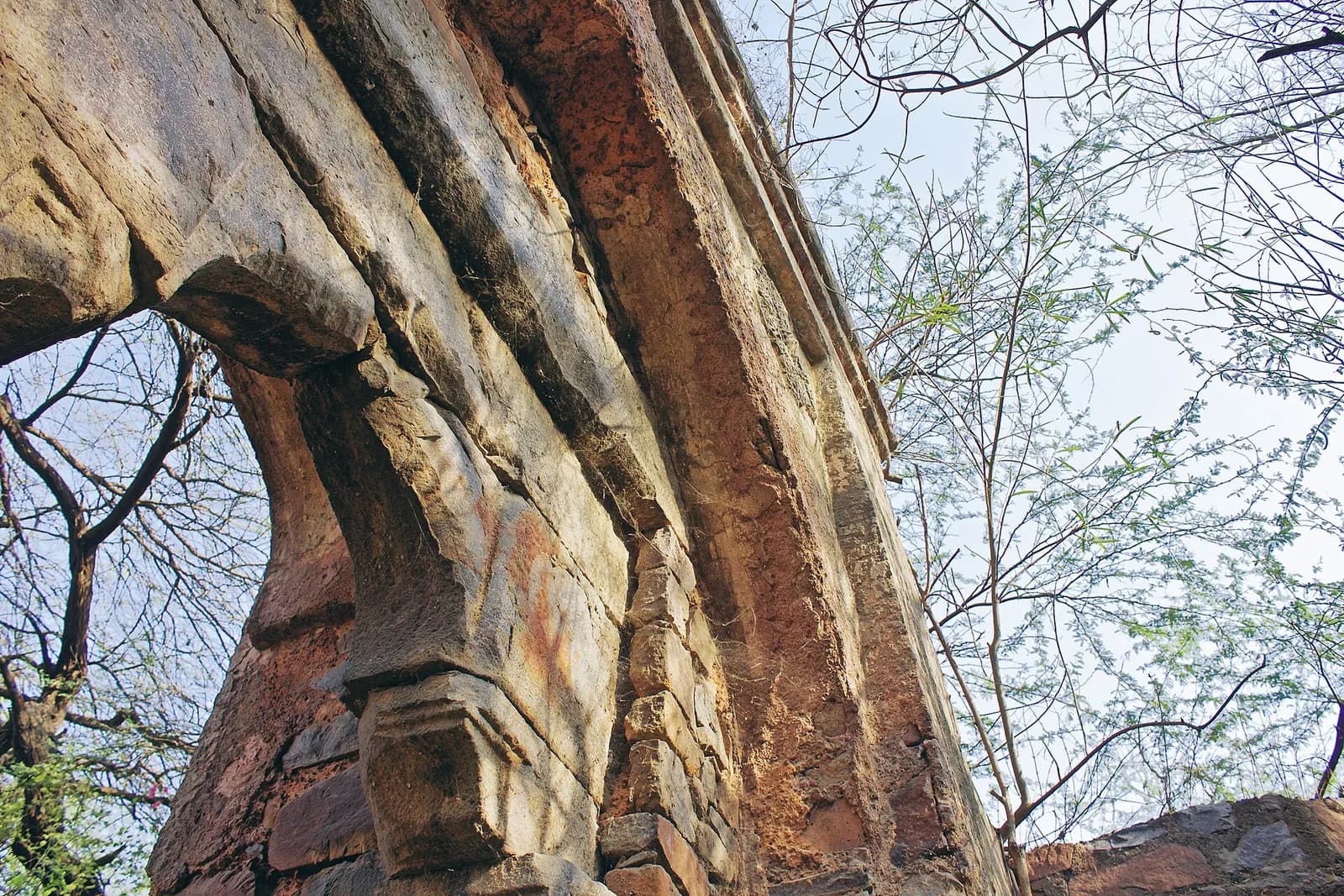
- The double gateway. The most striking feature is an unusual twin stone gateway at the north-eastern corner, the outer portal a bold pointed arch of rugged quartzite rubble bound with lime mortar, with simple stone medallions carved into the spandrels.
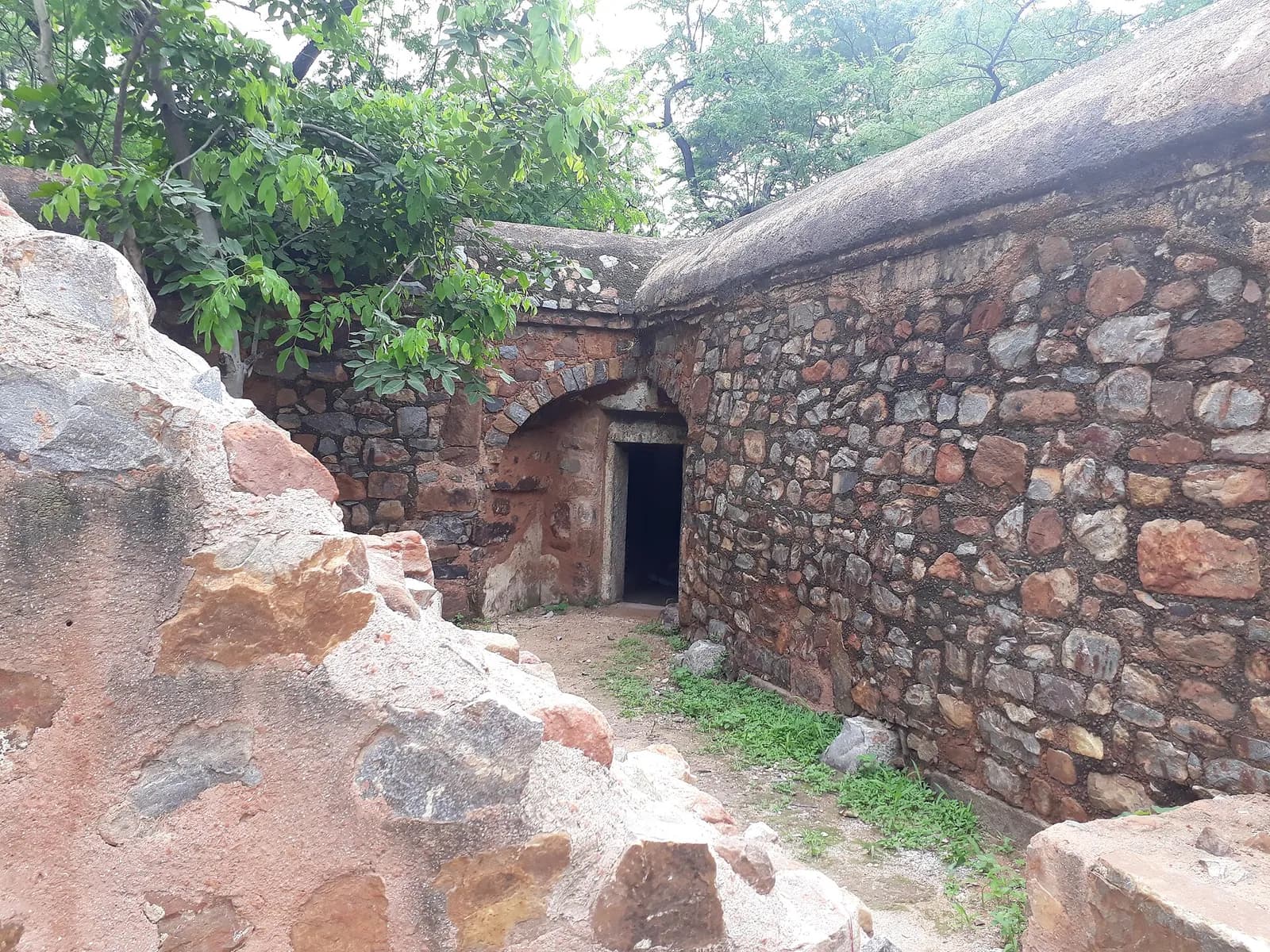
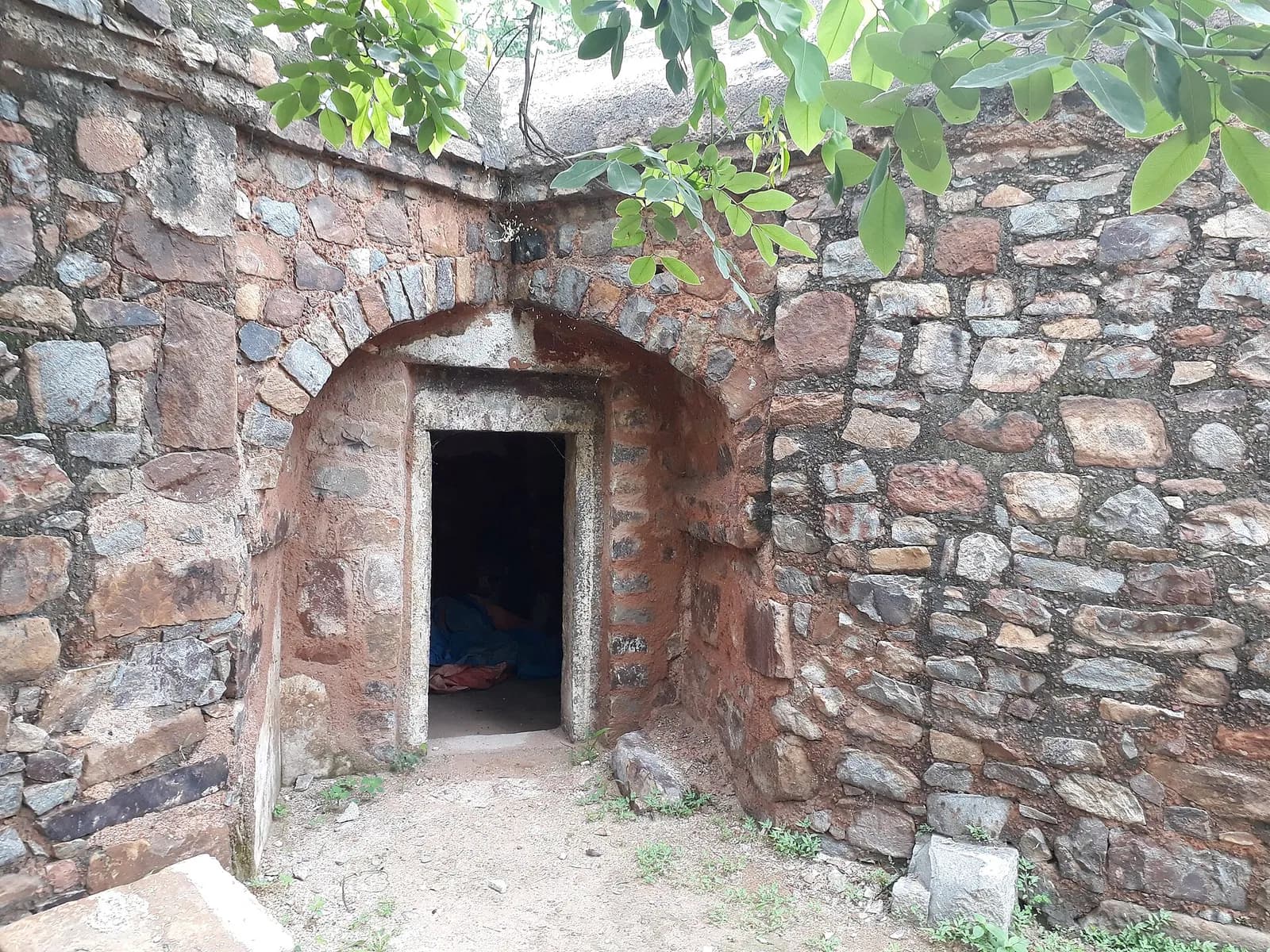
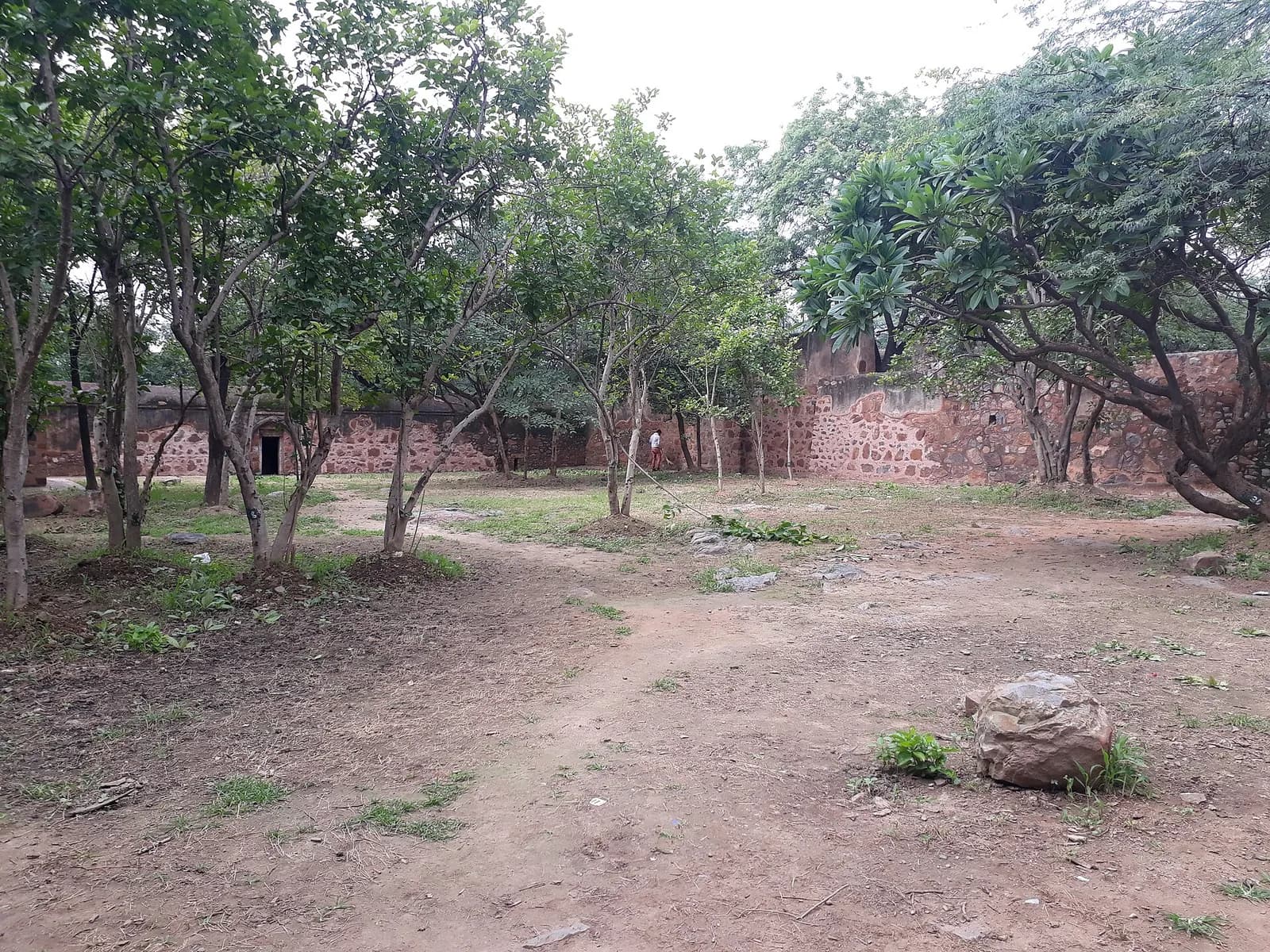
- The courtyard. The inner gate opens into a large, roofless rectangular courtyard, along the eastern and southern sides of which run small single-storeyed stone rooms that served as camp quarters for the hunting party, weapon stores and stables.
- The semi-circular ridge outpost. While the south and east walls are straight and reinforced with circular bastions, the north and west walls curve in a semi-circle, engineered to follow the ridge rocks and give an elevated, panoramic platform for surveying the forest for game or movement.
- Austere Tughlaq materials. Throughout, the building uses local quartzite rubble and lime mortar in the plain, fortress-like Tughlaq manner, with defensive bastions and reinforced walls rather than ornament.
This combination makes the lodge a fine small example of Tughlaq military and functional architecture, where even a hunting outpost was built like a small fort, with bastions, reinforced walls and a commanding position over the forest. The unusual twin gateway and the semi-circular ridge-hugging walls are its most distinctive features, cleverly adapted to the rocky terrain. For the visitor, appreciating these architectural details, the sturdy gateways, the ring of camp rooms, the bastioned and curving walls, adds real depth to a visit and shows that behind the ghost stories is a genuine and thoughtfully built medieval monument, remarkably intact after nearly seven centuries.
The haunted legend and Delhi's ghost lore
There is no avoiding the real reason Bhuli Bhatiyari ka Mahal is famous today: in contemporary Delhi pop culture it is celebrated as one of the city's most haunted places and the legend is part of why visitors seek it out, so it is worth telling plainly while keeping it in perspective as folklore. The stories belong to the city's rich tradition of urban legend:
- The legend of the wronged queen. The central ghost story tells of a medieval queen who, discovered in a secret affair by the ruling Sultan, was stripped of her titles and locked away in this isolated forest lodge, where she is said to have died of neglect and heartbreak, her restless spirit said to haunt the courtyard.
- Reported phenomena. Dark-tourism explorers and local lore describe disembodied whispers, sounds like a weeping woman and sudden drops in temperature as night falls, the usual stuff of ghost stories.
- A dark-tourism magnet. These tales have made the forest trail a focus for late-night thrill-seekers, though this is exactly why the authorities strictly forbid entry after dark.
It is worth being clear-eyed about all this. These are urban legends and folk tales, part of Delhi's pop culture rather than documented fact and the "phenomena" are the stock elements of ghost stories the world over, easily explained by the eerie atmosphere of an isolated forest ruin at dusk. The stories are fun and they are part of why the place is well known, but they are not a reason to take real risks. For the visitor, the sensible and rewarding approach is to enjoy the legend as folklore and atmosphere, in daylight and to treat the ghost reputation as a colourful layer over a genuine and fascinating historical monument, rather than a reason to break the sunset rule.
Safety and the sunset rule
Because of its fame as a haunted site, it is important to be clear about safety and this is the single most important thing to know before visiting. Bhuli Bhatiyari ka Mahal sits deep in an isolated patch of the Central Ridge forest and for good reason the authorities strictly ban all visitors after about 5:00 PM, at sunset. No guards or forest officials remain inside the gates after dark and the police actively fine people caught trespassing near the gates in the evening. The dangers after dark are entirely practical and have nothing to do with ghosts: an isolated, unlit forest with uneven ground, no staff, no help at hand and the ordinary risks of a secluded place at night. The right way to visit is firmly in daylight hours, ideally earlier in the day, allowing plenty of time to walk in and out of the forest before closing. For the visitor, respecting the sunset rule is not about superstition but about simple safety and it is the one firm rule of any visit to this otherwise peaceful and rewarding monument.
The forest setting: a daytime sanctuary
In complete contrast to its night-time reputation, Bhuli Bhatiyari ka Mahal by day is a genuinely peaceful and beautiful place and this is the side of it most visitors will enjoy. The reason the lodge has survived structurally intact since the 14th century, unconsumed by the city's relentless expansion, is its position within the Central Ridge Reserve Forest, a heavily protected patch of old-growth jungle that serves as a major green lung for Central Delhi. By day, the sunlight falls dappled through ancient trees onto the weathered stone of the courtyard and the ruin becomes a tranquil heritage sanctuary framed entirely by forest. It is a well-known offbeat route for local birdwatchers, who come to spot peacocks, owls and tree-pies among the trees and for photographers seeking isolated, atmospheric historical framing. The walk through the Ridge forest to reach the lodge is itself a pleasure, a rare stretch of wild greenery in the heart of the city. For the visitor, this daytime character, calm, green and full of birdsong, is the real reward of a visit and it could hardly be further from the eerie reputation that draws people to the name in the first place.
What to expect at Bhuli Bhatiyari ka Mahal
A visit to Bhuli Bhatiyari ka Mahal is atmospheric, a little adventurous and best approached with sensible preparation and knowing what to expect helps you enjoy it. The lodge is reached by a walk along a forest trail into the Central Ridge from near the Karol Bagh area, so the approach itself is a woodland walk rather than a city stroll. Arriving, you come upon the weathered stone lodge with its twin gateway, enter the roofless courtyard ringed by small camp rooms and can explore the bastioned and semi-circular walls with their views over the forest. Taking in the Tughlaq architecture, enjoying the quiet forest setting and the birdlife and soaking up the atmosphere, with the famous legend adding a frisson, is the essence of the visit, which takes perhaps 45 minutes to an hour including the walk.
A few practical points are important. Visit only in daylight and leave well before the 5:00 PM closure, as the forest is isolated and unsafe after dark. It is wise not to go entirely alone, to wear sturdy shoes for the forest trail and uneven stone, to carry water and to keep to the trail. As a secluded site ordinary caution about belongings and surroundings applies. The monument is lightly signposted within the forest, so a little navigation or asking locally, helps in finding the trail. For the visitor, the key is to treat Bhuli Bhatiyari ka Mahal as a rewarding daytime forest-and-heritage walk, coming prepared and sensibly, enjoying both the genuine medieval monument and the legend and atmosphere that surround it, while firmly respecting the safety rules.
Visiting tips
A few pointers make a visit to Bhuli Bhatiyari ka Mahal smoother and safer:
- Visit only in daylight and leave well before the 5:00 PM closure; the forest is unsafe after dark.
- Do not go entirely alone, as the lodge is secluded within the forest.
- Wear sturdy shoes for the forest trail and uneven stone and carry water.
- Come via Jhandewalan metro and the forest path near the Karol Bagh Hanuman statue.
- Enjoy the legend as folklore, a colourful layer over a genuine monument.
- Watch for birds, peacocks, owls and tree-pies among the Ridge trees.
- Keep to the trail and stay aware of your surroundings as in any isolated spot.
- Allow 45 minutes to an hour, including the forest walk in and out.
The key point is to treat the lodge as a daytime forest-heritage walk, coming prepared and respecting the firm sunset rule and enjoying both the real history and the famous legend.
Best time to visit Bhuli Bhatiyari ka Mahal
The best time to visit is during the cooler months, from October to March, when walking the Ridge forest trail is comfortable and within the day during the morning or early afternoon, always leaving plenty of time to walk out before the 5:00 PM closure. A cool winter morning is ideal, pleasant for the forest walk and good for spotting birds among the trees. The summer months are hot for the walk and the exposed courtyard and the monsoon leaves the forest green but the trail muddy and overgrown, so the winter window is clearly best. Whatever the season, the one unbreakable rule is to visit in daylight and leave before dark, as the isolated forest is closed and unsafe in the evening. Our guide to the best time to visit Delhi sets out the seasons across the city in more detail.
How to reach Bhuli Bhatiyari ka Mahal (nearest metro)
Bhuli Bhatiyari ka Mahal lies within the Central Ridge Reserve Forest near Karol Bagh in Central Delhi, reached by a walk through the forest. The nearest metro station is Jhandewalan on the Blue Line, from which the forest entry track into the Ridge is easily accessible, the path beginning near the large Hanuman statue at Karol Bagh. From the forest edge, the lodge is reached on foot along the trail through the trees. Because the monument sits within a protected forest and is reached only on foot, the metro combined with the forest walk is the natural approach and it is wise to allow time and to go in daylight. Set in the green heart of the city, it makes an unusual addition to a Delhi day tour or a heritage-focused New Delhi tour for those who enjoy the offbeat corners of Delhi.
Places to visit near Bhuli Bhatiyari ka Mahal
Bhuli Bhatiyari ka Mahal lies in Central Delhi within the Ridge forest, so while its immediate surroundings are woodland, it is within reach of many of the city's great attractions for a fuller day out. The nearby areas of Karol Bagh and Jhandewalan are busy market and temple districts and a short way off are the great monuments of the capital. The ceremonial India Gate and the heart of New Delhi lie to the south, while the old city holds the mighty Red Fort and the lanes of Chandni Chowk. The astronomical Jantar Mantar is in central Connaught Place and the ruins of Feroz Shah Kotla, built by the very same Sultan who raised this hunting lodge, are nearby too.
Further afield, the capital's other landmarks round out a full picture of the city: the towering Qutub Minar, the serene Humayun's Tomb and the modern marvels of the Lotus Temple and Akshardham. For more history, the old citadel of Purana Qila, the sprawling Mehrauli Archaeological Park and the historic Hauz Khas Fort are well worth adding and our roundup of the important monuments of Delhi ties them together. To extend your trip, see our guide to nearby places to visit in Delhi.
Bhuli Bhatiyari ka Mahal in your Delhi itinerary
For most visitors, Bhuli Bhatiyari ka Mahal works best as an unusual, atmospheric half-day stop for those who enjoy offbeat heritage and forest walks, rather than a mainstream sightseeing destination. A natural plan is to combine the forest walk and the lodge with a wider exploration of Central Delhi, perhaps the monuments built by the same Firoz Shah Tughlaq at Feroz Shah Kotla or the markets of Karol Bagh. The lodge itself, with the walk, needs about 45 minutes to an hour, but its genuine Tughlaq history, its beautiful forest setting and its famous legend give it a memorable character out of proportion to its modest size and it adds a note of mystery and discovery to a day of sightseeing. It suits the history enthusiast, the lover of folklore and the offbeat and the traveller who enjoys a rare patch of wild forest in the heart of the city.
If Delhi is your gateway to the wider Golden Triangle, Bhuli Bhatiyari ka Mahal offers something quite different from the usual monuments, a genuine medieval hunting lodge lost in a forest, carrying one of the city's best-known legends, best enjoyed as a peaceful daytime walk. Many of my guests who make the trip find it one of the more memorable and unusual stops, precisely because it combines real history, wild greenery and a famous ghost story and it deepens their sense of the many layers of Delhi before they travel on to Agra and Jaipur.
Travel tips for visiting Bhuli Bhatiyari ka Mahal
A few pointers make a visit even better and safer:
- Go only in daylight and leave well before the 5:00 PM closure.
- Reach it via Jhandewalan metro and the Ridge forest path near the Karol Bagh Hanuman statue.
- Do not go alone, wear sturdy shoes and carry water for the forest walk.
- Pair it with Feroz Shah Kotla or Central Delhi sights for a fuller day.
- Enjoy the legend as folklore and the forest as a daytime sanctuary.
- Watch for birds among the Ridge trees.
- Keep to the trail and stay aware of your surroundings.
- Allow 45 minutes to an hour, including the walk.
If you would like a local guide to take you safely to Bhuli Bhatiyari ka Mahal and tell both its real history and its famous legends, message our team on WhatsApp at +91 7302265809 with your travel dates and group size and we will shape the day for you.
Is Bhuli Bhatiyari ka Mahal worth visiting?
Yes, for the history-minded and the adventurous traveller Bhuli Bhatiyari ka Mahal is a genuinely rewarding and unusual stop, provided you come in daylight and sensibly. There are few places in Delhi where you can walk through a rare patch of old forest in the heart of the city to reach a real, intact 14th-century royal hunting lodge, admire its sturdy Tughlaq architecture, spot peacocks and owls among the trees and enjoy, at a safe distance, one of the capital's most famous ghost legends. By day it is peaceful, green and atmospheric, free to visit and quite unlike anywhere else on the usual tourist map. The caveats are real and important: it is isolated in the forest, strictly closed after sunset and best visited in daylight, not alone, with sensible precautions. For the traveller who wants the offbeat, forest-wrapped, legend-haunted side of Delhi beyond the famous sights, Bhuli Bhatiyari ka Mahal is a memorable discovery and I recommend it to curious guests who will treat it with the care it deserves.
Plan your trip with us
At Experience My India, through our Delhi and Golden Triangle travel desk, we design unhurried, well paced trips that make room for unusual hidden places like Bhuli Bhatiyari ka Mahal and not just the famous monuments, with guides who can lead you safely through the Ridge forest, tell both the real history and the folklore and make sure you visit at the right time of day. Whether you want a relaxed set of Delhi Agra tours or a full Golden Triangle route through Delhi, Agra and Jaipur, we plan around your pace, your interests and the right season. Share your dates and the kind of trip you have in mind through our enquiry page, tell us your group size and we will put together an honest, tailored plan rather than a rushed checklist.
Related guides
- Places to visit in Delhi, for the wider picture
- Agrasen ki Baoli, another atmospheric hidden site
Enquire Now
Ready to Explore
The Heart of Delhi?
Explore the Red Fort, Qutub Minar, Humayun's Tomb, and the vibrant streets of Old Delhi with our expert-guided premium tours of India's capital city.

Delhi
Premium Tour Package
Questions
Frequently asked questions
What is Bhuli Bhatiyari ka Mahal?
It is a mid-14th-century royal hunting lodge, a shikargah, built around 1354 by Sultan Firoz Shah Tughlaq inside what is now the Central Ridge Reserve Forest near Karol Bagh in Central Delhi. It is also one of the city's most famous "haunted" ruins.
Is Bhuli Bhatiyari ka Mahal really haunted?
What are the timings and why does it close at sunset?
Is there an entry fee?
Which is the nearest metro station?
Who built it and why is it called Bhuli Bhatiyari?
Is it safe to visit?
How much time do I need?
Explore more
Plan your Bhuli Bhatiyari ka Mahal trip with us

Interested in Bhuli Bhatiyari ka Mahal: History, Haunted Legend and Guide?
Chat with our travel team for a custom quote, or browse every package.
Related Attractions
9Ready to explore Bhuli Bhatiyari ka Mahal: History, Haunted Legend and Guide?
Book your private tour today and experience the magic of India's rich heritage.