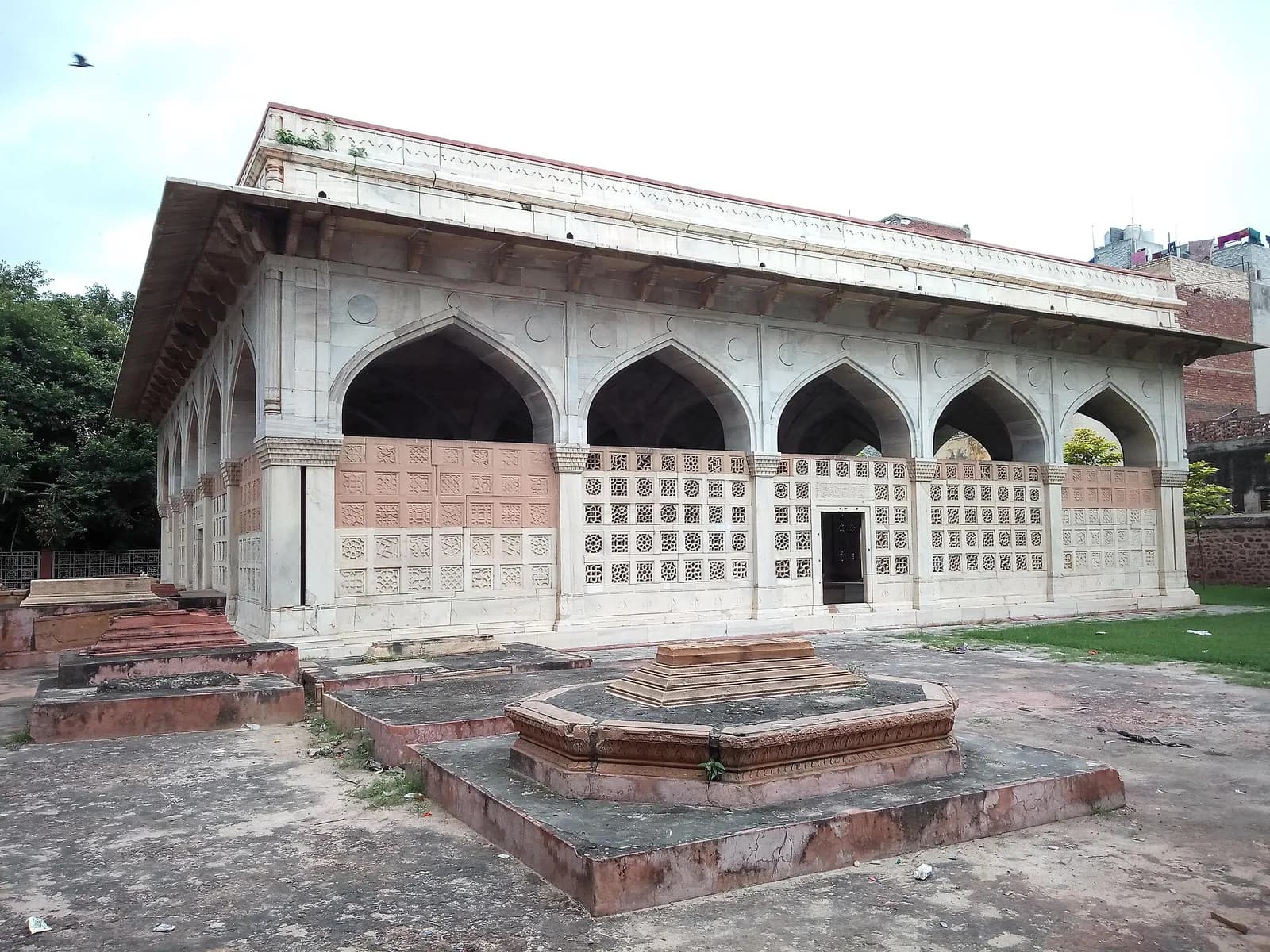
Chausath Khamba Delhi: History, Timings and Visitor Guide
Visiting Chausath Khamba in Nizamuddin, Delhi's 64-pillar marble pavilion? Its history, the architecture, the jaalis and reverse domes, timings and metro.
In a Nutshell
“Chausath Khamba, meaning the Sixty-Four Pillars, is an exquisite white marble Mughal pavilion-tomb in the Hazrat Nizamuddin Basti in Delhi, built in 1623 to 1624 for Mirza Aziz Koka, the foster brother of Emperor Akbar. Its flat roof rests on 64 marble columns that divide the hall into 25 bays, each hiding an inverted dome and its walls are filled with intricate marble lattice screens. A rare early all-marble monument, it marks the shift from Akbar's red sandstone to Shah Jahan's white marble. It is free to enter, open through the day and reached from JLN Stadium or Hazrat Nizamuddin metro. It features on our heritage Delhi tours, run by a unit of Experience My India.”
Chausath Khamba is one of Delhi's most beautiful and overlooked monuments, a jewel of white marble hidden in the lanes of Nizamuddin, prized by lovers of architecture and Sufi culture alike. For history lovers and those seeking the city's refined, offbeat heritage, it is a rewarding stop. Our team at Delhi Agra Tour Packages often includes it on a Nizamuddin heritage walk and it adds a graceful, atmospheric dimension to a wider Golden Triangle tour through the capital.
I am Abhay Sharma, Delhi born and a Golden Triangle guide since 2015 and I love bringing history-minded guests here, because few monuments are as quietly perfect as this marble pavilion, a turning point in Mughal art tucked away beside one of the city's greatest Sufi shrines. This guide gathers everything I would tell a visitor beforehand, checked against current information, including the history, the architecture, the timings and how to reach it.
Details
Chausath Khamba at a glance
| Detail | Information |
|---|---|
| Location | Hazrat Nizamuddin Basti, South Delhi |
| Name meaning | Sixty-Four Pillars |
| Built | 1623 to 1624, under Jahangir |
| Built for | Mirza Aziz Koka, foster brother of Akbar |
| Known for | 64 marble pillars, 25 hidden domes, marble jaalis |
| Entry | Free; no ticket required |
| Nearest metro | JLN Stadium or Hazrat Nizamuddin |
| Time needed | About 30 to 45 minutes |
Chausath Khamba timings
| Detail | Information |
|---|---|
| Open | Daily, 6:00 AM to 6:00 PM, daylight hours |
| Setting | In the Nizamuddin Basti lanes, by the dargah |
| Time needed | About 30 to 45 minutes |
Chausath Khamba is open every day, generally from 6:00 AM to 6:00 PM, during daylight hours, in the lanes of the Nizamuddin Basti. A visit, taking in the marble pavilion and its surroundings, takes about thirty to forty five minutes. These timings are current at the time of writing and can vary, so a daytime visit is best.
Entry fee
| Item | Information |
|---|---|
| Entry fee | Completely free for all visitors |
| Tickets | None required |
| Setting | A restored marble pavilion with a paved forecourt |
How to reach Chausath Khamba
| From | Route |
|---|---|
| JLN Stadium metro (Violet Line) | A short walk or e-rickshaw to the Basti |
| Hazrat Nizamuddin metro (Pink Line) | Also close, a short ride to the Basti |
| Mathura Road entrance | Walk or e-rickshaw in through the pedestrian lanes |
| By car | Not possible to the monument; lanes are pedestrian |
What is Chausath Khamba?
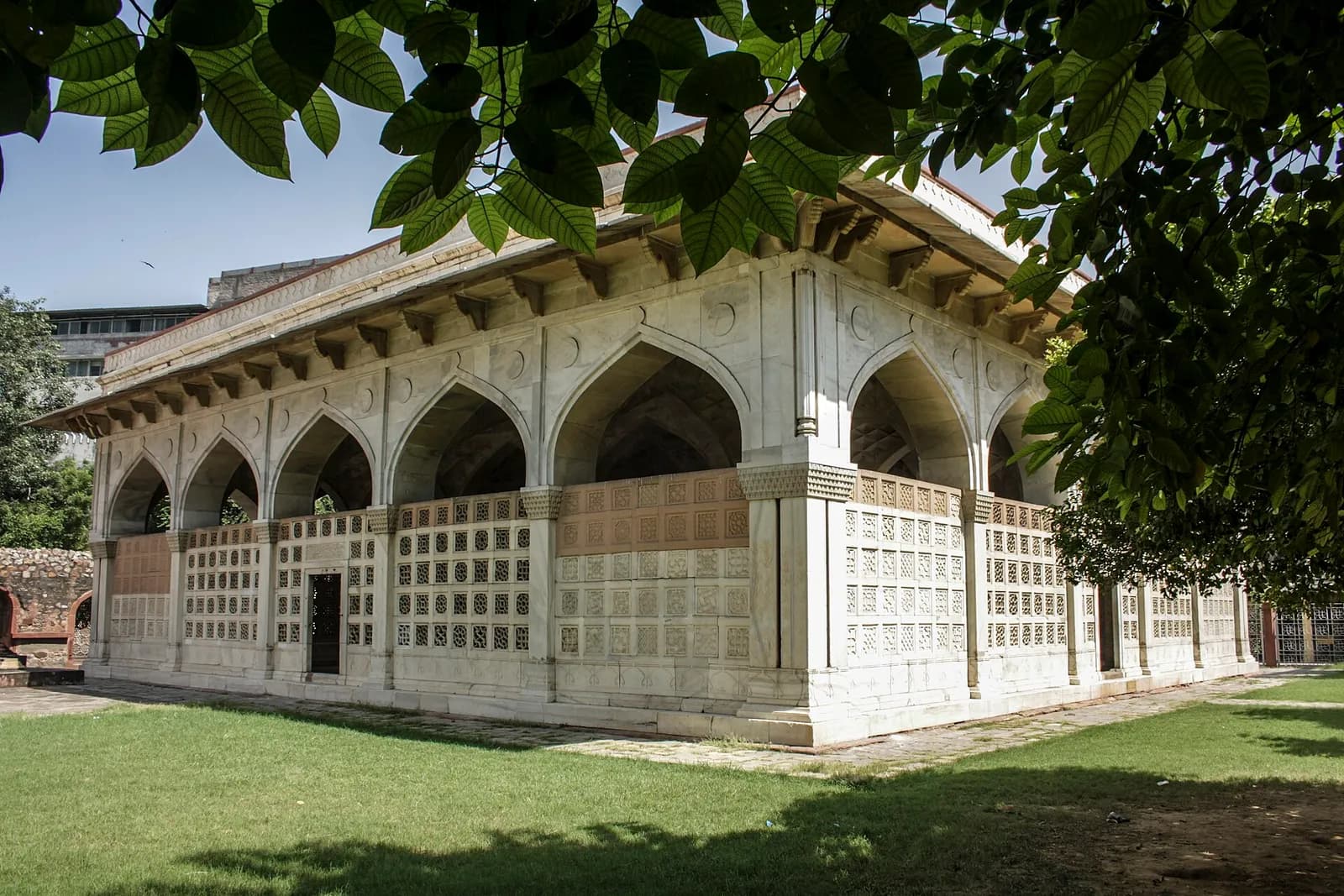
Chausath Khamba is a spectacular early 17th-century Mughal pavilion-tomb, built entirely of shimmering white marble, hidden away in the historic lanes of the Hazrat Nizamuddin Basti in Delhi. Its name translates from Urdu and Hindi as the Sixty-Four Pillars, for the 64 marble columns that carry its flat roof and it was built between 1623 and 1624 as the tomb of Mirza Aziz Koka, a powerful noble and the foster brother of Emperor Akbar, serving also as a family mausoleum for his line. Unlike the heavy, domed, walled tombs typical of the medieval city, it is an open, airy pavilion of marble pillars and delicate lattice screens and it marks a critical turning point in Mughal architecture, forecasting the shift from the red sandstone monuments of Akbar's age to the refined white marble masterpieces of Shah Jahan, culminating in the Taj Mahal. Beautifully restored and set beside the great Sufi shrine of Nizamuddin and the tomb of the poet Mirza Ghalib, it is a serene and exquisite hidden gem.
Several things make it special and they are worth drawing out:
- The sixty-four pillars. A flat-roofed marble pavilion carried on 64 monolithic marble columns, which give the monument its name.
- A foster brother's tomb. Built for Mirza Aziz Koka, Akbar's foster brother and a governor of Gujarat, as a family mausoleum.
- A turning point in Mughal art. An early all-marble monument that bridges Akbar's red sandstone and Shah Jahan's white marble.
- Hidden reverse domes and jaalis. A flat roof concealing 25 inverted domes and walls filled with intricate marble lattice screens.
- A living Sufi setting. Set in the Nizamuddin Basti beside the dargah and Ghalib's tomb, now a stage for Sufi music and heritage events.
It is one of the most beautiful and refined of the offbeat things to do in Delhi and a jewel-like entry among the important monuments of Delhi.
History of Chausath Khamba
The history of Chausath Khamba belongs to the golden age of the Mughal empire and to one of its most interesting noble families, which gives the exquisite marble pavilion a rich human story. The monument was constructed between 1623 and 1624, during the reign of the fourth Mughal emperor, Jahangir, at the height of imperial power and patronage. It was commissioned as the tomb of Mirza Aziz Koka, also honoured with the title Khan-i-Azam, a powerful noble who served several times as the royal governor of Gujarat, one of the empire's richest provinces. His story and that of his family, is the heart of the monument:
- The foster bond. Mirza Aziz Koka was the son of Ataga Khan, Akbar's prime minister and Jiji Anga, Akbar's chief wet nurse, so he grew up alongside the emperor and shared an intimate foster-brother bond with Akbar.
- A family insider. Despite later political disagreements, including his opposition to Jahangir's succession in favour of Prince Khusrau, his standing as a royal family insider was never lost.
- The return to Delhi. When Aziz Koka died at Ahmedabad in 1624, his body was brought across the country to Delhi to be entombed here, in the family precinct near the Sufi shrine.
- A family mausoleum. The hall holds several finely carved marble cenotaphs and served as a collective cemetery for the descendants of the Atgah Khail, the elite circle of nobles tied to his father's household.
This history places Chausath Khamba at the centre of the intimate, powerful world of the Mughal court's foster families, the kokas and anagas who grew up with the emperors and wielded great influence through those bonds. Aziz Koka's own life, as foster brother to Akbar, governor of Gujarat and a figure who could oppose an emperor's succession yet keep his place, embodies that world. That his family chose to be buried here, in the sacred precinct of Nizamuddin, reflects the deep Mughal devotion to the Sufi saints. For the visitor, knowing this story, of the foster brother, the family of nobles and their return to this holy ground, gives the beautiful marble pavilion a depth of human and imperial history that greatly enriches a visit.
Who was Mirza Aziz Koka?
The man for whom Chausath Khamba was built deserves to be known, for Mirza Aziz Koka was one of the most significant nobles of the Mughal golden age. He belonged to the most intimate circle of the imperial family, not by blood but by the powerful bond of fosterage that the Mughals held almost sacred. His mother, Jiji Anga, was the chief wet nurse of the young Akbar and his father, Ataga Khan, rose to become Akbar's prime minister, so Aziz Koka was raised in the imperial household as the emperor's foster brother or koka, a relationship of exceptional closeness and trust in Mughal culture.
On the strength of this bond and his own abilities, Aziz Koka rose high in the empire, serving several times as the governor of the wealthy province of Gujarat and holding the exalted title Khan-i-Azam, the Greatest Khan. He was a figure of real independence and standing: famously, he did not hesitate to disagree with the emperors, even opposing Jahangir's accession in favour of the rival prince Khusrau, yet such was the security of his position as a royal foster-insider that his status endured. His life thus illuminates the crucial role of the foster families in Mughal politics, where milk-kinship could rival blood. For the visitor, understanding who Aziz Koka was, the emperor's foster brother, a mighty governor and a noble bold enough to cross an emperor, turns his tomb from a beautiful empty pavilion into the resting place of a vivid historical personality and it connects Chausath Khamba directly to the human drama of the Mughal court at its height.
Architecture of Chausath Khamba
Architecturally, Chausath Khamba is a highly innovative and influential monument, breaking boldly with the conventions of the medieval tomb and its features reward a close and knowing look. Rather than a heavy, domed, walled mausoleum, it is an open, flat-roofed marble pavilion and its key elements are worth seeking out:
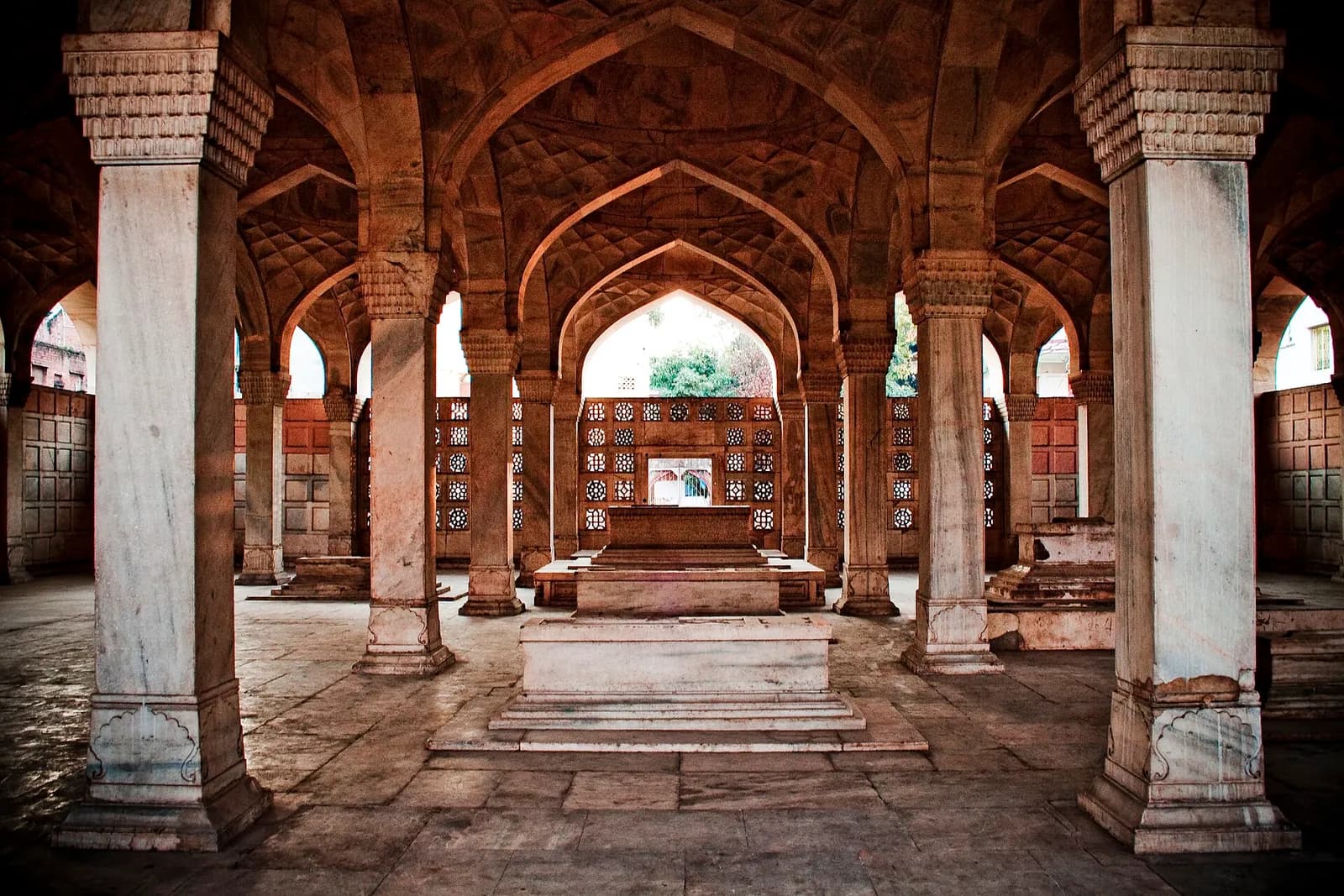
- The sixty-four columns. The monument takes its name from the 64 square, monolithic white marble pillars set across the floor in a grid, with the outer rows doubled into clustered columns at the corners to bear the heavy weight of the roof.
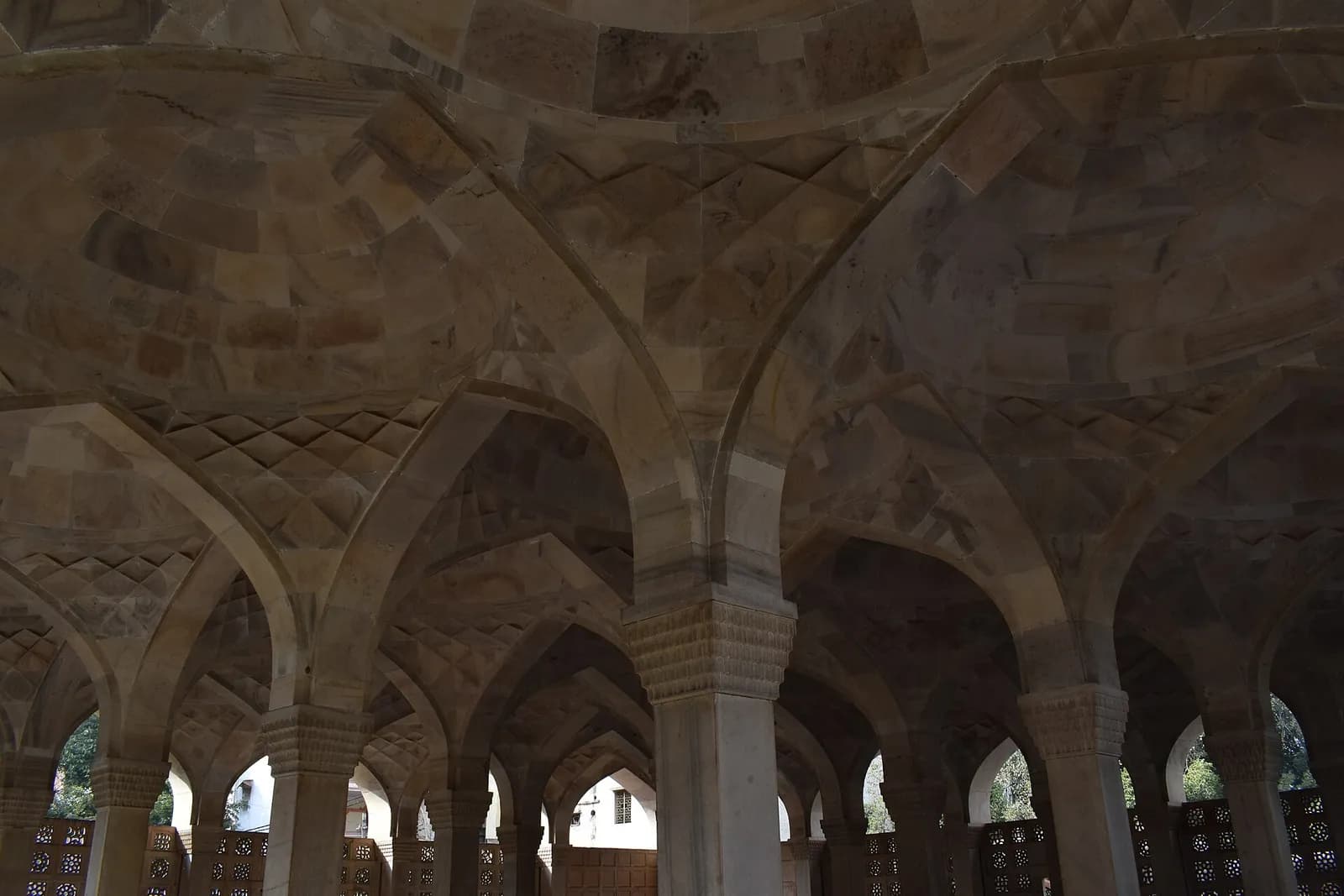
- The twenty-five hidden domes. From outside, the structure appears perfectly flat-roofed, but the columns divide the interior into 25 bays, each topped by its own inverted or reverse, dome, concealed beneath the flat lime-concrete roof terrace.
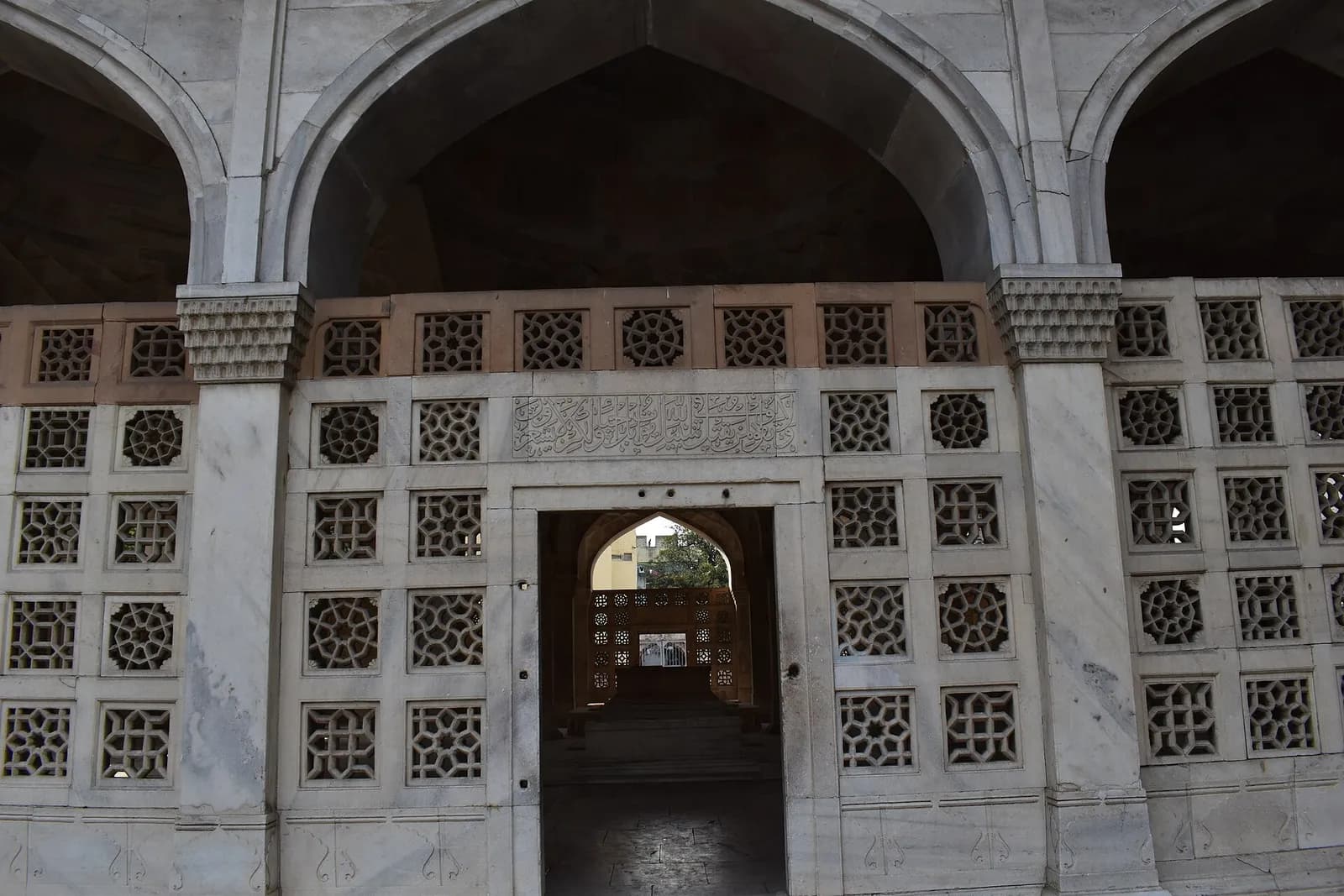
- The marble jaalis. The five perimeter arches on each of the four walls are filled with intricately carved marble lattice screens or jaalis, pierced in complex geometric star and floral patterns that bathe the interior graves in shifting, muted light.
- The Persian inspiration. The open, fluid layout was inspired by the classic wooden garden pavilions of Persia, such as the Chihil Sutun or Forty Pillars, of Isfahan.
The overall impression is of an airy, luminous and perfectly proportioned marble pavilion, utterly unlike the solid, inward tombs that came before, where light pours through the lattice screens and the eye travels freely among the columns. The cleverness of the design is remarkable: the apparently flat roof in fact hides 25 individual domes, a feat of engineering concealed for the sake of a serene, horizontal silhouette. And its influence was profound, for this open, pillared marble form laid the blueprint for the grand open-sided public audience halls, the Diwan-i-Aam, that Shah Jahan would later build in the Red Forts of Agra and Delhi. Knowing what to look for, the 64 pillars, the hidden reverse domes, the exquisite jaalis and the Persian pavilion form, turns a visit into an appreciation of one of the most forward-looking buildings in all of Mughal Delhi.
A turning point in Mughal architecture
Beyond its beauty, Chausath Khamba holds a special place in the history of Indian architecture as a pivotal transitional monument and understanding this greatly deepens a visit. The great monuments of Akbar's reign, such as his red fort at Agra and the city of Fatehpur Sikri, were built predominantly of red sandstone, a robust and warm but comparatively heavy material. The supreme masterpieces of his grandson Shah Jahan, above all the Taj Mahal, would be built of pure white marble, with an airy delicacy and a luminous refinement that marked the zenith of Mughal art. Chausath Khamba, built under Jahangir in the generation between these two, stands exactly at the hinge of that transformation.
In its complete use of white marble, its open and airy pavilion form, its delicate lattice screens and its refined proportions, Chausath Khamba forecasts and helps inaugurate the marble age of Shah Jahan, moving decisively away from the heavy red sandstone idiom of Akbar. It is, in a real sense, an early herald of the aesthetic that would produce the Taj Mahal. For the visitor, this gives the monument an importance far beyond its modest size and hidden location: it is a key step in the evolution of the most beautiful architecture India has produced, a bridge between two great styles. To stand within its marble pillars knowing that here, a generation before the Taj, the Mughal love affair with white marble was taking shape, is to see the monument as the significant and prophetic building it truly is.
The restoration and the Urs Mahal
Chausath Khamba is seen today in beautifully restored condition, thanks to a landmark conservation project and its forecourt has become a living cultural space, both of which are worth knowing about. By the late 2000s the monument was in critical danger: rainwater seeping through blocked roof channels had rusted the internal iron dowels anchoring the marble blocks and the expanding rust was fracturing the stones, threatening collapse. In a remarkable engineering effort between 2011 and 2014, the Aga Khan Trust for Culture and the Archaeological Survey of India systematically dismantled all 25 domes ring by ring, replaced the corroded iron with high-grade stainless steel, repaired thousands of cracks with traditional lime mortar and re-anchored the marble without altering the original design, saving the monument for future generations.
The restoration also reintegrated the monument with its setting. A harsh rubble wall built in the 1960s, which had cut the pavilion off from its forecourt, was removed and replaced with a light fence and the front courtyard was repaved in a formal Mughal grid. This open paved plaza now integrates with the adjacent Urs Mahal stage and serves as a living culture space, an open-air venue for heritage walks, cultural events and, most famously, prestigious Sufi qawwali performances during festivals such as the Jashn-e-Khusrau, which celebrate the poet-saint Amir Khusrau. So Chausath Khamba is not a dead relic but a vibrant part of the living Sufi and cultural life of Nizamuddin. For the visitor, this means the monument can be enjoyed both as a perfectly restored architectural jewel and, on the right evening, as the beautiful backdrop to some of the finest Sufi music in the city and knowing its rescue and its living role adds greatly to the experience.
What to expect at Chausath Khamba
A visit to Chausath Khamba is serene, beautiful and a genuine discovery, tucked into the atmospheric lanes of one of Delhi's great living Sufi quarters and knowing what to expect helps you appreciate it. The monument lies within the Hazrat Nizamuddin Basti, the dense, vibrant village precinct around the famous dargah, so reaching it involves walking through narrow, crowded pedestrian lanes full of the life, food and devotion of the Basti, immediately beside the tomb of the poet Mirza Ghalib and close to the shrine of Nizamuddin Auliya itself. Emerging from the lanes into the monument's repaved forecourt and seeing the luminous white marble pavilion is a lovely surprise. The experience is one of admiring the pavilion, walking among its 64 columns, studying the exquisite jaalis and the marble cenotaphs and appreciating the light that filters through the screens, all in a relatively quiet pocket amid the bustle. A visit takes about thirty to forty five minutes.
The setting is atmospheric and deeply cultural rather than manicured: this is a living religious and residential quarter, so the approach is busy and vibrant, while the monument itself and its forecourt are calm and beautiful. Because it sits among the sacred sites of the Basti, modest, respectful dress and conduct are appropriate, especially if you also visit the nearby dargah. The monument is best combined with the other treasures of Nizamuddin, Ghalib's tomb, the dargah and, across Mathura Road, Humayun's Tomb, for a rich heritage outing. If you can time a visit to coincide with a Sufi qawwali evening at the Urs Mahal, the experience is unforgettable. Come knowing the history and the architecture, dressed respectfully for the Sufi quarter and Chausath Khamba rewards you with one of the most refined and atmospheric hidden experiences in Delhi.
Chausath Khamba timings and entry
Chausath Khamba is open every day, generally from 6:00 AM to 6:00 PM, during daylight hours, within the Hazrat Nizamuddin Basti. Entry is completely free of charge for all visitors, with no ticket required. A visit, taking in the marble pavilion, its columns, screens and cenotaphs, takes about thirty to forty five minutes. Because the monument lies deep within the narrow, crowded pedestrian lanes of the Basti, cars cannot reach it, so visitors walk or take a short e-rickshaw ride from the main Mathura Road entrance into the precinct. As the monument sits among the sacred sites of the Sufi quarter, immediately beside Ghalib's tomb and near the dargah of Nizamuddin Auliya, modest and respectful dress and conduct are appropriate. The forecourt also hosts cultural and Sufi music events at the Urs Mahal, so timings and access can occasionally vary around programmes. These timings are current at the time of writing and can vary, so plan a daytime visit and reconfirm if your plans depend on exact hours or a particular event.
Visiting tips
A few pointers make the visit smoother and more rewarding:
- Know the story and architecture first. Mirza Aziz Koka, the 64 pillars, the hidden domes and the marble turning point give the monument its meaning.
- Walk in through the Basti. Reach it on foot or by e-rickshaw from the Mathura Road entrance, as cars cannot enter the lanes.
- Combine the Nizamuddin sites. See Ghalib's tomb right beside it, the dargah of Nizamuddin Auliya and Humayun's Tomb across Mathura Road.
- Dress respectfully. The monument sits among sacred Sufi sites, so modest dress and quiet conduct are appropriate.
- Study the jaalis and columns. Look for the pierced marble screens, the clustered corner pillars and the light they cast.
- Time a qawwali evening if you can. Sufi music programmes at the Urs Mahal forecourt are a special experience.
- Allow 30 to 45 minutes for the monument, more for the wider Basti.
The key point is to treat Chausath Khamba as part of a Nizamuddin heritage walk, approached respectfully through the living Sufi quarter, with its history and architecture in mind. Done so, this hidden marble jewel rewards you with one of the most refined and atmospheric experiences in the city.
Best time to visit Chausath Khamba
The best time to visit is the cooler months, from October to March and within the day the morning or the later afternoon, for comfortable walking in the Basti lanes and the loveliest light through the marble screens. A pleasant winter day is ideal, with soft light filtering through the jaalis onto the white marble and comfortable temperatures for exploring the quarter. The summer is hot and the crowded lanes tiring and the monsoon can make them wet, so the winter months are much the most comfortable. The monument is beautiful at any daylight hour, but the angled light of morning and late afternoon shows the lattice screens at their most magical. For a special experience, visiting during one of the Sufi qawwali festivals at the Urs Mahal, such as the Jashn-e-Khusrau, is unforgettable, though busier. Allow about half an hour to forty five minutes and combine it with the wider Nizamuddin heritage. Our guide to the best time to visit Delhi sets out the seasons across the city in more detail.
How to reach Chausath Khamba (nearest metro)
Chausath Khamba is in the northeastern part of the Hazrat Nizamuddin Basti in South Delhi, immediately beside the tomb of Mirza Ghalib and close to the dargah of Hazrat Nizamuddin Auliya. The nearest metro stations are JLN Stadium on the Violet Line and Hazrat Nizamuddin on the Pink Line, both a short distance away. Because cars cannot navigate the narrow, crowded pedestrian lanes of the Basti, visitors take a short walk or an e-rickshaw ride from the main Mathura Road entrance into the precinct to reach the monument's courtyard. App cabs and autos can bring you to the Mathura Road edge of the Basti, from where the final approach is on foot. Set in the heart of the Nizamuddin heritage quarter, it pairs naturally with a Delhi day tour or a heritage-focused New Delhi tour that takes in Humayun's Tomb and the Nizamuddin sites.
Places to visit near Chausath Khamba
Chausath Khamba sits in the Hazrat Nizamuddin Basti, one of the richest heritage and Sufi quarters in Delhi, so it is surrounded by remarkable sites and is best enjoyed as part of a wider walk. Immediately beside it stands the tomb of the great Urdu poet Mirza Ghalib and close by is the revered dargah of Hazrat Nizamuddin Auliya, the living heart of the Basti and a centre of Sufi devotion and qawwali. Just across Mathura Road lies the magnificent Humayun's Tomb, the great Mughal mausoleum and World Heritage Site, an essential pairing with Chausath Khamba.
A short ride brings you to the ceremonial India Gate and the old fort of Purana Qila, while the capital's other landmarks round out a full picture of the city: the mighty Red Fort and old city, the towering Qutub Minar and the modern marvels of the Lotus Temple and Akshardham. For more history, the citadel of Feroz Shah Kotla, the great circle of Connaught Place, the ancient stepwell of Agrasen ki Baoli, the sprawling Mehrauli Archaeological Park and the historic Hauz Khas Fort complete the sweep of Delhi's past.
Chausath Khamba in your Delhi itinerary
For most visitors, Chausath Khamba works beautifully as part of a Nizamuddin heritage walk rather than a destination on its own, since it takes under an hour and sits amid a cluster of extraordinary sites. The ideal plan is to combine it with its immediate neighbours, Ghalib's tomb right beside it and the dargah of Nizamuddin Auliya and with the magnificent Humayun's Tomb just across Mathura Road, for one of the richest and most atmospheric heritage outings in the city, spanning Mughal architecture, Urdu poetry and living Sufi devotion. It is a stop for travellers with a genuine interest in architecture, history and culture, who will appreciate both the beauty of the marble and its place in the Mughal story and it rewards an unhurried, respectful visit through the living quarter.
If Delhi is your gateway to the wider Golden Triangle, Chausath Khamba offers a beautiful and insightful prelude to the Mughal marble masterpieces you will see in Agra. Here, a generation before the Taj Mahal, you can see the Mughal love of white marble taking shape in an exquisite pavilion, so a visit deepens your appreciation of the architecture to come. Many of my history-minded guests find this hidden marble jewel and the chance to experience the living Sufi culture of Nizamuddin around it, among the most memorable and moving parts of their Delhi exploration and it adds a refined, cultural note to a trip before the journey on to Agra and Jaipur.
Travel tips for visiting Chausath Khamba
A few pointers make the visit smoother and more rewarding:
- Know the story first, Mirza Aziz Koka and the monument's role as a turning point to the marble age, as they give it meaning.
- Walk in through the Basti from the Mathura Road entrance, as cars cannot reach the monument.
- Pair it with Ghalib's tomb, the dargah and Humayun's Tomb for a full Nizamuddin heritage outing.
- Study the architecture, the 64 pillars, the hidden reverse domes and the pierced marble jaalis.
- Dress modestly and respectfully, as it lies among sacred Sufi sites.
- Time a Sufi qawwali evening at the Urs Mahal forecourt if you can, for a special experience.
- Come in the cooler months and good light, for comfort and the loveliest effect of the screens.
- Reach it via JLN Stadium or Hazrat Nizamuddin metro, then a walk or e-rickshaw into the Basti.
If you would like a local guide to bring the history and beauty of Chausath Khamba and the Nizamuddin quarter to life, message our team on WhatsApp at +91 7302265809 with your travel dates and group size and we will shape the day for you.
Is Chausath Khamba worth visiting?
For history lovers, architecture enthusiasts and those drawn to Sufi culture, yes, it is a genuinely rewarding and beautiful stop, one of the finest hidden gems in the city. There are few monuments in Delhi as exquisite or as quietly significant as this marble pavilion: sixty-four columns carrying a roof of twenty-five hidden domes, walls of intricate pierced marble screens, the tomb of Akbar's own foster brother and a pivotal place in the story of Mughal art as the herald of the white marble age that produced the Taj Mahal. Set beside Ghalib's tomb and the great dargah, beautifully restored and alive with Sufi music, it is as rich in culture as in architecture and it is free to enter. The honest note is that it is reached through the crowded, atmospheric lanes of a living religious quarter, which some find intense and it is a single pavilion rather than a sprawling complex, so it rewards those who come for its refined beauty and its history rather than for scale. But for the curious, respectful traveller, especially paired with the other Nizamuddin sites, it is one of the most beautiful and memorable discoveries in Delhi and I love showing it to guests with an eye for the finest Mughal craftsmanship.
Plan your trip with us
At Experience My India, through our Delhi and Golden Triangle travel desk, we design unhurried, well paced trips that make room for refined, hidden gems like Chausath Khamba and the Nizamuddin heritage, not just the headline monuments and we know how to navigate the Basti respectfully and tell the stories that bring the marble to life. Whether you want a relaxed set of Delhi Agra tours or a full Golden Triangle route through Delhi, Agra and Jaipur, we plan around your pace, your interests and the right season, with local guides who know the history and the living culture. Share your dates and the kind of trip you have in mind through our enquiry page, tell us your group size and we will put together an honest, tailored plan rather than a rushed checklist.
Related guides
- Places to visit in Delhi, for the wider picture
- Hidden places to visit in Delhi, the city's quieter corners
- Nearby places to visit in Delhi, to extend your trip
Enquire Now
Ready to Explore
The Heart of Delhi?
Explore the Red Fort, Qutub Minar, Humayun's Tomb, and the vibrant streets of Old Delhi with our expert-guided premium tours of India's capital city.

Delhi
Premium Tour Package
Questions
Frequently asked questions
What are the timings of Chausath Khamba?
It is open daily, generally from 6:00 AM to 6:00 PM, during daylight hours, in the Nizamuddin Basti. A visit takes about 30 to 45 minutes. Reconfirm, as timings can vary around events.
What is the entry fee for Chausath Khamba?
Why is it called Chausath Khamba?
Who built Chausath Khamba and when?
Why is Chausath Khamba architecturally important?
Which is the nearest metro station to Chausath Khamba?
What is near Chausath Khamba?
Is Chausath Khamba worth visiting?
Explore more
Plan your Chausath Khamba trip with us

Interested in Chausath Khamba Delhi: History, Timings and Visitor Guide?
Chat with our travel team for a custom quote, or browse every package.
Related Attractions
9Ready to explore Chausath Khamba Delhi: History, Timings and Visitor Guide?
Book your private tour today and experience the magic of India's rich heritage.