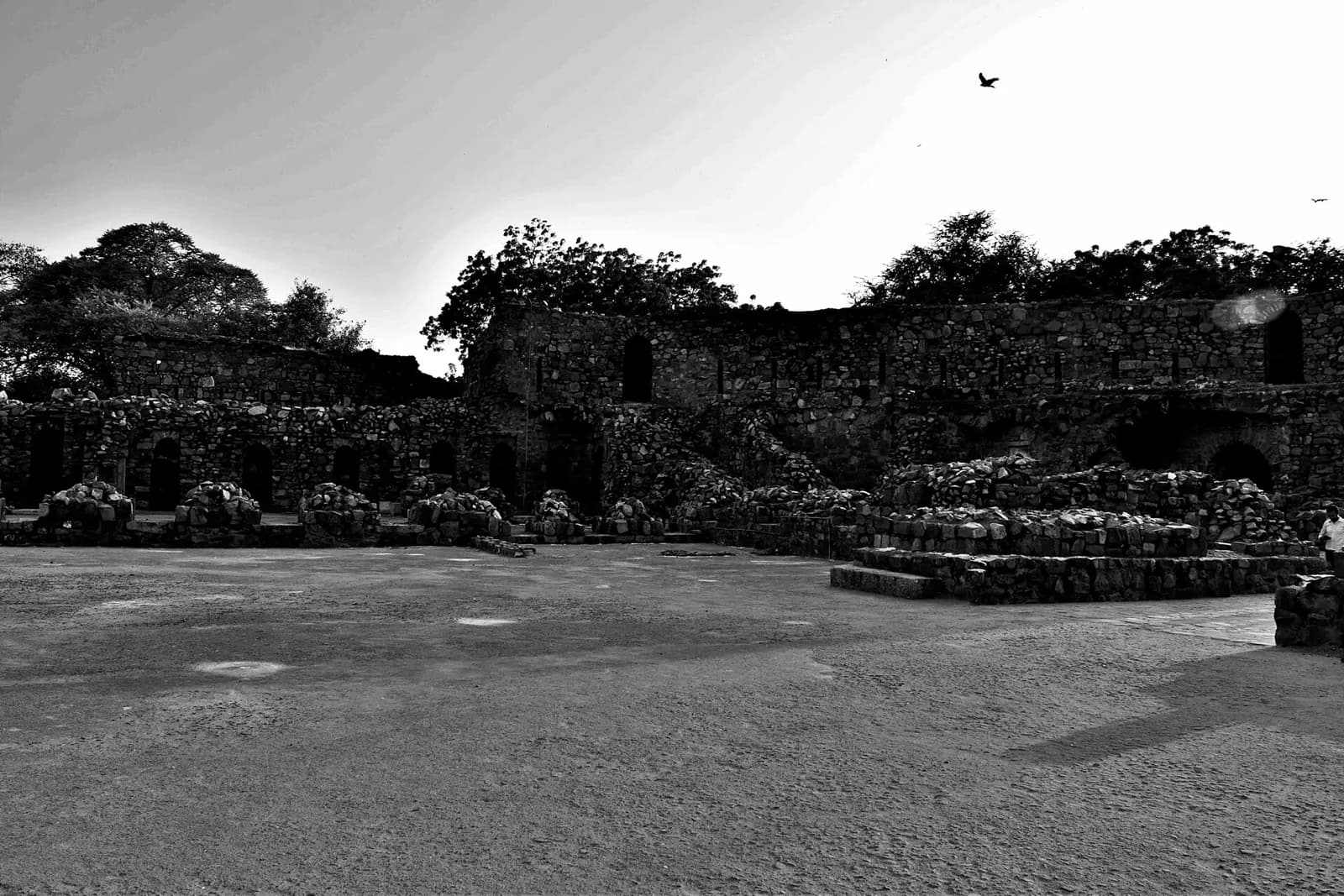
Feroz Shah Kotla Delhi: Timings, Entry, History and Visitor Guide
Visiting Feroz Shah Kotla in Delhi? Explore the Firozabad citadel, the Ashokan pillar, the djinn letters tradition, timings, entry fee and visitor tips.
In a Nutshell
“Feroz Shah Kotla is a 14th century ruined citadel in central Delhi, built in 1354 by Sultan Feroz Shah Tughlaq as the heart of Firozabad, the fifth city of medieval Delhi. It is famous for two very different things: a 3rd century BC polished Ashokan pillar that the Sultan transported here and a living folk tradition in which people leave letters to the djinns or spirits, believed to dwell in its chambers, especially on Thursdays. It is open daily for a small ticket, the nearest metro is Delhi Gate and it is cared for within the work of a unit of Experience My India.”
Feroz Shah Kotla is one of Delhi's most intriguing ruins, a place where ancient imperial history and living folk belief sit side by side. Few sites let you stand beneath a column raised by Emperor Ashoka and, a few steps away, watch people slip handwritten petitions into the walls for the djinns. If you love history with a touch of the mysterious, it is a fascinating stop. Our team at Delhi Agra Tour Packages suggests it to curious travellers and it adds an unusual dimension to a wider Golden Triangle tour.
I am Abhay Sharma, Delhi born and a Golden Triangle guide since 2015 and Feroz Shah Kotla is one of my favourite places to surprise history lovers. This guide gathers everything I would tell a guest before a visit, checking against current information, including the best days to come depending on whether you want quiet ruins or the vivid Thursday rituals.
Details
Feroz Shah Kotla at a glance
| Detail | Information |
|---|---|
| Location | Bahadur Shah Zafar Marg, near Raj Ghat, central Delhi |
| Built | 1354 |
| Built by | Sultan Feroz Shah Tughlaq, as the citadel of Firozabad |
| Famous for | The Ashokan pillar and the Thursday djinn letter tradition |
| Status | Archaeological Survey of India protected monument |
| Nearest metro | Delhi Gate (Violet Line), about 1 km |
| Time needed | 1 to 2 hours |
| Landmark | Beside the Arun Jaitley Stadium, formerly the Feroz Shah Kotla ground |
Feroz Shah Kotla timings
| Detail | Information |
|---|---|
| Opening days | Open all seven days |
| Timings | About 7:30 AM to 5:30 PM |
| Weekly closure | None |
The citadel is generally open daily from about 7:30 AM to 5:30 PM. Timings can change, so treat them as a guide and reconfirm and aim to arrive with enough time to explore before closing.
Entry ticket prices
| Visitor | Fee (at the time of writing, reconfirm) |
|---|---|
| Indian, SAARC and BIMSTEC visitors | About ₹20 online, a little more at the counter |
| Foreign nationals | About ₹250 to ₹300 |
| Children under 15 | Free |
| Still photography | Free for casual personal use |
The ticket is modest. The Archaeological Survey of India revises fees from time to time and the online rate is usually cheaper than the counter, so book online where you can and reconfirm the current fee.
Details
How to reach
| From | Route |
|---|---|
| Delhi Gate metro (Violet Line) | About 1 km away; a short walk or auto |
| ITO metro | Also nearby, then a short auto |
| New Delhi Railway Station | Roughly 3.7 km away |
| By road | Easy access via autos and cabs along Bahadur Shah Zafar Marg; paid parking near the gate |
What is Feroz Shah Kotla and why is it famous?
Feroz Shah Kotla is the ruined royal citadel built in the mid 14th century by Sultan Feroz Shah Tughlaq to serve as the fortified heart of his new capital, Firozabad, which counts as the fifth of the historic cities of Delhi. Within its walls stood palaces, a great mosque, a stepwell and the royal apartments of one of the Tughlaq dynasty's most prolific builders. Today it survives as an atmospheric complex of ruins in the centre of the modern city, protected by the Archaeological Survey of India.
It is famous for a rare combination of things:
- An ancient Ashokan pillar. Crowning the ruins is a polished sandstone column from the 3rd century BC, raised by Emperor Ashoka and brought here by Feroz Shah more than a thousand years later.
- A Timur connection. Its great mosque so impressed the conqueror Timur in 1398 that he is said to have modelled a mosque in Samarkand on it.
- The living djinn tradition. The ruins are the focus of a unique folk practice in which people leave written petitions to the djinns believed to dwell here, especially on Thursdays.
- Delhi's only circular baoli. A distinctive round stepwell sits within the complex.
Few monuments in Delhi fold together imperial antiquity, medieval power and living folk belief so completely. It belongs on any thoughtful list of things to do in Delhi for the curious and it is one of the most unusual of all the places to visit in Delhi.
Who built Feroz Shah Kotla and what was Firozabad?
Feroz Shah Kotla was built in 1354 by Sultan Feroz Shah Tughlaq, the third ruler of the Tughlaq dynasty and one of the great builder kings of the Delhi Sultanate. Feroz Shah was less a conqueror than a consolidator and patron, famous for founding cities, digging canals and raising mosques, tombs, colleges and hunting lodges across his realm and for his unusual interest in preserving and relocating ancient monuments. The citadel of Kotla was the royal core of Firozabad, a large new capital he laid out along the Yamuna, which stretched well beyond the fort walls and ranks as the fifth of Delhi's seven historic cities. In its heyday it was a thriving seat of power; today the Kotla is the best surviving fragment of that vanished city. The same ruler built the great madrasa and tank you can still see at Hauz Khas, so a visit here pairs naturally with that site for anyone following the Tughlaq story.
It helps to picture how much larger Firozabad was than the fort you visit. Feroz Shah laid out an extensive new capital stretching along the banks of the Yamuna, with the Kotla as its royal citadel but palaces, mosques, markets and homes spreading well beyond the walls. Much of that city has long since vanished under the modern districts of central Delhi, its stones reused in later buildings over the centuries, so the Kotla is really the last substantial survivor of a once sprawling capital. Knowing that changes how you see the ruins: they are not a small isolated fort but the surviving core of a vanished city, which is why they feel grander and more significant than their present size alone suggests. The river has since shifted away from the walls, but in Feroz Shah's day the citadel looked directly out over the Yamuna, a deliberate choice for both defence and beauty.
What is the Ashokan Pillar at Feroz Shah Kotla?
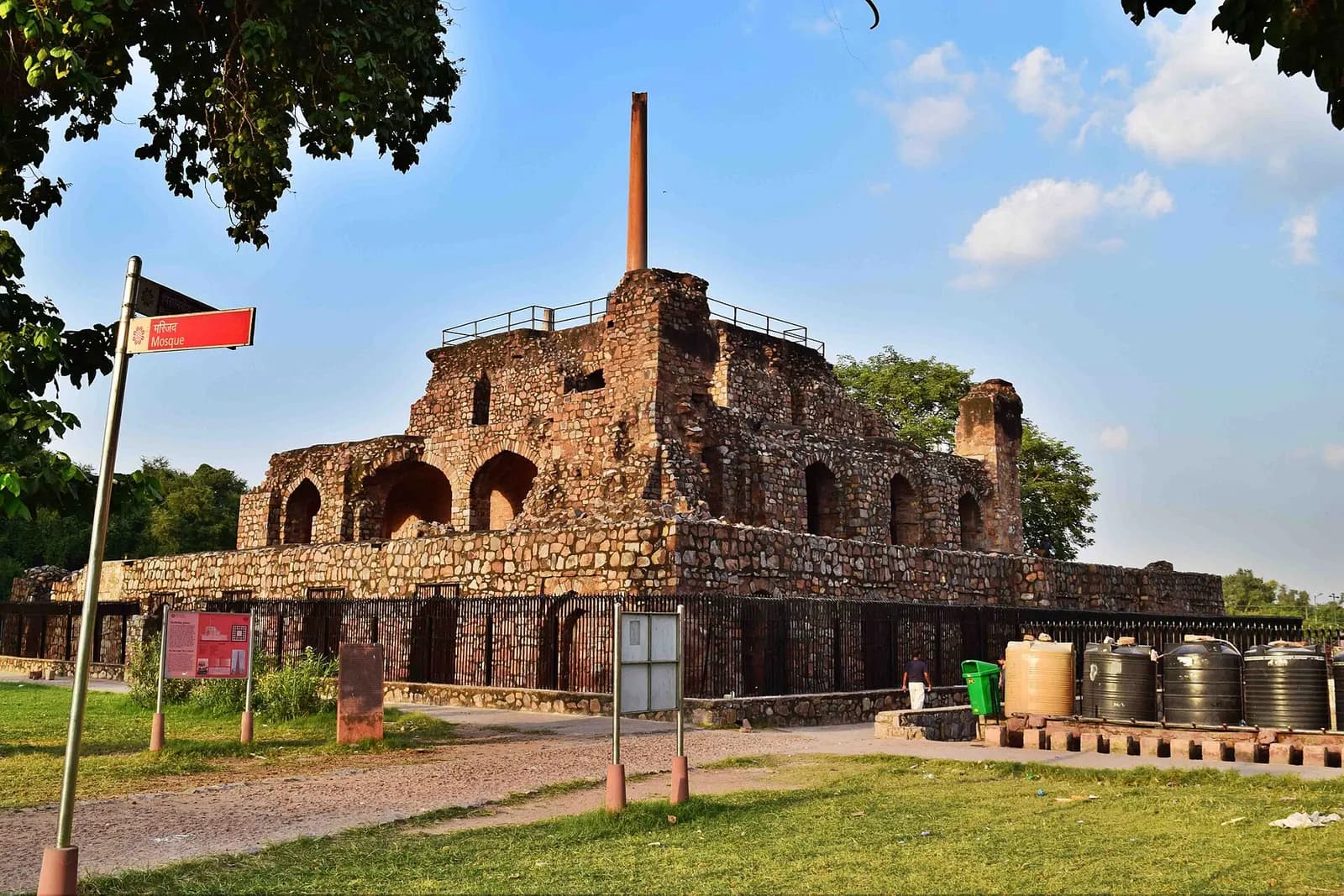
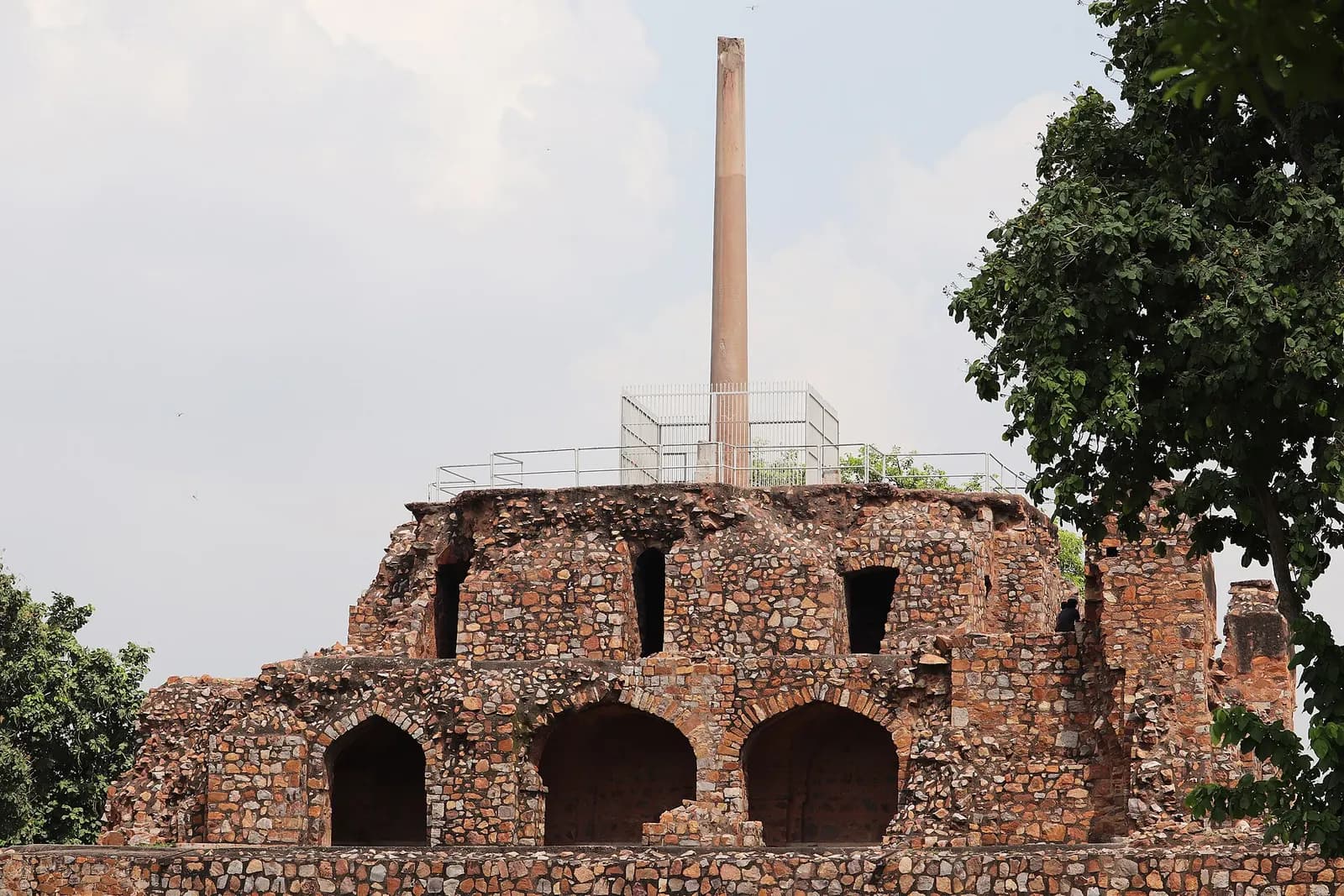
The showpiece of the ruins is one of the oldest and most remarkable objects in Delhi: a polished sandstone pillar from the 3rd century BC, inscribed with an edict of the Mauryan emperor Ashoka. Standing around 13 metres tall and gleaming with the characteristic Mauryan polish, it is far older than the fort around it, by well over a thousand years. What makes its presence here so extraordinary is how it arrived. Feroz Shah Tughlaq, fascinated by these ancient columns, had this one carefully transported from Topra in present day Haryana to Delhi around 1356, an immense feat of medieval engineering involving a specially built carriage and boats along the river. He then set it atop a stepped, pyramidal stone structure within his citadel, where it still stands, sometimes called the Minar-i-Zarrin, the golden minaret. It is a genuine wonder: a Mauryan imperial monument, preserved and re-erected by a medieval sultan, now rising above Tughlaq ruins in the heart of a modern capital. Few single objects tell so much of India's layered history at once.
There is a further twist that history lovers enjoy. The edict carved into the pillar is written in an ancient Brahmi script that, by Feroz Shah's time, no one could read; its meaning stayed a mystery for centuries until scholars finally deciphered Brahmi in the 19th century, revealing Ashoka's message of moral conduct and compassion. So for the whole of the medieval period, people revered a column covered in writing nobody understood, which only deepened its aura of mystery, an aura that arguably feeds the site's later reputation for the supernatural. It is also worth knowing that this was not the only such pillar Feroz Shah moved: he brought a second Ashokan column to Delhi too, which still stands on the northern ridge, evidence of a genuine, unusual fascination with India's ancient past in a medieval ruler. Standing beneath the polished shaft, catching the light exactly as it did over two thousand years ago, is one of the quiet thrills of visiting Delhi.
What else can you see at Feroz Shah Kotla?
Beyond the pillar, the complex holds several striking structures and a walk takes in a cross section of Tughlaq architecture. The main sights:
- The Ashokan pillar and its pyramidal base. The crowning feature, the ancient polished column atop its multi-tiered stone platform, with chambers below that are central to the djinn tradition.
- The Jami Masjid. One of the largest and oldest surviving Tughlaq mosques, built of local quartzite, famous for having hosted the conqueror Timur, who prayed here in 1398 and was reportedly so struck by it that he had a similar mosque built in Samarkand.
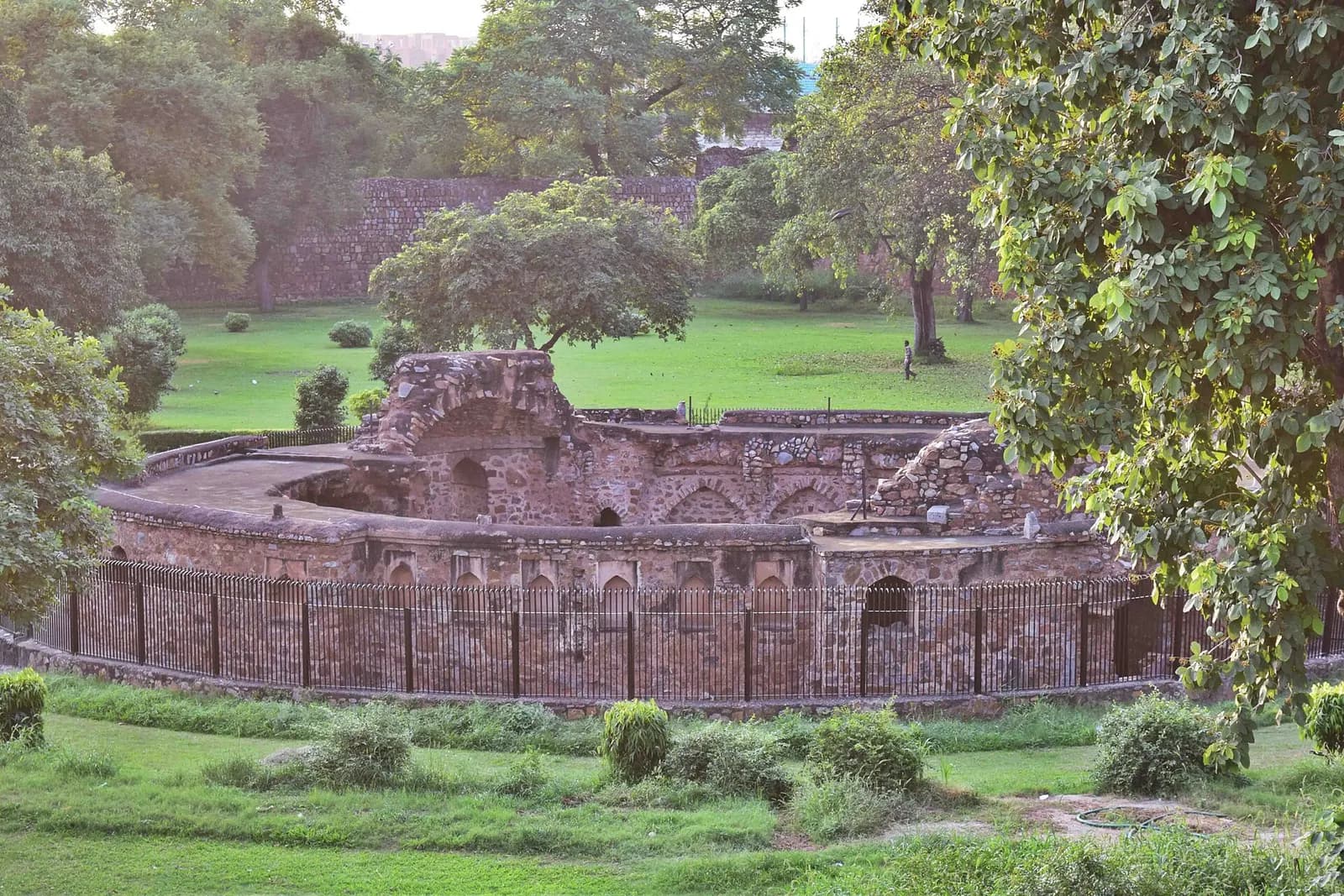
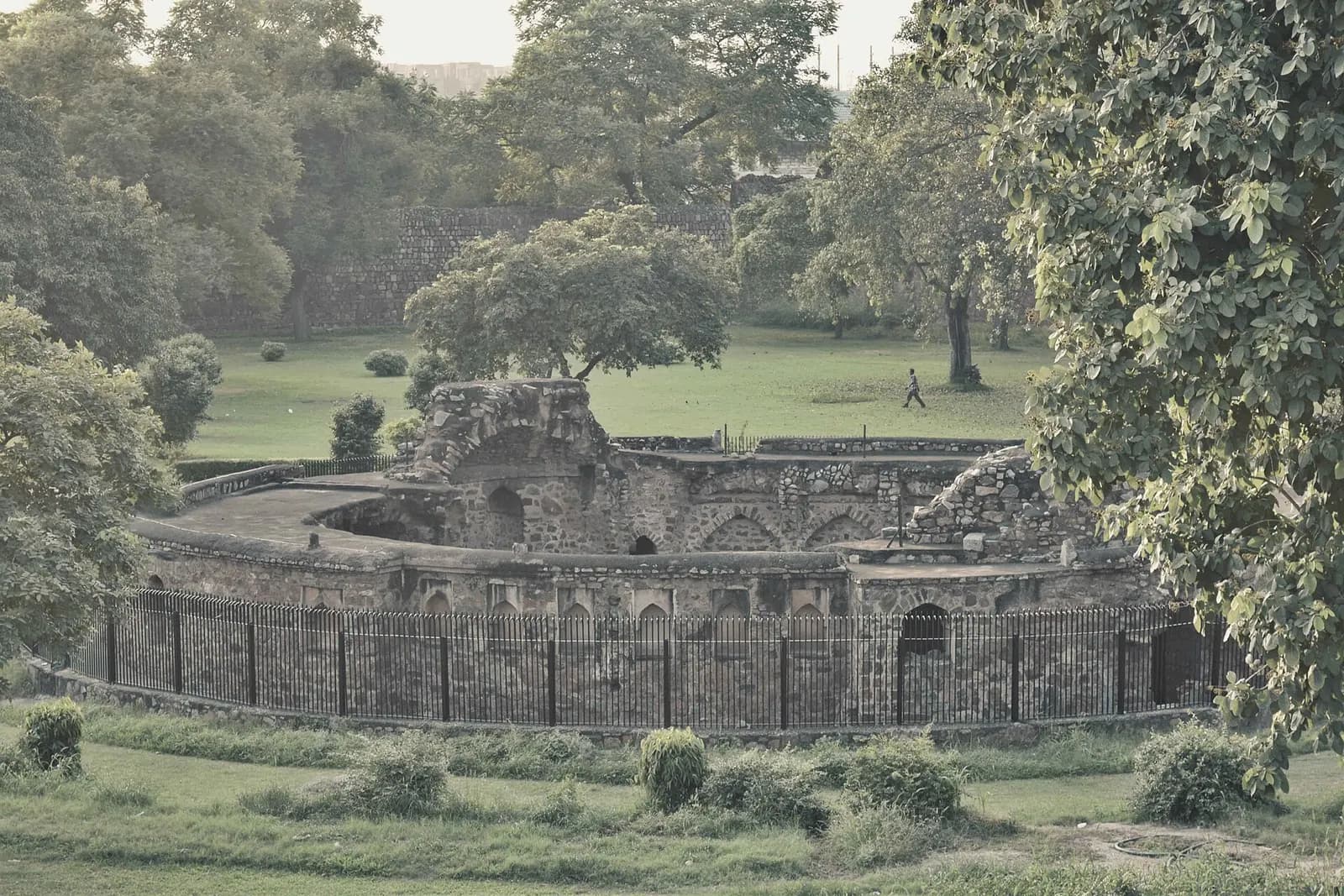
- The circular baoli. Delhi's only circular stepwell, a large subterranean well linked to tiers of steps, built to cope with water shortages. Its core is usually kept locked for safety but can be viewed from above.
- The palace ruins and fort walls. Towering stone structures, dark internal chambers, guard rooms and arched passages show the austere, military Indo Islamic architecture of the Tughlaqs.
Together these let you read the citadel as the royal heart of a lost capital, now weathered into one of the most evocative ruins in central Delhi.
The Jami Masjid is worth lingering over. Raised on a high plinth with chambers beneath, it was in its day one of the grandest mosques in Delhi, large enough to hold a great congregation and its scale still impresses even in ruin. The story of Timur is the detail everyone remembers: when the Central Asian conqueror sacked Delhi in 1398, he is said to have been so struck by this mosque that he took its design as a model for the great Bibi Khanym mosque he built in his capital, Samarkand. True or embellished, the tale captures how renowned Feroz Shah's buildings were across the medieval Islamic world. The circular baoli, meanwhile, is a rarity worth seeking out: most Delhi stepwells are rectangular, but this one is round, a deep shaft ringed by chambers and steps, built to secure the citadel's water supply. Its heart is usually gated for safety, but even viewed from above it is an elegant piece of engineering and a fitting companion to the other great baolis you may see elsewhere in the city.
What is the djinn folklore at Feroz Shah Kotla?
This is what makes Feroz Shah Kotla utterly unlike any other monument in Delhi. The ruins are the focus of a remarkable living folk tradition built around djinns, the spirits of Islamic belief that many locals hold to dwell in the dark chambers and alcoves beneath the pillar and through the complex. These are regarded as largely benevolent beings who can intercede in people's troubles and over the decades the fort has become a place of popular petition and prayer.
Every Thursday, especially in the afternoon and evening, the quiet ruins transform. Crowds of people arrive to light incense and candles, tie threads and above all to leave written letters and petitions addressed directly to the djinns, tucking folded papers into niches and cracks in the walls, asking for help with illness, family troubles, money or other personal grievances. People of different faiths take part and the atmosphere is one of hushed, hopeful devotion amid the stone. It is a genuinely extraordinary thing to witness, a medieval ruin serving as a living shrine of popular belief. If you come to see it, do so respectfully and discreetly, as these are real prayers and real hopes, not a show. Visit on a Thursday to experience it or on another day if you prefer the ruins quiet and empty.
What is fascinating is that the tradition, though it feels ancient, is thought to be relatively modern, growing to its present scale only in the decades since the 1970s, yet it has become deeply rooted in the life of the city. Petitioners often bring several copies of their letter, leaving one for the djinns at the fort and keeping others and the niches and dark chambers beneath the pillar fill with folded papers, burnt incense and the remains of offerings. The practice cuts across religious lines, drawing Hindus and Muslims alike, which makes it a striking example of Delhi's shared, syncretic folk culture. For an outside visitor it is an unusual window into the living beliefs of ordinary people, quite separate from the official history of the monument. Approach it with the same respect you would any place of prayer: observe quietly, keep your distance from people writing or praying and ask before photographing anyone. Seen in the right spirit, the Thursday gathering is one of the most memorable and humane things you can witness in Delhi.
Who was Feroz Shah Tughlaq?
Feroz Shah Tughlaq, who ruled in the mid to late 14th century, is remembered as one of the most constructive rulers of the Delhi Sultanate. Rather than expanding the empire by war, he poured his energy into public works and architecture and chroniclers credit him with founding several towns and building a vast number of mosques, tombs, colleges, reservoirs, hospitals and canals. He had a particular, almost antiquarian passion for India's ancient past, which is why he went to such lengths to relocate not one but two Ashokan pillars to Delhi, the one at Feroz Shah Kotla and another that stands on the northern ridge. He also repaired older monuments, including earlier sultanate structures. This blend of piety, practicality and reverence for the past defines his reign and Feroz Shah Kotla, with its mosque, its stepwell and above all its carefully re erected ancient pillar, is the perfect expression of the man. Knowing his character turns the ruins from anonymous stones into the legacy of a distinctive and thoughtful king.
His reign is often seen as the last stable, prosperous period of the Tughlaq dynasty before it declined and Delhi fell to Timur's devastating raid soon after his death. Under Feroz Shah the sultanate turned inward, investing in infrastructure and welfare rather than conquest; the canals he dug to carry water across the dry countryside were among the most ambitious engineering works of medieval India and some of their routes influenced waterways used for centuries afterwards. He is a somewhat paradoxical figure, pious and conservative in religion yet genuinely curious about the ancient, pre Islamic past, practical in his public works yet a great patron of art and architecture. Feroz Shah Kotla gathers all these threads in one place: the mosque for his piety, the stepwell for his practicality, the relocated Ashokan pillar for his antiquarian passion and the whole citadel for his ambition as a builder of cities. Reading the ruins with the man in mind makes them far richer than a glance would suggest.
What are the Feroz Shah Kotla timings and entry fee?
Feroz Shah Kotla is open every day of the week, generally from about 7:30 AM to 5:30 PM, so plan to arrive with time to explore before it closes. Entry is inexpensive: for Indian visitors and those from SAARC and BIMSTEC countries the fee is around ₹20 if booked online and a little more at the cash counter, while foreign nationals pay roughly ₹250 to ₹300 and children under 15 enter free. These figures are current at the time of writing and the Archaeological Survey of India revises fees from time to time, so book online where you can for the cheaper rate and reconfirm. Basic drinking water and restrooms are available, along with paid parking near the entry gate and casual photography is free. It is a compact site, so an hour or two is enough to see it well, longer if you stay for the Thursday rituals.
What is the best time to visit Feroz Shah Kotla?
The best season is the cool stretch from October to March, when Delhi's weather is pleasant for walking through the open air ruins; the summer months are harsh on this largely shadeless site. The best day, though, depends entirely on what you want. For a peaceful, almost empty historical experience, come on a Tuesday or Wednesday morning, when you can take in the pillar, the mosque and the ruins in silence. For the vivid, mystical side of the site, come on a Thursday afternoon or evening, when the djinn rituals are in full flow and the ruins fill with incense, candlelight and petitioners. Many visitors find it fascinating to see both faces of the place, so if you have time, a quiet weekday morning and a Thursday evening make a memorable contrast. Mornings are generally cooler and better for photography of the architecture.
Whichever day you pick, give yourself a little time to simply sit and take the place in. Feroz Shah Kotla has a particular atmosphere, part grand ruin, part sacred site, part quiet retreat in the middle of a roaring city, that rewards a slower visit. On a calm weekday morning the loudest sound is often birdsong and the distant hum of traffic and the ancient pillar catches the light above the weathered stone in a way that feels genuinely timeless. On a Thursday the same spot is transformed, thick with incense, candlelight and the murmur of prayer. Few monuments change character so completely from one day to the next and experiencing even one of those moods leaves a strong impression. It is this blend of the historical and the living, the imperial and the intimate, that makes the citadel so memorable and why I so often recommend it to travellers who feel they have seen the obvious sights and want something with more texture and surprise.
How do you reach Feroz Shah Kotla?
Feroz Shah Kotla is easy to reach, sitting centrally on Bahadur Shah Zafar Marg near Raj Ghat and beside the Arun Jaitley Stadium, long known as the Feroz Shah Kotla cricket ground. By metro, the nearest station is Delhi Gate on the Violet Line, about 1 km away, a short walk or auto ride and ITO station is also close by. If you are arriving from outside the city, New Delhi Railway Station is roughly 3.7 km away. By road it is readily reached by auto, app cab or local bus along the main road and there is paid parking near the entry gate.
Its central position, close to the Red Fort and Old Delhi and a short hop from India Gate, means it fits neatly into a central Delhi plan. If you are threading a wider route, a dedicated New Delhi tour can tie it together with the imperial sights, while a broader Delhi day tour folds the citadel into the full span of the capital.
What is there to see near Feroz Shah Kotla?
Feroz Shah Kotla sits in a central, history rich part of the city, so it pairs easily with plenty nearby. A short distance away is the mighty Red Fort and the bustling lanes of Old Delhi, which our Old Delhi tour explores, while the solemn riverside memorial of Raj Ghat is right beside the citadel. The colonial heart of the city at Connaught Place is a short ride away, as is the dramatic stepwell of Agrasen ki Baoli, a good companion to the fort's own circular baoli.
Following the Tughlaq thread, the dynasty's story continues at the sprawling Mehrauli Archaeological Park and the serene Lodhi Garden in the south. Together these turn Feroz Shah Kotla into a rewarding part of a central and historic Delhi day and you can see the fuller picture in our guide to the important monuments of Delhi.
How does Feroz Shah Kotla fit into a Delhi or Golden Triangle itinerary?
For most visitors, Feroz Shah Kotla works well as a central, offbeat stop slotted into a day that also takes in the Red Fort and Old Delhi nearby, since all three sit in the same historic belt along the river. It is compact, so it does not demand much time, which makes it an easy and rewarding addition for travellers who want more than the standard sights. Those following a fuller itinerary often balance it with the city's grander icons, the towering Qutub Minar, the serene Humayun's Tomb and the modern Lotus Temple, for a well rounded picture of Delhi.
If Delhi is your gateway to the wider Golden Triangle, Feroz Shah Kotla adds something no other stop quite does, a direct link from Emperor Ashoka in the 3rd century BC through the medieval Tughlaqs to a living folk tradition that continues every Thursday. Many of my more curious guests find it one of the most thought provoking places they visit. For the best season across the capital, our guide to the best time to visit Delhi is a useful companion and for more offbeat corners see our guide to the city's hidden places to visit.
Travel tips for visiting Feroz Shah Kotla
A few pointers make the visit smoother:
- Come October to March for comfortable weather, as the ruins are largely open and shadeless.
- Choose your day, a Tuesday or Wednesday morning for quiet ruins or a Thursday afternoon for the djinn rituals.
- Wear comfortable walking shoes, as you will cover a kilometre or two over uneven stone paths.
- Carry water and sun cover and try to come earlier in the day during the warmer months of the year.
- Be respectful at the djinn sites, as the letters and offerings are real prayers, not a spectacle.
- Start at the Ashokan pillar, the undisputed highlight and read up a little on its remarkable journey from Topra beforehand to appreciate it fully.
- Combine it with the Red Fort and Old Delhi nearby for a full central Delhi day.
- Allow extra time on a Thursday, as the site gets busy with petitioners and the atmosphere is worth lingering over.
If you would like a local to build Feroz Shah Kotla into a wider Delhi plan, message our team on WhatsApp at +91 7302265809 with your travel dates and group size and we will help you shape the day.
Plan your trip with us
At Experience My India, through our Delhi and Golden Triangle travel desk, we design unhurried, well paced trips that make room for intriguing, layered sites like Feroz Shah Kotla, not just the headline monuments. Whether you want a relaxed set of Delhi Agra tours or a full Golden Triangle route through Delhi, Agra and Jaipur, we plan around your pace, your interests and the right season, with local guides who can explain both the ancient history and the living folklore. Share your dates and the kind of trip you have in mind through our enquiry page, tell us your group size and we will put together an honest, tailored plan rather than a rushed checklist.
Related guides
- Akshardham temple, for a very different, modern Delhi landmark
- Nearby places to visit in Delhi, to extend your day
Enquire Now
Ready to Explore
The Heart of Delhi?
Explore the Red Fort, Qutub Minar, Humayun's Tomb, and the vibrant streets of Old Delhi with our expert-guided premium tours of India's capital city.

Delhi
Premium Tour Package
Questions
Frequently asked questions
What are the timings of Feroz Shah Kotla?
It is open every day, generally from about 7:30 AM to 5:30 PM. Timings can change, so reconfirm and arrive with time to explore before closing.
What is the entry fee for Feroz Shah Kotla?
Which is the nearest metro station to Feroz Shah Kotla?
Who built Feroz Shah Kotla and when?
What is the Ashokan pillar at Feroz Shah Kotla?
Why do people leave letters at Feroz Shah Kotla?
When is the best day to see the djinn rituals?
What else can you see at Feroz Shah Kotla?
How much time do I need at Feroz Shah Kotla?
Is Feroz Shah Kotla worth visiting?
Is Feroz Shah Kotla the same as the cricket stadium?
Explore more
Plan your Feroz Shah Kotla trip with us

Interested in Feroz Shah Kotla Delhi: Timings, Entry, History and Visitor Guide?
Chat with our travel team for a custom quote, or browse every package.
Related Attractions
9Ready to explore Feroz Shah Kotla Delhi: Timings, Entry, History and Visitor Guide?
Book your private tour today and experience the magic of India's rich heritage.