Hauz-i-Shamsi and the Jharna, Mehrauli: History and Guide
Visiting Hauz-i-Shamsi and the Jharna waterfall in Mehrauli? The Iltutmish dream legend, the Mughal pleasure garden, Jahaz Mahal, timings and how to reach.
In a Nutshell
“Hauz-i-Shamsi, also called Shamsi Talab, is a sacred 13th-century reservoir in Mehrauli village in South Delhi, excavated by Sultan Iltutmish in 1230 after a dream of the Prophet Muhammad is said to have revealed the spot. Beside it, the Jharna is a Mughal waterfall and pleasure garden fed by the reservoir's surplus water. Together they form a remarkable medieval water system, flanked by the Jahaz Mahal palace and central to the Phool Walon ki Sair festival, recently revived from decay into a cooling green lung for Mehrauli. It features on our Mehrauli heritage walks, run by a unit of Experience My India.”
Hauz-i-Shamsi and the adjoining Jharna are among the most atmospheric and historically rich corners of old Delhi, a deeply interconnected medieval water system that reveals the sophisticated hydraulic engineering of the Delhi Sultanate and the Mughal pleasure gardens that grew from it. For the traveller drawn to legends, to water architecture and to the living culture of Mehrauli, they make a wonderful and little-visited stop. Our team at Delhi Agra Tour Packages loves to bring guests here on a Mehrauli walk and it adds a serene, storied dimension to a wider Golden Triangle tour through the capital.
I am Abhay Sharma, Delhi born and a Golden Triangle guide since 2015 and I have a deep fondness for Hauz-i-Shamsi and the Jharna, because few places weave together so beautifully a miraculous founding legend, centuries of royal history, a clever medieval waterfall and a moving modern revival, all set in the dense old lanes of Mehrauli. This guide gathers everything I would tell a visitor beforehand, checking against current information, including the legend and history, the Mughal Jharna, the festival connection, the recent restoration and the timings and directions.
Details
Hauz-i-Shamsi and the Jharna at a glance
| Detail | Information |
|---|---|
| Names | Hauz-i-Shamsi (Shamsi Talab) and the Jharna (waterfall) |
| Reservoir built | 1230, by Sultan Iltutmish |
| The Jharna | Mughal waterfall and garden, developed around 1700 |
| Location | Mehrauli village, South Delhi, behind Jahaz Mahal |
| Managed by | Archaeological Survey of India (ASI) and DDA |
| Known for | Sacred reservoir, dream legend, Mughal waterfall, festival venue |
| Nearest metro | Qutub Minar (Yellow Line) |
| Entry | Free |
Hauz-i-Shamsi timings
| Detail | Information |
|---|---|
| Open | Every day |
| Hours | Sunrise to sunset (about 6:00 AM to 6:30 PM) |
| Busiest | During the autumn Phool Walon ki Sair |
The reservoir and the Jharna are open every day during daylight hours, from roughly sunrise to sunset, about 6:00 AM to 6:30 PM. The site is busiest and most festive during the autumn Phool Walon ki Sair festival. These timings are current at the time of writing and can vary, so reconfirm before a special trip.
Entry fee
| Visitor | Fee |
|---|---|
| All visitors | Free; no ticket required |
How to reach Hauz-i-Shamsi and the Jharna
| From | Route |
|---|---|
| Qutub Minar metro (Yellow Line) | Nearest station, an auto or e-rickshaw into Mehrauli village |
| Jahaz Mahal | The reservoir sits directly behind the palace |
| The Jharna | About 150 metres from the reservoir, down a small lane |
| By car | Mehrauli lanes are narrow; metro plus rickshaw is easier |
What are Hauz-i-Shamsi and the Jharna?
Hauz-i-Shamsi, also recorded as Shamsi Talab or Hauz-e-Shamsi, is a large sacred reservoir in the heart of Mehrauli village in South Delhi, excavated in the 13th century by Sultan Iltutmish, while the Jharna is a later Mughal waterfall and pleasure garden built to use the reservoir's surplus water, standing a short way down a lane from the lake. Together they form a single, deeply interconnected medieval water system, one of the most remarkable survivals of its kind in Delhi. The reservoir, founded on a miraculous dream legend and once reached only by boat, supplied water to medieval Delhi and became a sacred site; its overflow was later channelled through underground pipes to feed the Jharna, an elegant three-part waterfall and fountain garden where Mughal royalty took their summer ease. Flanked by the Lodi-era Jahaz Mahal palace, which seems to float on the water and serving as a key venue of the beloved Phool Walon ki Sair festival, the complex is a layered monument of Sultanate hydraulics, Mughal leisure and living culture, recently rescued from decay and revived as a cooling green sanctuary for the old quarter.
Several things make the complex special and they are worth drawing out:
- A sacred dream reservoir. Hauz-i-Shamsi was founded in 1230 on the site a dream is said to have revealed and it became a holy as well as a practical water source.
- A clever Mughal waterfall. The Jharna used the reservoir's surplus water to create an engineered three-tier waterfall and fountain garden for royal summer retreats.
- The floating palace. The Jahaz Mahal or Ship Palace, stands on the reservoir's edge and reflects in the water like a stone ship.
- A festival heart. The complex is a primary venue of Phool Walon ki Sair, Delhi's festival of Hindu-Muslim harmony.
- A revived green lung. Rescued from pollution and decay, the reservoir now cools the dense Mehrauli lanes and shelters migratory birds.
It is one of the most rewarding of the hidden places to visit in Delhi and a serene highlight among the offbeat things to do in Delhi.
The legend of Hauz-i-Shamsi
At the heart of the reservoir's story is one of the most famous founding legends in Delhi, recorded by medieval chroniclers and knowing it gives the site its sacred character. The legend ties the lake directly to Sultan Iltutmish and to a miraculous dream:
- A city in drought. According to medieval accounts, including those associated with the traveller Ibn Battuta, Delhi was suffering a terrible water shortage and Sultan Iltutmish prayed earnestly for a solution.
- The dream. The Sultan is said to have been visited in a dream by the Prophet Muhammad, riding his celestial steed, who pointed out a particular rocky spot in Mehrauli where water could be found.
- The sacred hoofprint. The next morning Iltutmish rode with his spiritual advisors to the site and is said to have found the imprint of a horse's hoof pressed into the rock, marking the exact spot.
- The reservoir. The Sultan at once ordered the excavation of a massive rainwater reservoir of several acres around the site in 1230, to supply the people of Delhi.
This legend is why Hauz-i-Shamsi was always far more than a practical water tank: it was a sacred site, founded on a vision and marked by a holy relic, the hoofprint stone. The story, told by chroniclers for centuries, gave the reservoir deep religious significance alongside its vital role in supplying water to the growing medieval city. For the visitor, knowing the legend transforms a quiet lake into a place of wonder and it explains the reverence in which the site has been held for nearly eight hundred years, as well as the special pavilion built to honour the sacred spot.
The central pavilion
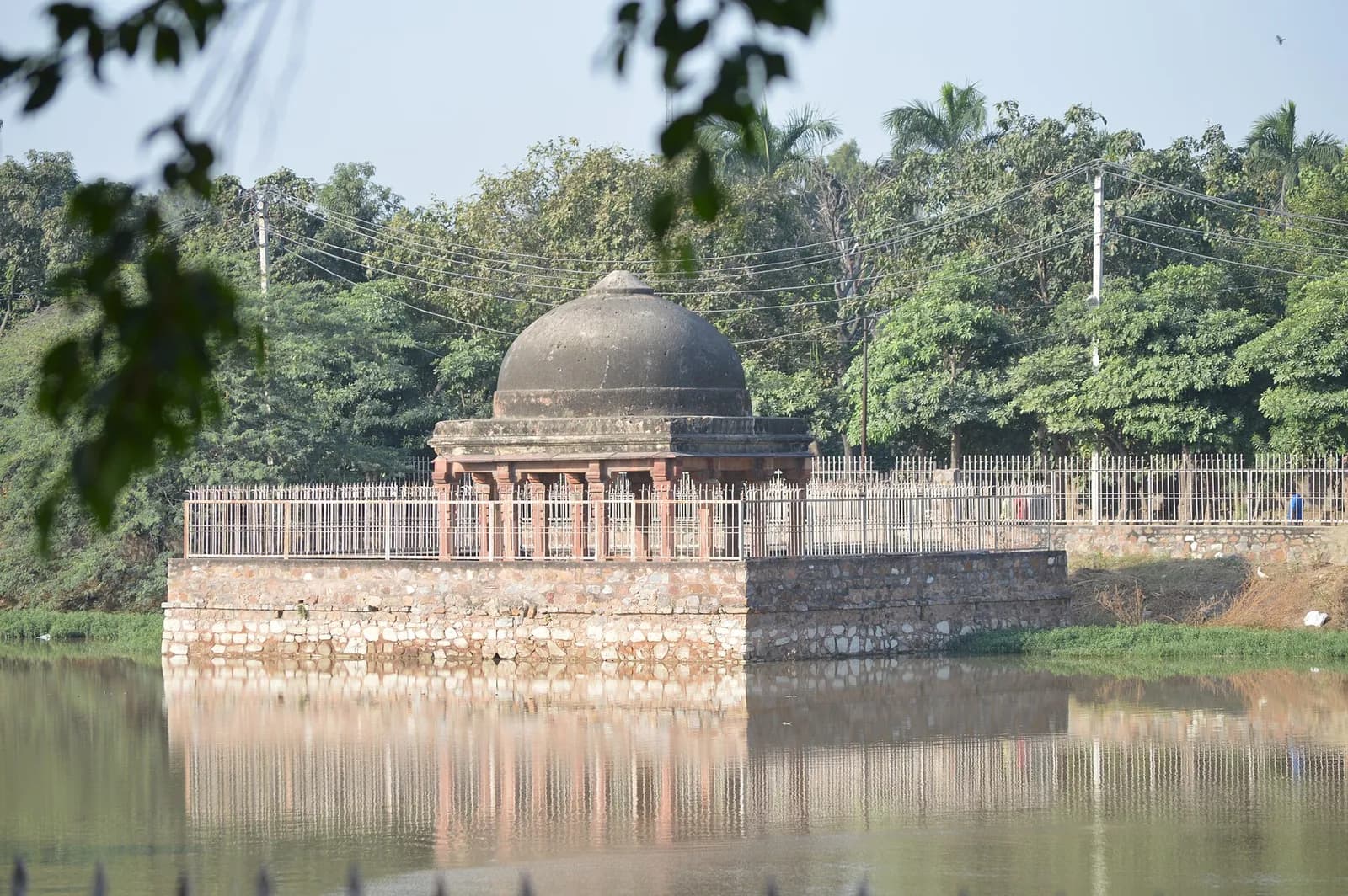
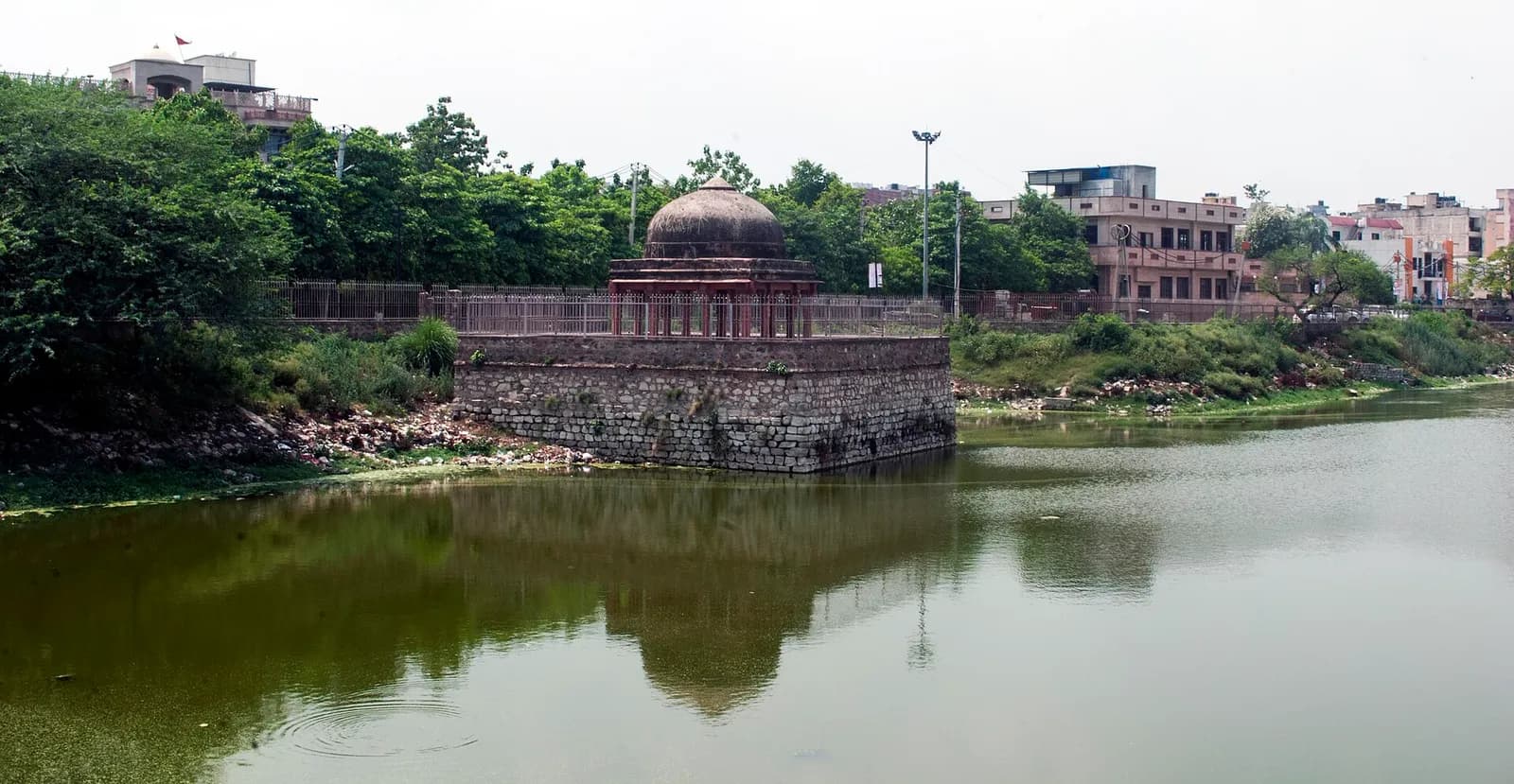
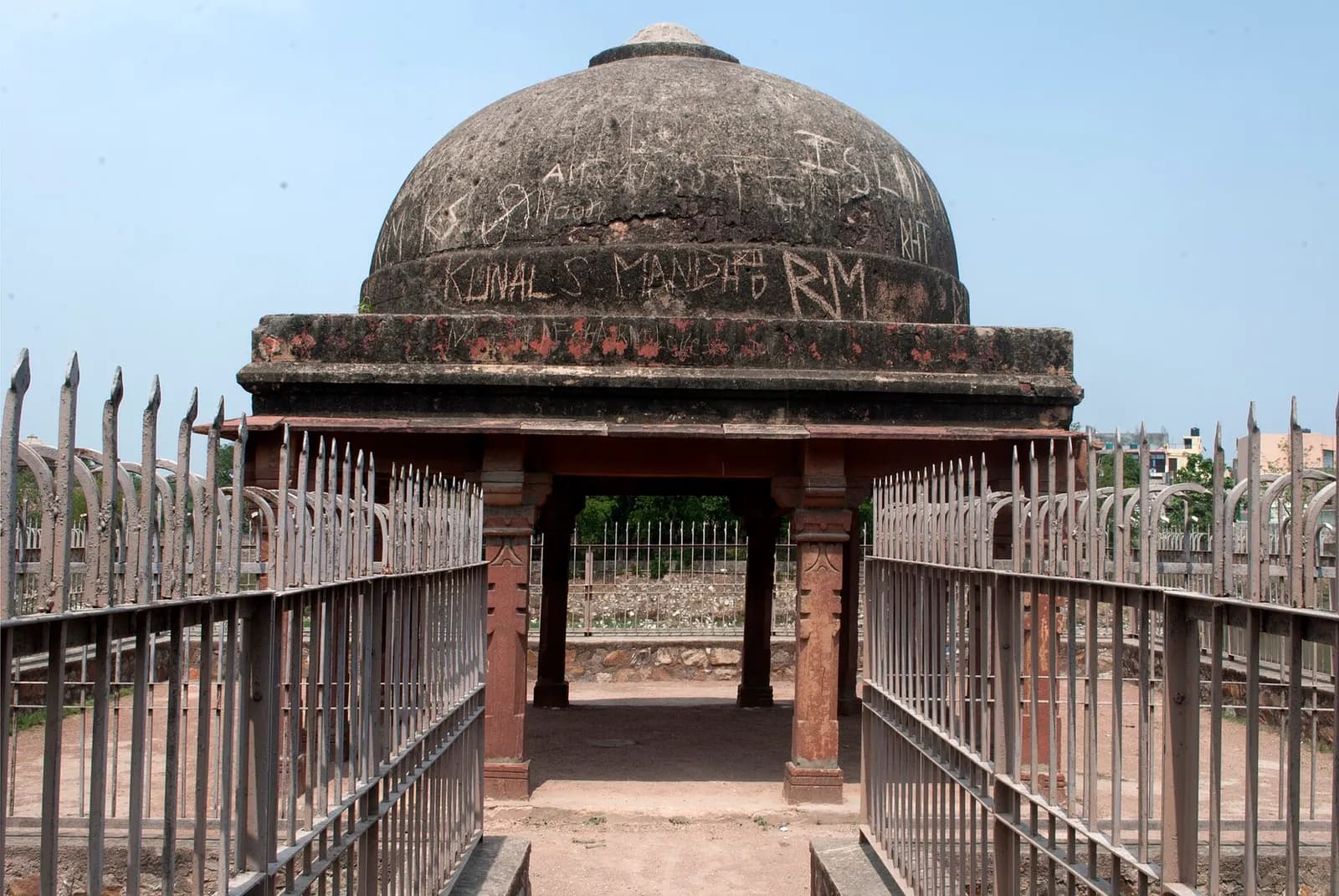
One of the most distinctive features of Hauz-i-Shamsi is the elegant domed pavilion that marks the sacred heart of the reservoir and it is worth looking for. To honour the holy site of the hoofprint, Sultan Iltutmish built a double-storeyed red sandstone domed pavilion resting on twelve pillars directly over the sacred stone. Historically this pavilion stood right in the deep centre of the lake and could be reached only by boat, a striking sight rising from the water. Over the centuries, however, the reservoir has shrunk through silting and the pressures of the surrounding city, so that the pavilion now sits exposed near the eastern embankment rather than in open water. It remains the architectural and spiritual focus of the reservoir, a graceful survival of 13th-century Sultanate design. For the visitor, the pavilion is the key thing to seek out at the lake, both for its beauty and because it marks the very spot of the founding legend and its changed position, once mid-lake, now at the edge, is itself a vivid record of how the reservoir and the city around it have changed over eight centuries.
The Mughal Jharna: a royal waterfall
If the reservoir is the sacred heart of the complex, the Jharna is its pleasure garden, a delightful piece of Mughal hydraulic engineering that used the lake's surplus water for royal leisure and it is the other half of a visit. Rather than let the overflow go to waste, later rulers channelled it into an elaborate waterfall and fountain retreat:
- The hydraulic network. In the late 14th century Sultan Firoz Shah Tughlaq repaired the embankments and built channels to manage the overflow; around 1700 the Mughal noble Nawab Ghaziuddin Khan Firoz Jang channelled the surplus through an underground masonry pipe to feed a new pleasure garden.
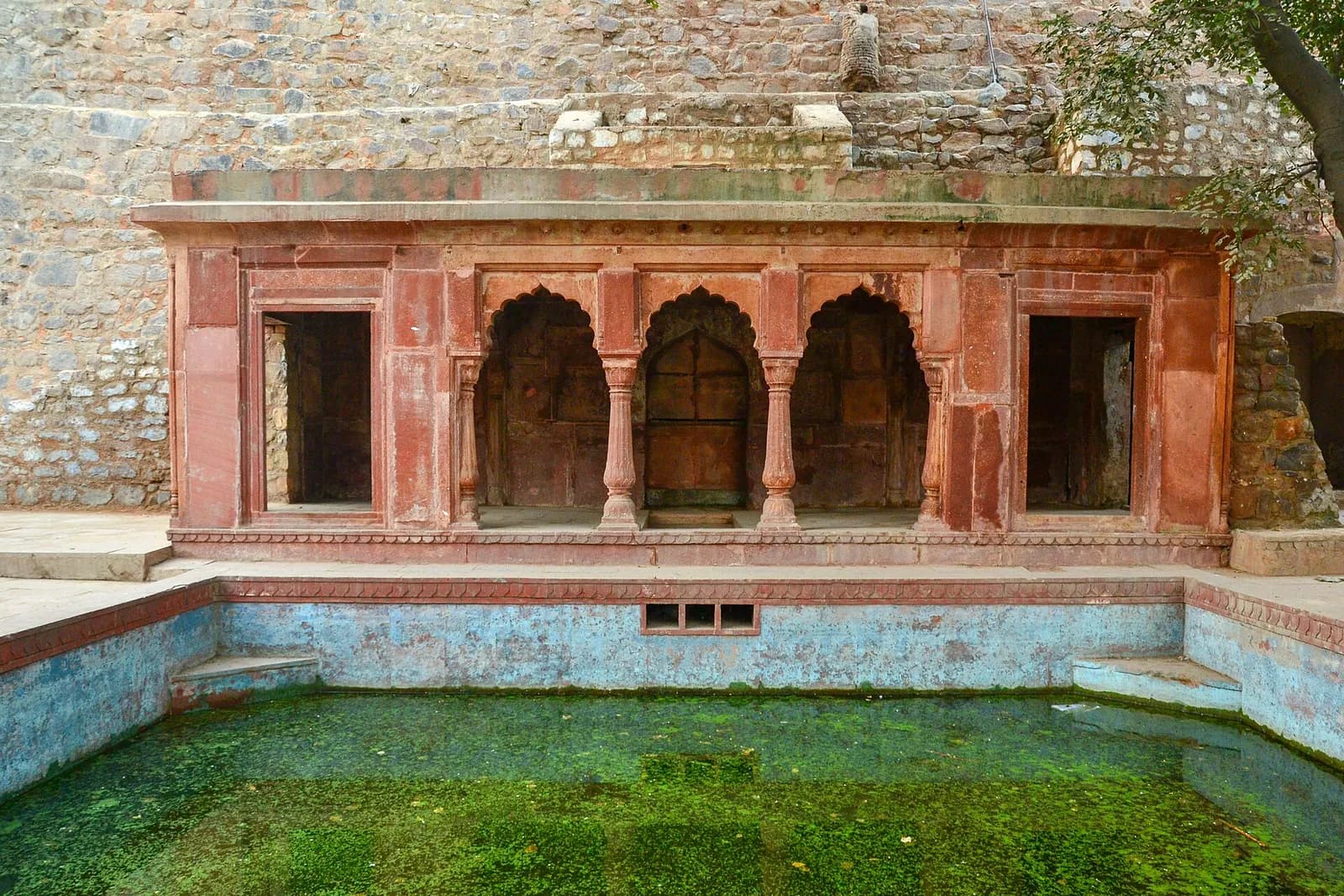
- The three-tier waterfall. The Jharna was built in three structural parts: a masonry reservoir tank that collected the piped water, a sloping stone chute down which it cascaded like a mountain waterfall and a lower paved fountain plaza lined with stone columns and many gravity-fed fountains.
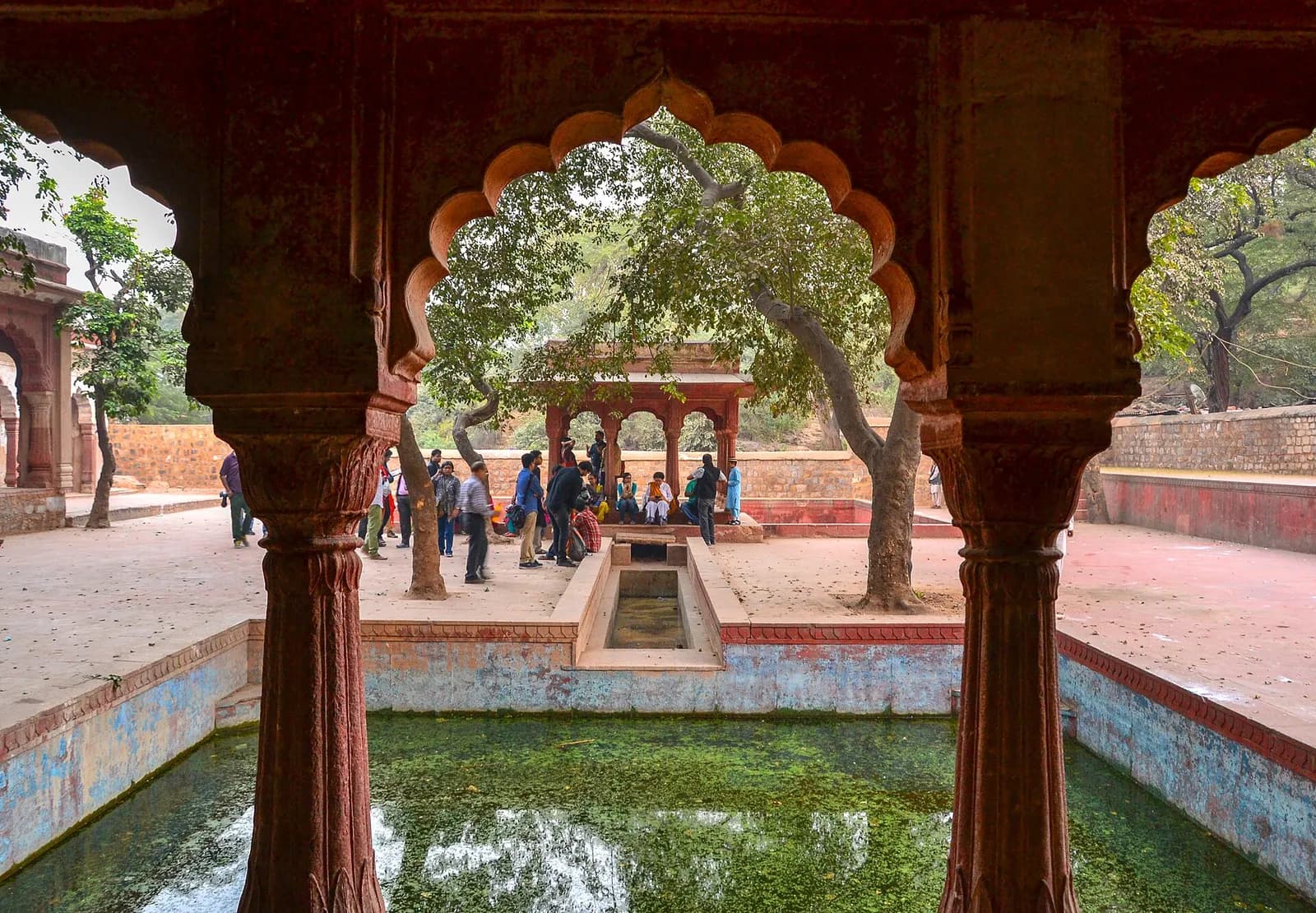
- The royal baradaris. In the fading decades of the Mughal empire, the emperors Akbar Shah II and Bahadur Shah Zafar added elegant arched stone pavilions or baradaris, flanking the waterfall, with the multi-cusped arches of the imperial gardens, where the royal family could sit cool beside the spray on hot summer days.
This makes the Jharna a sophisticated and beautiful example of Mughal water architecture, turning a practical overflow into a cascade and fountain garden designed purely for pleasure and relief from the Delhi heat. The sight of the sloping chute, the fountain plaza and the arched royal pavilions, even today, conjures the summer retreats of the late Mughal court, when emperors escaped the heat of the city beside the falling water. For the visitor, the Jharna is a rare and atmospheric survival, a royal waterfall hidden in the lanes of Mehrauli and it pairs perfectly with the sacred reservoir that feeds it to tell the full story of water, power and leisure in medieval Delhi.
The Jahaz Mahal connection
No account of Hauz-i-Shamsi is complete without the beautiful palace that stands on its edge, for the two are inseparably linked in sight and story. During the Lodi era, around the 16th century, the grand Jahaz Mahal or Ship Palace, was built directly on the eastern edge of the reservoir. Its stone chhatris and high pavilions were designed to reflect in the lake waters, so that from a distance the palace appeared to float on the reservoir like a great stone ship, which is how it earned its evocative name. The palace and the reservoir were conceived together as a single scenic ensemble, the still water mirroring the floating palace and they remain one of the most picturesque sights in Mehrauli. The Jahaz Mahal served as a retreat and, in later centuries, as a resting place for pilgrims and a venue for festivities. For the visitor, the palace and the reservoir should be seen together, as their builders intended and the reflection of the Ship Palace in the revived waters of Hauz-i-Shamsi is one of the loveliest scenes in old Delhi.
Phool Walon ki Sair at Hauz-i-Shamsi
The Hauz-i-Shamsi and Jharna complex is not only a historic monument but a living cultural venue, serving as one of the primary stages for Delhi's cherished festival of communal harmony and this gives it a special warmth. The complex is central to Phool Walon ki Sair, the autumn festival that celebrates the shared Hindu-Muslim culture or Ganga-Jamuni tehzeeb, of Delhi:
- A festival venue. After floral fans are offered at the nearby Yogmaya Temple and the Sufi dargah of Khwaja Bakhtiyar Kaki, the reservoir and the Jharna host the festival's main closing ceremonies.
- Nights of celebration. The arcades of the Jharna and the illuminated embankments of the Shamsi Talab come alive with night-long music, traditional wrestling matches and regional dances.
- A cradle of shared culture. The complex serves as a living home of Delhi's syncretic tradition, where Hindu and Muslim communities celebrate together.
This festival role makes Hauz-i-Shamsi far more than a quiet historic lake: for a few days each autumn it becomes the joyous heart of one of India's most treasured traditions of interfaith harmony, its waters and pavilions lit up for celebration. The connection ties the complex to the nearby Yogmaya Temple and the dargah of Bakhtiyar Kaki, all bound together in the single festival. For the visitor fortunate enough to be in Delhi during Phool Walon ki Sair, seeing the Jharna and the lake embankments alive with music and dance is an unforgettable experience and even at other times the knowledge of this living culture adds depth to a visit.
The decline and revival of Hauz-i-Shamsi
One of the most moving parts of the story is recent, for the complex nearly disappeared before being brought back to life and it is worth knowing as part of any visit today. The site's modern history is a tale of decay and remarkable recovery:
- The collapse into decay. Through the late 20th and early 21st centuries the complex fell into catastrophic decline, as illegal encroachments cut off the underground water feeds, sewage was directed into the sacred tank and the Jharna waterfall dried up and became a garbage-choked drain.
- The collaborative revival. A major community-led and state-funded ecological restoration turned the site around, driven by the Archaeological Survey of India, the non-profit SEEDS India and a local citizens' group, with comprehensive desilting of the waterbody.
- A modern climate buffer. Sewage inflows were cut off and solar-powered aerators and floating bio-islands of water-purifying plants installed, so that the revived reservoir now naturally filters its water, cools the dense surrounding lanes and shelters migratory birds.
This revival gives Hauz-i-Shamsi a powerful contemporary meaning alongside its ancient history: a nearly lost medieval reservoir, rescued by the combined effort of government, non-profits and local residents and turned into a working piece of green infrastructure for a crowded modern neighbourhood. The story of its recovery, from a polluted drain to a cooling, bird-filled sanctuary, is an inspiring example of heritage and ecological restoration going hand in hand. For the visitor, knowing this adds a note of hope and relevance to the visit and the sight of the clean, living water and the birds it now attracts is all the more rewarding for the knowledge of how close it came to being lost.
What to expect at Hauz-i-Shamsi and the Jharna
A visit to Hauz-i-Shamsi and the Jharna is peaceful, scenic and quietly fascinating, a world away from the busy monuments nearby and knowing what to expect helps you enjoy it. The reservoir sits in the dense old fabric of Mehrauli village, its revived waters now calm and often dotted with birds, with the domed pavilion near the eastern edge and the Jahaz Mahal palace standing on the bank, reflecting in the lake. A short walk down a lane brings you to the Jharna, where you can trace the stone waterfall chute, the fountain plaza and the arched royal baradaris, imagining the Mughal summer retreats. Walking the embankments, finding the central pavilion, admiring the Ship Palace on the water and exploring the Jharna's waterfall structure is the essence of the visit, which takes perhaps 45 minutes to an hour for both parts.
A few practical points help. The complex sits amid the narrow, busy lanes of Mehrauli village, so a little patience is needed to find it and the Jharna is a short walk from the reservoir. As a living neighbourhood site as well as a monument, it is best visited in daylight and with respect for local residents and worshippers. Sensible shoes help on the embankments and around the Jharna's stonework. The site is at its most vibrant during Phool Walon ki Sair, which is wonderful to witness but very crowded. For the visitor, the key is to approach the complex as a serene and storied place to wander rather than a grand monument, taking time to absorb the legend, the architecture and the revived natural beauty, ideally as part of a wider exploration of Mehrauli.
Visiting tips
A few pointers make a visit smoother and more rewarding:
- See both parts. Visit the reservoir for the pavilion and the Ship Palace reflection, then walk to the Jharna for the waterfall and baradaris.
- Pair it with Mehrauli. The complex sits amid the great monuments of Mehrauli, so combine it with the Qutub and the park.
- Find the central pavilion near the eastern embankment, marking the sacred spot of the legend.
- Come in daylight and with respect for the living neighbourhood around the site.
- Wear sensible shoes for the embankments and the Jharna's stonework.
- Visit in the cooler months for comfortable walking in the old lanes.
- Consider the festival. Phool Walon ki Sair in autumn fills the site with music and celebration.
- Allow 45 minutes to an hour for both the reservoir and the Jharna.
The key point is to treat Hauz-i-Shamsi and the Jharna as a single, serene water complex to explore at leisure, taking in the legend, the Mughal waterfall and the revived lake, ideally within a wider Mehrauli walk.
Best time to visit
The best time to visit is during the cooler months, from October to March, when walking the old lanes of Mehrauli and the embankments is comfortable and within the day during the softer light of morning or late afternoon, when the reservoir is calm and the Jahaz Mahal reflects beautifully in the water. A winter morning is ideal, cool and clear for the walk and the views and a good time to see the migratory birds the revived lake now attracts. The most vibrant time of all is the autumn Phool Walon ki Sair festival, when the reservoir and Jharna host the celebrations, though it is also the busiest. The summer months are hot for walking the open embankments and the monsoon can make the lanes muddy, though the reservoir is at its fullest then. Our guide to the best time to visit Delhi sets out the seasons across the city in more detail.
How to reach Hauz-i-Shamsi and the Jharna (nearest metro)
Hauz-i-Shamsi and the Jharna lie in the heart of Mehrauli village in South Delhi, close to the great Qutub complex. The nearest metro station is Qutub Minar on the Yellow Line, from which an auto-rickshaw or e-rickshaw ride into Mehrauli village, via the Mehrauli Bus Terminal road, brings you to the lake embankments. The reservoir sits directly behind the Jahaz Mahal palace and the Jharna is about 150 metres away down a small lane. Because the complex sits amid the narrow, busy lanes of old Mehrauli, the metro combined with a short rickshaw ride is the easiest approach, rather than driving. The great Qutub Minar complex is close by, so the two are easily combined. Set in the historic heart of south Delhi, the complex fits naturally into a Delhi day tour or a heritage-focused New Delhi tour built around the monuments of Mehrauli.
Places to visit near Hauz-i-Shamsi
Hauz-i-Shamsi sits in Mehrauli, one of the richest concentrations of historic monuments in Delhi, so it is surrounded by remarkable sites and is best enjoyed as part of a wider heritage outing. Right on its edge stands the Jahaz Mahal and nearby are the ancient Yogmaya Temple and the world-famous Qutub Minar complex, with the sprawling Mehrauli Archaeological Park close by, holding the Jamali Kamali mosque, the tomb of Balban, Rajon ki Baoli and Quli Khan's Tomb. A little further lie the historic Hauz Khas Fort and its lake and the medieval stepwell of Agrasen ki Baoli.
Further out, the capital's other great landmarks round out a full picture of the city: the serene Humayun's Tomb, the mighty Red Fort, the ceremonial India Gate and the modern marvels of the Lotus Temple and Akshardham. For more of Delhi's history, the old citadel of Purana Qila, the astronomical Jantar Mantar and the ruins of Feroz Shah Kotla are well worth adding and our roundup of the important monuments of Delhi ties them together.
Hauz-i-Shamsi in your Delhi itinerary
For most visitors, Hauz-i-Shamsi and the Jharna work best as a serene stop within a wider Mehrauli heritage walk rather than a destination on their own, since they sit amid one of Delhi's densest clusters of monuments. A natural plan is to combine the reservoir, the Jharna and the Jahaz Mahal with the ancient Yogmaya Temple, the adjacent Qutub Minar and the ruins of the Mehrauli Archaeological Park in a single rich half-day, moving from sacred reservoir to royal waterfall to great monuments. The complex itself needs only 45 minutes to an hour, but its legend, its Mughal waterfall and its lovely revived setting give it a charm out of proportion to its size and it adds a peaceful, scenic and storied counterpoint to a day among stone ruins. It suits the history lover, the photographer and the traveller curious about Delhi's water heritage and living culture.
If Delhi is your gateway to the wider Golden Triangle, Hauz-i-Shamsi offers a tranquil and deeply atmospheric corner of the old city, a sacred lake and a royal waterfall wrapped in legend and recently brought back to life that few visitors ever see. Many of my guests find it one of the most restful and memorable stops of their Mehrauli walk and it deepens their sense of the city's layered past, its water and its shared culture before they travel on to Agra and Jaipur.
Travel tips for visiting Hauz-i-Shamsi and the Jharna
A few pointers make a visit even better:
- Reach it via Qutub Minar metro, then an auto into Mehrauli village to the lake behind Jahaz Mahal.
- See the reservoir and the Jharna together, a short walk apart, for the full story.
- Combine with the Qutub, Yogmaya Temple and the Mehrauli park for a rich half-day.
- Look for the central pavilion and the Ship Palace reflection on the water.
- Visit in the cooler months and in soft light for the best views and birdlife.
- Come in daylight and with respect for the living neighbourhood.
- Wear sturdy shoes for the embankments and Jharna stonework.
- Time it for Phool Walon ki Sair in autumn to see the site at its most festive.
If you would like a local guide to show you Hauz-i-Shamsi, the Jharna and the wonders of Mehrauli and tell the stories behind them, message our team on WhatsApp at +91 7302265809 with your travel dates and group size and we will shape the day for you.
Is Hauz-i-Shamsi worth visiting?
Yes, for the history-minded and the curious traveller Hauz-i-Shamsi and the Jharna are a genuinely rewarding and atmospheric stop, one of the loveliest hidden corners of old Delhi. There is nowhere else in the city where you can see a sacred 13th-century reservoir founded on a miraculous dream, with its domed pavilion over the holy hoofprint stone, beside a clever Mughal waterfall and fountain garden where emperors took their summer ease, overlooked by a palace that seems to float on the water, all at the heart of a living festival of communal harmony and recently revived from ruin into a cooling, bird-filled sanctuary. It is free to visit, deeply peaceful and rich in legend and history. The caveats are small: it sits amid busy old lanes that take a little finding, the two parts are a short walk apart and it is a serene site rather than a grand monument. For the traveller who wants the storied, watery, living side of Delhi's heritage beyond the famous sights, Hauz-i-Shamsi is a treasure and I recommend it warmly to guests exploring Mehrauli.
Plan your trip with us
At Experience My India, through our Delhi and Golden Triangle travel desk, we design unhurried, well paced trips that make room for serene hidden places like Hauz-i-Shamsi and the Jharna and not just the famous monuments, with guides who can tell the legends and history that bring such sites to life and lead you through the old lanes of Mehrauli to find them. Whether you want a relaxed set of Delhi Agra tours or a full Golden Triangle route through Delhi, Agra and Jaipur, we plan around your pace, your interests and the right season. Share your dates and the kind of trip you have in mind through our enquiry page, tell us your group size and we will put together an honest, tailored plan rather than a rushed checklist.
Related guides
- Places to visit in Delhi, for the wider picture
- Nearby places to visit in Delhi, to extend your trip
Enquire Now
Ready to Explore
The Heart of Delhi?
Explore the Red Fort, Qutub Minar, Humayun's Tomb, and the vibrant streets of Old Delhi with our expert-guided premium tours of India's capital city.

Delhi
Premium Tour Package
Questions
Frequently asked questions
What is Hauz-i-Shamsi?
It is a sacred reservoir, also called Shamsi Talab, in Mehrauli village in South Delhi, excavated in 1230 by Sultan Iltutmish. According to legend it was built on a spot revealed in a dream of the Prophet Muhammad, marked by a sacred hoofprint stone.
What is the Jharna?
Who built Hauz-i-Shamsi and when?
What is the legend of the hoofprint?
What are the timings and entry fee?
Which is the nearest metro station?
How is it connected to the Jahaz Mahal and Phool Walon ki Sair?
Why was the reservoir restored?
Explore more
Plan your Hauz-i-Shamsi and the Jharna trip with us

Interested in Hauz-i-Shamsi and the Jharna, Mehrauli: History and Guide?
Chat with our travel team for a custom quote, or browse every package.
Related Attractions
9Ready to explore Hauz-i-Shamsi and the Jharna, Mehrauli: History and Guide?
Book your private tour today and experience the magic of India's rich heritage.