ISKCON Temple Delhi: Timings, Aarti, Darshan and Visitor Guide
Visiting ISKCON Temple Delhi? Timings, aarti schedule, free darshan, the giant Bhagavad Gita, Glory of India show, nearest metro, best time and visitor tips.
In a Nutshell
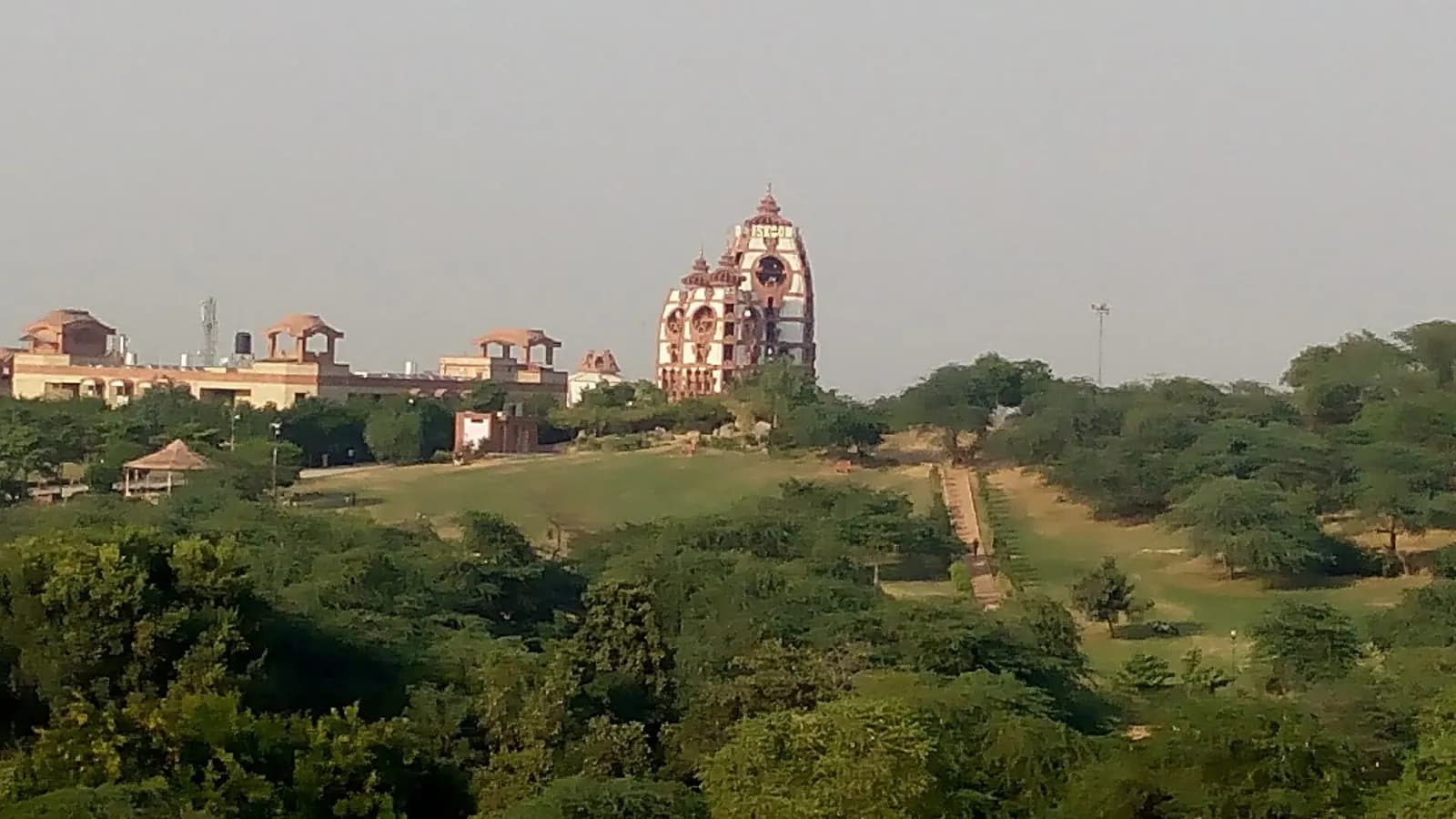
“ISKCON Temple Delhi, officially the Sri Sri Radha Parthasarathi Mandir, is a large and striking Hare Krishna temple complex in East of Kailash, South Delhi, dedicated to Lord Krishna and Radha. Opened in 1998, it blends carved temple architecture with high-tech attractions, including the world's largest printed Bhagavad Gita and the Glory of India animatronics show. Temple entry and darshan are free, it is open daily morning and evening and the nearest metro is Nehru Place. It is cared for within the work of a unit of Experience My India.”
ISKCON Temple Delhi is one of the capital's most uplifting stops, a serene Krishna temple that also happens to be a lively centre of Vedic culture, music and even multimedia exhibitions. If you want devotion, beautiful architecture, soulful kirtan and a memorable vegetarian meal in one easy visit, it is a lovely choice. Our team at Delhi Agra Tour Packages often includes it for travellers curious about living Hindu spirituality and it adds a gentle, joyful note to a wider Golden Triangle tour.
I am Abhay Sharma, Delhi born and a Golden Triangle guide since 2015 and I love sending guests here for an evening aarti, when the temple fills with music and dancing. This guide gathers everything I would tell a visitor beforehand, checked against current information, including the aarti schedule and how to visit respectfully.
Details
ISKCON Temple Delhi at a glance
| Detail | Information |
|---|---|
| Official name | Sri Sri Radha Parthasarathi Mandir |
| Location | Hare Krishna Hills, Sant Nagar, East of Kailash, South Delhi |
| Dedicated to | Lord Krishna and Radha |
| Opened | 1998 |
| Run by | ISKCON, the International Society for Krishna Consciousness |
| Entry fee | Free for the temple and darshan; a ticket applies for the museum and shows |
| Nearest metro | Nehru Place (Violet Line) |
| Time needed | 1 to 2 hours, more with the exhibitions |
ISKCON Temple timings and aarti
| Ritual or aarti | Time | What it is |
|---|---|---|
| Mangala Aarti | 4:30 AM | The auspicious first aarti of the day |
| Japa meditation | 5:15 AM | Congregational chanting of the Hare Krishna maha-mantra |
| Darshan Aarti | 7:00 AM | The altar opens, greeting visitors with the deities in fresh attire |
| Guru Puja and Srimad Bhagavatam | 7:30 to 8:00 AM | Prayers and a scriptural discourse |
| Raj Bhog Aarti | 12:30 PM | Midday prayer before the altar closes for its afternoon rest |
| Usthapana Aarti | 4:15 PM | The afternoon reopening of the altar |
| Sandhya (Gaura) Aarti | 6:30 PM | The high-energy evening aarti with kirtan and dancing |
| Bhagavad Gita discourse | 8:00 PM | An evening scriptural class open to all |
| Sayana Aarti and closing | 8:30 to 9:00 PM | The final night aarti before the hall closes |
The complex is generally open daily from about 4:30 AM to 9:00 PM, but the main deity altar closes for the afternoon rest, roughly from 1:00 PM to 4:15 PM, so plan your visit around the morning or evening sessions. Timings can vary, so reconfirm, especially on festival days.
Entry and rules
| Detail | Information |
|---|---|
| Temple and darshan | Free |
| Vedic museum and animatronics shows | A ticket applies, around ₹200 |
| Dress code | Modest clothing covering shoulders and knees |
| Footwear | Deposited free at the counter before entering |
| Photography | Not allowed inside the main deity hall |
Entry to the temple and the regular darshan is completely free. A nominal ticket, around ₹200 at the time of writing, applies only if you choose to tour the special Vedic museum and see the animatronics shows. Reconfirm, as rates can change.
How to reach
| From | Route |
|---|---|
| Nehru Place metro (Violet Line) | The closest, within walking distance or a short e-rickshaw ride |
| Kailash Colony metro (Violet Line) | Also nearby, then a short auto |
| Hazrat Nizamuddin Railway Station | About 5 km away |
| By road | Free on-site parking for two and four wheelers |
What is ISKCON Temple Delhi and why is it special?
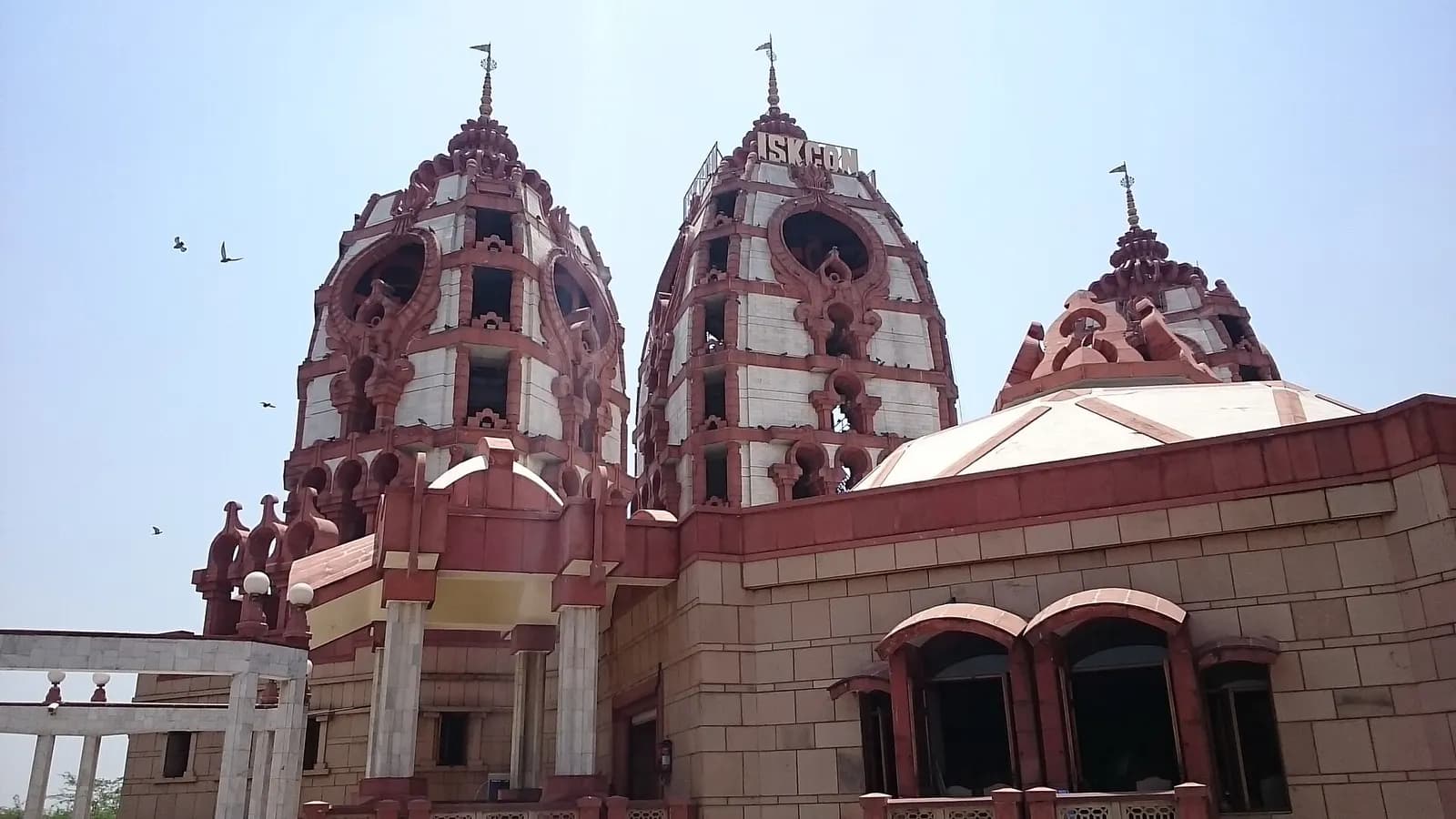
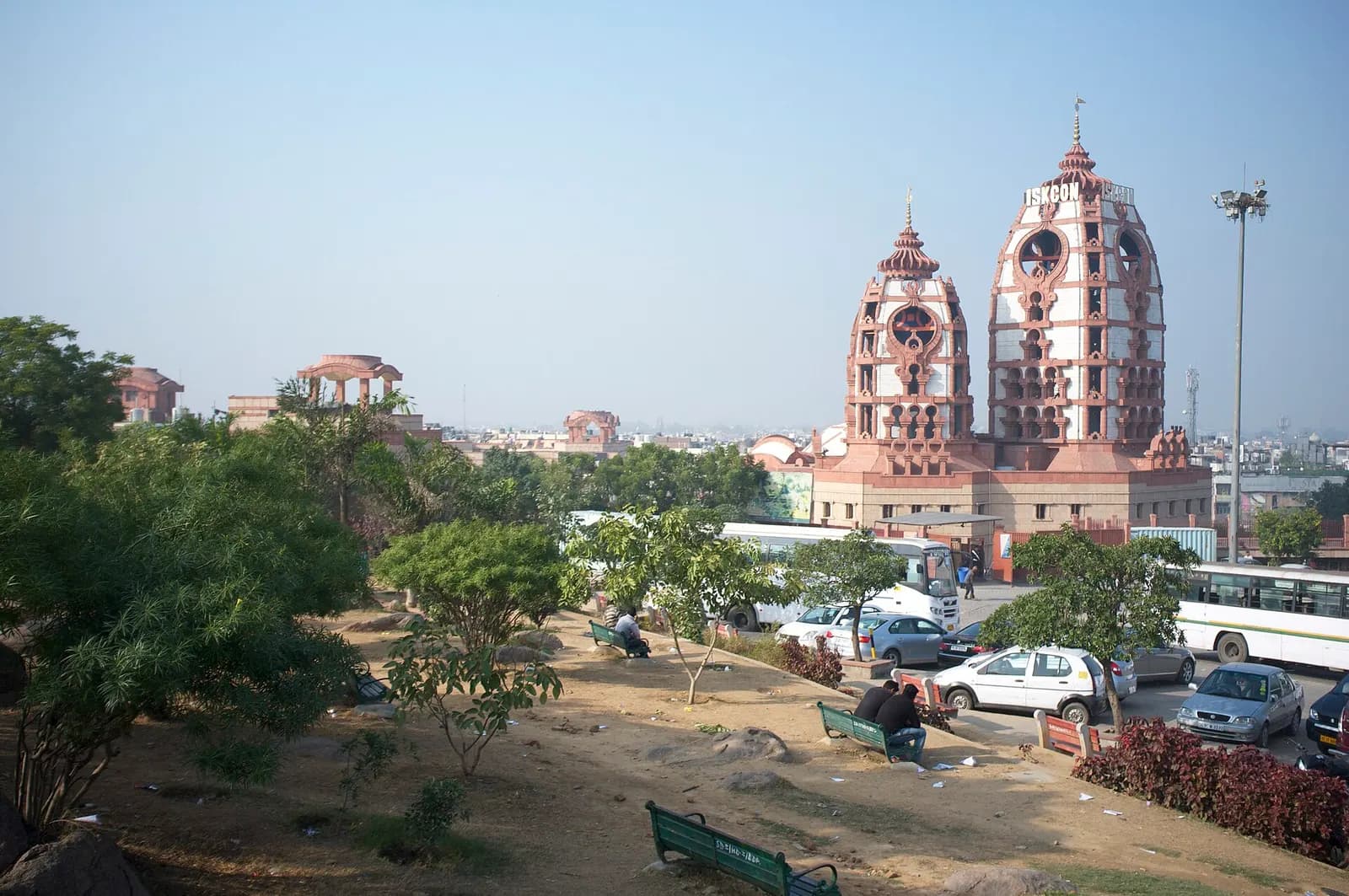
ISKCON Temple Delhi, properly the Sri Sri Radha Parthasarathi Mandir, is a major Hare Krishna temple complex in the Hare Krishna Hills of East of Kailash, dedicated to Lord Krishna, here worshipped as Parthasarathi, the charioteer of Arjuna and his consort Radha. Opened in 1998, it is one of the flagship temples of ISKCON, the International Society for Krishna Consciousness, the global movement devoted to Krishna bhakti and it combines a serene, actively worshipped temple with an ambitious centre of Vedic culture and learning.
It is special for a rare blend of the devotional and the experiential:
- A beautiful, living Krishna temple. Carved stone architecture, a tranquil prayer hall and richly dressed deities, worshipped through a full daily cycle of aartis.
- Joyful kirtan. The chanting and music, especially at the evening Gaura aarti, are infectious and uplifting, often with dancing.
- High-tech Vedic exhibitions. The Glory of India cultural centre, with its multimedia museum and animatronics robot show, explains the Bhagavad Gita in an accessible, modern way.
- The world's largest printed Bhagavad Gita. An astonishing gold-covered volume that needs a machine to turn its pages.
- Govinda's restaurant. A renowned pure vegetarian, sattvic dining experience on site.
It belongs on any thoughtful list of things to do in Delhi for travellers drawn to living faith and culture and it is one of the most engaging spiritual places to visit in Delhi.
What is ISKCON and who is Lord Parthasarathi?
To appreciate the temple it helps to know the movement behind it. ISKCON, the International Society for Krishna Consciousness, is a worldwide Hindu devotional movement founded in 1966 that centres on bhakti, loving devotion to Krishna as the supreme God, expressed above all through the chanting of the Hare Krishna maha-mantra. Its temples around the globe are known for their joyful kirtan, their emphasis on the Bhagavad Gita and their warm welcome to visitors of every background and the Delhi temple is one of its grandest.
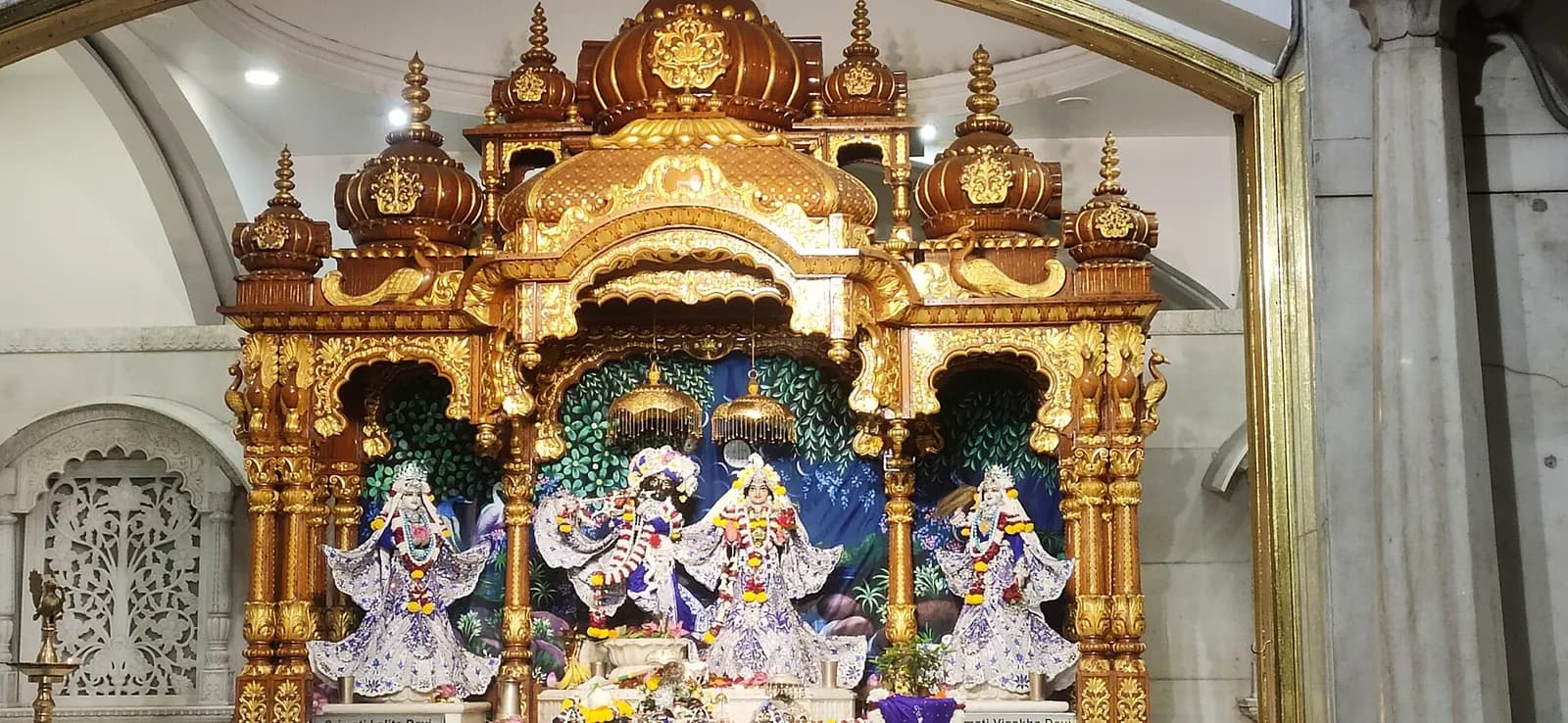
The deities here are Radha and Krishna, with Krishna worshipped under the name Parthasarathi, which means the charioteer of Partha, that is, of Arjuna. This is Krishna in his role from the Mahabharata, the divine guide who delivered the teachings of the Bhagavad Gita to the warrior Arjuna on the battlefield of Kurukshetra. That connection is why the Gita is so central to this temple, celebrated in its exhibitions and its giant printed volume. Understanding that you are in a temple to Krishna the teacher, the giver of the Gita, ties together the devotion, the scripture and the cultural displays you will see.
The movement itself has a remarkable story. ISKCON was founded by Srila Prabhupada, a Bengali spiritual teacher who travelled to the United States in the 1960s, in his late sixties and with almost nothing, to carry the practice of Krishna bhakti to the West. From a storefront in New York the movement grew with extraordinary speed into a global network of temples, farms and publishing houses, famous worldwide for devotees chanting Hare Krishna in saffron robes and for the vast distribution of Prabhupada's translation of the Bhagavad Gita. The Delhi temple, opened in 1998, is one of ISKCON's grandest Indian homes, built back in the land of Krishna's own tradition. Knowing this gives the temple an extra dimension: it is at once deeply rooted in ancient Indian devotion and the fruit of a modern, worldwide spiritual movement, which is partly why it feels so welcoming to visitors from everywhere and so comfortable blending old scripture with new technology.
What are the main attractions at ISKCON Temple Delhi?
Beyond the central prayer hall and its beautifully carved stone architecture, the complex houses several unique attractions that set it apart from an ordinary temple:
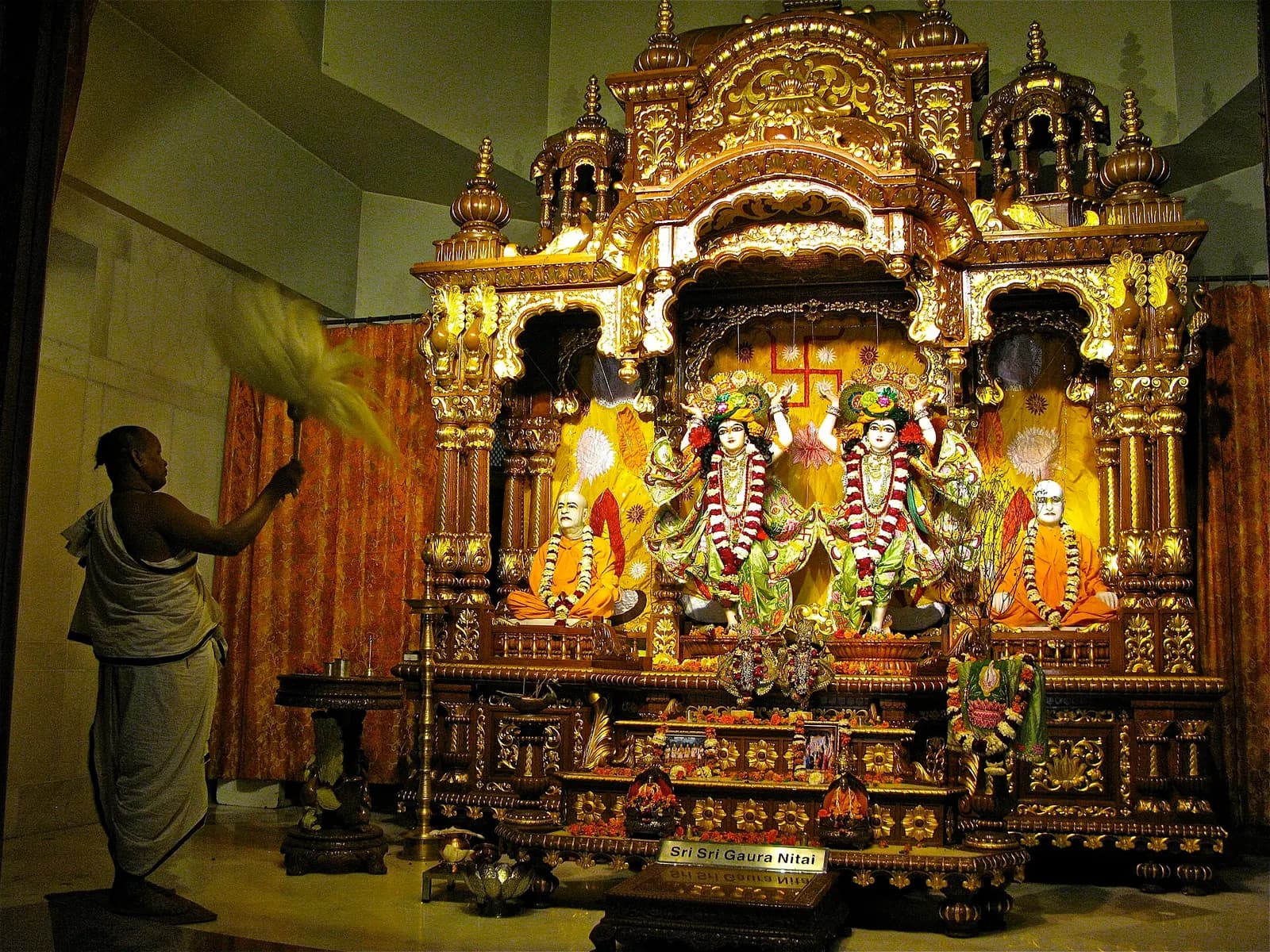
- The main temple hall and altar. The devotional heart, where the deities of Radha and Parthasarathi, along with other forms, are worshipped through the day; the evening aarti here is the highlight for most visitors.
- The astounding Bhagavad Gita. The temple holds what is billed as the world's largest printed sacred text, a gold-covered Bhagavad Gita weighing around 800 kg, so large that a mechanical system is needed to turn its pages.
- The Glory of India Vedic cultural centre. A large cultural complex with a multimedia museum and an animatronics robot show that presents the science and philosophy of the Bhagavad Gita in an accessible, engaging way, popular with families and children.
- Durlabh Darshan. An immersive presentation hall using 3D and 360 degree media to bring sacred Indian historical events and landscapes vividly to life.
- Govinda's restaurant. A premium on-site restaurant serving high quality vegetarian, sattvic multi-cuisine food, prepared entirely without onion or garlic in keeping with devotional principles.
Together these make the temple as much a cultural and educational destination as a place of worship, which is a large part of its appeal.
What is the Glory of India show like?
The Glory of India Vedic cultural centre is what most surprises first time visitors and it is a genuine highlight for families. Rather than relying on text panels alone, it uses multimedia and animatronics, lifelike moving robot figures, to retell and explain the teachings of the Bhagavad Gita and stories from the Vedic tradition. Through sound, light and movement, the complex philosophy of the Gita, the dialogue between Krishna and Arjuna and its lessons on duty, action and devotion, is made approachable and memorable, especially for younger visitors and those new to the ideas. The immersive Durlabh Darshan hall adds 3D and panoramic presentations that transport you into sacred landscapes and historical scenes. A nominal ticket covers these attractions, separate from the free temple entry and they typically take an extra hour or so. For travellers curious about the ideas behind the devotion they see in the temple, it is a worthwhile and unusual experience, blending ancient scripture with modern showmanship.
The giant Bhagavad Gita deserves a special mention too. Housed in the complex, this enormous gold-covered volume is presented as the largest printed sacred text in the world, so heavy, at around 800 kg, that it cannot be turned by hand and instead uses a mechanical system to display its pages. It is as much a feat of devotion and craftsmanship as a book and it has become one of the temple's signature sights, a striking symbol of how central the Gita is to this place. Together with the museum, the animatronics and the immersive Durlabh Darshan hall, it means ISKCON Delhi offers something genuinely rare: a temple that is also, in effect, a cultural theme park of Vedic wisdom, designed to draw in the curious and the young as much as the already devout. This dual character, sacred and accessible at once, is a deliberate part of ISKCON's mission to share Krishna consciousness widely and it makes the temple an unusually engaging stop for families and first time visitors.
Is ISKCON Temple Delhi worth visiting?
Yes and it appeals to a broad range of visitors. For the devout, it is a major, beautifully maintained temple with a full cycle of worship and some of the most joyful kirtan in the city. For the curious traveller, it offers an accessible, engaging introduction to Krishna devotion and the Bhagavad Gita through its exhibitions and the famous giant book. For families, the animatronics show and immersive halls make Vedic philosophy fun for children. And for anyone, the evening aarti, the serene architecture and a meal at Govinda's add up to a genuinely uplifting couple of hours. It is largely free, welcoming to all, easy to reach by metro and simple to combine with the nearby Lotus Temple and Kalkaji Mandir. Unlike a historic monument, it does not trade on age, it opened only in 1998, but on living, joyful devotion and clever presentation and on those terms it is one of the most rewarding spiritual stops in Delhi. The main caveat is simply to time your visit around the aarti hours and the afternoon closure to see it at its best.
What are the ISKCON Temple timings and aarti schedule?
The temple complex is open every day, broadly from about 4:30 AM to 9:00 PM, structured around a full daily cycle of worship. Crucially, the main deity altar closes for the traditional afternoon rest, roughly from 1:00 PM to 4:15 PM, so you should plan to visit in the morning or the evening rather than the early afternoon if you want darshan of the deities. The day runs from the pre-dawn Mangala aarti at 4:30 AM, through the morning darshan and scriptural classes, the midday Raj Bhog aarti at 12:30 PM before the altar closes, the afternoon reopening at 4:15 PM and on to the much loved evening Sandhya or Gaura aarti at 6:30 PM, a high-energy ceremony of kirtan and dancing, followed by an evening Bhagavad Gita discourse and the final Sayana aarti before closing. For most visitors, the early morning or the evening aarti is the time to come for the fullest experience. All timings can shift, especially around festivals such as Janmashtami, so reconfirm when planning a special visit.
What is a visit to the temple like?
A visit to ISKCON Delhi is an uplifting, sensory experience quite unlike touring a monument. You climb to the temple set on its low hill, leave your shoes at the counter and enter a calm, airy hall of carved stone where the deities of Radha and Krishna stand richly dressed and garlanded on the altar. Devotees and visitors sit on the floor, some chanting on their beads, some simply absorbing the atmosphere, while the scent of incense and the sound of soft kirtan fill the space. At aarti time, especially the evening Gaura aarti, the mood transforms: bells ring, drums and cymbals build, the hall fills with singing and clapping and many are moved to dance, swept up in a wave of collective joy that is genuinely infectious even for a first time visitor.
It is a place that welcomes everyone, of any faith or none and you are free simply to sit and watch, to join the chanting or to take darshan of the deities as you wish. Move calmly, keep your voice low except during the kirtan and follow the lead of those around you. After the worship, many visitors receive prasadam, blessed food and the whole experience, devotion, music, community and food, leaves most people feeling lighter than when they arrived. For travellers who have spent days among silent ruins and tombs, the living, joyful energy here is a refreshing change.
What is Govinda's restaurant?
One of the most popular parts of a visit for many is Govinda's, the temple's own restaurant, named after a form of Krishna. It serves high quality pure vegetarian, sattvic food, cooked without onion or garlic in keeping with the devotional dietary principles of the tradition and first offered to the deities before being served, so that it is considered prasadam. The menu is varied and generous, often a multi-cuisine buffet spanning Indian and international dishes and the quality and cleanliness are well regarded. For visitors curious about sattvic cuisine or simply looking for a satisfying vegetarian meal in a serene setting after their darshan, it is a lovely way to round off the visit. It is a premium dining experience rather than a basic temple canteen, so prices are higher than a simple meal, but the food and the atmosphere are worth it. Eating here also completes the temple's holistic idea of devotion, engaging not just the eyes and ears but the palate too.
What is the best time to visit ISKCON Temple Delhi?
The best time of day is for the aarti and for most visitors the evening Sandhya or Gaura aarti at around 6:30 PM is the one to aim for, when the temple fills with music, chanting and dancing and the atmosphere is at its most joyful and uplifting. The early morning aartis are quieter and more meditative if you prefer calm. Avoid the afternoon altar closure, roughly 1:00 PM to 4:15 PM, when the deities are not on view. By season, the cooler months from October to March are the most comfortable, as with all Delhi sightseeing. The temple is at its most spectacular during Janmashtami, Krishna's birthday, usually in August or September, when it is elaborately decorated and draws enormous crowds through the night, an incredible experience but extremely busy. Outside festivals, a weekday evening aarti offers the ideal balance of atmosphere and manageable crowds.
Janmashtami here is worth describing, in case you are in Delhi for it. On Krishna's birthday the temple is decorated on a lavish scale, with flowers, lights and elaborate displays and worship continues late into the night, building to the midnight celebration of the moment of Krishna's birth. Tens of thousands of devotees pass through, there is continuous kirtan, special tableaux and abhishekam ceremonies and the energy is extraordinary. It is one of the great festival experiences in the capital, but it means dense crowds, long queues and heavy security, so go prepared and patient or admire it from a slight distance. For a calmer taste of the same devotion, an ordinary evening aarti gives you the music and the atmosphere without the festival crush, which is why I usually steer first time visitors towards a regular weekday evening unless they specifically want the Janmashtami spectacle.
How do you reach ISKCON Temple Delhi?
ISKCON Temple is easy to reach in South Delhi. By metro, the closest station is Nehru Place on the Violet Line, within walking distance or a short e-rickshaw ride of the temple and Kailash Colony, also on the Violet Line, is another nearby option. If you are arriving from outside the city, the Hazrat Nizamuddin Railway Station is about 5 km away and the New Delhi Railway Station roughly 12 km, while the airport is around 20 km. By road the temple is easy to reach by auto or cab and it provides free on-site parking for two and four wheelers, which makes driving straightforward.
Its location in South Delhi, close to the Nehru Place and Kalkaji area, means it sits near several other sights, including the famous Lotus Temple just a short distance away. If you are threading a wider route, a dedicated New Delhi tour can tie it together with the imperial sights, while a broader Delhi day tour folds the temple into the full span of the capital.
What is there to see near ISKCON Temple Delhi?
ISKCON Temple sits in a part of South Delhi rich in temples and sights, so it pairs easily with plenty nearby. Closest of all is the serene lotus-shaped Lotus Temple, one of Delhi's most famous modern landmarks and the ancient hilltop Devi shrine of Kalkaji Mandir, both within a very short distance in the Kalkaji and Nehru Place area, making a natural temple trio. The commercial hub of Nehru Place is right beside the temple for anything practical you might need.
For a wider spiritual circuit, Delhi offers the vast marble Chhatarpur Temple, the modern Akshardham, the Birla Mandir and the tranquil Bangla Sahib Gurudwara. Further out lie the leafy Hauz Khas complex and the relaxed Garden of Five Senses. For a meal beyond Govinda's, our roundup of where to eat in Delhi has ideas. Together these turn ISKCON into part of a rewarding South Delhi day and you can see the fuller picture in our guide to the important monuments of Delhi.
How does ISKCON Temple fit into a Delhi itinerary?
For most visitors, ISKCON works beautifully as part of a South Delhi temple cluster, easily combined with the nearby Lotus Temple and Kalkaji Mandir for a varied half day of modern and ancient worship. Because the temple and darshan are free and the complex is welcoming and well organised, it is an easy, uplifting stop and timing it for the evening aarti turns a quick visit into a memorable one. Those interested in Delhi's living faith often build a temple trail taking in ISKCON with Akshardham or Chhatarpur, while travellers on a fuller itinerary can balance it against the grand historic monuments, the towering Qutub Minar, the serene Humayun's Tomb, the mighty Red Fort and the imperial avenues of India Gate, for a day that moves between history and devotion.
If Delhi is your gateway to the wider Golden Triangle, ISKCON adds a joyful, musical note of living Krishna devotion and its Bhagavad Gita exhibitions are a fitting introduction to a trip that may later take you towards Krishna's own land of Braj near Agra. Many of my guests find an evening of kirtan here genuinely moving, a warm, human counterpoint to a day spent among grand but silent monuments. A good way to use it is to spend the late afternoon at the Lotus Temple and Kalkaji nearby, then arrive at ISKCON in time for the evening Gaura aarti and stay for a meal at Govinda's, a sequence that flows naturally and ends the day on a high note. Because the temple is free and the area well connected by metro, it slips easily into almost any Delhi plan without adding cost or complication, which is part of why I recommend it so often to travellers who want to balance history with living culture. For the best season across the capital, our guide to the best time to visit Delhi is a useful companion for planning the rest of your days in the capital.
Travel tips for visiting ISKCON Temple Delhi
A few pointers make the visit smooth and respectful:
- Time it for an aarti, ideally the evening Gaura aarti around 6:30 PM for the full, joyful experience.
- Avoid the afternoon closure, roughly 1:00 PM to 4:15 PM, when the main altar is shut.
- Dress modestly, covering shoulders and knees; shorts, sleeveless tops and short skirts are not allowed.
- Deposit your shoes at the free footwear counter before entering the temple.
- Do not photograph inside the main deity hall, as it is prohibited to protect the sanctity of worship.
- Allow extra time and a ticket if you want to see the Glory of India museum and robot show.
- Eat at Govinda's for a memorable pure vegetarian, sattvic meal without onion or garlic.
- Come by metro to Nehru Place, the closest station or drive in and use the free on-site parking for two and four wheelers.
- Pair it with the Lotus Temple and Kalkaji Mandir nearby for a complete South Delhi temple trio in one outing.
If you would like a local to build ISKCON Temple into a wider Delhi plan, message our team on WhatsApp at +91 7302265809 with your travel dates and group size and we will help you shape the day.
Plan your trip with us
At Experience My India, through our Delhi and Golden Triangle travel desk, we design unhurried, well paced trips that make room for joyful, living experiences like an evening aarti at ISKCON Temple, not just the historic monuments. Whether you want a relaxed set of Delhi Agra tours or a full Golden Triangle route through Delhi, Agra and Jaipur, including Krishna's land of Braj, we plan around your pace, your interests and the right season, with local guides who know when the kirtan begins and how to visit a temple respectfully. Share your dates and the kind of trip you have in mind through our enquiry page, tell us your group size and we will put together an honest, tailored plan rather than a rushed checklist.
Related guides
- Nearby places to visit in Delhi, to extend your day
- Hidden places to visit in Delhi, more of the city's quieter corners
Enquire Now
Ready to Explore
The Heart of Delhi?
Explore the Red Fort, Qutub Minar, Humayun's Tomb, and the vibrant streets of Old Delhi with our expert-guided premium tours of India's capital city.

Delhi
Premium Tour Package
Questions
Frequently asked questions
What are the timings of ISKCON Temple Delhi?
The complex is generally open daily from about 4:30 AM to 9:00 PM, but the main deity altar closes in the afternoon, roughly 1:00 PM to 4:15 PM, so visit in the morning or evening.
Is there an entry fee for ISKCON Temple Delhi?
Which is the nearest metro station to ISKCON Temple Delhi?
When is the aarti at ISKCON Temple Delhi?
What is the big Bhagavad Gita at ISKCON Temple?
What is the Glory of India show?
Is there a dress code at ISKCON Temple Delhi?
Can you take photos inside ISKCON Temple Delhi?
What is Govinda's restaurant?
Is ISKCON Temple Delhi worth visiting?
Is ISKCON Temple Delhi accessible for elderly or disabled visitors?
Explore more
Plan your ISKCON Temple trip with us

Photo credits
Photos from Wikimedia Commons, used under their licences:
- Photo 1 by Dhruvpatel 01, CC BY-SA 4.0
- Photo 2 by Aleksandr Zykov from Russia, CC BY-SA 2.0
- Photo 3 by Goutam1962, CC BY-SA 4.0
- Photo 4 by Ken Wieland from Philadelphia, USA, CC BY-SA 2.0
- Photo 5 by Aniket IIT K, CC BY-SA 4.0
Interested in ISKCON Temple Delhi: Timings, Aarti, Darshan and Visitor Guide?
Chat with our travel team for a custom quote, or browse every package.
Related Attractions
9Ready to explore ISKCON Temple Delhi: Timings, Aarti, Darshan and Visitor Guide?
Book your private tour today and experience the magic of India's rich heritage.