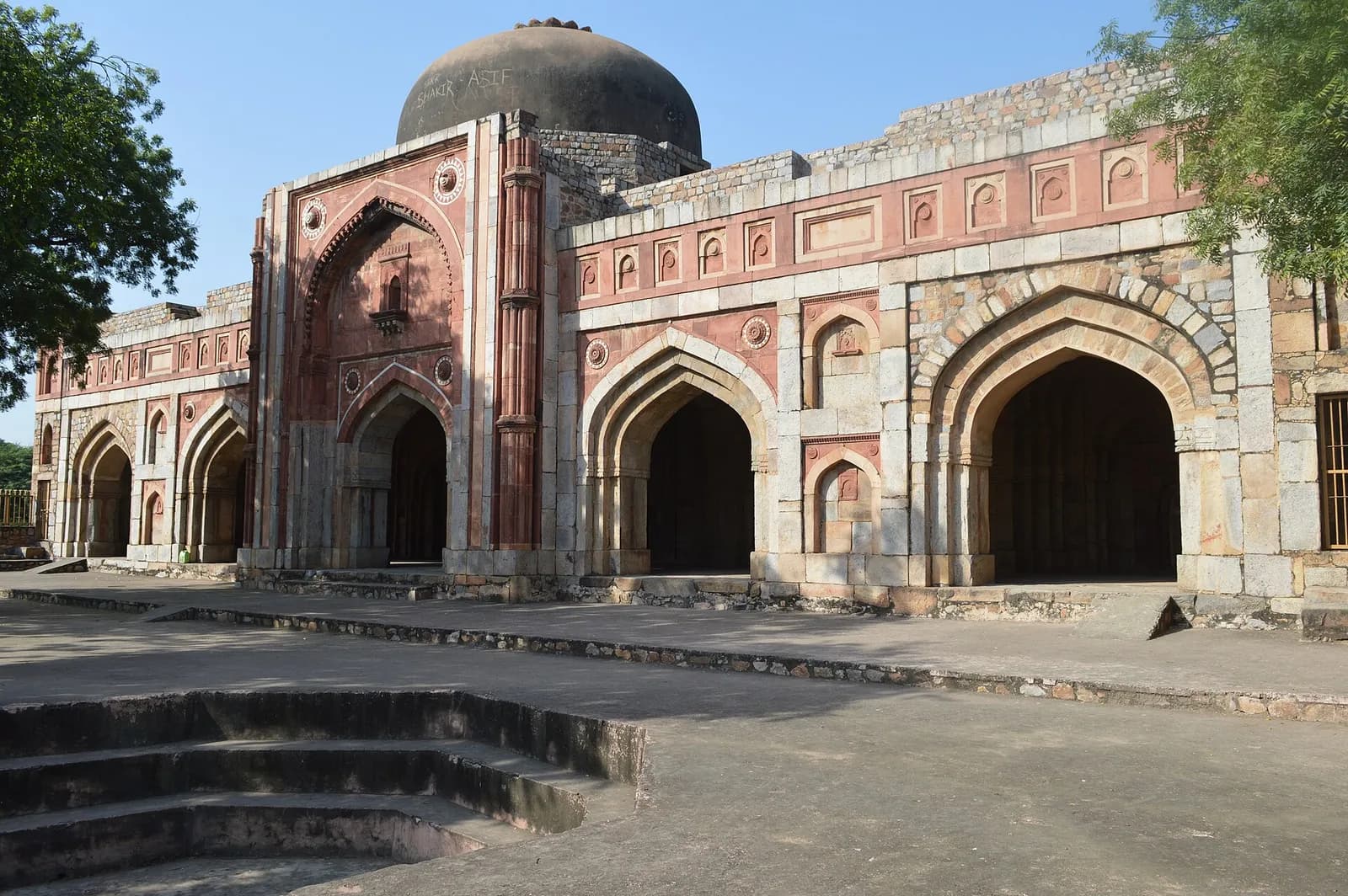
Jamali Kamali Delhi: History, Timings and Visitor Guide
Visiting Jamali Kamali mosque and tomb in Mehrauli? The poet-saint's story, the jewel-box tomb, the architecture, timings, free entry and the nearest metro.
In a Nutshell
“Jamali Kamali is a beautiful early 16th-century mosque and tomb complex in the Mehrauli Archaeological Park, South Delhi, opposite the Qutub Minar. Built between 1528 and 1536, straddling the end of the Delhi Sultanate and the birth of the Mughal Empire, it holds the grave of the Sufi poet-saint Shaikh Jamali and, beside him, the mysterious figure of Kamali. The mosque is a graceful bridge between Lodi and Mughal styles and the small tomb hides a jewel-box painted interior. It is free to enter, open through the day and reached from Qutub Minar metro. It features on our heritage Delhi tours, run by a unit of Experience My India.”
Jamali Kamali is one of Delhi's most beautiful and intriguing monuments, a refined mosque and a jewel-box tomb wrapped in a genuine historical mystery and a wealth of legend, set amid the green ruins of the Mehrauli park. For history lovers, architecture enthusiasts and those drawn to the city's atmospheric heritage, it is a fascinating stop. Our team at Delhi Agra Tour Packages often includes it on a Mehrauli heritage walk and it adds a graceful, story-rich dimension to a wider Golden Triangle tour through the capital.
I am Abhay Sharma, Delhi born and a Golden Triangle guide since 2015 and I love bringing history-minded guests here, because few monuments combine such beautiful architecture with so compelling a human mystery, the saint and his companion whose bond no one can fully explain. This guide gathers everything I would tell a visitor beforehand, checked against current information, including the history, the architecture, the timings and how to reach it.
Details
Jamali Kamali at a glance
| Detail | Information |
|---|---|
| Location | Mehrauli Archaeological Park, opposite Qutub Minar |
| Built | 1528 to 1536, Babur to Humayun |
| Holds | The Sufi poet-saint Shaikh Jamali and Kamali |
| Known for | Its Lodi-to-Mughal mosque and painted jewel-box tomb |
| Status | ASI Monument of National Importance |
| Entry | Free; the tomb interior is kept locked |
| Nearest metro | Qutub Minar, around 1.5 km away |
| Time needed | About 45 minutes to an hour |
Jamali Kamali timings
| Detail | Information |
|---|---|
| Open | Daily, sunrise to sunset, roughly 6:00 AM to 6:00 PM |
| Tomb interior | Kept locked; viewable only with ASI permission |
| Time needed | About 45 minutes to an hour |
Jamali Kamali is open every day from sunrise to sunset, roughly 6:00 AM to 6:00 PM, within the Mehrauli Archaeological Park. A visit, taking in the mosque and the exterior of the tomb, takes about forty five minutes to an hour. The painted interior of the tomb is kept permanently locked for conservation and can be seen only with rare, pre-approved ASI permission. These timings are current at the time of writing and can vary, so a daytime visit is best.
Entry fee
| Item | Information |
|---|---|
| Entry fee | Free for all visitors |
| Tickets | None; it lies within the open archaeological park |
| Tomb interior | Locked; viewable only with written ASI clearance |
How to reach Jamali Kamali
| From | Route |
|---|---|
| Qutub Minar metro (Yellow Line) | A short auto to the Mehrauli park, about 1.5 km |
| Within the park | A signposted walk through the archaeological park |
| Opposite | The Qutub Minar complex, across from the park |
| By car | Park near the Mehrauli Archaeological Park gate |
What is Jamali Kamali?
Jamali Kamali is a historic mosque and tomb complex of the early 16th century, set in the heart of the Mehrauli Archaeological Park in South Delhi, opposite the great Qutub Minar and it is celebrated both for its beautiful architecture and for the intriguing human story at its heart. Built between 1528 and 1536, in the pivotal years that span the fall of the Delhi Sultanate and the birth of the Mughal Empire, the complex comprises a refined mosque, whose design forms a graceful bridge between the austere Lodi style and the airy early Mughal manner and a small, outwardly modest tomb that conceals one of the most beautiful painted interiors in the city. The tomb holds the grave of the Sufi poet-saint Shaikh Jamali and beside him, in an identical grave, lies the mysterious figure known only as Kamali, whose identity and relationship to the saint remain one of medieval Delhi's great enigmas. Beautiful, atmospheric and wrapped in both history and legend, it is one of the finest and most fascinating monuments of the Mehrauli heritage.
Several things make it special and they are worth drawing out:
- A bridge between two ages. Built from 1528 to 1536, the complex straddles the end of the Sultanate and the dawn of the Mughal Empire in both its date and its style.
- The poet-saint Jamali. The tomb of Shaikh Jamali, a renowned Sufi saint and court poet to Sikandar Lodi, Babur and Humayun in turn.
- The mystery of Kamali. Beside Jamali lies Kamali, a figure of unknown identity whose bond with the saint has intrigued historians for centuries.
- The jewel-box tomb. A plain exterior hides a dazzling painted and tiled interior inscribed with Jamali's own poetry.
- A beautiful mosque. A graceful five-arched mosque of grey quartzite, red sandstone and white marble, rich in carved detail.
It is one of the most beautiful and intriguing of the offbeat things to do in Delhi and a fascinating entry among the important monuments of Delhi.
History of Jamali Kamali
The history of Jamali Kamali belongs to one of the most pivotal moments in Delhi's history, the hinge between the Delhi Sultanate and the Mughal Empire and this gives the complex a special significance beyond its beauty. Construction of the complex began in 1528, during the latter part of Emperor Babur's reign, soon after the first Mughal had defeated the last of the Lodi sultans and it was completed in 1536 under Babur's son and successor, Emperor Humayun. This brief span of years is remarkable, for it straddles the very end of the Delhi Sultanate and the absolute birth of the Mughal Empire, so the monument is, in a sense, a child of both ages, which is beautifully reflected in its transitional architecture.
At the centre of the story is the man for whom it was built, the Sufi saint and poet Shaikh Jamali, whose life itself bridged these eras. His fascinating identity and the enduring mystery of his companion Kamali, are the heart of the monument and deserve to be told in full, which the sections that follow do. In its later history, the complex passed, like so much of Mehrauli, from a living centre of Sufi devotion and learning into a protected historical monument, now in the care of the Archaeological Survey of India as a Monument of National Importance. For the visitor, knowing that this graceful complex was built in the very years when one empire gave way to another, around the grave of a saint who served the rulers of both, lends it a deep historical resonance and it is this combination of a pivotal date, a remarkable man and an unsolved mystery that makes Jamali Kamali so compelling.
Who was Shaikh Jamali?
The saint at the heart of the complex, Shaikh Jamali, was one of the most remarkable figures of his age and understanding him is key to appreciating the monument. Jamali was the literary pseudonym or takhallus, of Shaikh Fazlullah, also documented as Jalal Khan or Shaikh Jamali Kamboh and he was a widely travelled Suhrawardi Sufi saint, a respected scholar and a celebrated court poet whose influence spanned the courts of three very different rulers. His career is a vivid illustration of how a man of genuine spiritual and literary distinction could remain valued through the most turbulent of political changes:
- Court poet to Sikandar Lodi. Jamali served as a favoured court poet to the Lodi sultan Sikandar Lodi, at the height of the Delhi Sultanate.
- Retained by Babur. When the Mughals conquered Delhi, Jamali continued in his high-ranking role under the conquering emperor Babur, a mark of his esteem.
- Close to Humayun. He maintained a deep and fraternal bond with Babur's son, the emperor Humayun, under whom his tomb was completed.
Beyond the court, Jamali was a genuine traveller and mystic, who journeyed widely in the Islamic world and wrote poetry of real distinction, verses that still adorn the walls of his tomb. He died in 1535 or 1536, while accompanying an expedition to Gujarat and his body was brought back to Delhi to be interred in the complex he had built. For the visitor, Jamali is a figure who embodies the continuity of culture and faith across the great political rupture of his time, a saint and poet valued by sultan and emperor alike and knowing his story gives the beautiful tomb a profound human centre.
The mystery of Kamali
If Jamali is the known figure at the heart of the complex, Kamali is its enduring enigma and the mystery of who Kamali was and what Kamali meant to Jamali, is one of the most intriguing puzzles in all of medieval Delhi. Beside Jamali's grave, in the same jewel-box tomb, lies a second grave, structurally identical and placed side by side with that of the revered saint, belonging to the figure known only as Kamali. Yet despite this intimate and equal placement, there are no surviving royal records that detail Kamali's parentage, official position or biography, so Kamali's very identity has been lost to history, leaving only the name and the grave.
What historians can deduce is that Kamali must have held a place of great significance in Jamali's life, for a figure of no importance would not have been buried in so grand a marble tomb, side by side and equal with a celebrated Sufi saint. From this, a range of theories has grown up over the centuries and they remain unresolved:
- A disciple. Some believe Kamali was Jamali's foremost disciple, his closest spiritual follower.
- A brother. Others suggest Kamali was Jamali's biological brother or close relative.
- A fellow poet. Some hold that Kamali was himself a poet, a literary companion to the saint.
- A beloved companion. Another long-standing tradition holds that the two shared a deep personal bond and some interpret Kamali as Jamali's same-sex romantic partner.
The truth may never be known and that is precisely the enduring fascination of the place: the two lie together in eternal equality, their bond beyond doubt but its nature beyond recovery. In modern times, partly because of this last interpretation, the tomb has come to be regarded by many in the LGBTQIA+ community as a rare surviving medieval site honouring a profound, non-traditional companionship and it has acquired a special cultural significance for them. For the visitor, the mystery of Kamali is the human soul of the monument, a reminder that history preserves some bonds whose meaning it cannot fully explain and it lends the beautiful tomb an air of tender, unresolved intimacy.
Architecture of the mosque
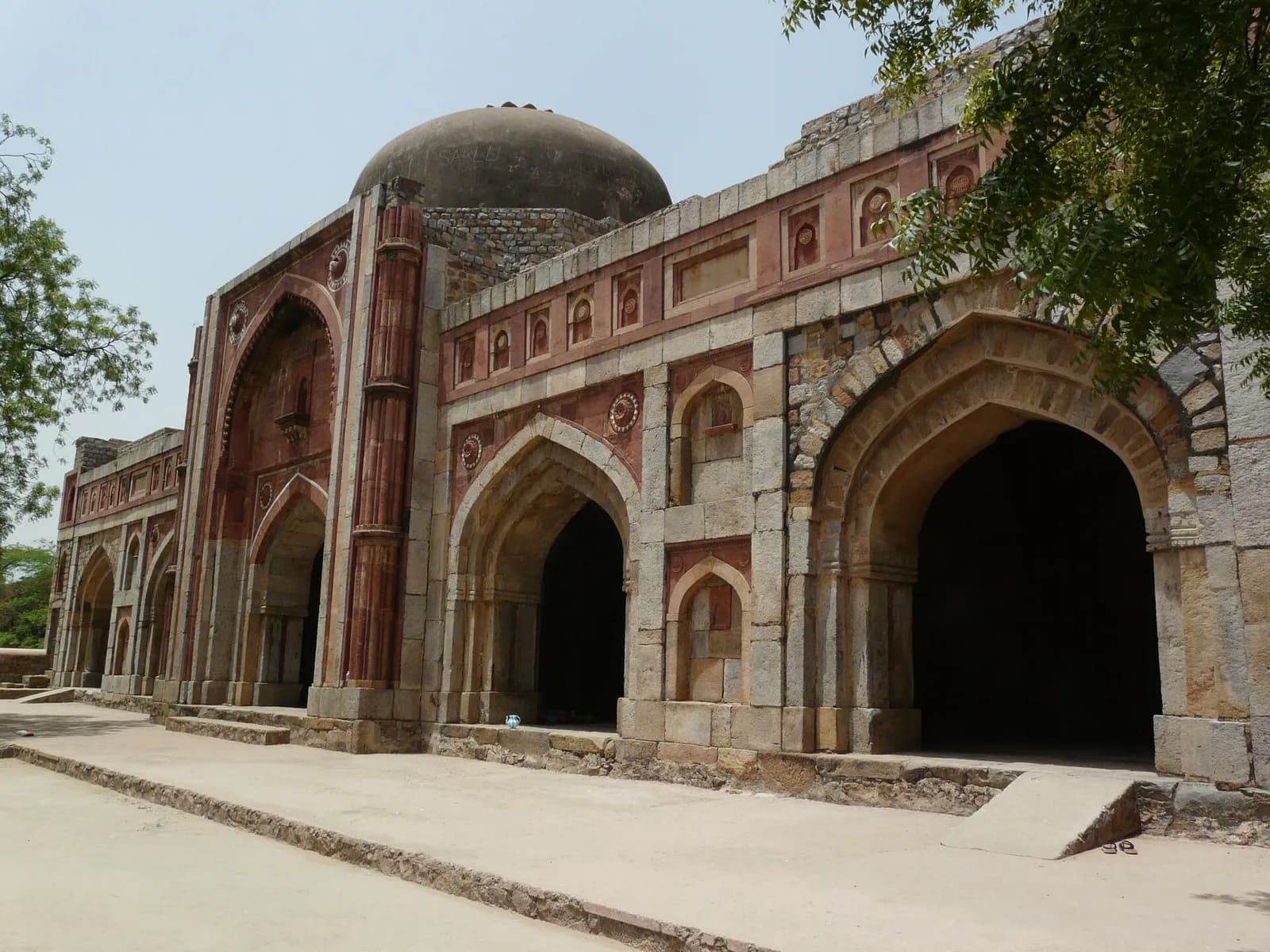
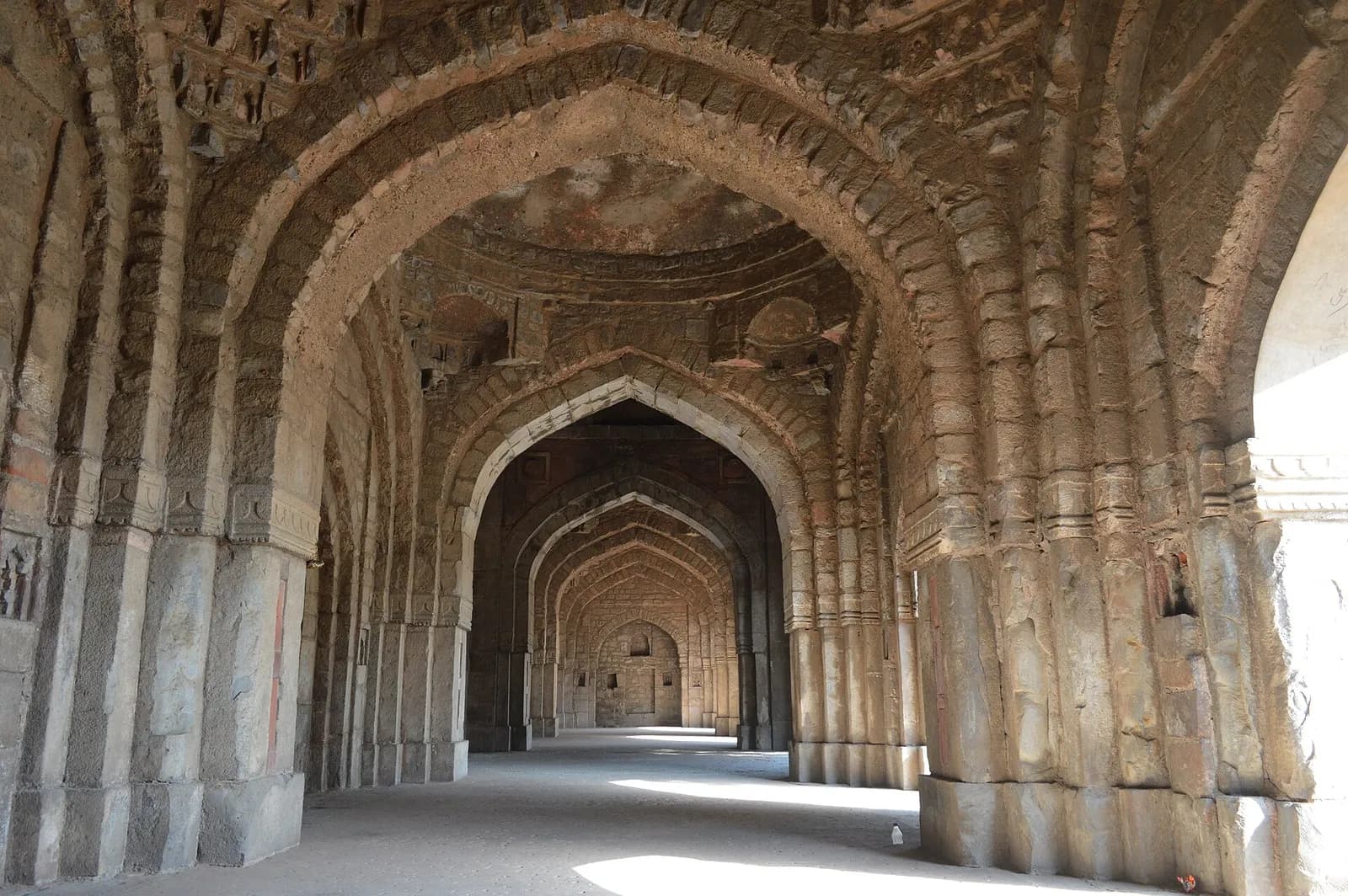
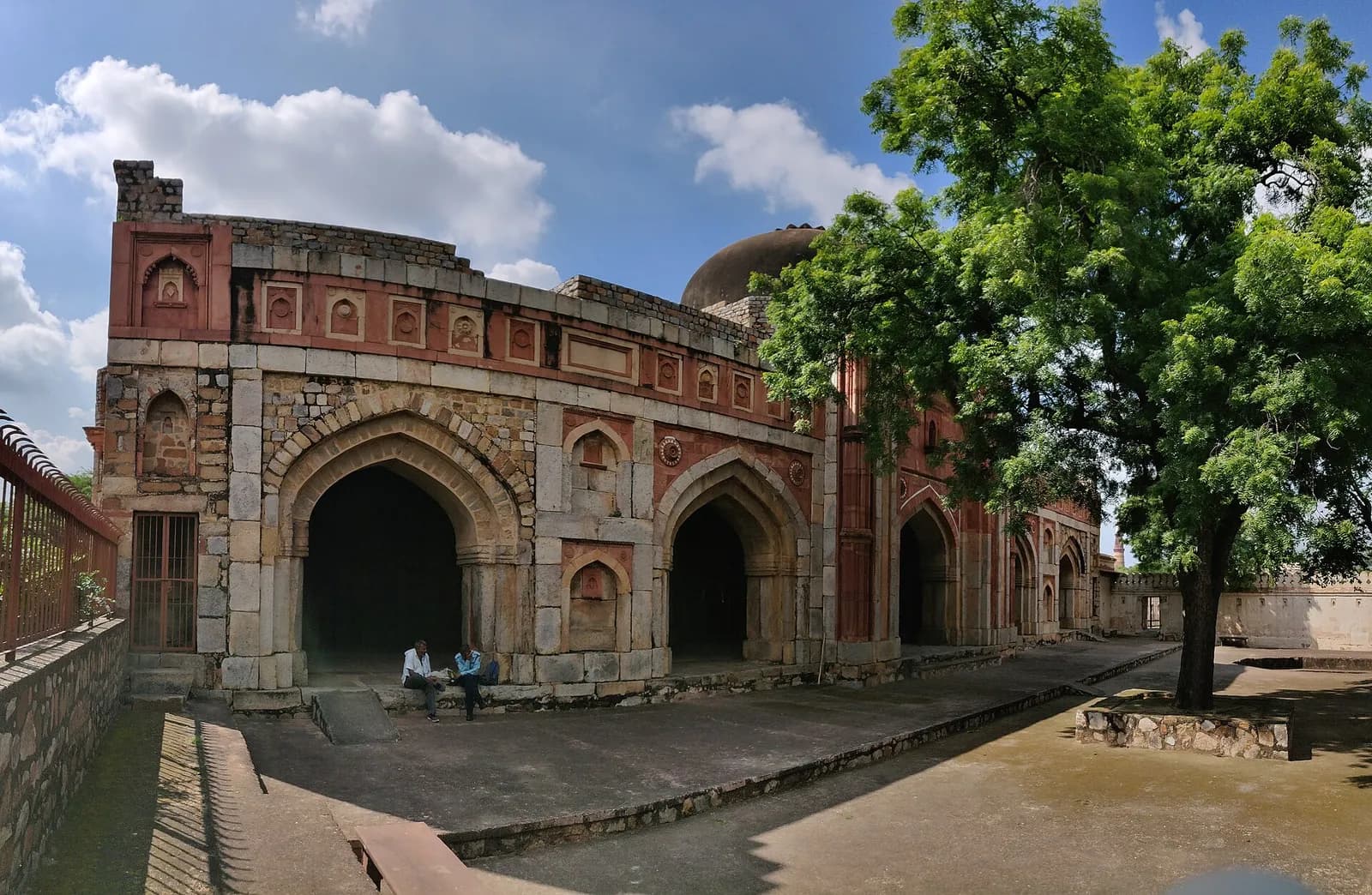
The Jamali Kamali mosque is a building of real beauty and historical importance, celebrated as a structural bridge between the heavy, austere style of the Lodi dynasty and the ornate, airy elegance of early Mughal engineering and its features reward a close look. Built predominantly of rugged grey Delhi quartzite combined with deep red sandstone, with arches and borders picked out in strips of stark white marble for a sharp colour contrast, it is both sturdy and refined. Its key elements are worth seeking out:
- The five-arched facade. The front of the prayer hall presents a series of five distinct arched openings, with the central archway noticeably larger than the flanking pairs and capped by a high, prominent plastered dome.
- Pilasters and medallions. The main central arch is bordered by deep, vertical fluted pilasters and the spandrels, the triangular spaces above the arch curves, are carved with circular lotus-flower medallions, a Hindu motif absorbed into Indo-Islamic art.
- The courtyard and mihrab. A vast open-air courtyard, designed for large Friday congregations, leads to the western prayer wall, whose sacred niche or mihrab, carries bands of marble inscribed with Quranic calligraphy in the elegant Naskh script, amid delicate geometric patterns.
- The rear towers. The back of the mosque features octagonal corner towers that echo the structural safety designs of the earlier Tughlaq and Lodi periods.
The overall impression is of a mosque poised exactly between two architectural ages, retaining the solidity and some of the forms of the Lodi style while reaching toward the grace, colour and refinement that would flower in Mughal architecture. The contrast of grey quartzite, red sandstone and white marble, the carved lotus medallions, the fine calligraphy of the mihrab and the balanced five-arched facade make it one of the most beautiful mosques of its period in Delhi. Knowing what to look for, the five arches, the fluted pilasters, the lotus medallions, the calligraphic mihrab and the rear towers, turns a visit into a rich appreciation of a key moment in the evolution of Indian architecture.
The jewel-box tomb
The tomb of Jamali and Kamali, immediately adjacent to the northern wall of the mosque courtyard, is famous for a wonderful contrast between its exterior and its interior, which is one of the great surprises of Delhi's heritage. From the outside, the tomb is deliberately modest and unassuming: a small, flat-roofed, square structure of simple stone and plaster, lacking the grand exterior dome that usually marks an important mausoleum, so that a passerby might barely notice it. This plain shell, however, conceals one of the most dazzlingly beautiful interiors in the whole city, which is why the tomb is often called a jewel box.
Within, the inner ceiling and walls are entirely covered in specialised, highly polished lime plaster worked in the fine chika technique and the flat ceiling is painted in deep crimson red, rich cobalt blue and gold leaf, arranged into an expansive, radiating sunburst pattern of extraordinary richness. The walls are decorated with vibrant imported glazed tiles and, most remarkably, inlaid among these patterns are tiles inscribed with Jamali's own Persian romantic and spiritual verses, so that the chamber becomes a physical manuscript of the saint's poetry, surrounding the graves with his own words. At the centre rest the two finely carved white marble cenotaphs of Jamali and Kamali, side by side on a raised platform. This astonishing interior is why the tomb is so treasured and also why, to protect the delicate painted ceiling and glazed tiles from humidity, touch and vandalism, the inner chamber is kept permanently locked under heavy iron gates, viewable only with rare, pre-approved written clearance from the ASI. For most visitors the interior must therefore remain a thing of description and imagination, but knowing what lies within the plain shell adds a wonderful sense of hidden treasure to the visit.
The haunted legends
In Delhi's contemporary popular culture, Jamali Kamali has acquired a strong reputation as one of the city's most famously haunted places, a modern layer of legend that draws many curious visitors and it is worth addressing clearly. According to local urban lore, visitors to the complex after twilight have reported disembodied whispering, heavy footsteps and even aggressive growling said to come from the dark staircases and wall niches, phenomena that local legend attributes to djinns, the invisible spirits of Islamic belief, said to haunt the ruins. These stories have made Jamali Kamali a staple of lists of Delhi's most haunted sites and a magnet for those drawn to the paranormal.
It is important to keep these tales in perspective. They are folklore and popular legend, not established fact and by day Jamali Kamali is simply a beautiful, peaceful and historically rich monument set in a green park, with nothing eerie about it. The haunted reputation owes much to the atmospheric ruins, the dark sealed tomb and the general air of mystery around Kamali, which together make fertile ground for ghost stories and to the modern appetite for such tales. For the visitor, the legends are best enjoyed as part of the monument's rich modern mythology rather than taken literally and in any case the complex is a daytime destination within the park, so the after-dark stories belong to legend rather than to any normal visit. Knowing the haunted reputation adds a layer of contemporary colour to the site, but it should not overshadow its genuine historical and architectural beauty, which is the real reason to come.
What to expect at Jamali Kamali
A visit to Jamali Kamali is beautiful, atmospheric and intellectually rewarding, set amid the green ruins of the Mehrauli Archaeological Park and knowing what to expect helps you make the most of it. The complex lies within the park, opposite the Qutub Minar, so reaching it involves a pleasant walk through the heritage grounds. Once there, you can explore the lovely mosque, with its five-arched facade, carved medallions and calligraphic mihrab and the vast courtyard and see the exterior of the famous tomb alongside. The main thing to understand is that the dazzling painted interior of the tomb is kept permanently locked for conservation and can be seen only with rare ASI permission, so for almost all visitors the jewel-box interior remains something known by description rather than directly seen, while the mosque and the tomb's exterior and setting are freely enjoyed. The whole visit takes about forty five minutes to an hour.
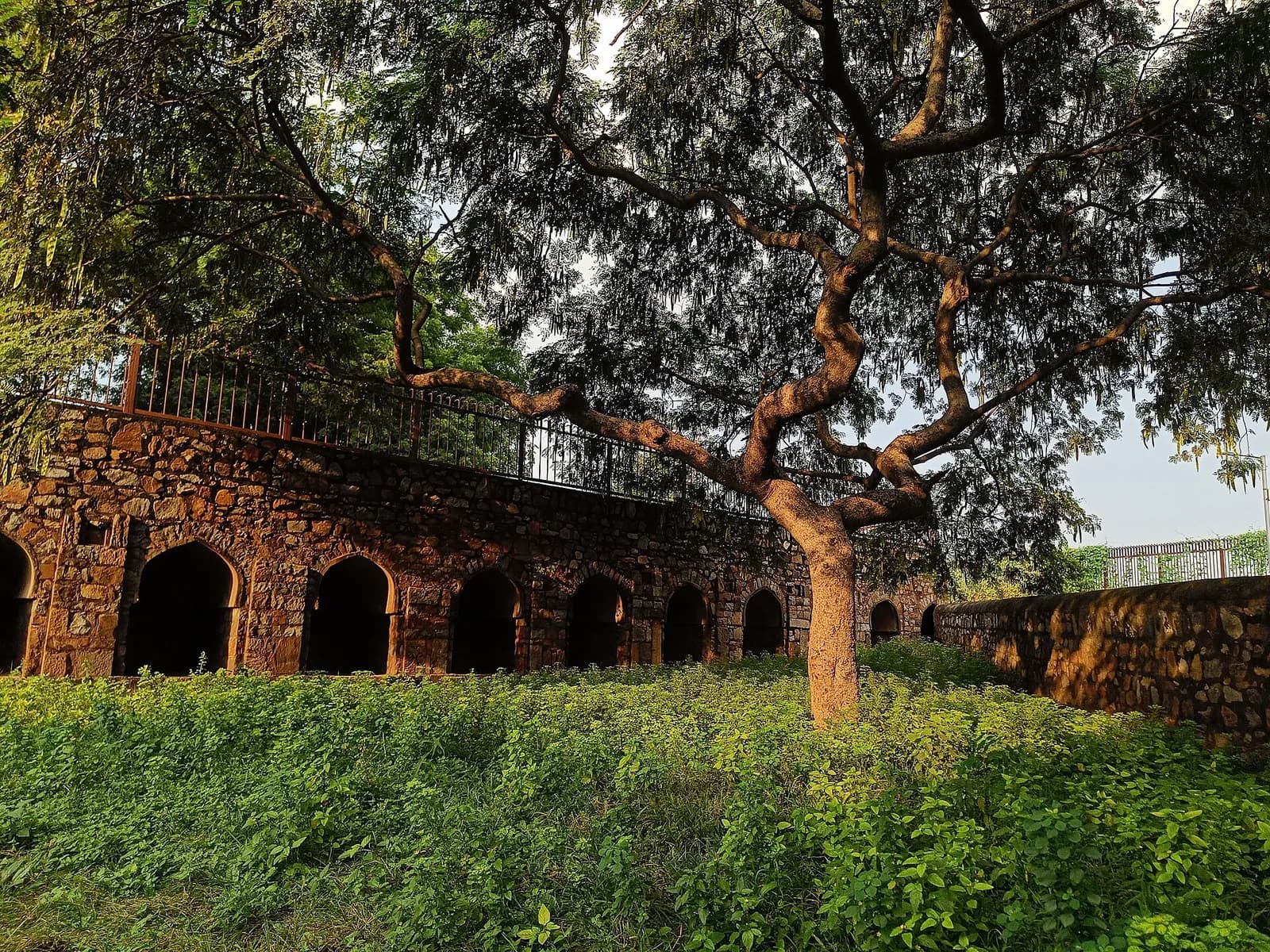
The setting within the archaeological park is green, quiet and semi-wild, a peaceful contrast to the city, though with limited facilities and some uneven ground. The complex is best combined with the other monuments of the park, such as the nearby Rajon ki Baoli, Gandhak ki Baoli and Balban's Tomb, for a fuller heritage walk. The mood is one of beauty, history and gentle mystery, ideal for those who love architecture, stories and tranquil heritage. Because the tomb interior is sealed and the park is a daytime destination, there is no question of the after-dark haunted experiences of legend and a daylight visit shows the monument at its loveliest. Come in good light, with time to wander the park and to absorb the story of Jamali and Kamali and the complex rewards you with one of the most beautiful and thought-provoking heritage experiences in Delhi.
Jamali Kamali timings and entry
Jamali Kamali is open every day from sunrise to sunset, roughly 6:00 AM to 6:00 PM, as it lies within the open Mehrauli Archaeological Park and entry is completely free of charge for all visitors, with no ticketing. A visit, taking in the mosque and the exterior of the tomb, takes about forty five minutes to an hour. The single most important point to understand is that the celebrated painted interior of the tomb is kept permanently locked and sealed under heavy iron gates, to protect its delicate coloured glaze tiles and ceiling paintings from humidity, touch and vandalism and it can be viewed only with rare, pre-approved written clearance obtained in advance from the ASI headquarters, so ordinary visitors should not expect to see inside the tomb. The mosque, the courtyard and the exterior of the tomb are freely accessible. The site sits within a green archaeological park with limited facilities and some uneven ground, so comfortable shoes are wise and a daytime visit is strongly recommended. These timings and conditions are current at the time of writing and can vary, so plan a daytime visit and reconfirm if your plans depend on exact hours, especially if you hope to arrange interior access.
Visiting tips
A few pointers make the visit smoother and more rewarding:
- Come in daylight. The park and the complex are best and most safely seen in good light and the after-dark legends are just legends.
- Do not expect to enter the tomb. The painted interior is sealed and needs rare advance ASI permission, so for most visitors it is admired from outside.
- Appreciate the mosque. Look for the five arches, the fluted pilasters, the lotus medallions and the calligraphic mihrab.
- Know the story. The tale of Jamali the poet-saint and the mystery of Kamali is the heart of the visit.
- Combine it with the park. See the nearby Rajon ki Baoli, Gandhak ki Baoli and Balban's Tomb for a full Mehrauli heritage walk.
- Wear comfortable shoes, as the park has uneven ground and some walking.
- Allow 45 minutes to an hour, more to explore the wider park.
The key point is to come in daylight, with the story of Jamali and Kamali in mind and to treat the complex as part of a walk through the beautiful Mehrauli Archaeological Park. Done so, its lovely architecture and gentle mystery make it one of the most rewarding heritage stops in the city, even though the jewel-box interior stays behind its iron gates.
Best time to visit Jamali Kamali
The best time to visit is the cooler months, from October to March and within the day the morning or the later afternoon, for comfortable weather in the open park and beautiful light on the mosque's grey, red and white stonework. A pleasant winter day is ideal, with soft light on the five-arched facade and comfortable temperatures for walking the archaeological park. The summer is hot and the open park tiring and the monsoon leaves the park lush but can make the ground muddy and the steps slippery. Because the complex is at its most beautiful and its most peaceful in good daylight and because the famous haunted tales are a matter of after-dark legend rather than any real visit, a morning or afternoon visit in the cool season is by far the best. Allow about an hour, more to explore the wider park. Our guide to the best time to visit Delhi sets out the seasons across the city in more detail.
How to reach Jamali Kamali (nearest metro)
Jamali Kamali lies within the Mehrauli Archaeological Park in South Delhi, opposite the Qutub Minar complex and it is easy to reach by metro. The nearest station is Qutub Minar on the Yellow Line, roughly one and a half kilometres from the park entrance and from there it is a short auto-rickshaw ride to the Mehrauli Archaeological Park, from which a signposted walk through the heritage grounds brings you to the complex. Because it sits within the park rather than on a main road, the final approach is on foot through the green ruins, which is a pleasant part of the experience. App cabs and autos serve the Mehrauli and Qutub area well. Set within the great Mehrauli heritage zone, it pairs naturally with a Delhi day tour or a heritage-focused New Delhi tour that takes in the Qutub complex and the park.
Places to visit near Jamali Kamali
Jamali Kamali sits within the Mehrauli Archaeological Park, a sprawling 200-acre heritage reserve with over a hundred historical ruins, so it is surrounded by remarkable monuments and is best enjoyed as part of a wider walk. Within the Mehrauli Archaeological Park itself lie Balban's Tomb, famed for the first true arch in India, the elegant four-tiered stepwell of Rajon ki Baoli, the older, sulphur-water Gandhak ki Baoli and the curious Metcalfe's Follies. Just outside rises the towering Qutub Minar, the great medieval victory tower and for comparison central Delhi's famous Agrasen ki Baoli is another great stepwell to see.
A ride away, the capital's other landmarks round out a full picture of the city: the mighty Red Fort and old city, the serene Humayun's Tomb, the ceremonial India Gate, the lotus-shaped Lotus Temple and the old fort of Purana Qila. For more history, the citadel of Feroz Shah Kotla, the great circle of Connaught Place and the astronomical Jantar Mantar complete the sweep of Delhi's past.
Jamali Kamali in your Delhi itinerary
For most visitors, Jamali Kamali works best as a beautiful, story-rich stop within a walking tour of the Mehrauli Archaeological Park rather than a destination on its own, since the complex takes about an hour and the park around it holds many more treasures. The natural plan is to spend a morning or afternoon exploring the park, taking in Jamali Kamali, Rajon ki Baoli, Gandhak ki Baoli and Balban's Tomb and combining it with the adjacent Qutub Minar complex, for one of the richest heritage days in the city. It is a stop for travellers with a genuine interest in history, architecture and human stories and it rewards knowing the tale of Jamali and the mystery of Kamali in advance, which turns a lovely monument into a deeply intriguing one.
If Delhi is your gateway to the wider Golden Triangle, Jamali Kamali offers a beautiful and thought-provoking window onto the hinge between two great eras of Indian history, the Sultanate and the Mughals, embodied in a saint who served both and in architecture poised between the two. Many of my history-minded guests find the combination of the lovely mosque, the hidden jewel-box tomb, the mystery of Kamali and the modern legends among the most memorable encounters of their Delhi exploration and it adds a graceful, mysterious note to a Mehrauli day before the journey on to Agra and Jaipur, where the Mughal story unfolds in full.
Travel tips for visiting Jamali Kamali
A few pointers make the visit smoother and more rewarding:
- Come in the cooler months and in daylight, October to March, in the morning or late afternoon for the best light and the park at its loveliest.
- Know the story first, Jamali the poet-saint and the enduring mystery of Kamali, as it is the heart of the visit.
- Appreciate the mosque closely, its five arches, lotus medallions, pilasters and calligraphic mihrab.
- Understand the tomb is sealed, its jewel-box interior viewable only with rare ASI permission, so admire it from outside.
- Take the legends lightly, as the haunted tales are folklore and the complex is a beautiful daytime destination.
- Combine it with the park, Rajon ki Baoli, Gandhak ki Baoli and Balban's Tomb, for a full Mehrauli day.
- Allow 45 minutes to an hour, more for the wider park.
- Reach it via Qutub Minar metro, then a short auto and a walk into the park.
If you would like a local guide to bring the beauty and the mysteries of Jamali Kamali and the Mehrauli park to life, message our team on WhatsApp at +91 7302265809 with your travel dates and group size and we will shape the day for you.
Is Jamali Kamali worth visiting?
For history lovers, architecture enthusiasts and those drawn to a good mystery, yes, it is a genuinely rewarding and beautiful stop. There are few monuments in Delhi that combine such lovely architecture, a mosque poised between the Lodi and Mughal ages and a tomb hiding a dazzling painted interior, with so compelling a human story, the poet-saint Jamali and the unsolved enigma of his companion Kamali, lying together in eternal, unexplained equality. Set amid the green ruins of the Mehrauli Archaeological Park and wrapped in a wealth of legend, it is a place rich in both beauty and meaning. Entry is free. The honest note is that the famous jewel-box interior of the tomb is kept locked and is seen by very few, so for most visitors it is admired from outside and the complex rewards being visited as part of a wider park walk rather than as a quick isolated stop. But for the curious traveller who comes in daylight and knows its story, it is one of the most beautiful and thought-provoking heritage sites in the whole city and I love showing it to guests with a taste for architecture and for the human stories behind the stones.
Plan your trip with us
At Experience My India, through our Delhi and Golden Triangle travel desk, we design unhurried, well paced trips that make room for beautiful, story-rich stops like Jamali Kamali and the Mehrauli Archaeological Park, not just the headline monuments and we know how to turn a park full of ruins into a rich and rewarding heritage walk. Whether you want a relaxed set of Delhi Agra tours or a full Golden Triangle route through Delhi, Agra and Jaipur, we plan around your pace, your interests and the right season, with local guides who know the history and the stories. Share your dates and the kind of trip you have in mind through our enquiry page, tell us your group size and we will put together an honest, tailored plan rather than a rushed checklist.
Related guides
- Places to visit in Delhi, for the wider picture
- Hidden places to visit in Delhi, the city's quieter corners
- Nearby places to visit in Delhi, to extend your trip
Enquire Now
Ready to Explore
The Heart of Delhi?
Explore the Red Fort, Qutub Minar, Humayun's Tomb, and the vibrant streets of Old Delhi with our expert-guided premium tours of India's capital city.

Delhi
Premium Tour Package
Questions
Frequently asked questions
What are the timings of Jamali Kamali?
It is open daily from sunrise to sunset, roughly 6:00 AM to 6:00 PM, within the Mehrauli Archaeological Park. A visit takes about 45 minutes to an hour. Reconfirm, as timings can vary.
What is the entry fee for Jamali Kamali?
Who were Jamali and Kamali?
Can you go inside the Jamali Kamali tomb?
Is Jamali Kamali really haunted?
When was Jamali Kamali built?
Which is the nearest metro station to Jamali Kamali?
Is Jamali Kamali worth visiting?
Explore more
Plan your Jamali Kamali trip with us

Interested in Jamali Kamali Delhi: History, Timings and Visitor Guide?
Chat with our travel team for a custom quote, or browse every package.
Related Attractions
9Ready to explore Jamali Kamali Delhi: History, Timings and Visitor Guide?
Book your private tour today and experience the magic of India's rich heritage.