Jantar Mantar Delhi: Timings, Entry Fee, Instruments and Visitor Guide
Visiting Jantar Mantar Delhi? Timings, entry fee, the 1724 observatory, Samrat and Misra Yantra, the nearest metro, photography and visitor tips.
In a Nutshell
“Jantar Mantar in Delhi is an open air astronomical observatory built in 1724 by Maharaja Sawai Jai Singh II of Jaipur, the first of his five such observatories in India. It is a group of large, terracotta coloured masonry instruments, including the giant Samrat Yantra sundial and the heart shaped Misra Yantra, built to track the sun, moon and planets with the naked eye. It sits on Sansad Marg near Connaught Place, is open daily for a small ticket and the nearest metro is Janpath. It is cared for by a unit of Experience My India.”
Jantar Mantar is one of central Delhi's most intriguing sights, a set of giant stone instruments that look like abstract modern sculptures but are in fact a working 18th century observatory. If you like your sightseeing with a dose of science and ingenuity, it is a short, rewarding stop in the heart of the city. Our team at Delhi Agra Tour Packages often slips it into a central Delhi morning and it pairs easily with the bigger monuments on a wider Golden Triangle tour.
I am Abhay Sharma, Delhi born and a Golden Triangle guide since 2015 and Jantar Mantar is one of the places I most enjoy explaining to guests, because it rewards a little context so much. Walk in cold and the instruments look like puzzling red ramps and bowls; learn what each one does and the whole place comes alive. This guide gathers everything I would tell a guest before a visit, checked against current information, including one common myth I will clear up straight away.
Details
Jantar Mantar at a glance
| Detail | Information |
|---|---|
| Location | Sansad Marg (Parliament Street), near Connaught Place, New Delhi |
| Built | 1724 |
| Built by | Maharaja Sawai Jai Singh II of Jaipur |
| Type | Open air astronomical observatory, masonry instruments |
| Status | Archaeological Survey of India protected monument (Delhi's is not the UNESCO site; that is the one in Jaipur) |
| Nearest metro | Janpath (Violet Line), a 3 to 5 minute walk |
| Time needed | About 1 to 1.5 hours |
| Known for | The Samrat Yantra sundial and the heart shaped Misra Yantra |
Details
Jantar Mantar timings
| Detail | Information |
|---|---|
| Opening days | Open all seven days |
| Timings | About 6:00 AM to 6:00 PM, generally sunrise to sunset |
| Weekly closure | None |
Hours are usually given as roughly 6:00 AM to 6:00 PM, broadly sunrise to sunset and the exact closing shifts with the season, so treat the window as a guide and reconfirm if you are arriving late in the day.
Details
Entry ticket prices
| Visitor | Fee (at the time of writing, reconfirm) |
|---|---|
| Indian, SAARC and BIMSTEC visitors | About ₹20 online, a little more at the cash counter |
| Foreign nationals | About ₹250 online, a little more at the cash counter |
| Children under 15 | Free |
| Still photography | Free for casual personal use |
The ticket is modest, as with most Archaeological Survey of India monuments and the online rate is usually a little cheaper than the counter. Fees are revised from time to time, so buy online where you can and carry a little cash. Casual still photography is free; drones and professional commercial video need prior ASI permits.
Details
How to reach
| From | Route |
|---|---|
| Janpath metro (Violet Line) | The closest, a 3 to 5 minute walk to the entrance |
| Rajiv Chowk metro (Blue and Yellow Lines) | About a 10 to 12 minute walk through Connaught Place |
| Patel Chowk metro (Yellow Line) | A close alternative along Sansad Marg |
| By car | Parking is tight at the gate; use the Connaught Place multi level lots and walk or take an auto |
What is Jantar Mantar and why is it famous?
Jantar Mantar is an early 18th century open air astronomical observatory in the heart of New Delhi, a collection of massive masonry instruments built to measure time and track the movements of the sun, moon, planets and stars, all with the naked eye and no lenses or telescopes. The name comes from the words for instrument and formula and the whole complex is essentially a set of giant scientific tools rendered in brick, lime plaster and stone, finished in the warm terracotta red that makes the site so photogenic.
It is famous for two reasons. First, for its sheer strangeness and beauty: the instruments look like bold, abstract sculptures, all ramps, curves and sunken bowls, which is why the place is such a draw for photographers and the curious. Second, for what it represents, the remarkable scientific ambition of a warrior astronomer king who wanted to correct and improve the astronomical tables of his age. It belongs on any thoughtful list of things to do in Delhi, especially for anyone who likes a sight that makes them think.
Is Delhi's Jantar Mantar a UNESCO World Heritage Site?
This is worth clearing up, because it is one of the most common mix ups about the site. The Jantar Mantar that holds UNESCO World Heritage status, inscribed in 2010, is the larger and better preserved observatory in Jaipur, not the one in Delhi. Delhi's Jantar Mantar is a protected Monument of National Importance looked after by the Archaeological Survey of India and it is the oldest of Jai Singh's observatories, but it does not carry the UNESCO listing. Many guides and listings blur the two, so if you see Delhi's Jantar Mantar described as a World Heritage Site, that honour actually belongs to its grander cousin in Jaipur. Knowing the difference also makes a nice link for travellers heading on to Rajasthan, where you can see the UNESCO site for yourself among the other places to visit in Jaipur.
Who built Jantar Mantar and when?
Jantar Mantar in Delhi was built in 1724 by Maharaja Sawai Jai Singh II of Jaipur, a Rajput ruler who was also one of the most gifted astronomers and mathematicians of his time. He built five such observatories across northern and central India, at Delhi, Jaipur, Ujjain, Varanasi and Mathura and the Delhi one was the first of them, which makes it the prototype for the whole remarkable project. The Mathura observatory no longer survives, but the other four do in varying states.
Jai Singh carried out the work with the backing of the Mughal emperor Muhammad Shah, in whose service he held high office. The area around the observatory in Delhi was historically known as a settlement tied to his family, a reminder that this was a Jaipur royal project planted in the Mughal capital. By the mid 19th century the Delhi observatory had fallen into disrepair and it was damaged during the upheavals of 1857, before later restoration brought it back to the condition visitors see today.
Why did Jai Singh build Jantar Mantar?
Jai Singh built Jantar Mantar to improve the accuracy of astronomical knowledge in his age. He had found the small brass instruments then in use too limited and prone to error for precise measurement and reasoned that much larger, fixed masonry instruments would give far more reliable readings of the positions and movements of celestial bodies. His goal was to compile a dependable set of astronomical tables, correcting and updating earlier work by drawing on Hindu, Islamic and Ptolemaic traditions of positional astronomy. The tables he eventually produced were dedicated to his Mughal patron and the whole project reflected a genuinely international outlook, gathering knowledge from Indian, Persian and European sources at a moment when astronomy was one of the great shared sciences of the age.
The result was a scientific instrument the size of a garden, built for patient observation of the heavens with nothing but the human eye, a shadow and a finely marked scale. Rather than looking through a lens, an observer at Jantar Mantar reads the sky off the stone itself, by where a shadow falls or where a point of light lands on a graduated surface. This is what makes the site so different from a modern observatory and so rewarding to understand: the measuring and the architecture are the same thing. That ambition, to measure the cosmos with masonry, is what gives the place its enduring fascination and why it still draws astronomers, students and the simply curious three centuries on.
Is the monument the same as the Jantar Mantar protest site?
This is a point of real confusion, so it is worth separating clearly. The name Jantar Mantar is attached to two different things on the same stretch of Sansad Marg. One is the historic 18th century observatory described on this page, the walled complex of astronomical instruments that you buy a ticket to enter. The other is the open area and road nearby that has, for decades, been Delhi's designated site for public protests, rallies and demonstrations, a place you will often hear about in the news. The two sit close together and share a name, but they are not the same: the monument is a ticketed heritage site run by the Archaeological Survey of India, while the protest ground is a public space outside it. If you are visiting the observatory, head for the monument gate on Sansad Marg; the demonstrations, when they happen, are a separate affair on the road and do not usually affect a normal visit to the instruments.
What instruments are inside Jantar Mantar?
The complex holds a group of masonry instruments, commonly counted as around a dozen, of which four are the dominant, must see structures. Each was built for a specific kind of measurement and small plaques placed by the Archaeological Survey of India explain them at the site.
| Instrument | What it does |
|---|---|
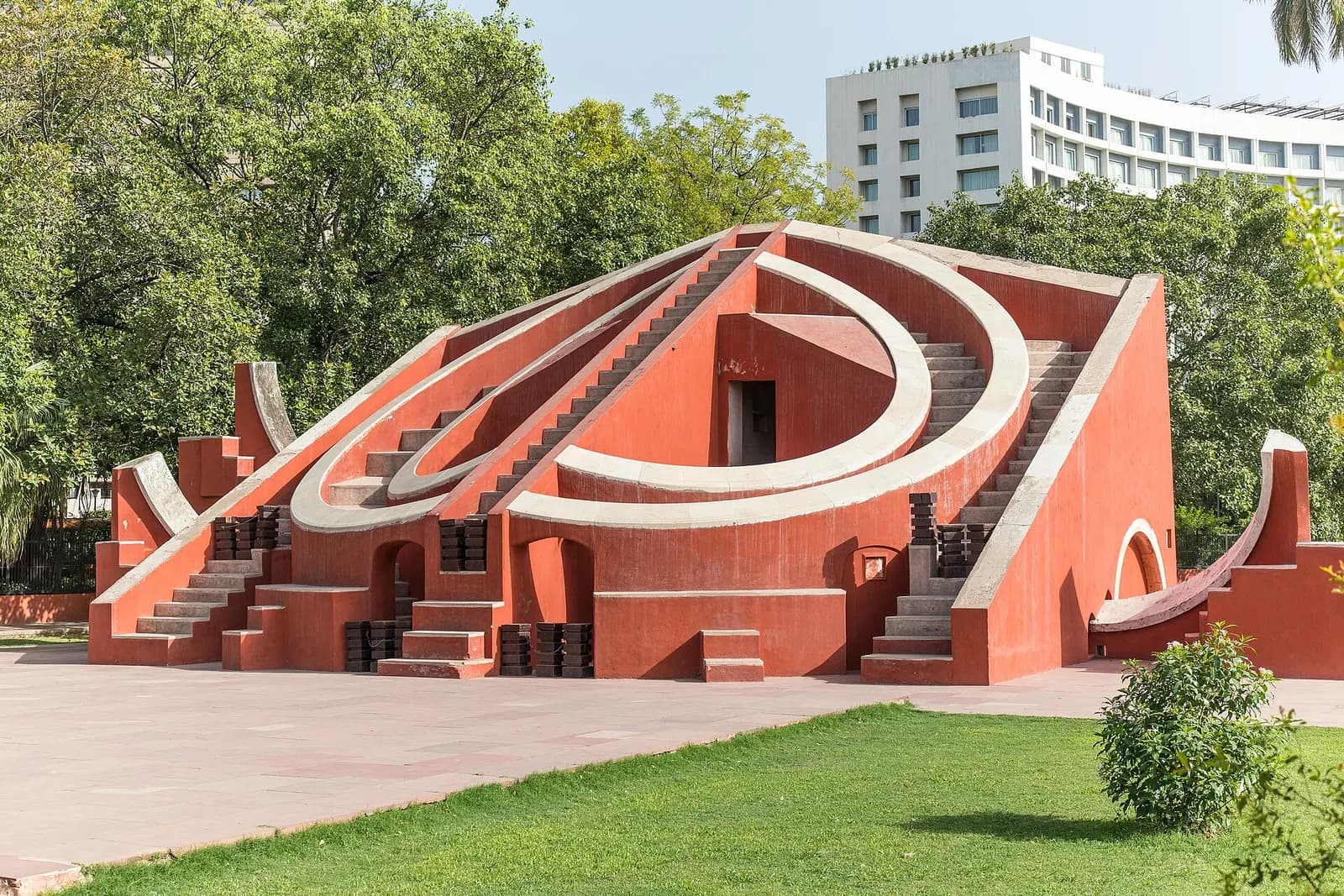
| Samrat Yantra | A giant sundial, the supreme instrument, used to tell local time from the sun's shadow |
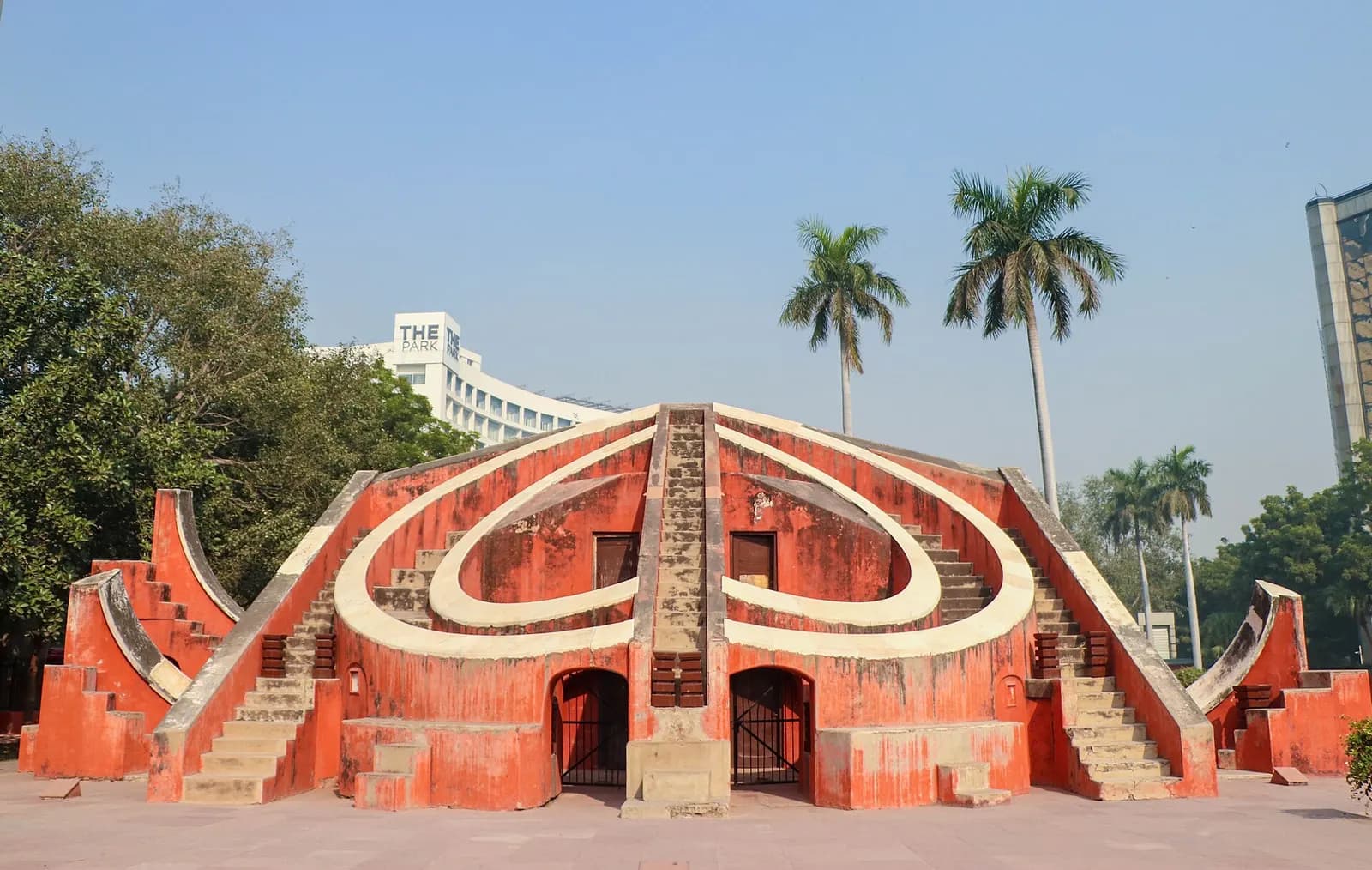
| Misra Yantra | A composite, heart shaped instrument combining several devices, the icon of the Delhi site |
| Jai Prakash Yantra | Two sunken hemispherical bowls that map the sky to fix the position of the sun and stars |
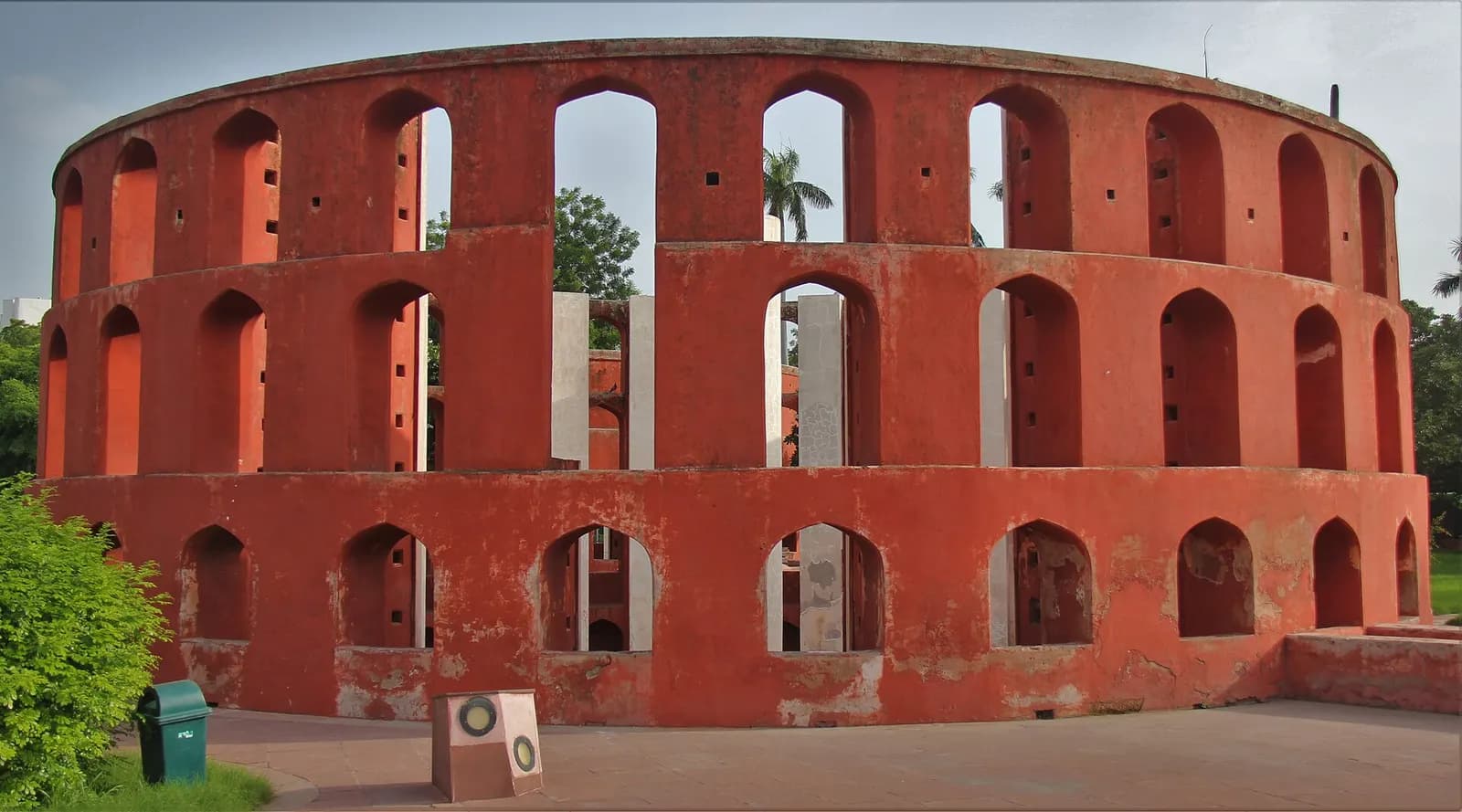
| Ram Yantra | Two open, cylindrical structures with a central pillar, used to measure altitude and direction |
What is the Samrat Yantra?
The Samrat Yantra, meaning supreme instrument, is the largest and most commanding structure at Jantar Mantar, a giant equinoctial sundial. It is built as a massive right angled triangle, its tall hypotenuse aligned with the earth's axis to act as a huge gnomon, the part that casts the shadow, flanked by two curved quadrant scales on either side. As the sun moves across the sky, the edge of the triangle throws a shadow onto the curved scales and by reading where the shadow falls you can tell the local time. It was designed to read time with impressive precision for an instrument of its kind, far better than the small portable devices of the day, though the famous claim of accuracy to within about two seconds belongs to the even larger Samrat Yantra at Jaipur, the world's biggest stone sundial, rather than to Delhi's. Standing beneath Delhi's version and watching the shadow creep along the scale is still the highlight of a visit.
What is the Misra Yantra?
The Misra Yantra, meaning mixed instrument, is the striking heart shaped structure that has become the emblem of the Delhi Jantar Mantar, the one you will see on postcards and photographs. Its name reflects its nature: it is a composite, combining several separate instruments in a single structure. It was designed to work out the shortest and longest days of the year and, remarkably, to indicate the moment of noon in various cities around the world. It carries a particular historical interest too, because it is the one major instrument at the site generally thought not to have been devised by Jai Singh himself and is instead attributed to a later hand, his son Maharaja Madho Singh. That makes it both the visual signature of the observatory and a small later addition to the original scheme.
What are the Jai Prakash and Ram Yantra?
The Jai Prakash Yantra is for many the most ingenious instrument on the site. It consists of two large hemispherical bowls sunk into the ground, their concave marble surfaces carved with coordinate lines that map the sky. Crosswires stretched above the bowls cast a point of shadow or light onto the markings, so that the inverted image of the heavens can be read directly off the stone, letting observers fix the position of the sun and stars. The two bowls are complementary, built so that one can be used while standing in the gaps of the other.
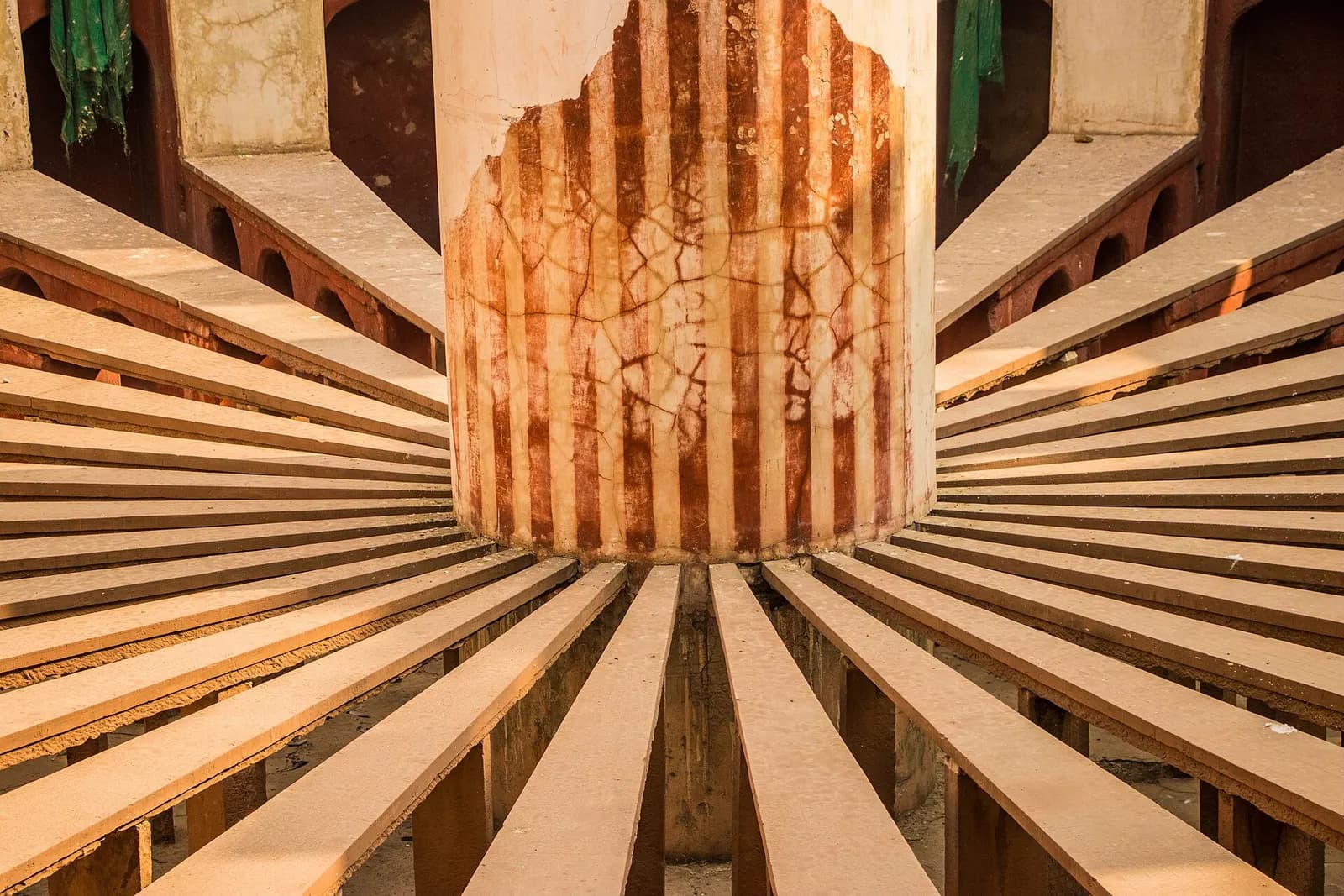
The Ram Yantra is a pair of large, open topped cylindrical structures, each with a pillar at its centre and graduated floors and walls. They are used to measure the altitude and the azimuth, the height above the horizon and the compass direction, of celestial bodies. Like the Jai Prakash, the two Ram Yantra are built as a complementary pair, the solid parts of one corresponding to the open parts of the other, so that between them they cover the whole sky. Seen together, these instruments show how cleverly the whole observatory was conceived as a single working system.
Tucked to one side of the complex is a small shrine to Bhairava, a form of Shiva, which is traditionally said to date from Jai Singh's own time and is a reminder that the observatory sat within a living cultural world, not a purely scientific one. As you move between the instruments, it is worth pausing at each plaque and taking a moment to work out, from the shape alone, what the structure was built to measure; the site rewards that slow, puzzle solving attention far more than a quick loop. Children in particular often find the giant shapes fascinating once someone explains the trick behind them.
How accurate was Jantar Mantar?
For its time, Jantar Mantar was a serious scientific instrument and its large fixed structures gave far more reliable readings than the small handheld devices Jai Singh had found wanting. The great sundials and bowls could track time and celestial positions with an accuracy that was genuinely impressive for naked eye, pre telescopic astronomy. That said, it is worth being honest about the limits. The instruments measure to the precision that masonry, human eyesight and the marked scales allow and even in Jai Singh's own day the telescope was already beginning to transform astronomy in Europe. Jantar Mantar is best understood not as the last word in precision but as a magnificent high point of a long observational tradition, a bridge between ancient methods and the modern science that would soon overtake it. That is part of what makes it so poignant to stand among the instruments today.
It also helps to know why the instruments are so large. Jai Singh's key insight was that size equals precision for this kind of measurement: the bigger the scale, the finer the divisions you can mark on it and the more exactly you can read where a shadow or a point of light falls. A small brass instrument can only be divided so far before the human eye can no longer separate the marks, but a sundial the height of a building can carry a scale fine enough to read time to a tiny fraction. That is the logic behind every oversized ramp and bowl on the site. Far from being crude, the giant forms are the whole point, a deliberate trade of portability for accuracy and understanding that single idea turns a field of strange red shapes into a coherent, brilliant machine for reading the sky.
What are the Jantar Mantar timings and entry fee?
Jantar Mantar is open every day of the week, with no weekly closure, broadly from about 6:00 AM to 6:00 PM, which is to say roughly sunrise to sunset. Because the actual closing follows the daylight and shifts across the seasons, treat these as a guide and reconfirm if you plan a late visit.
Entry is inexpensive. For Indian visitors and those from SAARC and BIMSTEC countries the fee is around ₹20 if booked online and a little more at the cash counter, while foreign nationals pay roughly ₹250 online and a little more at the counter. Children under 15 enter free. These figures are current at the time of writing, the Archaeological Survey of India revises them from time to time, so buy online where you can for the cheaper rate and to skip the queue and carry a little cash for any extras. Casual still photography is free; drones and professional commercial video need prior written permission from the ASI.
What is the best time to visit Jantar Mantar?
There are two answers, depending on what you want. For comfort, the cool months from October to March are far and away the best, since the whole site is open and shadeless and Delhi summers are brutal. But for actually seeing the instruments work, the best moment of any day is around midday, roughly 11:30 AM to 1:30 PM, when the sun is high and casts the clearest, sharpest shadows on the sundials, so you can watch the Samrat Yantra tell the time before your eyes. If you can combine a winter visit with a near midday arrival, you get both comfort and the instruments at their most legible. Early morning is quieter and softer for photography, if you prefer calm over function.
A practical note on crowds and pace: Jantar Mantar is rarely overwhelming, but because it sits in the busy Connaught Place area it can see a steady trickle of visitors through the middle of the day, especially on weekends and holidays. It never feels like the crush of the big ticket monuments, though and even at its busiest you can find a quiet corner to study an instrument. Because the visit is short, an hour or so, it is easy to time it around the heat and the light rather than the crowds, which is a luxury the larger sights do not allow. Give yourself a little longer than you think if you want to actually understand each yantra rather than simply photograph it.
How do you reach Jantar Mantar?
Jantar Mantar is very easy to reach, sitting right in the centre of the city on Sansad Marg near Connaught Place. By metro, the closest station is Janpath on the Violet Line, a three to five minute walk from the entrance. Rajiv Chowk, the big Blue and Yellow Line interchange, is about a ten to twelve minute walk away through Connaught Place and Patel Chowk on the Yellow Line is another close option along Sansad Marg. Parking right outside the monument is limited, so if you are driving it is far easier to use one of the authorised multi level car parks in Connaught Place and walk or take a short auto the rest of the way.
Its central position, a short hop from India Gate and the government quarter, means it slots into almost any central Delhi plan. If you are building a wider route, a dedicated New Delhi tour can tie it together with the imperial sights, while a broader Delhi day tour folds the observatory into the full span of the capital.
What is there to see near Jantar Mantar?
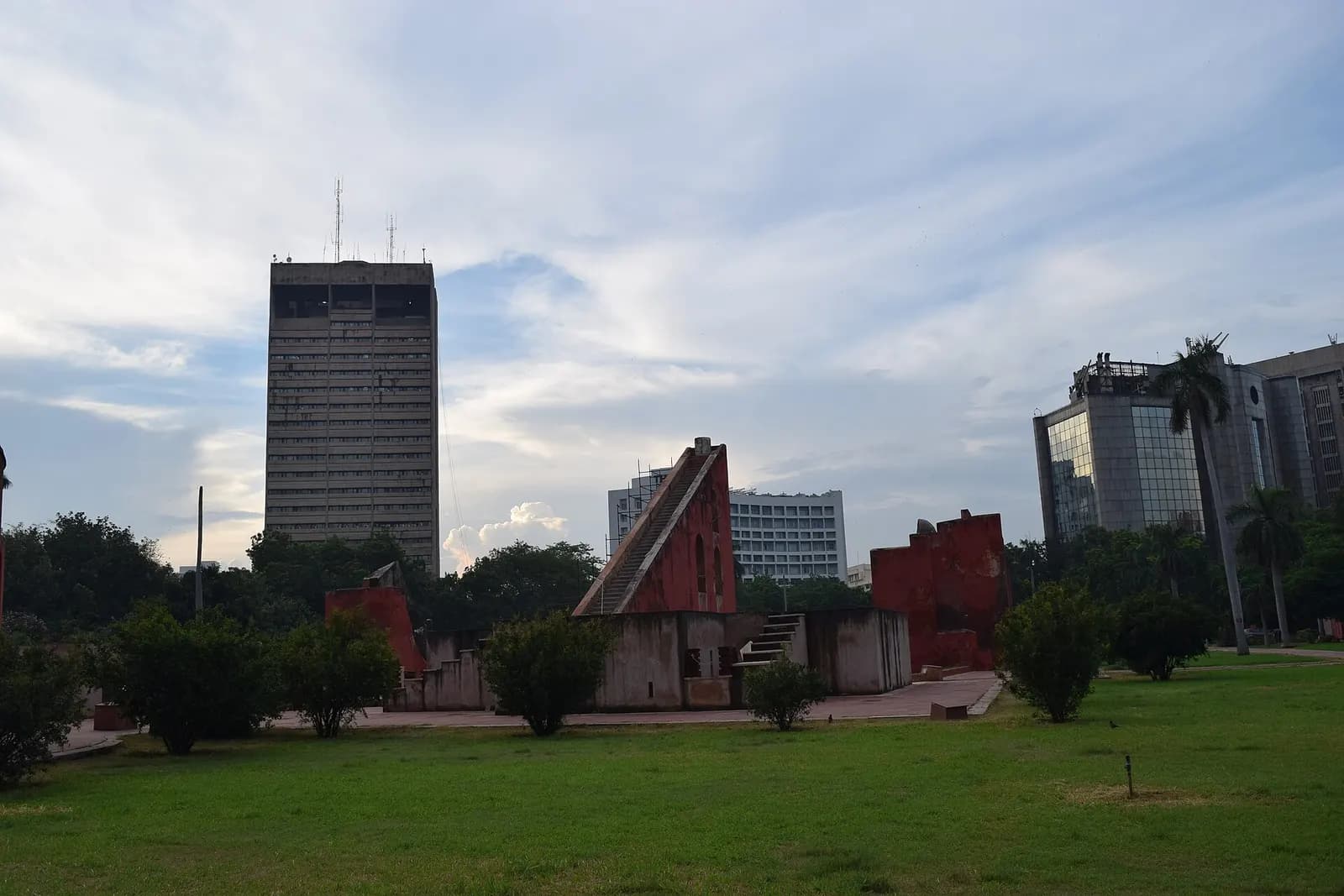
Jantar Mantar sits in one of the busiest and best connected corners of Delhi, so it pairs easily with plenty nearby. Right next door is Connaught Place, the grand colonial era circle of shops, cafes and restaurants that is the commercial heart of New Delhi, perfect for a meal or a coffee before or after. Less than a fifteen minute walk away is the dramatic stepwell of Agrasen ki Baoli, a deep, atmospheric historic tank hidden among the high rises and a favourite for photography. Close by too is the serene Bangla Sahib Gurudwara, one of Delhi's most important Sikh shrines, famous for its golden dome and vast sacred pool.
A little further out the heritage keeps coming, from the leafy ruins and cafes of Hauz Khas to the lawns and tombs of Lodhi Garden. For somewhere to eat around the centre, our roundup of where to eat in Delhi has ideas. Together these turn Jantar Mantar into a natural first stop on a rewarding central Delhi day and you can see the fuller picture in our guide to the important monuments of Delhi.
How does Jantar Mantar fit into a Delhi or Golden Triangle itinerary?
For most visitors, Jantar Mantar works best as a short, sharp stop of an hour or so, folded into a central Delhi morning or afternoon with Connaught Place, Agrasen ki Baoli and Bangla Sahib all within easy reach. It is compact and does not demand a half day, which makes it an ideal addition rather than a centrepiece. History and science minded travellers love linking it with the city's great monuments, the towering Qutub Minar, the mighty Red Fort, the serene Humayun's Tomb and the modern Lotus Temple, for a day that spans Delhi's whole range.
There is a lovely thread to follow if Delhi is your gateway to the wider Golden Triangle. Jantar Mantar was built by the founder of Jaipur, Maharaja Sawai Jai Singh II, so it makes a perfect taste of what is to come when you travel on to Rajasthan, where his grander, UNESCO listed observatory and the pink city he planned await. Seeing the Delhi prototype first and the Jaipur masterwork later gives the trip a satisfying arc. For the best season across the capital, our guide to the best time to visit Delhi is a useful companion and the roundup of places to visit in Delhi helps you build the rest of the day.
Travel tips for visiting Jantar Mantar
A few pointers make the visit much better. The single most useful tip is to get context: the instruments look like abstract sculptures and their brilliance is easy to miss without it, so read the ASI plaques in front of each yantra or hire a certified guide at the entrance. Come in the cooler months, October to March and if you can, arrive near midday, roughly 11:30 AM to 1:30 PM, to watch the sundials cast their sharpest shadows. The whole site is open and shadeless, so carry water, a hat and sun cover and wear comfortable shoes for the walking. For preservation and safety you are not allowed to climb the steps or onto the surfaces of the instruments, so admire them from the ground. Casual still photography is free and the bold red geometry is wonderfully photogenic, so take your time. Buy your ticket online for the cheaper rate and because parking is tight, come by metro from Janpath if you can.
If you would like a local to build Jantar Mantar into a wider Delhi plan, message our team on WhatsApp at +91 7302265809 with your travel dates and group size and we will help you shape the day.
Plan your trip with us
At Experience My India, through our Delhi and Golden Triangle travel desk, we design unhurried, well paced trips that make room for clever, characterful sights like Jantar Mantar, not just the headline monuments. Whether you want a relaxed Delhi Agra tours or a full Golden Triangle route through Delhi, Agra and Jaipur, including the grander Jantar Mantar in Jaipur, we plan around your pace, your interests and the right season, with local guides who can actually explain what each instrument does. Share your dates and the kind of trip you have in mind through our enquiry page, tell us your group size and we will put together an honest, tailored plan rather than a rushed checklist.
Related guides
- Akshardham temple, for a very different, modern Delhi landmark
- Nearby places to visit in Delhi, to extend your day
Enquire Now
Ready to Explore
The Heart of Delhi?
Explore the Red Fort, Qutub Minar, Humayun's Tomb, and the vibrant streets of Old Delhi with our expert-guided premium tours of India's capital city.

Delhi
Premium Tour Package
Questions
Frequently asked questions
What are the timings of Jantar Mantar Delhi?
It is open every day, broadly from about 6:00 AM to 6:00 PM, roughly sunrise to sunset. Reconfirm if you plan to arrive close to closing.
What is the entry fee for Jantar Mantar Delhi?
Which is the nearest metro station to Jantar Mantar?
Who built Jantar Mantar in Delhi and when?
Is Jantar Mantar Delhi a UNESCO World Heritage Site?
What are the main instruments at Jantar Mantar?
What is the Samrat Yantra?
Why is the Misra Yantra special?
How much time do I need at Jantar Mantar?
What is the best time to visit Jantar Mantar?
Is Jantar Mantar worth visiting?
Explore more
Plan your Jantar Mantar trip with us

Photo credits
Photos from Wikimedia Commons, used under their licences:
- Photo 1 by Karthiknanda, CC BY-SA 4.0
- Photo 2 by Alessio, CC BY-SA 4.0
- Photo 3 by AKS.9955, CC BY-SA 4.0
- Photo 4 by Ranjithsiji, CC BY-SA 4.0
- Photo 5 by Karthiknanda, CC BY-SA 4.0
Interested in Jantar Mantar Delhi: Timings, Entry Fee, Instruments and Visitor Guide?
Chat with our travel team for a custom quote, or browse every package.
Related Attractions
9Ready to explore Jantar Mantar Delhi: Timings, Entry Fee, Instruments and Visitor Guide?
Book your private tour today and experience the magic of India's rich heritage.