



Khan Market Delhi: Shopping, Restaurants and Guide
Visiting Khan Market in Delhi? What it's famous for, the bookstores, restaurants and boutiques, timings, which day it is closed, nearest metro and visitor tips.
In a Nutshell
“Khan Market is one of Delhi's most famous and upmarket shopping and dining destinations, a compact U-shaped market in the heart of Lutyens' Delhi known for its heritage bookstores, luxury boutiques and celebrated cafes and restaurants. Built in 1951 for partition refugees, it has become one of the most expensive retail streets in the world. Retail shops open from about 10:00 AM and are closed on Sundays, while its cafes and bars stay open late and through the weekend. Access is free and the Khan Market metro is right outside. It features on our Delhi tours, run by a unit of Experience My India.”
Khan Market is where fashionable Delhi shops, eats and meets, a small but storied market of iconic bookshops, designer stores, Ayurvedic boutiques and legendary food joints, set among the leafy avenues of the capital's most exclusive district. For visitors it offers excellent shopping, dining and people-watching in a refined, walkable setting. Our team at Delhi Agra Tour Packages often suggests it for an afternoon of browsing and a meal and it makes an easy, enjoyable stop on a wider Golden Triangle tour through the capital.
I am Abhay Sharma, Delhi born and a Golden Triangle guide since 2015 and I often send guests here for the bookshops and a bite at one of its famous eateries, a very different, cosmopolitan side of Delhi from the monuments. This guide gathers everything I would tell a visitor beforehand, checked against current information, including what it is famous for, the timings, the closed day and how to reach it.
Details
Khan Market at a glance
| Detail | Information |
|---|---|
| Location | Lutyens' Delhi, near India Gate and Lodhi Estate |
| Established | 1951, for partition refugees |
| Named after | Khan Abdul Jabbar Khan, Dr Khan Sahib |
| Known for | Bookstores, luxury boutiques, cafes and restaurants |
| Reputation | Among the most expensive retail streets in the world |
| Entry | Free to wander; retail closed Sundays |
| Nearest metro | Khan Market (Violet Line), right outside |
| Time needed | About 2 to 3 hours with shopping and a meal |
Khan Market timings
| Detail | Information |
|---|---|
| Retail shops | About 10:00 AM to 8:30 PM |
| Restaurants and bars | Open late, often until around midnight |
| Retail closed | Sundays |
| Cafes and bars | Mostly open on Sundays |
Khan Market's retail shops generally open from about 10:00 AM to 8:30 PM, while its restaurants, cafes and bars stay open much later, often until around midnight. Retail shops are closed on Sundays, but most cafes, bars and restaurants remain open to serve the weekend crowds. Timings vary by shop, so reconfirm for a specific store.
Khan Market and which day it is closed
| Detail | Information |
|---|---|
| Retail shops | Closed on Sundays |
| Restaurants, cafes, bars | Mostly open all week, including Sundays |
| Entry | Free to walk around at any time |
How to reach Khan Market
| From | Route |
|---|---|
| Khan Market metro (Violet Line) | Right outside; Gate 4 opens at the market |
| India Gate and central Delhi | A short auto or taxi ride |
| Connaught Place | A short metro or cab ride |
| By car | Parking is very congested; public transit is better |
What is Khan Market?
Khan Market is one of Delhi's most famous, fashionable and upmarket shopping and dining destinations, a compact, U-shaped market complex in the heart of Lutyens' Delhi, the elegant, tree-lined district of the capital built as the imperial centre. Unlike Delhi's large, heavily commercial shopping malls, Khan Market is a street-level warren of small shops, narrow-staircase boutiques and rooftop cafes, famous for a sophisticated blend of heritage bookstores, high-fashion and lifestyle brands, wellness boutiques and celebrated restaurants and cafes. Over the decades it has grown from a humble refugee cooperative market into a global retail phenomenon, repeatedly ranked among the most expensive retail streets in the world and into the favourite haunt of Delhi's elite, its diplomats, bureaucrats, writers and well-heeled shoppers. For the visitor, it offers a refined, walkable and very cosmopolitan slice of the capital, a world away from its monuments and bazaars.
Several things make it special and they are worth drawing out:
- Delhi's most upmarket market. A chic, compact shopping street, the haunt of the capital's elite and among the costliest retail streets anywhere.
- Legendary bookstores. Iconic, multi-generational bookshops that are intellectual meeting grounds for Delhi's literary and political circles.
- Luxury fashion and lifestyle. Premium home decor, Ayurvedic wellness boutiques and top Indian designer showrooms.
- Famous food and cafes. Celebrated eateries, rooftop cafes and bars, from legendary kebab joints to stylish coffee bars.
- A Lutyens' Delhi setting. Tucked among the capital's most exclusive residential enclaves, near India Gate and the Lodhi area.
It is one of the most enjoyable and cosmopolitan of the things to do in Delhi for shopping and dining and a highlight of any guide to shopping in Delhi.
History of Khan Market
Khan Market's history is a story of resilience and transformation. It was established in 1951 by India's Rehabilitation Ministry, in the aftermath of partition, to provide seed land and commercial opportunities to refugees arriving from the North-West Frontier Province, giving displaced families a chance to rebuild their livelihoods through small shops. It was named in honour of Khan Abdul Jabbar Khan, popularly known as Dr Khan Sahib, the former Chief Minister of the North-West Frontier Province and the elder brother of the legendary Pashtun independence activist Khan Abdul Ghaffar Khan, known as the Frontier Gandhi. Dr Khan Sahib had saved thousands of refugees during the upheavals of partition and the market carries his name in tribute.
From these humble beginnings as a neighbourhood cooperative market for refugees, Khan Market evolved, over the following decades, into something its founders could never have imagined: a global retail phenomenon, repeatedly ranked as India's most expensive retail high street and placing among the top twenty or so costliest retail streets in the world. Its position in the prime real estate of Lutyens' Delhi, encircled by the VVIP residential enclaves of Golf Links, Lodhi Estate and Shahjahan Road, home to elite bureaucrats, diplomats and members of parliament, turned it into the shopping and dining hub of the capital's powerful and well-to-do. Knowing this history, that this chic market began as a lifeline for partition refugees and is named for a hero of that time, adds a poignant and human dimension to what might otherwise seem simply an expensive shopping street.
Why is Khan Market so expensive?
A question many visitors ask is why Khan Market commands such extraordinary rents, ranking among the most expensive retail streets in the world and the answer lies in a simple collision of geography and economics. The market occupies a small, fixed footprint in the most prestigious part of the capital and, crucially, its physical borders are entirely locked in by elite residential blocks, so expansion is simply impossible. This fixed, strictly limited supply of retail floor space, set against the soaring demand from luxury brands, restaurateurs and boutiques all desperate for a prestigious Khan Market address, is what drives its rents to such dizzying heights. The commercial transformation of the market intensified this: from the 1990s, the families who lived in the flats above the shops gradually sold or leased their homes and almost all of the upper floors were converted into cafes, bars and boutiques, packing ever more high-value commerce into the same unchangeable space.
The result is a market where even small shops change hands for enormous sums and where a presence is a statement of prestige as much as a commercial decision. For the visitor, none of this affects the pleasure of wandering and browsing, which is free, but it explains the particular character of the place: compact, exclusive, intensely sought-after and lined with the brands and eateries that can command and justify its address. Understanding why Khan Market is so expensive helps make sense of its atmosphere of polished, high-end calm, so different from the sprawling, bargain-filled bazaars elsewhere in the city.
Shopping at Khan Market: bookstores, fashion and lifestyle
Khan Market's shopping is its heart and it is distinctive for its sophisticated, curated character rather than sheer volume. Three strands stand out:
- The legendary bookstores. A major calling card of the market, its iconic multi-generational family bookstores, among them Bahrisons Booksellers, operating since 1953 and Faqir Chand and Sons, which have long served as intellectual meeting grounds for Delhi's literary and political circles. Browsing these beloved bookshops is one of the quintessential Khan Market experiences.
- Luxury fashion and lifestyle. The market houses premier flagship stores, including celebrated home decor galleries such as Good Earth, natural Ayurvedic wellness boutiques like Kama Ayurveda and Forest Essentials and the showrooms of top Indian designers, making it a prime spot for high-end Indian fashion and lifestyle shopping.
- Curated boutiques. Alongside these, a wealth of smaller boutiques, stationers, gift shops and specialist stores fill the lanes and upper floors, rewarding slow, curious browsing.
What sets Khan Market apart from a mall is this blend of the intellectual and the luxurious, the bookshop and the boutique side by side, all in an intimate, walkable setting. For visitors seeking quality Indian brands, beautiful home and wellness products or simply the pleasure of browsing some of the country's best-loved bookshops, it is one of the finest shopping experiences in Delhi. It is a place to graze and discover rather than to tick off a list and the curated, upscale character is precisely its appeal.
Where to eat at Khan Market (restaurants and cafes)
For many Delhiites and visitors, the food is as much the draw as the shopping and Khan Market is one of the capital's premier dining destinations, packed with cafes, restaurants and bars across its upper floors and lanes. Among its celebrated culinary spots are:
- Khan Chacha. A historic and much-loved eatery widely celebrated for its Mughlai seekh rolls, kebabs and tikkas, a Khan Market institution and a favourite quick bite.
- The Big Chill Cafe. A multi-storey cafe famous for its hearty Italian and continental fare and its desserts, a long-standing Delhi favourite with a cult following.
- Artisanal cafes and bars. Specialist coffee bars, artisanal chocolate boutiques, bakeries and a range of stylish rooftop cafes, restaurants and bars that stay open late into the night.
The dining scene spans everything from a famous roll grabbed on the go to a leisurely multi-course meal or evening drinks and the mix of cuisines, from Mughlai to Italian to contemporary, is a large part of the market's cosmopolitan appeal. Crucially, while the retail shops close on Sundays, most of the cafes, bars and restaurants stay open all week and late into the evening, so Khan Market is a dining destination in its own right even when the shopping is shut. Whether you want a quick, legendary kebab roll or a relaxed dinner with a view over the market, the food here is a highlight of any visit.
Khan Market layout and atmosphere
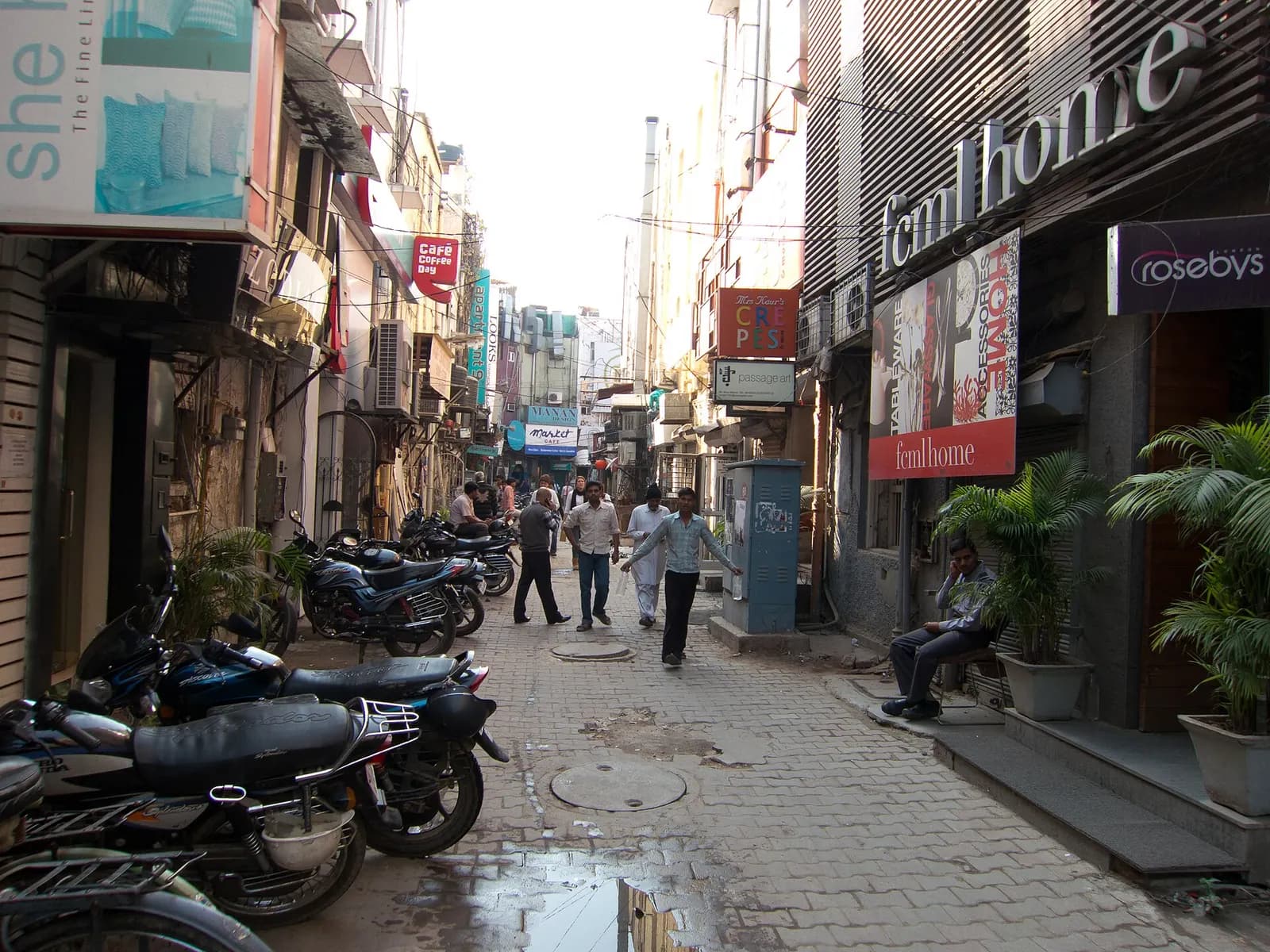
Understanding the market's unusual layout helps you navigate and enjoy it. Khan Market was built originally as a compact, uniform two-storey, U-shaped double-row complex, initially housing 154 retail shops on the ground floor and 74 residential flats above. That basic U-shape survives, so the market is essentially two parallel rows of shops with lanes between and behind them, small, walkable and easy to explore on foot, if a little labyrinthine at first. Over the decades, as the upper-floor flats were converted to commercial use, the market grew upward rather than outward, so that today its narrow buildings are stacked with ground-floor shops, first-floor boutiques and rooftop cafes, all reached by tight internal staircases.
The atmosphere is refined, busy and cosmopolitan, a steady flow of well-dressed shoppers, diners, writers and professionals browsing the bookshops, ducking into boutiques and lingering over coffee. It lacks the frantic, bargaining energy of Delhi's older bazaars; instead it feels more like an upmarket village of shops and eateries, polished but still human in scale. Part of its charm is precisely this intimacy, the sense of a small, self-contained world of quality shops and familiar haunts, where regulars have their favourite bookseller, kebab stall and coffee spot. Wandering its lanes, browsing without pressure and pausing to eat and watch the fashionable crowd is the essence of the Khan Market experience.
What to expect at Khan Market
A visit to Khan Market is a relaxed, upmarket browse rather than a sightseeing march and knowing what to expect helps you make the most of it. You arrive, ideally by metro right at the door, into a compact, busy warren of smart shops and eateries, buzzing with well-dressed Delhiites, families, writers and visitors going about their shopping and dining. The pace is unhurried and the mood polished; there is none of the hard bargaining or hawking of the older bazaars, just quality shops to drift between and cafes to pause in. You might start in a famous bookshop, leaf through new releases, wander into a designer or wellness boutique, climb a narrow staircase to a rooftop cafe for coffee and then grab a legendary kebab roll or settle in for a proper meal, all within a few minutes' walk.
Part of the pleasure is simply soaking up the atmosphere of fashionable Delhi at leisure, people-watching over a drink, discovering a small boutique or a specialist food shop and enjoying the cosmopolitan, village-like feel of the place. It is compact enough to see thoroughly in a couple of hours, yet rich enough to fill a whole afternoon and an evening if you linger over the shopping, the bookshops and the food. First-time visitors sometimes expect something grander or larger and are surprised by how small and intimate the market actually is; its appeal lies not in scale but in quality, character and the pleasure of browsing without pressure. Come with time to wander, a little money to spend and an appetite and Khan Market delivers one of the most enjoyable, civilised afternoons in the capital, a genuine taste of how modern, affluent Delhi shops and relaxes and a side of the city that most monument-focused visitors never pause to see.
Khan Market timings and which day it is closed
Khan Market's timings vary between its shops and its eateries, which is worth knowing to plan your visit. The retail shops generally operate from about 10:00 AM to 8:30 PM, while the restaurants, upscale cafes and bars stay open much later, often running until around midnight. The key point to remember is the closed day: the retail shops are closed on Sundays, in the traditional manner of the market, so Sunday is not the day for shopping here. However, the vast majority of the cafes, bars, fine-dining restaurants and some larger brand showrooms remain fully open on Sundays to serve the large weekend dining crowds, so a Sunday visit still works well if your aim is food and atmosphere rather than shopping. Access to wander the lanes is free at any time. These timings are general and vary by individual shop or restaurant, so reconfirm for a specific place, especially if you are making a special trip for a particular store.
Parking and accessibility at Khan Market
A couple of practical points are worth knowing before you go, as the market's historic, space-locked nature creates some challenges:
- Parking is difficult. Parking in the market's tight central rows is notoriously congested and although a managed parking system exists, finding a free slot on a weekend evening is nearly impossible. Arriving by metro or app-based cab is strongly recommended.
- Steep staircases, few lifts. Because the market is a retrofitted historic complex, most of the premier first and second-floor restaurants and boutiques are reached only by narrow, steep concrete staircases and lack modern passenger lifts, which can be a challenge for anyone with limited mobility.
Knowing these in advance saves frustration: plan to arrive by metro, which drops you right at the market, rather than battling for parking and be prepared for some stair-climbing if you want to reach the upper-floor cafes and shops. For visitors with mobility needs, the ground-floor shops and eateries are the most accessible. Otherwise the market is easy to enjoy on foot and its compact size means you can see a great deal in a short walk.
Best time to visit Khan Market
The best time to visit depends on what you want. For shopping, come on a weekday or Saturday during the day, from late morning onwards, when the retail shops are open and the market is lively but not overwhelming; remember the shops are closed on Sundays. For dining and atmosphere, the evenings are wonderful, when the cafes and bars fill up and the market glows and this works any day of the week, including Sundays, since the eateries stay open. Weekday evenings are a little calmer than the busy weekend nights. In terms of season, the cooler months from October to March are the most pleasant for strolling the open lanes and enjoying the rooftop cafes, while the summer is hot for walking between shops. A relaxed weekday afternoon drifting into evening, shopping and then dining, is close to ideal. Our guide to the best time to visit Delhi sets out the seasons across the city in more detail.
How to reach Khan Market (nearest metro)
Khan Market is extremely easy to reach, which is part of its appeal. The Khan Market metro station on the Violet Line is located right in front of the market and stepping out from Gate No. 4 places you directly at the entry mouth of the retail lanes, so the metro is by far the best and most convenient way to arrive. App-based cabs and autos can also drop you right at the market. Driving is the least convenient option, as parking in and around the market is heavily congested, especially on weekend evenings, so public transit is strongly recommended. The market sits in central Lutyens' Delhi, close to India Gate and the Lodhi area, so it combines easily with the central sights. A guided New Delhi tour can fold a Khan Market stop into a day of the imperial avenues and monuments, giving a nice balance of sightseeing, shopping and dining.
Places to visit near Khan Market
Khan Market sits in the heart of central Delhi, so it pairs easily with the area's sights and with the city's other shopping destinations. Close by is the lovely Lodhi Garden, with its medieval tombs in beautiful grounds, ideal for a stroll before or after shopping and the ceremonial India Gate and the imperial avenues are a short ride away, as is the serene Humayun's Tomb to the south-east.
For more shopping, the market makes a natural pairing with Delhi's other famous retail destinations: the great commercial circle of Connaught Place, the bargain-hunter's favourite Sarojini Nagar market, the bustling Karol Bagh market, the antique-and-curio lanes of Sunder Nagar market and the city's big Delhi shopping malls. A little further out, the capital's great monuments, the mighty Red Fort, the towering Qutub Minar and the modern Lotus Temple and Akshardham, are all a manageable ride away, as are the important monuments of Delhi more broadly. Together these let you balance a Khan Market afternoon with the city's sights and its other markets.
Khan Market in your Delhi itinerary
For most visitors, Khan Market works best as a relaxed shopping-and-dining stop of a couple of hours within a central Delhi day, ideally in the afternoon drifting into the evening, so you can browse the shops while they are open and then settle into one of the cafes or restaurants as the market lights up. It is a refreshing change of pace from monument sightseeing and a great place to buy quality Indian books, fashion, home decor and wellness products or simply to eat well and watch fashionable Delhi at leisure. Because it is so central and metro-connected, it slots in easily after a morning at India Gate and the central monuments or as an evening destination in its own right. If your visit falls on a Sunday, treat it as a dining rather than a shopping trip, since the retail shops will be closed.
If Delhi is your gateway to the wider Golden Triangle, Khan Market offers a taste of the capital's cosmopolitan, contemporary side, a polished counterpoint to the Mughal and colonial grandeur and an excellent place to pick up gifts, books and quality souvenirs before you travel on. Many of my guests enjoy an afternoon here for exactly that, combining a little shopping with a famous Khan Market meal and it adds a stylish, modern note to a trip before the journey on to Agra and Jaipur.
Travel tips for visiting Khan Market
A few pointers make the visit smoother and more rewarding:
- Come by metro, Khan Market station Gate 4, as parking is very congested.
- Shop on a weekday or Saturday, since the retail shops are closed on Sundays.
- Visit in the evening for dining, when the cafes and bars are at their liveliest, open all week.
- Browse the bookstores, a signature Khan Market experience and the designer and wellness boutiques.
- Try a famous eatery, from a legendary kebab roll to a relaxed cafe meal.
- Be ready for stairs, as many upper-floor cafes and shops lack lifts.
- Come in the cooler months, which suit strolling the open lanes and rooftops.
- Allow 2 to 3 hours, to shop, browse and eat at a relaxed pace.
If you would like a local guide to build Khan Market into a wider Delhi plan, message our team on WhatsApp at +91 7302265809 with your travel dates and group size and we will shape the day for you.
Is Khan Market worth visiting?
For shoppers, book lovers and foodies, yes, very much so. Khan Market is one of Delhi's most enjoyable and distinctive destinations, offering a refined, cosmopolitan mix of iconic bookshops, luxury and lifestyle boutiques and some of the city's best-loved cafes and restaurants, all in a compact, walkable setting in the elegant heart of the capital. It is free to wander, superbly connected by metro and a welcome change of pace from monument sightseeing, as well as an excellent place for quality shopping and dining. The honest note is that it is an upmarket and genuinely expensive, shopping street rather than a budget bazaar, so bargain-hunters may prefer markets like Sarojini Nagar and anyone expecting a historic monument should know it is a modern retail and dining hub, albeit one with a fascinating backstory. For the right visitor, though, especially those who love books, good food and stylish browsing, it is one of the most pleasant afternoons Delhi offers and I recommend it warmly.
Plan your trip with us
At Experience My India, through our Delhi and Golden Triangle travel desk, we design unhurried, well paced trips that make room for the capital's shopping and dining as well as its monuments, with stops like Khan Market woven in for a relaxed afternoon of books, browsing and good food. Whether you want a relaxed set of Delhi Agra tours or a full Golden Triangle route through Delhi, Agra and Jaipur, we plan around your pace, your interests and the right season, with local guides who know the city's best markets, bookshops and eateries. Share your dates and the kind of trip you have in mind through our enquiry page, tell us your group size and we will put together an honest, tailored plan rather than a rushed checklist.
Related guides
- Places to visit in Delhi, for the wider picture
- Hidden places to visit in Delhi, the city's quieter corners
- Nearby places to visit in Delhi, to extend your trip
Enquire Now
Ready to Explore
The Heart of Delhi?
Explore the Red Fort, Qutub Minar, Humayun's Tomb, and the vibrant streets of Old Delhi with our expert-guided premium tours of India's capital city.

Delhi
Premium Tour Package
Questions
Frequently asked questions
What is Khan Market famous for?
It is famous as one of Delhi's most upmarket shopping and dining destinations, known for its heritage bookstores, luxury and lifestyle boutiques and celebrated cafes and restaurants and as one of the most expensive retail streets in the world.
What are the timings of Khan Market?
Which day is Khan Market closed?
Which is the nearest metro station to Khan Market?
Why is Khan Market so expensive?
Who is Khan Market named after?
What are the best things to do at Khan Market?
Is Khan Market good for shopping?
Where can I eat at Khan Market?
Is Khan Market worth visiting?
Explore more
Plan your Khan Market trip with us

Photo credits
Interested in Khan Market Delhi: Shopping, Restaurants and Guide?
Chat with our travel team for a custom quote, or browse every package.
Related Attractions
9Ready to explore Khan Market Delhi: Shopping, Restaurants and Guide?
Book your private tour today and experience the magic of India's rich heritage.