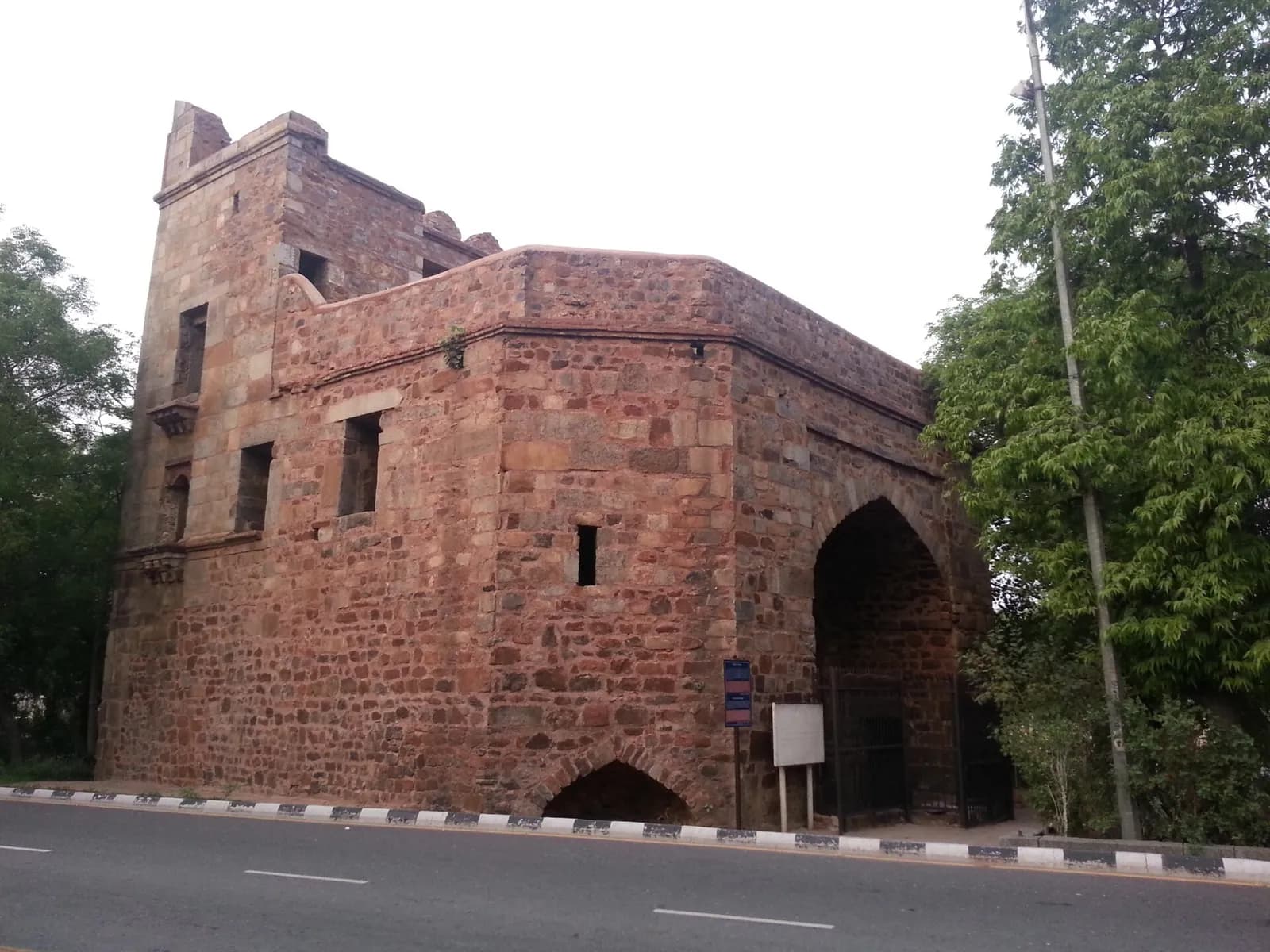
 Bahadur Shah Zafar Marg, Delhi
Khooni Darwaza Delhi: History, Story, Timings and Guide
The dark history and story of Khooni Darwaza, the Bloody Gate, in Delhi: Sher Shah Suri's gate, the Mughal princes, timings, free entry and the nearest metro.
Quick answer
Khooni Darwaza, the Bloody Gate, is a 16th-century gateway on Bahadur Shah Zafar Marg in central Delhi, built by the Afghan ruler Sher Shah Suri around 1540 to 1545 as a gate of his capital Shergarh. Originally called Lal Darwaza and Kabuli Darwaza, it earned its dark name from centuries of public killings, most infamously the shooting of three Mughal princes of Bahadur Shah Zafar's family here in 1857. A tall quartzite arch of three tiers, it now stands on a traffic island opposite the Feroz Shah Kotla stadium. The interior is permanently sealed, but it can be viewed free from the perimeter and it is reached from Delhi Gate metro. It features on our heritage Delhi tours, run by a unit of Experience My India.
- #khooni-darwaza
- #delhi
- #khooni-darwaza-delhi
- #delhi-attractions
- #delhi-travel
Khooni Darwaza is one of Delhi's most sombre and story-laden monuments, a weathered gate steeped in centuries of political violence that offers a stark window onto the darker chapters of the city's Mughal and colonial past. For history lovers and those drawn to the city's grimmer, offbeat heritage, it is a fascinating, if haunting, stop. Our team at Delhi Agra Tour Packages sometimes points it out on a heritage route through central Delhi and it adds a dark, dramatic footnote to a wider Golden Triangle tour through the capital.
I am Abhay Sharma, Delhi born and a Golden Triangle guide since 2015 and I find few monuments in the city carry so heavy a weight of history as this one, which is exactly what makes it so compelling to those with an interest in Delhi's turbulent past. This guide gathers everything I would tell a visitor beforehand, checked against current information, including the history, the story behind the name, the timings and how to reach it.
Khooni Darwaza at a glance
| Detail | Information |
|---|---|
| Location | Bahadur Shah Zafar Marg, central Delhi |
| Also known as | Bloody Gate, Lal Darwaza, Kabuli Darwaza |
| Built | Around 1540 to 1545, by Sher Shah Suri |
| Famous for | Centuries of public killings and the 1857 executions |
| Height | About 15.5 metres, three tiers |
| Entry | Free; viewed from the perimeter, interior sealed |
| Nearest metro | Delhi Gate, about a 3 to 5 minute walk |
| Time needed | About 10 to 15 minutes |
Khooni Darwaza timings
| Detail | Information |
|---|---|
| Perimeter viewing | Monday to Saturday, around 10:00 AM to 7:00 PM |
| Sunday | Closed |
| Interior | Permanently sealed to the public |
| Time needed | About 10 to 15 minutes |
The surrounding lawn and perimeter space can generally be viewed from around 10:00 AM to 7:00 PM, Monday to Saturday and it is closed on Sundays. A roadside look takes only ten to fifteen minutes. The interior is permanently sealed, so the visit is of the exterior. These timings are current at the time of writing and can vary, so a daytime visit is best.
Entry fee
| Item | Information |
|---|---|
| Entry fee | Free to view from the perimeter lawns |
| Tickets | None |
| Interior | Permanently closed and sealed by the ASI |
How to reach Khooni Darwaza
| From | Route |
|---|---|
| Delhi Gate metro (Violet Line) | A 3 to 5 minute walk down Bahadur Shah Zafar Marg |
| The stadium crossing | Opposite the Feroz Shah Kotla stadium |
| Central Delhi | A short ride along Bahadur Shah Zafar Marg |
| By car | The gate sits on a traffic island; park nearby |
What is Khooni Darwaza?
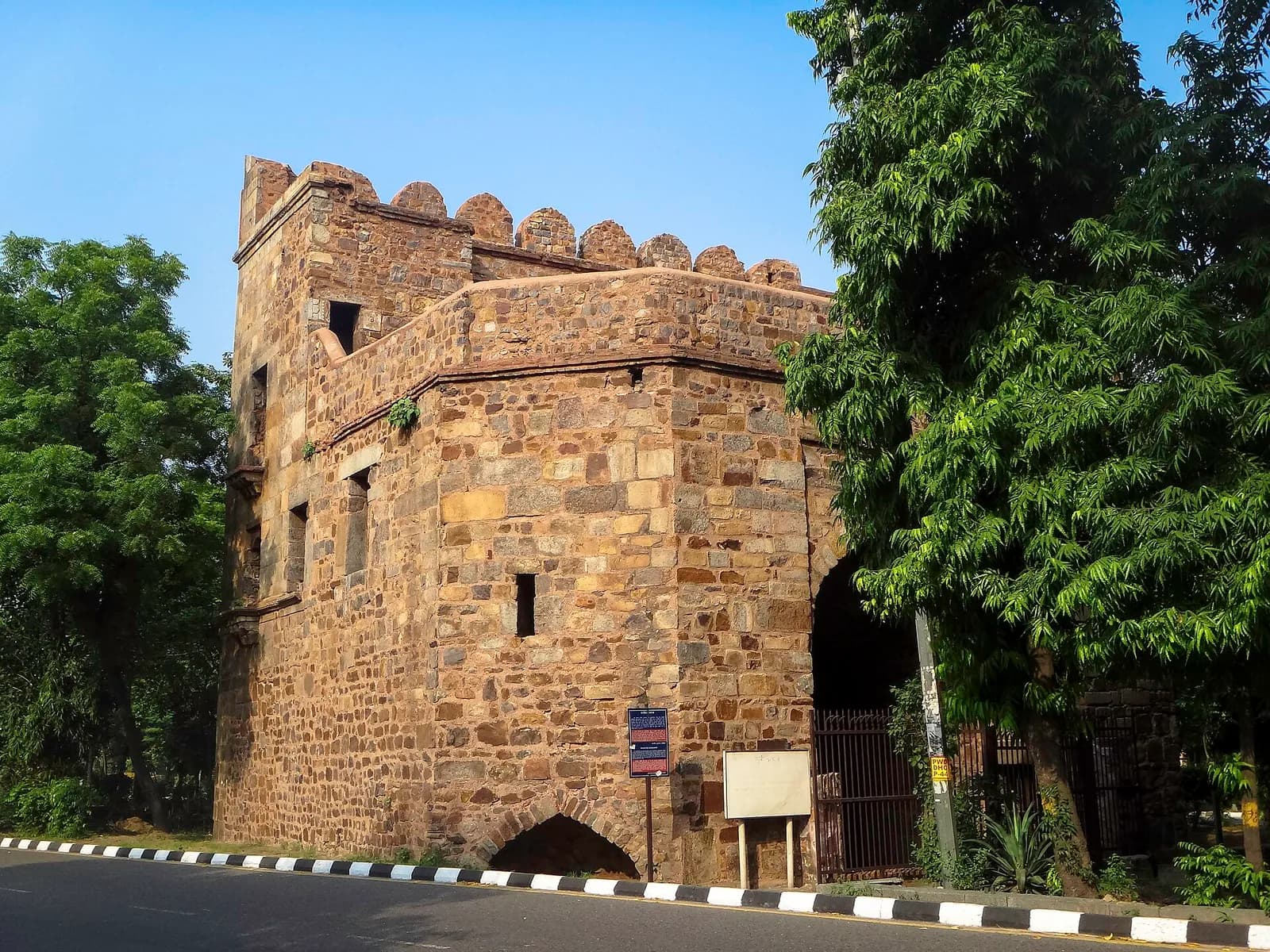
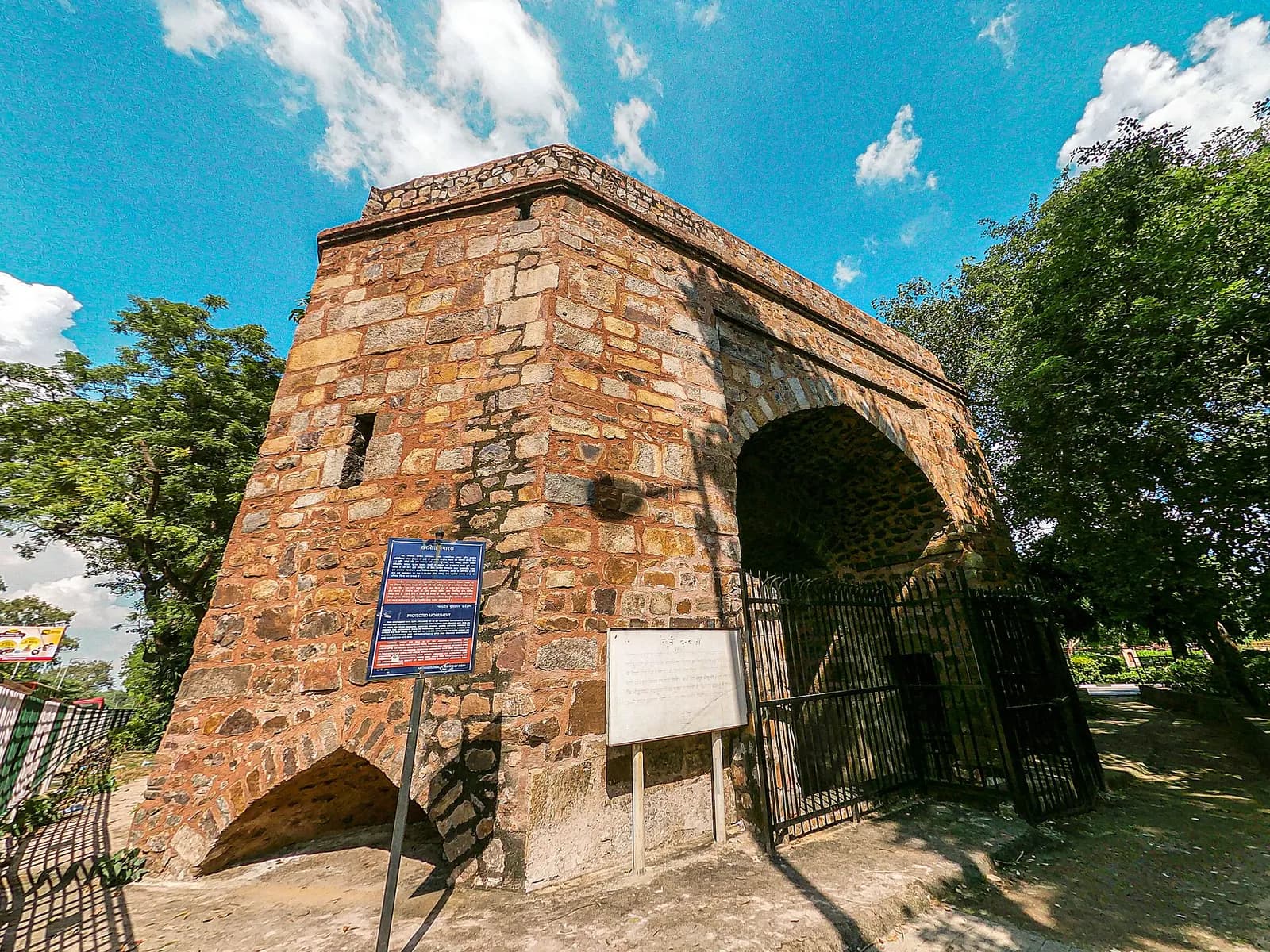
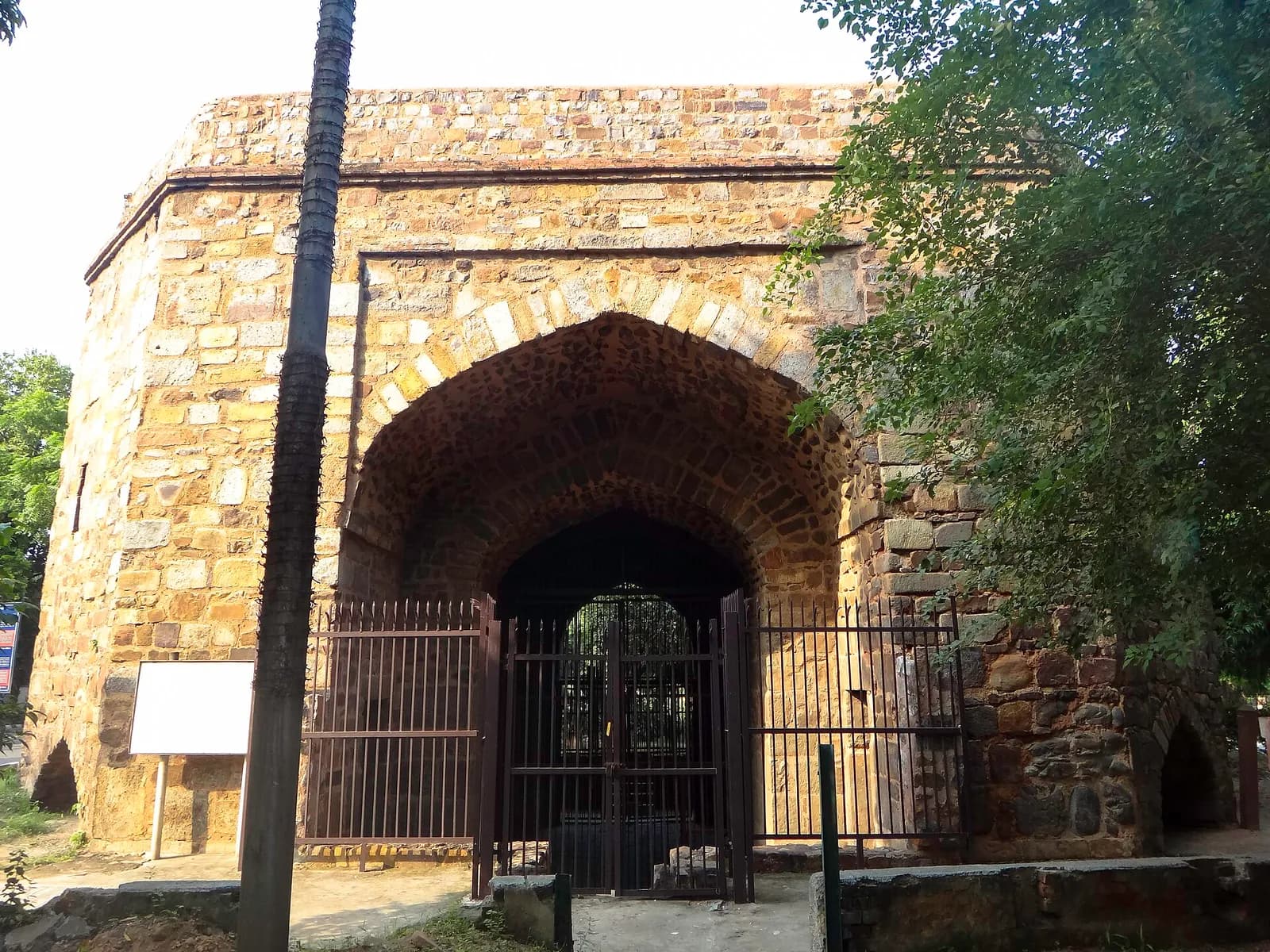
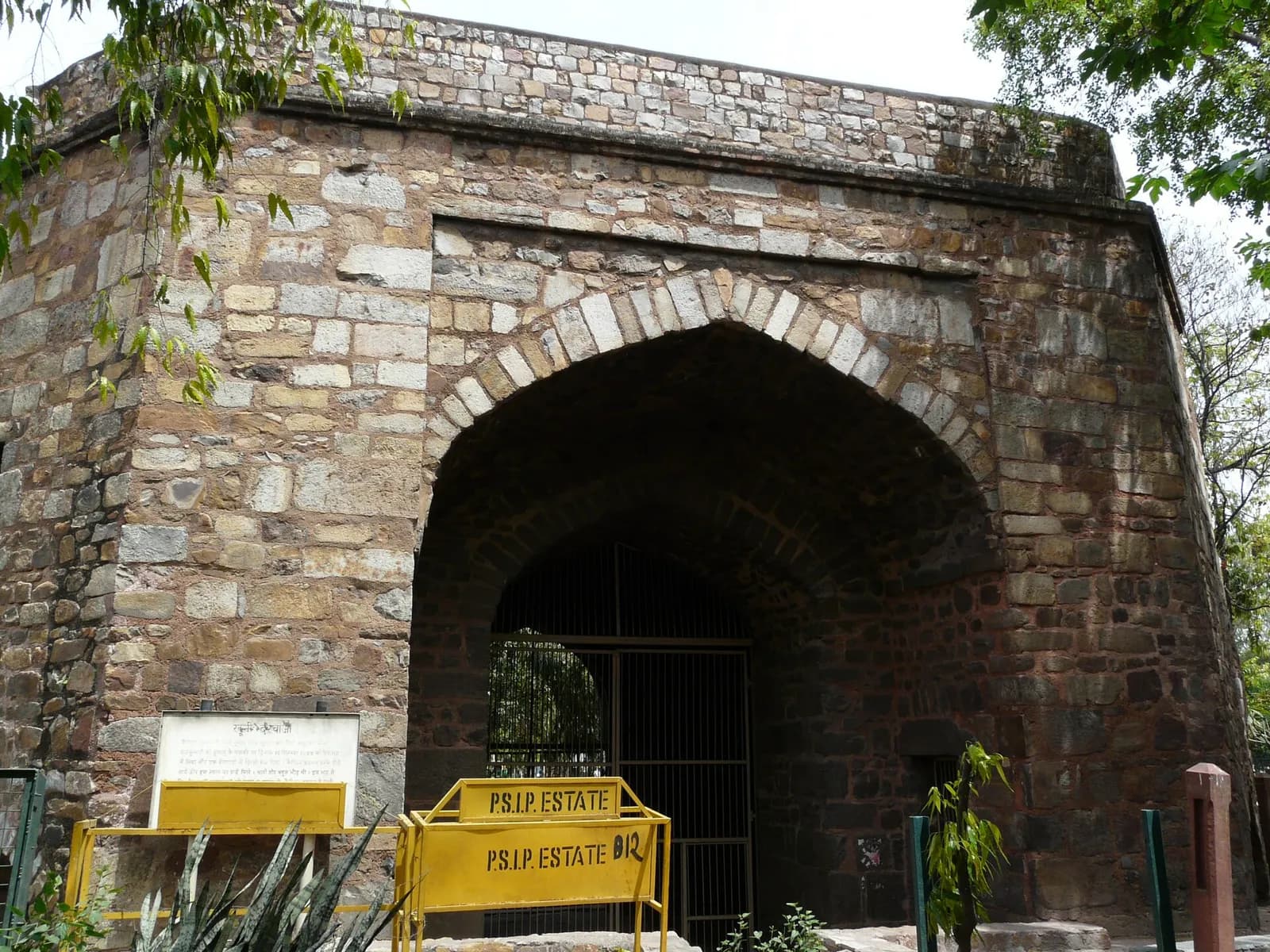
Khooni Darwaza, which translates as the Bloody Gate, is a historic 16th-century gateway in central Delhi, built by the Afghan ruler Sher Shah Suri and infamous for the many acts of public violence associated with it over the centuries. A massive, standalone quartzite archway rising about 15.5 metres in three tiers, it originally formed the northern gate of Sher Shah's capital, Shergarh and was known in its day by gentler names, Lal Darwaza, the Red Gate and Kabuli Darwaza. It earned its permanent, dark moniker from its long history as a site of executions and killings, spanning the Mughal era, the 1857 uprising and even the violence of Partition. Today the weathered gate stands, rather incongruously, on a small fenced traffic island in the middle of a busy multi-lane road opposite the Feroz Shah Kotla stadium, its interior permanently sealed, a sombre and atmospheric relic of the city's turbulent past amid the rush of modern Delhi.
Several things make it notable and they are worth drawing out:
- A Sher Shah Suri gate. Built around 1540 to 1545 as a gate of the Sur capital of Shergarh, one of the few surviving structures of that short-lived dynasty.
- A site of centuries of killings. Associated with political executions under the Mughals, the British and during Partition, which is how it earned its grim name.
- The 1857 executions. The place where three princes of the last Mughal emperor's family were shot in 1857, its most infamous single episode.
- A striking contrast. A grim Mughal-era gate now marooned on a traffic island amid six lanes of modern Delhi traffic.
- A haunted reputation. One of the city's most famously haunted ruins in local folklore, owing to its dark history.
It is one of the most sombre and historically charged of the offbeat things to do in Delhi and a grimly fascinating entry among the important monuments of Delhi.
Why is it called Khooni Darwaza?
A natural question and one many visitors search for, is why this gate originally the Lal Darwaza or Red Gate, came to be called Khooni Darwaza, the Bloody Gate and the answer lies in its long and dark history as a site of public killing. The gate was built by Sher Shah Suri in the mid-16th century as a dignified northern gateway to his capital and its early names were innocent enough: Lal Darwaza for its reddish design and Kabuli Darwaza because it stood astride the main trade route along which caravans set out toward Kabul. The sinister name came later, earned through centuries of bloodshed associated with the structure.
Over the generations, the gate became a designated venue for political executions and the public display of the dead, a place where rulers made grim examples of their enemies and rivals. This accumulation of violence, culminating in the notorious events of 1857, gave the gate its enduring reputation and its chilling popular name, which long ago displaced the original ones. So the shift from Lal Darwaza to Khooni Darwaza is itself the story of the monument: a handsome city gate transformed by history into a byword for political killing. Knowing this is the key to understanding the place, because its significance lies not in its architecture, impressive though it is, but in the dark human history written into its stones, which is what draws the curious visitor to seek it out today.
History of Khooni Darwaza
The history of Khooni Darwaza spans several dynasties and centuries and it is a history of power and bloodshed. The gate was constructed in the mid-16th century, between about 1540 and 1545, by the Afghan king Sher Shah Suri, the brilliant ruler who briefly displaced the Mughals and whose administrative reforms left a lasting mark on India. It formed the northern gateway in the fortified outer walls of his capital city, Shergarh, laid out in the area of present-day Delhi and in its original form it was a proud piece of royal infrastructure. Its grim reputation was built up over the following centuries through a series of notorious killings:
- Jahangir's vengeance. The Mughal emperor Jahangir is said to have ordered the execution at this gate of the two sons of Abdul Rahim Khan-i-Khanan, one of Akbar's celebrated Navaratnas, leaving their bodies exposed.
- Aurangzeb's warning. After his victory in the war of succession in 1659, Aurangzeb is said to have had the severed head of his elder brother and rival Dara Shikoh displayed at this gate as a chilling political statement.
- The 1857 executions. The gate's most infamous episode, the shooting of three princes of the last Mughal emperor's family, which cemented its dark name.
- Partition violence. In 1947, the gate again witnessed bloodshed when fleeing refugees heading toward the camp at Purana Qila were attacked near the structure.
Taken together, this is a history as dark as any monument in Delhi can claim, a gate that served as a stage for royal vengeance, fratricidal politics, colonial reprisal and communal violence across four centuries. Each episode added to its reputation, until the name Khooni Darwaza became inseparable from the structure. For the visitor, this layered history of killing is precisely what gives the otherwise plain gate its powerful and sombre resonance and knowing it transforms a glance at a roadside ruin into an encounter with the grimmer currents of the city's past.
Khooni Darwaza and the 1857 uprising
Of all the dark episodes associated with the gate, it is the events of 1857 that are most infamous and that most define its place in history. In the aftermath of the uprising, as the British retook Delhi and the last Mughal emperor Bahadur Shah Zafar was captured, attention turned to the imperial princes who might rally future resistance. On 22 September 1857, the British officer Captain William Hodson captured three members of the imperial family, the emperor's sons Mirza Mughal and Mirza Khizr Sultan and his grandson Mirza Abu Bakr, who had taken shelter at Humayun's Tomb. Having taken them into custody under a promise of safe passage, Hodson instead had the unarmed princes brought to this gate ordered them stripped and shot them dead at close range, leaving their bodies exposed in public as a deliberate deterrent to further rebellion.
This act, cold and calculated, was one of the most notorious of the entire campaign and it is the single event most responsible for the gate's enduring name and reputation. The spot where the princes fell is remembered to this day and for many who come to the gate it is this episode, above all the others, that they have in mind as they stand before the weathered stone. It marked, in a sense, the brutal end of the Mughal line as a political force, the emperor's heirs killed and displayed at a city gate and it stands as a stark symbol of the violence with which the uprising was suppressed. For Indian visitors in particular, the gate is a place of sombre national memory, where the last princes of a dynasty that had ruled for more than three centuries met a grim end. Standing before it and knowing what happened here on that September day in 1857 is a profoundly affecting experience and it is the heart of why the monument matters.
Architecture and design
Though its fame rests on its history rather than its beauty, Khooni Darwaza is an impressive piece of mid-16th-century architecture and its form rewards a knowing look from the perimeter. The gate fuses the robust, military proportions of Afghan building under the Lodi and Sur dynasties with the emerging refinement of early Mughal decorative taste, a transitional style typical of its era. Its key features are worth noting:
- The scale. A massive, standalone archway rising about 15.5 metres, roughly 51 feet, in a commanding vertical sweep.
- The three tiers. A three-storeyed design, with upper levels that once allowed guards to monitor the roads approaching from the north.
- The masonry. Built of quartzite rubble stone masonry, the sturdy, rough-hewn stonework characteristic of the Lodi and Sur periods.
- The detailing. Adorned with traditional window canopies or jharokhas, overhanging eaves or chhajjas, defensive shooting holes and pointed arched niches.
The overall impression is of a strong, austere and purposeful structure, built for defence and surveillance rather than display, though softened by the decorative touches of its age. The upper tiers were engineered as elevated platforms from which guards could watch the northern approaches, while the ground-level arches, grimly, served as frames for the public display of the executed, a chilling link between the building's design and its dark function. Knowing what to look for, the three tiers, the quartzite masonry, the jharokhas and shooting holes, lets you appreciate it as a rare survival of Sur-era architecture as well as a monument of history, even though, with the interior sealed, the appreciation must be from the outside.
What to expect at Khooni Darwaza
A visit to Khooni Darwaza is brief, sombre and distinctly unusual, quite unlike any conventional tourist monument and knowing what to expect helps you understand it. The gate stands on a small, fenced traffic island in the middle of a heavily congested multi-lane stretch of Bahadur Shah Zafar Marg, directly opposite the Feroz Shah Kotla stadium and near Maulana Azad Medical College, so the setting is one of roaring modern traffic rather than quiet heritage, a striking illustration of how Delhi's history sits cheek by jowl with its present. The interior is permanently sealed, so there is nothing to explore inside and the visit consists of viewing the weathered gate from the perimeter lawns and taking in its history. The whole stop takes only about ten to fifteen minutes.
Because the monument's power lies entirely in its dark past rather than in any facilities or grandeur, the experience is really one of standing before the gate, knowing what happened here across the centuries and reflecting on it. The structure has a genuinely heavy, brooding atmosphere, heightened by its grim reputation and its lonely position amid the traffic and it has long been labelled in local folklore as one of the city's most haunted ruins, with tales of the ghosts of the executed princes said to linger. By day, with the traffic rushing past, it is simply a sombre historical gate, best appreciated briefly and with its story in mind. Come knowing the history, view it safely from the perimeter and the gate offers a stark, memorable encounter with the darker side of Delhi's past.
Khooni Darwaza timings and entry
Khooni Darwaza can generally be viewed from its surrounding perimeter space from around 10:00 AM to 7:00 PM, Monday to Saturday and it is closed on Sundays. Entry to view the monument from the perimeter lawns is completely free and a roadside look takes only about ten to fifteen minutes. The interior, however, is permanently sealed and barred to the public: the inner flights of stairs and upper rooms were closed by the Archaeological Survey of India for safety and heritage preservation following a serious crime inside the monument in 2002 and they have remained permanently locked since. So the visit is strictly of the exterior, viewed from outside. Because the gate stands on a traffic island amid busy multi-lane roads, visitors should take care crossing and viewing it and keep to the safe perimeter areas. These timings and conditions are current at the time of writing and can vary, so plan a daytime visit, ideally not on a Sunday and reconfirm if your plans depend on exact hours.
Safety and visiting notes
Because the gate sits amid heavy traffic and its interior is closed, a few practical points help:
- View from the perimeter only. The interior is permanently sealed, so plan on seeing the gate from outside.
- Take care with the traffic. The monument stands on a traffic island amid busy multi-lane roads, so cross carefully and keep to safe areas.
- Visit by day, not on Sunday. The perimeter is generally viewable Monday to Saturday, roughly 10:00 AM to 7:00 PM.
- Know the history first. The gate's significance is entirely in its past, so read the story before you go.
- Keep the stop short. Ten to fifteen minutes is enough to view the gate and absorb its history.
- Combine it with nearby heritage. It pairs well with other central Delhi sites for a fuller outing.
The key point is that this is a sombre, roadside heritage view rather than an explorable attraction, so coming with the history in hand, viewing safely from the perimeter and keeping the visit brief is the right approach. Treated that way, the gate delivers a powerful, concentrated encounter with a dark chapter of the city's story, even though it cannot be entered.
Best time to visit Khooni Darwaza
The best time to visit is the cooler months, from October to March and within the day the daytime viewing window, Monday to Saturday, avoiding Sundays when the perimeter is closed. A pleasant winter day is ideal, with comfortable temperatures for the brief roadside stop and good light for seeing and photographing the gate. The summer is hot and the traffic around the island intense and the monsoon humid, so the winter months are much the most comfortable, though the visit is quick in any season. Because the monument is best appreciated in daylight and from the busy roadside, a midday or afternoon visit on a weekday works well and it combines naturally with other central Delhi sights. Avoid lingering after dark given the traffic and the isolated island setting. Our guide to the best time to visit Delhi sets out the seasons across the city in more detail.
How to reach Khooni Darwaza (nearest metro)
Khooni Darwaza stands on Bahadur Shah Zafar Marg in central Delhi, on a traffic island opposite the Feroz Shah Kotla stadium and near Maulana Azad Medical College and it is easy to reach by metro. The nearest station is Delhi Gate on the Violet Line and from the station exit it is a brief three to five minute walk along the sidewalk of Bahadur Shah Zafar Marg toward the stadium crossing, where the gate stands. App cabs and autos can also drop you nearby, though the gate's position on a traffic island amid busy roads means a little care is needed to view it safely. Because it sits right in the heart of central Delhi, close to the old city and the government district, it pairs naturally with a heritage-focused New Delhi tour or a broader Delhi day tour that takes in the city's layered history.
Places to visit near Khooni Darwaza
Khooni Darwaza sits in central Delhi, between the old city and the government quarter, so it combines well with the capital's great monuments on a wider heritage plan. Its 1857 story links it directly to Humayun's Tomb, where the Mughal princes were captured before being brought here and the nearby citadel of Feroz Shah Kotla, with its Ashoka pillar, is directly opposite across the road. A short ride brings you to the mighty Red Fort, the great Mughal citadel and the old fort of Purana Qila, itself linked to the gate's Partition history.
The ceremonial heart of New Delhi, with India Gate and the great circle of Connaught Place, is a manageable ride away and the capital's other landmarks round out a full picture of the city: the towering Qutub Minar and the modern marvels of the Lotus Temple and Akshardham. For more layered history, the ancient stepwell of Agrasen ki Baoli, the astronomical Jantar Mantar and the historic Hauz Khas Fort complete the sweep of Delhi's past.
Khooni Darwaza in your Delhi itinerary
For most visitors, Khooni Darwaza works best as a short, sombre stop woven into a central Delhi heritage outing rather than a destination in itself, given that the visit takes only ten to fifteen minutes and that the interior cannot be entered. The natural pairing is with the 1857 and Mughal history around it: see the gate and connect it with Humayun's Tomb where the princes were seized, with the Red Fort and old city at the heart of the uprising and with the Feroz Shah Kotla citadel directly opposite. It is a stop for travellers with a genuine interest in history, especially the darker and more dramatic chapters of Delhi's past, rather than for those seeking grand or beautiful sights and it rewards knowing the story of the gate in advance.
If Delhi is your gateway to the wider Golden Triangle, Khooni Darwaza offers a stark and memorable perspective on the violence that runs through the city's imperial and colonial history, a grim counterpoint to the splendour of the Mughal monuments elsewhere. Many of my history-minded guests find the story of the gate and above all the fate of the Mughal princes in 1857, genuinely moving and seeing the weathered structure marooned amid the modern traffic a powerful image of how the past survives in the present city. It adds a sombre, thought-provoking note to a Delhi exploration before the journey on to Agra and Jaipur.
Travel tips for visiting Khooni Darwaza
A few pointers make the visit smoother and more meaningful:
- Know the history first, Sher Shah's gate, the 1857 executions and the earlier killings, as the gate's power is entirely in its story.
- Visit by day, Monday to Saturday, as the perimeter is generally closed on Sundays.
- Come in the cooler months, October to March, for a more comfortable roadside stop.
- View from the perimeter, as the interior is permanently sealed and take care with the surrounding traffic.
- Keep the stop brief, about ten to fifteen minutes and combine it with nearby sites.
- Connect it with Humayun's Tomb, where the princes were captured before being brought here.
- Reach it via Delhi Gate metro, a 3 to 5 minute walk toward the stadium crossing.
- Avoid lingering after dark, given the traffic and the island setting.
If you would like a local guide to weave Khooni Darwaza and the surrounding 1857 heritage into a wider Delhi plan, message our team on WhatsApp at +91 7302265809 with your travel dates and group size and we will shape the day for you.
Is Khooni Darwaza worth visiting?
For history lovers and those drawn to the darker, offbeat chapters of Delhi's past, yes, it is a worthwhile, if sombre, stop. There are few monuments in the city with so heavy a weight of history, a gate that witnessed royal vengeance under the Mughals, the grim end of the imperial princes in 1857 and the violence of Partition, all written into its weathered stones. It is free and quick to see and its story is genuinely powerful. The honest note is that it is a sealed, roadside ruin on a traffic island, not an explorable or beautiful attraction and its entire appeal rests on an interest in history; a visitor expecting a grand monument to enter and admire will be disappointed, as there is nothing to see but the exterior. But for the curious, history-minded traveller who knows what happened here, it is one of the most sombre and memorable places in central Delhi, a stark reminder of the violence beneath the city's grand imperial story and I find it a stop that stays with people long after.
Plan your trip with us
At Experience My India, through our Delhi and Golden Triangle travel desk, we design unhurried, well paced trips that make room for the full story of the city, its darker and more dramatic heritage like Khooni Darwaza as well as its headline monuments and we know how to place such a stop within a wider, meaningful route. Whether you want a relaxed set of Delhi Agra tours or a full Golden Triangle route through Delhi, Agra and Jaipur, we plan around your pace, your interests and the right season, with local guides who know the stories behind the stones. Share your dates and the kind of trip you have in mind through our enquiry page, tell us your group size and we will put together an honest, tailored plan rather than a rushed checklist.
Related guides
- Places to visit in Delhi, for the wider picture
- Hidden places to visit in Delhi, the city's quieter corners
- Nearby places to visit in Delhi, to extend your trip
Enquire Now
What our travellers say
“Our Golden Triangle honeymoon was flawless. Sunrise at the Taj with a private guide felt like a dream — every detail was handled.”
“As a first-time visitor to India, I felt completely safe and looked after. The driver and guide were superb professionals.”
“Travelling with two kids is hard, but they made it effortless. Great pacing, clean cars and zero surprises on price.”
“Booked the Agra day trip on short notice and it went off without a hitch. The guide's history knowledge made the Taj come alive.”
“Best decision of our India trip. Car was spotless, driver was punctual every single day, and the itinerary never felt rushed.”
“Organised a same-day Agra trip for my parents. Communication before and during the trip was excellent — genuinely stress-free.”
“Sunrise at the Taj Mahal was magical. Our guide spoke great English and answered every question with patience.”
“Three generations travelling together and everyone was comfortable — good vehicle, sensible stops, and no hidden costs.”
“I've used a few tour operators across Asia and this was among the smoothest. Fair pricing and they actually answer the phone.”
“Our custom Rajasthan-Agra combo was planned around our budget without cutting corners on comfort. Highly recommend.”
“Solo female traveller here — I felt safe throughout. The driver was respectful and the whole trip was timed perfectly.”
Ready to Explore
The Heart of Delhi?
Explore the Red Fort, Qutub Minar, Humayun's Tomb, and the vibrant streets of Old Delhi with our expert-guided premium tours of India's capital city.

Delhi
Premium Tour Package
Questions
Frequently asked questions
Why is it called Khooni Darwaza?
Originally the Lal Darwaza or Red Gate, built by Sher Shah Suri, it became known as Khooni Darwaza, the Bloody Gate, because of centuries of public executions and killings here, most infamously the shooting of three Mughal princes in 1857.
What are the timings of Khooni Darwaza?
What is the entry fee for Khooni Darwaza?
Can you go inside Khooni Darwaza?
What happened at Khooni Darwaza in 1857?
Who built Khooni Darwaza?
Which is the nearest metro station to Khooni Darwaza?
Is Khooni Darwaza haunted?
Is Khooni Darwaza worth visiting?
What does Khooni Darwaza mean?
Explore more
Plan your Khooni Darwaza trip with us

Interested in Khooni Darwaza Delhi: History, Story, Timings and Guide?
Chat with our travel team for a custom quote, or browse every package.
Related Attractions
9Khooni Darwaza Delhi on the map
Open in Google MapsReady to explore Khooni Darwaza Delhi: History, Story, Timings and Guide?
Book your private tour today and experience the magic of India's rich heritage.