Lal Gumbad, Malviya Nagar: History, Legend and Guide
Visiting Lal Gumbad (Rakabwala Gumbad) in Malviya Nagar? The Sufi saint's tomb, the stolen golden stirrup legend, Tughlaq design, timings and how to reach.
In a Nutshell
“Lal Gumbad, meaning the Red Dome, is a late-14th-century Tughlaq-era tomb in Malviya Nagar in South Delhi, built around 1380 for the Sufi saint Shaikh Kabiruddin Auliya. Also called Rakabwala Gumbad after a legend of thieves who stole the golden stirrup-shaped finial from its dome, it is a refined, fortress-like monument of red sandstone with sloping battered walls, echoing the great Tomb of Ghiyasuddin Tughlaq. Set in a quiet public park amid residential colonies, it is a free, offbeat heritage gem. It features on our offbeat Delhi heritage tours, run by a unit of Experience My India.”
Lal Gumbad is one of the most charming and overlooked medieval monuments in South Delhi, a jewel of Tughlaq architecture hidden in a neighbourhood park, wrapped in a wonderful legend of daring robbery. For the traveller who loves offbeat heritage, Sufi history and the quiet corners of the city that most visitors never find, it is a genuine discovery. Our team at Delhi Agra Tour Packages is glad to include it for guests who enjoy the hidden side of Delhi and it adds an authentic, local depth to a wider Golden Triangle tour through the capital.
I am Abhay Sharma, Delhi born and a Golden Triangle guide since 2015 and Lal Gumbad is one of my favourite small surprises in the city, because it packs so much into one modest monument: a revered Sufi saint's shrine, a textbook of sturdy Tughlaq military architecture and the irresistible story of the stolen golden stirrup that gave it its nickname. This guide gathers everything I would tell a visitor beforehand, checking against current information, including its history, the legend, its architecture and the timings and directions.
Details
Lal Gumbad at a glance
| Detail | Information |
|---|---|
| Official name | Tomb of Shaikh Kabiruddin Auliya (Lal Gumbad) |
| Also called | Rakabwala Gumbad (the Stirrup Dome) |
| Built | Around 1380, in the Firoz Shah Tughlaq era |
| Location | Panchsheel Enclave, near Malviya Nagar, South Delhi |
| Managed by | Archaeological Survey of India (ASI) |
| Known for | Red sandstone Tughlaq tomb; the stolen golden stirrup legend |
| Nearest metro | Malviya Nagar or Panchsheel Park (Magenta Line) |
| Entry | Free |
Lal Gumbad timings
| Detail | Information |
|---|---|
| Open | Every day |
| Hours | Sunrise to sunset (about 6:00 AM to 6:00 PM) |
| Best time | Morning and late afternoon |
Lal Gumbad is open every day from roughly sunrise to sunset, approximately 6:00 AM to 6:00 PM, within its public park. The early morning and late afternoon are the pleasantest times to visit and the best for the red sandstone in soft light. These timings are current at the time of writing and can vary, so reconfirm before a special trip.
Entry fee
| Visitor | Fee |
|---|---|
| All visitors | Free; no ticket required |
How to reach Lal Gumbad
| From | Route |
|---|---|
| Malviya Nagar metro (Magenta Line) | Nearest station, a short auto or e-rickshaw ride |
| Panchsheel Park metro (Magenta Line) | Equally close, a short ride into the colony lanes |
| Within Panchsheel Enclave | The tomb sits in a public park among residences |
| By car | Reachable; the park gates are in quiet residential lanes |
What is Lal Gumbad?
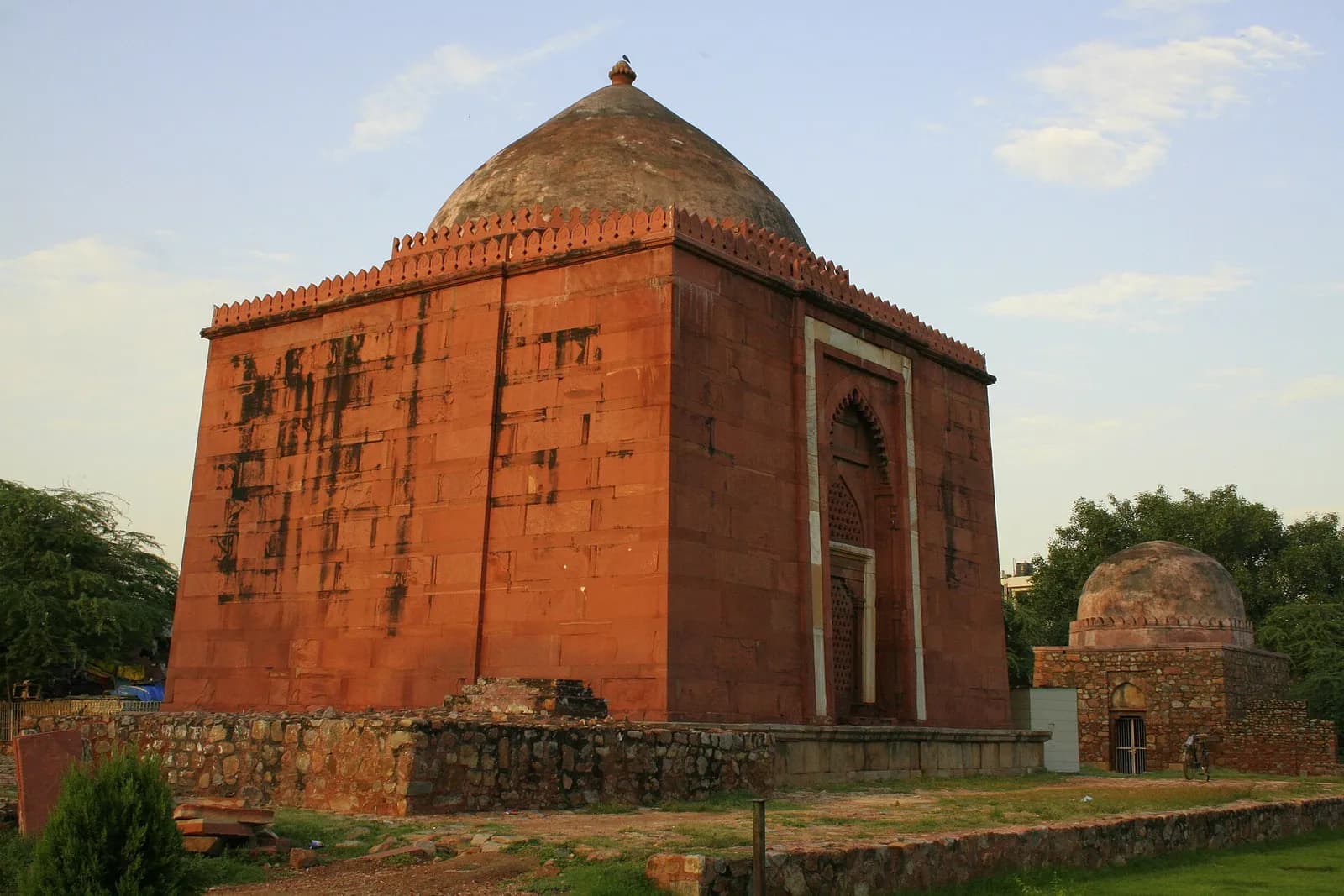
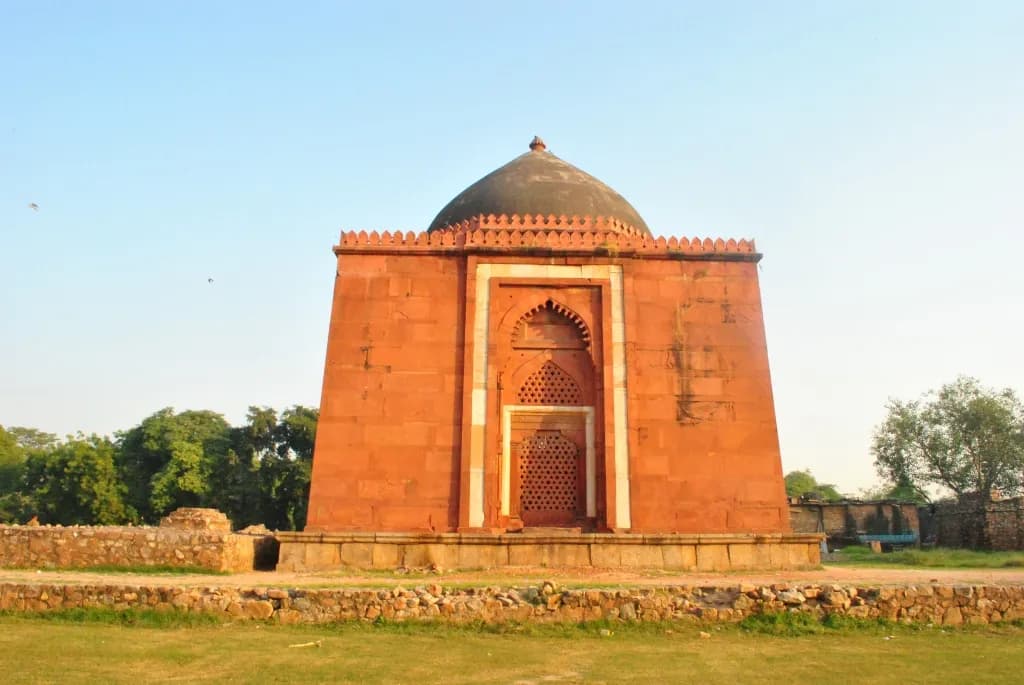
Lal Gumbad, whose name translates as the Red Dome, is a late-14th-century tomb in the Panchsheel Enclave area near Malviya Nagar in South Delhi, built to honour the Sufi saint Shaikh Kabiruddin Auliya and it is a fine, compact example of Tughlaq-era architecture. Constructed around 1380 during the reign of Sultan Firoz Shah Tughlaq, it is popularly known as Rakabwala Gumbad, the Stirrup Dome, after a celebrated legend about the theft of the golden ornament that once crowned its dome. Built of rough grey quartzite faced with vibrant red sandstone, with the sharply sloping battered walls and fortress-like solidity typical of Tughlaq military architecture, it closely echoes the design of the great Tomb of Ghiyasuddin Tughlaq at Tughlaqabad, scaled down into a refined spiritual sanctuary. Protected by the Archaeological Survey of India and set today within a quiet public park amid modern residential colonies, it is one of the most rewarding hidden monuments of South Delhi, free to visit and rich in history and legend.
Several things make it special and they are worth drawing out:
- A Sufi saint's tomb. Built for Shaikh Kabiruddin Auliya, a revered 14th-century Sufi saint in the spiritual lineage of Hazrat Nizamuddin Auliya.
- The Red Dome. Named for its vibrant red sandstone facing, a striking contrast to its white marble entrance accents.
- The stirrup legend. Its nickname Rakabwala Gumbad comes from a famous story of thieves who stole the golden stirrup-shaped finial from its dome.
- Tughlaq military architecture. Sloping battered walls and a fortress-like form, mirroring the great Tughlaqabad tomb in miniature.
- A neighbourhood green lung. Set in a well-kept park, it is a rare place to see 14th-century architecture amid everyday South Delhi life.
It is one of the most charming of the hidden places to visit in Delhi and a delightful find among the offbeat things to do in Delhi.
History of Lal Gumbad and the saint
The history of Lal Gumbad is rooted in the Sufi culture of the Delhi Sultanate and in the prolific building era of the Tughlaq dynasty and knowing it gives the monument its meaning. The tomb was raised for a holy man, in a period when Delhi was dotted with the shrines of revered saints:
- The Tughlaq era. The tomb was built around 1380, during the long and stable reign of Sultan Firoz Shah Tughlaq, one of the great builder-kings of the Delhi Sultanate.
- The saint it honours. It was raised over the burial place of Shaikh Kabiruddin Auliya, a highly revered Sufi saint of the 14th century.
- The spiritual lineage. He was a prominent disciple of Shaikh Roshan Chirag-e-Delhi, tracing his spiritual descent directly back to the legendary Sufi master Hazrat Nizamuddin Auliya, which placed him at the heart of Delhi's Chishti Sufi tradition.
- A shrine for a holy man. The mausoleum was built over his grave on his death, a fitting monument for a saint of his standing.
This history connects Lal Gumbad to the great chain of Chishti Sufi saints who shaped the spiritual life of medieval Delhi, from Nizamuddin Auliya through Chirag-e-Delhi to Kabiruddin Auliya. That it was built in the Firoz Shah Tughlaq era, a time of prolific monument-building across the city, explains both its sturdy Tughlaq style and its survival. For the visitor, knowing that this is the tomb of a revered Sufi saint and not merely a noble or a ruler, adds a layer of spiritual significance to the monument and it ties a quiet Malviya Nagar park into the wider sacred geography of Sufi Delhi that centres on the great dargah of Nizamuddin.
It is worth pausing on what it meant to be buried in this way in 14th-century Delhi. The Chishti Sufis were among the most beloved figures of the age, revered by ordinary people and courted by sultans alike and the tomb of such a saint became a place of pilgrimage and blessing long after his death. Firoz Shah Tughlaq, who reigned for decades and built on a scale rarely matched in the Sultanate, was a notably pious ruler who restored older monuments and raised many new ones and the construction of a fine stone tomb for a saint of Kabiruddin Auliya's standing fits naturally into the devotional culture of his court. The choice of the costly red sandstone and the careful, imperial-style architecture signal just how highly the saint was regarded, for this is no humble grave but a dignified monument built to endure. For the visitor, this context explains why such a refined building stands in what was then open country south of the city and why it has been cared for and remembered across the centuries since.
The legend of the stolen stirrup
The monument's most memorable feature is not architectural but a story, the legend that gave it its popular name and it delights every visitor who hears it. The alternative name Rakabwala Gumbad, the Stirrup Dome, comes from a tale of daring medieval robbery:
- The golden finial. The summit of the great dome was originally crowned with a beautiful ornate golden finial shaped like a stirrup, a rakab, glinting above the red sandstone.
- The daring theft. According to local folklore, a band of exceptionally bold thieves climbed the steep, smooth plastered curve of the dome, chiselled away the golden ornament and escaped with it into the surrounding scrub forest.
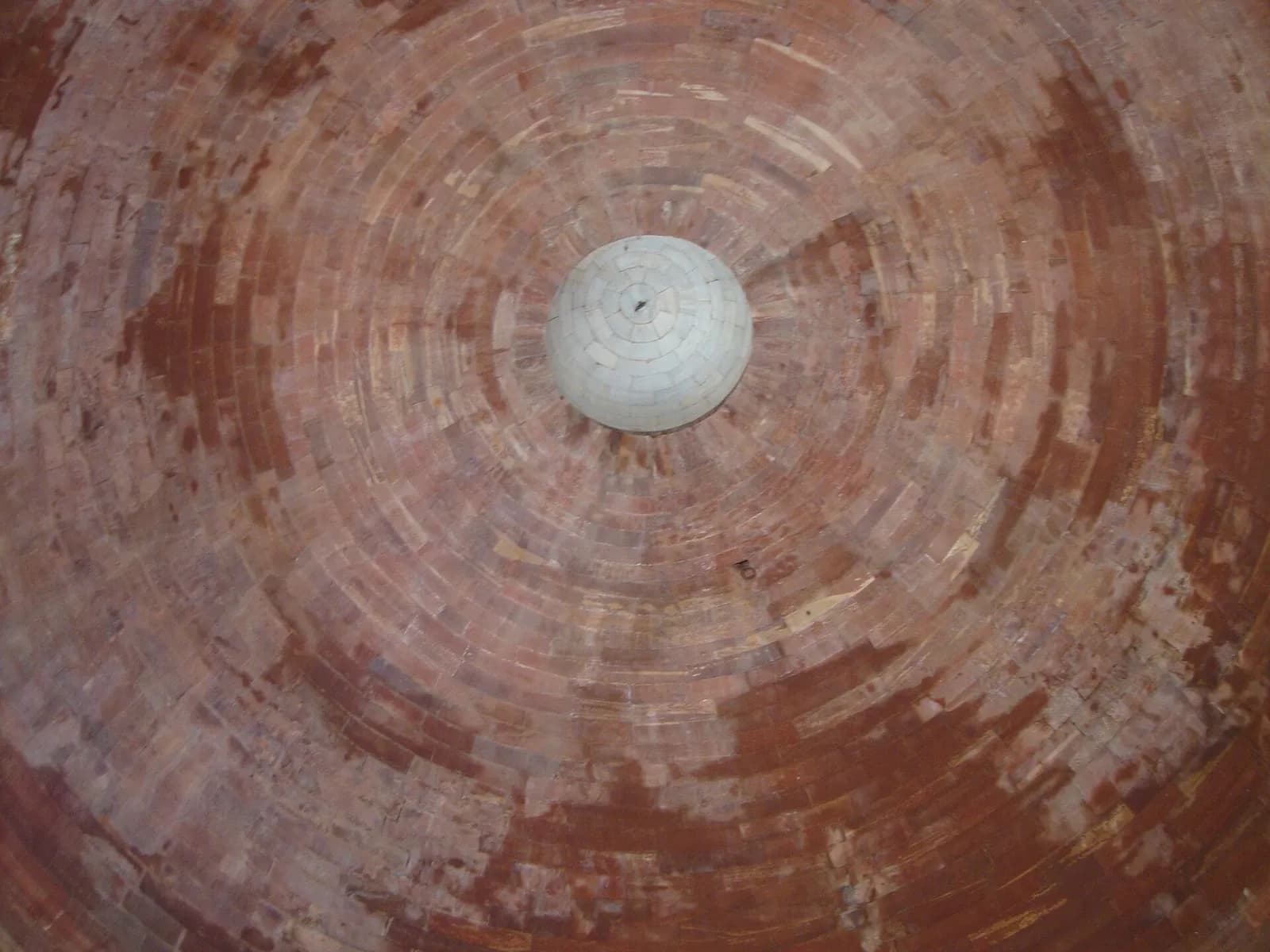
- The empty anchor. The iron rod that once anchored the stolen finial is said to remain visible at the very apex of the dome to this day, a silent reminder of the theft.
This legend is what gives Lal Gumbad its enduring local name and much of its charm, turning a dignified saint's tomb into the setting of a memorable adventure story. Whether taken as history or folklore, the tale of the thieves scaling the sheer dome to steal its golden stirrup captures the imagination and is part of why the monument is remembered and loved locally. For the visitor, looking up at the apex of the dome to find the empty iron anchor where the golden stirrup once sat is one of the small pleasures of a visit, a direct link to the centuries-old story that named the place.
Stories like this one are common around Delhi's medieval monuments, where folk memory fills the gaps that written history leaves and they are part of what makes exploring the city's ruins so rewarding. The detail that gives this legend its staying power is its plausibility: the dome really is steep and smooth, a genuinely daring climb and the final anchor really is empty, so the tale has a physical anchor, quite literally, that visitors can see for themselves. Whether a precious golden ornament ever truly crowned the dome or whether the story grew up to explain the bare iron rod, the legend has attached itself firmly to the monument and given it the affectionate local name by which it is far better known than its formal title. For the visitor, it is a reminder that these monuments are not only architecture and history but living stories in the memory of the neighbourhoods that have grown up around them.
Architecture of Lal Gumbad
Architecturally, Lal Gumbad is celebrated as a refined, standalone version of the grand Tughlaq style and its features repay close attention, especially its resemblance to the great imperial tomb at Tughlaqabad. The monument is a textbook of Tughlaq design language:
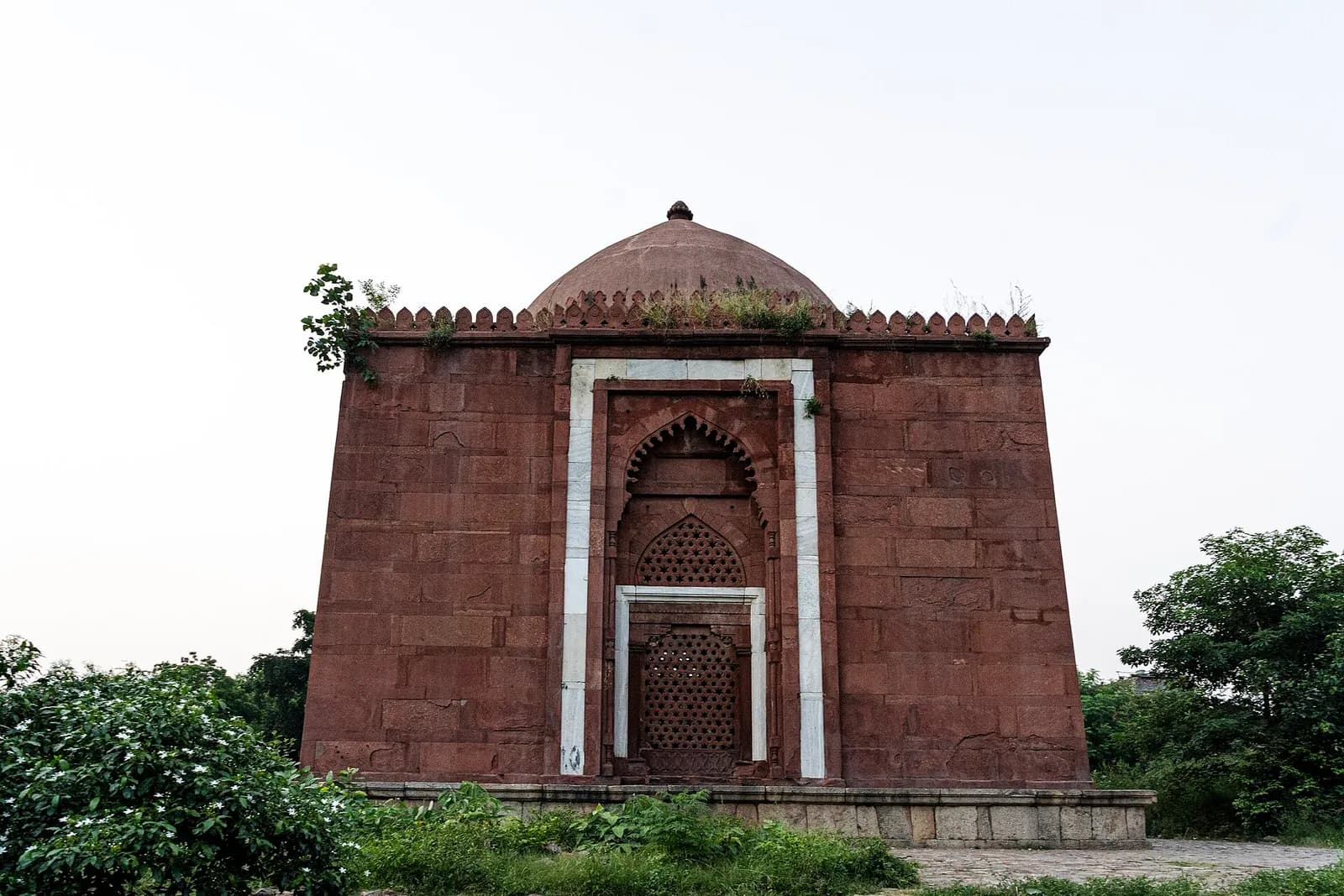
- The red sandstone facing. The name Lal Gumbad, the Red Dome, comes from the vibrant red sandstone that faces the whole exterior over a core of rough grey quartzite rubble, contrasting sharply with the white marble that details the entrance arches.
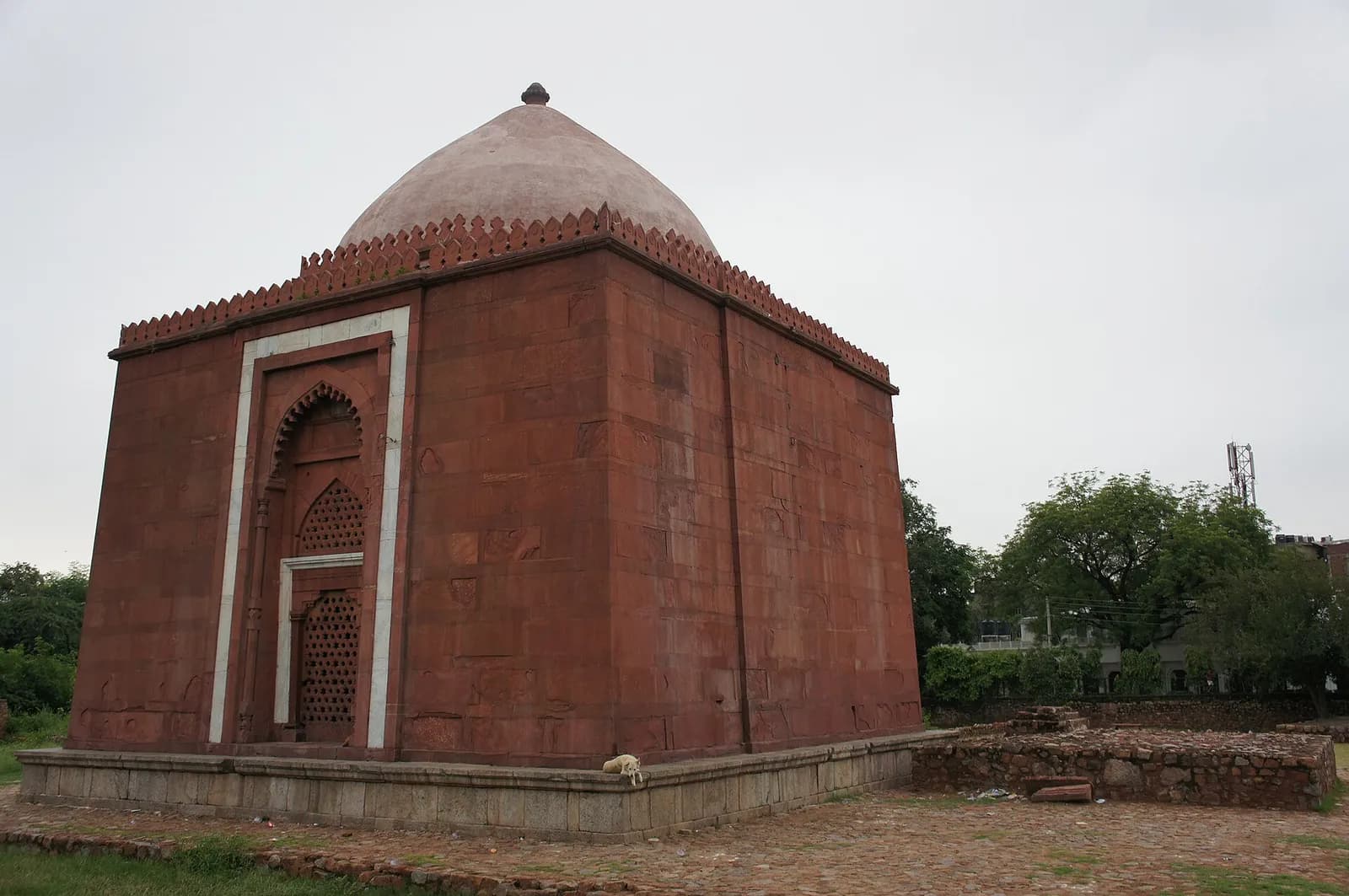
- The battered walls. Following the signature military engineering of the Tughlaq dynasty, the thick walls slope sharply inward as they rise, shifting the weight toward a wide base for stability and a fortress-like appearance.
- The dome and squinches. The square base rises into an octagonal frame by means of interior corner squinches, which support the high plastered dome and the roofline is finished with stone crenellations like battlements.
- The marble portal. The main entrance on the east is a tall arched pishtaq outlined in white marble, carved with lotus-bud fringe patterns along the inner curve, while the interior walls carry austere lime plaster with incised circular medallions of simple geometric motifs.
- The iron rings. Rows of large, heavy iron rings are set deep into the sandstone of the exterior walls, used by the builders to anchor scaffolding during construction and later to hang cloth canopies for shade during religious gatherings.
This combination makes Lal Gumbad an unusually complete small example of Tughlaq architecture, which is admired precisely for echoing the mighty Tomb of Ghiyasuddin Tughlaq at nearby Tughlaqabad while refining it into an intimate spiritual sanctuary. The sloping battered walls, the red sandstone, the crenellated roofline and the sturdy, defensive solidity are all hallmarks of the style, which valued strength and austerity over ornament. For the visitor, the pleasure lies in reading these features, the way the walls lean in, the marble-edged doorway, the empty finial anchor on the dome and the curious iron rings, which together tell the story of how and why the monument was built the way it was.
Conservation and the neighbourhood park
Part of what makes Lal Gumbad so appealing today is its modern setting, as a protected monument reborn as a neighbourhood green space and this is worth knowing before a visit. Like many of Delhi's smaller monuments, it passed through a period of neglect before being rescued:
- Encroachment and clearance. Through the mid-20th century the tomb was heavily hemmed in by local housing extensions that blocked the public view, until the ASI launched a conservation drive to clear the unauthorised boundaries.
- Stabilisation. The weathered red sandstone facade panels were stabilised and the monument secured behind a protective green fence within a cleared open space.
- A green lung. The grounds were transformed into a well-maintained public park, a vital green space for the dense Panchsheel Enclave neighbourhood.
This gives Lal Gumbad a pleasant contemporary character as a living part of its community, where local walkers, birdwatchers and heritage enthusiasts share a quiet park with a 14th-century monument. The transformation from an encroached, hidden ruin into a protected and well-kept neighbourhood park is a small success story of urban heritage conservation. For the visitor, it means Lal Gumbad is easy and pleasant to visit, set in greenery rather than surrounded by clutter and it offers the rare experience of seeing medieval architecture woven naturally into the everyday life of a modern Delhi residential colony.
What to expect at Lal Gumbad
A visit to Lal Gumbad is quiet, pleasant and quick, a gentle contrast to the busy major monuments and knowing what to expect helps you enjoy it. The tomb stands in a well-kept public park in the residential area of Panchsheel Enclave, so the setting is calm and green, frequented mostly by local walkers rather than tourists. Arriving, you see the striking red sandstone monument with its sloping battered walls and crenellated dome rising from the lawns. Walking around the exterior to appreciate the Tughlaq architecture, looking up to find the empty iron anchor where the golden stirrup once sat, examining the marble-edged entrance and the rows of iron rings and stepping inside to see the austere plastered interior and the saint's grave is the essence of the visit, which takes only about 20 to 30 minutes.
A few practical points help. As a working neighbourhood park and a shrine, it deserves quiet and respectful conduct. The monument is a compact single structure, so it is a short visit, best combined with other South Delhi sights to make a fuller outing. It is easy to reach and pleasant underfoot, set in the park, though the interior can be dim, so visiting in daylight is best. Because it sits in residential lanes and is lightly signposted, a little navigation is needed to find the park gates. For the visitor, the key is to come to Lal Gumbad as a charming short discovery rather than a major destination, taking a little time to appreciate its architecture and its legend and ideally folding it into a wider exploration of the monuments of South Delhi.
Visiting tips
A few pointers make a visit to Lal Gumbad smoother and more rewarding:
- Look for the empty finial anchor at the apex of the dome, the trace of the stolen golden stirrup.
- Compare it with Tughlaqabad. The tomb mirrors the great Ghiyasuddin Tughlaq tomb, so the two make an interesting pairing.
- Combine it with other South Delhi sights, as Lal Gumbad alone is a short visit.
- Come in soft morning or late-afternoon light for the best of the red sandstone.
- Visit in daylight, as the interior can be dim.
- Respect the shrine and the park, which are a quiet space for the local community.
- Allow about 20 to 30 minutes for the monument itself.
- Ask locally for the park gates, as the tomb sits in residential lanes.
The key point is to treat Lal Gumbad as a delightful short stop on a wider South Delhi heritage outing, coming for its Tughlaq architecture and its stirrup legend and enjoying the quiet green setting.
Best time to visit Lal Gumbad
The best time to visit is during the cooler months, from October to March, when walking in the park and around the monument is comfortable and within the day during the early morning or late afternoon, when the light is soft and the red sandstone glows warmly. A winter morning is ideal, cool and bright for appreciating the architecture and the park. The summer months are hot for standing in the open grounds at midday and the monsoon leaves the park green but humid, so the winter window is clearly the most pleasant. Because the visit is short, it is easily combined with other South Delhi monuments on a cool-season day out. Our guide to the best time to visit Delhi sets out the seasons across the city in more detail.
How to reach Lal Gumbad (nearest metro)
Lal Gumbad sits in the Panchsheel Enclave area near the commercial hub of Malviya Nagar in South Delhi, tucked within a public park among residential colonies and is easy to reach. The nearest metro stations are Malviya Nagar and Panchsheel Park, both on the Magenta Line, from either of which a short five-minute auto-rickshaw or e-rickshaw ride into the residential lanes brings you to the monument park gates. Because the tomb sits in quiet residential streets and is lightly signposted, a short rickshaw ride from the metro is the easiest approach and asking locally for the park helps. The monument is well placed among the attractions of South Delhi, within reach of the Hauz Khas area and the Mehrauli monuments. Set in the heart of residential South Delhi, it fits naturally into a Delhi day tour or a heritage-focused New Delhi tour built around the lesser-known monuments of the south of the city.
Places to visit near Lal Gumbad
Lal Gumbad lies in South Delhi, within easy reach of some of the city's finest historic sites, so it makes a good addition to a wider heritage outing. Close by are the historic Hauz Khas Fort and its lake, with the tombs and madrasa overlooking the water and a little further the great monuments of Mehrauli, including the world-famous Qutub Minar and the sprawling Mehrauli Archaeological Park with its Jamali Kamali mosque, Balban's Tomb and many other ruins. The medieval stepwell of Agrasen ki Baoli is another fine nearby stop and the great fort of Tughlaqabad, whose imperial tomb Lal Gumbad so closely echoes, lies to the south-east.
Further out, the capital's other great landmarks round out a full picture of the city: the towering Qutub Minar, the serene Humayun's Tomb, the mighty Red Fort, the ceremonial India Gate and the modern marvels of the Lotus Temple and Akshardham. For more of Delhi's history, the old citadel of Purana Qila, the astronomical Jantar Mantar and the ruins of Feroz Shah Kotla are well worth adding and our roundup of the important monuments of Delhi ties them together.
Lal Gumbad in your Delhi itinerary
For most visitors, Lal Gumbad works best as a short, charming stop woven into a wider South Delhi heritage outing rather than a destination on its own, since it is a compact single monument that takes only a short time to see. A natural plan is to combine it with the nearby Hauz Khas Fort and the great monuments of Mehrauli or with the fort of Tughlaqabad whose imperial tomb it mirrors, for a day that moves through the sturdy world of Tughlaq Delhi. The tomb itself needs only 20 to 30 minutes, but its fine architecture, its Sufi significance and its wonderful stirrup legend give it a charm out of proportion to its size and it adds a note of local discovery to a day of sightseeing. It suits the history enthusiast, the architecture lover and the traveller who enjoys finding the hidden monuments tucked into Delhi's residential neighbourhoods.
If Delhi is your gateway to the wider Golden Triangle, Lal Gumbad offers a delightful glimpse of the real, lived heritage of the city, a 14th-century saint's tomb set in a neighbourhood park, admired by local walkers, carrying a centuries-old story of stolen gold. Many of my guests enjoy it precisely because it is so unexpected and so local, a monument most visitors never see and it deepens their sense of how deeply history is woven into everyday Delhi before they travel on to Agra and Jaipur.
Travel tips for visiting Lal Gumbad
A few pointers make a visit even better:
- Reach it via Malviya Nagar or Panchsheel Park metro, then a short rickshaw ride into the colony.
- Combine it with Hauz Khas, Mehrauli or Tughlaqabad for a fuller South Delhi day.
- Find the empty iron anchor on the dome, where the golden stirrup once sat.
- Admire the Tughlaq features, the battered walls, red sandstone, marble portal and iron rings.
- Come in soft light and in the cooler months for the best of the monument.
- Respect the shrine and the park, a quiet local green space.
- Ask locally for the park gates, as the tomb sits in residential lanes.
- Allow 20 to 30 minutes for the monument itself.
If you would like a local guide to show you Lal Gumbad and the hidden monuments of South Delhi and tell the stories behind them, message our team on WhatsApp at +91 7302265809 with your travel dates and group size and we will shape the day for you.
Is Lal Gumbad worth visiting?
Yes, for the history-minded and the curious traveller Lal Gumbad is a delightful and rewarding stop, one of the most charming hidden monuments in South Delhi. There is a real pleasure in finding a complete, elegant 14th-century Tughlaq tomb, faced in glowing red sandstone, set in a quiet neighbourhood park, carrying both the spiritual weight of a revered Sufi saint's shrine and the irresistible legend of thieves who scaled its dome to steal a golden stirrup. It is free to visit, quick to see, easy to reach and a fine miniature echo of the great imperial tomb at Tughlaqabad. The only caveats are that it is a compact single monument best combined with other sights and that it sits in residential lanes that take a moment to navigate. For the traveller who wants the hidden, lived, local heritage of Delhi beyond the famous sights, Lal Gumbad is a small treasure and I recommend it warmly to guests exploring the quieter corners of the city.
Plan your trip with us
At Experience My India, through our Delhi and Golden Triangle travel desk, we design unhurried, well paced trips that make room for charming hidden monuments like Lal Gumbad and not just the famous sights, with guides who can tell the history, the architecture and the legends that make such places come alive and lead you to the ones tucked away in residential neighbourhoods. Whether you want a relaxed set of Delhi Agra tours or a full Golden Triangle route through Delhi, Agra and Jaipur, we plan around your pace, your interests and the right season. Share your dates and the kind of trip you have in mind through our enquiry page, tell us your group size and we will put together an honest, tailored plan rather than a rushed checklist.
Related guides
- Places to visit in Delhi, for the wider picture
- Nearby places to visit in Delhi, to extend your trip
Enquire Now
Ready to Explore
The Heart of Delhi?
Explore the Red Fort, Qutub Minar, Humayun's Tomb, and the vibrant streets of Old Delhi with our expert-guided premium tours of India's capital city.

Delhi
Premium Tour Package
Questions
Frequently asked questions
What is Lal Gumbad?
Lal Gumbad, the Red Dome, is a late-14th-century Tughlaq-era tomb in Malviya Nagar in South Delhi, built around 1380 for the Sufi saint Shaikh Kabiruddin Auliya. It is also called Rakabwala Gumbad.
Why is it called Rakabwala Gumbad?
Who was Shaikh Kabiruddin Auliya?
What are the timings and entry fee?
Which is the nearest metro station?
Why does Lal Gumbad look like Tughlaqabad's tomb?
What are the iron rings on the walls for?
Is Lal Gumbad easy to find and is it safe to visit?
Can you go inside Lal Gumbad?
How much time do I need?
Explore more
Plan your Lal Gumbad trip with us

Interested in Lal Gumbad, Malviya Nagar: History, Legend and Guide?
Chat with our travel team for a custom quote, or browse every package.
Related Attractions
9Ready to explore Lal Gumbad, Malviya Nagar: History, Legend and Guide?
Book your private tour today and experience the magic of India's rich heritage.