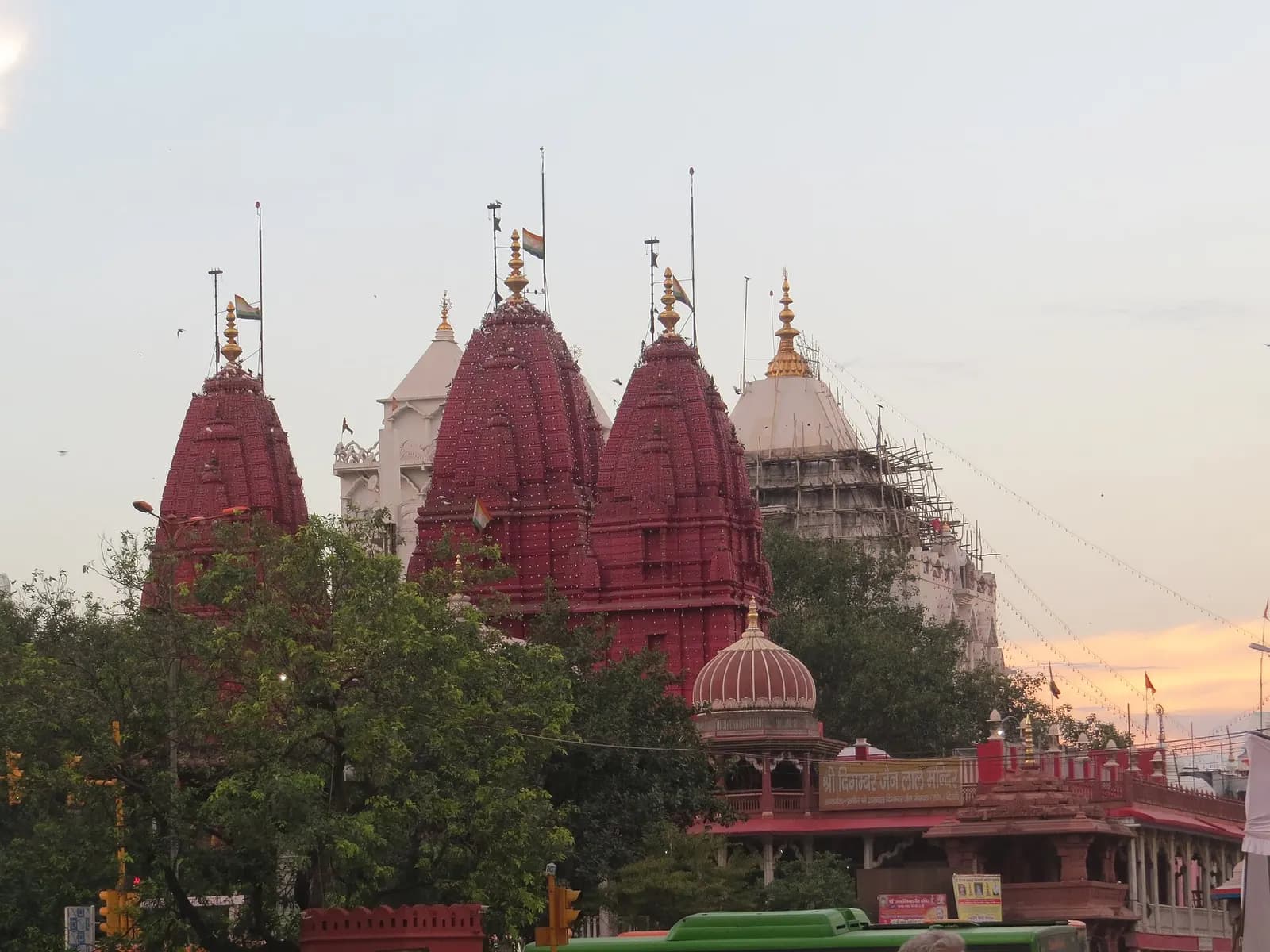
Lal Mandir Delhi (Digambar Jain Temple): Timings and Guide
Visiting Lal Mandir, the Digambar Jain temple opposite the Red Fort in Delhi? Timings, free entry, the Jain birds hospital, the leather rule and nearest metro.
In a Nutshell
“Lal Mandir, the Shri Digambar Jain Lal Mandir, is the oldest and best-known Jain temple in Delhi, standing in striking red sandstone directly opposite the Red Fort at the start of Chandni Chowk. Built in 1656 and rebuilt in 1878, it enshrines the Jain Tirthankaras and is famous for the charitable Jain birds hospital behind it, which treats injured birds free of charge. Entry is free, it is open morning and evening and leather items are not allowed inside. It is a short walk from the Chandni Chowk or Jama Masjid metro. It features on our Delhi tours, run by a unit of Experience My India.”
Lal Mandir is one of Old Delhi's most distinctive landmarks, a vivid red temple whose spires rise opposite the Red Fort, revered as the city's oldest Jain shrine and beloved for the remarkable bird hospital that embodies the Jain ideal of non-violence. Visiting it and the nearby Gauri Shankar temple, is a lovely part of an Old Delhi walk. Our team at Delhi Agra Tour Packages often includes it on a Chandni Chowk circuit and it fits naturally into a Golden Triangle tour through the capital.
I am Abhay Sharma, Delhi born and a Golden Triangle guide since 2015 and I always point out the bird hospital to my guests, because it captures something gentle and distinctive about Jain Delhi. This guide gathers everything I would tell a visitor beforehand, checked against current information, including the timings, the leather rule, the bird hospital and how to reach it.
Details
Lal Mandir at a glance
| Detail | Information |
|---|---|
| Location | Opposite the Red Fort, start of Chandni Chowk, Old Delhi |
| Full name | Shri Digambar Jain Lal Mandir |
| Built | 1656, rebuilt and expanded in 1878 |
| Known for | Delhi's oldest Jain temple, red sandstone, the bird hospital |
| Main deity | Lord Parshvanatha, the 23rd Jain Tirthankara |
| Entry | Free; leather items not allowed |
| Nearest metro | Chandni Chowk (Yellow Line) or Jama Masjid (Violet Line) |
| Time needed | About 45 minutes to 1 hour, more with the bird hospital |
Lal Mandir timings
| Season | Timings |
|---|---|
| Summer (March to October) | 5:30 AM to 11:30 AM and 6:00 PM to 9:30 PM |
| Winter (November to February) | 6:00 AM to 12:00 PM and 5:30 PM to 9:00 PM |
| Entry fee | Free |
Lal Mandir is open daily in two sessions that shift with the season, roughly early morning to late morning and again in the evening, as shown above. Timings can change, so reconfirm and plan your visit for the morning or evening darshan rather than the midday closure.
Entry and rules
| Item | Information |
|---|---|
| Entry fee | Free for everyone |
| Footwear | Removed before entry, as in any temple |
| Leather | All leather items prohibited inside, a Jain principle |
| Photography | Not allowed inside the inner sanctum |
How to reach Lal Mandir
| From | Route |
|---|---|
| Chandni Chowk metro (Yellow Line) | A short walk along Chandni Chowk |
| Jama Masjid metro (Violet Line) | Also within easy walking distance |
| The Red Fort | Directly opposite, a couple of minutes away |
| Old Delhi railway station | About 1.5 km away |
What is Lal Mandir (the Digambar Jain Temple)?
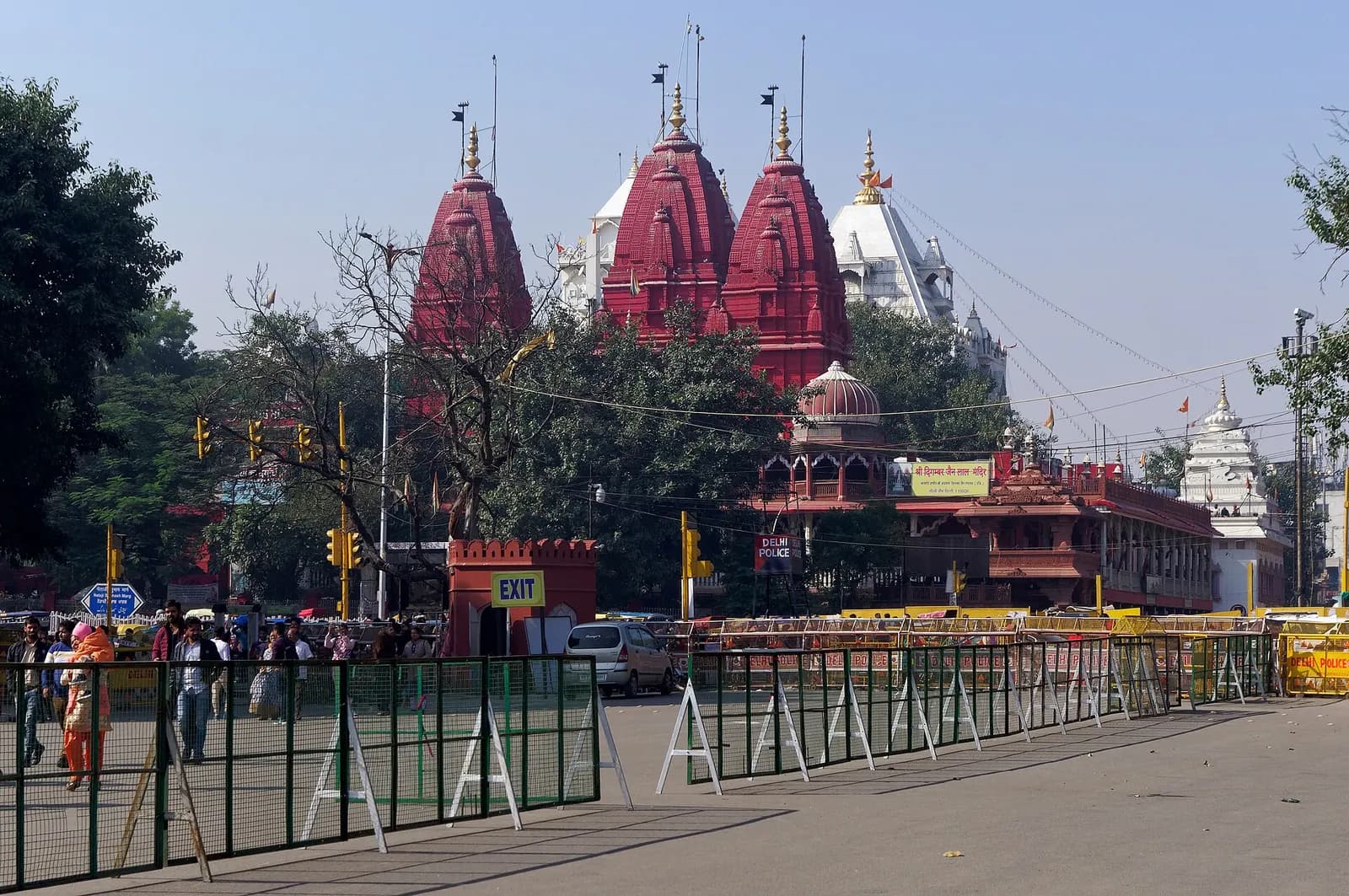
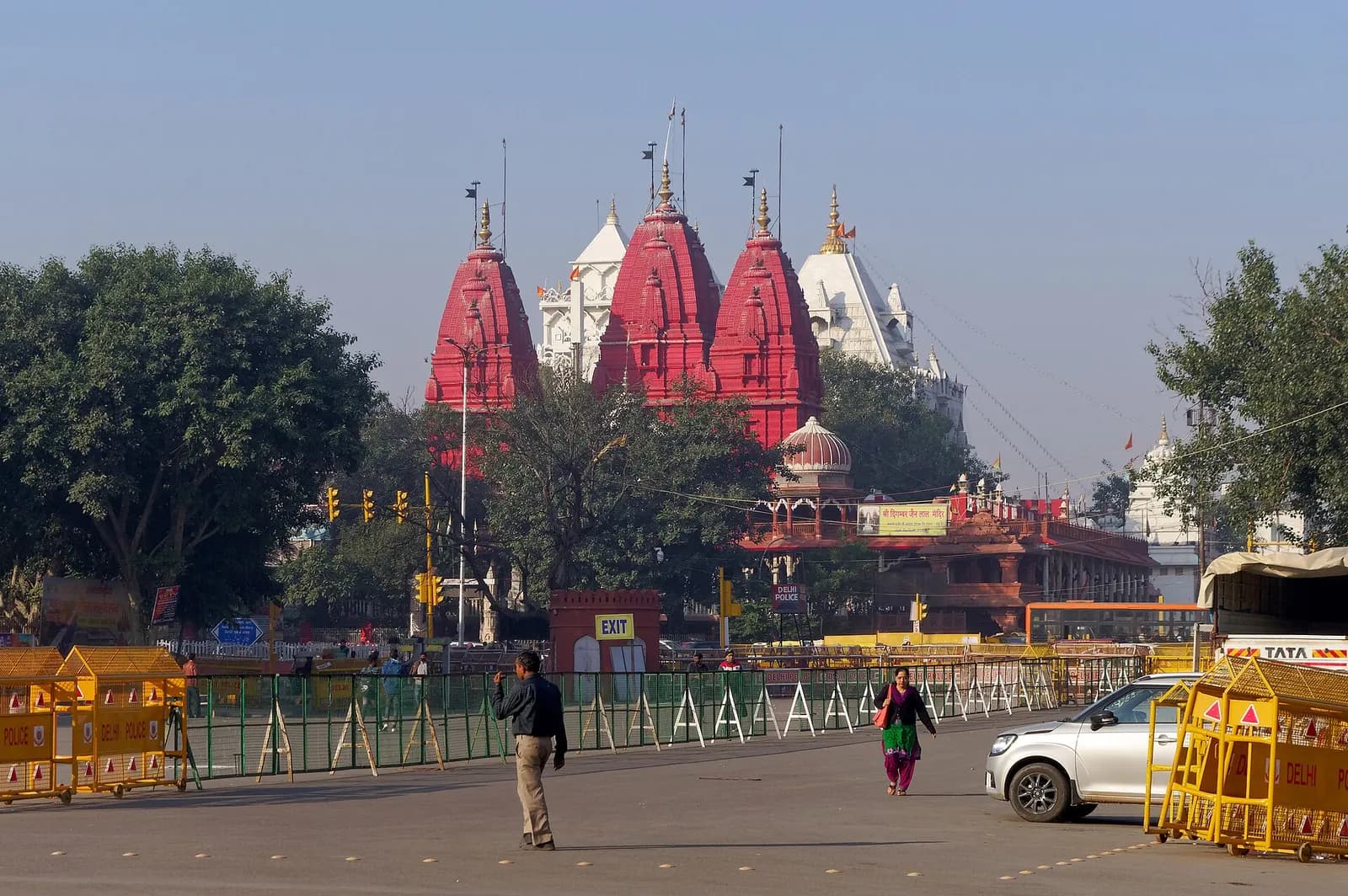
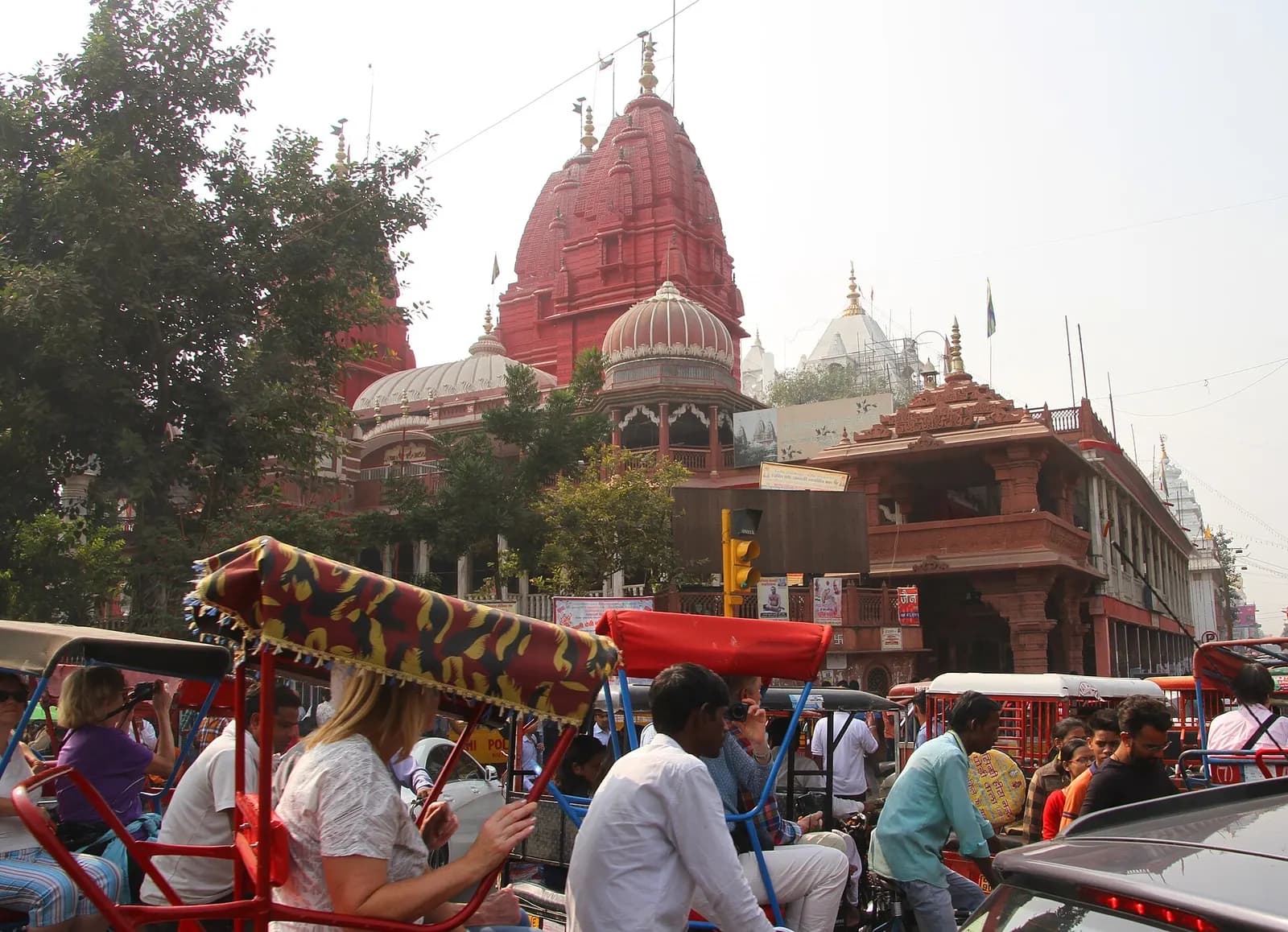
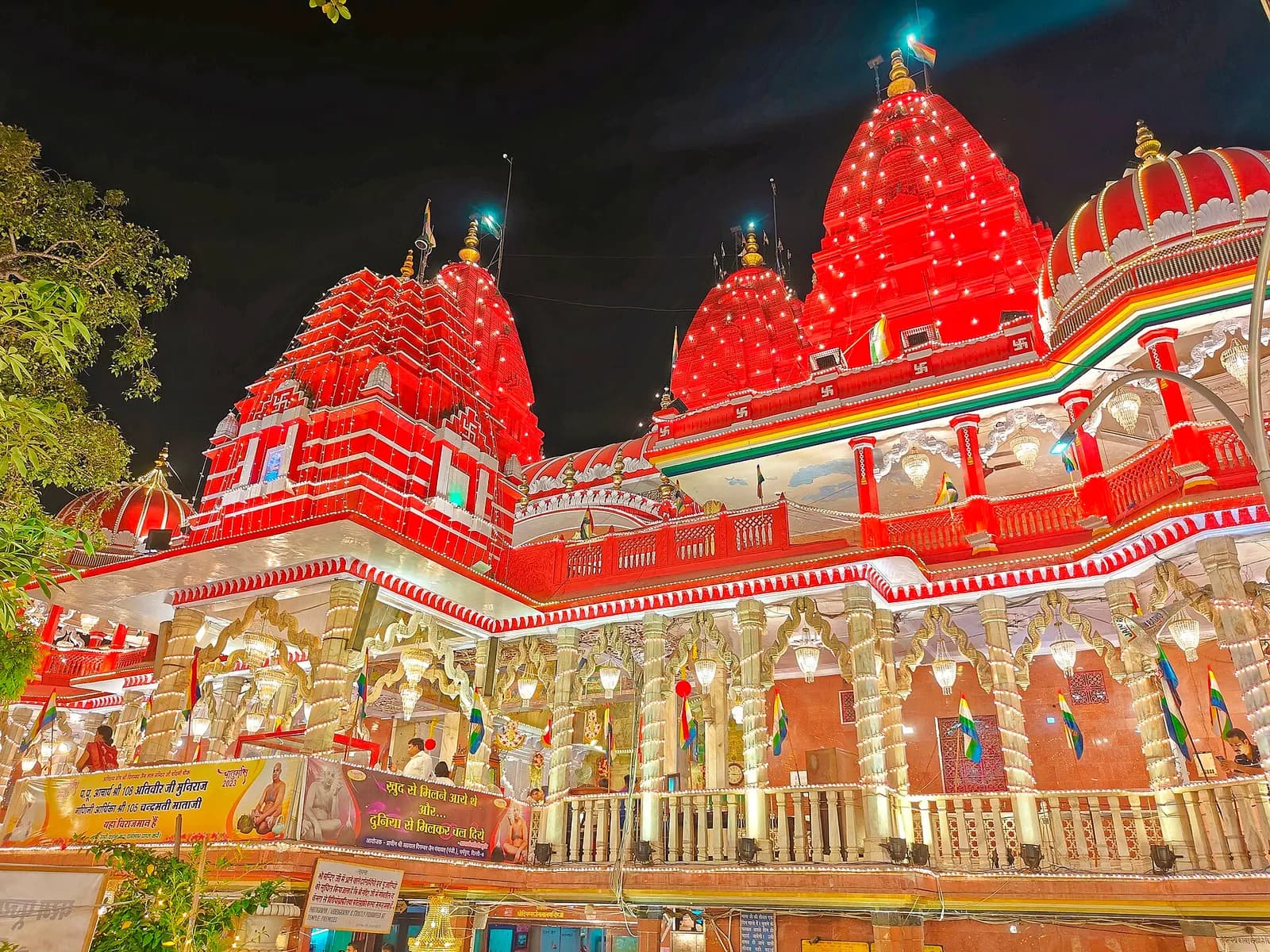
Lal Mandir, formally the Shri Digambar Jain Lal Mandir, is the oldest and most famous Jain temple in Delhi, standing in vivid red sandstone at the eastern end of Chandni Chowk, directly opposite the Red Fort, in the heart of the old walled city. Its popular name, Lal Mandir, simply means red temple, after its striking red stone facade and its spires are a landmark of Old Delhi. A living, active place of worship for the Jain community, it enshrines the Jain Tirthankaras and is revered both for its age and for the charitable Jain birds hospital behind it, a unique institution embodying the Jain principle of non-violence to all living creatures. Compact but rich in devotion and history, it makes a memorable stop on any walk through Old Delhi.
Several things make it special and they are worth drawing out:
- Delhi's oldest Jain temple. Built in 1656, it is the oldest and best-known Jain shrine in the city.
- The striking red temple. Its vibrant red sandstone facade and carved spires give it its name and make it an Old Delhi landmark.
- A setting opposite the Red Fort. It stands right across from the great Mughal fort, at the start of Chandni Chowk.
- The Jain birds hospital. A remarkable charitable avian hospital behind the temple, treating injured birds free in the spirit of non-violence.
- Sacred Jain icons. The sanctum enshrines revered Tirthankaras, including an icon dating back to 1491.
It is one of the most distinctive of the things to do in Delhi and a notable stop among the important monuments of Delhi.
History of Lal Mandir
The temple's history reaches back to the founding of Old Delhi itself. It was originally established in 1656, during the reign of the Mughal emperor Shah Jahan, the builder of Shahjahanabad, as the old city was then called. According to its history, the temple's deities were at first housed in a makeshift tent belonging to an Agrawal Jain officer serving in the imperial Mughal army, a reminder of the Jain community's long presence in the city and its service even within the Mughal establishment. Over time the shrine grew into a permanent temple on this prominent site opposite the fort.
The striking red temple seen today owes its present form largely to a major expansion and rebuilding in 1878, following the decline and fall of the Mughal Empire, when the structure was enlarged and given the vivid red sandstone character that earned it the name Lal Mandir. Through the centuries it has remained the principal and oldest Jain temple of Delhi, a continuous centre of worship for the community. Knowing this history, that the temple began in a soldier's tent in Shah Jahan's capital and grew into the grand red landmark of today, adds depth to a visit and places it firmly within the long, layered story of Old Delhi, right across from the Mughal fort that defined the city.
Lal Mandir architecture and deities
Architecturally, Lal Mandir is built in the classical Nagara style, the north Indian temple form, with carved shikharas, the temple spires, detailed with delicate geometric ornament, all in the warm red sandstone that gives the temple its name and its glowing presence against the Old Delhi sky. The main devotional hall is on the first floor, reached from the entrance below and it is here that the temple's sacred icons are enshrined.
The sanctum and its deities reward a reverent look:
- Lord Parshvanatha. The primary idol is of Parshvanatha, the 23rd Jain Tirthankara, the temple's central object of devotion.
- Lord Mahavira. An icon of Mahavira, the 24th and last Tirthankara, is also enshrined here.
- Lord Adinath. An icon of Adinath, the first Tirthankara, completes the principal deities.
- An ancient icon. One of the gilded marble icons in the temple dates all the way back to 1491, a remarkable survival of great age.
The interior is richly decorated in the Jain manner, with gilding, fine carving and painted and inlaid ornament, creating an atmosphere of serene devotion above the bustle of Chandni Chowk below. As a Digambar Jain temple, it follows the traditions of that major Jain sect and the sanctum is a place of quiet worship. Because photography is not allowed inside the inner sanctum, this is a part of the visit to experience with your eyes, taking in the craftsmanship and the calm. The contrast between the noisy street outside and the hushed ornate hall above is one of the pleasures of the visit.
The Jain Birds Hospital at Lal Mandir
One of the most remarkable and beloved features of Lal Mandir is the Jain birds hospital, housed in a secondary building directly behind the main temple, which is well worth seeing and is a highlight for many visitors. Established in 1956, this unique charity operates on the foundational Jain principle of Ahimsa, non-violence and compassion to all living creatures and it functions as a genuine, fully working avian veterinary hospital dedicated to birds. It has dedicated wards, an intensive care unit and an outpatient department and it treats thousands of injured and sick city birds every year, completely free of charge, before releasing those that recover. For visitors, it is an extraordinary and touching place, a hospital devoted entirely to birds, run on a principle of reverence for all life and it is unlike anything most people have seen. It makes the temple more than a place of worship: a living expression of the Jain ethic of compassion. Seeing the recovering birds and understanding the quiet, centuries-old philosophy behind the hospital often moves visitors as much as the temple itself and it is a part of the visit I always encourage my guests not to miss. The hospital has traditionally focused on vegetarian and non-predatory birds, in keeping with its principles and it is largely sustained by the donations and devotion of the Jain community, which considers the care of helpless creatures a sacred duty. Visitors are usually welcome to look around the public areas and see the recovering birds in their wards and a small donation towards their care is always appreciated, though never demanded. It is worth climbing the few floors to take it in, as the sight of pigeons, parakeets and other city birds being nursed back to health, purely out of compassion and at no charge to anyone, is a gentle and memorable lesson in the values the temple stands for. Few experiences in Delhi are quite so quietly affecting and it gives the whole visit a meaning well beyond the architecture.
Shri Gauri Shankar Temple next door
Right beside Lal Mandir stands another revered shrine, the Shri Gauri Shankar Temple, a centuries-old Hindu temple dedicated to Lord Shiva and Goddess Parvati, so the two temples are easily visited together and make a striking pairing of faiths on the same Chandni Chowk stretch. Founded in the eighteenth century, the Gauri Shankar temple is famous for its ancient natural stone Shiva lingam, said to be many centuries old, encased in marble and encircled by silverwork and for its richly decorated sanctum with silver-leaf paintings and gold-adorned icons of Shiva and Parvati. It is one of the important centres of Shiva worship in the city and it is especially busy on Mondays and during the holy month of Shravan. Visiting both temples, the Jain Lal Mandir and the Shiva Gauri Shankar, side by side is a lovely way to sense the religious variety of Old Delhi within a few steps and it is striking how two such different traditions sit peacefully shoulder to shoulder on the same historic street, each with its own devotees, rituals and atmosphere, just across from the great Mughal fort. Seeing them together, along with the gurudwara and mosque further along Chandni Chowk, gives a vivid sense of the layered, plural faith of the old city. For a fuller account of the Gauri Shankar temple, its legend, its lingam and its rituals, see our dedicated guide to the Shri Gauri Shankar Mandir, which covers it in detail.
What to expect at Lal Mandir
A visit to Lal Mandir is a brief but atmospheric step out of the Old Delhi bustle and knowing what to expect helps you enjoy it respectfully. You arrive at the eastern end of Chandni Chowk, directly across from the Red Fort, where the red spires rise above the crowded street. Before entering you remove your shoes and leave behind any leather items, then climb to the main hall on the first floor, where the noise of the market gives way to a hushed, richly decorated sanctum glowing with gilding and lamplight. Devotees come and go quietly for darshan and the mood is serene and reverent. The temple is compact, so the visit itself is short, perhaps twenty minutes to half an hour, but it is the kind of place that leaves a strong impression through its atmosphere rather than its size.
Most visitors then step around to the bird hospital behind the temple, which is often the part that stays with them longest and next door to the Gauri Shankar temple, so the three together make a rewarding half hour or more. Because it is an active place of worship rather than a ticketed monument, there are no guides or set routes; you simply enter, pay your respects or observe quietly and move on. Many travellers come mainly for the Red Fort opposite and are glad they crossed the road to see this striking red temple and its remarkable hospital. Come in a quiet, respectful frame of mind, observe the footwear and leather rules and the visit slots gently and memorably into an Old Delhi morning.
Jainism and the spirit of Ahimsa at Lal Mandir
Part of what makes Lal Mandir special is that it is a window onto Jainism, one of India's ancient religions and its defining principle of Ahimsa or non-violence towards all living beings. Jains revere a lineage of twenty-four Tirthankaras, spiritual teachers who showed the path to liberation and the temple here enshrines several of them, with Parshvanatha, the 23rd, as its principal deity. The Digambar tradition to which the temple belongs is one of the two major Jain sects and its temples are known for their serenity, their fine craftsmanship and their atmosphere of disciplined devotion. The commitment to non-violence runs so deep in Jain practice that it extends to the smallest creatures, which is exactly the ethic embodied by the bird hospital behind the temple.
For a visitor, understanding this background turns the visit from a quick look at a pretty red temple into an encounter with a distinctive and gentle worldview. The care for injured birds, the vegetarian ethic, the prohibition on leather, all flow from the same reverence for life and seeing them in practice at one of the community's oldest temples is quietly thought-provoking. You do not need to be a follower to appreciate it; the temple welcomes respectful visitors of all backgrounds and taking a moment to grasp the philosophy behind what you are seeing deepens the experience considerably. It is this combination of beauty, age and living ethical tradition that gives Lal Mandir its particular character among Delhi's many temples.
Lal Mandir timings and entry
Lal Mandir is open daily in two sessions, which shift with the season. In summer, roughly March to October, it is generally open from about 5:30 AM to 11:30 AM and again from 6:00 PM to 9:30 PM, while in winter, roughly November to February, it is open from about 6:00 AM to 12:00 PM and from 5:30 PM to 9:00 PM. It closes in the middle of the day, so plan your visit for the morning or the evening darshan. Entry is completely free for everyone, as at Jain temples generally. The main things to prepare for are the footwear and leather rules, explained below, which are important at this temple. These timings are current at the time of writing and can change with the season and on festival days, so reconfirm before a special trip and allow around forty five minutes to an hour for the temple, more if you also visit the bird hospital.
Rules: footwear, leather and photography
A few rules, rooted in Jain religious principles, are important to observe at Lal Mandir and knowing them in advance avoids any awkwardness:
- Remove your shoes. Footwear must be taken off before entering the temple, as at any Indian temple.
- No leather items. All leather items, including leather wallets, belts, jackets, bags and shoes, are strictly prohibited inside the temple premises, in keeping with Jain principles of non-violence.
- No photography in the sanctum. Photography is not allowed inside the inner sanctum, to preserve its sanctity.
- Dress and behave respectfully. Modest dress and quiet, respectful conduct are expected in this active place of worship.
- Mind the bird hospital rules. Follow the guidance in the birds hospital, which is a working veterinary facility.
The leather rule is the one that most often catches visitors out, so it is wise to leave leather belts, wallets and bags behind or be ready to deposit them and to wear non-leather footwear that is easy to remove. Observing these simple courtesies is part of a respectful visit to one of the community's most sacred temples.
Best time to visit Lal Mandir
The best time to visit is during the morning or evening darshan sessions, avoiding the midday closure, with the early morning especially peaceful and atmospheric as the temple opens and the aarti is performed. In terms of season, the cooler months from October to March are the most comfortable for exploring Old Delhi on foot, since the summer heat and monsoon humidity in the crowded lanes can be tiring; the temple's own timings shift slightly between summer and winter, as noted above. Because Lal Mandir sits right at the start of Chandni Chowk opposite the Red Fort, it combines perfectly with a morning tour of Old Delhi, so a cool-season morning, taking in the temple, the bird hospital and the nearby sights, is ideal. Evenings, when the temple reopens and is lit, are also lovely. Our guide to the best time to visit Delhi sets out the seasons across the city in more detail.
How to reach Lal Mandir (nearest metro)
Lal Mandir stands at the eastern end of Chandni Chowk, directly opposite the Red Fort, in Old Delhi and it is very easy to reach. The nearest metro stations are Chandni Chowk on the Yellow Line and Jama Masjid on the Violet Line, both within easy walking distance along or near the Chandni Chowk street, though the walk through the busy market is part of the experience. From the Red Fort, the temple is just across the road, a couple of minutes away. The Old Delhi railway station is about 1.5 kilometres away. Because the Chandni Chowk area is congested and partly pedestrianised, arriving by metro and walking or taking a cycle-rickshaw through the lanes, is far easier than coming by car. A guided Old Delhi tour takes the logistics off your hands and threads the temple into the wider walled city, while a broader New Delhi tour covers the newer half of the capital.
Places to visit near Lal Mandir
Lal Mandir sits in the richest cluster of sights in Old Delhi, so it is easy to build a full morning around it. Directly opposite is the mighty Red Fort, the great Mughal citadel and the natural partner to a temple visit and the famous market street of Chandni Chowk runs west from here, lined with temples, the revered Shri Gauri Shankar Mandir next door, the great gurudwara and mosque of the old city and legendary food lanes. The whole quarter rewards slow wandering on foot.
A little further out, the central and southern landmarks are an easy ride away: the ceremonial India Gate, the serene Humayun's Tomb, the towering Qutub Minar and the modern Lotus Temple and Akshardham. The central ring, with the great circle of Connaught Place, the ancient Agrasen ki Baoli, the astronomical Jantar Mantar, the much loved Pracheen Hanuman Mandir and the serene Bangla Sahib Gurudwara, is also within reach. Together these make Lal Mandir a fine starting point for exploring the old and new city.
Lal Mandir in your Old Delhi itinerary
For most visitors, Lal Mandir belongs in an Old Delhi morning combined with the Red Fort, Chandni Chowk and the other temples and shrines of the old city, which all sit within a short walk of each other. A classic plan is to see the Red Fort first, then cross to Lal Mandir and the bird hospital, step next door to the Gauri Shankar temple and continue west along Chandni Chowk, taking in the bazaars, the gurudwara, the mosque and the famous food lanes. This rich Old Delhi morning pairs beautifully with a central or New Delhi afternoon of the imperial avenues and later monuments, giving a full and balanced day across the old and new capital. Because the temple is compact and free, it is an easy and rewarding addition that adds a gentle, spiritual note to a day among the grander monuments.
If Delhi is your gateway to the wider Golden Triangle, Lal Mandir and its bird hospital offer a glimpse of the city's Jain heritage and its ethic of compassion, a quiet counterpoint to the Mughal grandeur across the road. Many of my guests are touched by the bird hospital in particular and the temple adds a distinctive, humane note to an Old Delhi walk before the journey on to Agra and Jaipur.
Travel tips for visiting Lal Mandir
A few pointers make the visit smoother and more respectful:
- Visit at darshan times, in the morning or evening, avoiding the midday closure.
- Leave leather behind, as leather wallets, belts, bags and shoes are not allowed inside.
- Wear easy-to-remove, non-leather footwear, since shoes come off at the entrance.
- Do not photograph the inner sanctum, where photography is banned.
- See the bird hospital, behind the temple, a moving and unique part of the visit.
- Step next door to Gauri Shankar, the Shiva temple right beside it.
- Come in the cooler months and combine it with a morning Old Delhi walk.
- Arrive by metro and on foot, from Chandni Chowk or Jama Masjid, as the area is congested.
If you would like a local guide to build Lal Mandir into a wider Old Delhi plan, message our team on WhatsApp at +91 7302265809 with your travel dates and group size and we will shape the day for you.
Is Lal Mandir worth visiting?
Yes, for most visitors to Old Delhi it is a rewarding and distinctive stop. It is the city's oldest Jain temple, a striking red landmark right opposite the Red Fort, free to enter and rich in devotion and history and its famous bird hospital is a genuinely unusual and moving place that few other cities can match. Combined with the neighbouring Gauri Shankar temple and its position at the head of Chandni Chowk, it slots perfectly into an Old Delhi walk and adds a gentle, spiritual dimension to a day among the monuments and bazaars. The honest note is that it is a compact, active place of worship rather than a grand sightseeing monument, so it is best appreciated with respect and in combination with the surrounding sights rather than as a destination in itself; approached that way, especially for the bird hospital, it rarely fails to leave an impression. I include it often on Old Delhi itineraries and guests remember the bird hospital long afterwards.
Plan your trip with us
At Experience My India, through our Delhi and Golden Triangle travel desk, we design unhurried, well paced trips that make room for distinctive, meaningful stops like Lal Mandir and its bird hospital, not just the grand monuments and we help you experience Old Delhi, its temples, history and food, with understanding. Whether you want a relaxed set of Delhi Agra tours or a full Golden Triangle route through Delhi, Agra and Jaipur, we plan around your pace, your interests and the right season, with local guides who know the old city's shrines and etiquette. Share your dates and the kind of trip you have in mind through our enquiry page, tell us your group size and we will put together an honest, tailored plan rather than a rushed checklist.
Related guides
- Places to visit in Delhi, for the wider picture
- Hidden places to visit in Delhi, the city's quieter corners
- Nearby places to visit in Delhi, to extend your trip
Enquire Now
Ready to Explore
The Heart of Delhi?
Explore the Red Fort, Qutub Minar, Humayun's Tomb, and the vibrant streets of Old Delhi with our expert-guided premium tours of India's capital city.

Delhi
Premium Tour Package
Questions
Frequently asked questions
What are the timings of Lal Mandir?
It is open daily in two sessions that shift with the season: roughly 5:30 AM to 11:30 AM and 6:00 PM to 9:30 PM in summer and 6:00 AM to 12:00 PM and 5:30 PM to 9:00 PM in winter. It closes at midday. Reconfirm, as timings can change.
What is the entry fee for Lal Mandir?
Which is the nearest metro station to Lal Mandir?
Why is it called Lal Mandir?
What is the Jain birds hospital at Lal Mandir?
Can I wear leather inside Lal Mandir?
Who built Lal Mandir and when?
Which deities are worshipped at Lal Mandir?
Can I take photos inside Lal Mandir?
Is Lal Mandir worth visiting?
Explore more
Plan your Lal Mandir Delhi (Digambar Jain Temple) trip with us

Interested in Lal Mandir Delhi (Digambar Jain Temple): Timings and Guide?
Chat with our travel team for a custom quote, or browse every package.
Related Attractions
9Ready to explore Lal Mandir Delhi (Digambar Jain Temple): Timings and Guide?
Book your private tour today and experience the magic of India's rich heritage.