Malcha Mahal, Delhi: History, the Awadh Story and Guide
Visiting Malcha Mahal, the Tughlaq hunting lodge in the Delhi Ridge forest and the House of Awadh ruin? Its history, the true story, timings and how to reach.
In a Nutshell
“Malcha Mahal is a 14th-century Tughlaq hunting lodge hidden deep in the Ridge forest of Chanakyapuri in New Delhi, built by Sultan Firoz Shah Tughlaq. It is famous today for a remarkable modern story: from 1985 it was home to a family who claimed to be the royal heirs of Awadh and lived there in extreme isolation, a story a later investigation showed to be a fabricated identity. Reached by a forest trek, the roofless stone ruin is now being opened for controlled heritage walks. It is strictly day-only for safety. Entry is free. It features on our offbeat Delhi heritage tours, run by a unit of Experience My India.”
Malcha Mahal is one of the most hauntingly atmospheric and extraordinary of Delhi's hidden ruins, a genuine medieval hunting lodge lost in a forest in the diplomatic heart of the capital, carrying one of the strangest and most poignant human stories in the whole city. For the traveller drawn to offbeat heritage, forest walks and the layered history and legend of old Delhi, it is an unforgettable daytime destination. Our team at Delhi Agra Tour Packages is glad to include it for guests who seek out the stranger corners of the city and it adds a unique, atmospheric note to a wider Golden Triangle tour through the capital.
I am Abhay Sharma, Delhi born and a Golden Triangle guide since 2015 and Malcha Mahal is one of the most memorable places I take curious guests, because it holds together so much: a real and austere 14th-century Tughlaq monument, a beautiful and wild patch of Ridge forest and the unforgettable modern tale of the family who lived here claiming a lost crown. This guide gathers everything I would tell a visitor beforehand, checked against current information, including its true history, the Awadh story, its architecture and the timings, safety and directions.
Details
Malcha Mahal at a glance
| Detail | Information |
|---|---|
| What it is | A 14th-century Tughlaq royal hunting lodge (shikargah) |
| Built | Around the mid-14th century, by Firoz Shah Tughlaq |
| Location | Ridge forest, Chanakyapuri, New Delhi, near the ISRO station |
| Famous for | Tughlaq ruin; the modern House of Awadh story |
| Nearest metro | Durgabai Deshmukh South Campus (Pink Line) |
| Access | A forest trek of about 1.5 km from the trail head |
| Entry | Free |
| Important | Strictly day-only; no entry after about 5:00 PM |
Malcha Mahal timings
| Detail | Information |
|---|---|
| Open | Every day |
| Hours | Officially about 10:00 AM to 5:00 PM |
| Strict closure | No entry on the forest trail after about 5:00 PM |
Malcha Mahal is officially open every day from around 10:00 AM to 5:00 PM, but visitors are strictly prohibited from the forest trail or the monument after about 5:00 PM, at sunset, because of the dense forest, the lack of any lighting and safety concerns and police patrol the trail in the evening. Daytime is the only safe and permitted time to visit. These timings are current at the time of writing and can vary, so reconfirm before a trip.
Entry fee
| Visitor | Fee |
|---|---|
| All visitors | Free; no ticket required |
How to reach Malcha Mahal
| From | Route |
|---|---|
| Durgabai Deshmukh South Campus metro (Pink Line) | Nearest station, about 4 km away, then a taxi or auto |
| Dhaula Kuan metro (Airport Express Line) | An alternative, then a taxi or auto to the trail head |
| Forest entry near the ISRO station | A trek of about 1.5 km on foot down an unpaved trail |
| By car | Drive to the forest edge, then walk the trail |
What is Malcha Mahal?
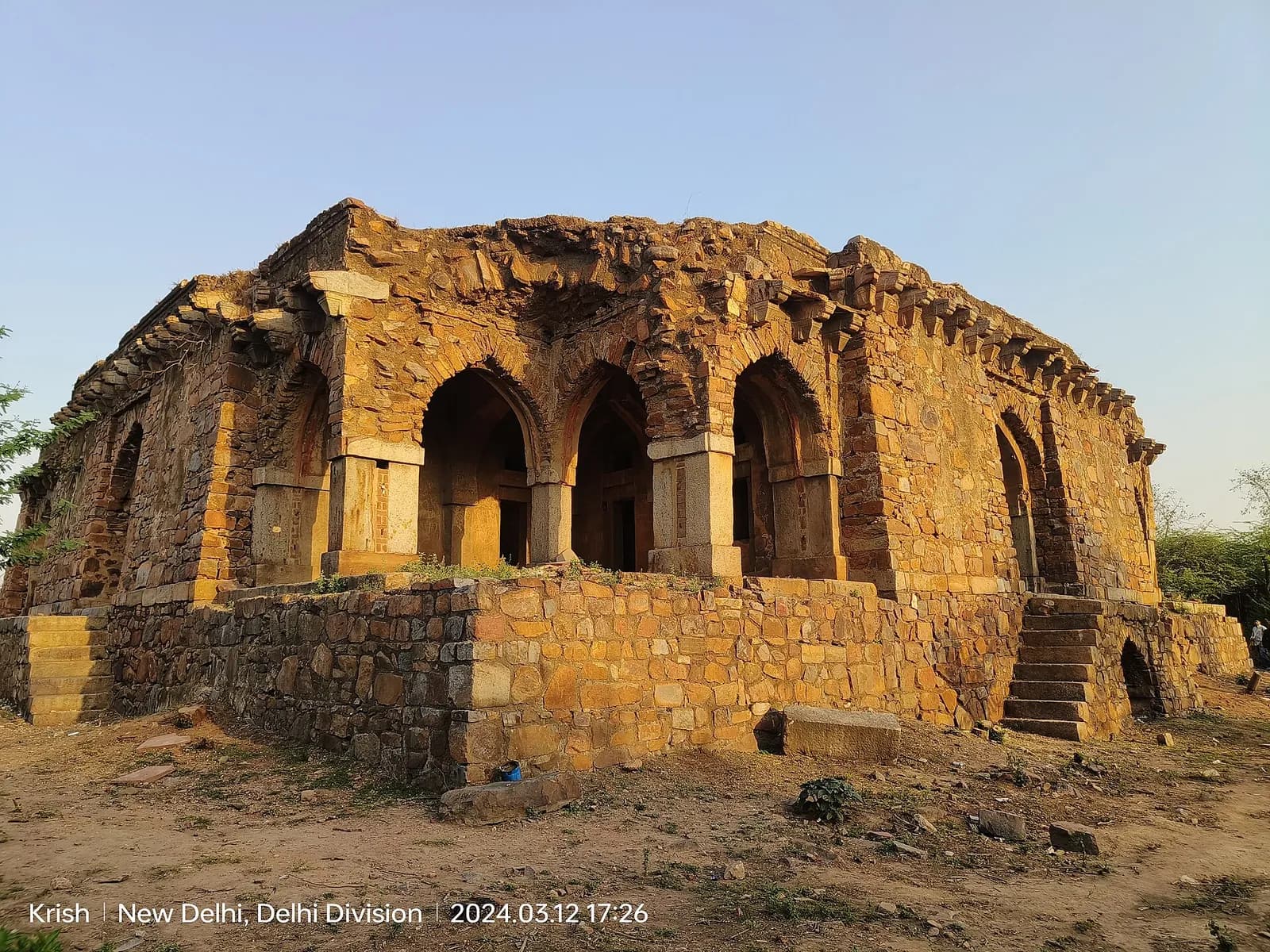
Malcha Mahal is a 14th-century Tughlaq royal hunting lodge, hidden deep inside the Ridge Reserve Forest in the Chanakyapuri diplomatic enclave of New Delhi, near the secured ISRO Earth Station, built by Sultan Firoz Shah Tughlaq. Standing on a rocky outcrop of the Aravalli ridge, it was one of a network of forest hunting lodges, a shikargah, where the Sultan and his court rested during hunting expeditions and it is a stark, austere example of early Tughlaq stone architecture. For centuries it stood beside the agrarian village of Malcha, which gave it its name, until that village was cleared in the early 20th century to build Lutyens' New Delhi, leaving the lodge isolated as the forest grew back around it. Its modern fame, however, comes from an extraordinary and poignant human story: from 1985 it was home to a family who claimed to be the royal heirs of the Nawab of Awadh and lived there in extreme, aggressive isolation, a claim a later international investigation showed to be a fabricated identity. Roofless, reached only by a forest trek and now being gently opened for controlled heritage walks, it is one of the most atmospheric and unforgettable hidden places in all of Delhi.
Several things make it special and they are worth drawing out:
- A real Tughlaq hunting lodge. A genuine 14th-century royal shikargah built by Firoz Shah Tughlaq, not merely a legend.
- Lost in a forest. Hidden deep in the Ridge forest of Chanakyapuri, reached only by a trek through the trees.
- The House of Awadh story. Home from 1985 to a family claiming a lost royal crown, in one of Delhi's strangest and saddest modern tales.
- A fabricated identity revealed. A later investigation showed the family's royal claim to be invented, a remarkable piece of history.
- Opening to heritage walks. Once feared and secret, the ruin is now being cleared and gently opened to visitors.
It is one of the most intriguing of the hidden places to visit in Delhi and an unforgettable entry among the offbeat things to do in Delhi.
History of Malcha Mahal: the Tughlaq origins
Behind its famous modern story, Malcha Mahal has a genuine medieval history, rooted in the Tughlaq dynasty's use of the forests around Delhi and knowing it grounds the whole site. The lodge belongs to the great building era of Sultan Firoz Shah Tughlaq:
- The builder and the date. It was built in the mid-14th century by Sultan Firoz Shah Tughlaq, the prolific builder-emperor of the Delhi Sultanate who raised countless monuments across the region.
- A hunting lodge. Like the neighbouring Bhuli Bhatiyari ka Mahal, it was never meant to be a populated palace but was built as a functional hunting lodge, standing on a rocky outcrop of the Aravalli ridge where the Sultan and his party could rest securely while hunting.
- The lost village of Malcha. The lodge was named after Malcha, an agrarian village that surrounded it for centuries. When the British cleared the local farmlands in the 1910s and 1920s to build Lutyens' New Delhi, the village was dismantled and its people relocated, leaving the stone lodge isolated as the jungle returned.
This history gives Malcha Mahal its true character as a survival from the working royal landscape of 14th-century Delhi, a hunting outpost in the forests that then surrounded the city and as a poignant reminder of the village and farming world that was swept away to build the imperial capital. The clearing of Malcha village in the early 20th century is itself part of the larger story of how New Delhi was built over older landscapes. For the visitor, knowing that this isolated ruin was once a busy royal hunting lodge and later stood beside a living village now vanished, adds real depth to a place otherwise known mainly for its modern legend.
The House of Awadh: the true story
The reason Malcha Mahal is famous today lies not in the 14th century but in the late 20th, in one of the most extraordinary and tragic human stories in modern Delhi and it is worth telling carefully and with compassion. It is a tale of a claimed lost royalty, extreme isolation and a mystery finally unravelled:
- The railway station protest. In the 1970s, a woman calling herself Begum Wilayat Mahal occupied a VIP waiting room at New Delhi Railway Station for years, claiming to be a direct descendant of the last Nawab of Awadh and demanding the return of ancestral palaces or a royal pension, living there with her two adult children and loyal servants.
- The allotment of the ruin. In 1985, to end the long public standoff, the government allotted the 700-year-old Malcha Mahal ruin to the family as a private residence.
- A life of severe isolation. The family moved into the lodge, which had no doors, windows, electricity or running water and cut themselves off entirely from the world, famously warning off outsiders and keeping large dogs to deter rangers and journalists.
- A tragic end. The story ended in deep misfortune. Begum Wilayat Mahal died in 1993. Her daughter, who went by Princess Sakina, died around 2014 and the last of the family, who went by Prince Ali Raza, was found dead at the ruin in 2017, ending the occupation.
- The identity revealed. In 2019, a major investigation traced the family's relatives and found that their claim to royal Awadh lineage was fabricated. The woman known as Begum Wilayat Mahal had in fact been the eccentric widow of a university official from Lucknow, who had constructed an elaborate royal story to seek property compensation.
This story gives Malcha Mahal a depth of human tragedy that few monuments possess: a family who lived for decades in a crumbling medieval ruin in the forest, sustained by a fabricated royal identity, cut off from the world and ending in isolation and loss. It is a tale that has fascinated journalists, writers and the public for years and the 2019 revelation of the invented lineage added a final, poignant twist. For the visitor, approaching the ruin with knowledge of this story and with compassion for the people who lived and died there, transforms the empty stone chambers into a place heavy with recent human memory and it is this, far more than any ghost story, that gives Malcha Mahal its extraordinary atmosphere.
Architecture of Malcha Mahal
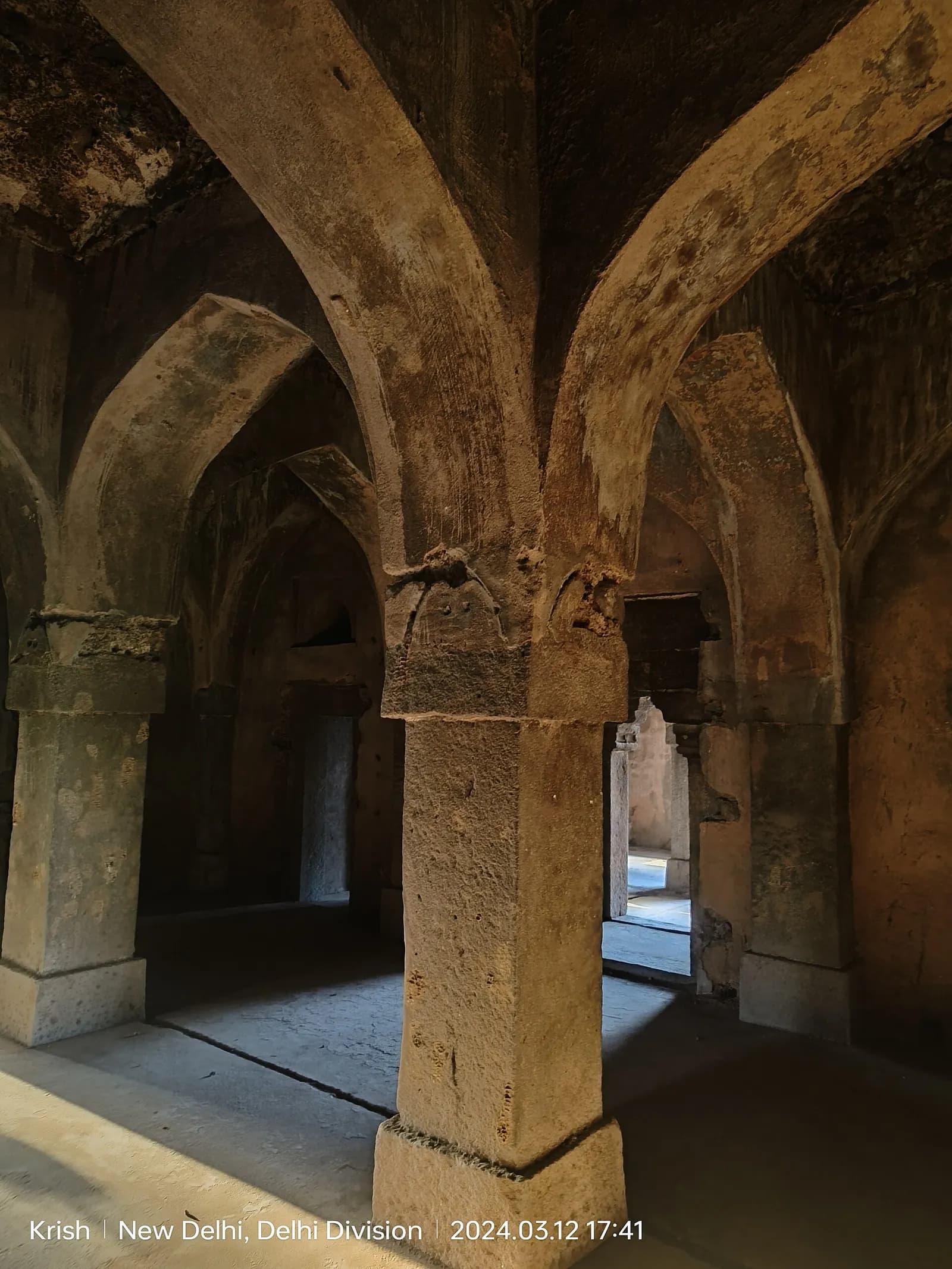
Beneath the layers of story, Malcha Mahal is a genuine and interesting piece of early Tughlaq architecture, stark and unornamented and its features are worth noticing. True to its age, it is built for rugged function rather than decoration:
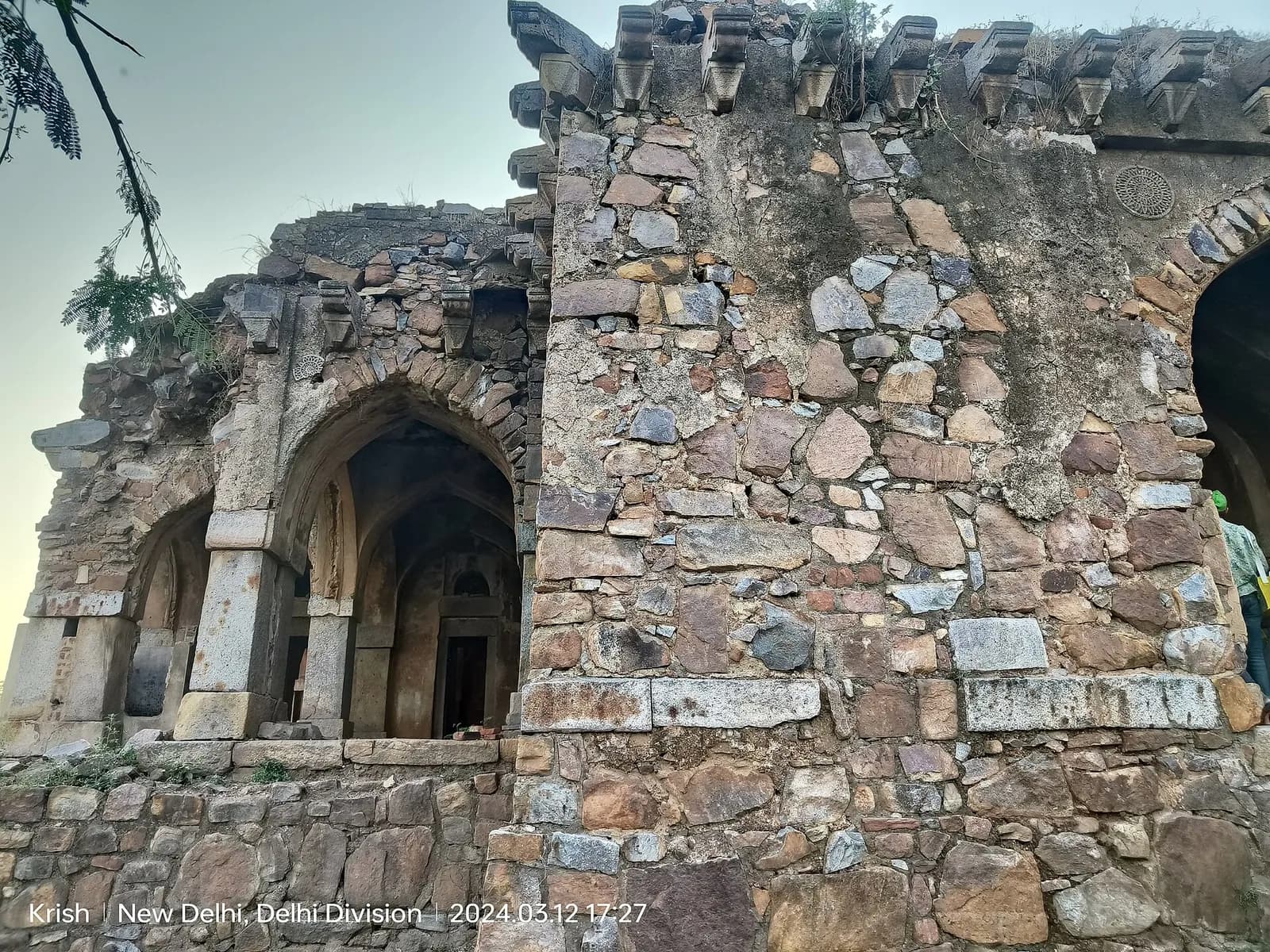
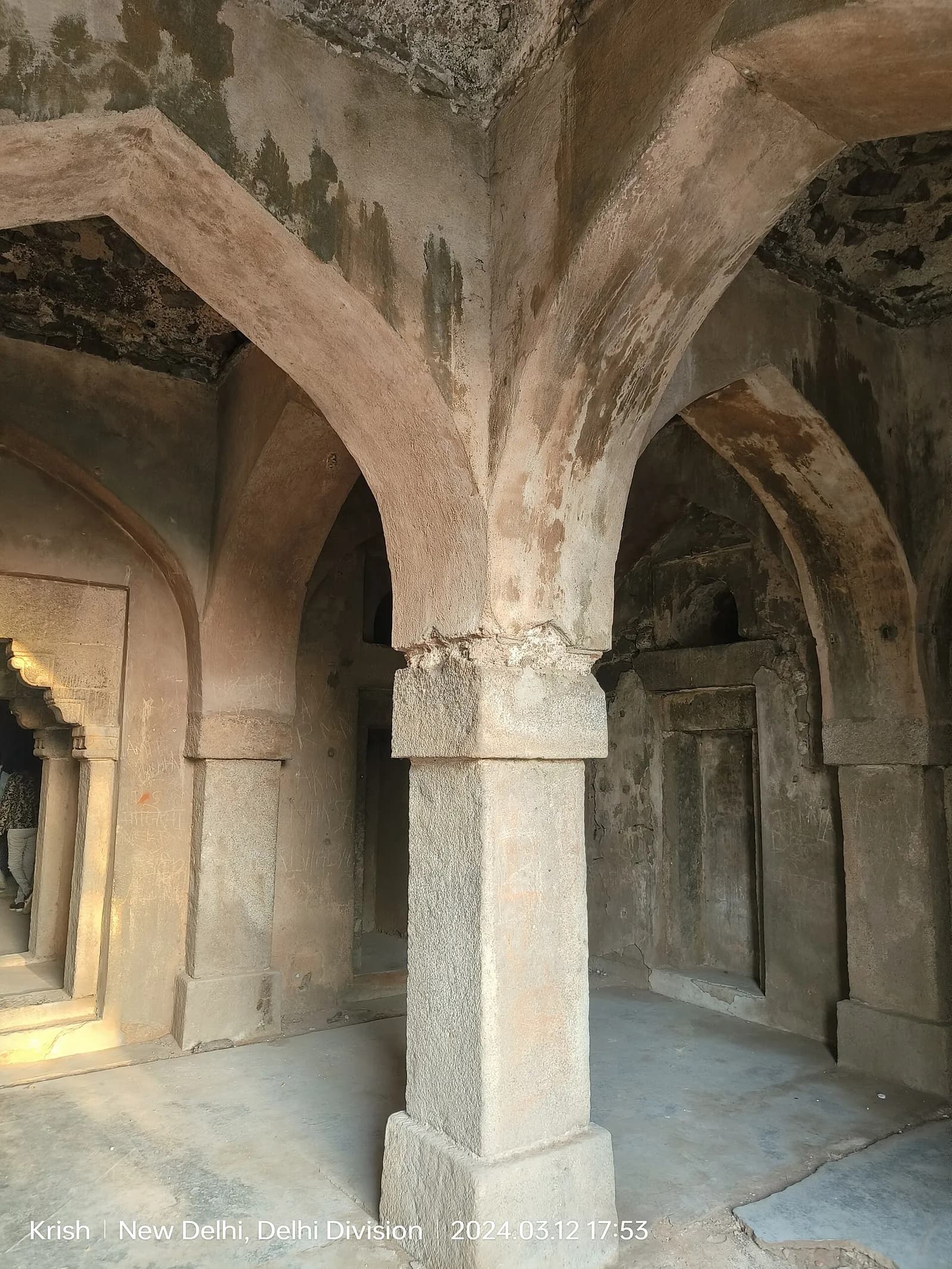
- The quartzite arches. The lodge is built of heavy grey Delhi quartzite rubble bound with thick lime-and-sand mortar, its facade dominated by wide, deep stone arches designed to carry the weight of the heavy stone ceilings.
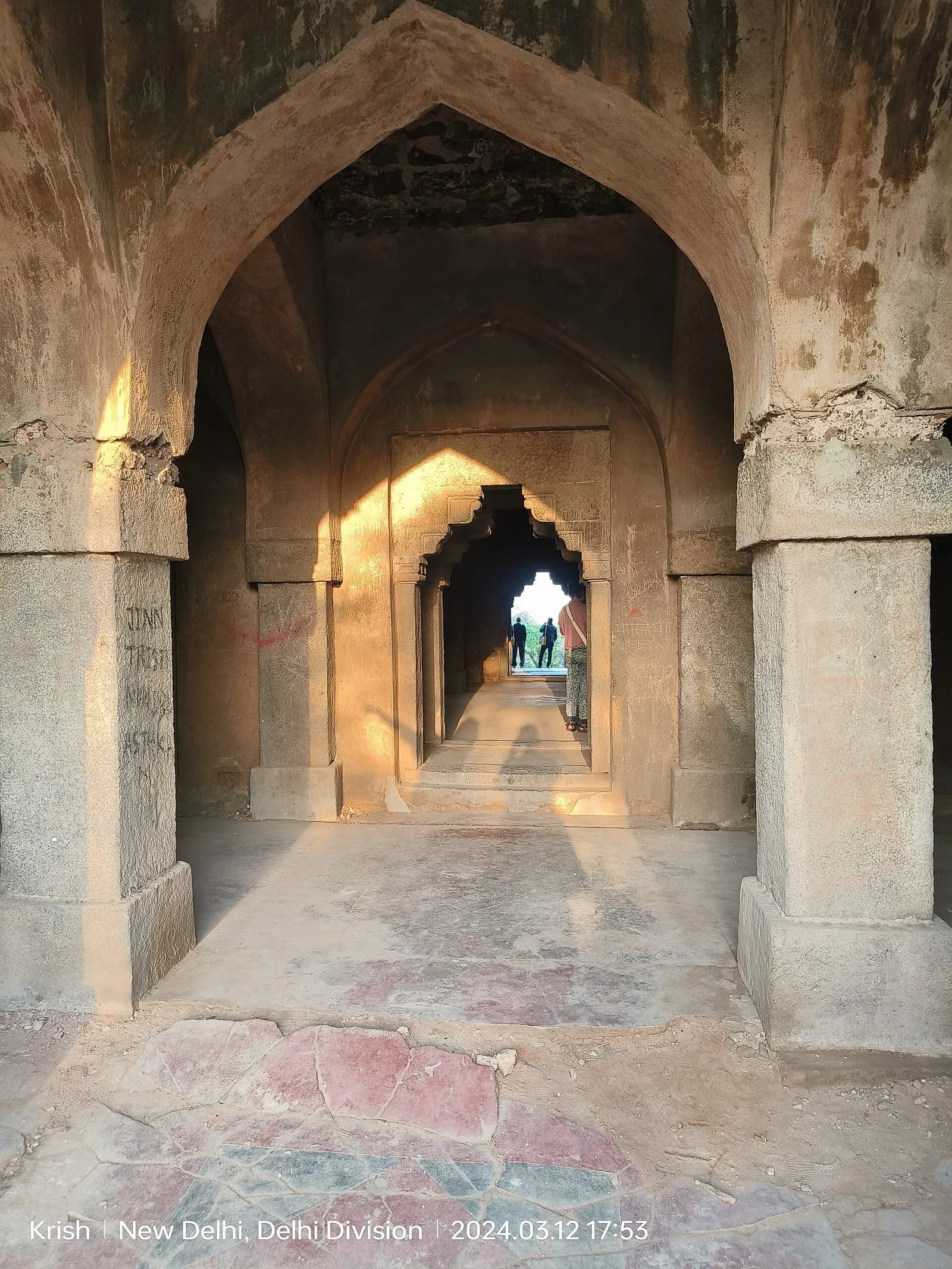
- The nine-chamber plan. The floor plan is a precise grid of nine chambers, a central square hall surrounded by eight arched spaces, with no doors or window frames, showing that the lodge was built to stand open to the air so that cool forest breezes could flow through it in the summer heat.
- The roof terrace. A narrow winding stair leads up to a wide flat roof terrace, once topped by small domes or parapets that have collapsed over the centuries of weathering, leaving the underlying structure exposed to the monsoon rains.
This makes Malcha Mahal a fine, if austere, example of the stark engineering of the early Tughlaq period, where even a hunting lodge was solidly built of local stone in a simple, functional grid, open to the forest air. The nine-chamber plan and the deliberate absence of doors and windows are its most distinctive features, perfectly suited to a summer hunting retreat in the forest. For the visitor, appreciating this genuine medieval architecture, the sturdy arches, the open chambers, the weathered roof terrace, adds real substance to a visit and is a reminder that beneath the modern legend lies a real and thoughtfully built monument, nearly seven centuries old.
The haunted reputation
Like its neighbour Bhuli Bhatiyari ka Mahal, Malcha Mahal has acquired a reputation as one of Delhi's "haunted" places and it is worth addressing plainly. The reputation grew precisely because of the family who lived here in such extreme, aggressive secrecy, in a dark and dense forest patch, warning off all outsiders. After their deaths, local urban legend attached ghost stories to the ruin, attributing its eerie atmosphere to the restless spirit of Begum Wilayat Mahal and to the many dogs said to be buried across the forest grounds. In truth, these are folklore, part of Delhi's rich tradition of urban legend and the genuinely haunting quality of Malcha Mahal comes not from the supernatural but from its real and recent human tragedy and from the deep isolation of a medieval ruin in a dark forest. The sadness of the place is real; the ghosts are legend. For the visitor, the sensible and respectful approach is to understand the ghost reputation as folklore grown from a true and tragic story and to treat the ruin with the dignity its recent history deserves, rather than as a mere thrill.
The government takeover and heritage walks
An important recent development is that Malcha Mahal, once feared and secret, is now being gently brought into the public fold and this is changing how it can be visited. With the passing of its reclusive occupants, the authorities have worked to demystify and open the monument. The Delhi government has included Malcha Mahal in its monument adoption and public heritage walk initiatives and structural clearance work has been carried out, pruning invasive trees, securing the ruins with iron grilles, adding basic visitor amenities and planting native trees, all aimed at gradually opening the site to controlled heritage tourism without harming the forest ecosystem. This means that the ruin, long associated with secrecy and "keep out" warnings, is now slowly becoming an accessible, if still remote and atmospheric, heritage destination. For the visitor, this is welcome news, making a visit safer and more straightforward than in the past, though the site remains a remote forest ruin reached on foot and strictly day-only. It is worth checking the latest access arrangements, as the situation is evolving.
What to expect at Malcha Mahal
A visit to Malcha Mahal is atmospheric, remote and genuinely moving, quite unlike any ordinary monument and knowing what to expect helps you prepare. The ruin is reached only by a trek of about 1.5 kilometres along an unpaved forest trail from the trail head near the ISRO station, so the approach is a real walk through the Ridge forest, part of the experience. Arriving, you come upon the stark, roofless stone lodge with its deep arches and open nine-chamber plan, standing silent among the trees. Exploring the chambers, climbing to the roof terrace, taking in the austere Tughlaq architecture and absorbing the extraordinary atmosphere, heavy with both medieval and very recent history, is the essence of the visit, which with the walk takes about an hour and a half to two hours.
A few practical points are important. Visit only in daylight and leave well before the 5:00 PM closure, as the forest is isolated and unsafe after dark and the trail is patrolled in the evening. It is wise not to go alone, to wear sturdy shoes for the forest trek and uneven stone, to carry water and to keep to the trail. The site is remote and lightly developed, so come prepared and self-sufficient. Given the sad human story of the place, it deserves to be approached with respect rather than as a thrill-seeking ghost hunt. For the visitor, the key is to treat Malcha Mahal as a remote forest-and-heritage trek to a monument of real history and deep poignancy, coming prepared, in daylight and with sensitivity to the lives that ended here.
Visiting tips
A few pointers make a visit to Malcha Mahal smoother, safer and more respectful:
- Visit only in daylight and leave well before the 5:00 PM closure; the forest is unsafe and patrolled after dark.
- Do not go alone, as the ruin is remote and reached by a forest trek.
- Wear sturdy shoes for the 1.5 km unpaved trail and uneven stone and carry water.
- Check the latest access, as the site is being opened for controlled heritage walks.
- Approach with respect for the real and tragic human story of the place.
- Keep to the trail and stay aware of your surroundings in the forest.
- Come via the Pink Line metro and a taxi or auto to the trail head near the ISRO station.
- Allow about two hours, including the forest trek in and out.
The key point is to treat Malcha Mahal as a remote, atmospheric heritage trek, coming prepared and in daylight, respecting both the safety rules and the poignant history of the ruin.
Best time to visit Malcha Mahal
The best time to visit is during the cooler months, from October to March, when the forest trek is comfortable and during the day during the morning or early afternoon, always leaving plenty of time to walk out before the 5:00 PM closure. A cool winter morning is ideal, pleasant for the walk through the Ridge forest and for exploring the open ruin. The summer months are hot for the trek and the exposed stone and the monsoon leaves the trail muddy and the forest dense, so the winter window is clearly best. Whatever the season, the firm rule is to visit in daylight and leave before dark, as the isolated forest trail is closed and unsafe in the evening. Our guide to the best time to visit Delhi sets out the seasons across the city in more detail.
How to reach Malcha Mahal (nearest metro)
Malcha Mahal lies deep in the Ridge forest of Chanakyapuri in New Delhi, near the ISRO Earth Station and reaching it takes some effort, which is part of its remote appeal. The nearest metro station is Durgabai Deshmukh South Campus on the Pink Line, about 4 kilometres away, with Dhaula Kuan on the Airport Express Line an alternative. From either station, you take a taxi or auto-rickshaw to the forest entry point near the ISRO station, followed by a trek of about 1.5 kilometres on foot down an unpaved forest trail to the ruin. Because the monument is reached only by this forest walk, it is wise to allow plenty of time, to go in daylight and not to go alone. Set in the green heart of the diplomatic enclave, it makes an unusual addition to a Delhi day tour or a heritage-focused New Delhi tour for those who enjoy the offbeat corners of the city.
Places to visit near Malcha Mahal
Malcha Mahal lies in the forested diplomatic enclave of Chanakyapuri in New Delhi, so while its immediate surroundings are woodland, it is within reach of many of the capital's great attractions for a fuller day out. The grand avenues and monuments of Lutyens' New Delhi, including the ceremonial India Gate, lie nearby, as do the museums and institutions of the central city. A short way off are the great sights of the capital: the mighty Red Fort and old Delhi, the serene Humayun's Tomb and the astronomical Jantar Mantar in Connaught Place. The ruins of Feroz Shah Kotla, built by the very Sultan who raised this hunting lodge, are also within reach.
Further afield, the capital's other landmarks round out a full picture of the city: the towering Qutub Minar and the modern marvels of the Lotus Temple and Akshardham. For more history, the old citadel of Purana Qila, the sprawling Mehrauli Archaeological Park and the historic Hauz Khas Fort and the medieval stepwell of Agrasen ki Baoli are well worth adding and our roundup of the important monuments of Delhi ties them together.
Malcha Mahal in your Delhi itinerary
For most visitors, Malcha Mahal works best as an unusual, atmospheric half-day expedition for those who enjoy offbeat heritage, forest walks and the deeper stories of the city, rather than a mainstream sightseeing stop. A natural plan is to combine the forest trek and the ruin with a wider exploration of central New Delhi, perhaps the monuments of Lutyens' Delhi nearby or the works of the same Firoz Shah Tughlaq at Feroz Shah Kotla. The ruin, with the walk, needs about two hours, but its genuine Tughlaq history, its remote forest setting and its extraordinary modern story give it a power and poignancy out of all proportion to its modest size and it adds a note of mystery, history and real human depth to a day of sightseeing. It suits the history enthusiast, the lover of the offbeat and the atmospheric and the traveller who wants to understand the many hidden layers of Delhi.
If Delhi is your gateway to the wider Golden Triangle, Malcha Mahal offers one of the most unusual and moving experiences in the city, a genuine medieval ruin lost in a forest, carrying a true and tragic modern tale that few monuments can match. Many of my guests who make the trek find it the most memorable and thought-provoking stop of their trip, precisely because it combines real history, wild greenery and an unforgettable human story and it deepens their sense of the depth and strangeness of Delhi before they travel on to Agra and Jaipur.
Travel tips for visiting Malcha Mahal
A few pointers make a visit even better and safer:
- Go only in daylight and leave well before the 5:00 PM closure.
- Reach it via the Pink Line metro and a taxi or auto to the trail head near the ISRO station.
- Do not go alone, wear sturdy shoes and carry water for the 1.5 km trek.
- Check the latest access arrangements, as the site is being opened for heritage walks.
- Approach with respect for the poignant human story of the ruin.
- Pair it with central New Delhi sights or Feroz Shah Kotla for a fuller day.
- Keep to the trail and stay aware of your surroundings.
- Allow about two hours, including the forest walk.
If you would like a local guide to take you safely to Malcha Mahal and tell both its medieval history and its remarkable modern story, message our team on WhatsApp at +91 7302265809 with your travel dates and group size and we will shape the day for you.
Is Malcha Mahal worth visiting?
Yes, for the history-minded and the thoughtful traveller Malcha Mahal is a genuinely rewarding and unforgettable stop, provided you come in daylight, prepared and with respect. There are few places anywhere that bring together so much in one remote forest ruin: a real, austere 14th-century Tughlaq hunting lodge, a beautiful and wild patch of Ridge forest reached by a genuine trek and one of the most extraordinary and poignant human stories in modern India, of a family who lived here for decades claiming a lost crown. By day it is remote, atmospheric and deeply moving, free to visit and quite unlike anywhere else in the city. The caveats are real and important: it is isolated in the forest, reached by a 1.5 kilometre trek, strictly day-only and best visited not alone and with sensible precautions and it deserves to be treated with dignity rather than as a ghost-hunting thrill. For the traveller who wants the deepest, strangest, most human layers of Delhi beyond the famous sights, Malcha Mahal is an unforgettable discovery and I recommend it to curious and respectful guests.
Plan your trip with us
At Experience My India, through our Delhi and Golden Triangle travel desk, we design unhurried, well paced trips that make room for remarkable hidden places like Malcha Mahal and not just the famous monuments, with guides who can lead you safely through the Ridge forest, tell both the medieval history and the true modern story and make sure you visit at the right time of day and with the respect such a place deserves. Whether you want a relaxed set of Delhi Agra tours or a full Golden Triangle route through Delhi, Agra and Jaipur, we plan around your pace, your interests and the right season. Share your dates and the kind of trip you have in mind through our enquiry page, tell us your group size and we will put together an honest, tailored plan rather than a rushed checklist.
Related guides
- Places to visit in Delhi, for the wider picture
- Nearby places to visit in Delhi, to extend your trip
Enquire Now
Ready to Explore
The Heart of Delhi?
Explore the Red Fort, Qutub Minar, Humayun's Tomb, and the vibrant streets of Old Delhi with our expert-guided premium tours of India's capital city.

Delhi
Premium Tour Package
Questions
Frequently asked questions
What is Malcha Mahal?
It is a 14th-century Tughlaq royal hunting lodge, a shikargah, built by Sultan Firoz Shah Tughlaq inside the Ridge forest of Chanakyapuri in New Delhi. It is famous today for the modern story of a family who lived there claiming to be the heirs of Awadh.
What is the story of the family who lived there?
Is Malcha Mahal haunted?
What are the timings and why does it close at sunset?
Which is the nearest metro station?
Is there an entry fee?
Can you actually visit Malcha Mahal now?
How much time do I need?
Explore more
Plan your Malcha Mahal trip with us

Interested in Malcha Mahal, Delhi: History, the Awadh Story and Guide?
Chat with our travel team for a custom quote, or browse every package.
Related Attractions
9Ready to explore Malcha Mahal, Delhi: History, the Awadh Story and Guide?
Book your private tour today and experience the magic of India's rich heritage.